

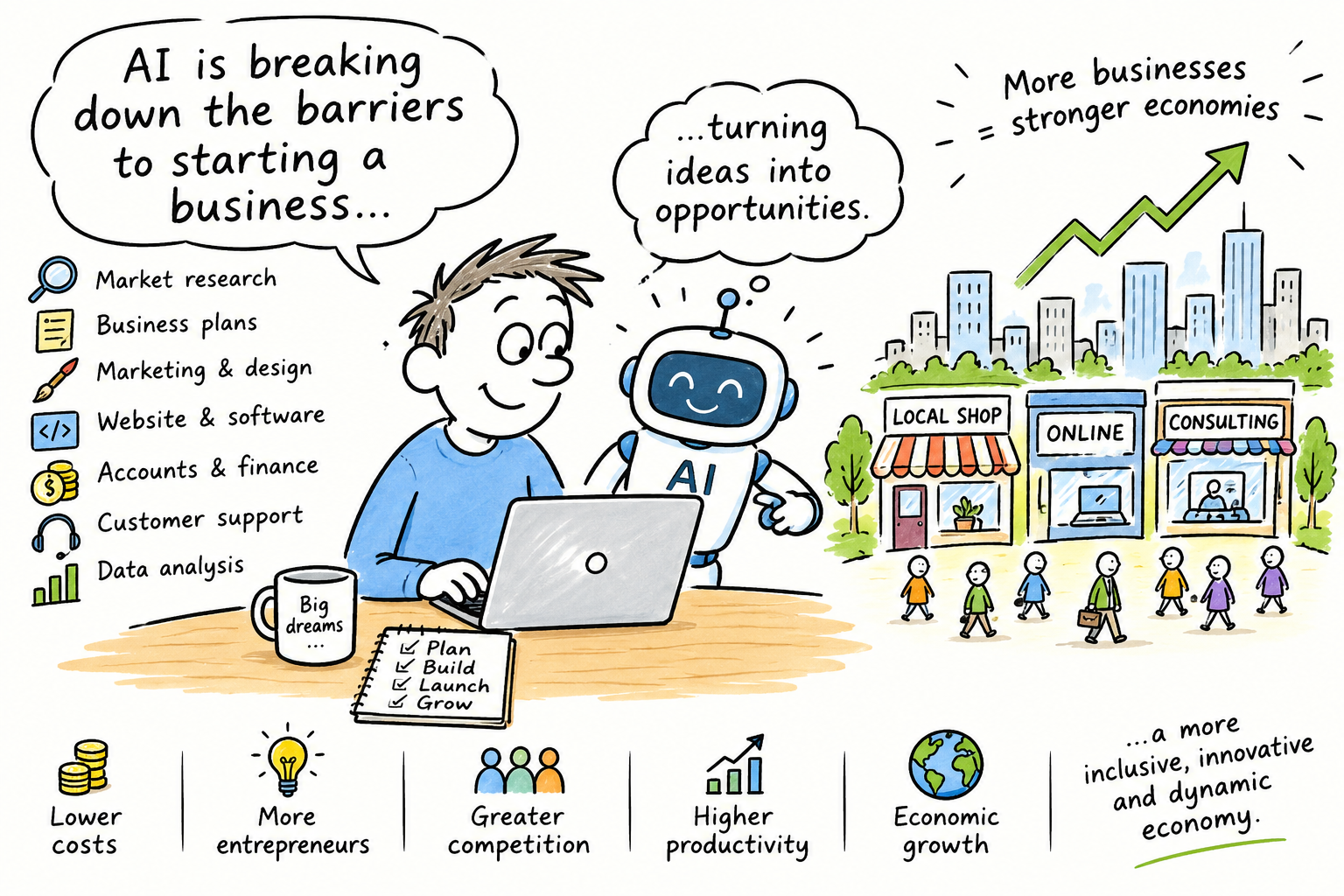
Artificial intelligence is beginning to reshape the economics of starting and running a business.
AI is easily accessible
What once required substantial financial investment, specialist skills and a team of employees can increasingly be achieved by an individual with a computer, an internet connection and access to AI tools.
The implications could extend well beyond entrepreneurship, potentially changing productivity, employment, competition and economic growth.
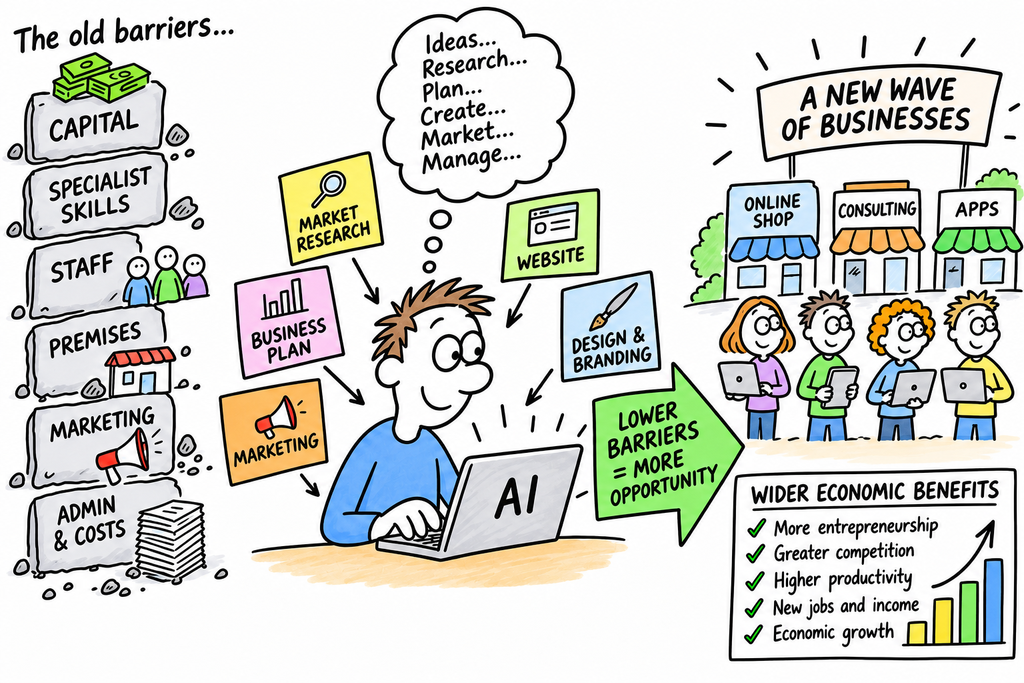
Traditionally, starting a business involved considerable upfront costs. Entrepreneurs needed to invest in staff, premises, marketing, professional services, technology and administration, often before generating their first pound of revenue.
These expenses created significant barriers to entry, particularly for individuals without access to capital or business connections.
AI is changing this economic equation
An individual can now use AI to conduct market research, develop business plans, build websites, write software, produce marketing campaigns, analyse financial information and manage customer enquiries.
Tasks that previously required several employees or expensive external consultants can increasingly be handled by one person at a fraction of the cost.
This has the potential to create a new generation of micro-businesses, independent entrepreneurs and highly productive one-person companies.
Lower operating costs could allow businesses to become profitable with considerably less revenue than was previously necessary.
For the many
The wider economic consequences could be significant. If millions of individuals can establish businesses with relatively little capital, entrepreneurship could become a much more accessible route to generating income and creating employment.
Smaller businesses may also become more competitive, challenging established corporations that have traditionally benefited from economies of scale, larger workforces and greater financial resources.
But first we will have a period of transition and discovery.
Productive
There is also a potentially important productivity dividend. Businesses able to produce more with fewer employees could reduce operating costs, improve margins and increase output.
At a national level, this could contribute to economic growth without requiring the same expansion in the workforce.
For governments struggling with ageing populations, labour shortages and weak productivity, AI could become an increasingly important economic tool.
Saturation
However, there is another side to the equation. As the cost of establishing a business falls, competition will intensify.
Markets could become saturated with similar products and services, while automation may displace certain administrative, creative and professional roles.
The economic benefits will depend partly on whether new businesses and industries create sufficient opportunities to offset employment lost elsewhere.
Access to AI will also matter. If the technology becomes concentrated among a small number of powerful companies, the savings generated by automation may not be distributed evenly.
Nevertheless, AI could represent a significant democratisation of business ownership. The traditional advantages of capital, staffing and infrastructure may become less important, while creativity, commercial judgement and the ability to identify opportunities become increasingly valuable.
The Next Wave
The next wave of business creation may not come from large corporations investing billions, but from individuals using AI to build businesses that previously would have been financially impossible.
AI is not eliminating the risks of entrepreneurship. It is, however, dramatically reducing the cost of trying. That could have profound implications for the future structure of the global economy.