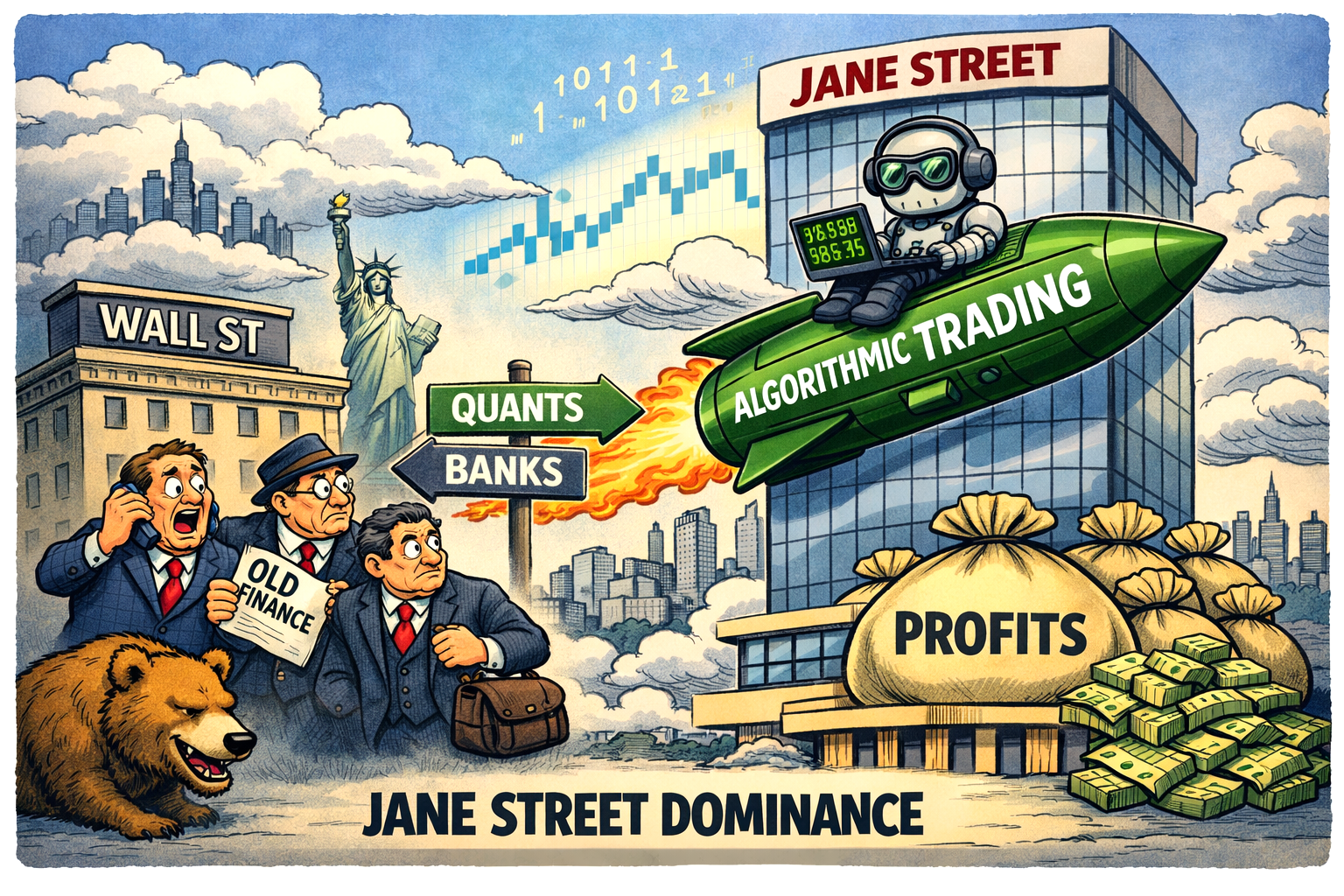
The idea that “Jane Street is taking over Wall Street” is not a literal claim of ownership but a reflection of a deeper structural shift in global finance.
Over the past ten years, the centre of gravity in markets has moved away from the traditional, relationship‑driven banking model and towards firms built on mathematics, automation, and relentless execution.
Down your street
Jane Street is the most visible and successful expression of that shift, and its ascent tells a larger story about how modern markets now function.
Founded in 2000, Jane Street began as a niche player in the then‑nascent world of exchange‑traded funds. ETFs were still viewed as a technical curiosity, but the firm recognised early that they would become the backbone of global investing.
By building sophisticated systems to price, hedge, and arbitrage these instruments, Jane Street positioned itself at the heart of a market that has since grown to more than $10 trillion.
Today, it is one of the largest ETF liquidity providers in the world, often stepping in when banks cannot or will not.
Different
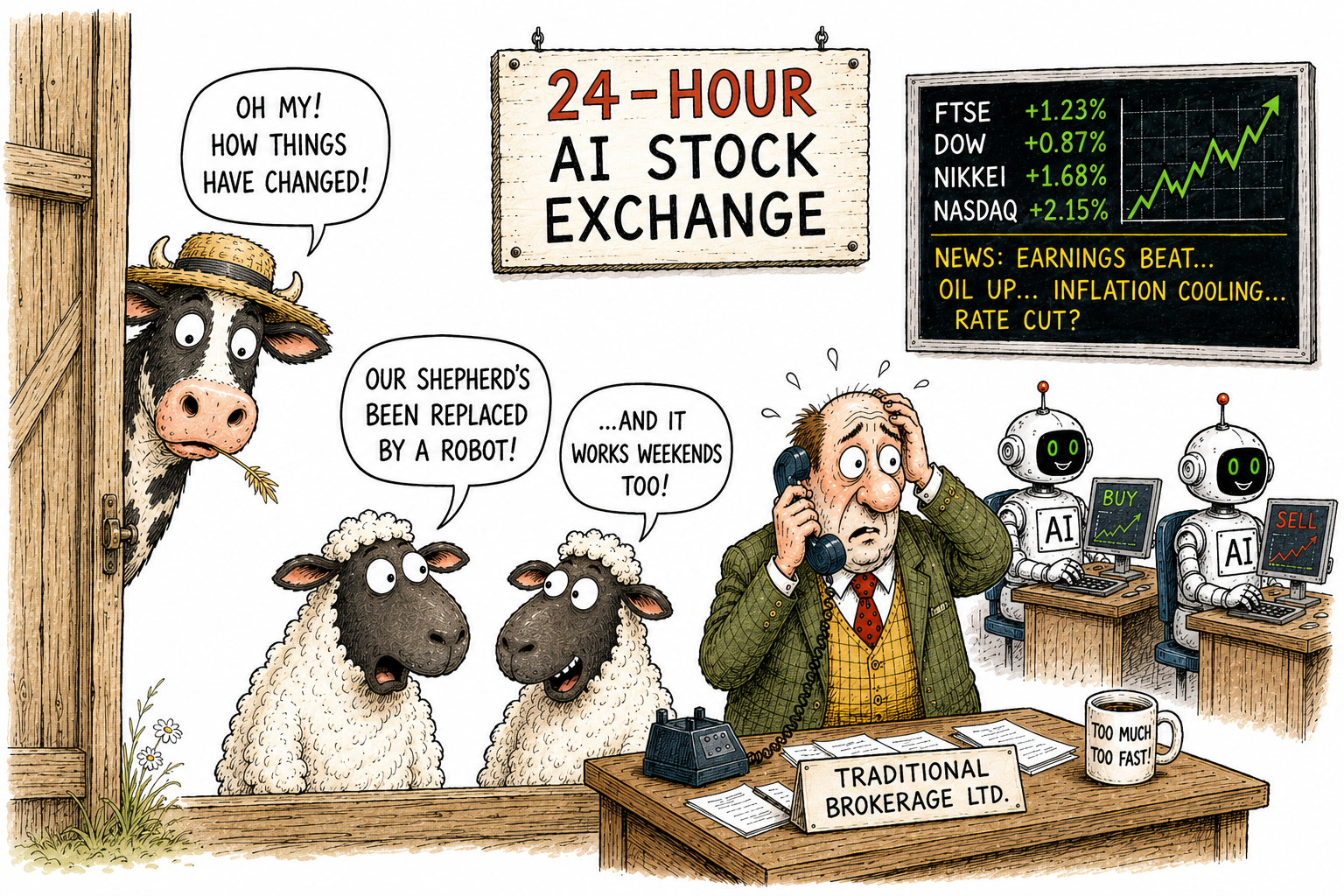
What makes the firm stand out is not just scale but method. Jane Street operates with a level of automation that traditional banks struggle to match.
Its trading is driven by quantitative models, rapid data ingestion, and a culture that treats technology as the primary engine of profit.
This allows it to operate across asset classes — bonds, options, currencies, commodities — with a consistency and precision that human‑centred trading desks cannot replicate.
The results are striking. In recent years, Jane Street has generated trading revenues comparable to major global banks, despite employing only a fraction of their staff and avoiding the capital‑intensive business lines that weigh down traditional institutions.
Its profitability has surged during periods of market stress, when liquidity evaporates and automated firms with strong balance sheets become indispensable.
Break from tradition
Culturally, too, Jane Street represents a break from Wall Street tradition. It has no CEO, minimal hierarchy, and a compensation model that rewards collective performance rather than individual deal‑making.
This structure attracts elite quantitative talent and reinforces the firm’s identity as a technology‑driven institution rather than a bank with traders attached.
Its culture is radically different
Jane Street has:
- No CEO, minimal hierarchy, and a collective‑profit pay model.
- Extremely high compensation — ~£700k average pay in the UK, with interns earning over $23k/month
To say Jane Street is “taking over” is to acknowledge that the old Wall Street — built on phone calls, intuition, and personal networks — is being eclipsed by firms whose competitive edge lies in code, computation, calculations and speed.
The transformation is quiet but profound: the future of market‑making belongs to those who can automate complexity, and Jane Street is already operating in that future.
AI plays a central role in how Jane Street operates. The firm’s entire trading model is built around automation, data analysis, and algorithmic decision‑making.
Here’s how AI fits into its structure:
Core of its trading engine
Jane Street’s systems ingest vast amounts of market data in real time — prices, volumes, volatility, and correlations across thousands of instruments.
Machine‑learning models help identify patterns and optimise execution strategies, allowing trades to be placed faster and more efficiently than any human desk could manage.
Reinforcement and predictive modelling
AI techniques such as reinforcement learning are used to refine trading algorithms. These systems learn from past market behaviour, adjusting parameters to improve outcomes under different conditions — for example, predicting liquidity shifts or price movements in ETFs and derivatives.
Risk and portfolio management
AI also supports risk control. Automated models continuously assess exposure across asset classes, recalibrating positions when volatility spikes or correlations change.
This enables Jane Street to maintain tight risk limits while trading billions of dollars daily.
Talent and culture
The firm’s workforce is dominated by mathematicians, physicists, and computer scientists rather than traditional bankers.
They design and maintain AI‑driven systems that make trading decisions autonomously, with human oversight focused on model validation and strategic direction.
Broader impact
Jane Street’s success has influenced the entire financial ecosystem. Banks and hedge funds now emulate its AI‑centred approach, shifting from intuition‑based trading to quantitative automation.
In that sense, AI isn’t just a tool for Jane Street — it’s the foundation of its dominance.
In short, AI is the invisible trader behind Jane Street’s rise, enabling the firm to process information, execute trades, and manage risk at a scale and speed that traditional Wall Street institutions can’t match.