

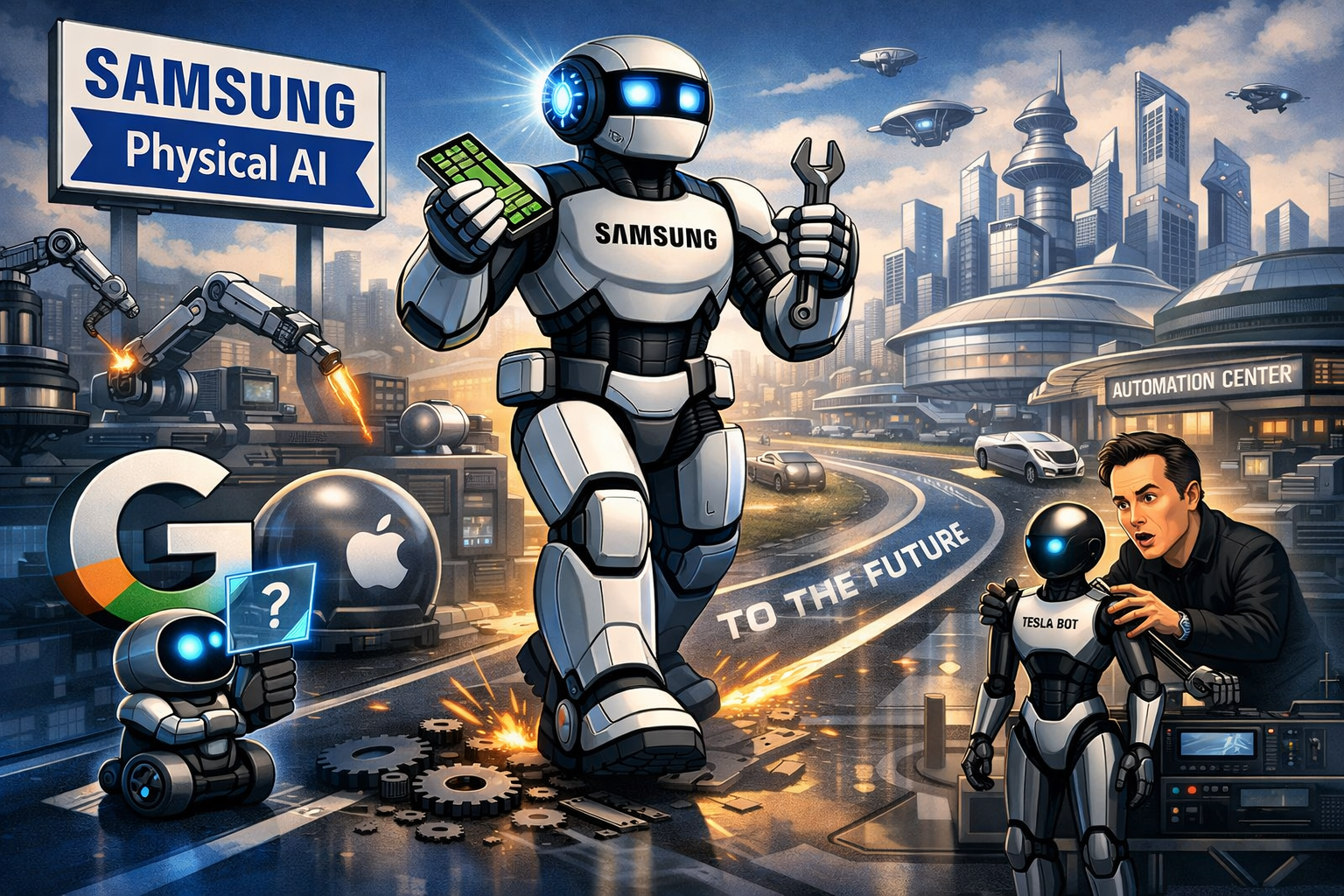
Samsung’s push into physical AI marks one of the most significant strategic pivots in its recent history, signalling a future where artificial intelligence is not only embedded in silicon but expressed through motion, autonomy and real‑world interaction.
For years, the company has dominated consumer electronics through iterative hardware improvements and software refinement.
Now it is positioning robotics as the next frontier — a domain where AI becomes tangible, embodied and capable of acting directly within homes, workplaces and industrial environments.
RX Robotics eXperience
The newly created RX, or Robotics eXperience, will consolidate Samsung’s robotics capabilities and is intended to drive a mid- to long-term strategy from core tech development to commercialisation,
The shift is driven by two converging forces. First, generative and multimodal AI have matured to the point where machines can perceive, reason and respond with far greater nuance.
Second, global labour shortages and rising expectations for automation have created a commercial opening for robots that are not merely programmable tools but adaptive assistants.
Samsung’s investment in “physical AI” aims to bridge these trends, producing machines that can navigate complex spaces, manipulate objects safely and collaborate with humans.
Prototypes
Early prototypes, including household assistance robots and mobile platforms capable of environmental mapping, hint at Samsung’s ambition to build a robotics ecosystem rather than isolated products.
The company’s vast manufacturing footprint gives it a unique advantage: it can integrate sensors, processors, batteries and actuators at scale, reducing costs and accelerating iteration.
Useful
Crucially, Samsung appears intent on keeping robotics tied to everyday usefulness — from elder care and domestic support to logistics and retail automation.
If successful, Samsung’s move could reshape the competitive landscape. Rivals such as Apple and Google have focused heavily on software‑centric AI, while Tesla and various start‑ups pursue humanoid designs.
Samsung’s approach is more pragmatic: build robots that solve real problems now, while gradually increasing autonomy as AI models improve.
The result is a quiet but profound transition. Samsung is no longer just a hardware giant — it is becoming an architect of intelligent machines that operate in the physical world, signalling a new era where AI is not only something we use, but something that moves.