

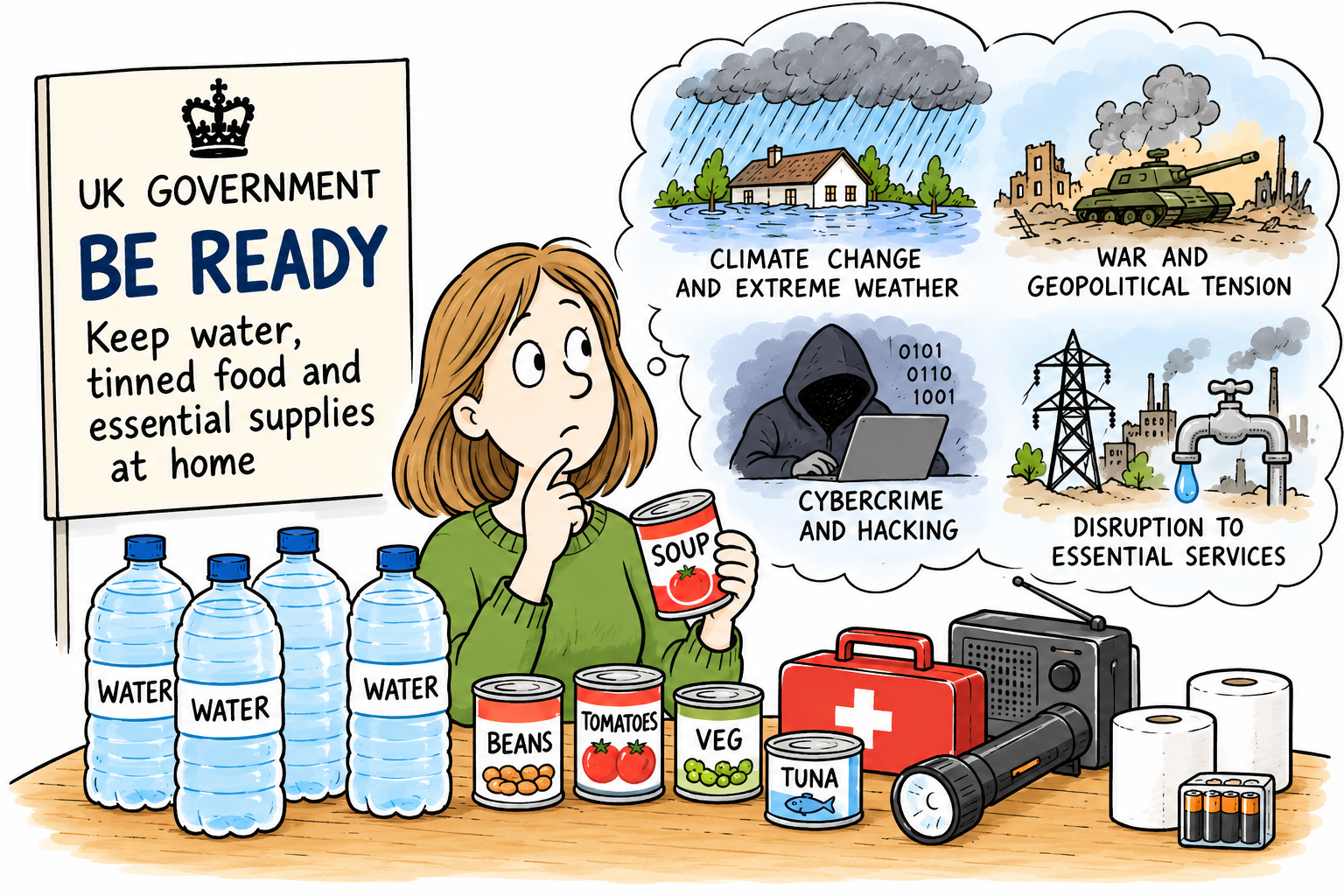
The British government’s advised UK households on 22nd October 2026 to prepare for emergencies by keeping essential supplies, including drinking water and tinned food.
This has raised an obvious question: what does the government know that the public should be worried about? Or is this ‘nothing’ other than sensible thinking?
The answer is more complicated than the prospect of an imminent war or national emergency.
Britain faces a combination of risks, from climate change and extreme weather to cyberattacks, international conflict and disruption to essential services.
The concern is that several problems could occur simultaneously, leaving households temporarily without electricity, water, communications or access to shops.
Why now?
The international security environment has deteriorated. The war in Ukraine, tensions in the Middle East, increasingly confrontational relations between major powers and the vulnerability of critical infrastructure have all reinforced the importance of national preparedness.
Cybercrime and state-sponsored cyberattacks also threaten systems on which modern life depends, including energy networks, financial services and water supplies.
Climate change presents a different but equally practical challenge. Flooding, storms, drought and extreme temperatures can disrupt transport, damage infrastructure and interrupt supplies.
Britain’s reliance on interconnected systems means that a problem in one area can quickly affect another.
The government’s message reflects a growing recognition that emergency services cannot necessarily reach everyone immediately during a major incident. Households may need to manage independently while essential services are restored.
What is really behind the announcement?
The timing is significant. On 22nd October 2026, the Cabinet Office announced a new three-year “Be Ready” campaign.
The advice asks people to prepare to manage for three days, including keeping bottled water and non-perishable food at home.
The government says only 13% of people feel prepared for an emergency that could cut them off from essential services.
A recent PHP software security incident, which reportedly triggered millions of hacking attempts, has also highlighted the potential consequences of cyber vulnerabilities.
Officials have warned about the growing threats posed by hostile states, organised crime and the use of artificial intelligence to identify weaknesses in computer systems.
There is, however, an important distinction between preparing for a risk and predicting that it will happen.
There is no confirmed evidence in the published announcement that the government expects an imminent war, nationwide blackout or collapse of essential supplies.
Its stated objective is to improve the country’s ability to withstand emergencies, rather than to signal that a particular disaster is approaching.
It is not just the UK, other European countries such as, Germany, Sweden, Finland, Netherlands, Norway and France have also offered this warning
A warning worth taking seriously
The underlying message is that modern Britain is vulnerable to disruptions that could affect millions of people.
Electricity, water, banking, communications and food distribution are interconnected. A serious failure in one system can have consequences far beyond its original cause.
The government is also seeking to reduce pressure on emergency services by encouraging households to cope independently during the initial stages of an incident.
The recommendation is modest: prepare gradually, keep essential supplies and avoid panic buying. For a household, three days of drinking water means approximately nine litres per person, with additional water needed for cooking and hygiene.
Rising risks
The real reason for the announcement is therefore a combination of rising risks, lessons from recent disruptions and a recognition that public preparedness remains inadequate.
Whether the next emergency comes from extreme weather, a cyberattack or international conflict, the government wants Britain to be less dependent on an immediate rescue.
Electricity: A major grid failure could disrupt homes, businesses, transport and public services.
Heating/Energy/Oil: During a winter outage, homes could become dangerously cold, particularly if heating systems depend on electricity.
Water: Pumping and treatment systems can be affected by prolonged electricity failures.
Food: Supermarkets, refrigeration, distribution centres and payment systems all depend on reliable power.
Communications: Mobile networks and internet services may become unavailable if backup systems are exhausted.
Cybersecurity: An attack on critical infrastructure could cause disruption even when there is no physical damage.
That is sensible contingency planning. It is not proof of a secret warning. But it does underline an uncomfortable reality?
The stability of everyday life depends on infrastructure and international systems that individuals cannot control, and which may not always work when they are needed most.
Be prepared is the clear message!
You have been warned!