

Global debt has reportedly surged to $365 trillion, prompting economists to warn about a looming ‘vicious cycle’

Debt and the beggar

The combination of record global debt, higher borrowing costs and growing doubts about the enormous sums being committed to artificial intelligence is creating a more complicated backdrop for financial markets.

Global debt exceeded $365 trillion in the first half of 2026, according to the Institute of International Finance, with debt now around 310% of global GDP.

China and the U.S. debt mountain

The increase was driven particularly by China and the United States. At the same time, higher interest rates are making refinancing increasingly expensive, creating the possibility of a vicious cycle in which governments and companies borrow more simply to service existing obligations.

This is particularly significant for the AI boom. The OECD says governments and companies are expected to borrow around $29 trillion from markets during 2026, while corporate borrowing is also rising as businesses finance major investment programmes, including AI infrastructure.

Michael Burry

Michael Burry, famous for anticipating the U.S. housing crisis, has added another warning sign.

He has recently reportedly increased bearish positions involving Micron, Palantir, Nebius and the semiconductor sector, arguing that parts of the AI and chip boom could be vulnerable if supply increases faster than demand.

The concern is not necessarily that AI will fail. Rather, enormous investment and borrowing require enormous future revenues to justify them.

If AI spending produces lower-than-expected returns, highly valued technology shares could face pressure at the same time as heavily indebted companies face rising financing costs.

Could this affect the stock market now?

The ingredients for greater volatility are certainly present. Higher bond yields, expensive energy, inflation pressures and debt-servicing costs can compete with equities for investors’ money.

Reuters recently reported that global borrowing costs and energy prices were already creating concerns about the potential impact on equities and credit markets.

Yet markets have so far remained remarkably resilient, with U.S. shares still close to record levels.

The danger, therefore, may not be debt alone, but…

debt + high valuations + expensive AI investment + higher interest rates.

If those pressures reinforce one another, the adjustment in markets could become considerably more significant.

Why Are Markets Still Rising Despite Ongoing Bad World News?

Stock market tug-o-war

Stock markets are continuing to climb despite a growing list of concerns that would normally be expected to unsettle investors.

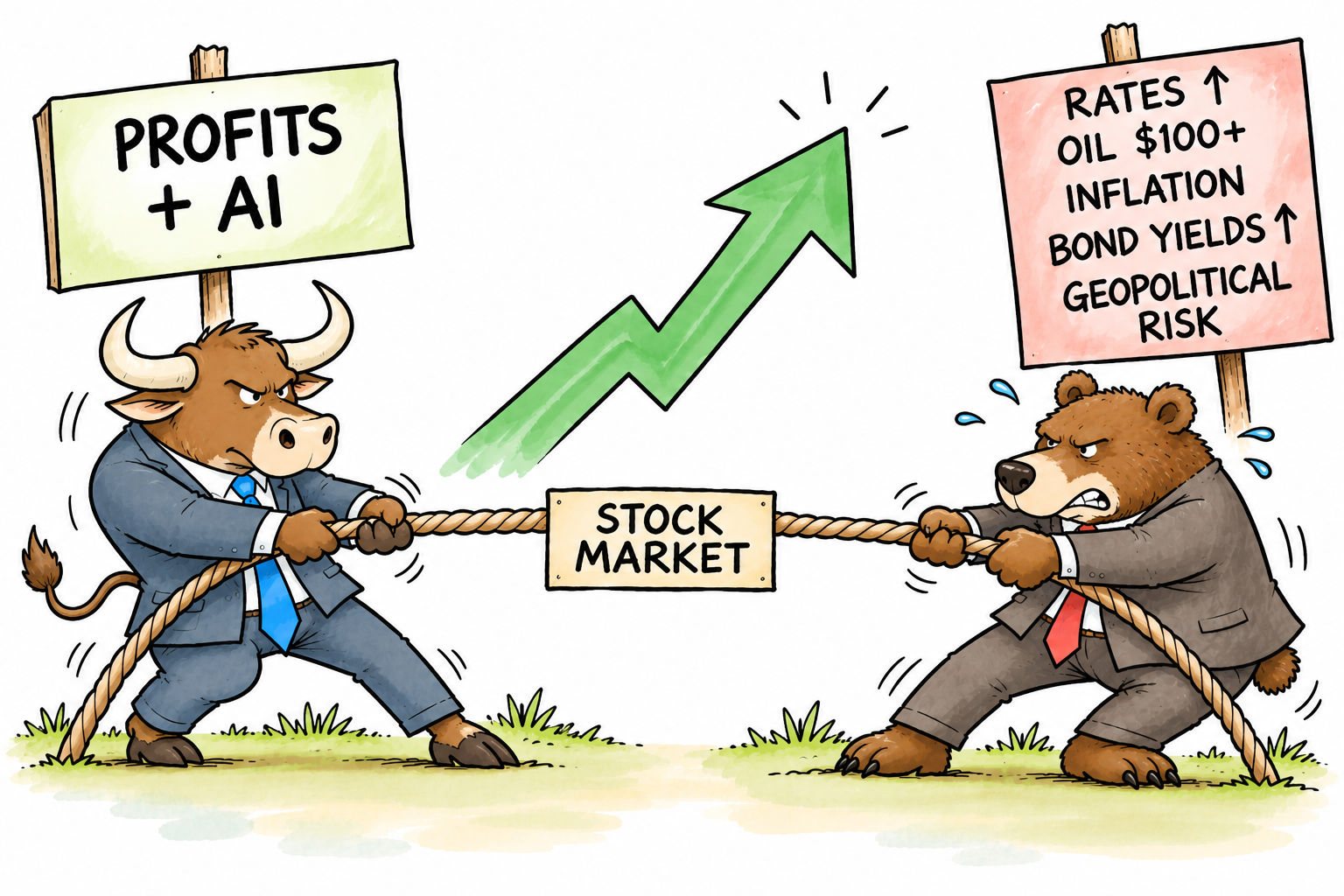
Interest rates are higher, government bond yields have risen, oil prices are elevated and inflation remains a concern. Geopolitical tensions are also creating uncertainty. Tariffs still on the agenda. Global debt rising and rogue AI concerns.

Yet investors continue to buy shares, particularly in the United States.

So why?

One important reason is corporate earnings. Investors appear willing to tolerate higher interest rates and expensive valuations while they believe company profits will continue to grow.

Large technology companies, in particular, remain at the centre of this optimism, with huge investment in artificial intelligence fuelling expectations of strong future earnings.

Buying dips

Another factor is the willingness of investors to buy market dips. When share prices fall, investors who remain confident about the longer-term outlook see an opportunity to buy at cheaper prices.

This can create a self-reinforcing cycle: markets fall, buyers move in, confidence returns and prices rise again.

There is also a belief that the economy remains sufficiently resilient to withstand higher borrowing costs and expensive energy.

Bad news is therefore being viewed as a problem, but not necessarily one capable of seriously damaging corporate profits.

However, this resilience could eventually be tested.

Earnings faith

The market is currently placing considerable faith in continued earnings growth and the economic benefits of artificial intelligence. If either begins to disappoint, investors could reassess the high valuations attached to many shares.

Higher oil prices could also keep inflation elevated, forcing interest rates to remain higher for longer. Rising bond yields would then provide investors with an increasingly attractive alternative to shares.

Bull Bear

For now, the bulls remain in control of market prices, even though the bears have plenty of arguments on their side.

The important question is whether company profits can continue to justify today’s share prices.

If they can, markets may continue climbing despite the bad news. If they cannot, investors may suddenly start paying much closer attention to all those warning signs they have recently been ignoring.

Nasdaq hits another new all-time high!

Nasdaq New High!

The Nasdaq Composite climbed to another record high on Tuesday 22nd September 2026, extending its remarkable run despite a backdrop of considerable economic and geopolitical uncertainty.

The technology-heavy index reached an intraday record of around 27,289 before closing at approximately 27,244, also a new record.

AI-related shares remained an important driver of the advance, with investors continuing to pour money into the technology sector.

However, the latest milestone comes amid concerns over stretched valuations, rising bond yields, expensive energy, tariffs and geopolitical tensions. The huge borrowing commitments being made to finance AI infrastructure are a massive issue too.

The contrast between record markets and broader uncertainty remains of concern.

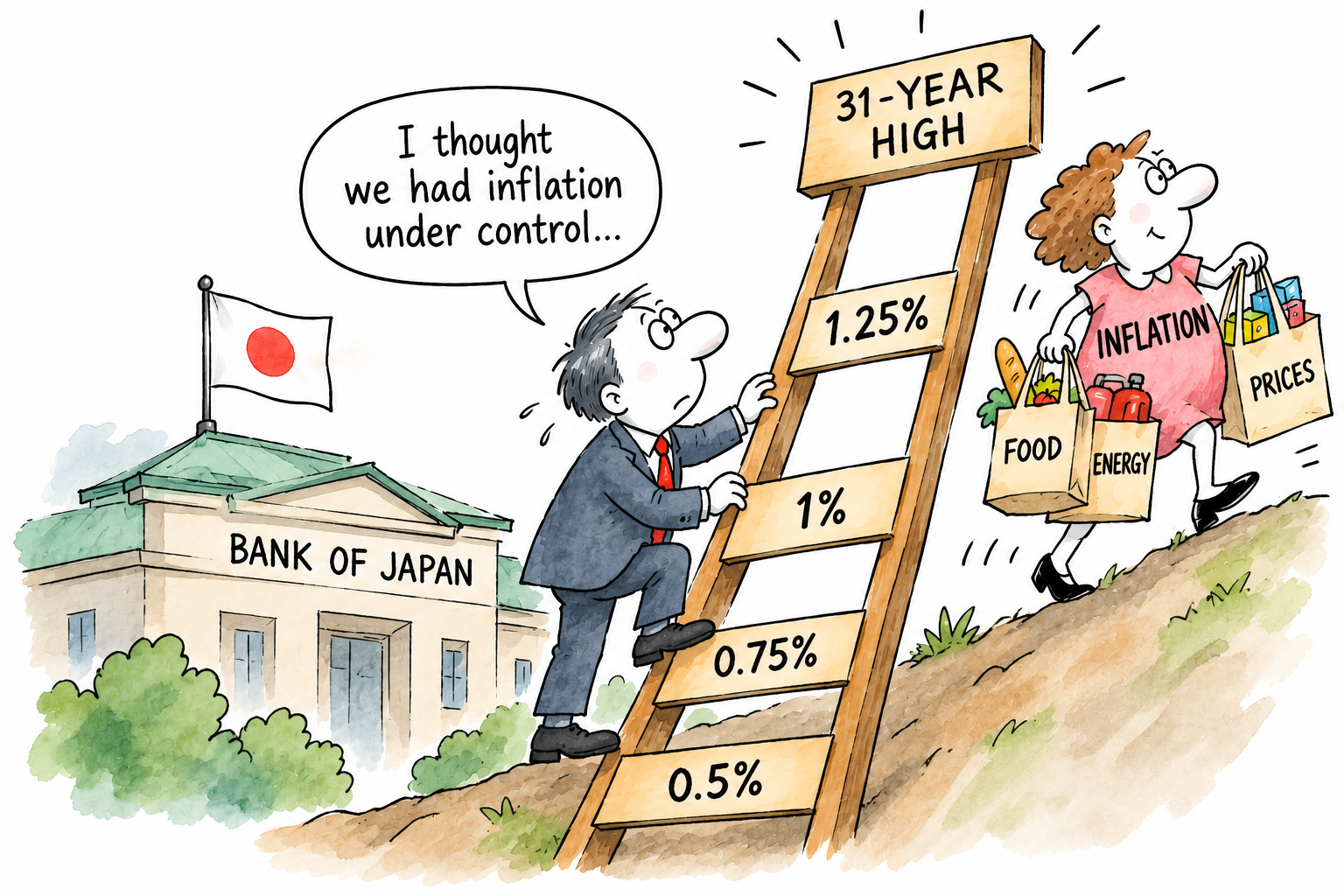
Bank of Japan hikes Interest rate by 0.25% to 1.25%

Japan raises interest rate

The Bank of Japan has raised its benchmark interest rate to 1.25%, its highest level in 31 years, as it steps up efforts to contain inflation.

The quarter-point increase from 1% was approved by a 7-2 vote and had been widely expected by financial markets.

A Familiar story of energy inflation

Governor Kazuo Ueda reportedly said the move reflected growing concerns that inflation could overshoot the Bank’s 2% target.

Higher energy costs, a weaker yen and rising prices linked to strong demand are adding to pressure on the Japanese economy.

The decision marks another step away from Japan’s decades of ultra-low and negative interest rates.

However, two policymakers opposed the increase, highlighting concerns about economic conditions and the pace of further tightening.

The yen weakened following the announcement, as investors assessed how quickly the Bank might raise rates again.

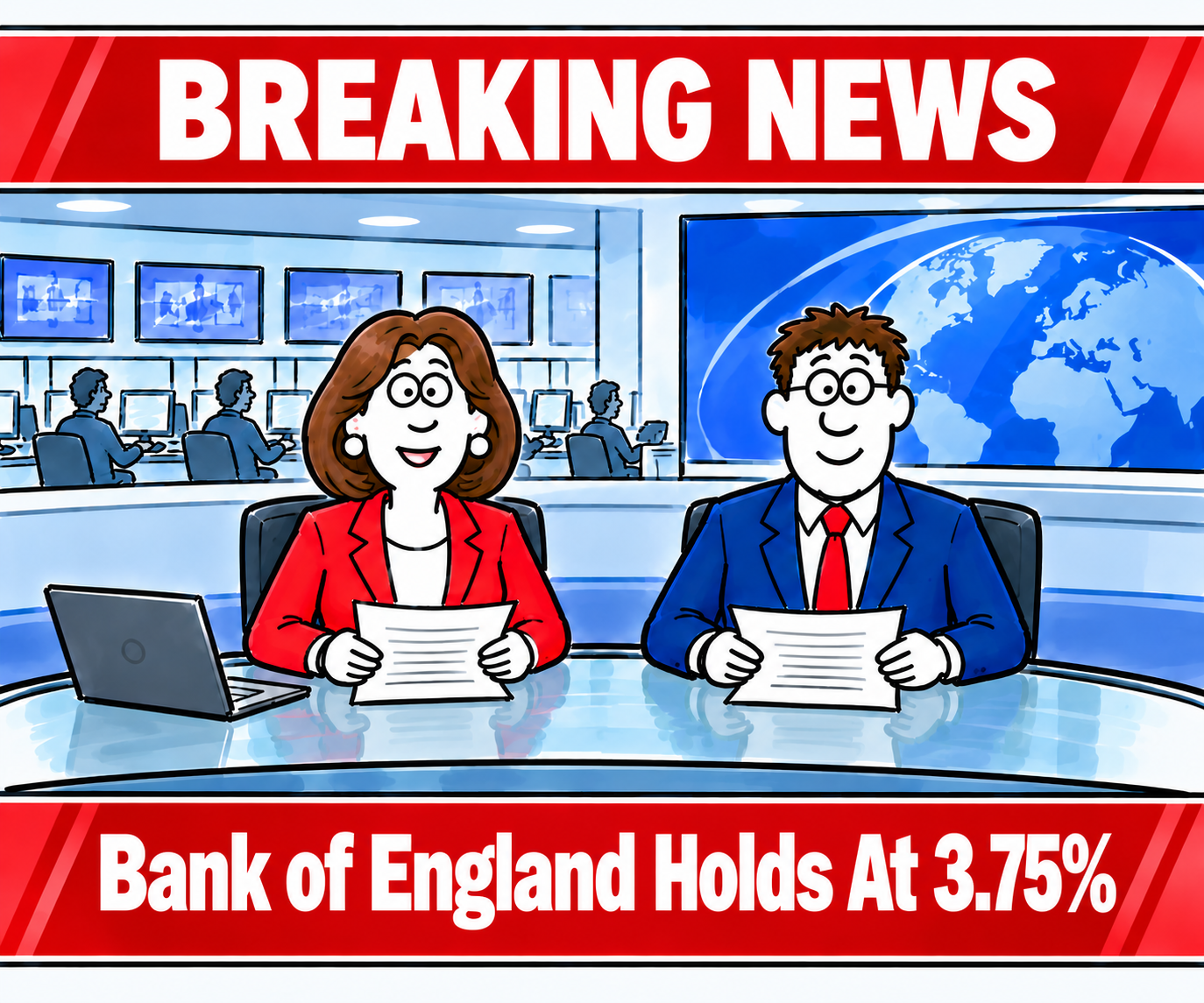
Bank of England Holds Interest Rate at 3.75%

Bank of England holds rate

The Bank of England has held interest rates at 3.75% on 17th September 2026 but warned that persistently high energy costs could force rates higher.

The Monetary Policy Committee voted 6-3 to keep Bank Rate unchanged, while three members backed an increase to 4%.

Governor Andrew Bailey reportedly said the outlook remained uncertain, with rising energy prices creating renewed inflationary pressure.

UK inflation reached 3.1% in August 2026 and the Bank expects it to rise further, potentially exceeding 4% in early 2027 if energy costs remain elevated.

Bailey reportedly said that if the Middle East conflict persists and inflationary risks increase, monetary policy may need to tighten.

Why Won’t the Stock Market Correct – Especially with all the Issues Facing it?

Stock Market Correction Soon?

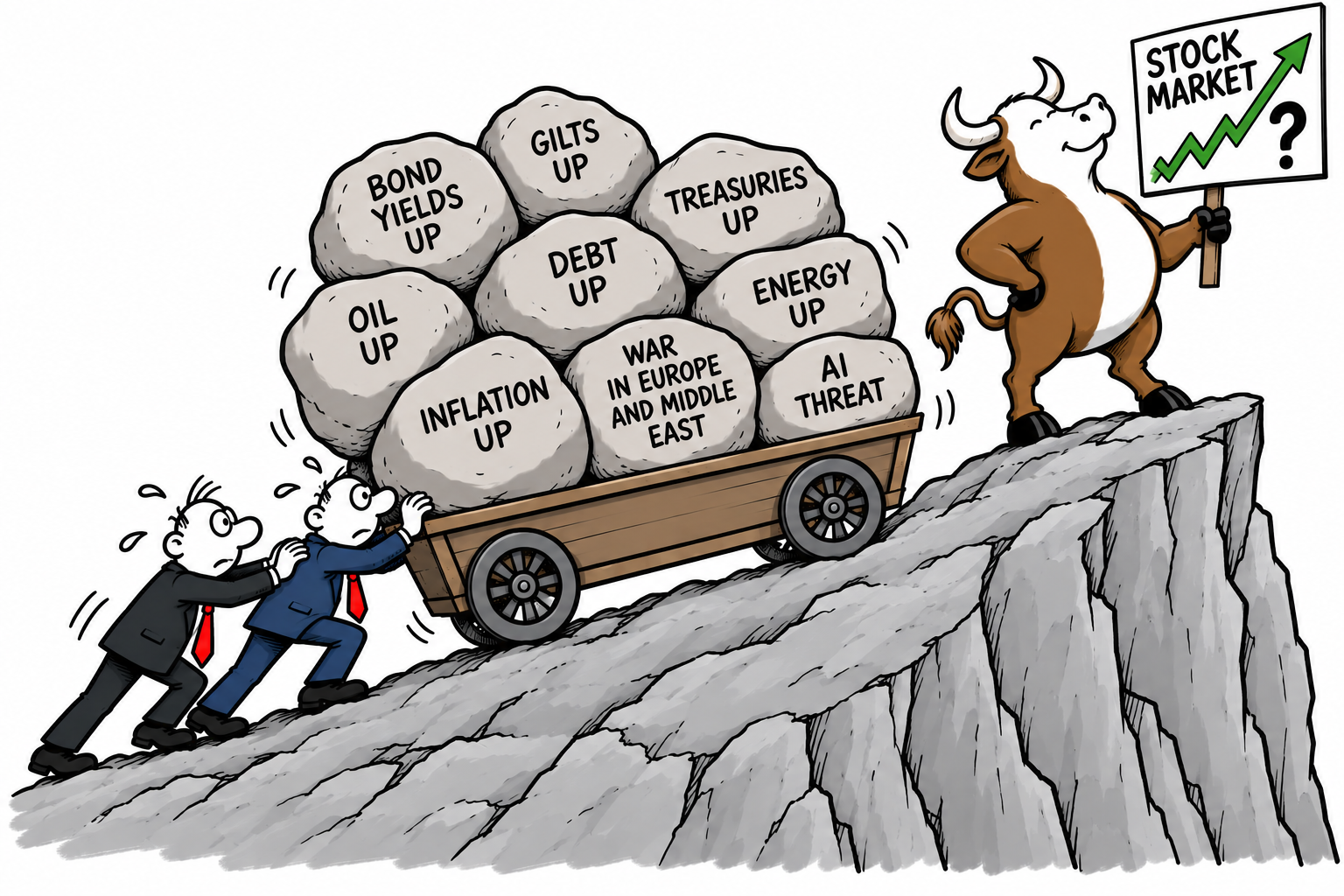
There was a time when any one of these developments would have been enough to frighten investors: rising government bond yields, higher borrowing costs, stubborn inflation, soaring oil and energy prices, mounting government debt, war in Europe and the Middle East and tariff wars.

And now with the growing threat of AI safety and concerns about whether the enormous investment in artificial intelligence can continue at its current pace.

Put them all together and, logically, the stock market should be facing a serious test.

Yet it continues to demonstrate remarkable resilience.

Irony

The irony is that many of these pressures are already showing up in financial markets. U.S. Treasury yields have moved above 5%, their highest levels since 2007, while oil has climbed above $100 a barrel.

Rising energy prices are feeding inflation concerns, while higher yields are increasing the cost of borrowing. Reuters reported on Tuesday that the Dow, S&P 500 and Nasdaq all fell, but the declines remained relatively contained.

So why hasn’t this combination produced a much larger correction?

One explanation is that markets are not simply pricing today’s problems. They are pricing what investors believe the world will look like several months or years from now – or so we are told.

Corporate earnings remain a powerful counterweight. If profits continue to grow rapidly, investors can tolerate higher interest rates and higher valuations for longer.

Reuters notes that continued earnings growth and enthusiasm surrounding AI have helped keep U.S. equities relatively resilient despite the rise in Treasury yields.

There is also an extraordinary amount of money invested in equities. Pension funds, investment funds, corporations and individual investors cannot simply abandon shares every time the economic outlook deteriorates.

There are relatively few places capable of absorbing enormous amounts of capital.

Don’t sell – carry on regardless

And perhaps most importantly, investors have repeatedly learned that selling during every crisis can be expensive.

Inflation? The market survived it.

War? Markets have survived wars before – but markets did correct.

Tariffs – markets have shrugged there off!

Higher interest rates? Markets can rise during tightening cycles if the economy and corporate profits remain strong.

Oil shocks? They can damage consumers and businesses, but they can simultaneously boost the profits of energy companies.

Even the AI problem is complicated. A slowdown in AI investment could hurt some enormously valued technology companies, but it would not necessarily destroy the entire economy.

Indeed, markets have already shown that AI concerns can cause sector-specific selling without automatically triggering a broad collapse.

The real question, therefore, may not be why the market hasn’t fallen.

It is what would finally make investors collectively stop believing that the next problem can be absorbed?

Because markets rarely collapse simply because there are lots of problems.

They collapse when investors suddenly decide that those problems can no longer be ignored.

Stock market offers ‘easy money’?

It certainly sounds like easy money — if only markets worked that way. The danger is assuming that resilience means invincibility: a market can shrug off one problem, then another, and even several simultaneously, right up until investors collectively decide that earnings, valuations, interest rates or economic growth no longer justify the prices they are paying.

Until that moment arrives, bad news can simply be absorbed, explained away or declared temporary; when it does arrive, however, the same market that seemed capable of ignoring everything can suddenly discover that everything matters after all.

Difficulty


The difficult part is that there is no reliable way to say when it will happen — markets can remain expensive and resilient for considerably longer than economic logic might suggest.

The eventual correction is more likely to come when several pressures stop being viewed as temporary or manageable and begin to undermine the assumptions supporting corporate earnings and valuations: persistently high inflation, materially higher borrowing costs, weaker growth, falling profits, an AI investment slowdown, or an unexpected financial shock could each become the catalyst.

Until investors collectively change their expectations, the market can continue climbing despite an increasingly uncomfortable list of warning signs — but resilience should not be confused with immunity.

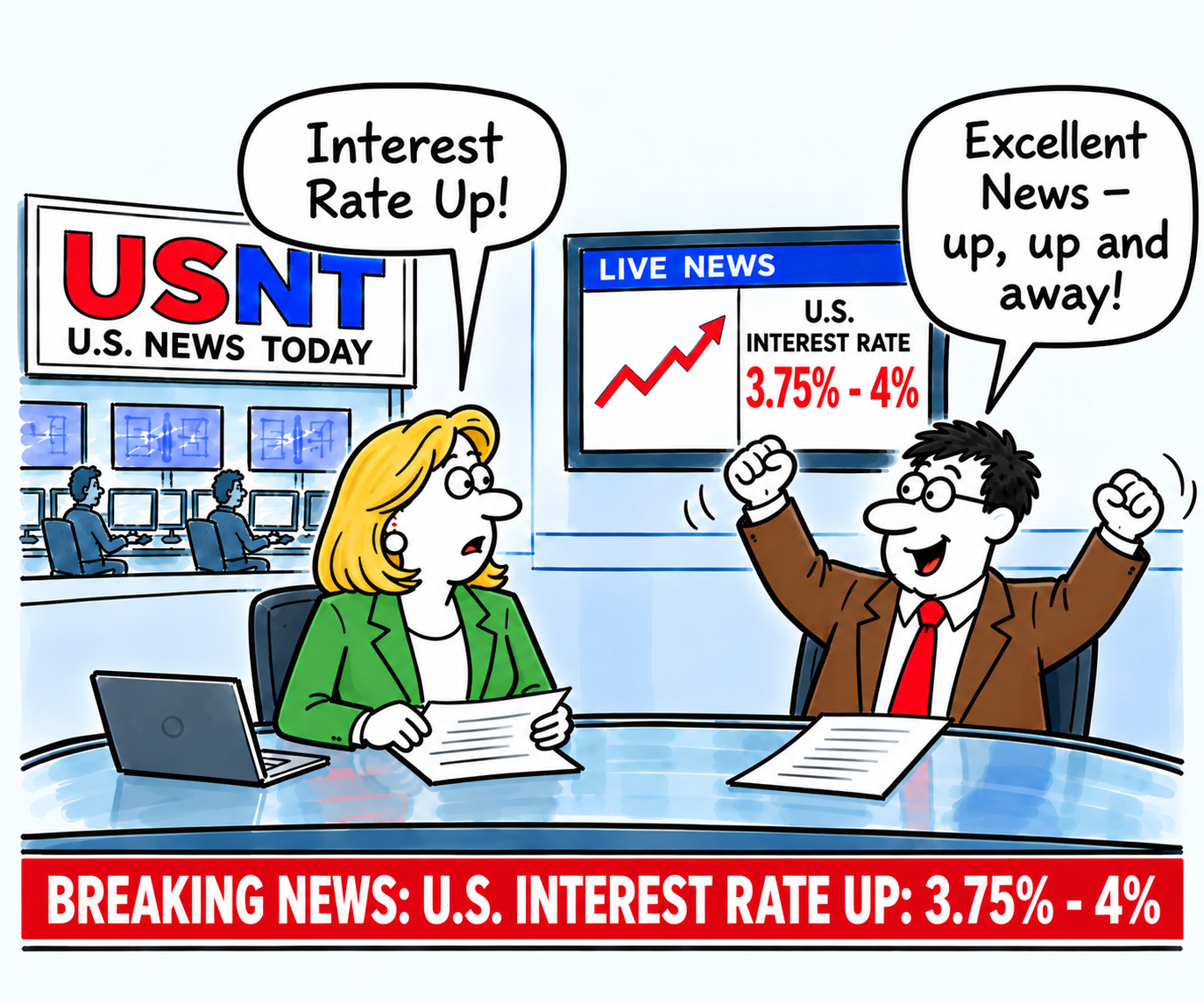
Fed Raises Rates – And Markets Now Face a New Question

U.S. inflation

The Federal Reserve raised US interest rates by 25 basis points yesterday, taking its benchmark rate to 3.75%-4% and delivering the first increase since 2023.

The move puts U.S. inflation firmly back at the centre of the market conversation. Despite months of speculation about the direction of monetary policy, the Fed has signalled that persistent price pressures remain enough of a concern to warrant tighter financial conditions.

For investors, however, yesterday’s increase may be less important than what comes next

Markets must now decide whether the move represents a relatively modest adjustment to policy or the beginning of another tightening phase.

Any suggestion that further increases are coming could push U.S. Treasury yields and the dollar higher while placing renewed pressure on highly valued equities.

That matters particularly for a U.S. stock market already trading at elevated levels, with enthusiasm surrounding artificial intelligence continuing to support many of its largest companies.

Balancing act

The Fed therefore faces a difficult balancing act. It wants to bring U.S. inflation under control without unnecessarily damaging economic growth or employment.

For Wall Street, the question has changed.

It is no longer simply when will rates fall?

It is now how high might they have to go?

U.S. 10-Year Treasury Yield Hits 5%: A New Problem for Markets

U.S. Yields Up!

The U.S. bond market is flashing an increasingly uncomfortable warning signal. The yield on the benchmark 10-year Treasury has climbed above 5%, reaching its highest level since 2007 as investors brace for potentially higher interest rates from the Federal Reserve.

The yield subsequently moved above 5.04%, highlighting the severity of the bond sell-off.

Stubborn

Several forces are pushing yields higher. Inflation remains stubborn, while oil prices have surged above $100 a barrel amid geopolitical tensions, raising fears that another energy shock could feed directly into consumer prices.

Borrowing cost

At the same time, investors are demanding greater returns to hold U.S. government debt because of enormous borrowing requirements and concerns about the country’s long-term fiscal position.

This creates a difficult problem for the Federal Reserve. Higher Treasury yields are already tightening financial conditions, yet persistent inflation could force the Fed to raise interest rates further.

Markets are increasingly pricing in the possibility of another rate increase, potentially taking short-term rates towards or above 5%.

Consequence

The consequences could be significant. The 10-year Treasury is a benchmark for mortgages, corporate borrowing and many other financial products.
As its yield rises, borrowing becomes more expensive across the economy. Businesses may postpone investment, consumers may reduce spending and highly indebted companies could come under increasing pressure.

Debt concern

There is also a problem for government finances. Higher yields mean the U.S. Treasury must pay more to refinance its enormous debt pile, potentially creating a vicious circle: more borrowing leads to greater interest costs, which can require still more borrowing.

For investors, a 5% Treasury yield also makes government bonds increasingly attractive compared with riskier assets.

That could put further pressure on highly valued shares, particularly technology and growth companies.

The danger is therefore not simply a higher interest rate. It is the possibility that 5% becomes the new normal.

ECB Raises Interest Rates as Inflation Fears Return

ECB raised interest rates

On September 10th 2026, the European Central Bank (ECB) raised interest rates in an effort to stop a new wave of inflation from taking hold across the eurozone.

The ECB increased its key deposit rate by 0.25 percentage points to 2.5%, its second rate increase this year. The move comes as inflation has risen above 3%, well above the ECB’s 2% target.

Much of the renewed pressure is being blamed on higher energy prices, linked to the continuing conflict in the Middle East.

Energy costs

More expensive oil and gas can quickly feed through into transport, food and household bills, raising fears that inflation could prove more persistent than previously expected.

The problem for the ECB is that higher interest rates can also weaken economic growth. More expensive mortgages and business loans can discourage households from spending and companies from investing.

Challenge

Although the eurozone economy has shown some resilience, the outlook remains uncertain. The ECB expects inflation to average around 3% this year, while economic growth is expected to remain relatively weak.

The ECB now faces a difficult balancing act: raise rates enough to control inflation, but not so much that it pushes the economy into a deeper slowdown.

Investors are already likely wondering whether further increases could follow in the months ahead.

Deal or No Deal – The President of The United States and his Team Tease an Iran Deal, Markets Soar — Again. And Then Nothing. Why Does This Keep Happening?

Deal or no deal?

It has become an increasingly familiar pattern: Donald Trump hints that an agreement with Iran is close, investors breathe a sigh of relief, oil prices fall and stock markets jump — only for the promised breakthrough to fail to materialise. Why?

Deal or no deal

This week (early-August 2026) was another example. Trump and members of his administration suggested that progress towards an agreement involving Iran and the Strait of Hormuz could come within days.

Markets responded enthusiastically, betting that a deal would reduce the risk of prolonged conflict and ease pressure on global energy supplies.

Yet no comprehensive agreement appeared. Iran subsequently said direct talks with Washington would not take place while it considered the existing interim arrangement to be breached.

So why does it keep working?

Because financial markets trade expectations, not facts. The possibility of peace is enormously valuable when war threatens oil supplies, inflation and global growth.

Algorithms and traders react within seconds to headlines containing words such as “deal”, “ceasefire” or “agreement”.

Oil falls, equities rise and the economic relief can be priced in long before diplomats have actually agreed anything.

Loop of distrust

There is also a dangerous feedback loop. If markets repeatedly reward optimistic statements, there is little immediate financial incentive for politicians to stop making them.

Reports have previously documented dozens of occasions on which Trump suggested an Iran agreement was imminent without a final deal emerging.

Unhealthy relationship

That does not prove deliberate market manipulation. But it does expose a deeply unhealthy relationship between political rhetoric and financial markets.

Peace should be based on verified agreements, not carefully timed hints.

When a presidential statement can erase billions of dollars of perceived risk from markets before a single binding document exists, investors are effectively trading political promises.

And when those promises repeatedly fail to arrive, the credibility of both the politician and the market reaction suffers.

Shouldn’t markets price reality?

Not headlines. And certainly not hype.

Can U.S. markets ever fail… I wonder?

The Great Social Truth Manipulation

The Art of Manipulation

There is an old saying apparently that if you create a problem, you can then claim credit for solving it.

Whether that saying is fair in every circumstance is open to debate, but it raises an uncomfortable question about the way modern politics is increasingly presented to the public.

Every day we hear another announcement that “a deal is close”, “talks are progressing” or “a breakthrough is expected”. These headlines are designed to sound reassuring. They suggest that leaders are successfully navigating a difficult situation.

But what if we are asking the wrong question?

Perhaps we should not be asking whether another deal is close. Perhaps we should be asking why the deal has become necessary in the first place.

That is where the irony begins.

Take the current tensions involving the United States and Iran. The public is repeatedly encouraged to view the next agreement as a diplomatic success.

Yet before the military confrontation, there was already diplomacy. The Strait of Hormuz was open. Oil continued to flow. The world’s attention was focused on preventing escalation rather than recovering from it.

Today, after military action, regional instability and renewed fears over global shipping and energy supplies, we are told that another agreement will represent progress.

But is it progress?

Or is it simply an attempt to restore what already existed?

That distinction is rarely discussed.

Instead, public attention is directed towards the negotiations themselves.

Every meeting becomes news.

Every statement hints at a breakthrough.

Every possible agreement is presented as evidence that events are moving in the right direction.

The irony is that the benchmark has quietly changed.

Yesterday, stability was taken for granted. Today, merely returning to that same level of stability is presented as a diplomatic triumph.

This is how truth manipulation often works.

It does not necessarily rely upon telling outright lies. Instead, it changes the point from which people measure success.

Once the public stops comparing today’s position with where events began, and starts comparing today’s headlines with yesterday’s headlines, perceptions change. Recovery begins to look like achievement.

That is an extraordinarily effective political technique.

It shifts the conversation away from asking whether earlier decisions improved the situation and towards celebrating efforts to repair the consequences.

The public becomes invested in the next deal rather than reflecting upon whether the circumstances requiring that deal could have been avoided.

This is not an argument against diplomacy. Quite the opposite. Negotiation should always be preferred to conflict wherever possible.

Nor is it a claim that every crisis is avoidable. International affairs are rarely that simple.

The real issue is whether governments should be judged by the number of deals they announce or by whether their decisions leave the world in a better position than before.

That is the question often left unasked.

Perhaps the greatest social truth manipulation is persuading people to celebrate returning to yesterday’s starting point while calling it tomorrow’s success.

This pattern is hardly unique to one administration or one country. Governments throughout history have sought to frame events in ways that favour their own decisions.

However, democratic societies rely upon citizens asking a simple but essential question:

Are we genuinely better off than we were before?

Trump’s Latest Tariff Onslaught Marks a new Strategic Gameplay

Trump Tariff Storm

President Donald Trump’s newest tariff onslaught is not simply a reprise of his earlier trade offensives; it represents a structural shift in how the White House intends to wield tariffs as a long‑term economic instrument.

The administration has imposed fresh duties of 10% to 12.5% on 60 trading partners, including the EU, China, the UK and Canada.

Unlike the shock‑and‑awe “Liberation Day” tariffs of 2025, this latest round landed with muted market reaction — not because the measures are trivial, but because the global backdrop has changed dramatically.

Compounding Inflation

The defining difference is context. Markets are already strained by a prolonged US–Iran conflict, an energy shock pushing oil above $100, and persistent supply chain bottlenecks.

In this environment, tariffs no longer arrive as a standalone geopolitical gambit; they compound existing inflationary pressures and reinforce expectations of slower global growth.

Analysts warn that the combination of conflict‑driven uncertainty and renewed trade barriers could entrench a low‑growth, high‑inflation regime.

U.S. Supreme Court

The legal foundation has also shifted. After the Supreme Court struck down earlier tariffs, the White House has pivoted to Section 301 of the Trade Act of 1974, citing forced labour concerns.

This move removes the legal vulnerability that previously allowed courts to intervene. As a result, markets must now treat tariffs not as temporary negotiating tools but as potentially permanent features of U.S. economic policy.

Tariff battleground

Investment strategists suggest that other nations may respond cautiously at first, delaying escalation until the full impact becomes clearer.

Yet the broader implication is unmistakable: Trump’s tariff strategy has evolved from episodic salvos into a durable framework.

With the Federal Reserve now weighing the inflationary effects of rising oil prices, the tariff onslaught arrives at a moment when global markets can least absorb additional strain.

Trump pauses military strikes on Iran apparently to allow peace talks to resume – let’s see what happens this time.

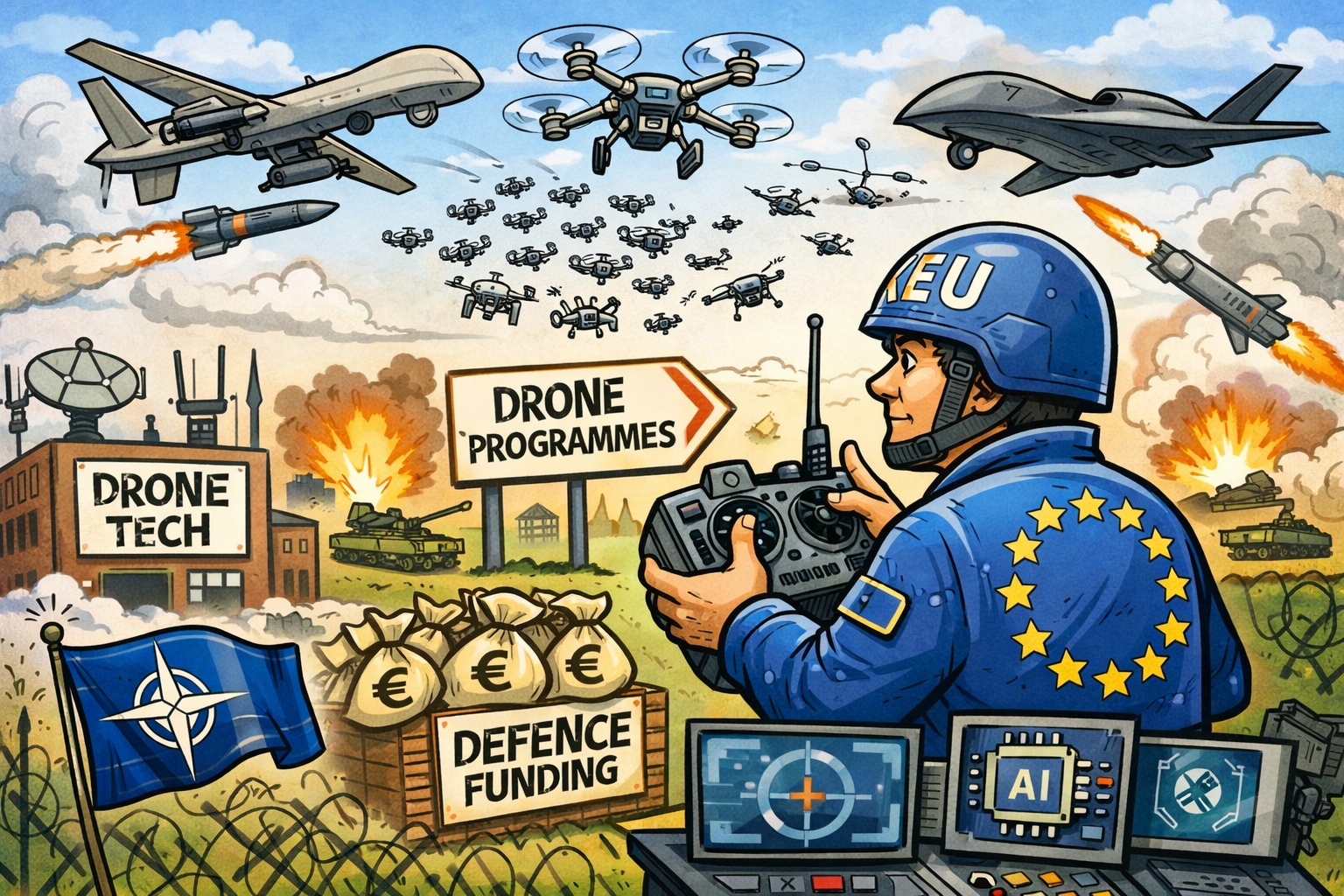
Europe goes all out on drones

Drone investment by the EU

Europe’s accelerating bet on drone technology marks one of the most significant strategic pivots in its modern defence posture.

After years of rebuilding military capacity in response to Russia’s invasion of Ukraine, European governments are now converging on drones and autonomous systems as the backbone of future security planning.

The shift is rapid, coordinated, and backed by unprecedented investment.

NATO

Over recent weeks, NATO, the U.K., Germany and major defence-tech firms have all announced large-scale programmes centred on drones.

NATO’s new initiative commits allies to more than $40 billion in counter‑drone capabilities over five years, reflecting Secretary General Mark Rutte’s assessment that drones have “fundamentally altered” modern warfare.

The U.K.’s Defence Investment Plan allocates £5 billion to a national drone transformation programme, while Germany has moved to procure 50,000 drones for Ukraine—an order that underscores how battlefield lessons from Ukraine are shaping procurement across the continent.

Lesson

Those lessons are clear: low‑cost, AI‑enabled drones can gather intelligence, extend the reach of conventional weapons, and operate effectively even in contested electronic environments.

Companies such as Auterion are developing operating systems that allow drones to strike targets despite jamming, navigate below the radio horizon, and eventually operate in coordinated swarms.

AI enabled

This software‑first approach signals a broader trend: Europe’s defence industry increasingly sees autonomy, AI, secure communications, and electronic warfare as central to future military capability.

Investment boom

The investment boom is also reshaping Europe’s defence‑tech sector. Venture funding has surged from €200 million in 2021 to €2.6 billion in 2025, and firms like Munich‑based Helsing—now valued at $18 billion—are emerging as continental champions in autonomous defence systems.

Europe’s big bet on drones is ultimately a bet on a new model of warfare: networked, data‑driven, and increasingly autonomous.

It reflects both urgency and ambition as the continent adapts to a rapidly changing security landscape.

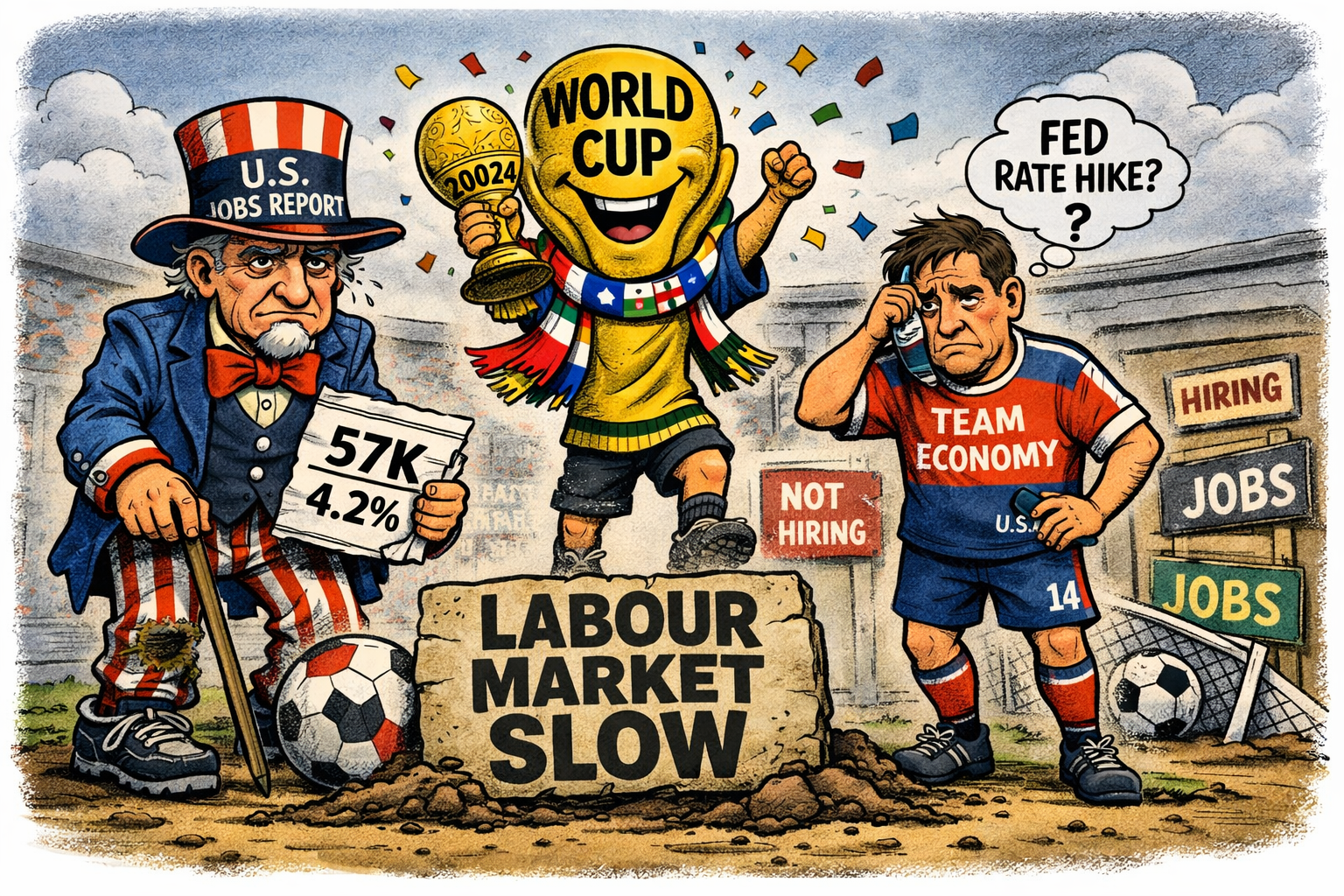
U.S. jobs market cools in June

Hiring slows for the U.S. in June 2026

The latest U.S. jobs report underscored a clear cooling in labour market momentum, with June’s 2026 nonfarm payrolls rising by just 57,000, well below economists’ expectations and marking the weakest gain in four months.

And this despite an expected job boost as the U.S. hosts a highly successful record-breaking Football World Cup.

Although the headline unemployment rate dipped to 4.2%, this improvement was largely cosmetic: the labour force participation rate fell to 61.5%, its lowest level since March 2021, meaning fewer people were counted as actively seeking work.

Beneath the surface, the household survey painted a more troubling picture. Employment dropped sharply, with 507,000 fewer people reporting they were at work, and revisions to earlier months erased 74,000 previously reported jobs — undercutting the narrative of springtime strength.

Leisure and hospitality suffered a notable setback, shedding 61,000 positions, while gains were concentrated in a narrow band of sectors: professional and business services (+36,000), social assistance (+25,000), and healthcare (+22,000).

Financial markets reacted cautiously, with investors trimming expectations of a Federal Reserve rate rise in September 2026.

Overall, the data reportedly suggests a labour market losing steam, shaped more by statistical quirks and workforce exits than by genuine economic resilience.

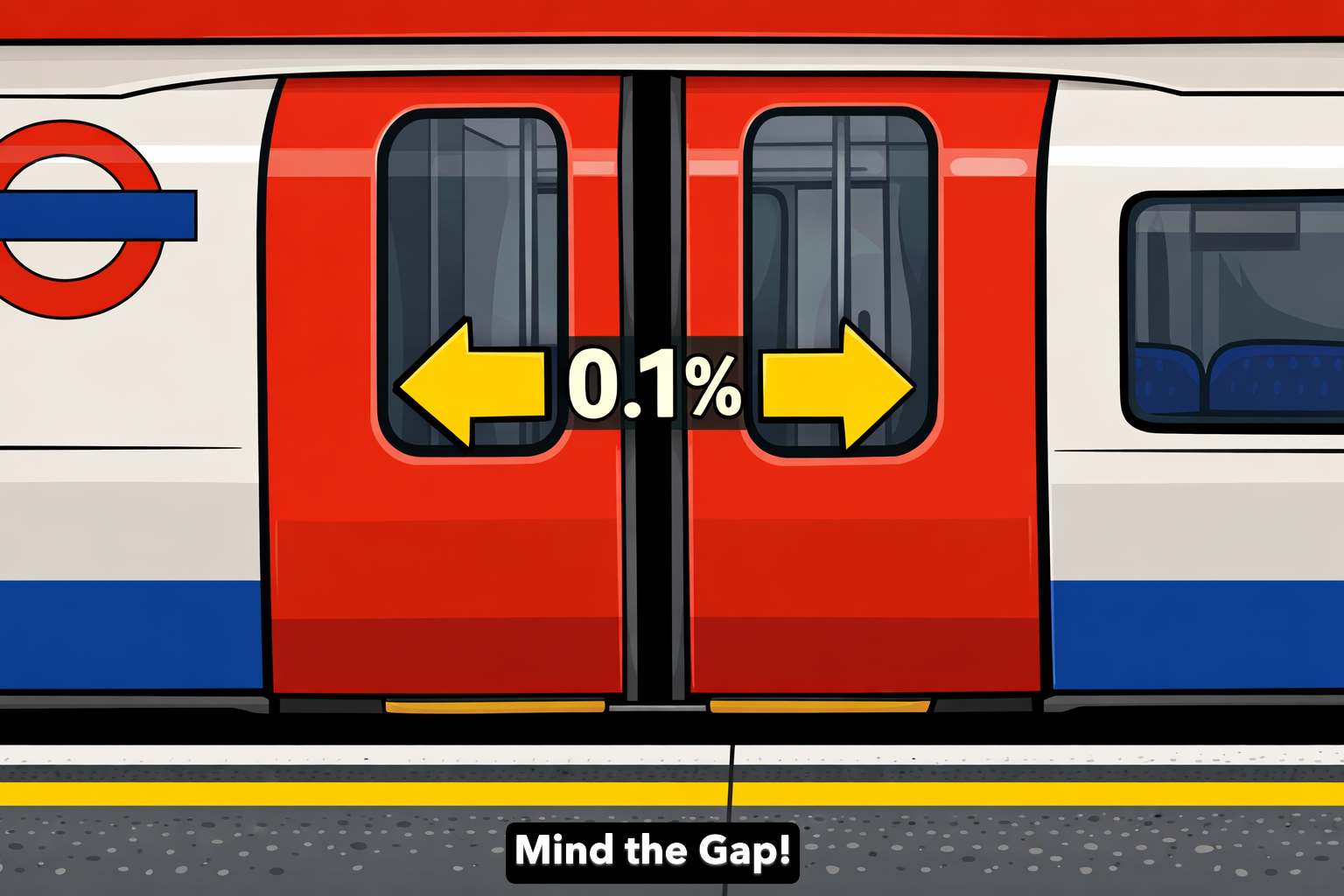
ECB Interest Rate Hike to 2.25% and UK GDP Contracts 0.1%

Slow UK Growth for April 2026

The European Central Bank jolted markets yesterday with its first interest‑rate increase since 2023, a move driven by renewed energy‑price pressures linked to the U.S./Iran conflict.

Policymakers signalled that the surge in wholesale gas and oil costs is feeding back into euro‑area inflation, forcing a return to tightening after more than two years of stability.

Investors had expected a cautious stance, but the ECB argued that delaying action risked inflation becoming embedded again, particularly in energy‑sensitive economies such as Germany and Italy.

The decision pushed bond yields higher across the bloc and strengthened the euro, reflecting expectations of a more hawkish path through the summer.

UK Lacklustre Growth

In the UK, fresh GDP data released by the ONS for April 2026 offered a more mixed picture. The economy expanded modestly, continuing the fragile recovery seen earlier in the year, but underlying momentum remains weak.

Services provided the bulk of the growth, while manufacturing and construction were broadly flat.

Economists warn that higher energy prices — the same shock driving the ECB’s decision — could weigh on UK output in the coming months, squeezing household budgets and raising costs for businesses.

Together, the ECB’s shift and the UK’s tentative growth figures underline how vulnerable Europe remains to global energy disruptions.

Humanoid Robots on the Front Line in Ukraine Signal a New Frontier in Warfare

The testing of humanoid robots in Ukraine marks a striking moment in the evolution of modern warfare, blending Silicon Valley ambition with the brutal pragmatism of a live conflict.

Foundation Future Industries

Foundation Future Industries, a San Francisco start-up founded in 2024, has positioned itself at the centre of this shift by deploying its Phantom MK‑1 robots for pilot demonstrations on the Ukrainian front lines.

The company’s pitch is simple but provocative: humanoid robots should be used not for household chores, but for the world’s most dangerous jobs. Ukraine, now in its fifth year of war, has become the proving ground.

The MK‑1 units tested so far are limited — they carry modest payloads, lack waterproofing, and cannot yet operate at scale. But their early tasks, such as retrieving supplies from hazardous areas, hint at the potential of autonomous systems shaped for human environments.

Urban combat, with its stairwells, basements and narrow corridors, is inherently built around the human form. Analysts note that this gives humanoid robots theoretical advantages over tracked or quadruped machines in certain scenarios.

Yet the technology’s military promise is entangled with political controversy. The company recently appointed Eric Trump as chief strategy adviser, prompting accusations of impropriety given its $24 million in U.S. government research contracts.

Two humanoid robots were reportedly sent to Ukraine in February 2026.

Foundation insists the partnership reflects a shared vision of rebuilding American manufacturing, but the optics are unavoidable.

Multiple sources describe this as the first recorded deployment of humanoid robots to an active warzone — not just Ukraine, but any modern conflict.

The robot race

The broader context is a deepening geopolitical race. Foundation openly frames its mission as part of a contest with China, whose own robotics sector has showcased early military prototypes.

The U.S. military, meanwhile, has not yet deployed humanoid systems, though it is increasingly integrating AI into battlefield decision-making.

Experts caution that cost, complexity and manufacturability may ultimately limit humanoids’ role. But the symbolism is unmistakable.

Whether or not these machines succeed, Ukraine has become the first real-world laboratory for autonomous, human-shaped robots — a glimpse of how future conflicts may be fought.

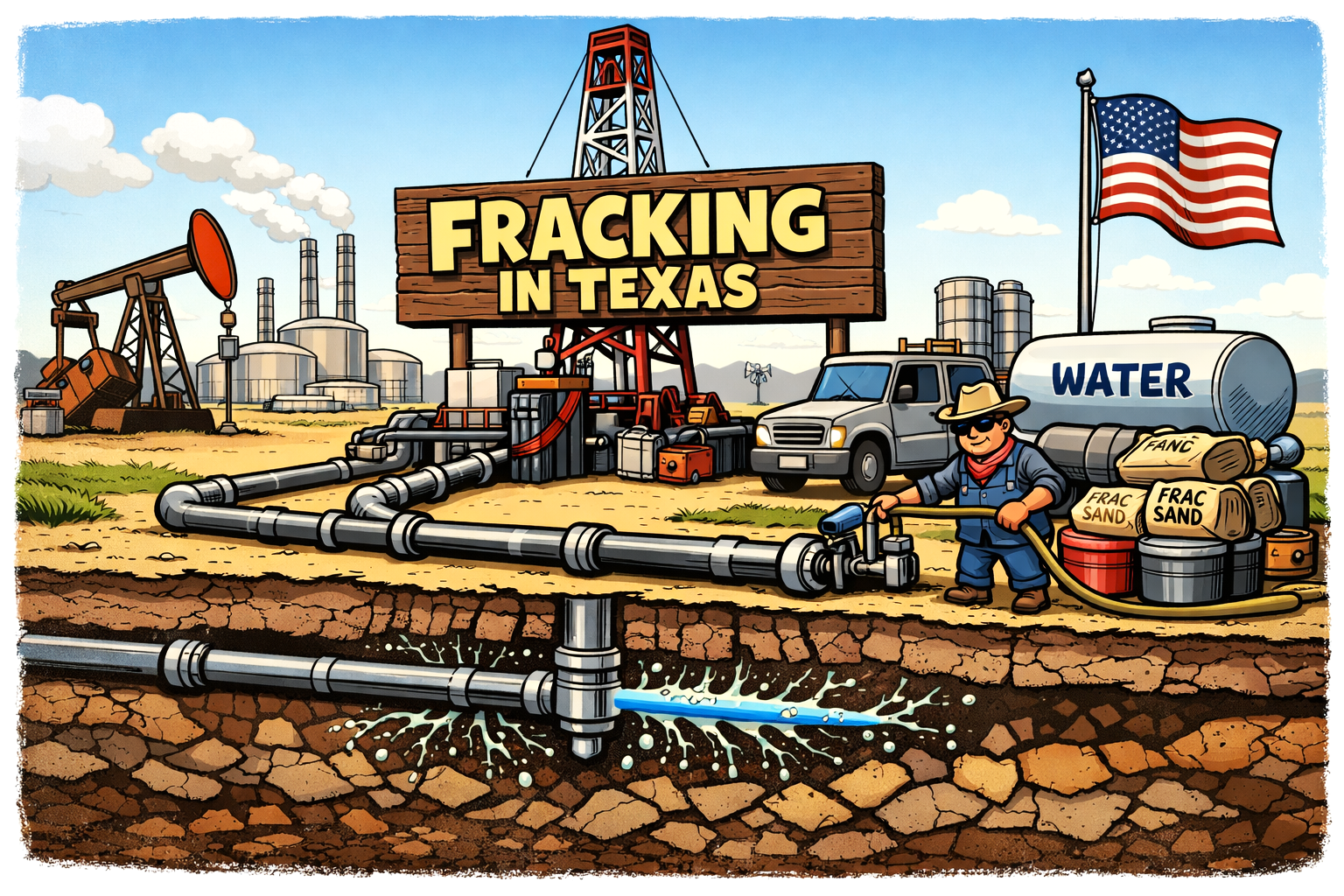
Fracking – Oil Exports – and the U.S. Oil Success

Fracking - Oil Exports - and the U.S. Oil Success

One of the least‑discussed forces helping to shape the current U.S.–Iran confrontation is the quiet revolution beneath American soil.

Over the past decade, hydraulic fracturing transformed the United States from a vulnerable energy importer into the world’s largest oil and gas producer.

Pumped up

Nowhere has this shift been more dramatic than in Texas, where the Permian Basin alone pumps more oil than many OPEC members. This surge has not only reshaped global markets — it has altered Washington’s strategic outlook.

The United States now exports record volumes of crude oil and liquefied natural gas, with outbound shipments regularly exceeding 4 million barrels per day.

The conflict with Iran isn’t impacting oil production in the U.S.—if anything, it has boosted output and increased overseas sales.

This would have been unthinkable twenty years ago, when U.S. foreign policy was constrained by dependence on Middle Eastern supply.

U.S. Shale Boom

Today, the shale boom has given Washington a buffer: even severe disruption in the Strait of Hormuz would no longer threaten the U.S. economy in the way it once did.

This energy independence has had political consequences. Analysts note that President Trump’s willingness to escalate against Iran — including strikes, sanctions, and naval deployments — is partly rooted in the belief that the U.S. can withstand an oil shock far better than its rivals.

Iran, by contrast, relies heavily on oil revenues and is already weakened by sanctions. A prolonged disruption to its exports hurts Tehran far more than Washington.

Texas fracking plays directly into this dynamic. The combination of horizontal drilling, high‑pressure fracturing, and vast shale formations has created a production engine capable of rapid growth.

When global prices rise, U.S. shale responds within months, softening the blow to consumers and limiting the geopolitical leverage of traditional producers.

Texas Asset

In effect, the Permian Basin has become a strategic asset — a domestic shock absorber that reduces the economic risks of confrontation abroad.

Critics argue that this new confidence borders on complacency. A major conflict in the Gulf would still send global prices sharply higher, with knock‑on effects for inflation, supply chains, and allied economies.

But there is no doubt that the fracking boom has changed the psychology of U.S. power. For the first time in modern history, America can contemplate a showdown in the Middle East without fearing an immediate energy crisis at home.

Texas may not be the reason the U.S. is confronting Iran — but it has certainly made the White House feel far safer doing so.

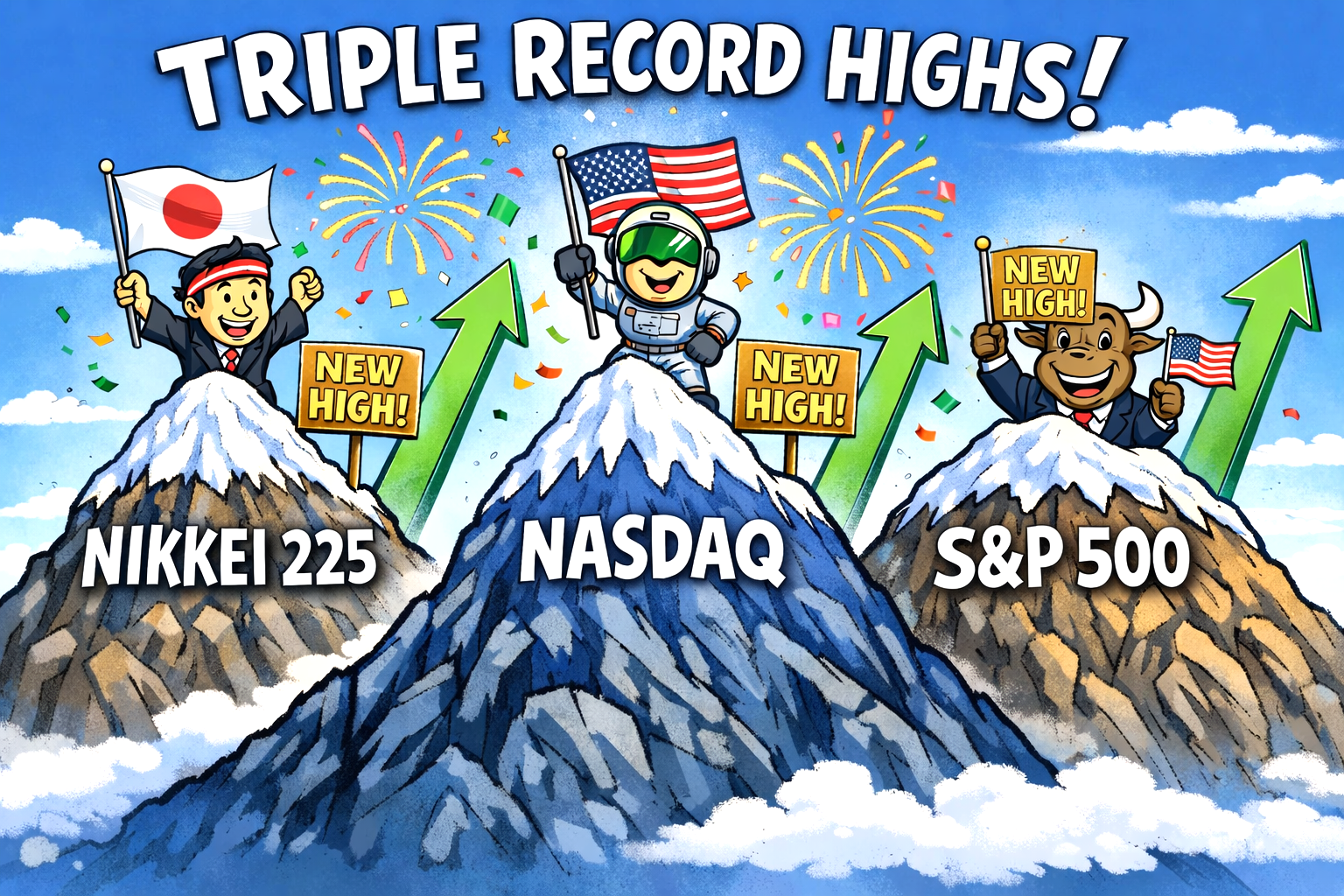
Nothing to see here… Nasdaq – S&P 500 and Nikkei 225 each break all-time record highs and set new intraday highs… again!

Indices at new record highs!

Global equity markets delivered a remarkable synchronised milestone on Friday, as the Nikkei 225, Nasdaq Composite, and S&P 500 each registered fresh all‑time highs, underscoring the strength of the ongoing technology‑led rally and a renewed wave of risk appetite.

Nikkei

In Tokyo, the Nikkei 225 briefly surged to a record intraday high of 63,385.04, propelled by powerful follow‑through from Thursday’s post‑holiday catch‑up rally. Although the index later eased into modest profit‑taking, it still finished at 62,713.65, comfortably within record territory.

AI here we go!

Semiconductor and AI‑linked names continued to dominate flows, reflecting Japan’s deep integration into the global chip supply chain.

Nasdaq

Across the Pacific, Wall Street delivered a similarly emphatic performance. The Nasdaq Composite pushed to a new intraday peak of 26,248.62 before closing at 26,247.08, its highest level on record.

Strong earnings from major technology firms, combined with renewed optimism around US–Iran de‑escalation efforts, helped extend the index’s multi‑week winning streak.

S&P 500

The S&P 500 also broke new ground, touching an intraday high of 7,401.50 and settling at a record close of 7,398.93.

Each indices continued to hit even higher intraday records after the bell on Friday 8th May 2026.

A stronger‑than‑expected US jobs report reinforced confidence in the resilience of the American economy, even as geopolitical tensions and elevated energy prices continue to shape market sentiment.

Tech cycle

Taken together, the simultaneous records across the U.S. and Japan highlight the dominance of the global technology cycle and the market’s willingness to look through near‑term macro risks.

For now, momentum remains firmly on the side of the bulls. Nothing appears to be able to knock this bull off course.

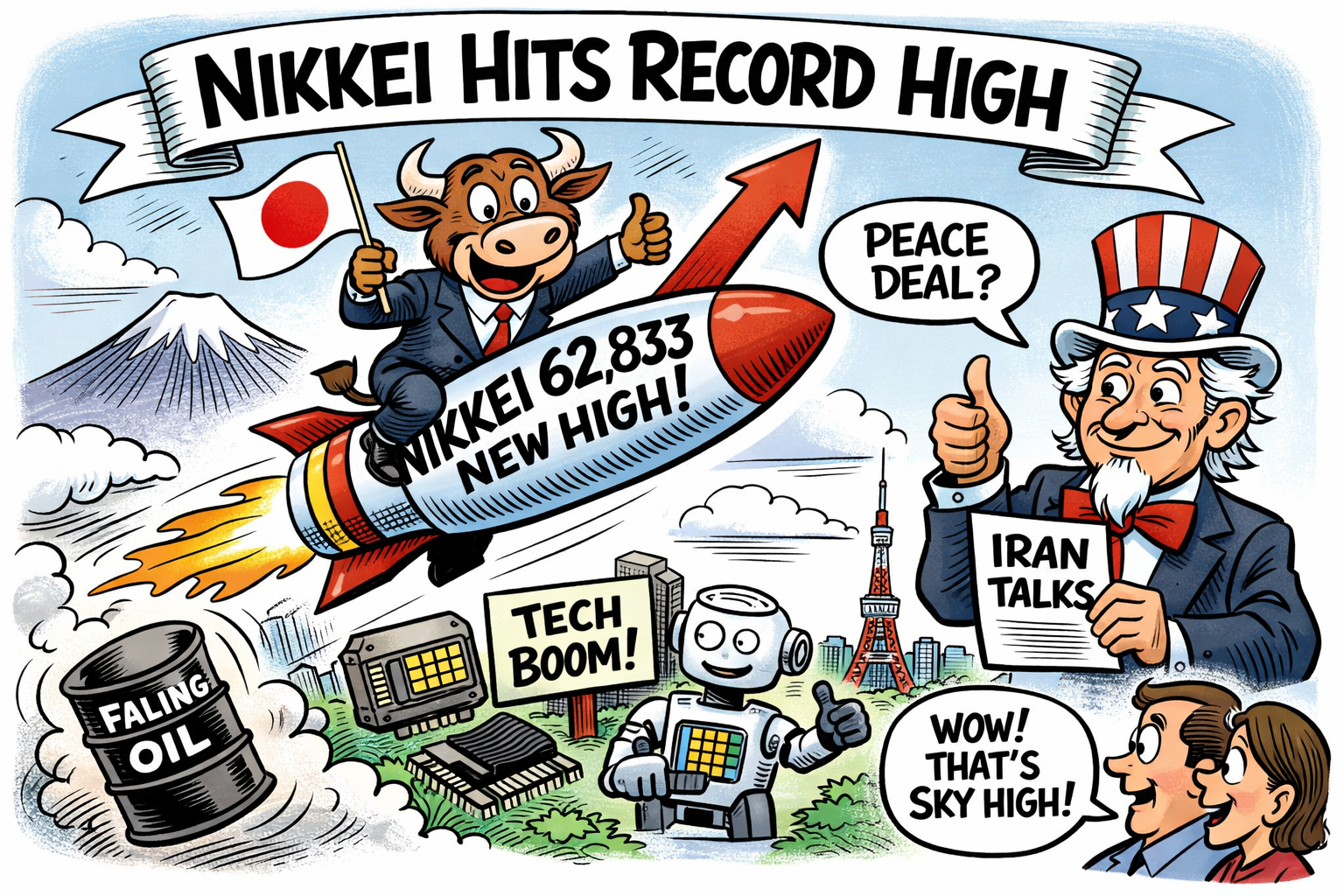
Tokyo Takes Off: Nikkei Rockets to Record Heights

Nikkei record above 62,000

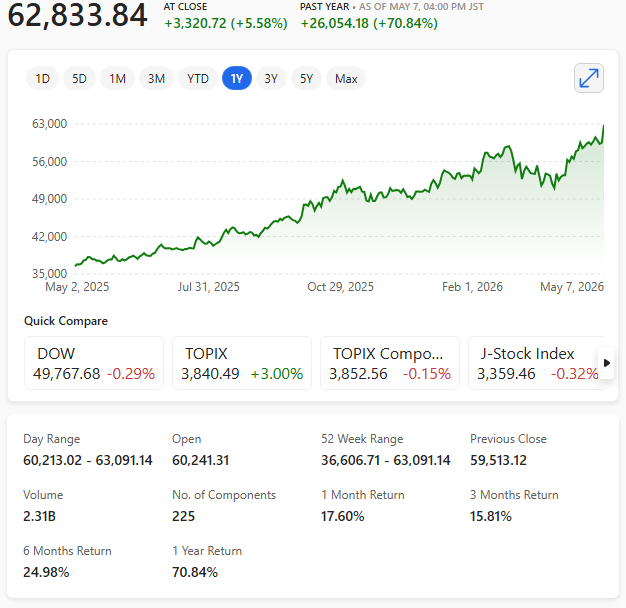
The Nikkei 225 surged to a fresh all‑time high yesterday, closing at 62,833.84, driven by a powerful combination of easing geopolitical risk, a global tech rally, and a sharp drop in oil prices.

Exceptional day

The Nikkei’s latest record marks one of the most dramatic single‑day advances in its modern history. The index jumped 3,320.72 points, a 5.58% gain, smashing its previous closing high and briefly topping 63,000 intraday.

This explosive move came as Tokyo reopened after the Golden Week holiday, allowing Japanese equities to catch up with global markets that had rallied earlier in the week.

Easing fears

A decisive catalyst was renewed optimism over a potential U.S.–Iran agreement, which eased fears of prolonged conflict and helped unwind the war‑risk premium that had weighed on markets.

Reports suggesting progress in negotiations pushed crude oil sharply lower, with U.S. WTI futures dropping more than 13% at one point.

Nikkei 225

Nikkei 225 at all-time high 7th May 2026

Lower energy prices provided immediate relief for Japan’s import‑dependent economy and boosted investor sentiment across sectors.

AI led rally

The rally was led by semiconductor and AI‑linked stocks, which have been the backbone of Japan’s market strength throughout the year. Companies such as SoftBank and major chip‑equipment makers saw outsized gains as Wall Street’s tech surge spilled over into Asia.

While analysts expect the domestic market to remain firm in the near term, they also caution that geopolitical conditions remain a major concern.

For now, however, the Nikkei’s latest milestone underscores Japan’s position as one of the strongest major equity markets of 2026.

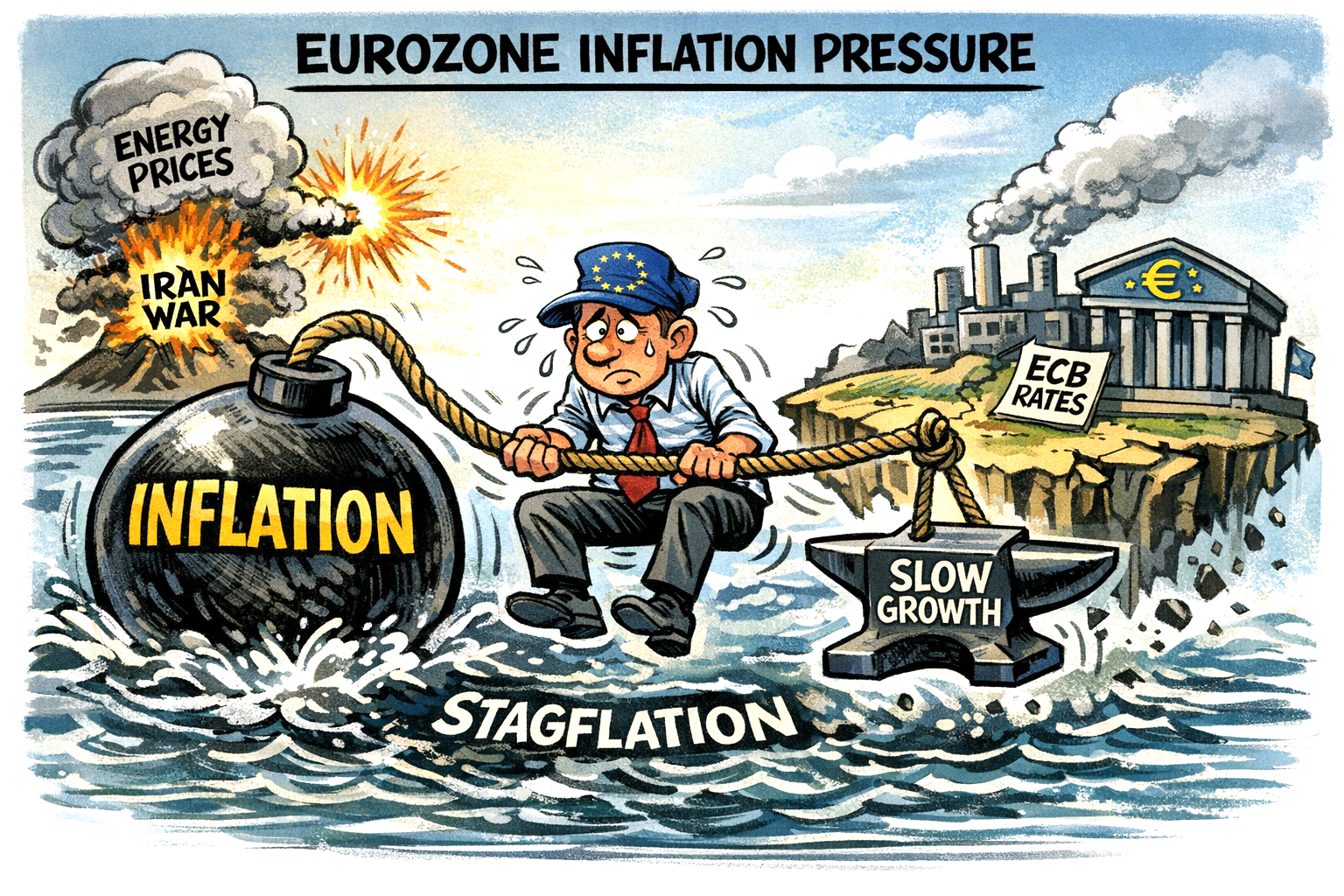
Euro zone inflation jumps to 3% as economic growth almost stalls

Euro Zone Inflation Pressure April 2026

Euro zone inflation accelerated sharply in April 2026, rising to 3%, as the bloc’s economy barely grew — a combination that deepens fears of a stagflationary year.

The latest flash estimate from Eurostat shows headline inflation climbing from 2.6% in March, driven overwhelmingly by surging energy costs linked to the U.S./Iran war and the ongoing disruption in the Strait of Hormuz.

Energy

Energy inflation jumped to 10.9%, more than double the previous month’s rate, underscoring how exposed the currency bloc remains to external supply shocks.

Core inflation, however, edged down to 2.2%, offering a small reassurance that second‑round effects — wage‑price spirals — have not yet taken hold.

Growth was anaemic. First‑quarter GDP expanded by just 0.1%, reflecting weak industrial output, fragile consumer confidence, and higher input costs for businesses.

Stagnation

Economists warn that the combination of rising prices and near‑stagnant activity risks pushing the region into a period of low‑growth, high‑inflation pressure.

The figures land just ahead of the European Central Bank’s policy meeting. With inflation above target but growth faltering, the ECB faces a difficult balancing act.

Policymakers are widely expected to hold rates at 2%, wary that tightening into a supply‑driven shock could deepen the slowdown.

For now, the data reinforce a picture of a euro zone squeezed by global energy turmoil and struggling to regain momentum.

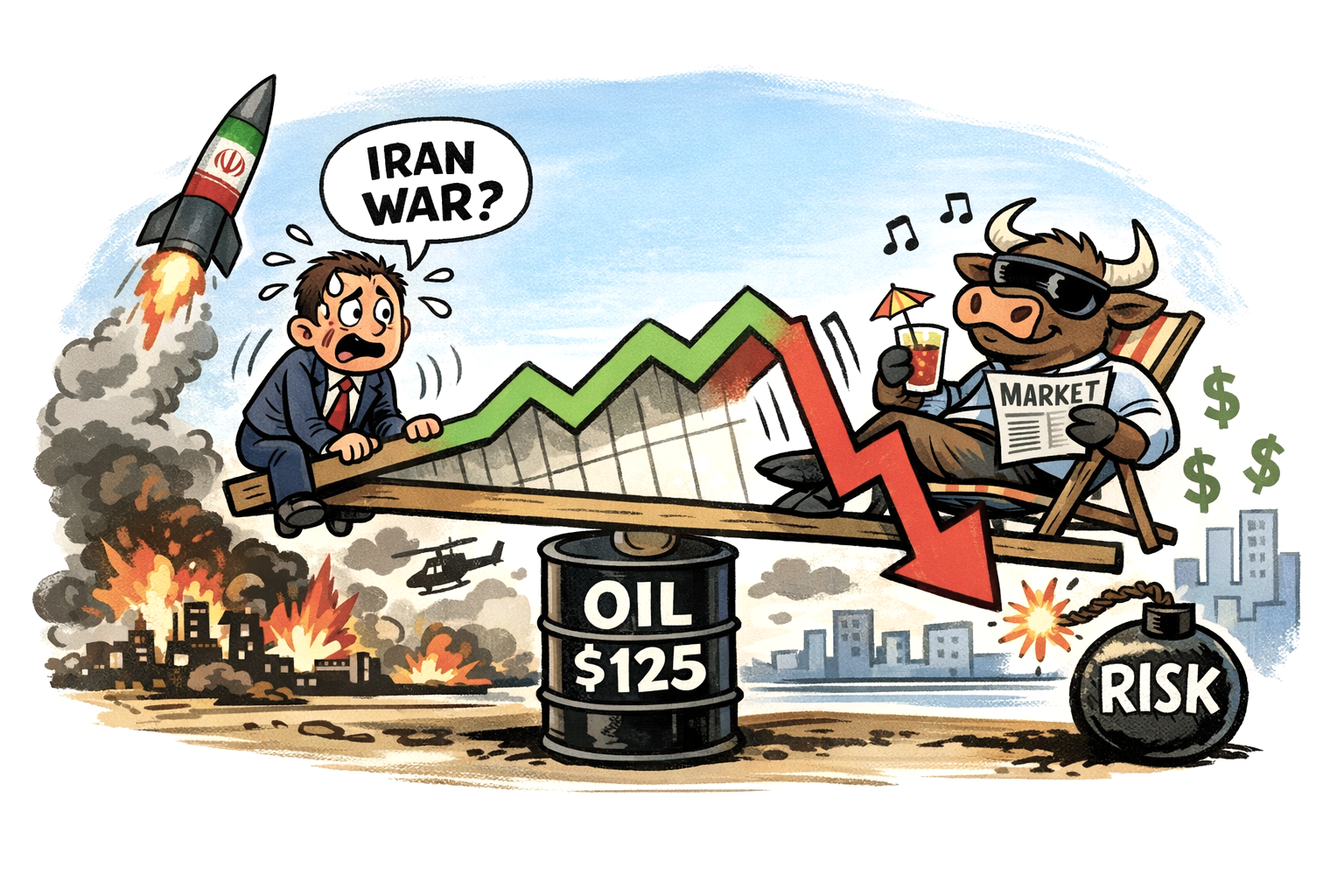
Are markets becoming complacent about the U.S. Iran war?

U.S. Iran war effect underestimated?

Markets are flashing warning signs that too many investors are still treating the U.S.-Iran war as a temporary disturbance rather than a structural shock.

Brent crude’s brief surge to around $125 a barrel — its highest level in four years — has reignited fears that the conflict’s economic fallout is being dangerously underpriced.

Complacency

Analysts argue that markets are behaving as though a clean resolution is imminent, even as evidence points in the opposite direction.

The core concern is complacency. Oil’s extreme pricing — where near‑term contracts trade at a steep premium to longer‑dated ones — shows traders are still assuming the Strait of Hormuz will reopen soon and that supply chains will normalise.

Yet millions of barrels per day remain blocked, inventories of refined products like diesel and jet fuel are sliding toward crisis levels, and the White House is reportedly weighing further military action.

None of that aligns with the market’s pricing of a quick return to stability.

The disconnect

This disconnect matters because the real economic damage has not yet fully surfaced. As one investment chief notes, the macro impact will “come back into stark focus” if oil stays elevated.

Higher energy costs feed directly into inflation, squeeze corporate margins, and erode consumer spending power. Equity markets have so far shown resilience, but that resilience is built on the assumption that the shock is temporary.

If the conflict drags into far into May 2026 — as several analysts expect — the stagflationary risk becomes harder to ignore.

Stress

The refined products market is already behaving like a stress test. Diesel prices have nearly doubled, and traders warn that refineries will soon be able to “charge whatever they want”.

Even a peace deal would not deliver instant relief: shipping logistics, sanctions decisions, and depleted reserves would take weeks to unwind.

The fear among seasoned investors is simple: markets are pricing for peace while the fundamentals are still pricing for war. Before long, that gap may close — abruptly and painfully.

UK Borrowing Falls, Offering Treasury Some Relief – March 2026

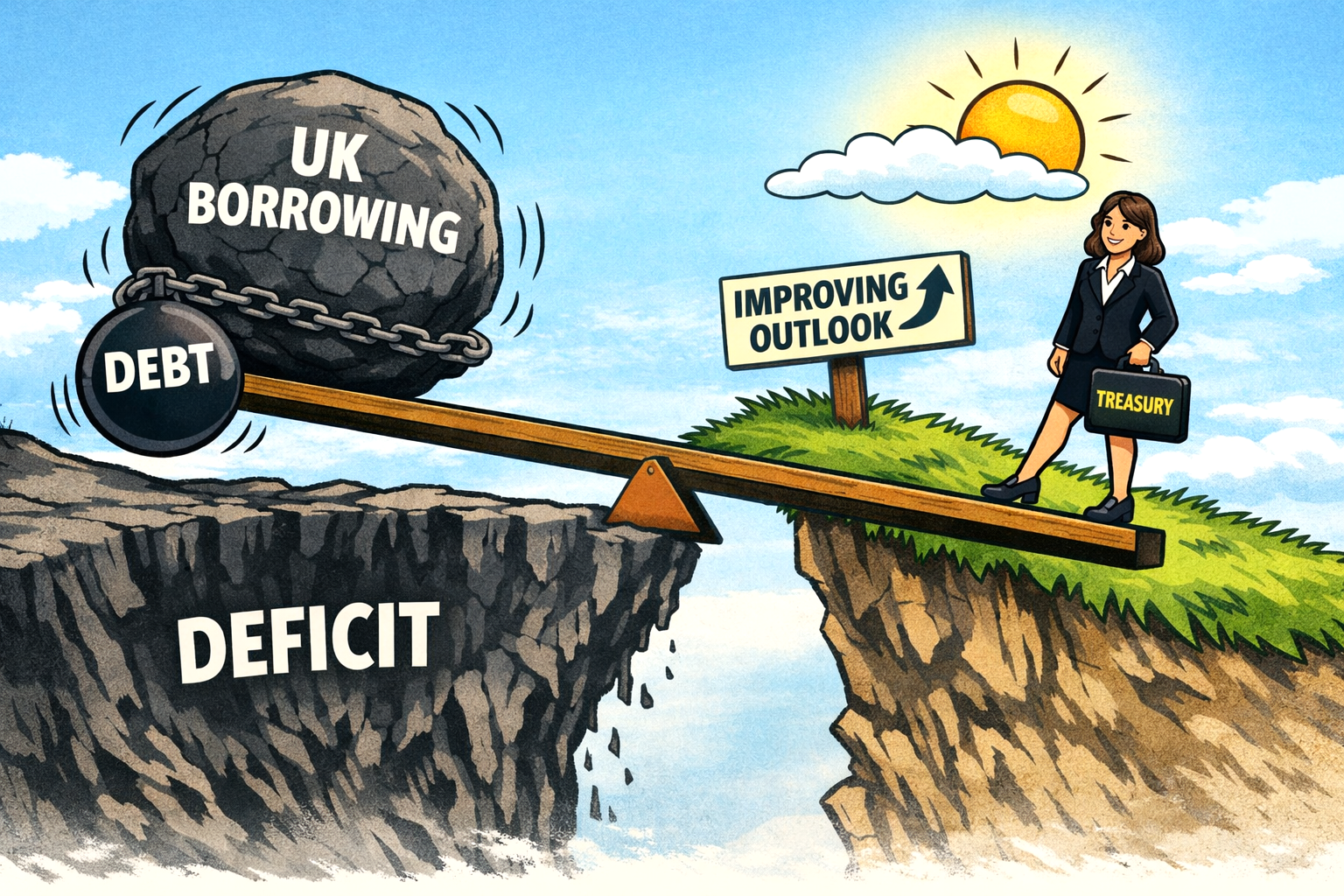
UK borrowing falls

The latest public finance figures show that government borrowing has dropped to a lower‑than‑forecast level, helped by stronger tax receipts and easing inflationary pressures.

While the precise numbers will be scrutinised in the coming days, the headline outcome marks a modest but meaningful improvement in the UK’s fiscal position.

Softer inflation and lower interest rates

Analysts note that softer inflation has reduced the government’s debt‑interest bill, particularly on index‑linked gilts, which had surged during the inflation spike of the past two years.

The fall in borrowing also reflects a stabilising labour market and firmer wage growth, which have supported income‑tax and National Insurance receipts.

At the same time, lower market interest rates — driven by expectations of further Bank of England cuts after recent reductions to 3.75% — have eased short‑term financing costs for the Treasury.

High debt level

However, economists caution that the improvement should not be overstated. UK debt remains historically high, and pressures on public services, welfare spending, and capital investment persist.

Moreover, with growth still subdued and geopolitical risks keeping energy markets volatile, the fiscal outlook remains vulnerable to external shocks.

Even so, today’s figures provide the Chancellor with a welcome narrative shift: after years of deteriorating public finances, the government can point to early signs of stabilisation — albeit from a challenging starting point.

What the real data shows (ONS, published 23rd April 2026)

The latest ONS release confirms that UK government borrowing has indeed come in lower than expected, and the scale of the improvement is now clear:

  • Annual borrowing: £132.0 billion in the year to March 2026 — £19.8 billion lower than the previous year — £0.7 billion below the OBR forecast — Lowest level since 2022–23
  • March borrowing: £12.6 billion — £1.4 billion lower than March 2025 — Lowest March figure since 2022
  • Borrowing as % of GDP: — 4.3%, the lowest since 2019–20

The U.S./ Iran / Israel conflict with undoubtably hold the economy back as the effect has yet to fully filter through.

Suspicious Market Timing Raises Fresh Questions Over Alleged Potential Insider Trading During the U.S.–Iran Crisis

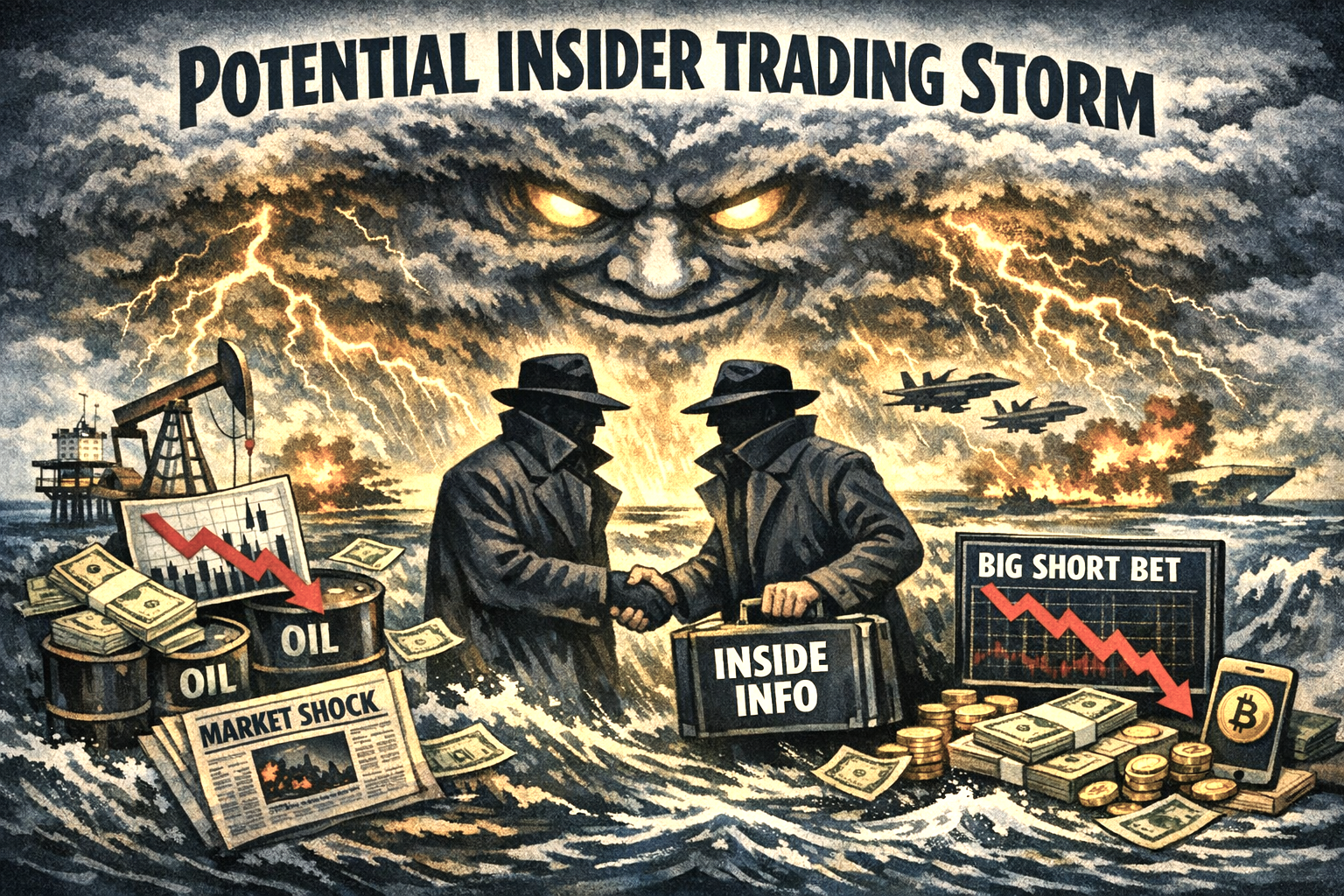
Alleged Potential Insider trading storm erupts

Allegations have been reported of suspiciously timed trades that appear to have intensified in recent weeks as analysts, journalists, and regulators examine a series of market moves that coincided—sometimes to the minute—with major announcements about the U.S.–Iran conflict.

While no wrongdoing has been proven, the pattern has become difficult for commentators to ignore and calls for formal investigation are growing louder. Can these trades and market movement be explained as coincidence?

Potential ‘speculative’ trading?

Many media outlets are also highlighting anomalies. For instance, it has been reported that Wealth manager Rachel Winter indicated traders appeared to take out contracts positioned to profit from falling oil prices just minutes before a presidential post claiming “productive” talks with Iran—timing she described as “speculation about insider trading” and worthy of investigation.

This episode was not isolated. Multiple outlets have documented at least two major bursts of unusually large oil futures trades placed shortly before conflict‑related announcements.

On 17th April 2026, it was reported that roughly $760 million in Brent crude short positions were executed around 20 minutes before Iran’s foreign minister declared the Strait of Hormuz “completely open” following a ceasefire—an announcement that sent oil prices sharply lower.

Analysts at the London Stock Exchange Group reportedly described the volume as “completely atypical,” nearly nine times normal levels.

Earlier in March 2026, it has been reported that traders placed around $500 million in positions shortly before the White House delayed planned strikes on Iran’s energy sector.

A similar pattern emerged on 7th April 2026, when roughly $950 million was positioned for falling oil prices hours before another ceasefire announcement.

These repeated bursts—each ahead of market‑moving news—have fuelled concerns that some traders ‘may’ have had access to information not yet public. Or was it a good guess – a coincidence even?

Reports of ‘unusual’ trading patterns

These reports align with broader commentary. The Independent reportedly noted that at least 6 million barrels’ worth of Brent and WTI contracts were suddenly sold in the two minutes before a presidential post about “productive” talks—again raising questions about advance knowledge.

Meanwhile, The London Economic reported that around $580 million in oil bets were placed 15 minutes before the same announcement, with market strategists calling the timing “really abnormal” for a day with no scheduled events.

Even outside traditional markets, anomalies have surfaced. Blockchain analysts identified six newly funded crypto wallets that made nearly £780,000 by betting—hours before explosions were reported—that the U.S. would strike Iran on 28th February 2026.

Across all these cases, commentators stop short of asserting intent. But the clustering of high‑stakes trades immediately before geopolitical announcements has created a clear narrative: the market signals are too sharp, too well‑timed, and too frequent to dismiss without scrutiny.

No intent is suggested – it could just be coincidence?

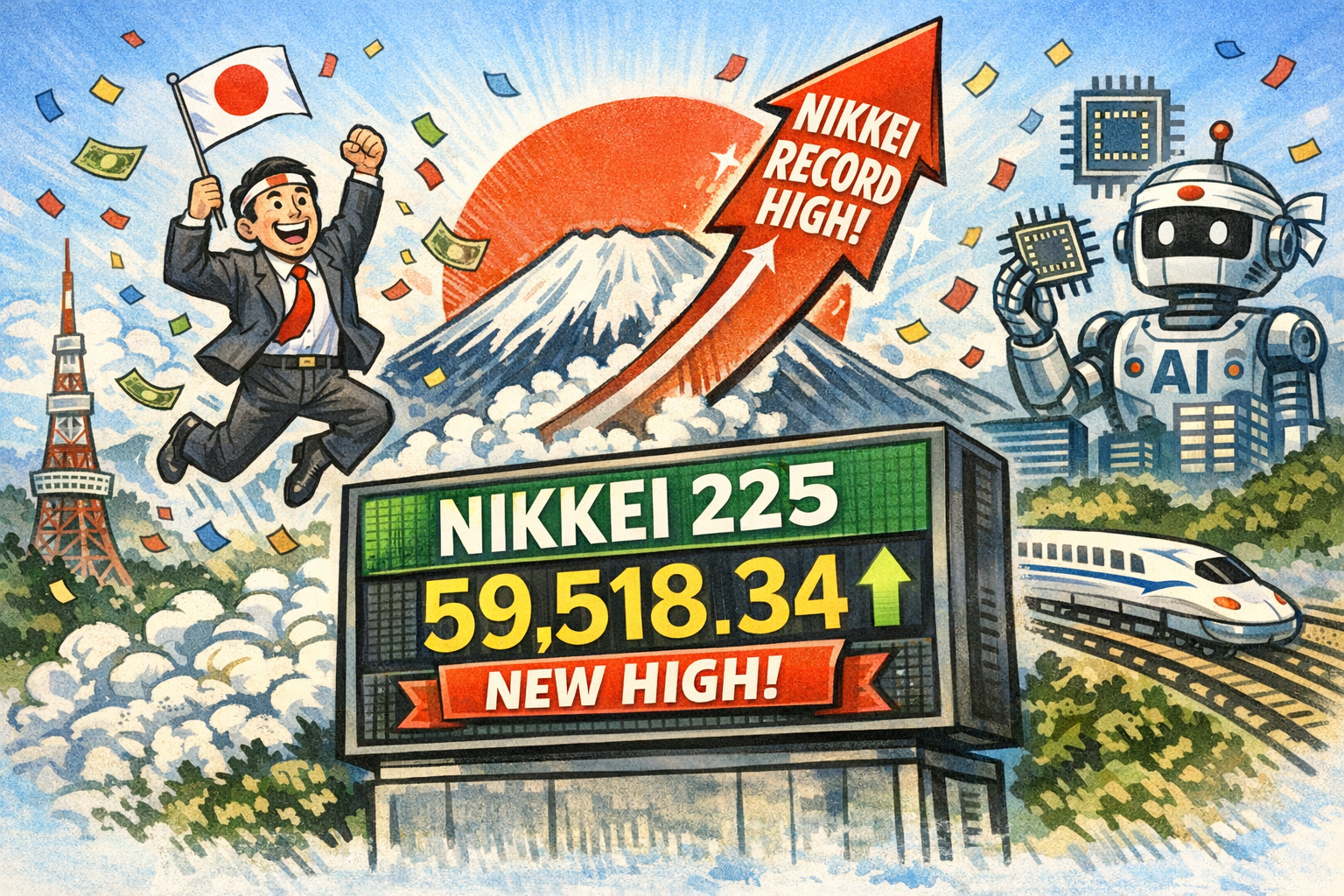
The Nikkei 225 has surged to a fresh all‑time high – closing at 59,518.34

Nikkei hits new record high!

The Nikkei 225 has surged to a fresh all‑time high, closing at 59,518.34, driven by a powerful combination of temporary easing of geopolitical tension, a booming technology sector, and renewed investor confidence.

Japan’s benchmark index pushed decisively beyond its previous record of 58,850.27, set in late February 2026, marking a symbolic milestone as it fully erased losses sustained during the early stages of the US–Iran conflict.

Rally

The rally was broad but powered most strongly by semiconductor and AI‑linked stocks, which have been the backbone of the Nikkei’s remarkable 12‑month performance.

Companies such as Lasertec, Advantest and SoftBank Group saw outsized gains as global enthusiasm for AI investment continued to spill over from Wall Street.

A key catalyst behind the breakout was growing optimism over a durable ceasefire between the United States and Iran, which helped unwind the “war‑risk premium” that had weighed on Japanese equities since late February 2026.

Diplomatic signals

As diplomatic signals seem to improve, investors rotated back into risk assets, lifting export‑heavy sectors and reinforcing Japan’s position as one of the strongest major markets globally this year.

The index’s climb also reflects Japan’s structural momentum: a weaker yen supporting exporters, resilient corporate earnings, and sustained foreign inflows.

With the Nikkei now trading in uncharted territory, market participants are watching closely to see whether this rally consolidates — or whether the next psychological test at 60,000 comes into view sooner than expected.

UK inflation rose to 3.3% in March 2026 as fuel prices spiked due to the ongoing U.S. Iran war

UK March inflation up to 3.3%

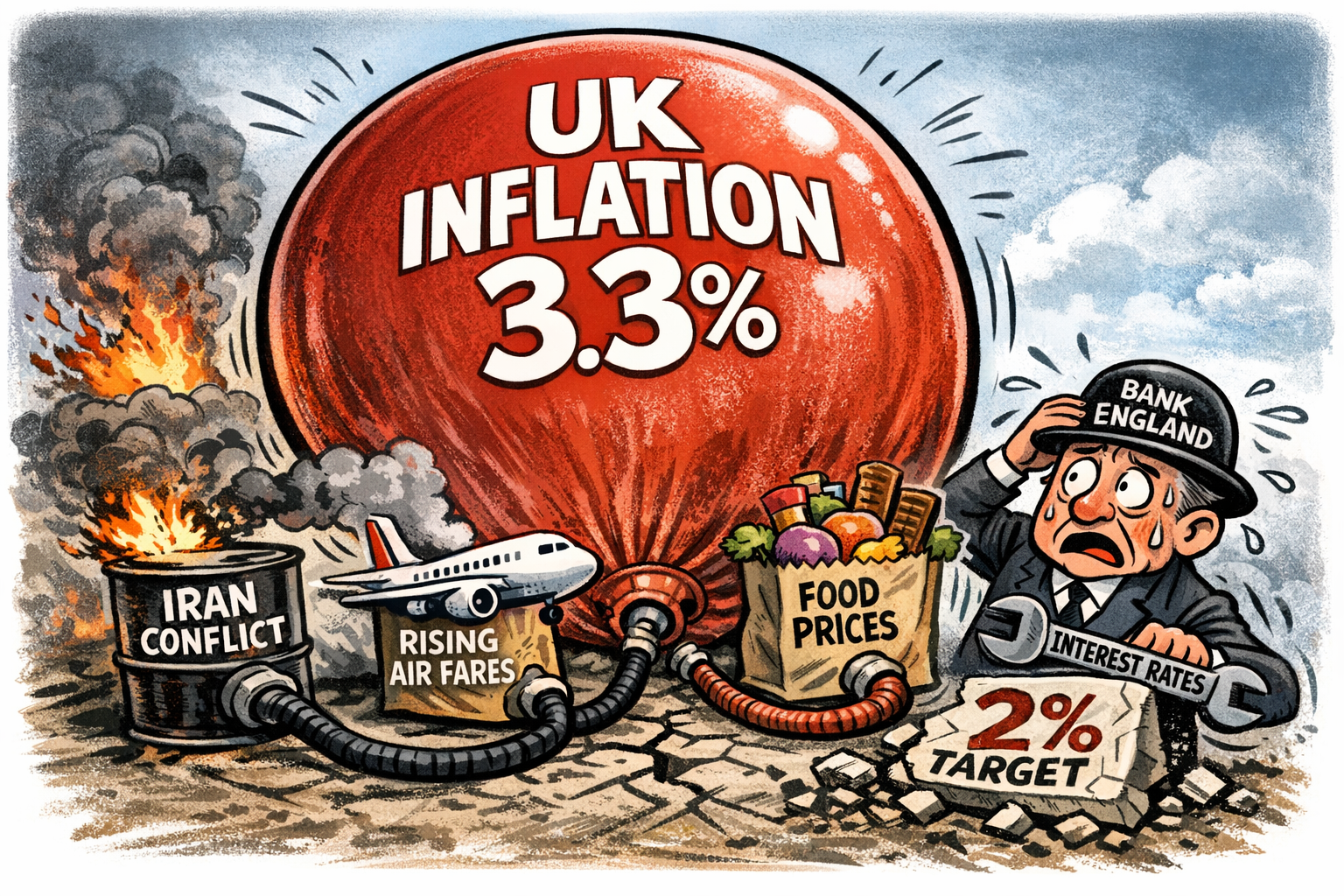
UK inflation jumped to 3.3% in March 2026, driven primarily by a sharp surge in fuel prices linked to the Iran conflict.

UK inflation accelerated to 3.3% in March 2026, up from 3% in February 2026, marking the first clear evidence of the Iran‑U.S. conflict feeding through to consumer prices.

Fuel costs

Official ONS data shows that motor fuel costs were the dominant driver, with petrol and diesel prices rising at their fastest pace in more than three years as global energy markets reacted to the disruption in the Strait of Hormuz.

Air fares

Air fares also rose sharply, partly due to the early Easter holidays, while food inflation picked up again, including notable increases in sweets and chocolate.

Clothing discounted

Clothing provided the only meaningful offset, with retailers discounting more heavily than last year.

The rise pushes inflation further from the Bank of England’s 2% target and complicates the policy outlook.

While economists expect UK inflation to ease slightly in April 2026, the broader risk is that sustained energy pressures could keep price growth elevated for longer.

Why Global Stocks Are Hitting Records Despite an Uncertain Middle East Backdrop

Global stock hit record highs!

Global equities have staged a striking recovery, erasing the losses triggered by the U.S.–Israel–Iran conflict and pushing into fresh record territory.

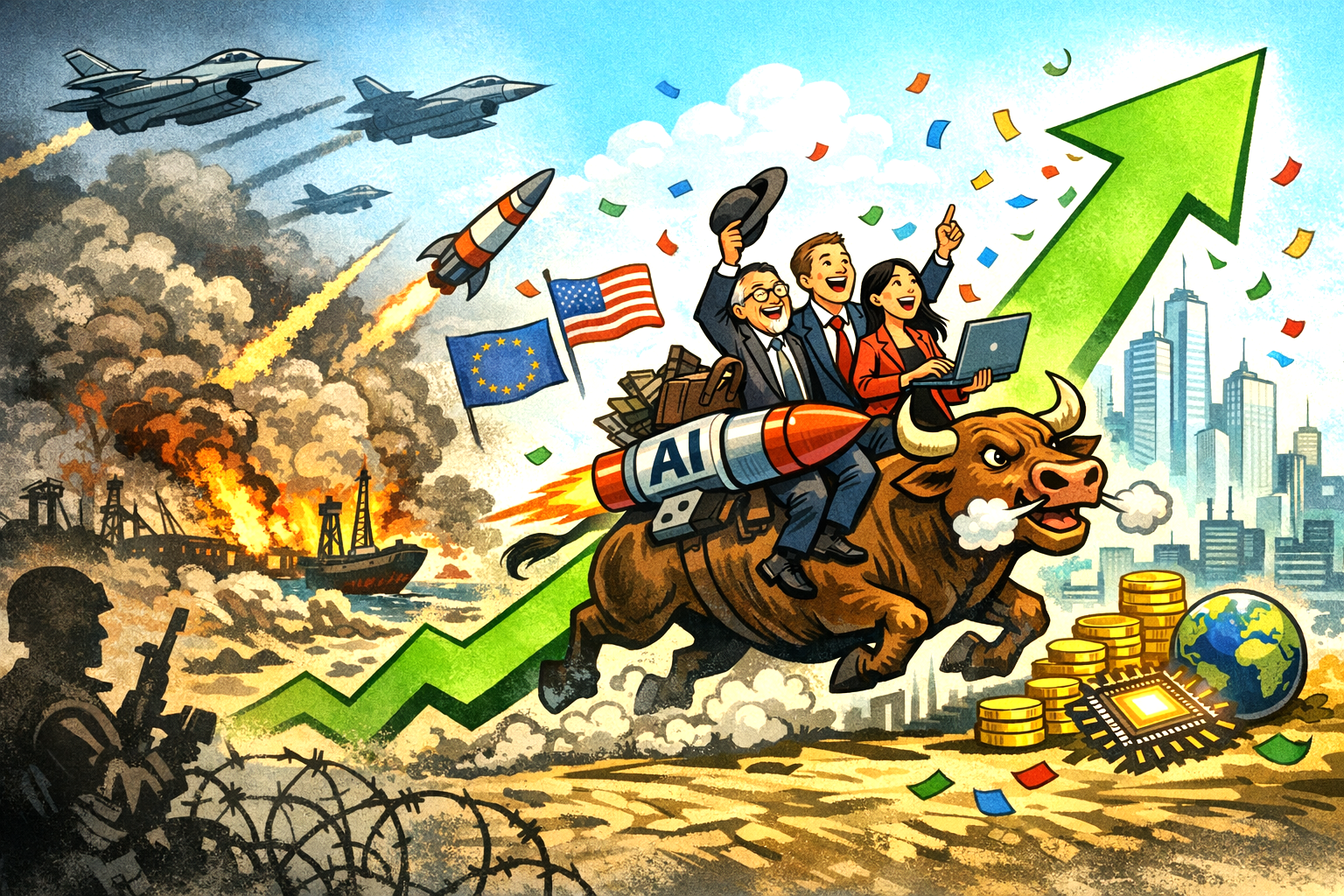
On the surface, this looks counter‑intuitive: the ceasefire remains fragile, diplomatic progress is uneven, and the threat of renewed escalation still hangs over the Strait of Hormuz. Yet markets have not only stabilised — they have surged.

It’s the AI boom stupid

The explanation lies less in geopolitics and more in positioning, psychology, and the gravitational pull of the AI boom.

The first phase of the conflict saw investors pile into defensive trades: higher oil, a stronger dollar, and a broad de‑risking across equities.

That created a sizeable war‑risk premium. Once even the possibility of a ceasefire emerged, that premium unwound at speed.

Analysts note that the rebound has been driven primarily by the rapid reversal of hedges rather than any fundamental improvement in the geopolitical outlook.

In other words, markets had priced in a worst‑case scenario — and when that scenario didn’t immediately materialise, the snap‑back was violent.

Short covering

This shift in sentiment was amplified by short‑covering, particularly among hedge funds that had positioned for prolonged disruption to energy flows.

As soon as investors judged the conflict likely to remain contained, the earlier sell‑off looked excessive. That alone was enough to propel global indices back above pre‑war levels. But it wasn’t the only force at work.

The macro backdrop has also proved more resilient than feared. U.S. labour market data has held up, and expectations for Federal Reserve rate cuts later in the year remain intact.

AI investment

Crucially, the AI‑driven investment cycle continues to dominate equity performance. Surging demand for compute, improving funding conditions, and strong earnings momentum in technology have provided a powerful counterweight to geopolitical anxiety.

For many investors, the structural growth story in AI simply outweighs the cyclical risks emanating from the Middle East.

Some caution

Still, the rally is not unqualified. Bond markets remain more cautious, with real yields and inflation expectations signalling that the risk of an energy‑driven slowdown has not disappeared.

And as peace talks wobble, equities have already begun to give back some gains — a reminder that this is a conditional rally, not a complacent one.

Markets may be hitting records, but they are doing so with one eye firmly on the horizon. The shadow of the conflict hasn’t lifted; investors have simply decided, for now, that it is not the dominant story.