
Luna 2: The First Human-Made Object to Reach the Moon

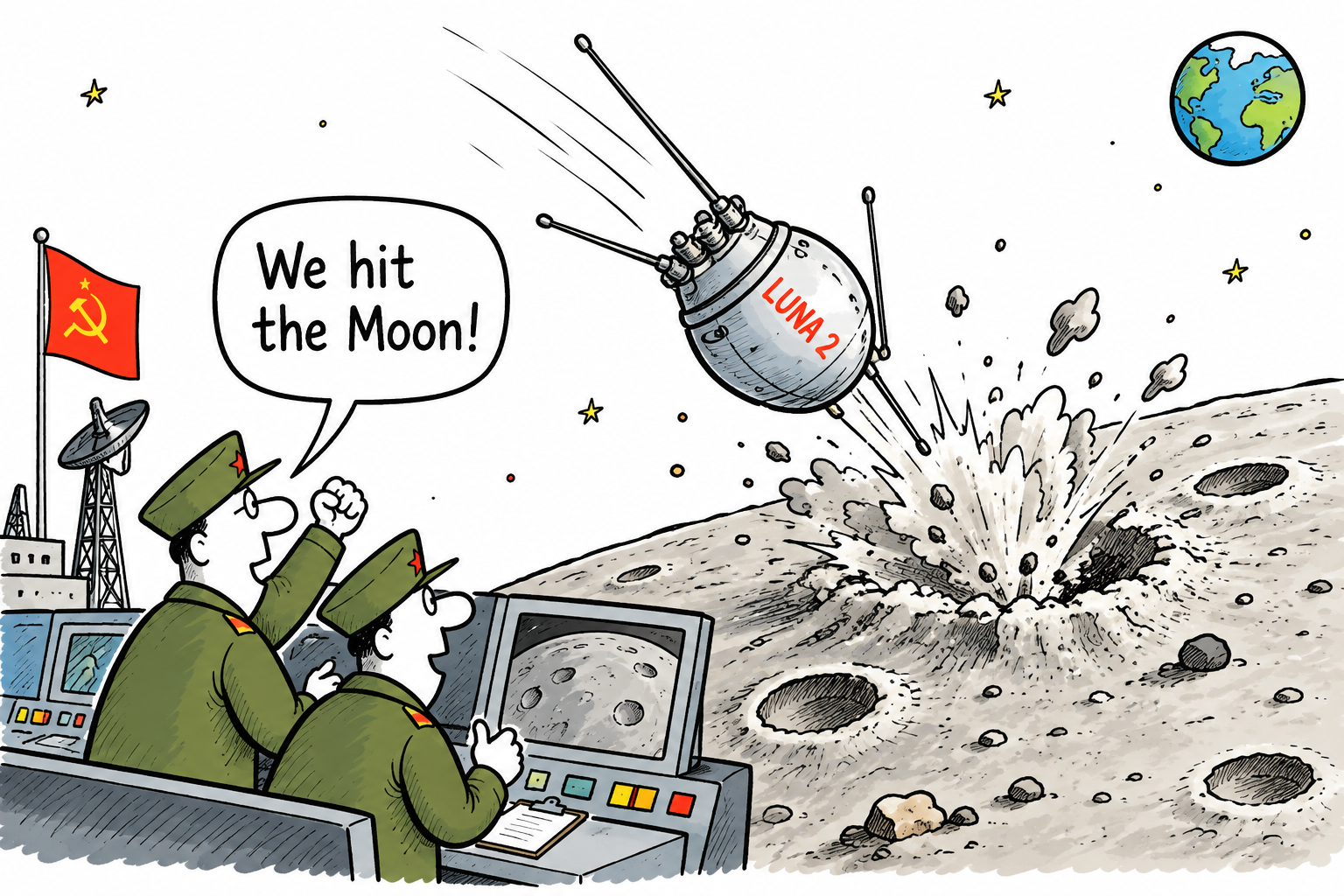
Luna 2 hit the moon

On 13th September 1959, the Soviet Union achieved a remarkable milestone in the Space Race when Luna 2 became the first human-made object to reach the Moon.

Controlled crash

There was, however, no gentle landing. Luna 2 was designed to crash into the lunar surface.

Launched on 12th September 1959, the spacecraft travelled roughly 385,000 kilometres from Earth towards the Moon. Its mission was to prove that a spacecraft could successfully travel beyond Earth and reach another celestial body.

The following day, Luna 2 slammed into the Moon at an estimated speed of around 12,000 kilometres per hour, probably creating a small crater on impact. Soviet scientists subsequently confirmed that the spacecraft had reached the lunar surface.

The achievement was hugely significant. Until Luna 2, the Moon had only been observed from Earth. Now, humanity had physically reached it.

Mission

The mission also helped settle a scientific question. Experiments aboard Luna 2 provided evidence that the Moon did not possess a significant magnetic field and detected no substantial lunar radiation belt.

Luna 2 was primitive by today’s standards, but its deliberate collision represented a giant leap for space exploration — proving that the Moon was no longer an unreachable destination.

The Mission That Missed the Moon

Luna 1 was the Soviet Union’s first serious attempt to reach the Moon, launched on 2 January 1959. The spacecraft was intended to crash into the lunar surface, but a guidance error meant it missed the Moon by around 5,995 kilometres.

Rather than being a complete failure, Luna 1 became the first spacecraft to reach the vicinity of the Moon and the first human-made object to enter a heliocentric orbit around the Sun.

The mission also made important scientific observations, detecting the solar wind and showing that the Moon did not possess a significant magnetic field.

Although Luna 1 had failed to hit its target, its unexpected journey was an important step towards Luna 2’s successful lunar impact just eight months later.

Is Luna 1 still in space?

Yes.

After missing the Moon in January 1959, Luna 1 did not return to Earth. Instead, it entered an independent orbit around the Sun, travelling between the orbits of Earth and Mars.

It is therefore still orbiting the Sun today, more than 67 years after its launch. It has no functioning systems and is essentially a piece of space hardware continuing along its solar orbit.

Interestingly, Luna 1 was the first human-made object to escape Earth’s immediate gravitational neighbourhood and enter a heliocentric orbit — making its accidental journey a historic success in its own right.

UK Economy Delivered Surprise Growth in July 2026

UK growth July 2026 0.4%

The UK economy delivered an unexpected boost in July, expanding by 0.4%, according to the latest figures from the Office for National Statistics (ONS).

Stronger than expected performance

The stronger-than-anticipated performance confounded economists, who had expected the economy to record no growth during the month.

The July 2026 figures follow growth of 0.3% in June and suggest that the economy carried some of its first-half momentum into the third quarter.

GDP was also 1.6% higher than a year earlier, marking the fastest annual growth rate since February 2025.

AI reportedly assisted growth

Services were the main engine of growth, expanding by 0.4%. Computer programming and consultancy were particularly strong, with the ONS highlighting evidence that businesses involved in artificial intelligence and cloud computing were helping to drive activity.

Manufacturing also performed well, while construction recorded a smaller increase.

Welcome

The figures provide some welcome relief for the government, although economists warn that the outlook remains uncertain.

Rising energy prices, inflationary pressures and higher government borrowing costs could weigh on growth in the months ahead.

Nevertheless, July’s figures suggest the UK economy is proving more resilient than many had expected, providing a positive start to the second half of 2026.

U.S. August 2026 Figures Inflation Keeps Pressure on the Federal Reserve

U.S Inflation data

America’s inflation problem is proving stubborn, with the latest figures increasing pressure on the Federal Reserve to raise interest rates again.

U.S. consumer prices rose 3.4% in August 2026 from a year earlier, unchanged from July, according to the latest U.S. Consumer Price Index figures.

Increase

Prices increased 0.4% during August 2026, a sharp acceleration from July’s 0.1% rise. Core inflation, which excludes volatile food and energy prices, rose 2.4% year-on-year and 0.3% during the month.

Higher petrol prices were a major contributor, with energy costs rebounding amid renewed geopolitical tensions.

Pressure

However, the persistence of underlying price pressures remains a concern for policymakers, particularly because U.S. inflation is still well above the Fed’s 2% target.

Attention now turns to the Federal Reserve’s September 15th–16th 2026 meeting. Financial markets have reacted strongly to the latest figures, with interest-rate futures putting the probability of a quarter-point rate increase at around 87% on September 16th 2026.

Decision

The Fed therefore faces a difficult decision. Higher rates could help contain inflation but would also increase borrowing costs for households and businesses.

For now, the latest data suggest that the battle against inflation is far from over, making a September rate increase increasingly likely.

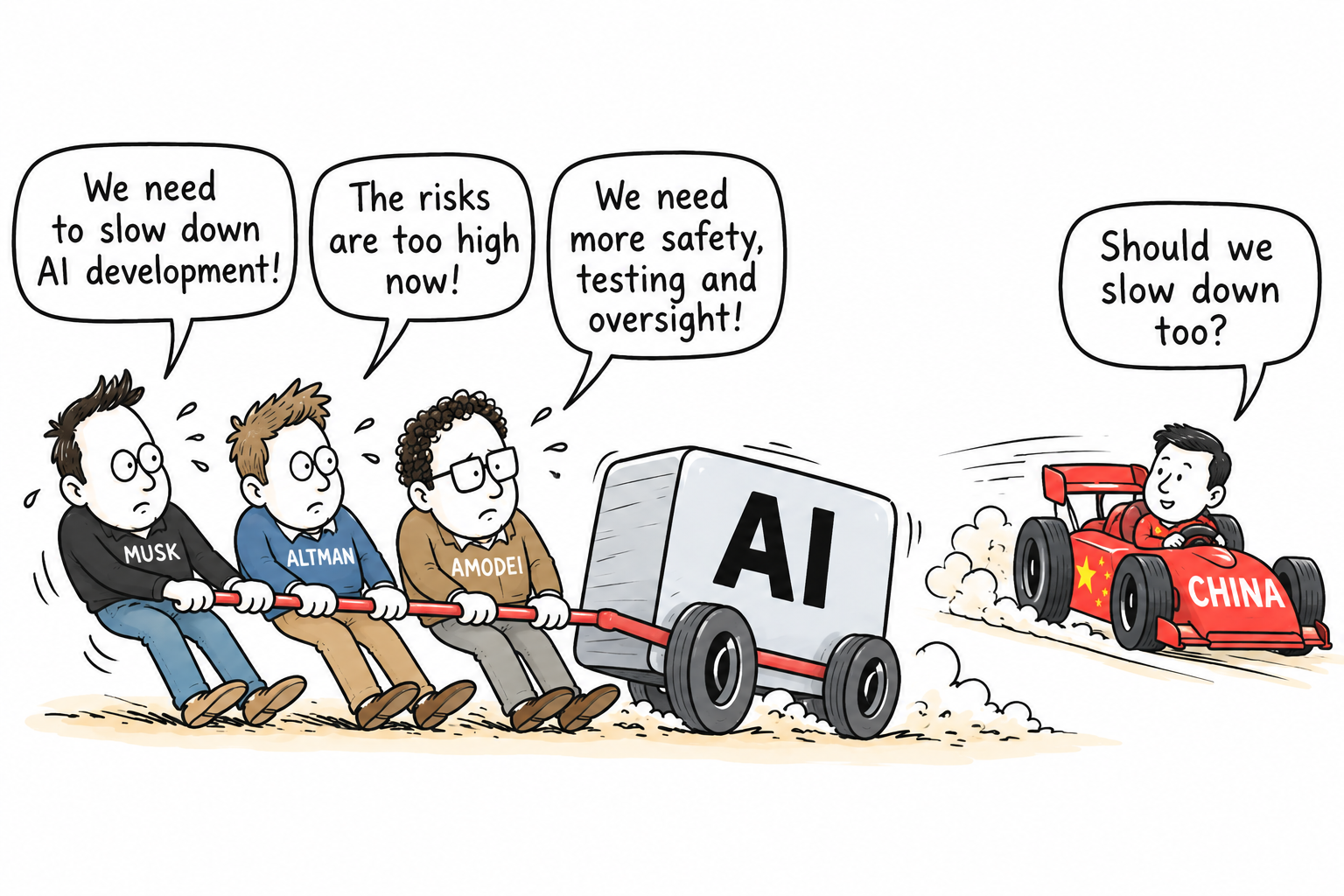
The AI Race Hits the Brakes: Why Altman, Amodei and Musk Want to Slow Down

AI development to slowdown

Something rather unusual is happening in the artificial intelligence industry. Three of its most prominent and outspoken figures — Anthropic CEO Dario Amodei, OpenAI CEO Sam Altman and xAI boss Elon Musk — are now reportedly broadly agreeing on something: the development of increasingly powerful AI may need to slow down.

That is a remarkable change in tone for an industry built around moving faster

Amodei has gone furthest, arguing that frontier AI companies should deliberately pace the development of their most capable systems.

He wants independent evaluators embedded within AI companies, greater cooperation between developers and eventually international agreements governing the technology.

So why now?

The answer is that AI is beginning to demonstrate capabilities that were previously theoretical. Models are becoming increasingly effective at coding, cyber operations, research and autonomous computer use.

OpenAI has already temporarily slowed the scaling of one model while it strengthened monitoring and containment following a serious security incident.

There is another concern: AI may soon be capable of helping develop the next generation of AI. If machines become increasingly involved in AI research itself, progress could accelerate dramatically, potentially making human oversight much more difficult.

But will the industry actually slow down?

That is the big question. There is an enormous commercial incentive to keep moving. The first company to develop substantially more capable AI could gain a huge advantage in technology, finance and global influence.

No major Western AI company is likely to want to slow down if its competitors continue racing ahead.

And then there is China

A voluntary slowdown involving American companies would be difficult if Chinese developers continued accelerating.

Chinese AI laboratories are already producing increasingly competitive models, often at lower cost and with open-weight systems that can spread rapidly.

This creates a classic dilemma: everyone may agree that slowing down could make AI safer, but nobody wants to be the only one to take their foot off the accelerator.

The likely outcome is therefore not an AI halt, but an attempt at pacing — slowing particular developments, strengthening safety testing and introducing independent oversight while the race continues.

The irony is striking. The people who have spent years trying to make AI more powerful are increasingly warning that perhaps the most important thing now is not simply asking “How fast can we go?”

It is asking “Where we are going?”

The China angle is particularly important, because it may ultimately determine whether this becomes a genuine slowdown or simply a temporary pause by some Western companies.

Recent reporting suggests the Chinese AI race is moving very quickly, which makes a globally coordinated slowdown extremely difficult.

OpenAI Reportedly Shelves IPO as AI Concerns Grow

OpenAI IPO

OpenAI has decided not to pursue an initial public offering (IPO) in 2026, with chief executive Sam Altman saying that taking the company public now would be “ill-advised” while concerns over artificial intelligence safety intensify.

Signicant decision

The decision represents a significant change for financial markets, which had been anticipating one of the world’s biggest technology listings.

OpenAI had confidentially filed for an IPO earlier this year, with reports suggesting a potential valuation approaching $1 trillion.

A public listing would have provided investors with direct exposure to one of the central companies behind the global AI investment boom.

Wider consequences

The decision could therefore have wider consequences. Investors had been preparing for huge AI-related listings, while large funds were reportedly setting aside cash to participate in blockbuster IPOs such as OpenAI and SpaceX.

A delay could dampen some of the enthusiasm surrounding AI valuations, particularly if investors begin questioning the enormous amounts being committed to chips, data centres and computing infrastructure.

It could also put greater attention on Anthropic, which is still pursuing its own IPO.

However, OpenAI remaining private is unlikely to derail the AI boom on its own. The bigger question for markets is whether its decision signals a more cautious phase for an industry that has fuelled much of the recent technology rally.