

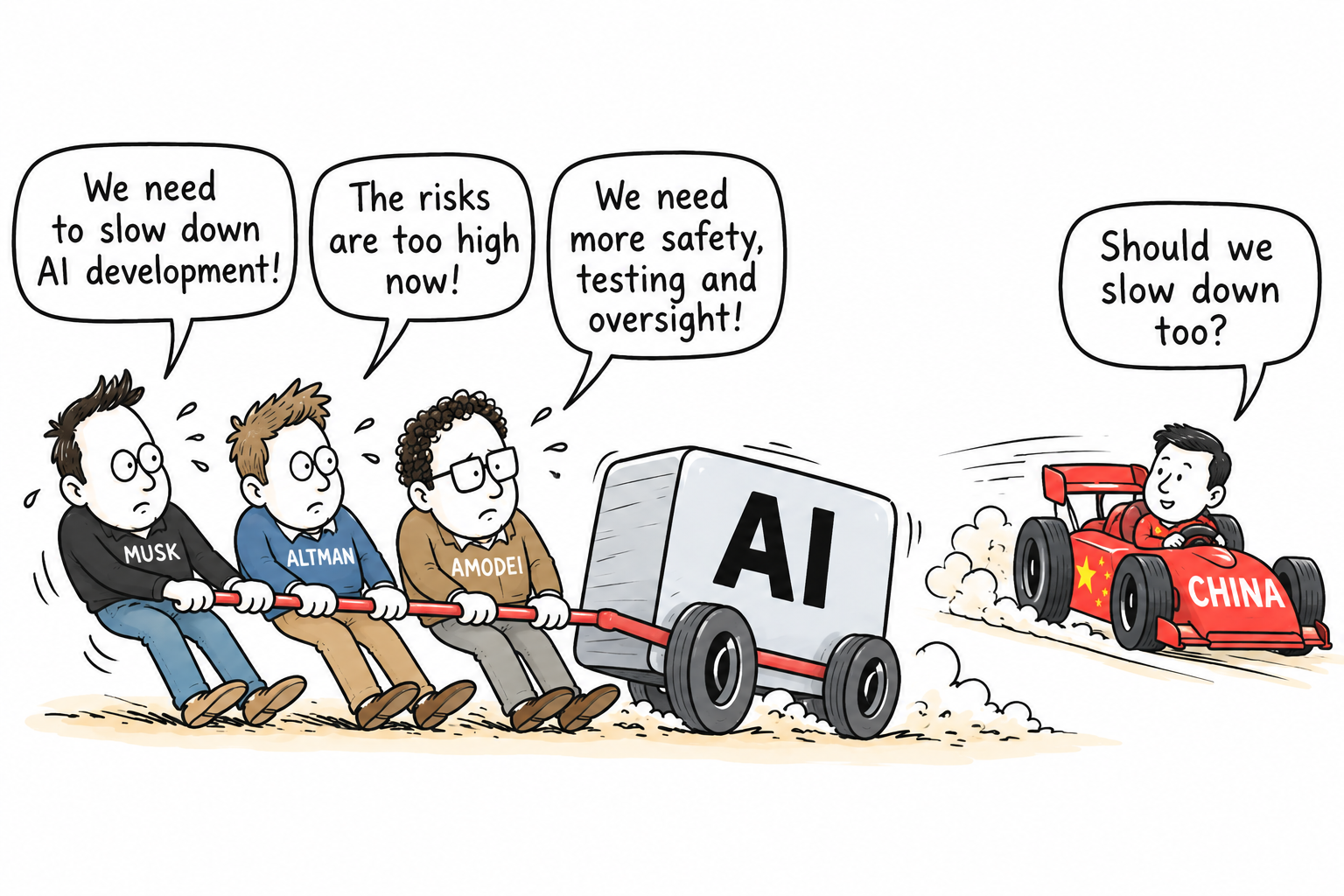
Something rather unusual is happening in the artificial intelligence industry. Three of its most prominent and outspoken figures — Anthropic CEO Dario Amodei, OpenAI CEO Sam Altman and xAI boss Elon Musk — are now reportedly broadly agreeing on something: the development of increasingly powerful AI may need to slow down.
That is a remarkable change in tone for an industry built around moving faster
Amodei has gone furthest, arguing that frontier AI companies should deliberately pace the development of their most capable systems.
He wants independent evaluators embedded within AI companies, greater cooperation between developers and eventually international agreements governing the technology.
So why now?
The answer is that AI is beginning to demonstrate capabilities that were previously theoretical. Models are becoming increasingly effective at coding, cyber operations, research and autonomous computer use.
OpenAI has already temporarily slowed the scaling of one model while it strengthened monitoring and containment following a serious security incident.
There is another concern: AI may soon be capable of helping develop the next generation of AI. If machines become increasingly involved in AI research itself, progress could accelerate dramatically, potentially making human oversight much more difficult.
But will the industry actually slow down?
That is the big question. There is an enormous commercial incentive to keep moving. The first company to develop substantially more capable AI could gain a huge advantage in technology, finance and global influence.
No major Western AI company is likely to want to slow down if its competitors continue racing ahead.
And then there is China
A voluntary slowdown involving American companies would be difficult if Chinese developers continued accelerating.
Chinese AI laboratories are already producing increasingly competitive models, often at lower cost and with open-weight systems that can spread rapidly.
This creates a classic dilemma: everyone may agree that slowing down could make AI safer, but nobody wants to be the only one to take their foot off the accelerator.
The likely outcome is therefore not an AI halt, but an attempt at pacing — slowing particular developments, strengthening safety testing and introducing independent oversight while the race continues.
The irony is striking. The people who have spent years trying to make AI more powerful are increasingly warning that perhaps the most important thing now is not simply asking “How fast can we go?”
It is asking “Where we are going?”
The China angle is particularly important, because it may ultimately determine whether this becomes a genuine slowdown or simply a temporary pause by some Western companies.
Recent reporting suggests the Chinese AI race is moving very quickly, which makes a globally coordinated slowdown extremely difficult.