The artificial intelligence revolution continues to dominate financial markets, attracting extraordinary investment from some of the world’s largest technology companies.
Yet beneath the enthusiasm, a growing number of economic, financial and political concerns are emerging. While technology shares have recently staged a recovery, the fundamental questions surrounding the sustainability of the AI investment boom remain unanswered.
The central issue is becoming increasingly difficult to ignore: can the commercial returns from artificial intelligence justify the enormous cost of building the infrastructure required to support it?
An unprecedented investment programme
Microsoft, Amazon, Alphabet, Meta, Oracle and many others are committing hundreds of billions of dollars to data centres, specialist processors and supporting infrastructure. Their ambitions are substantial, with AI expected to transform productivity, business operations, healthcare, manufacturing and countless other industries.
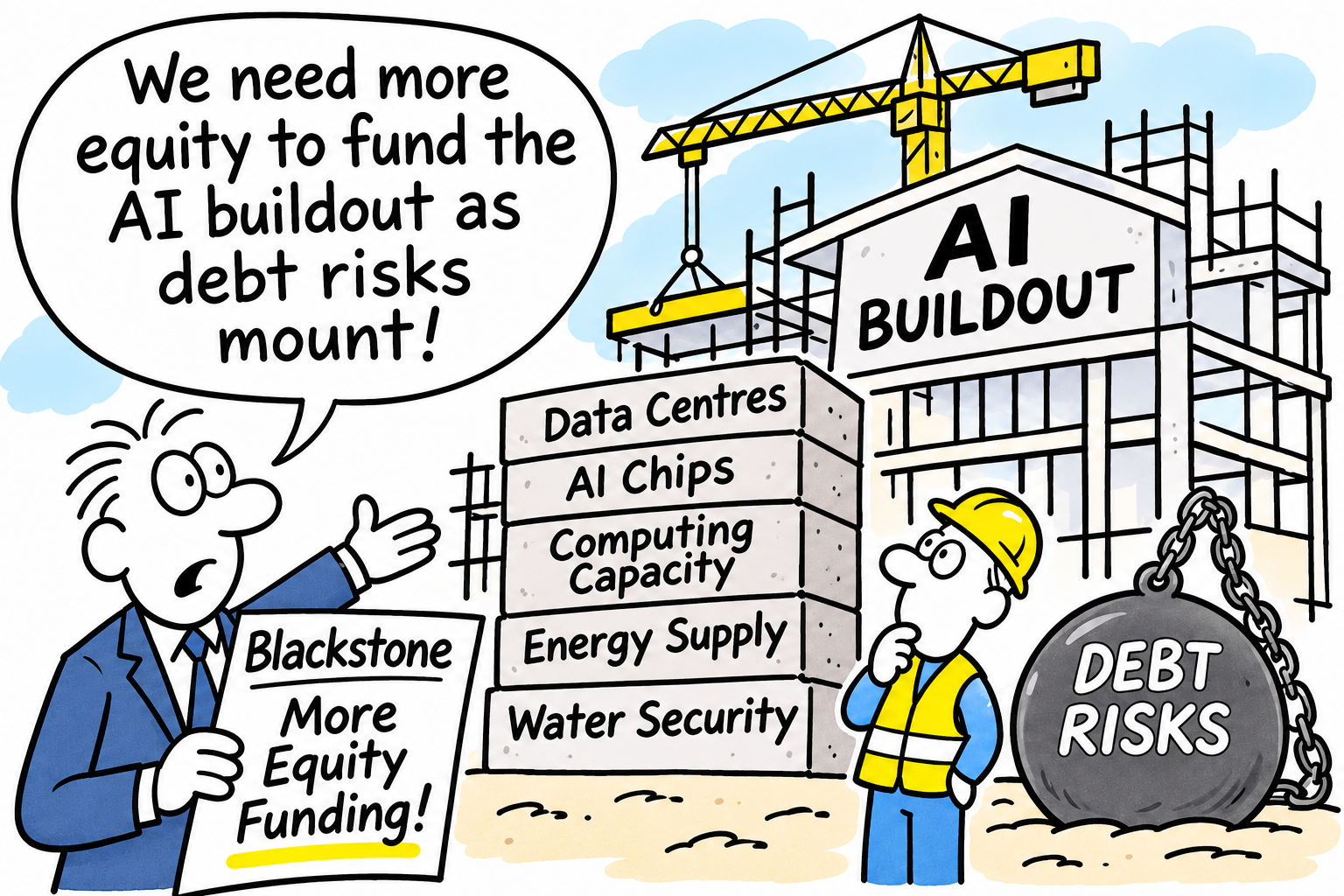
However, the scale of expenditure is creating growing financial pressures. The Bank of England has highlighted the increasing reliance on borrowing to finance AI infrastructure. Morgan Stanley reportedly estimated that global AI-related debt issuance had reached approximately $450 billion by early September 2026, more than double the total for the whole of 2025.
The Bank has also highlighted the growing involvement of private credit and more complicated financing arrangements. These developments raise questions about where the financial risks ultimately sit, particularly if expected commercial returns fail to materialise.
Debt itself is not necessarily a problem. Large companies routinely borrow to finance expansion. The concern is whether the investment will generate sufficient cash flow to service that borrowing while continuing to fund further development.
The returns question
Technology companies are investing on the assumption that AI adoption will eventually produce enormous commercial opportunities. However, the gap between infrastructure expenditure and demonstrable financial returns remains an important consideration.
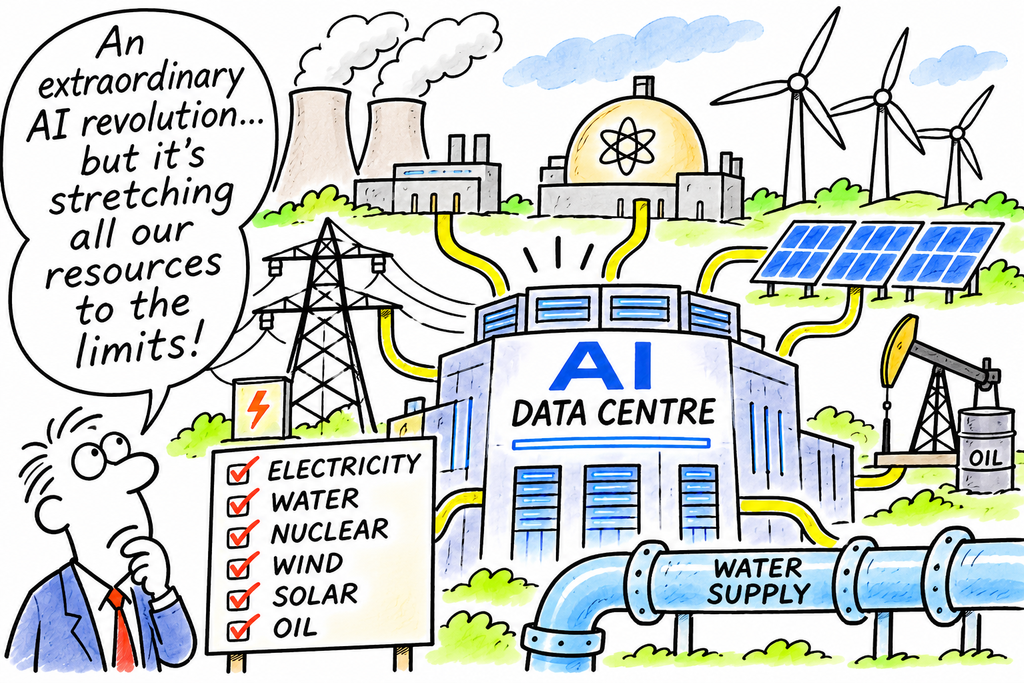
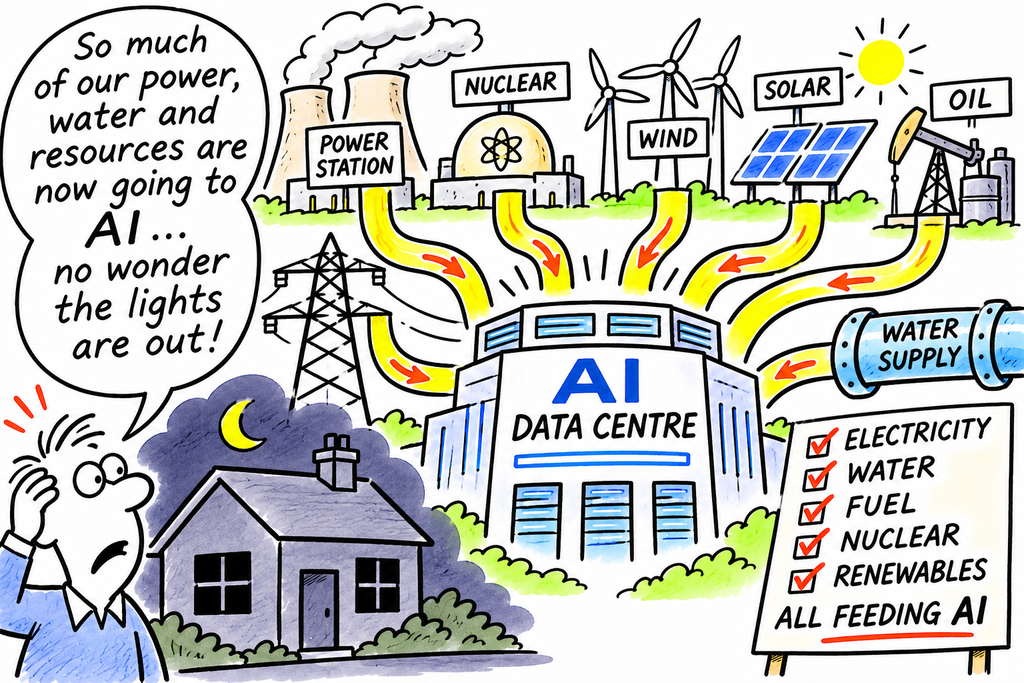
Data centres are expensive to construct and operate. Specialist chips require continual investment, while electricity, cooling, water and network infrastructure add further costs.
The industry must also contend with rapidly changing technology. Today’s expensive processors and facilities could become less competitive as more efficient systems emerge.
There is also the possibility that investment is running ahead of commercial demand. Businesses are experimenting with AI, but widespread adoption does not automatically translate into sufficient revenue to justify the enormous infrastructure costs.
Investors will increasingly want evidence that AI-related revenues and productivity improvements are keeping pace with capital expenditure.
Chinese competition adds another complication
Competition from China represents another potential challenge.
Chinese developers have demonstrated that increasingly capable AI models can be produced using more cost-efficient approaches. This could put pressure on the pricing structures of American technology companies.
If businesses can access capable AI systems at considerably lower prices, the commercial returns expected by companies investing heavily in infrastructure could be affected.
The AI industry may ultimately become much larger, but that does not guarantee that every company currently investing in it will generate attractive returns.
The political landscape changes
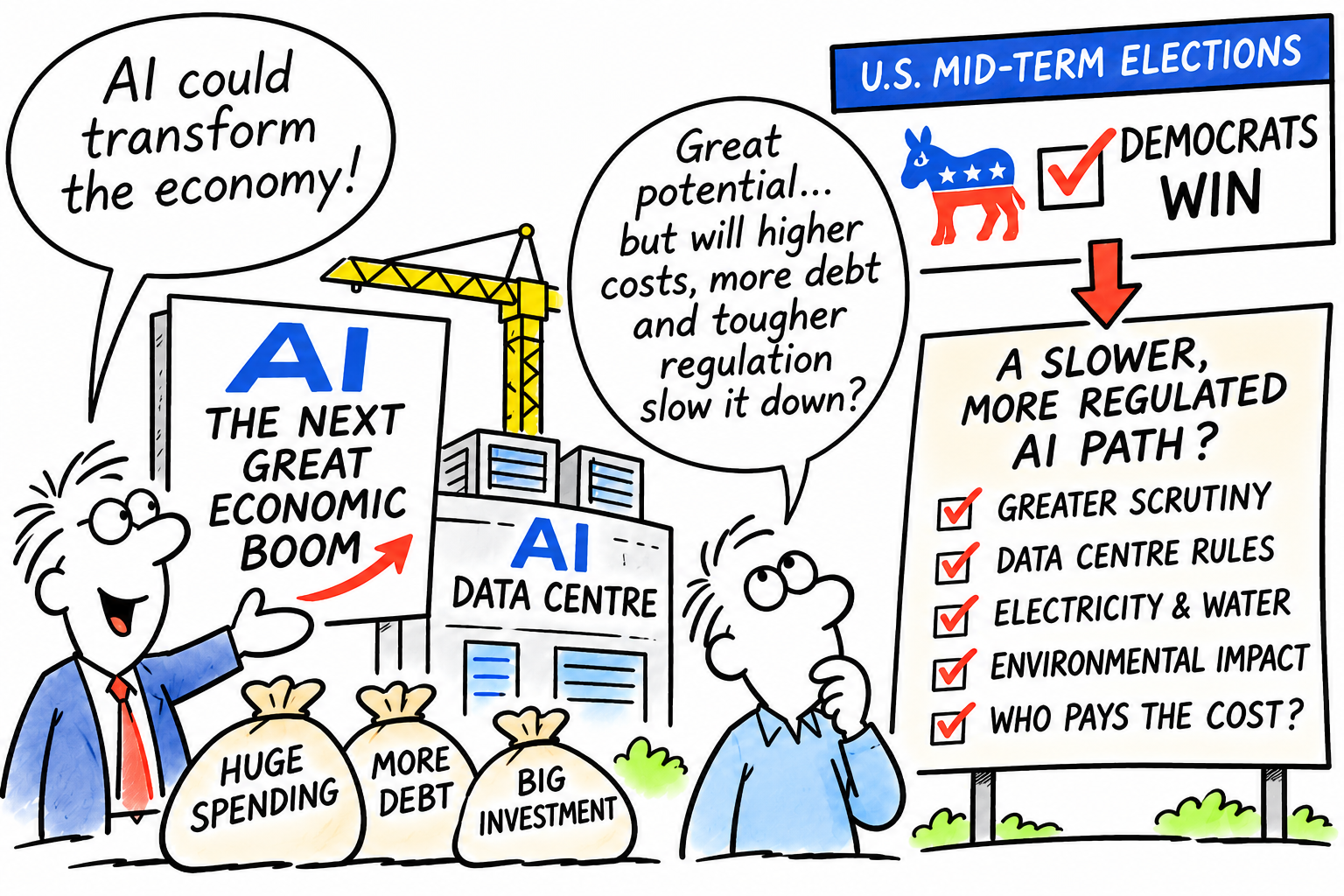
The U.S. midterm elections have introduced another dimension.
Democrats have secured control of both the House of Representatives and the Senate, creating a more challenging political environment for President Trump during the remainder of his term.
Technology companies could face increased scrutiny over data-centre construction, electricity consumption, environmental considerations, water supplies and AI regulation.
There are already disagreements in Washington over who should pay for the additional electricity infrastructure required by data centres. Some lawmakers want technology companies to shoulder more of the cost rather than passing it on to ordinary electricity consumers.
These concerns are particularly relevant in states such as Texas, where substantial AI infrastructure investment is planned.
Greater political scrutiny does not necessarily mean that AI development will stop. However, additional regulation, planning restrictions and infrastructure costs could slow the expansion or reduce the profitability of some projects.
Why is the Nasdaq recovering?
Despite these concerns, technology shares have recently demonstrated considerable resilience.
On 3rd November 2026, the Nasdaq gained approximately 0.83%, supported by a recovery in major AI and semiconductor shares. Nvidia, Broadcom and Micron were among the beneficiaries.
However, this recovery seemed to start ahead of the full midterm election results. Following the Democratic victories, global markets initially reacted negatively, reflecting concerns about potential regulatory changes and the future pace of AI infrastructure investment.
The recovery in technology shares should therefore not be interpreted as evidence that the underlying problems have disappeared.
Investors may be buying following recent declines, taking advantage of lower valuations or closing short positions. Such activity can produce substantial market recoveries without any corresponding improvement in the industry’s financial fundamentals.
A defining moment for investors
The AI revolution could ultimately prove to be one of the most important technological developments in modern economic history. Its potential should not be underestimated.
However, technological success and investment success are not necessarily the same thing.
The companies building the infrastructure must demonstrate that their investments can generate sustainable revenues, adequate cash flow and acceptable returns. Meanwhile, increasing borrowing, competition, resource constraints and political intervention could complicate that process.
For investors, the next stage of the AI story may be less about excitement surrounding technological possibilities and more about financial discipline.
Capital expenditure, debt issuance, free cash flow, AI-related revenues and institutional investment decisions deserve particularly close attention.
The wider economic consequences also matter. If AI delivers the productivity improvements its supporters anticipate, the benefits could extend well beyond the technology sector.
Conversely, if investment expectations become disconnected from commercial reality, the financial consequences could reach credit markets and the wider economy.
The AI revolution may be gathering momentum, but the investment boom financing it is approaching an important test.
The question is no longer simply how transformative AI might become. It is whether the extraordinary sums being committed today can generate sufficient economic value tomorrow.
For investors, that distinction could become increasingly important.