
How Wall Street Turned Trump’s Geopolitical Brinkmanship into the ‘TACO’ Trade

TACO Trade

For seasoned traders, geopolitical brinkmanship rarely arrives as a surprise. Over the past decade, markets have developed a reflexive understanding of how political theatre interacts with asset prices.

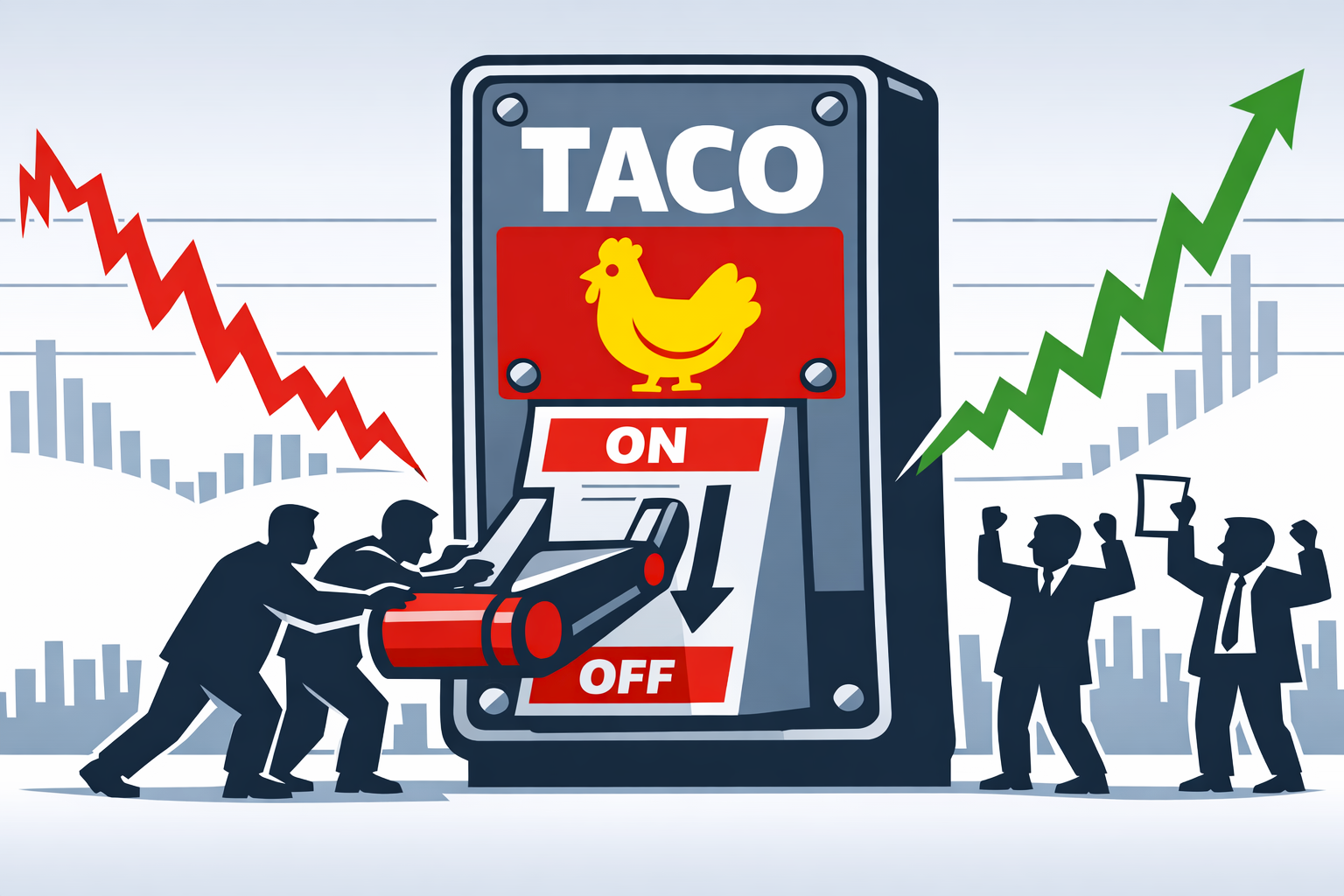
Nowhere is this more evident than in the so‑called TACO trade — shorthand on Wall Street for “Trump Always Chickens Out.”

Pattern

It is not a political judgement, but a market pattern: a repeated cycle in which aggressive rhetoric triggers short‑term volatility before ultimately giving way to de‑escalation.

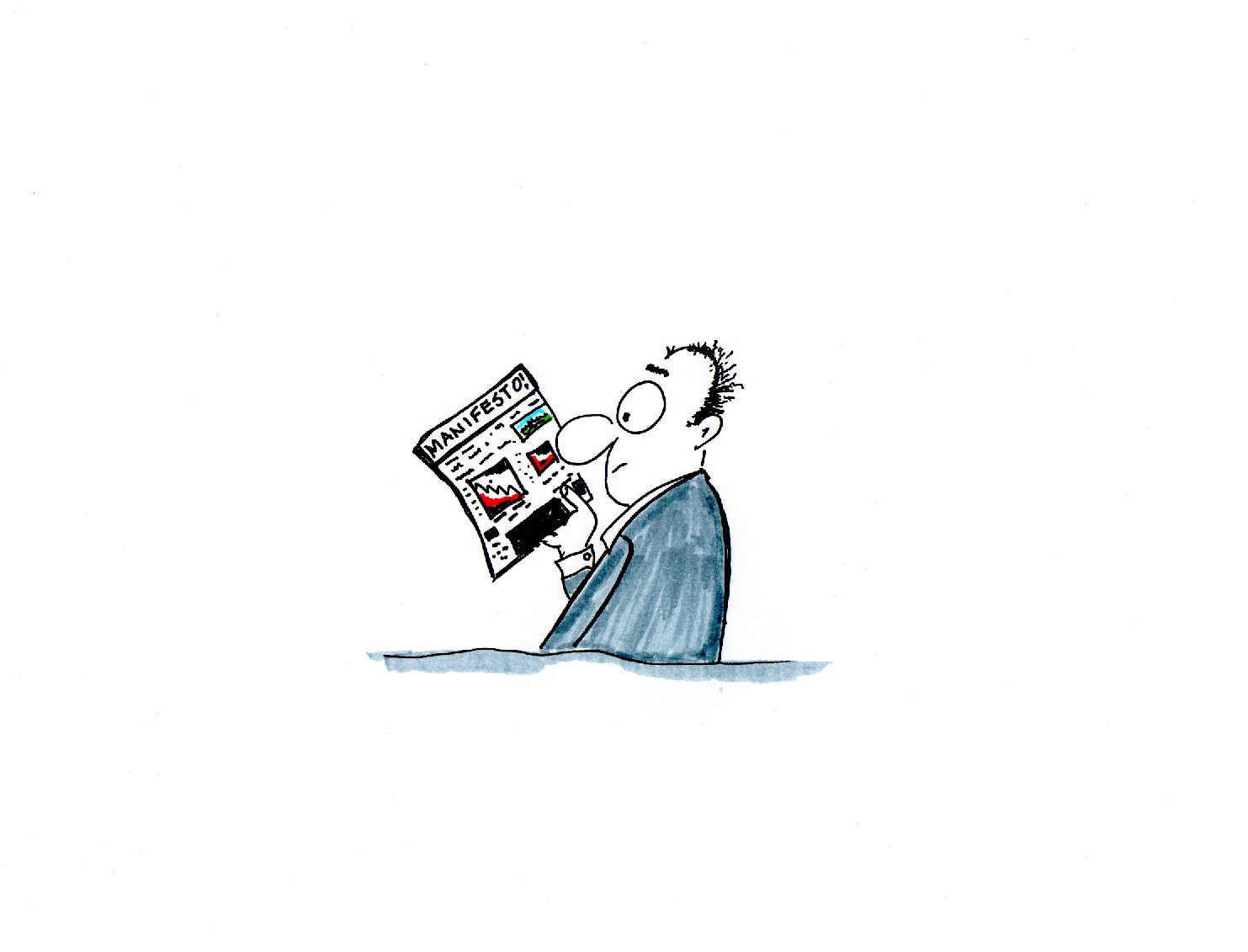
The latest Iran crisis has revived this playbook. As President Trump reaffirmed his deadline for Iran to reopen the Strait of Hormuz and threatened strikes on power plants and bridges, global markets initially reacted in predictable fashion.

Oil prices swung sharply, Treasury yields dipped, and investors sought safety as the deadline approached.

Positioning

Headlines on various news outlets captured the tension: warnings of higher energy prices, unsettled European markets, and futures trading nervously ahead of each new statement.

Yet beneath the surface, traders were already positioning for the familiar TACO outcome. The pattern is simple: price in the threat early, then fade it.

Hedge funds bought oil and volatility on the initial sabre‑rattling, but quietly prepared to unwind those positions as soon as signs of negotiation emerged.

When reports surfaced that Iran had submitted a ceasefire proposal — dismissed publicly as “not good enough” but nonetheless signalling movement — markets began to relax.

Oil turned mixed, futures rose, and Treasury yields reversed higher as safe‑haven demand faded.

Behaviour

This behaviour reflects a deeper truth about modern markets: headline risk decays quickly when investors believe the political actor prefers brinkmanship to actual escalation.

Trump’s negotiating style, built on maximalist threats followed by last‑minute recalibration, has become sufficiently familiar that traders now model it. The TACO trade is simply the codification of that expectation.

What makes this episode notable is how efficiently markets anticipated the pivot. Even as rhetoric hardened, the S&P 500 futures market edged higher, suggesting investors were already discounting the likelihood of military action.
Analysts warned that markets might be “completely wrong” about the risk of war, yet price action told a different story: traders were betting on de‑escalation before it arrived.

Whether the TACO trade remains reliable is another question. Markets adapt, and geopolitical actors can surprise.

But in this latest Iran standoff, Wall Street’s instincts proved consistent: fade the fear, wait for the climb‑down, and trade the relief rally when it comes.

Is it “playing with the markets”?

From a trader’s perspective, what you’re seeing isn’t so much deliberate market manipulation as a predictable feedback loop between political communication and investor psychology.

Markets react to signals, not intentions

When a political leader issues threats, deadlines or ultimatums, markets price the risk of escalation. When those threats repeatedly end in de‑escalation, markets begin to price the pattern instead of the words.

That’s how the TACO trade emerged: investors noticed the pattern and traded accordingly.

The pattern becomes self‑reinforcing

If traders expect a climb‑down, they position for it. If enough traders position for it, the market moves in that direction. This makes the pattern appear even stronger.

It’s not “playing with the markets” in the sense of intentional manipulation — it’s more that political brinkmanship creates volatility, and markets learn to anticipate the likely outcome.

Markets hate uncertainty but love repetition

If a leader consistently escalates rhetorically but de‑escalates in practice, markets adapt. They stop reacting to the drama and start trading the expected resolution.

That’s what happened around the Iran ceasefire discussions:

  • Oil spiked on the threats
  • Traders anticipated a softening
  • Oil fell sharply when negotiations appeared
  • Equity futures rose as the risk premium evaporated

This is classic pattern‑recognition, not evidence of someone intentionally moving markets.

Why it feels like market‑playing

Because the cycle is dramatic:

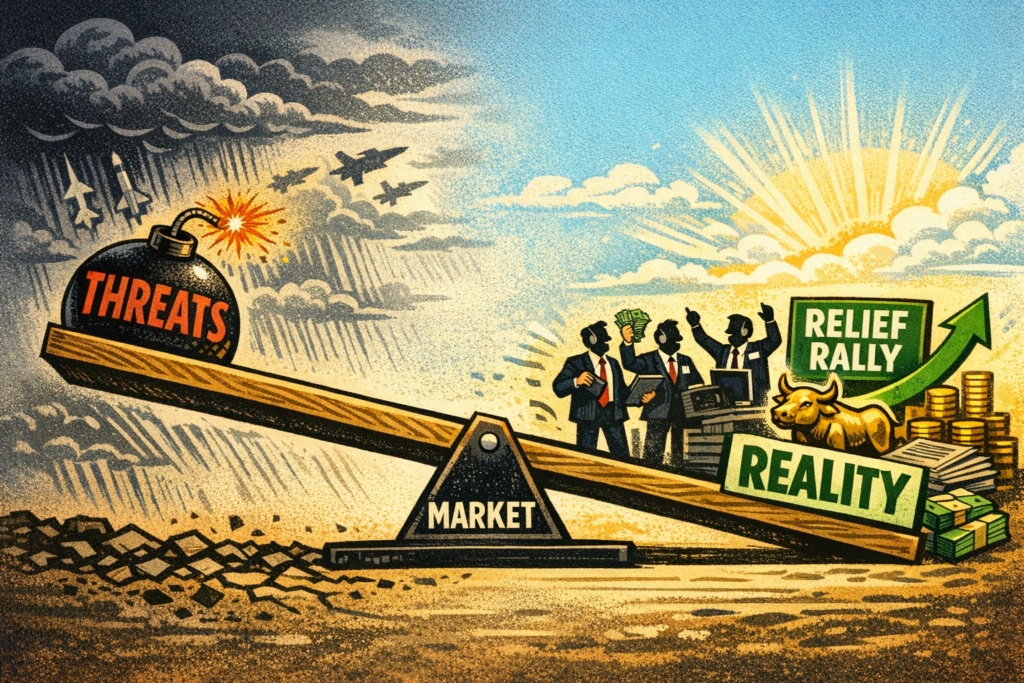
  1. Threat → volatility
  2. Deadline → fear trades
  3. Climb‑down → relief rally

To an outside observer, it can look like the political actor is pulling the market up and down. But from a market‑structure perspective, it’s simply headline‑driven trading meeting predictable political choreography.

The real issue is transparency, not intent

Markets can handle tough talk. What they struggle with is ambiguity — when the gap between rhetoric and action becomes wide enough that traders start pricing the gap rather than the policy.

That’s why the TACO trade exists: it’s a market response to inconsistency, not a claim of manipulation.

Is it a form of manipulation or planned market reaction.

You decide…

Thieves in the night.

The camu camu berry is one of the world’s most abundant sources of vitamin C – in fact, one single teaspoon of camu camu powder has 1180% of your recommended daily intake!

Camu camu berry rich in vitamin C

The camu camu berry is one of the world’s most abundant sources of vitamin C – in fact, one single teaspoon of camu camu powder has 1180% of your recommended daily intake!

Red peppers come second a vitamin race against the camu camu berry.

Where can the berries naturally be found?

Camu camu berries, scientifically referred to as Myrciaria dubia, originate from the Amazon rainforest. They flourish naturally along riverbanks and floodplains, prospering in moist, marshy zones with acidic soil and plentiful sunshine. These berries are predominantly found in areas of Peru and Brazil.

Harvesting and farming of the camu camu berry

Camu camu berries are harvested both from the wild and through cultivation. Traditionally, in the Amazon rainforest, local communities collect the berries from naturally occurring shrubs along riverbanks.

With the rising demand for their health benefits, commercial farming of camu camu has expanded. These farms are often found in Peru and Brazil, where the conditions are perfect for growing camu camu. Harvesting typically occurs in the rainy season when the berries reach full ripeness.

Fact or Fiction: Diamonds discovered on Mercury

Diamond planet

Mercury, the smallest planet in the solar system and nearest to the sun, conceals an intriguing secret: a diamond mantle approximately 10 miles thick under its surface. This revelation comes from data provided by NASA’s MESSENGER spacecraft.

Diamond mantle

Recent studies indicate that Mercury’s mantle is composed not of graphene, as was previously believed, but of diamond. The extreme pressure at the boundary between the mantle and core is thought to have facilitated the formation of diamond.

Graphite patches

Mercury’s surface is peppered with dark-coloured graphite patches, a form of carbon that has intrigued scientists for many years.

Carbon-rich magma

Researchers believe that in Mercury’s early history, it had a carbon-rich magma ocean. As the ocean of magma rose to the surface, it formed the graphite patches that are visible today.

Fact or fiction: Russia traded warships for Soda

Retro Soda

The fascinating tale of Pepsi’s unexpected naval acquisition dates back to the late 1950’s.

In 1959, during the Cold War, the United States and the Soviet Union were engaged in an ideological battle – communism vs capitalism.

In that time, the U.S.S.R. held an exhibition in New York to demonstrate its cultural and technological progress. In response, the United States established the American National Exhibition in Moscow, which featured various American products, including the famous carbonated beverage, Pepsi-Cola

The kitchen exhibition

In July 1959, then-Vice President Nixon and Soviet Premier Khrushchev engaged in a lively debate at the American National Exhibition. Set against the backdrop of a model American kitchen, they argued over the merits of capitalism versus communism. The exhibition also showcased a Pepsi-Cola booth, symbolizing the beverage’s American and Russian variants.

Pepsi for Khrushchev

Donald M. Kendall, an executive at Pepsi, embarked on a mission to have Khrushchev hold a Pepsi. On the exhibition’s eve, Kendall made a bold promise to Nixon. He aimed to showcase the trip’s significance, culminating in the staged moment where Khrushchev tentatively sipped Pepsi. This pivotal event was captured in a photograph, acquainting numerous Russians with the fizzy beverage for the first time.

The deal

The Soviet Union had a long-established tradition of exchanging vodka for Pepsi concentrate. However, the arrangement took an extraordinary turn when Pepsi served as an intermediary in a remarkable swap: the Soviets offered a fleet of 17 submarines, a cruiser, a frigate, and a destroyer – estimated to be worth around $3 billion – as compensation for their pending Pepsi delivery. This deal briefly made Pepsi the possessor of the world’s sixth-largest naval force.

Pepsi’s fleet

The company eventually sold the warships for scrap, but for a brief period, they boasted an impressive naval fleet.

This event marks a unique chapter in the history of both the beverage industry and naval affairs, where the worlds of carbonated drinks and military warships intersected.

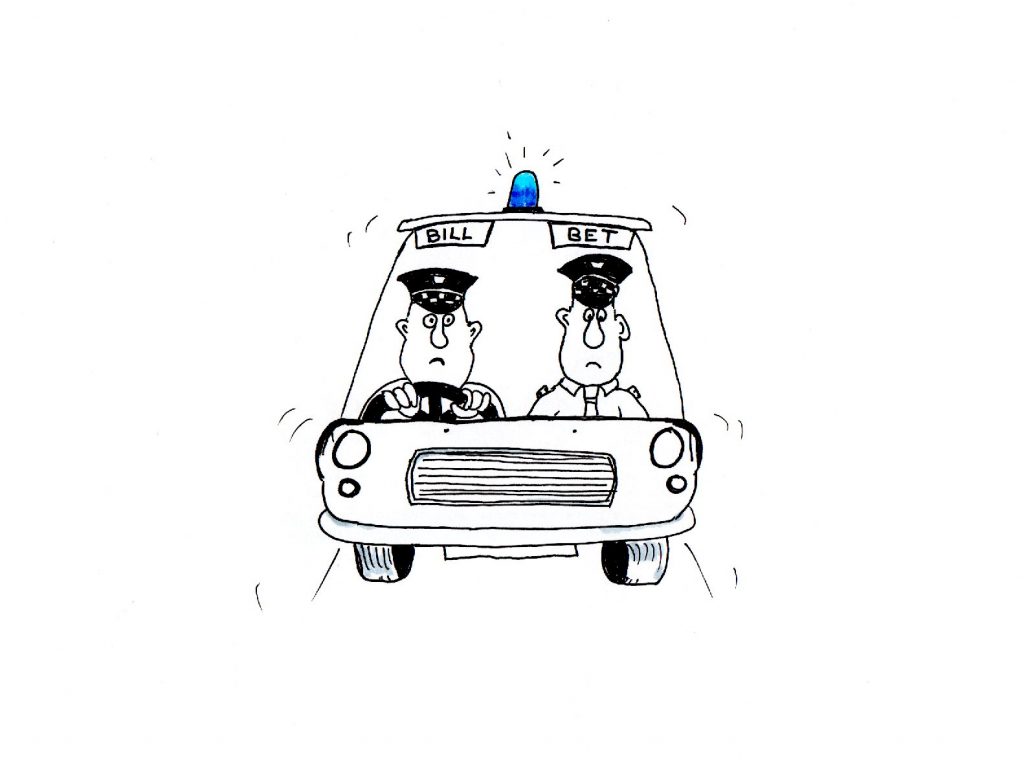
“Meet Bill and Bet!”

UK election betting scandal

UK Election betting scandal mars politicians and the police!

Just when you think the state of UK politics couldn’t get any worse… it does!

The ‘clicky’ inner circles of both the Conservative and of the Labour Party with their mucky little antics – placing bets on the date of the UK election – KNOWING THE OUTCOME!!

Why would anyone behave in this way?

No wonder the public are utterly disenfranchised with politics. The morally bankrupt behaviour and greed shown by some in both the Conservative and Labour Party is breathtaking and bereft of any basic moral compass.

These people are broken and should not be in positions of trust representing our country.

And the police too!

UK election betting scandal
“Meet Bill and Bet!”

Billy and Betty off to place their bets!

“SS Sunak – rats deserting the Sinking Ship!”

Sinking Ship!

SS Sunak – rats deserting a Sinking Ship!

UK Election: I don’t know if it’s just me but… where are all the Conservative Party cabinet BIG hitters?

Sunak has very little support, if any from his cabinet!

Where is Jeremy Hunt, the Chancellor of the Exchequer for example?

He’s not that visible on the election campaign trail. His absence could easily be construed as ‘distinctly unhelpful.’

Where is he?

“Here… I think you may need this!”

Take cover!

UK election engulfed in yet another politically charged fallout from scandalous greed driven morally bankrupt politicians, and police. All connected to the inner workings of a failed government bereft of any sense of moral duty. The opposition Party are implicated too!

Why?

Is this really the best we can do?

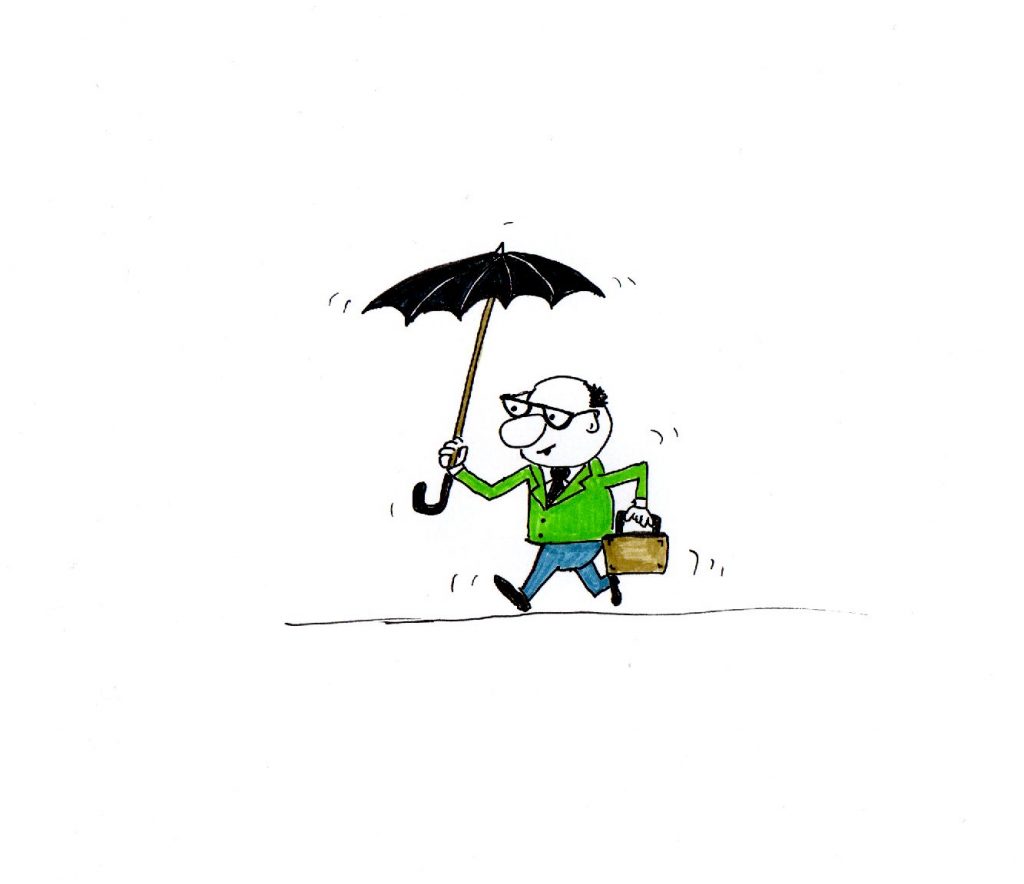
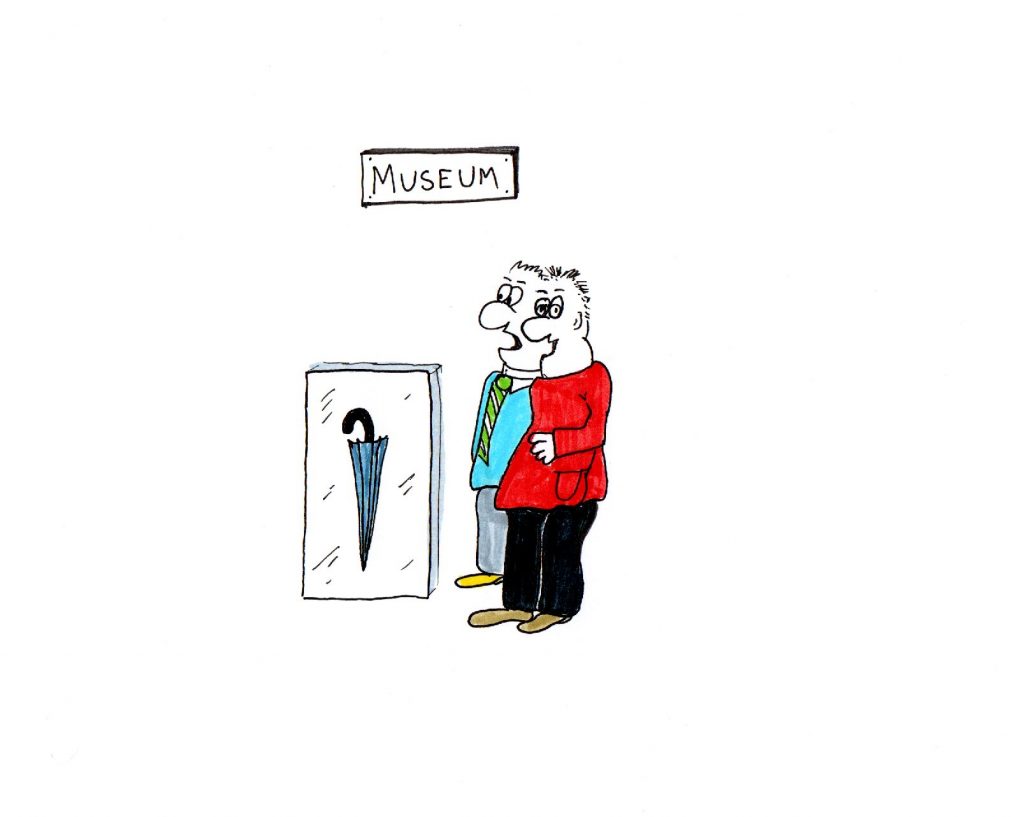
“I’ve been saving this for a rainy day, Mr. Sunak – but I think you might need it now.”

Umbrella for Sunak

Bank of England offers no election help to Rishi Sunak as the UK interest rate is held at 5.25%. Not that they should.

But the UK inflation is on target now at 2% so that’s some consolation. The PM claimed credit as the inflation target was met – happily informing us that his plan was working. But isn’t it the job of the Bank of England to maintain inflation at 2%?

Not that they have done a very good job of that either.

Soggy wet politics!

“Vote Now! Pay Later. Our Deal. Labour”

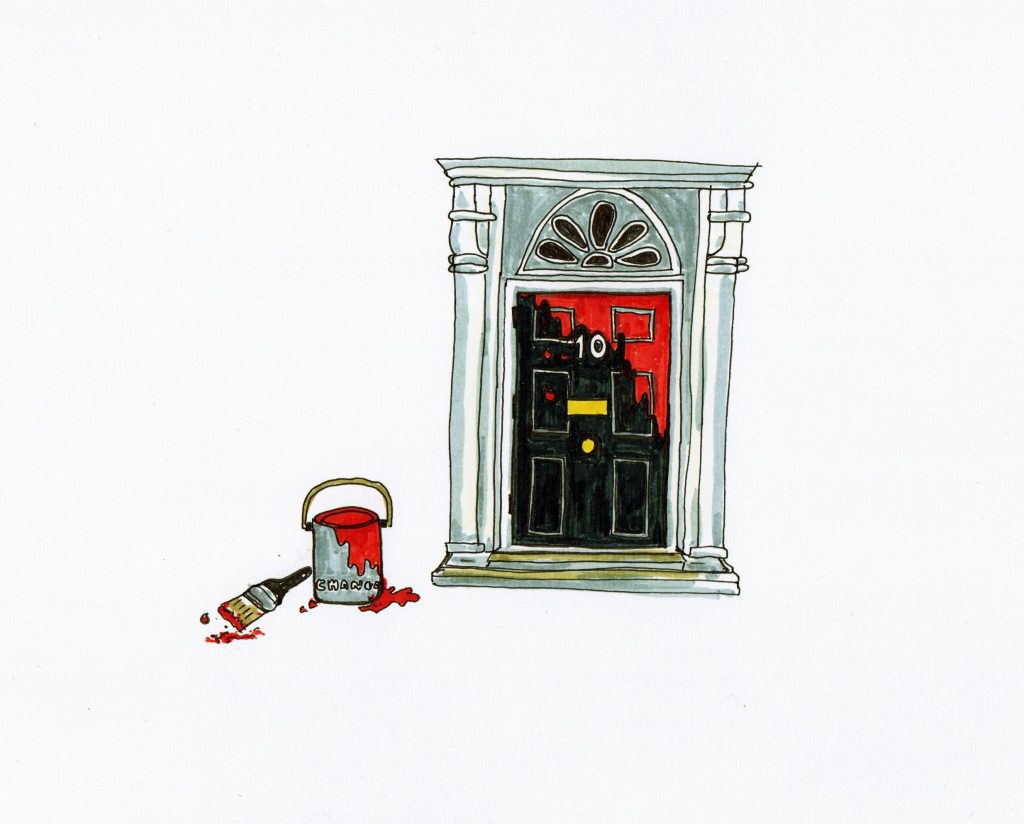
UK Election – The Labour Party slogan is ‘CHANGE’ – but ‘CHANGE‘ to what?

I do not support any party. I have no idea what the Labour party stands for anymore. And as for the Conservatives – not a clue either – too many deceits and for far too long!

We have choice – but no choice!