

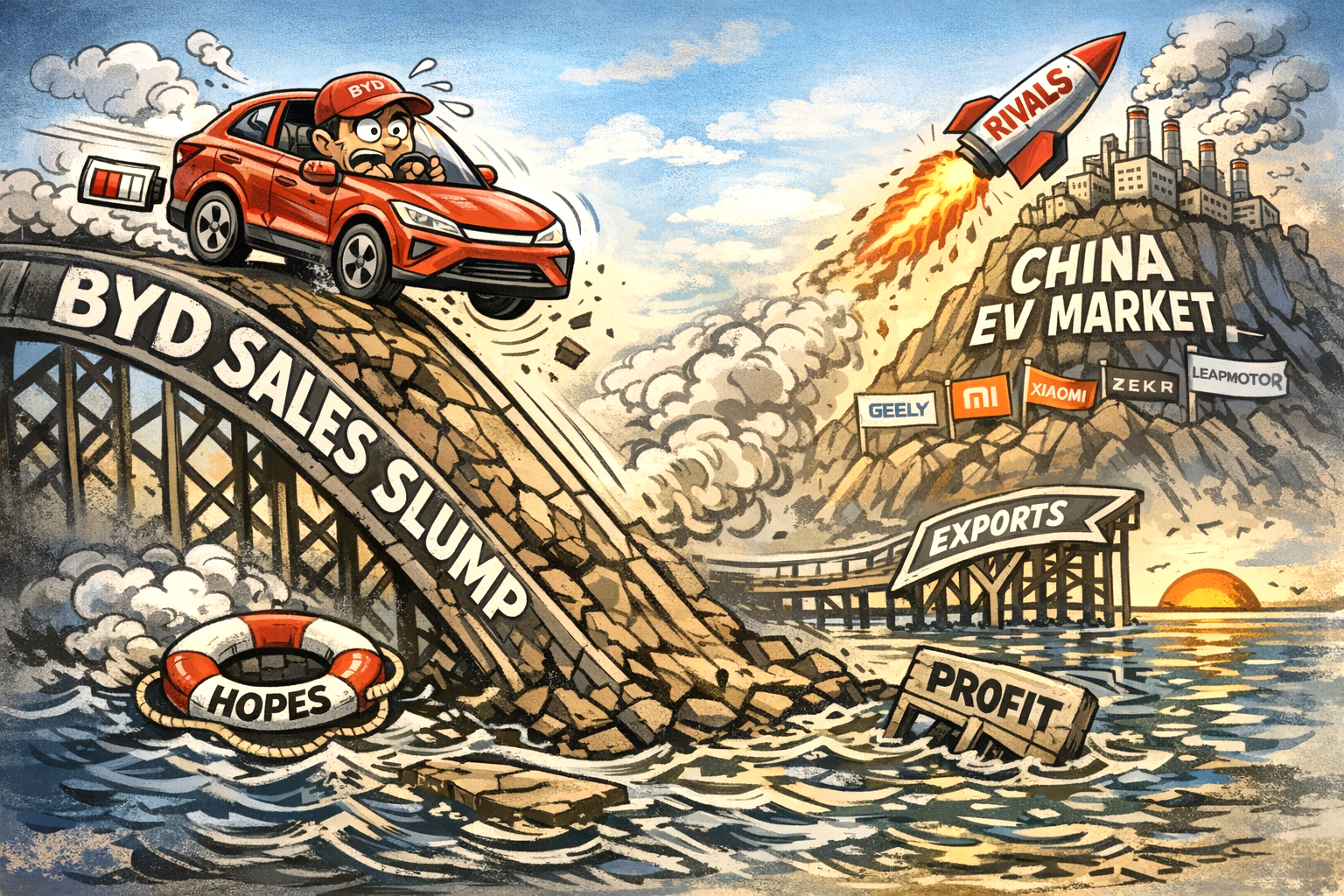
BYD has entered its most prolonged slowdown on record, with April 2026 marking the eighth consecutive month of falling electric‑vehicle sales.
China’s EV champion BYD is facing a decisive shift in its growth story. The company reported 314,100 passenger‑vehicle sales in April, a 15.7% year‑on‑year decline, extending a downturn that has now lasted eight months — the longest in its history.
Weak demand
Although sales ticked up slightly from March 2026, the broader trend is unmistakable: domestic demand is weakening, and the once‑relentless rise of China’s largest EV maker has stalled.
The slowdown reflects the brutal reality of China’s EV market. A wave of new models, aggressive discounting, and rapid innovation from rivals such as Leapmotor, Zeekr, Geely and Xiaomi has intensified competition.
BYD’s core Dynasty and Ocean series — the backbone of its domestic volume — fell 21.2% year‑on‑year, signalling pressure at the heart of its line‑up.
Niche brands mixed
Meanwhile, premium and niche brands delivered a mixed performance: Fang Cheng Bao surged 190%, while Denza dropped 26.9%, and ultra‑luxury Yangwang grew from a small base.
Yet the picture is not uniformly bleak. Overseas sales are booming, hitting a record 134,542 vehicles in April, up 70.9% from a year earlier.
Exports now account for over 42% of BYD’s monthly volume, underscoring a strategic pivot toward global markets as China’s price war erodes margins at home.
From January to April 2026, international sales rose nearly 60%, even as total global volume fell. BYD is targeting 1.5 million overseas sales in 2026, a goal that now looks central to its future.
Profit plunge
Financially, the strain is clear. BYD’s Q1 profit plunged 55%, with revenue down nearly 12% as domestic competition intensified and hardware costs rose.
The company is responding with faster‑charging battery technology, expanded model launches, and a global manufacturing push spanning Brazil, Indonesia, Hungary and Malaysia.
The story of BYD in 2026 is one of divergence: a weakening home market colliding with accelerating global expansion.
The question now is whether overseas momentum can scale fast enough to counter China’s slowdown.