Elon Musk: The Trillion‑Dollar Man

Elon Musk has spent two decades bending entire industries around his will, but the past year has pushed him into a category previously reserved for myth.

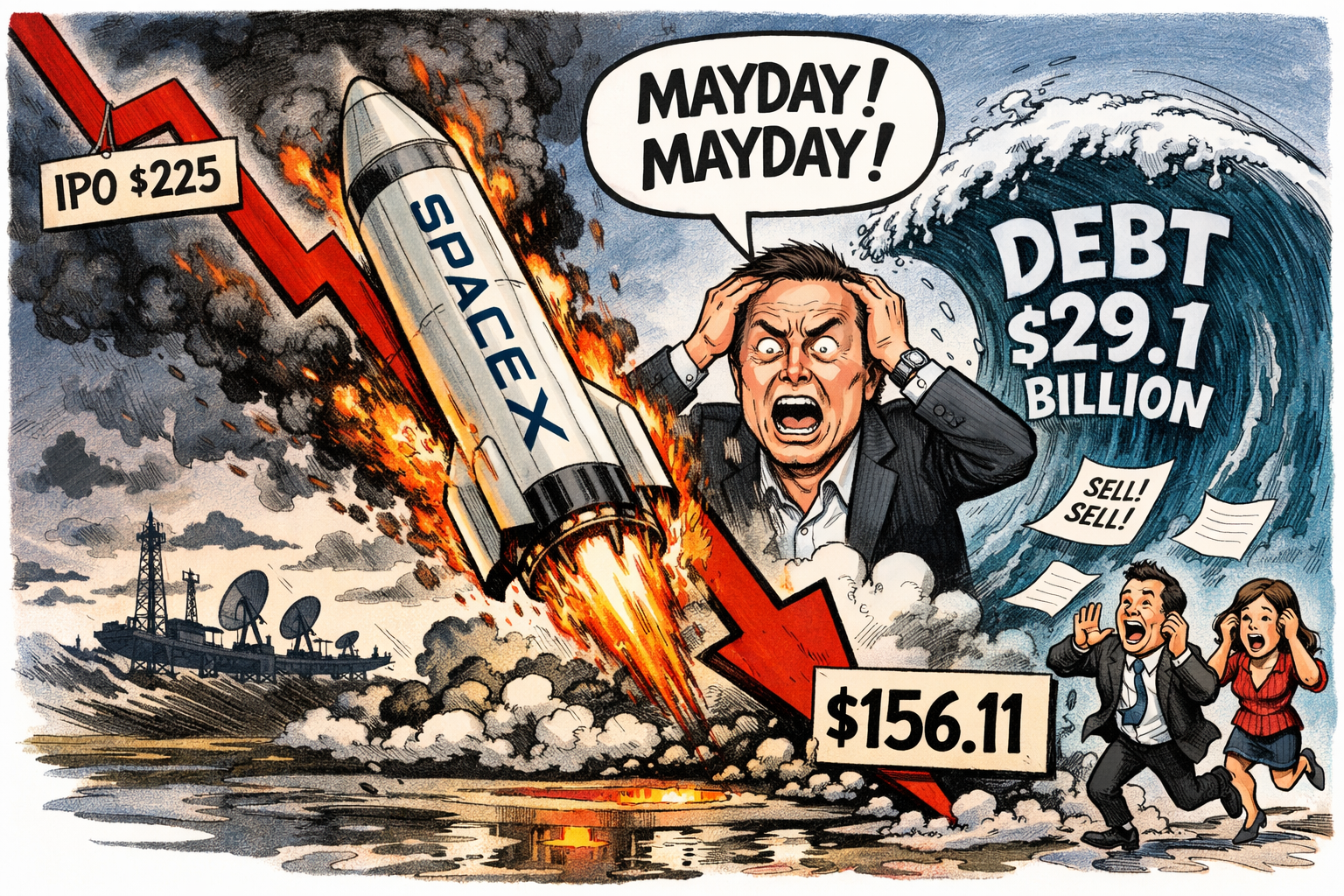
With the SpaceX IPO igniting global markets and sending shockwaves through the aerospace and technology sectors, Musk has become the first individual in history to be calculated as worth $1 trillion.

Empire buidling

It is a milestone that reflects not only personal wealth, but the scale of the industrial empires he has built — and the future investors believe he is about to unlock.

SpaceX’s long‑anticipated public listing has been the catalyst. The company’s valuation surged as soon as trading began, propelled by overwhelming demand for exposure to the world’s dominant launch provider and the backbone of the modern satellite economy.

Starlink

Starlink’s global footprint, the Falcon and Starship programmes, and SpaceX’s near‑monopoly on commercial and government launches have created a business with both extraordinary cash flow and unmatched strategic importance.

Investors are effectively betting on Musk’s ability to commercialise space in the same way he electrified the car industry.

Tesla, Neuralink, X.ai, X, The Boring Company, Solar City & SpaceX

The IPO has also crystallised the value of Musk’s wider ecosystem. Tesla, despite its volatility, remains the world’s most recognisable electric‑vehicle brand.

Neuralink and The Boring Company, though smaller, contribute to the perception of a founder whose ventures consistently reshape their sectors.

But it is SpaceX — with its blend of infrastructure, defence relevance, and global communications — that has propelled Musk into trillion‑dollar territory.

Speculative

Critics argue that such valuations are speculative, driven by hype rather than fundamentals. Yet SpaceX’s track record is unusually concrete: reusable rockets, profitable satellite services, and a launch cadence unmatched by any nation, let alone any company.

We can make the future

The market is effectively pricing in a future where SpaceX becomes the backbone of off‑planet logistics, lunar infrastructure, and perhaps even the first commercial missions to Mars.

Trillion Dollar Man

For Musk, the symbolism is obvious. Becoming the world’s first trillion‑dollar individual cements his status as the defining industrialist of the 21st century.

A figure whose ambitions stretch far beyond Earth, and whose companies now command the kind of economic gravity once associated only with nation‑states.

Context: Countries With GDP ≥ $1 Trillion (Nominal USD, 2026) – Approx’ indication only

United States — 29.0
China — 18.5
Germany — 4.6
Japan — 4.3
India — 4.0
United Kingdom — 3.4
France — 3.2
Italy — 2.3
Canada — 2.2
Brazil — 2.1
Russia — 2.0
South Korea — 1.9
Australia — 1.8
Mexico — 1.7
Spain — 1.6
Indonesia — 1.5
Netherlands — 1.2
Saudi Arabia — 1.1
Turkey — 1.0
Switzerland — 1.0

Markets in Asia continue volatility as Softbank falls 10%

Softbank down 10%

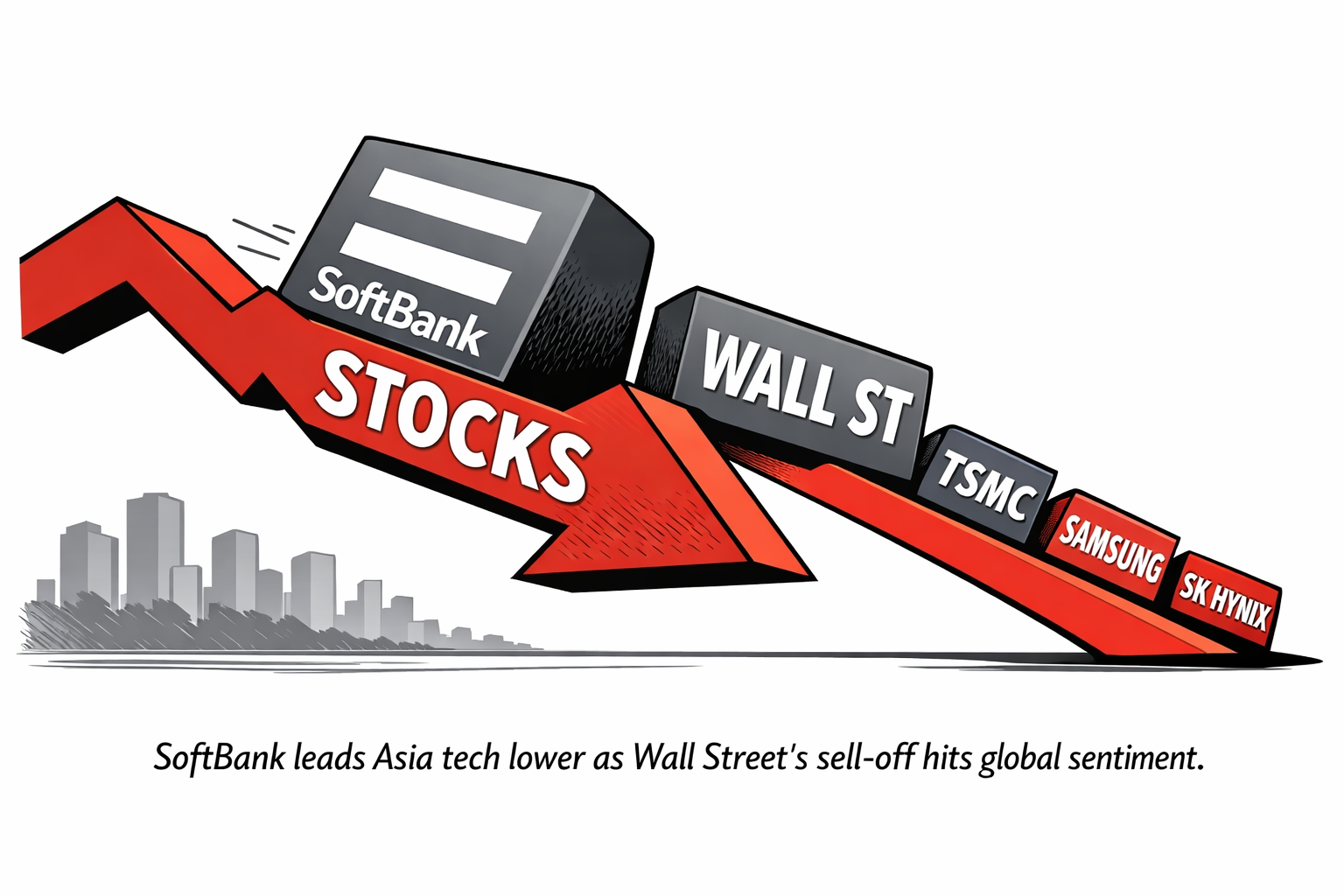
SoftBank’s sharp 10% slide on Wednesday became the defining symbol of a broader rout across Asia’s technology markets, as the region absorbed the full force of Wall Street’s overnight tech sell‑off.

The reversal ended a brief rebound in chipmakers and reignited concerns that valuations across the artificial‑intelligence complex have run too hot for too long.

The immediate pressure on SoftBank stemmed from reports that its attempt to raise at least $6 billion through a margin loan backed by its OpenAI stake had stalled.

That setback landed at a moment when sentiment toward high‑growth tech names was becoming more fragile, amplifying the downside.

Investors rotated out of risk, hitting Japan’s semiconductor ecosystem: Advantest and Renesas both fell more than 3%, while South Korea’s SK Hynix plunged over 8% and Samsung Electronics dropped 7.45%.

Taiwan’s TSMC and Hon Hai were also dragged lower.

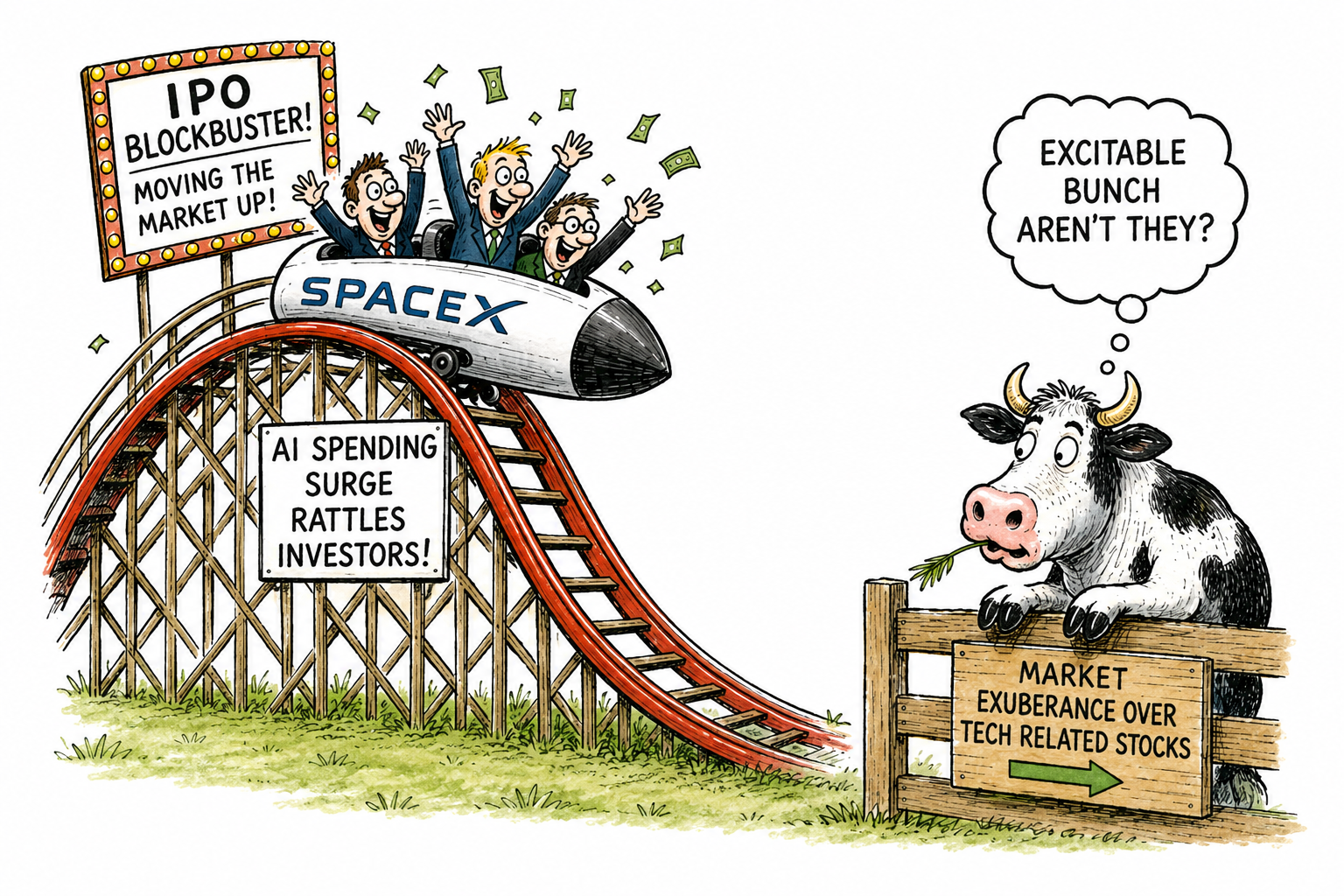
A deeper structural worry is now taking hold. Massive AI‑related fundraising — including upcoming listings for SpaceX, Anthropic and OpenAI — appears to be siphoning capital away from publicly traded tech stocks.

Some investors see this as the early stage of a rotation; others fear it signals overheating. For Japan, one unexpected beneficiary could be defence contractors, with strategists suggesting a shift toward “heavies” as retail traders search for stability.

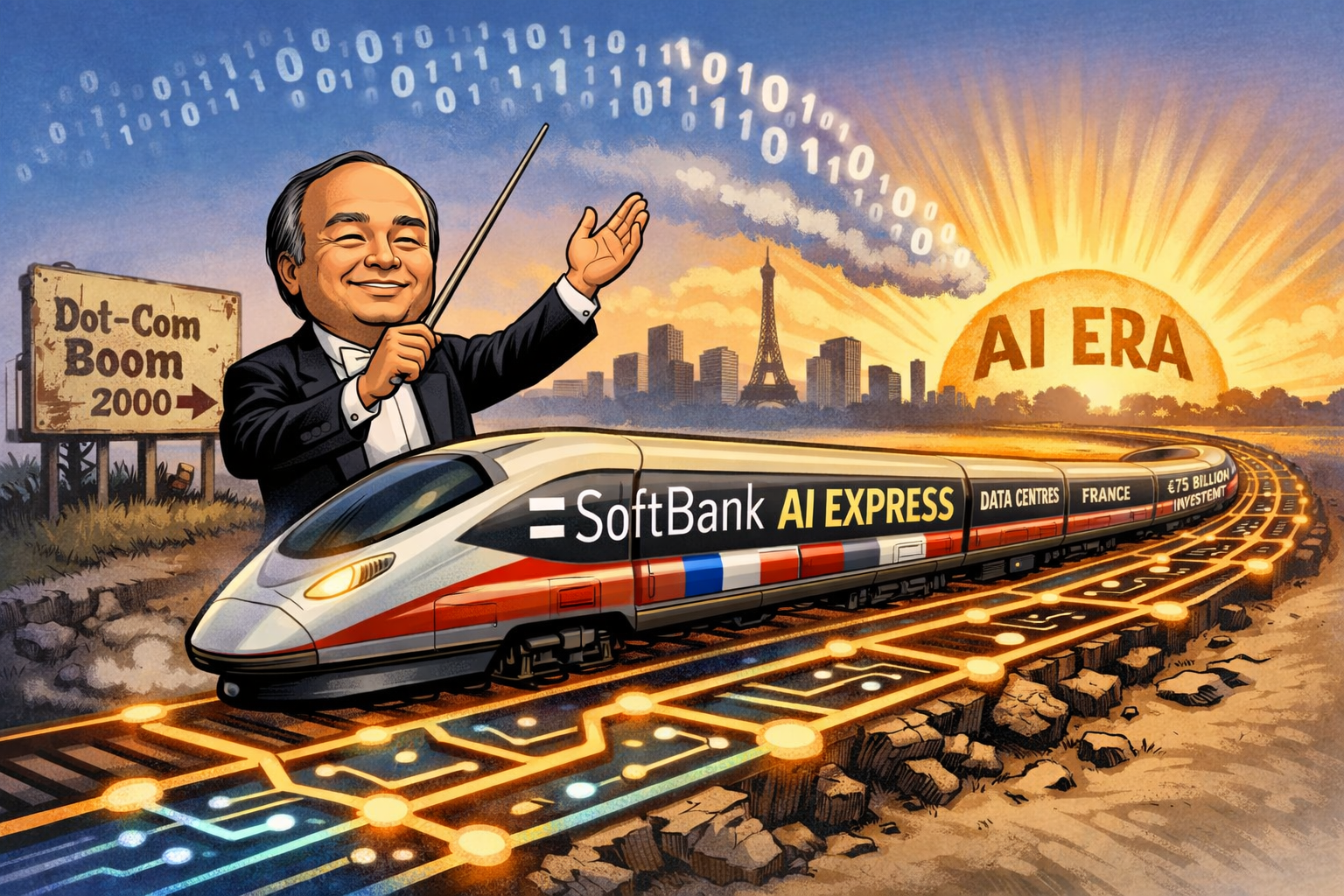
AI revolution will be “50 times bigger” than the dot‑com boom says Masayoshi Son of Softbank

In essence, Son is reframing SoftBank’s entire identity around AI, portraying it not as a sector but as the next economic infrastructure — a claim that, if realised, would make the dot‑com era look modest by comparison.

SoftBank becomes Japan’s most valuable company as of May 2026.

Scale of transformation: Son argues that artificial intelligence will reshape every industry, dwarfing the internet’s impact in the early 2000s.

SoftBank’s strategy: He reportedly plans to channel the group’s investment focus almost entirely toward AI ventures, positioning SoftBank as a global accelerator for AI‑driven companies.

Vision Fund revival: After years of losses, Masayoshi Son sees AI as the catalyst to reignite the Vision Fund’s profitability, citing rapid advances in generative and autonomous systems.

Economic outlook: He predicts exponential productivity gains and new business models emerging from AI integration, describing it as a “moment of singularity” for technology and finance.

Investor sentiment: Some analysts remain cautious, recalling SoftBank’s volatile history with tech valuations, but acknowledge that Son’s influence could again shape global investment trends.

AI is more than the next dot-com era – it’s the new tech revolution in creation.

Nvidia moves into PCs – All hail Nvidia!

New AI PC chips from Nvidia

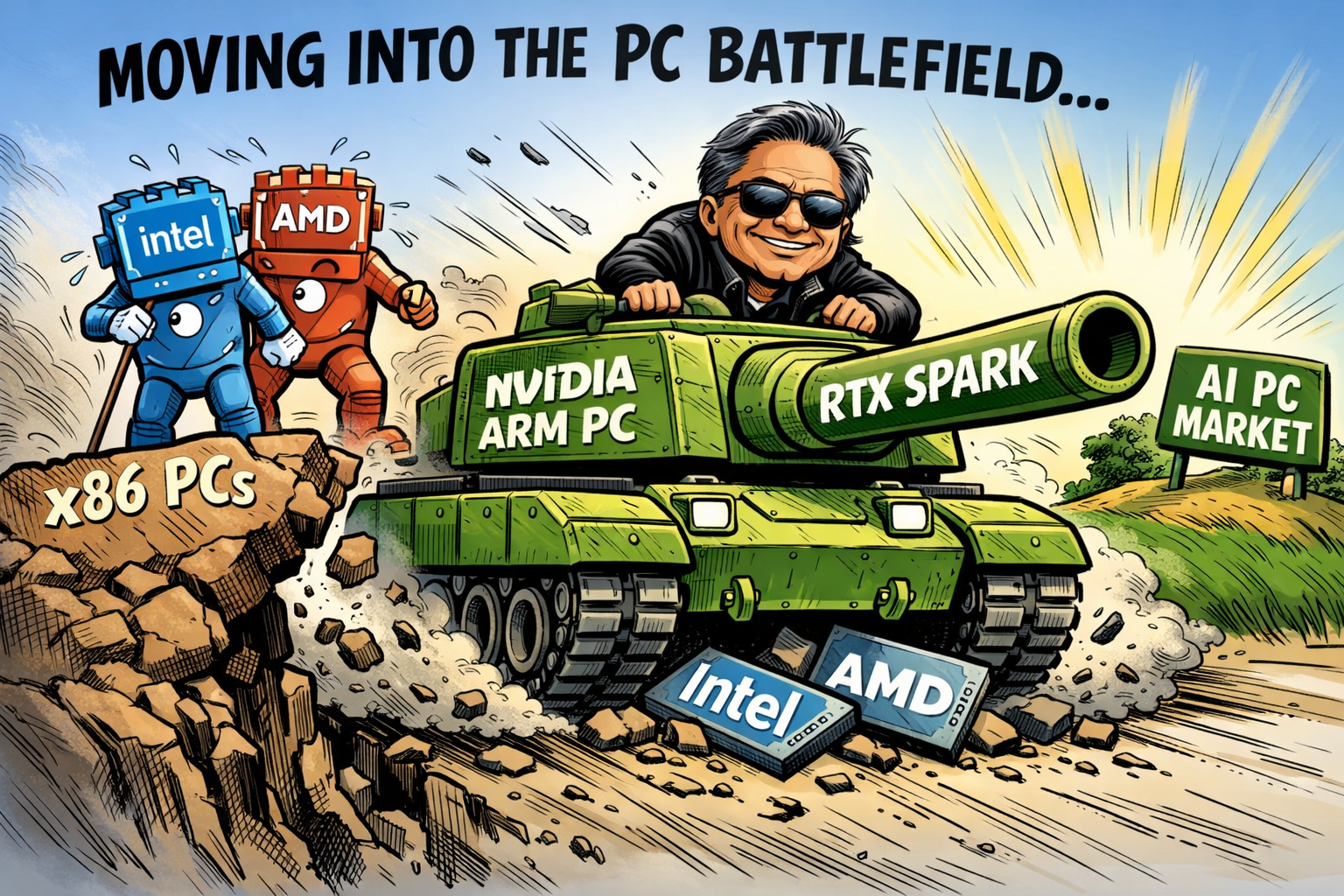
Nvidia’s long‑anticipated push into the PC market has finally materialised — and it marks the company’s most aggressive attempt yet to extend its dominance beyond the data centre.

At Computex in Taipei, Jensen Huang unveiled the N1X, an Arm‑based CPU fused with a Blackwell‑class GPU into a new RTX Spark superchip, set to appear this autumn in premium Windows laptops from Microsoft, Dell, HP, ASUS, Lenovo and MSI .

The move is strategically significant. For decades, the PC’s central processor has been the guarded territory of Intel and AMD, with Apple’s M‑series proving the only major Arm‑based disruption.

Nvidia is now entering that arena with a design built explicitly for the age of agentic AI — machines that run multiple AI processes simultaneously, shifting huge volumes of data between GPU and CPU.

Nvidia has argued for months that CPUs have become the bottleneck in modern AI workflows, and the N1X is its answer: a custom Arm design, co‑developed with Microsoft and manufactured on TSMC’s 3‑nanometre process, paired with 128GB of unified memory for high‑bandwidth compute.

Huang framed the launch as a generational reset: “the first completely re‑engineered, reinvented line of PCs in 40 years.” It’s hyperbole with intent.

Nvidia wants to define the AI PC in the same way it defined the AI data centre — not as an incremental upgrade, but as a new category.

More than 30 laptops and 10 desktops are reportedly planned over time, with early models aimed at creators, AI developers and high‑end gamers seeking thin, light machines with workstation‑level capability.

The competitive implications are profound. Arm‑based computing is accelerating across the industry, and Nvidia’s arrival puts direct pressure on Intel and AMD just as both are scrambling to articulate their own AI‑centric roadmaps.

If RTX Spark delivers the performance uplift Nvidia promises, the centre of gravity in the PC market could shift rapidly — from x86 incumbents to a company that has already rewritten the rules of modern computing once.

All hail Nvidia.

The Coming Shockwave: How Three Mega‑IPOs Could Reshape the S&P 500 and Nasdaq – Opinion

IPOs for SpaceX, OpenAI and Anthropic

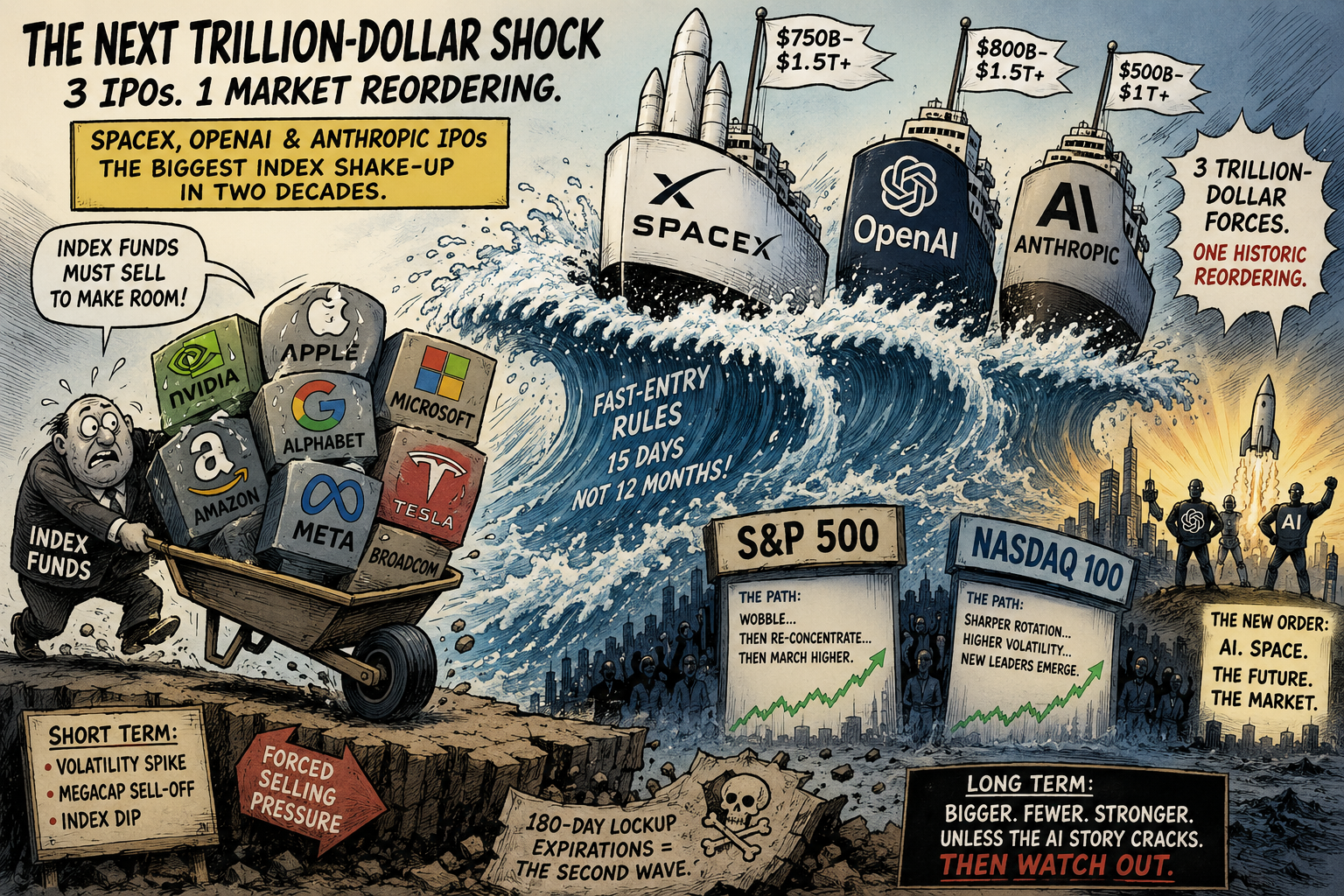
The expected public listings of SpaceX, OpenAI and Anthropic represent the most consequential cluster of IPOs in two decades.

Each company sits at the centre of a structural shift—space infrastructure, frontier AI models and safety‑driven AI systems—and each is likely to command a valuation in the high hundreds of billions, if not beyond.

Their arrival on public markets will not be a routine liquidity event. It will be a reordering of index composition, capital flows and investor psychology.

At the mechanical level, the impact on the S&P 500 and Nasdaq will be immediate. Index providers now operate fast‑entry rules that allow very large IPOs to join major benchmarks within days rather than months.

This compresses the adjustment period and forces passive funds to sell existing constituents to make room for the newcomers.

The selling pressure will fall disproportionately on the current megacap cohort—Microsoft, Apple, Alphabet, Amazon, Meta, Nvidia and Tesla—because these names dominate index weightings and therefore become the primary source of liquidity for rebalancing.

The indices themselves may not fall sharply, but the internal rotation will be violent.

The Nasdaq will feel the shock most acutely. Its concentration in technology means the inclusion of three new giants will trigger a scramble for weight, with ETFs forced to buy limited‑float shares at whatever price the market sets.

The S&P 500, broader and more liquid, will absorb the change more smoothly, but even there the effect will be visible: a temporary dip in existing leaders, a spike in volatility and a rapid reshaping of the top‑ten constituents.

The S&P 500 and Nasdaq will almost certainly experience a temporary liquidity shock, a forced rotation out of existing megacaps, and then—once the dust settles—a re‑concentration around the new AI/space giants.

The scale of SpaceX, OpenAI and Anthropic means the indices will not be able to absorb them quietly.

What will likely happen when SpaceX, OpenAI and Anthropic list their IPOs?

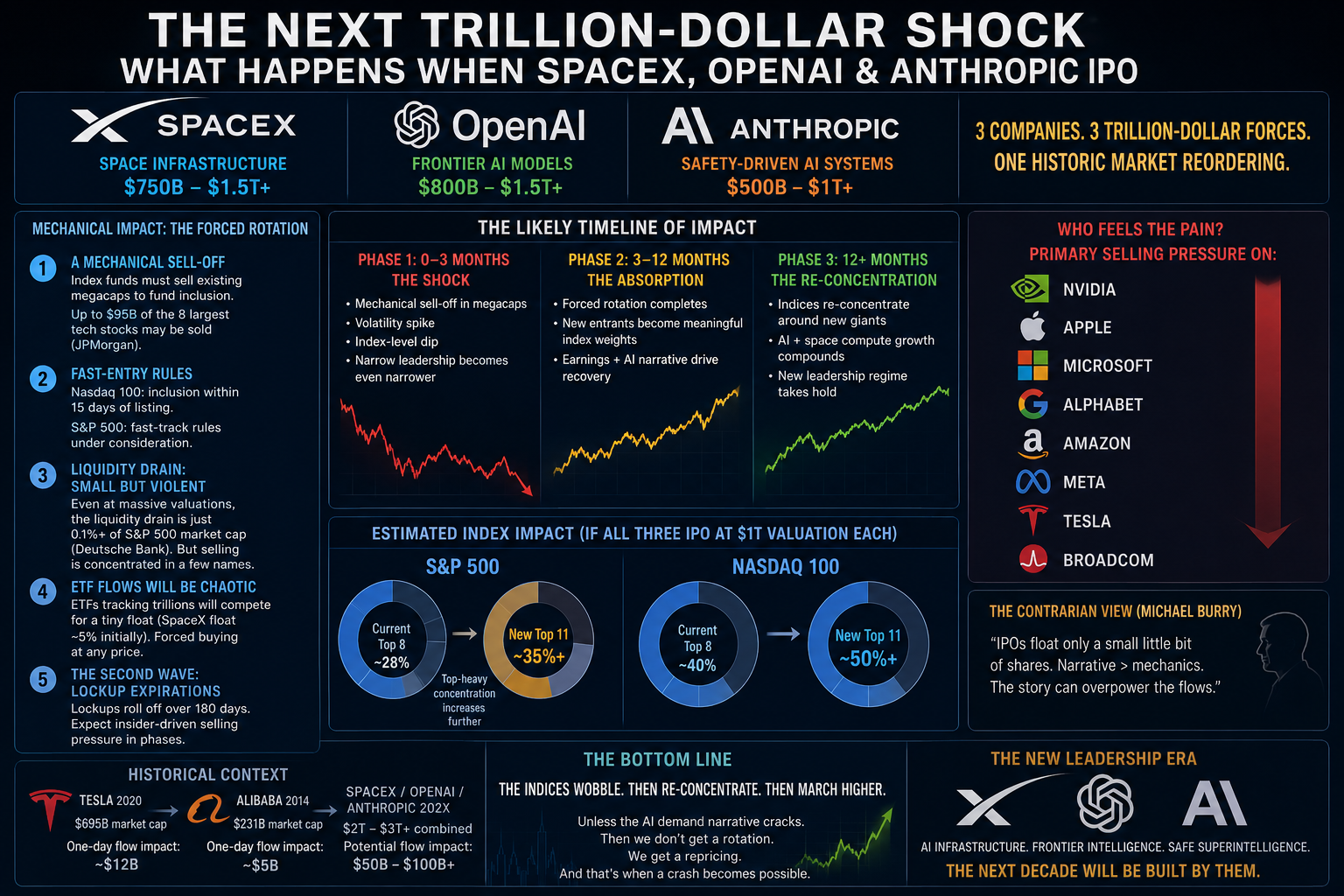
1. A mechanical sell‑off in today’s biggest tech names

Index funds must sell existing holdings to make room for the new entrants.

  • Goldman Sachs notes passive funds will need to rebalance as soon as these mega‑caps are added.
  • JPMorgan estimates that at a $2T valuation, up to $95bn of the eight largest tech stocks may need to be sold to rebalance portfolios.

This means pressure on Nvidia, Apple, Microsoft, Alphabet, Amazon, Meta, Tesla, Broadcom—the very names currently carrying the indices.

2. Fast‑entry rules accelerate the shock

Nasdaq’s new “fast entry” rules allow these companies to join the Nasdaq 100 within 15 days of listing. S&P Dow Jones is considering similar fast‑track inclusion for mega‑caps. The Motley Fool

This compresses what used to be a 12‑month absorption period into weeks.

3. Liquidity drain is real—but limited in absolute terms

Deutsche Bank estimates that even the largest IPOs would still represent just over 0.1% of S&P 500 market cap. So the market‑wide liquidity drain is modest, but the rotation effect is violent because it concentrates selling in a handful of megacaps.

4. ETF flows will be chaotic

Strategas warns that ETFs tracking trillions will compete for a tiny float, making inclusion “frantic.” SpaceX is reportedly floating only ~5% of shares initially. That means forced buying at any price, followed by forced selling elsewhere.

5. After lockups expire (180 days), the second wave hits

SpaceX’s prospectus notes that selling pressure increases as lockups roll off in phases over 180 days. Expect a two‑stage impact:

  • Stage 1: violent index rebalancing
  • Stage 2: insider‑driven supply shock

So what happens to the S&P 500?

Short-term (0–3 months after IPOs):

  • Mild index-level dip as megacaps are sold to fund inclusion.
  • Volatility spike around rebalance windows.
  • Narrow leadership becomes even narrower temporarily.

This is consistent with historical mega‑IPO patterns (e.g., Tesla’s inclusion forced tens of billions in one-day flows).

Medium-term (3–12 months):

  • The S&P 500 becomes more top‑heavy, not less.
  • SpaceX, OpenAI, Anthropic quickly become meaningful index weights due to their trillion‑dollar valuations.
  • If AI earnings continue to dominate, the index likely recovers and re‑concentrates around the new entrants.

HSBC reportedly notes that stronger tech valuations—especially from high‑valuation IPOs—could push the S&P 500 above 8,000 if earnings broaden.

What about the Nasdaq?

The Nasdaq 100 is hit harder because:

  • It is more tech‑concentrated.
  • Fast‑entry rules force inclusion within 15 days.

Expect:

  • Sharper rotation, especially out of semiconductor and hyperscaler names.
  • Higher volatility as QQQ must buy the new entrants aggressively.
  • A structural reshaping: SpaceX, OpenAI and Anthropic could become low‑ to mid‑single‑digit weights almost immediately.

The contrarian view (Michael Burry)

Burry argues the IPOs won’t break the bull market, because IPOs float only a “small little bit” of shares, limiting true supply impact. He believes narrative > mechanics.

There’s truth in that: the story of AI and space‑compute may ultimately lift the indices after the initial turbulence.

My Opinion

Short-term: Expect a sell‑off in existing megacaps, a volatility spike, and mechanical downward pressure on both S&P 500 and Nasdaq.

Medium-term: Once the forced rotation is complete, the indices likely resume their upward trend, now with three new trillion‑dollar engines powering them.

Long-term: This is the biggest index‑composition shock since the dot‑com era. The S&P 500 and Nasdaq will become even more dominated by AI‑infrastructure and space‑compute giants.

In other words: the indices wobble, then re‑concentrate, then march higher—unless AI demand itself cracks.

If that happens then we’ll most likely witness a crash!

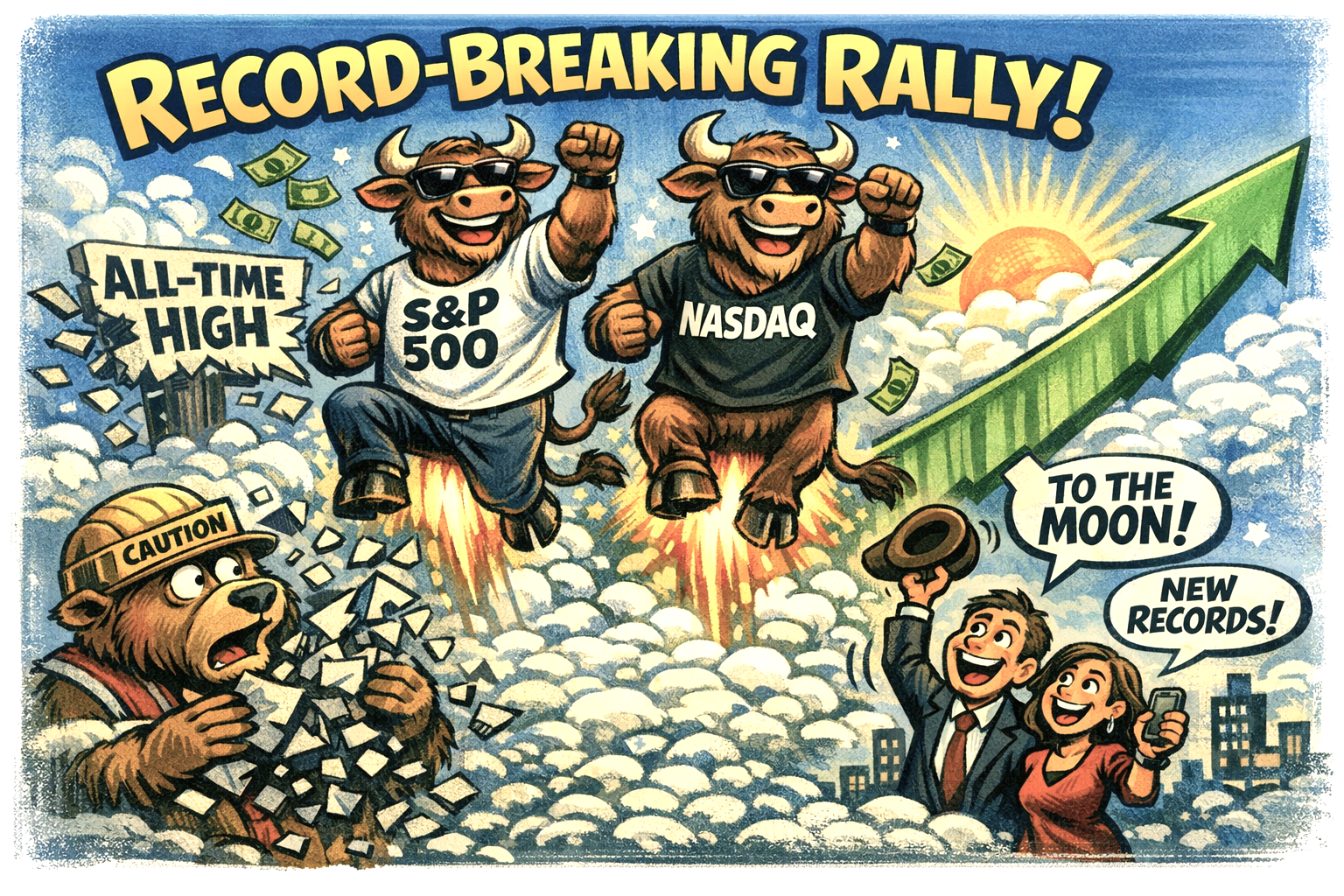
S&P 500 and Nasdaq Composite and 100 All Hit Fresh Record Highs as Tech Momentum Intensifies – 26th May 2026

New record all-time highs for U.S. indices

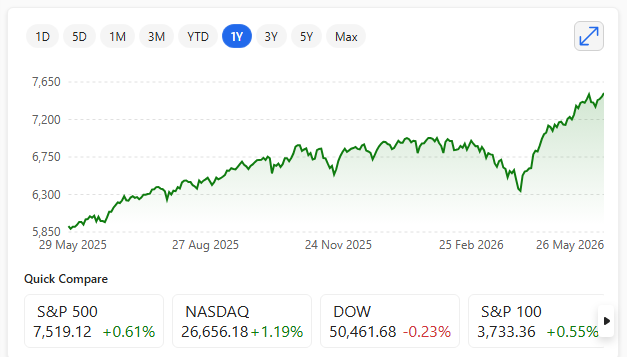
The S&P 500 and Nasdaq Composite surged to new all‑time highs yesterday, extending a rally that shows little sign of fatigue as investors continue to pile into megacap technology and AI‑linked names.

The move higher came despite a patchy run of U.S. macro data, underscoring how dominant earnings strength and sector‑specific momentum have become in driving equity sentiment.

S&P 500: 7,519.12, up 45.65 points (+0.61%) — a record closing high.

S&P 500 26th May 2026

The S&P 500’s climb was supported by broad participation across technology, communication services and consumer discretionary, with investors rewarding companies delivering consistent revenue and margin expansion.

Market breadth has improved modestly in recent weeks, helping reinforce confidence that the rally is not solely dependent on a handful of giants.

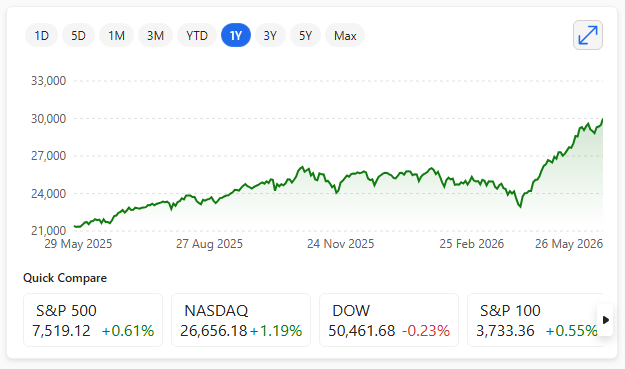
Nasdaq Composite: 26,656.18, up 312.21 points (+1.19%) — also a record closing high, with an intraday peak of 26,725.29.

Nasdaq Composite 26th May 2026

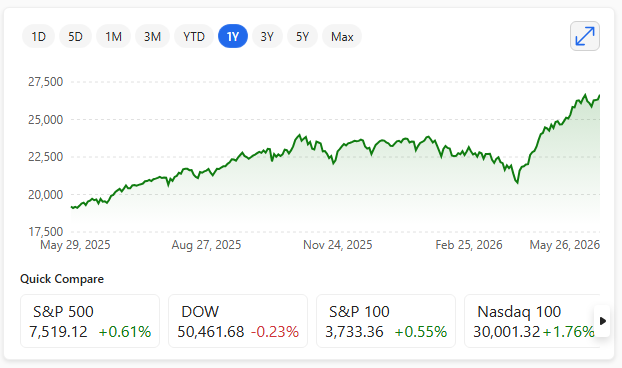
Nasdaq‑100 (NDX): 30,001.32Up: +519.68 points (+1.76%) Intraday high: 30,044.49 – a new record high.

Nasdaq 100 26th May 2026

The Nasdaq once again outperformed, propelled by heavy demand for semiconductor, cloud and AI infrastructure stocks.

Upbeat guidance from several major tech firms earlier this month has strengthened the view that the sector’s earnings cycle still has room to run.

While valuations remain elevated and leave the market exposed to any negative surprise, investors have so far shown little inclination to rotate away from the winners.

Yesterday’s triple records highlight the market’s conviction that the AI‑driven profit cycle remains intact.

BYD’s EV sales drop for an eighth month in prolonged slowdown

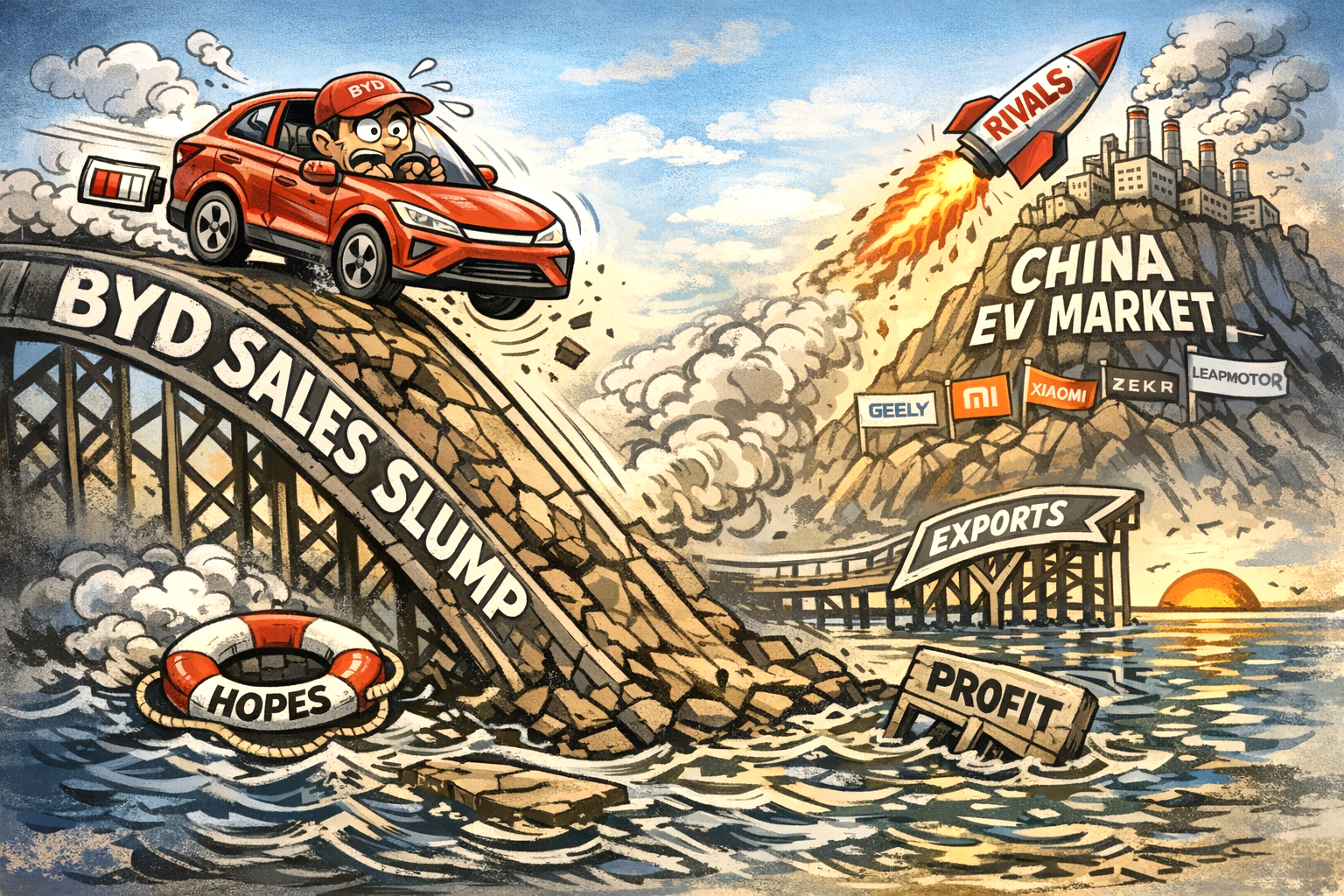
BYD sales fall

BYD has entered its most prolonged slowdown on record, with April 2026 marking the eighth consecutive month of falling electric‑vehicle sales.

China’s EV champion BYD is facing a decisive shift in its growth story. The company reported 314,100 passenger‑vehicle sales in April, a 15.7% year‑on‑year decline, extending a downturn that has now lasted eight months — the longest in its history.

Weak demand

Although sales ticked up slightly from March 2026, the broader trend is unmistakable: domestic demand is weakening, and the once‑relentless rise of China’s largest EV maker has stalled.

The slowdown reflects the brutal reality of China’s EV market. A wave of new models, aggressive discounting, and rapid innovation from rivals such as Leapmotor, Zeekr, Geely and Xiaomi has intensified competition.

BYD’s core Dynasty and Ocean series — the backbone of its domestic volume — fell 21.2% year‑on‑year, signalling pressure at the heart of its line‑up.

Niche brands mixed

Meanwhile, premium and niche brands delivered a mixed performance: Fang Cheng Bao surged 190%, while Denza dropped 26.9%, and ultra‑luxury Yangwang grew from a small base.

Yet the picture is not uniformly bleak. Overseas sales are booming, hitting a record 134,542 vehicles in April, up 70.9% from a year earlier.

Exports now account for over 42% of BYD’s monthly volume, underscoring a strategic pivot toward global markets as China’s price war erodes margins at home.

From January to April 2026, international sales rose nearly 60%, even as total global volume fell. BYD is targeting 1.5 million overseas sales in 2026, a goal that now looks central to its future.

Profit plunge

Financially, the strain is clear. BYD’s Q1 profit plunged 55%, with revenue down nearly 12% as domestic competition intensified and hardware costs rose.

The company is responding with faster‑charging battery technology, expanded model launches, and a global manufacturing push spanning Brazil, Indonesia, Hungary and Malaysia.

The story of BYD in 2026 is one of divergence: a weakening home market colliding with accelerating global expansion.

The question now is whether overseas momentum can scale fast enough to counter China’s slowdown.

Wall Street Closes at Fresh Record Highs as AI Tech Stocks Surge

S&P 500 and Nasdaq hit new record high!

Wall Street ended April on a strong note as both the S&P 500 and the Nasdaq Composite closed at new record highs on 30th April 2026.

Investors pushed major indices higher for a second consecutive session, encouraged by resilient corporate earnings and renewed confidence in the technology sector.

The S&P 500 finished at 7,209, surpassing its previous peak set only days earlier. The Nasdaq Composite also broke new ground, closing at 24,892 after strong gains in semiconductor and cloud‑computing stocks.

IndexClose (30 Apr 2026)Previous Record CloseNew Record?
S&P 5007,209.017,173.91Yes
Nasdaq Composite24,892.3124,887.10Yes

Market sentiment was buoyed by expectations that the Federal Reserve will maintain its current policy stance, with inflation data showing signs of stabilising.

April’s performance caps a remarkable start to the year for U.S. equities, driven largely by robust demand for AI‑related technologies.

While analysts warn that valuations are becoming stretched, investors appear comfortable extending the rally as earnings continue to justify optimism.

Hyperscalers Amazon – Alphabet – Meta and Microsoft reported 29th April 2026 – here’s a brief round-up

Hyperscalers go hyper!

The latest earnings from the U.S. tech hyperscalers underline how aggressively AI investment is reshaping their financial profiles.

Amazon delivered a strong first quarter, with revenue up 17% to $181.5bn, driven by a sharp 28% surge in AWS sales and continued momentum in advertising. Net income jumped to $30.3bn, boosted by gains from its Anthropic investment, though free cash flow tightened as Amazon accelerated AI‑related capital expenditure.

Alphabet reported a robust start to 2026, with first‑quarter revenue rising 15% to over $113bn and operating income up 16%, supported by broad‑based strength across Search, YouTube and Google Cloud. AI infrastructure demand remains a major driver, with Google Cloud revenue climbing 48% in the latest comparable quarter.

Meta posted one of the strongest sets of results, with revenue up 33% to $56.3bn and net income soaring 61% to $26.8bn, helped by a significant tax benefit. Ad impressions and pricing both increased, while capital expenditure remained heavy as Meta scales its Superintelligence Labs.

Microsoft continued its consistent outperformance, with quarterly revenue up 18% to $82.9bn and net income rising 23%. Its AI business surpassed a $37bn annual run rate, and Intelligent Cloud revenue grew 30%, underscoring Microsoft’s leadership in enterprise AI adoption.

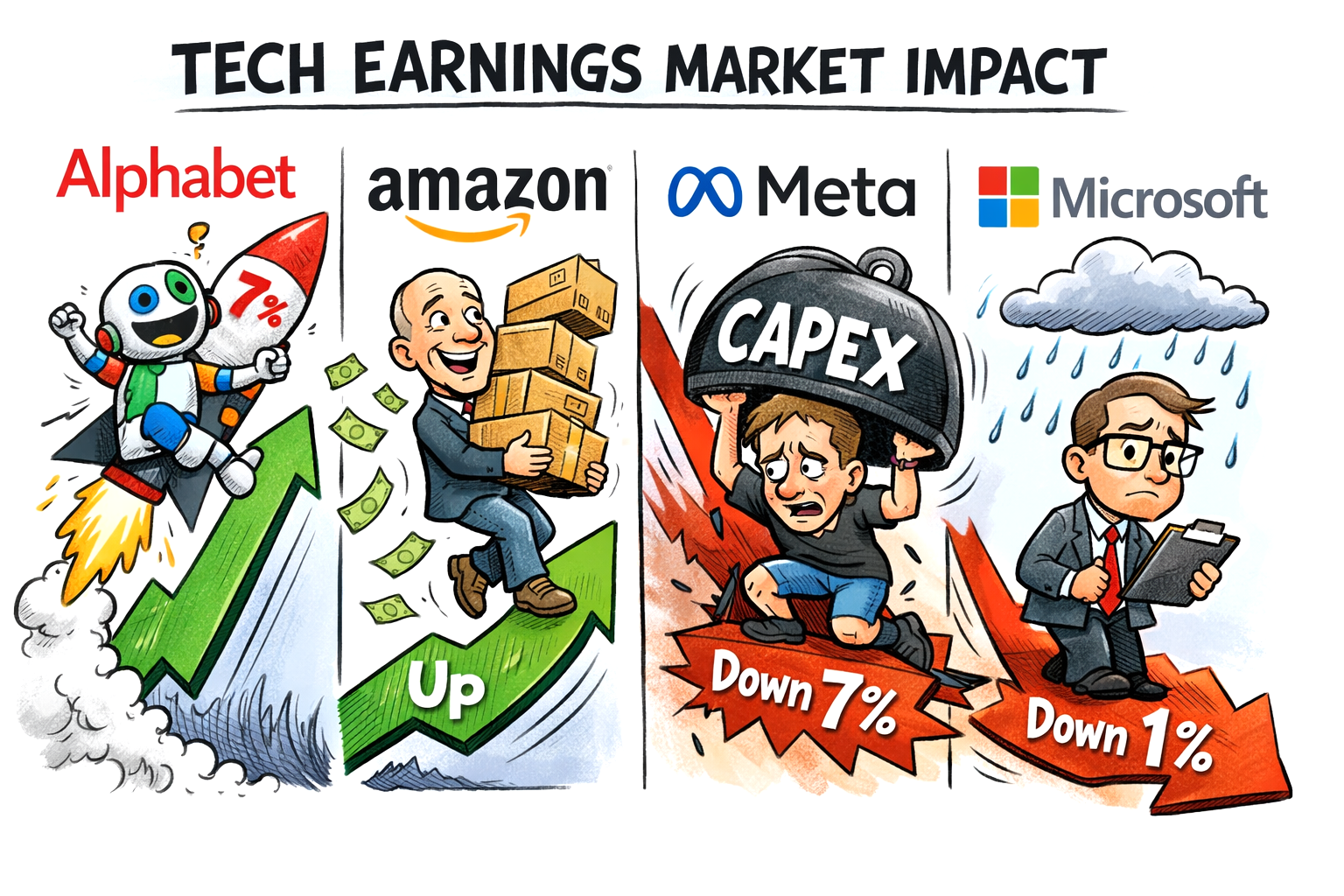
Alphabet and Amazon lifted markets sharply, while Meta fell and Microsoft dipped.

Alphabet’s strong cloud‑driven beat triggered a 7% after‑hours jump. Amazon also rose, gaining around 1–3% as investors welcomed AWS acceleration despite heavy AI spending.

Meta slumped 7% after hours on surging capex concerns.

Microsoft slipped about 1%, reflecting cautious sentiment despite solid cloud growth.

What Happens to the S&P 500 if the Magnificent Seven Fail to Deliver on AI?

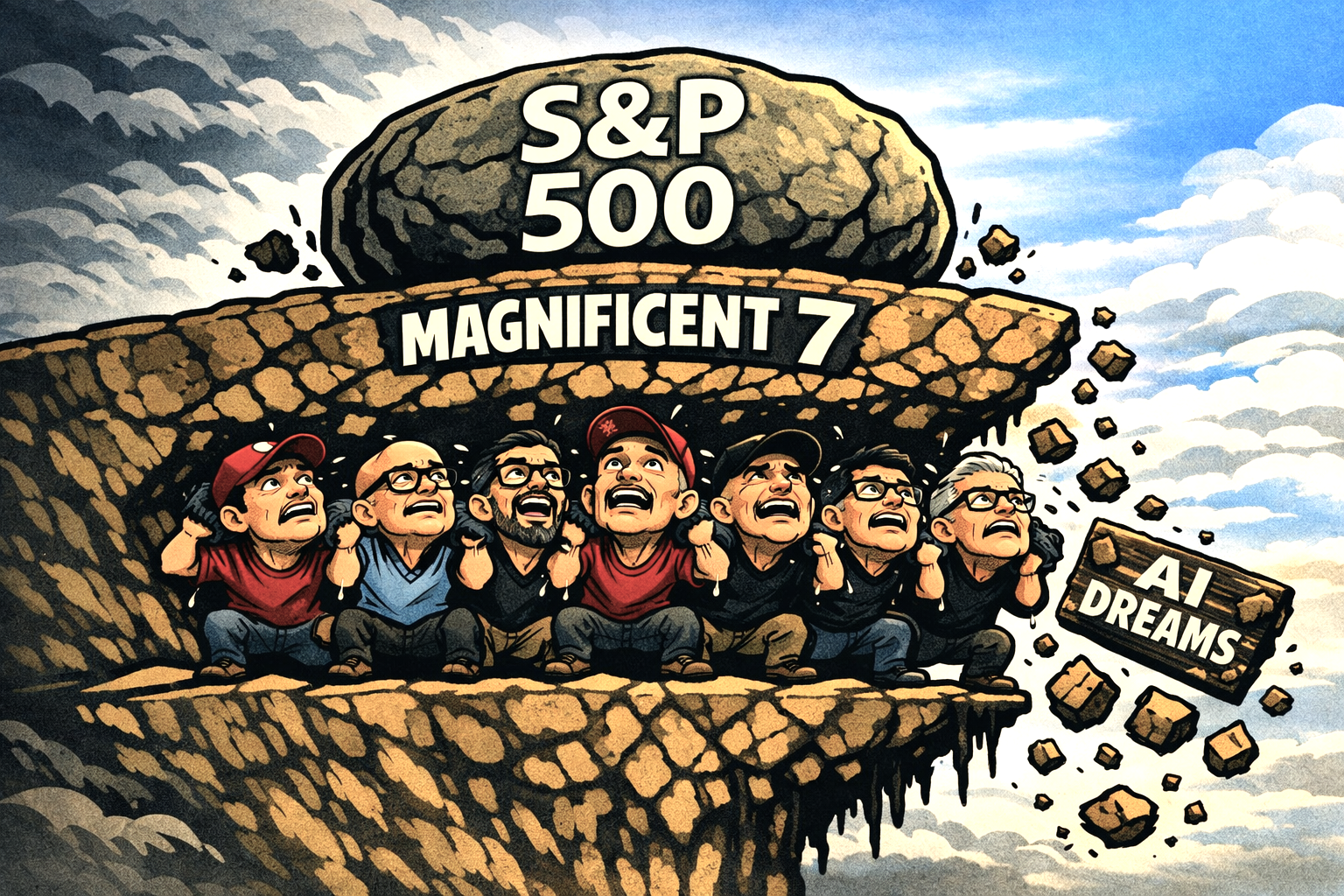
Mag 7 holding up the S&P 500 to the tune of almost 35% value of the entire S&P 500

The S&P 500 has never been so dependent on so few companies. The Magnificent Seven — Microsoft, Apple, Nvidia, Alphabet, Amazon, Meta and Tesla — now account for roughly one‑third of the entire index’s value – that’s 33% of the whole S&P 500 vlauation.

Their dominance is not simply a reflection of current earnings power; it is a collective bet on an AI‑centred future that investors assume will transform productivity, reshape industries and justify valuations that stretch far beyond historical norms.

If one, several, or all of these companies fail to deliver the AI revolution that markets have priced in, the consequences for the S&P 500 would be immediate, structural and potentially severe.

Mild

The mildest scenario is a stumble by one or two members. If Apple’s device strategy falters, or Tesla’s autonomy narrative weakens further for instance, the index absorbs the shock.

A 3–5% pullback is plausible, driven by mechanical index weighting rather than systemic fear. Investors already expect uneven performance within the group, and the remaining leaders could offset the disappointment.

Major

The more destabilising scenario is a collective slowdown among the AI infrastructure leaders – Microsoft, Nvidia and Alphabet. These firms sit at the centre of the global capex cycle.

If cloud AI demand proves slower, less profitable or more niche than expected, the market would be forced to reassess the entire economic promise of generative AI.

In this case, the S&P 500 could see a 10–15% correction as valuations compress, volatility spikes and passive flows unwind years of momentum.

Dramatic

The most dramatic outcome is a broad failure of the AI ‘sector’ itself. If the promised productivity gains do not materialise, if enterprise adoption stalls, or if regulatory and cost pressures erode margins, the S&P 500 would face a structural reset.

With a third of the index priced for exponential growth, a collective disappointment could trigger a decline of 20% or more.

This would not resemble a cyclical recession; it would be a leadership collapse similar to the dot‑com unwind, but with far greater concentration and far more passive capital tied to the winners.

The uncomfortable truth is that the S&P 500’s trajectory is now inseparable from the Magnificent Seven. If they deliver, the index continues to defy gravity. If they falter, the market must rebuild a new narrative — and a new set of leaders — from the ground up.

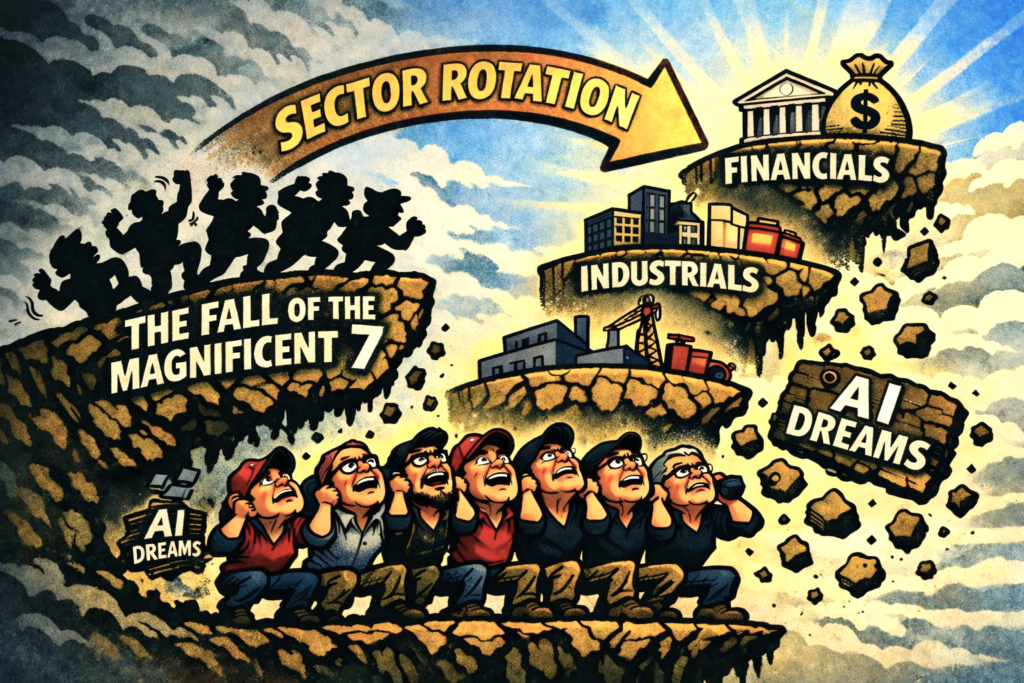
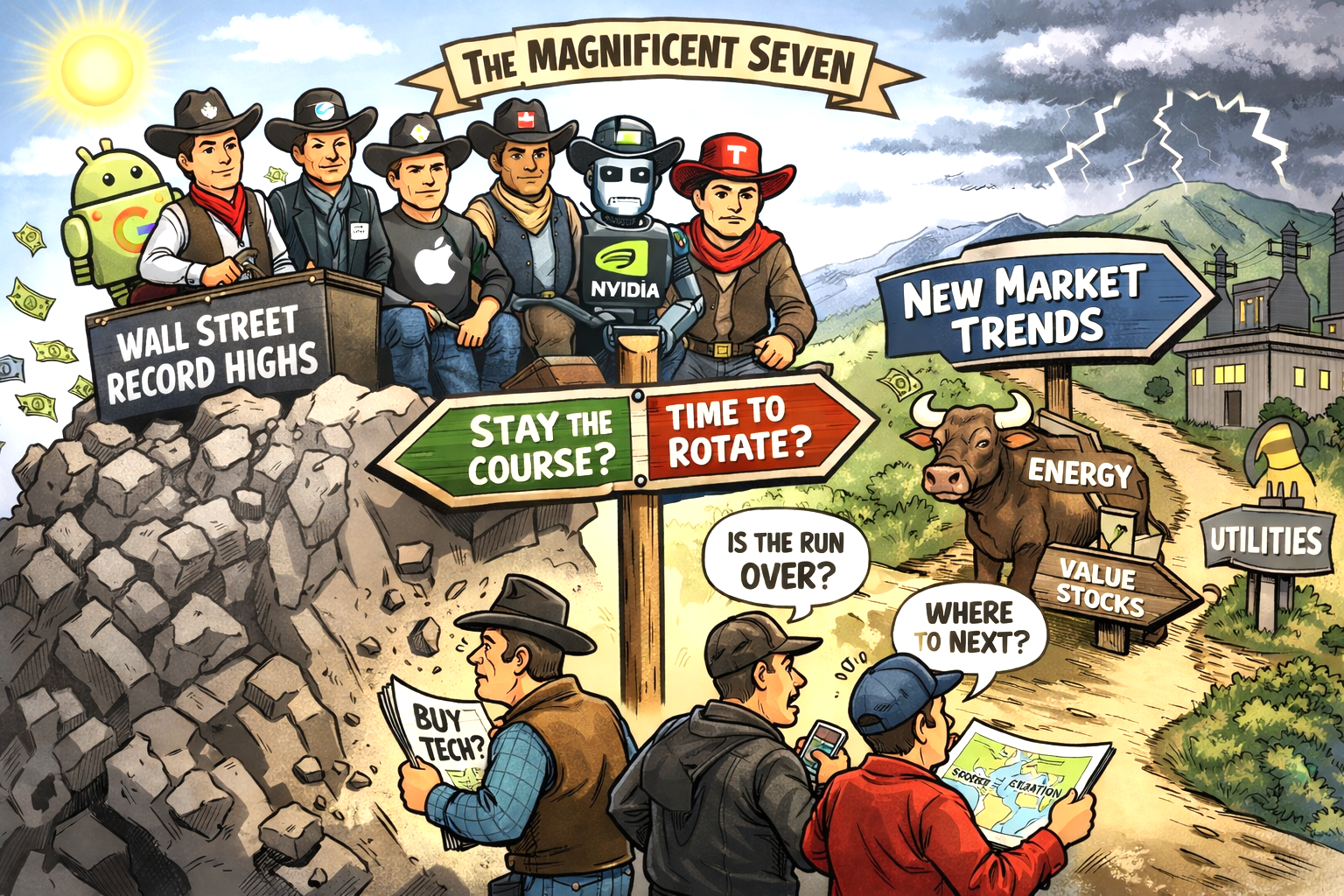
If the Magnificent Seven Lose Their Grip, Who Rises Next?

For years, the S&P 500 has been defined by the gravitational pull of the Magnificent Seven. Their dominance has shaped index performance, investor psychology and the entire narrative arc of global markets.

If these companies lose momentum — whether through slower AI adoption, regulatory pressure, margin compression or simple over‑expectation — leadership will not disappear.

It will rotate. And the beneficiaries are already hiding in plain sight.

Alternative investment to AI

The first and most obvious winners would be Energy and Utilities. As AI enthusiasm cools, investors tend to rediscover the appeal of tangible cash flow. Energy companies, with their dividends and pricing power, become natural refuges.

Utilities, often dismissed as dull, regain relevance as defensive anchors in a more volatile market. If AI‑driven data‑centre demand slows, the sector’s cost pressures ease, improving margins.

Next in line are Industrials and Infrastructure. A retreat from speculative tech would likely redirect capital towards physical productivity — logistics, construction, defence, electrification and manufacturing modernisation.

These sectors have been quietly compounding earnings while Silicon Valley has monopolised attention. If the market shifts from promise to proof, industrials become the new growth story.

Healthcare and Pharmaceuticals would also rise. Their earnings cycles are largely independent of AI hype, driven instead by demographics, innovation and regulatory frameworks. When tech stumbles, healthcare’s stability becomes a premium rather than an afterthought.

Biotech, in particular, benefits from capital rotation when investors seek uncorrelated growth.

Financials stand to gain as well. A correction in mega‑cap tech would rebalance passive flows, giving banks and insurers a larger share of index‑tracking capital. Higher rates and wider spreads already support the sector; a shift away from tech simply amplifies the effect.

Finally, Consumer Staples would reassert themselves. In a market recalibrating after an AI disappointment, investors gravitate towards predictable earnings. Food, beverages and household goods regain their defensive premium as volatility rises.

The broader truth is simple: if the Magnificent Seven falter, the S&P 500 does not collapse — it redistributes. Leadership moves from code to concrete, from speculative multiples to operational reality. The market has always found new champions. It will again.

Big Tech’s Talent Exodus Fuels a New Wave of AI Startups

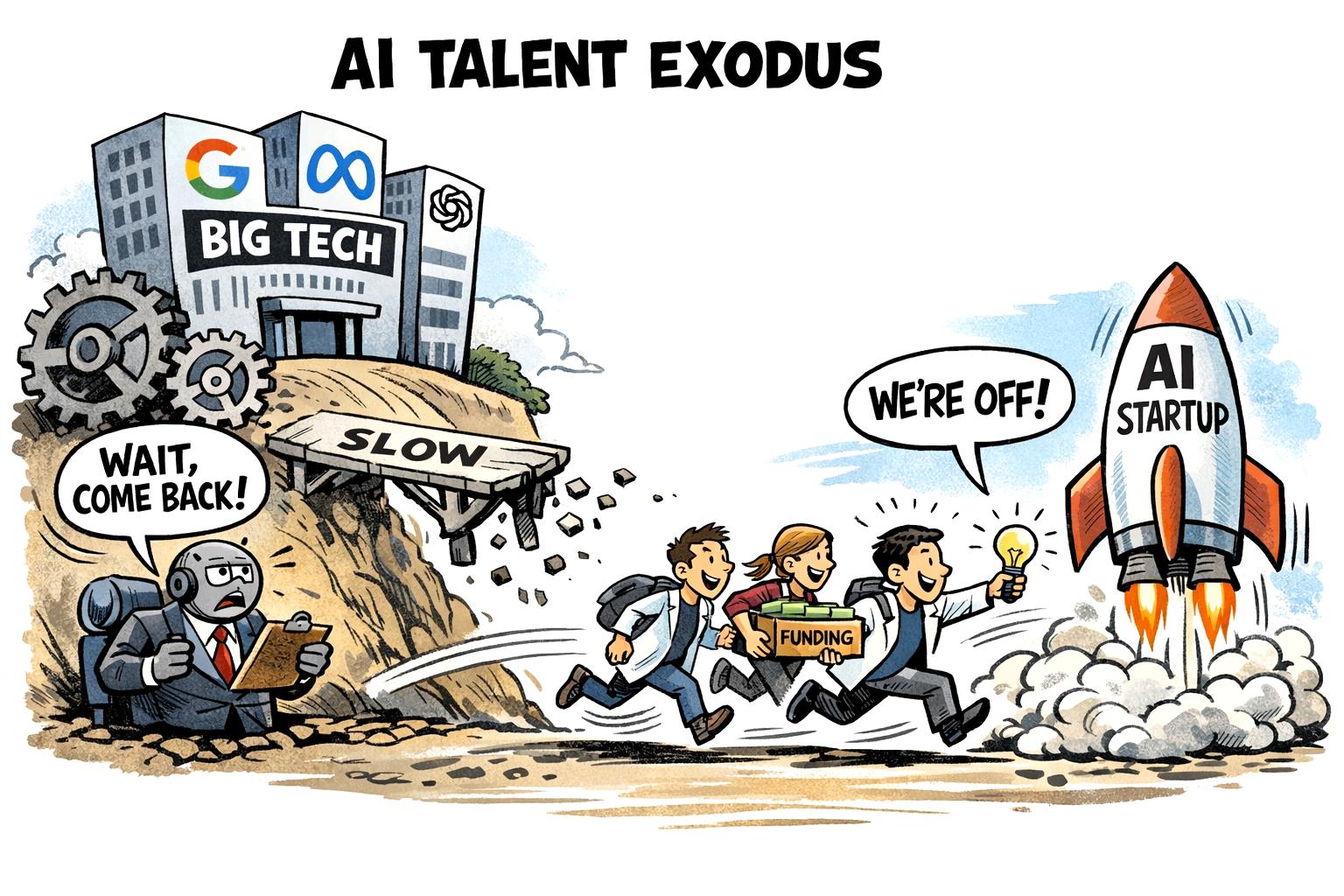
Big Tech AI Exodus

A quiet but decisive shift is under way in the global AI race: some of the most accomplished researchers at Meta, Google, OpenAI and other frontier labs are walking out of the biggest companies in the sector to build their own.

Trend

The trend has accelerated sharply over the past year, with new ventures raising extraordinary sums within months of being founded, as investors bet that smaller teams can move faster than the giants they left behind.

The motivations are remarkably consistent. Researchers say that the commercial pressure inside the largest AI labs has narrowed the scope of what they are allowed to explore.

Rush

With Big Tech locked into a high‑stakes contest to release ever‑larger models on tight schedules, entire areas of research — from new architectures to interpretability and agentic systems — are being deprioritised.

That creates an opening for smaller firms that can pursue ideas too experimental or too slow‑burn for corporate roadmaps.

Investors

Investors have responded with enthusiasm. Former Google DeepMind scientist David Silver secured a record $1.1 billion seed round for his new company, Ineffable Intelligence, while other ex‑DeepMind and ex‑Meta researchers are raising similar sums for ventures focused on reinforcement learning, continuous‑learning systems and autonomous labs.

In total, AI startups founded since early 2025 have already attracted nearly $19 billion in funding this year, putting them on track to surpass last year’s total.

Independence

Founders argue that independence gives them both speed and neutrality. Chip‑design startup Ricursive Intelligence, for example, says customers are more willing to trust a standalone company than a Big Tech competitor with its own hardware ambitions.

Many of these startups are also rebuilding their old teams, hiring colleagues from the very companies they left.

The result is a new competitive dynamic: Big Tech still dominates the AI landscape, but the frontier of innovation is increasingly being pushed by smaller, highly focused labs that believe they can out‑pace the giants – and with lower investment too.

Is the Magnificent Seven Trade a little less Magnificent now?

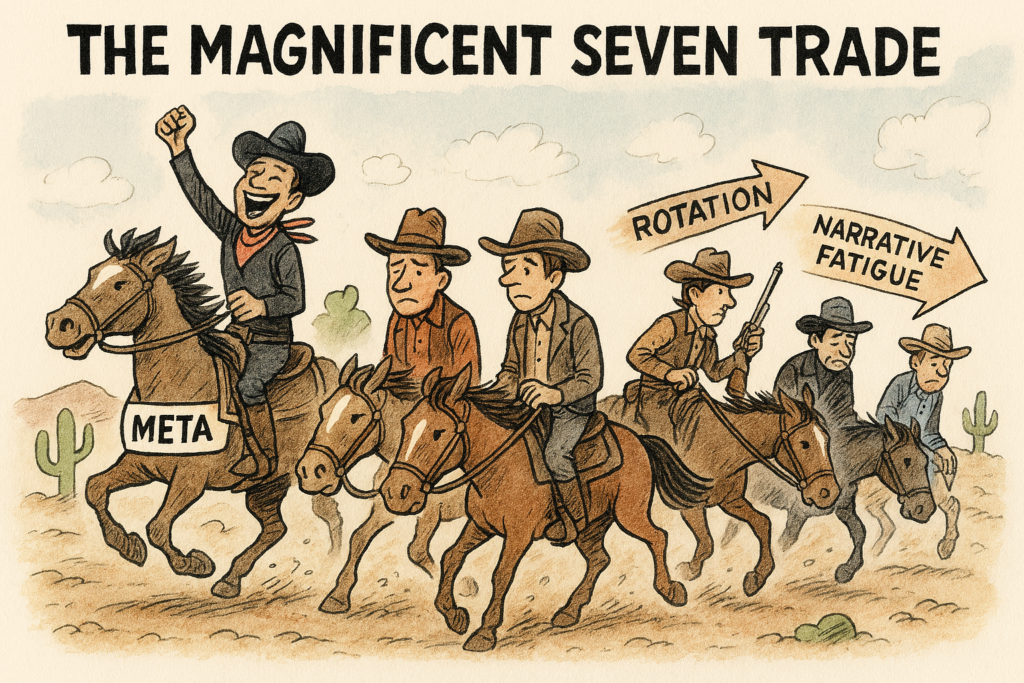
Magnificent Seven Stocks

For much of the past three years, the so‑called Magnificent Seven – Apple, Microsoft, Alphabet, Amazon, Meta, Tesla and Nvidia – have powered US equities to repeated record highs.

Their sheer scale, earnings strength and centrality to the AI boom turned them into a market narrative as much as an investment theme.

But as 2026 unfolds, the question is no longer whether they can keep leading the market higher, but whether the idea of treating them as a single trade still makes sense.

The short answer is closer to: the trade isn’t dead, but the era of effortless, broad‑based mega‑cap dominance is fading.

Mag 7 fatigue

The first sign of fatigue is the breakdown in cohesion. Last year, only a minority of the seven outperformed the wider S&P 500, a sharp contrast to the near‑uniform surges of 2023 and early 2024.

Nvidia and Alphabet continue to benefit from the structural demand for AI infrastructure and cloud‑driven productivity gains. Others, however, appear to be wrestling with slower growth, regulatory pressure or strategic resets.

Apple faces a maturing hardware cycle, Tesla is contending with intensifying global competition, and Meta’s spending plans continue to divide investors.

Mag 7 trade – which company is missing?

Divergence

This divergence matters. For years, investors could simply buy the group and let the rising tide of AI enthusiasm and index concentration do the work.

That simplicity has evaporated. Stock‑picking is back, and the market is finally distinguishing between companies with accelerating earnings power and those relying on past momentum.

At the same time, market breadth is improving. Capital is rotating into industrials and defensive sectors as investors seek exposure to areas that have lagged the mega‑cap rally. However, AI is affecting software stocks, law and financial sectors.

Healthy future

This broadening is healthy: it reduces concentration risk and signals that the U.S. economy is no longer dependent on a handful of tech giants to sustain equity performance.

Yet it would be premature to declare the Magnificent Seven irrelevant. Their combined earnings growth is still expected to outpace the rest of the index, and their role in AI, cloud computing and digital infrastructure remains foundational.

Change

What has changed is the nature of the trade. These are no longer seven interchangeable vehicles for tech exposure; they are seven distinct stories with diverging trajectories.

The Magnificent Seven haven’t left the stage. They have likely stopped performing in unison – and for investors, that marks the beginning of a more nuanced, more selective chapter.

China’s AI Tech Surge Puts Pressure on America’s AI Dominance

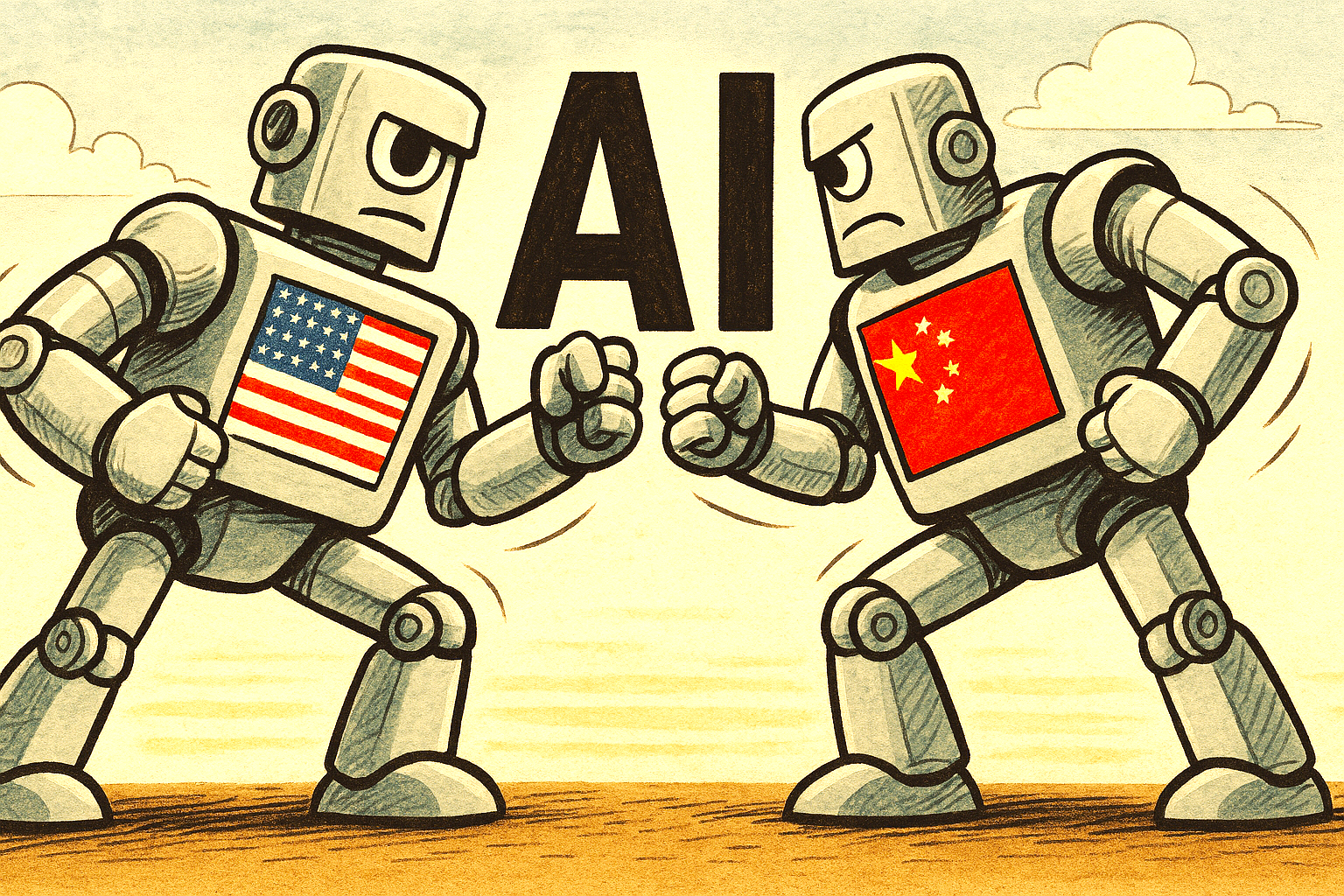
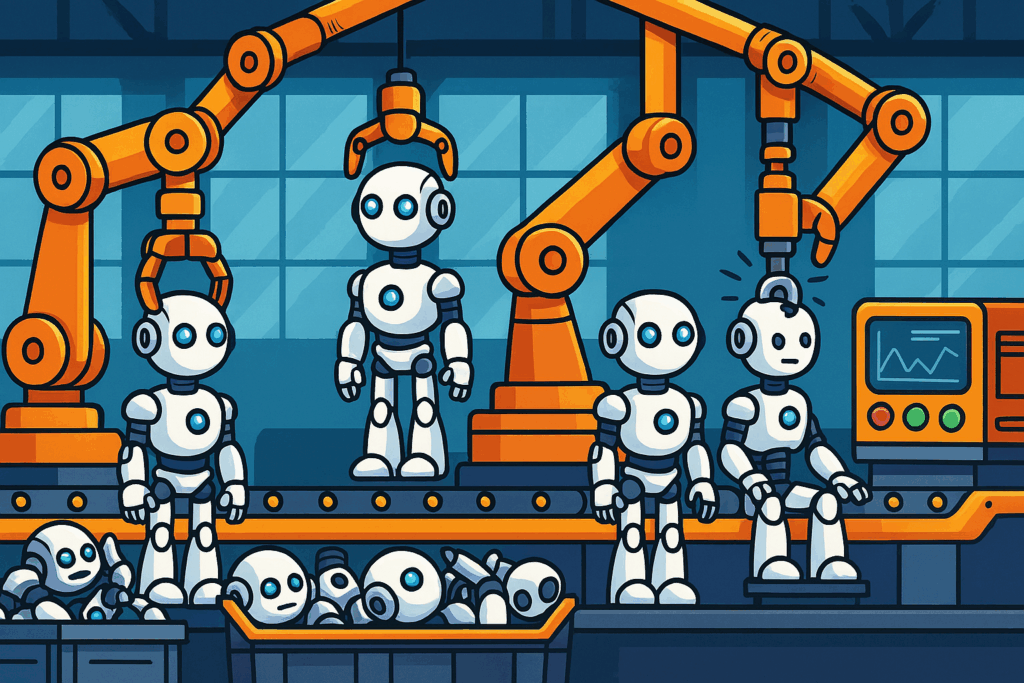
Robots line up for AI battle

For much of the modern AI era, the United States has held a clear advantage in frontier research, compute infrastructure, and commercial deployment.

Silicon Valley’s combination of elite talent, abundant capital, and world‑class semiconductor design created an environment where breakthroughs could scale at extraordinary speed.

Challenge

That dominance, however, is no longer uncontested. China’s accelerating push into advanced AI is reshaping the global technological landscape and posing the most credible challenge yet to America’s leadership.
China’s strategy is not built on a single breakthrough but on coordinated national effort. Beijing has spent years aligning universities, state‑backed funds, and private‑sector giants around a shared objective: achieving self‑sufficiency in critical technologies and becoming a global AI powerhouse.

Competitive

Companies such as Huawei, Baidu, Alibaba and Tencent are now producing increasingly competitive large models, while domestic chipmakers are narrowing the performance gap with U.S. suppliers despite export controls.

Crucially, China’s AI ecosystem benefits from scale and cost advantages that the U.S. cannot easily replicate.

Massive data availability, lower energy costs, and vertically integrated supply chains allow Chinese firms to train and deploy models at prices that appeal to developing economies.

For many countries, especially those already reliant on Chinese infrastructure, adopting a Chinese AI stack is becoming a pragmatic economic choice rather than a geopolitical statement.

Investment returns?

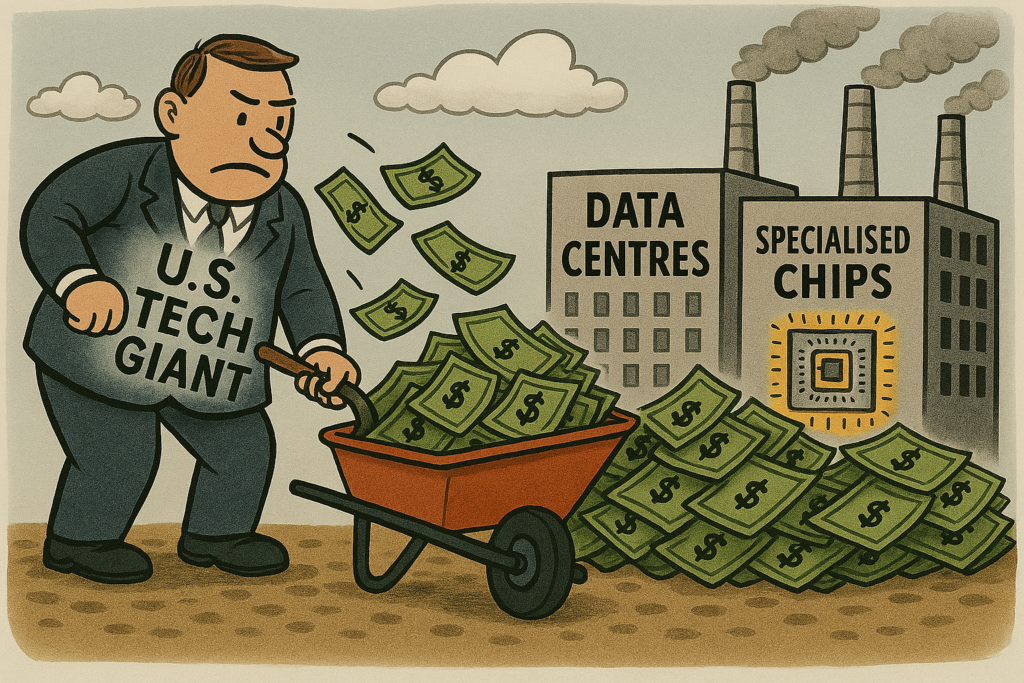
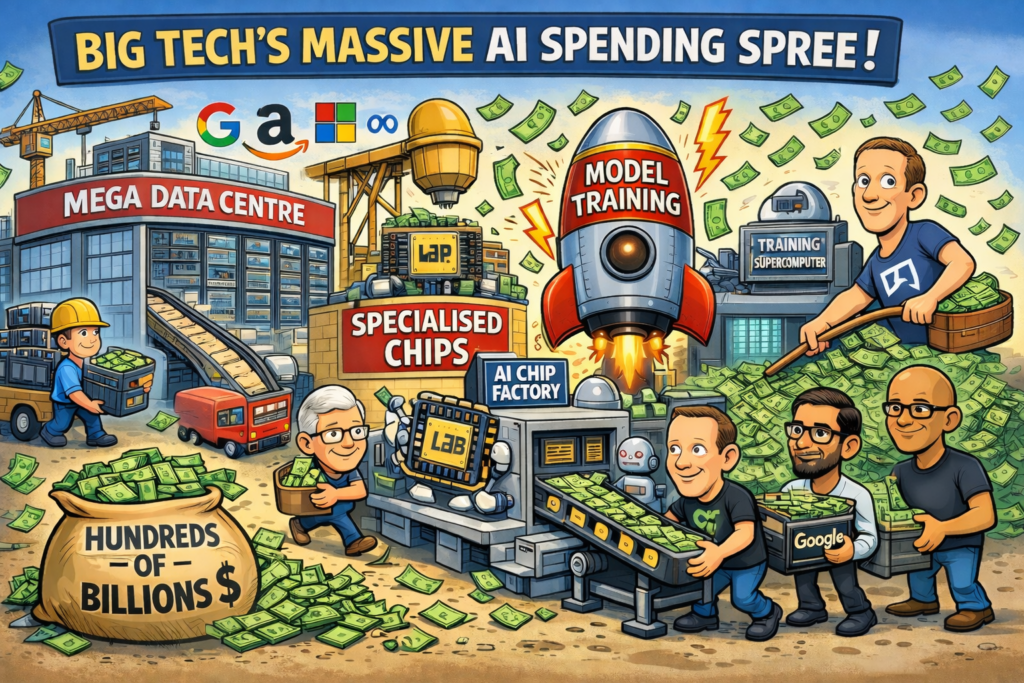
This shift is occurring just as U.S. tech giants embark on unprecedented spending cycles. Hyperscalers are pouring hundreds of billions of dollars into data centres, specialised chips, and model training.

The U.S. and its massive BIG Tech Spending Spree – Feeding the AI Habit

While this investment underscores America’s determination to stay ahead, it also raises questions about sustainability.

Investors are increasingly asking whether such vast capital expenditure can deliver long‑term returns in a world where China is offering cheaper, rapidly improving alternatives.

The emerging reality is not one of immediate American decline but of a genuinely multipolar AI landscape. The U.S. still leads in foundational research, top‑tier talent, and cutting‑edge semiconductor design.

Yet China’s rise represents a powerful economy that has mounted a serious challenge to the technological frontier.

The global AI race is no longer defined by a single centre of gravity. Instead, two competing ecosystems — one market‑driven, one reportedly state‑directed — are shaping the future of intelligent technology.

The outcome will influence not only economic power but the digital architecture of much of the world.

Alibaba Steps Into ‘Physical AI’ With New Robotics Model

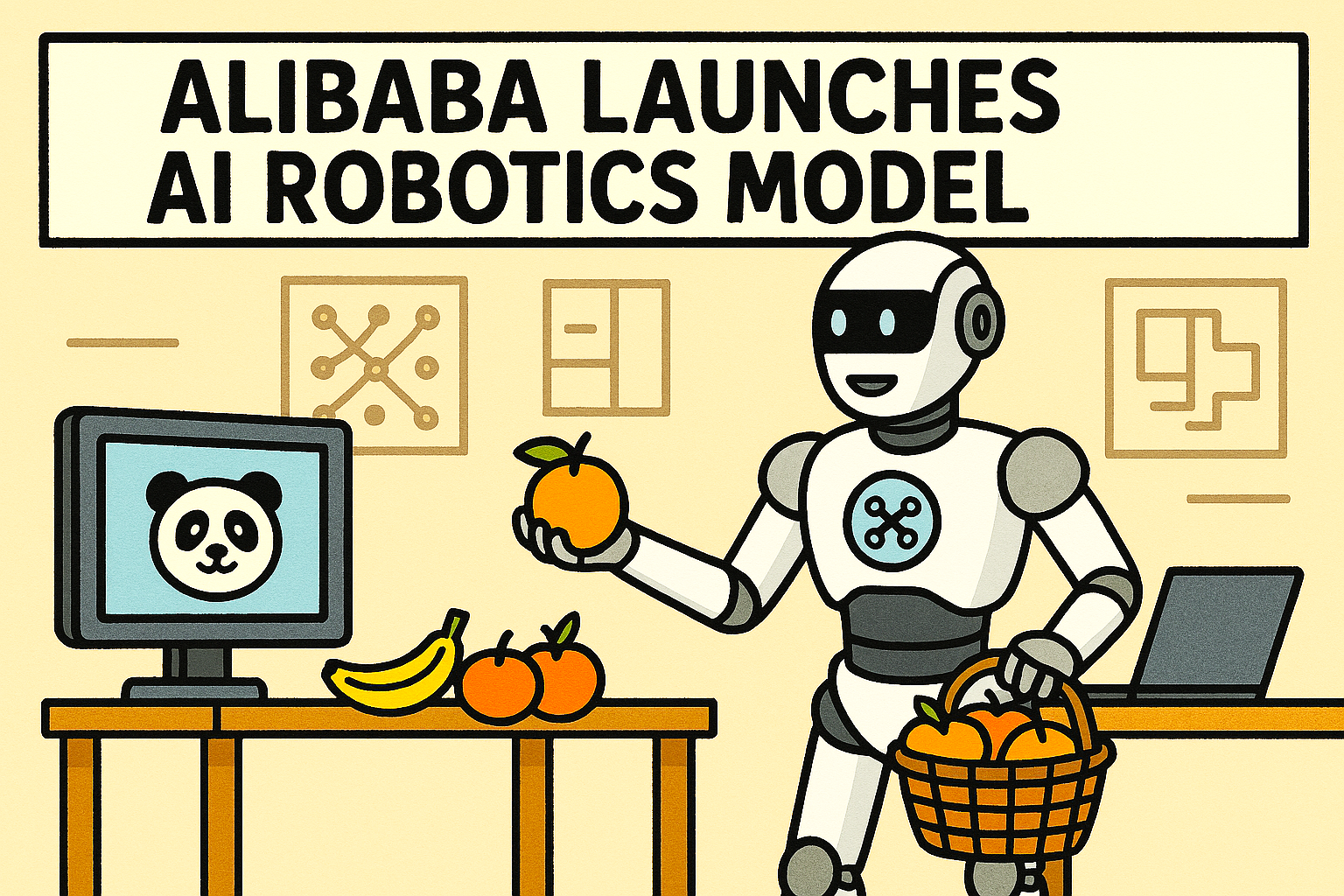
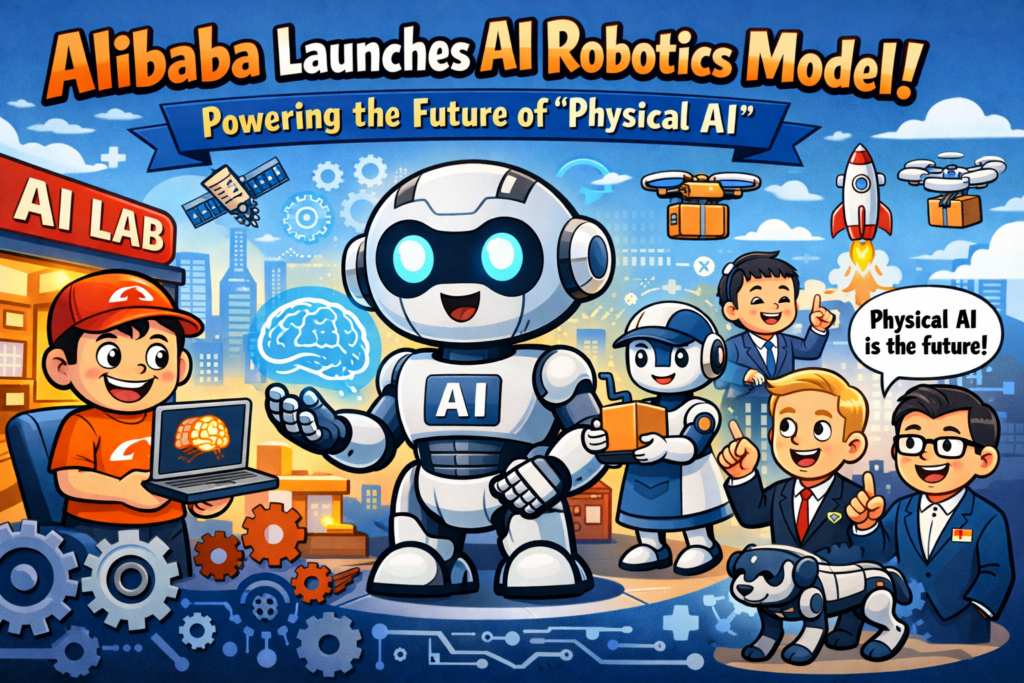
AI robotics model

China’s Alibaba has taken a decisive step into the fast‑emerging field of ‘physical AI’ with the launch of a new foundation model designed specifically to power real‑world robots.

The model, known as RynnBrain*, marks one of the company’s most ambitious moves since restructuring its cloud and research divisions, and signals China’s intention to compete directly with the United States in embodied artificial intelligence.

Unlike traditional large language models, which operate entirely in digital environments, RynnBrain is built to interpret and act within the physical world.

It combines vision, language and spatial reasoning, enabling robots to recognise objects, understand their surroundings and plan multi‑step actions.

DAMO Acadamy

In demonstrations released by Alibaba’s DAMO Academy, the model guided a robot through tasks such as identifying fruit and sorting it into containers — a deceptively simple exercise that requires sophisticated perception and motor control.

The company describes RynnBrain as a ‘general‑purpose embodied intelligence model’, capable of supporting a wide range of robotic applications, from warehouse automation to domestic assistance.

Crucially, Alibaba has opted to open‑source the model, a strategic decision that invites global developers to build on its capabilities and accelerates the creation of a broader ecosystem around Chinese robotics research.

Physical AI

The timing is significant. Over the past year, major technology firms including Google, Nvidia and OpenAI have begun to emphasise physical AI as the next frontier of artificial intelligence.

The shift reflects a growing belief that the most transformative applications of AI will not be confined to screens, but will instead involve machines that can navigate, manipulate and collaborate within human environments.

Alibaba’s entry adds competitive pressure to a field already heating up. While U.S. companies currently dominate embodied AI research, China has made robotics a national priority, viewing it as a strategic industry with implications for manufacturing, logistics and economic resilience.
RynnBrain

By releasing RynnBrain openly, Alibaba positions itself as both a contributor to global research and a catalyst for domestic innovation.

The launch also highlights a broader trend: the convergence of AI models with physical systems. As robots become more capable and more affordable, the line between software intelligence and mechanical action is beginning to blur.

RynnBrain is an early example of this shift — a model designed not just to understand language or images, but to translate that understanding into purposeful action.

Whether Alibaba’s approach will reshape the global robotics landscape remains to be seen, but the message is clear: the race to build the brains of future machines is accelerating, and China intends to be at the forefront.

Other Major Players in Physical AI

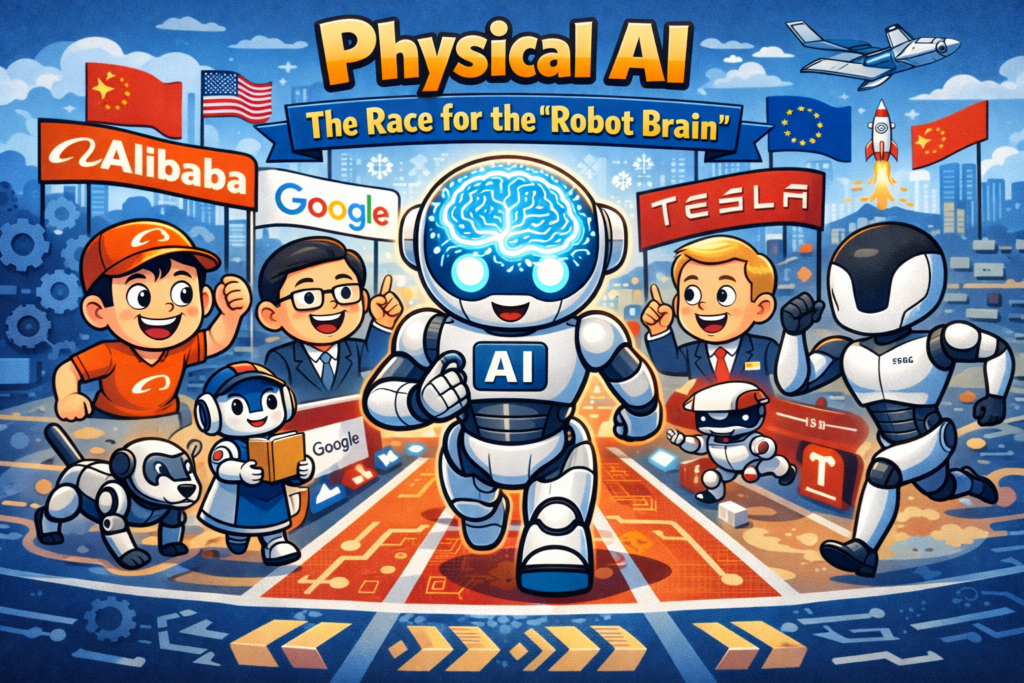
Physical AI — AI that can perceive, reason and act in the real world — has become the next strategic battleground for global tech giants. Alibaba is far from alone.

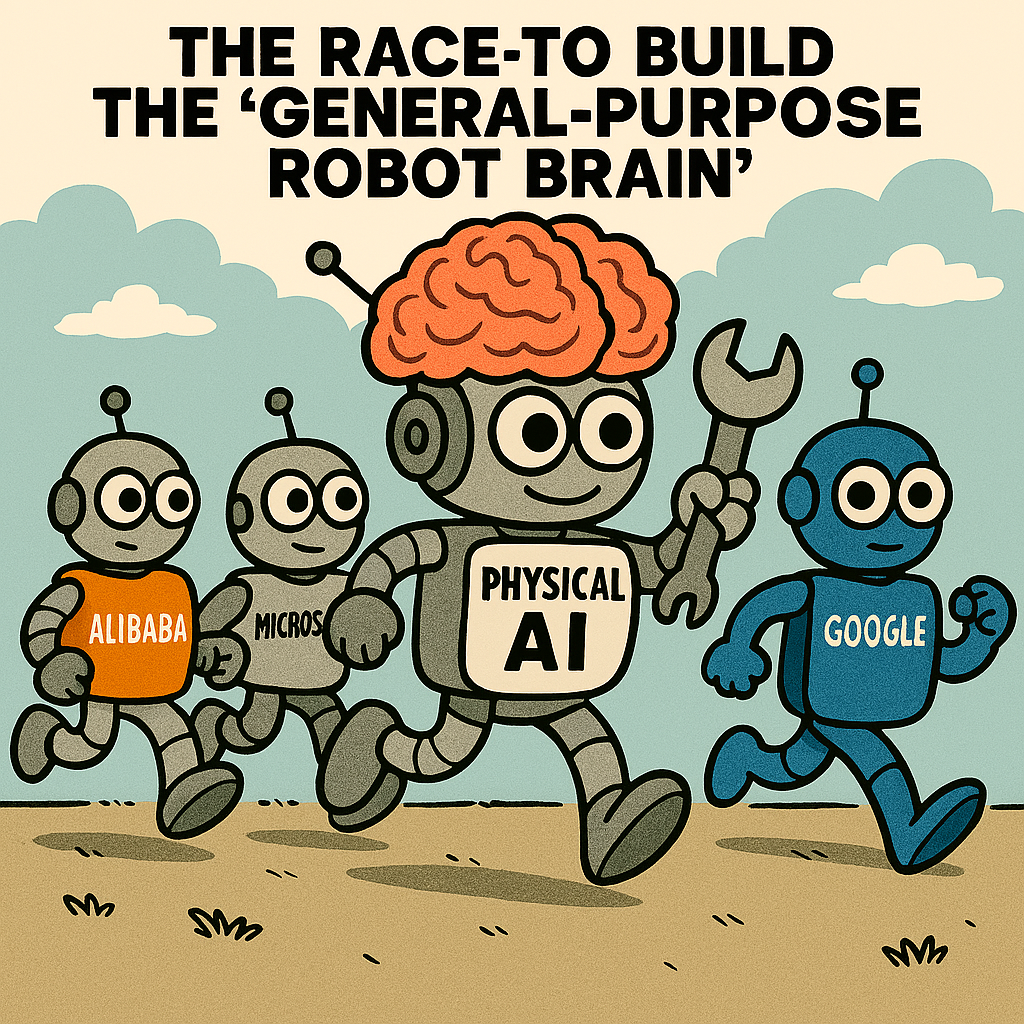
Several companies are racing to build the ‘general‑purpose robot brain’.

Below are the most significant players.

1. Google DeepMind

Focus: Embodied AI, robotics‑ready multimodal model’s Key systems:

RT‑2 (Robotic Transformer)

Gemini‑based robotics extensions

Google has been working on robotics for over a decade. RT‑2 was one of the first models to show that a language model could directly control a robot arm, interpret objects, and perform multi‑step tasks.

DeepMind is now integrating robotics capabilities into the Gemini family.

2. OpenAI

Focus: General‑purpose embodied intelligence Key systems:

OpenAI Robotics (revived internally)

Vision‑language‑action research

OpenAI paused robotics in 2020 but has quietly restarted the programme. Their models are being trained to understand video, track objects and perform physical tasks. They are also working with hardware partners to test embodied versions of their models.

3. Nvidia

Focus: The infrastructure layer for physical AI Key systems:

  • Nvidia Isaac (robotics platform)
  • Cosmos models
  • Omniverse simulation

Nvidia is not building consumer robots; it is building the entire ecosystem for everyone else. Its simulation tools, training environments and robotics‑ready AI models are becoming the backbone of the industry.

4. Tesla

Focus: Humanoid robotics Key system:

  • Optimus (Tesla Bot)

Tesla is training its robot using the same AI stack as its autonomous driving system. The company claims Optimus will eventually perform factory and household tasks.

It is one of the most visible attempts to build a general‑purpose humanoid robot.

5. Amazon

Focus: Warehouse automation and domestic robotics Key systems:

  • Proteus (autonomous warehouse robot)
  • Astro (home robot)

Amazon is integrating multimodal AI into its logistics robots and experimenting with home assistants that can navigate physical spaces.

6. Figure AI

Focus: General‑purpose humanoid robots’ Key system:

  • Figure 01

Backed by OpenAI, Microsoft and Nvidia, Figure is developing a humanoid robot designed to perform everyday tasks.

Their recent demos show robots manipulating objects and responding to natural language instructions.

7. Boston Dynamics

In partnership with Google’s DeepMind Boston Dynamics is also building a ‘foundation model intelligence’ robot brain.

The Big Picture

Alibaba is entering a field dominated by U.S. companies, but the global race is wide open. Physical AI is becoming the next strategic platform — the equivalent of smartphones in the 2000s or cloud computing in the 2010s.

*RynnBrain explained

RynnBrain is Alibaba’s open‑source ‘physical AI‘ framework designed to give robots far more capable real‑world intelligence, enabling them to plan, navigate, and manipulate objects across dynamic environments such as factories and homes.

Developed by the company’s DAMO Academy, it competes directly with Google’s Gemini Robotics and Nvidia’s Cosmos‑Reason models, with Alibaba claiming stronger benchmark performance.

The system is released openly on platforms like GitHub and Hugging Face, offered in configurations from lightweight 2‑billion‑parameter models to advanced mixture‑of‑experts variants, and includes specialised versions—Plan, Nav, and CoP—targeting manipulation, navigation, and spatial reasoning respectively.

Its launch signals China’s ambition to lead global robotics and embodied AI development.

Artificially Inflated Artificial Intelligence Stocks – The FOMO Effect?

Fear of Missing Out FOMO

The meteoric rise of artificial intelligence (AI) stocks has captivated investors worldwide, but beneath the headlines lies a growing concern: are these valuations built on genuine fundamentals, or are they the product of collective psychology?

Increasingly, analysts point to the possibility that the fear of missing out (FOMO) is a potential driver of this rally, especially in the AI related ‘retail’ trader.

The European Central Bank recently warned that AI-related equities, particularly the so-called ‘Magnificent Seven’ tech giants—Alphabet, Amazon, Apple, Meta, Microsoft, Nvidia, and Tesla—are showing signs of ‘stretched valuations‘.

This echoes the dot-com bubble of the late 1990s, when enthusiasm for the internet led to unsustainable price surges.

Today, investors are piling into AI stocks not only because of their technological promise but also because they fear being left behind in what could be a transformative era.

Nvidia, now the world’s most valuable company, exemplifies this trend. Its dominance in AI chips has fuelled extraordinary gains, yet critics argue its valuation has raced far ahead of realistic earnings expectations.

The psychology is clear: when investors see others profiting, they rush in, often ignoring traditional measures of risk and return.

This dynamic creates a paradox. On one hand, AI undeniably represents a revolutionary force with vast potential across industries. On the other, the concentration of capital in a handful of firms raises systemic risks.

If expectations falter, the correction could be brutal, much like the dot-com crash that erased trillions in market value.

Ultimately, the AI boom may prove to be both a genuine technological leap and a speculative bubble. For sure there are undeniable revolutionary technological advancements right now – but is it all just too fast and too soon?

The challenge for investors is to distinguish between sustainable growth and hype-driven inflation—before it is too late.

The FOMO monster is definitely ‘artificially’ affecting the U.S. stock market – it will likely reveal itself soon.

China’s humanoid robots are coming for Elon Musk’s Tesla $1 trillion dollar payday

China humanoid robot challenge

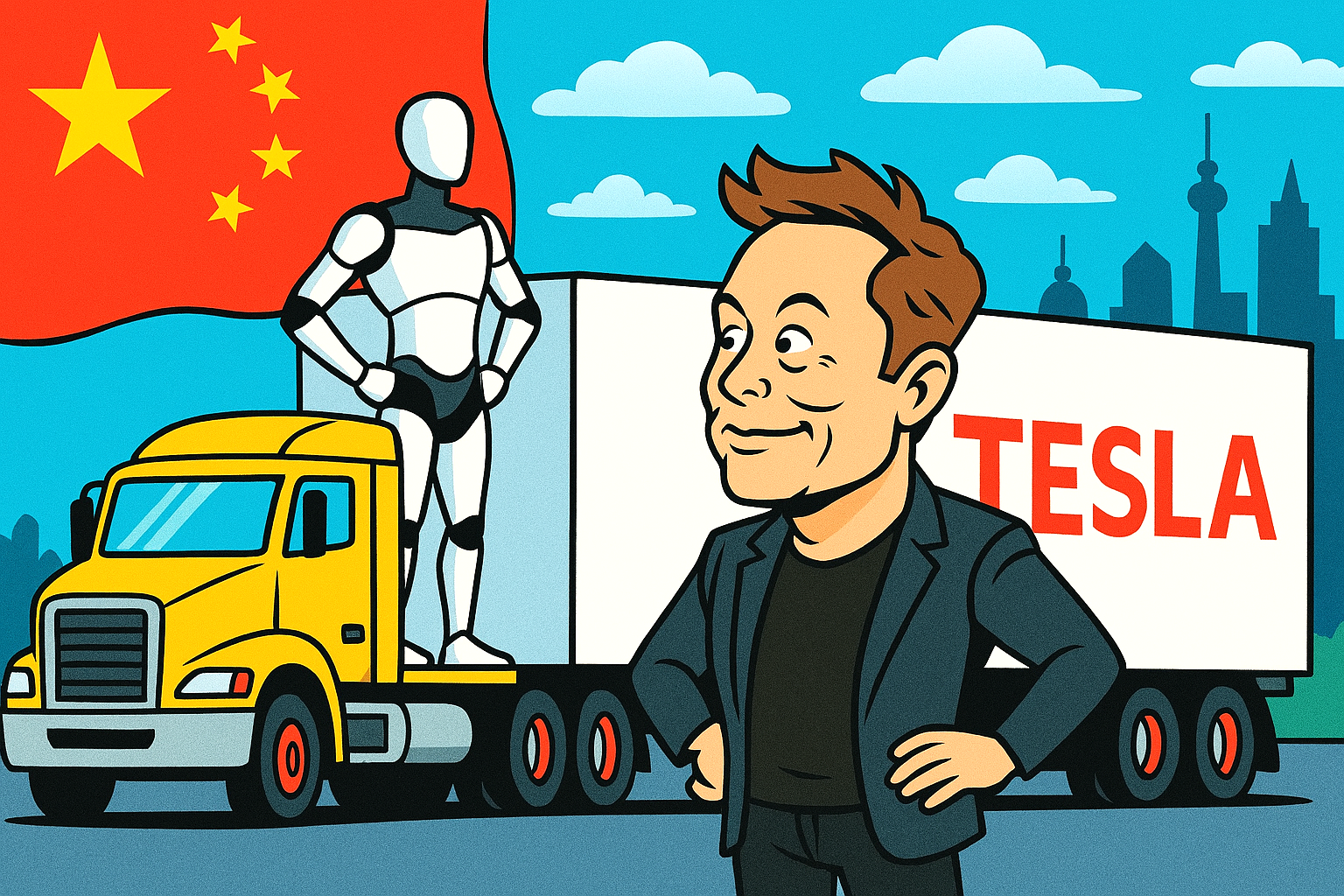
Elon Musk’s $1 trillion Tesla payday is tightly bound to the rise of humanoid robots—and China’s role in their production may determine whether his vision succeeds.

Elon Musk’s record-breaking compensation package, worth up to $1 trillion, hinges on Tesla’s transformation from an electric vehicle pioneer into a robotics powerhouse.

At the centre of this ambition is Optimus, Tesla’s humanoid robot, designed to walk, learn, and mimic human actions. Musk envisions deploying one million robots within the next decade, a scale that would redefine both Tesla’s business model and the global labour market.

Yet the road to mass production likely runs directly through China. While Tesla engineers designed prototype Optimus in the United States, China dominates the industrial infrastructure and critical components needed for large-scale deployment.

Robot installations in China

In 2023 alone, China reportedly installed over 290,000 industrial robots, more than the rest of the world combined, and reached a robot density of 470 per 10,000 workers, surpassing Japan and Germany.

This aggressive expansion is reportedly backed by state subsidies, low-cost financing, and mandates requiring provincial governments to integrate automation into their restructuring plans.

For Musk, this creates both opportunity and risk. On one hand, China’s manufacturing ecosystem offers the scale and efficiency necessary to bring Optimus to market at competitive costs.

On the other, Beijing’s strict regulations on humanoid robots introduce uncertainty, with geopolitical permission becoming the most unpredictable factor in Tesla’s robot revolution.

If Musk can navigate these challenges, Optimus could anchor Tesla’s evolution into a robotics giant, securing the milestones required for his trillion-dollar payday, and beyond.

But if Chinese competitors or regulatory hurdles slow progress, Tesla risks losing ground in the very sector Musk believes will make work ‘optional’ and money ‘irrelevant’.

In short, the robots coming from China are not just machines—they are very much the ‘key code’ to Musk’s trillion-dollar future.

Never underestimate Elon Musk.

Tesla’s China Sales Plunge to Three-Year Low Amid Fierce Competition

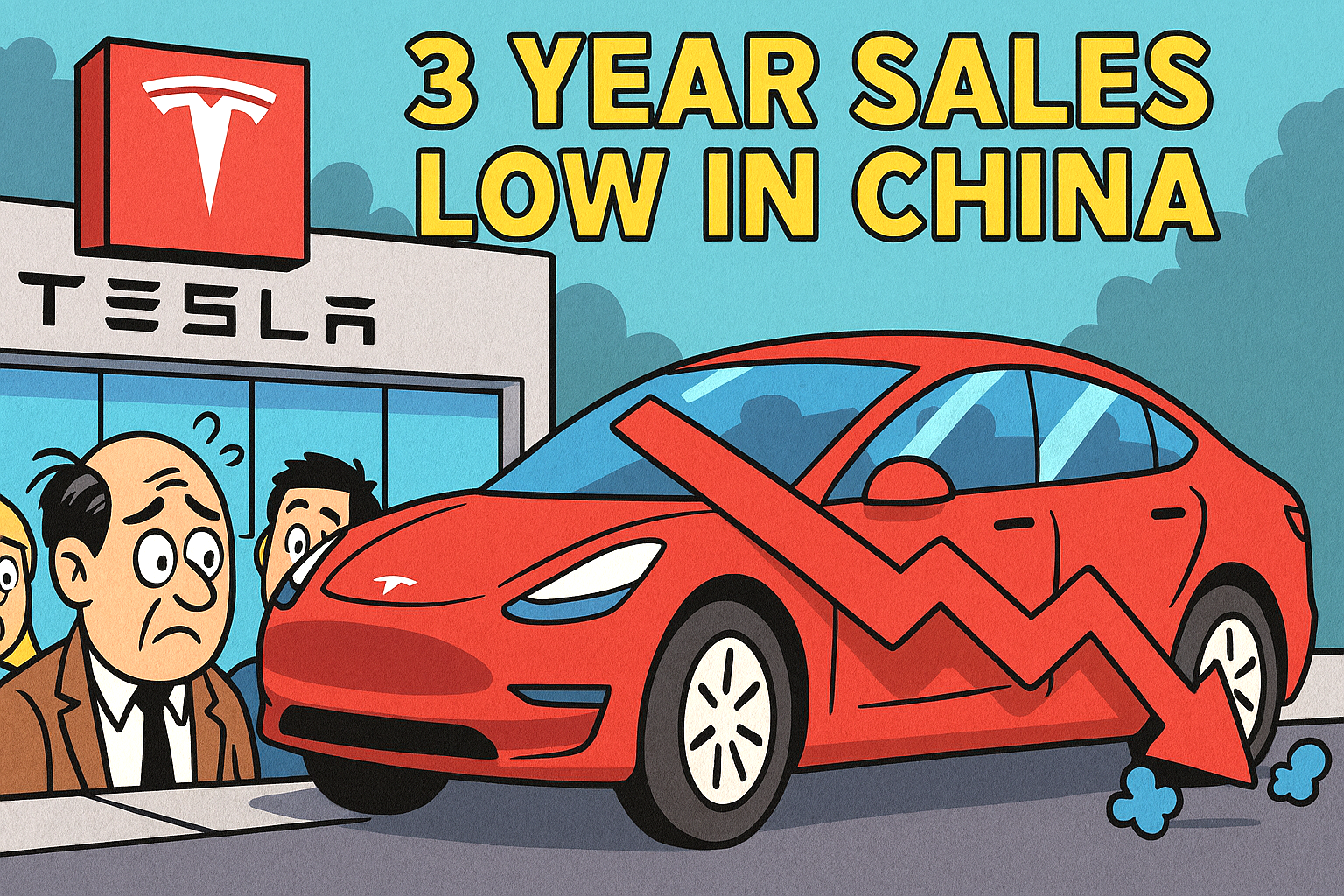
Tesla sales fall in China

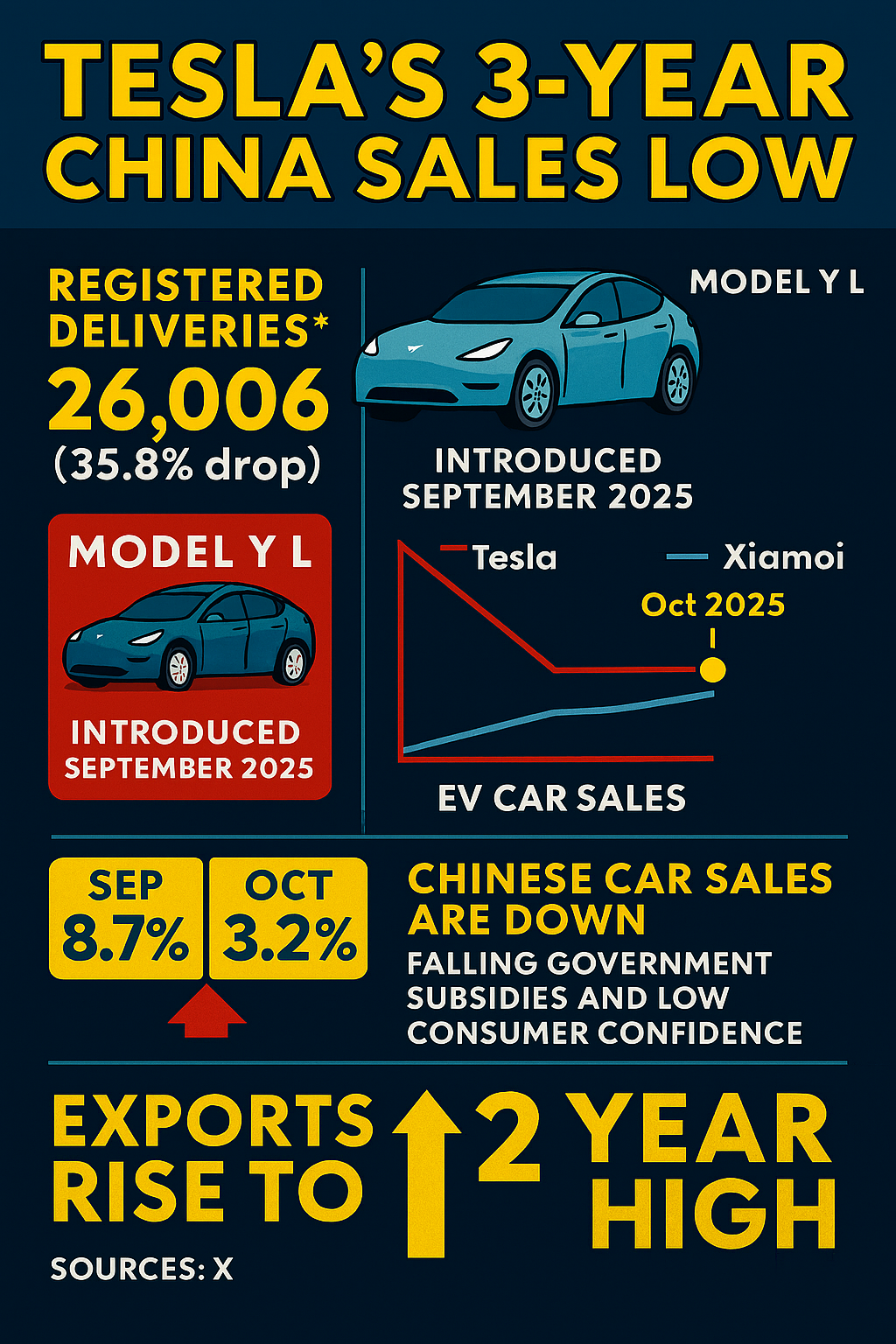
Tesla has hit a troubling milestone in China, with October 2025 marking its lowest monthly sales in three years.

The American electric vehicle giant sold just 26,006 units, a staggering 35.8% (approx’) drop compared to the same month last year.

This slump follows a brief surge in September 2025, when Tesla launched the Model Y L—a longer-wheelbase, six-seat version tailored for Chinese consumers.

Despite initial enthusiasm, the momentum quickly faded as domestic rivals ramped up their offerings. Xiaomi, for instance, recorded 48,654 EV sales in October 2025, outpacing Tesla and highlighting the growing strength of local brands.

Tesla’s market share in China’s EV sector shrank to around 3.2%, down from 8.7% the previous month, underscoring the brand’s struggle to maintain relevance in the world’s most competitive electric vehicle market.

Broader economic factors also played a role, with overall car sales in China declining amid reduced government subsidies and waning consumer confidence.

While Tesla’s exports from China rose to a two-year high, the domestic downturn signals a strategic challenge.

As local manufacturers innovate rapidly and offer aggressive pricing, Tesla will likely rethink its approach to regain traction in a market that once promised boundless growth.

Tesla’s $1 Trillion Bet on Elon Musk

$1 trillion Elon pay deal

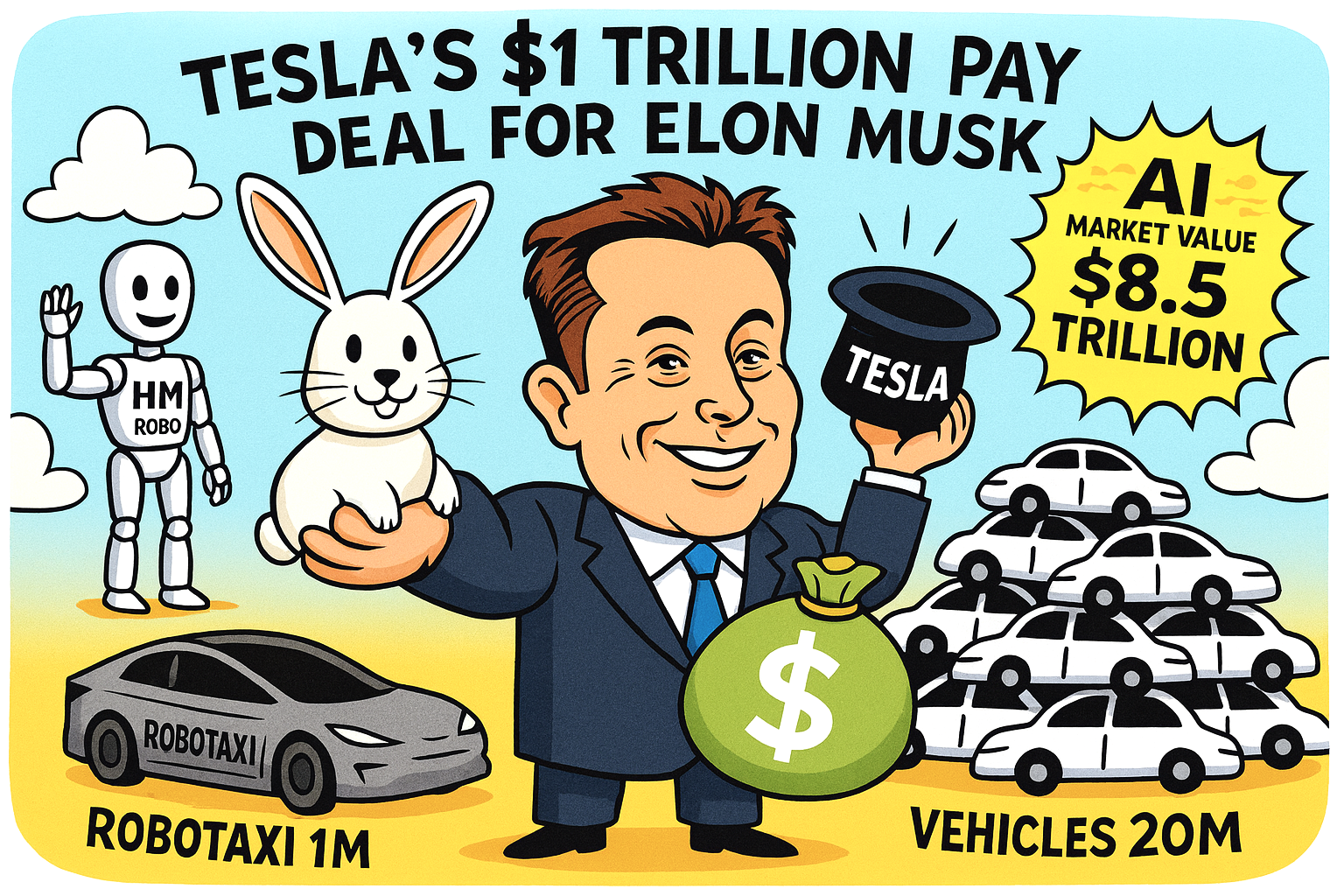
In a move that has stunned financial analysts, corporate governance experts, and the broader public alike, Tesla Inc. has approved a record-breaking $1 trillion (£761 billion) compensation package for its CEO, Elon Musk.

In a landmark decision, Tesla shareholders have approved a staggering $1 trillion (£761 billion) compensation package for CEO Elon Musk, marking the largest executive pay deal in corporate history.

The vote, held at Tesla’s annual meeting in Austin, Texas, reportedly saw over 75% of investors back the plan, reaffirming their confidence in Musk’s leadership and long-term vision.

Share deal

The deal is entirely performance-based, with Musk eligible to receive up to 423 million Tesla shares if the company meets a series of ambitious milestones.

These include producing 20 million vehicles annually, deploying one million robotaxis and humanoid robots, and reaching a market valuation of $8.5 trillion.

Reportedly there is no salary or cash bonus—Musk’s payout depends solely on Tesla’s success.

Supporters argue the package aligns Musk’s incentives with shareholder interests, encouraging innovation and growth.

Critics, however, warn of governance risks and the unprecedented concentration of wealth and power.

Musk, already the world’s richest person, could become the first trillionaire if Tesla achieves its targets.

The vote signals Tesla’s intent to evolve beyond electric vehicles into a broader tech powerhouse, betting on AI, robotics, and autonomy—with Musk at the helm.

Are we looking at an AI house of cards? Bubble worries emerge after Oracle blowout figures

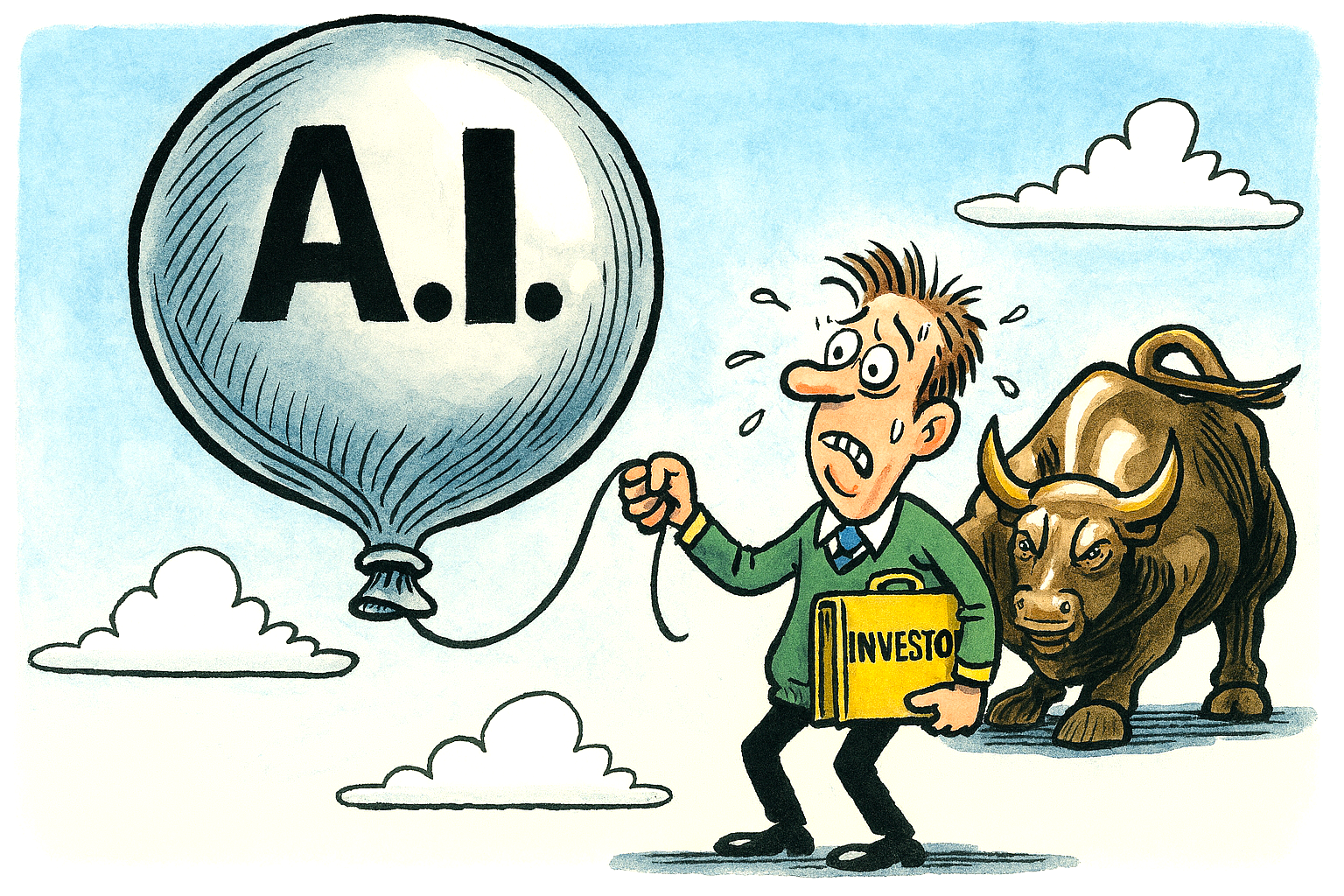
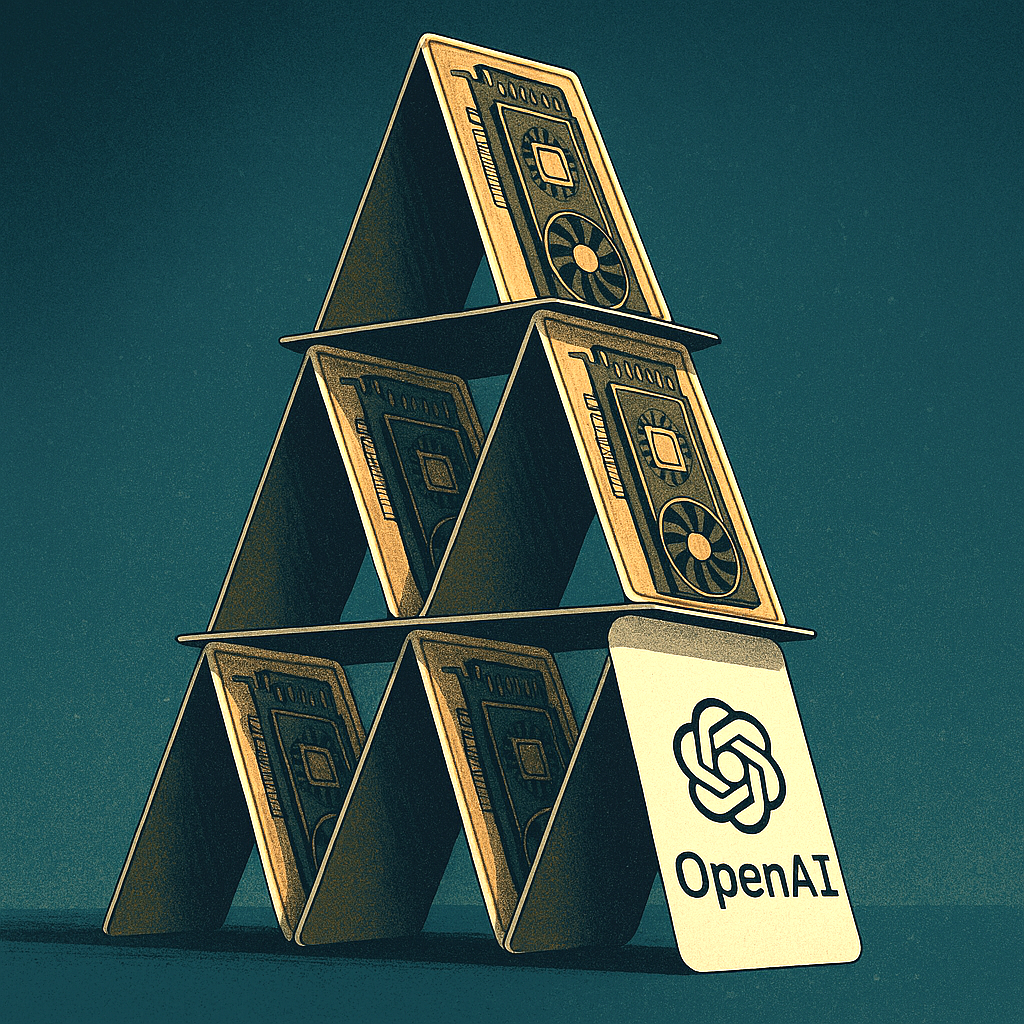
AI Bubble?

There’s growing concern that parts of the AI boom—especially the infrastructure and monetisation frenzy—might be built on shaky foundations.

The term ‘AI house of cards’ is being used to describe deals like Oracle’s multiyear agreement with OpenAI, which has committed to buying $300 billion in computing power over five years starting in 2027.

That’s on top of OpenAI’s existing $100 billion in commitments, despite having only about $12 billion in annual recurring revenue. Analysts are questioning whether the math adds up, and whether Oracle’s backlog—up 359% year-over-year—is too dependent on a single customer.

Oracle’s stock surged 36%, then dropped 5% Friday as investors took profits and reassessed the risks.

Some analysts remain neutral, citing murky contract details and the possibility that OpenAI’s nonprofit status could limit its ability to absorb the $40 billion it raised earlier this year.

The broader picture? AI infrastructure spending is ballooning into the trillions, echoing the dot-com era’s early adoption frenzy. If demand doesn’t materialise fast enough, we could see a correction.

But others argue this is just the messy middle of a long-term transformation—where data centres become the new utilities

The AI infrastructure boom—especially the Oracle–OpenAI deal—is raising eyebrows because the financial and operational foundations look more speculative than solid.

Here’s why some analysts are calling it a potential house of cards

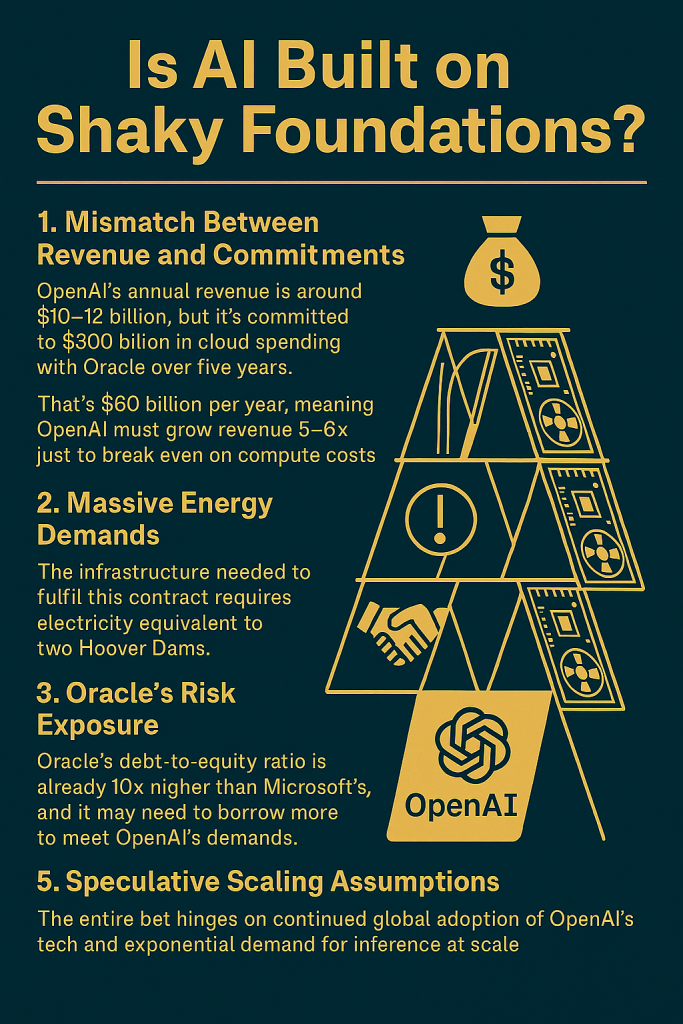
⚠️ 1. Mismatch Between Revenue and Commitments

  • OpenAI’s annual revenue is reportedly around $10–12 billion, but it’s committed to $300 billion in cloud spending with Oracle over five years.
  • That’s $60 billion per year, meaning OpenAI would need to grow revenue 5–6x just to break even on compute costs.
  • CEO Sam Altman projects $44 billion in losses before profitability in 2029.

🔌 2. Massive Energy Demands

  • The infrastructure needed to fulfill this contract requires electricity equivalent to two Hoover Dams.
  • That’s not just expensive—it’s logistically daunting. Data centres are planned across five U.S. states, but power sourcing and environmental impact remain unclear.
AI House of Cards Infographic

💸 3. Oracle’s Risk Exposure

  • Oracle’s debt-to-equity ratio is already 10x higher than Microsoft’s, and it may need to borrow more to meet OpenAI’s demands.
  • The deal accounts for most of Oracle’s $317 billion backlog, tying its future growth to a single customer.

🔄 4. Shifting Alliances and Uncertain Lock-In

  • OpenAI recently ended its exclusive cloud deal with Microsoft, freeing it to sign with Oracle—but also introducing risk if future models are restricted by AGI clauses.
  • Microsoft is now integrating Anthropic’s Claude into Office 365, signalling a diversification away from OpenAI.

🧮 5. Speculative Scaling Assumptions

  • The entire bet hinges on continued global adoption of OpenAI’s tech and exponential demand for inference at scale.
  • If adoption plateaus or competitors leapfrog, the infrastructure could become overbuilt—echoing the dot-com frenzy of the early 2000s.

Is this a moment for the AI frenzy to take a breather?

China’s EV Price War: BYD falters as the Chinese EV machine reshapes the global car market

EV global price war

China’s electric vehicle (EV) powerhouse is rewriting the global automotive playbook—but not without homegrown company damage.

BYD, now the world’s largest EV manufacturer by volume, has been caught in the crossfire of a domestic price war.

Damaging price war

The price war is damaging margins. It is unnerving investors and revealing the perils of hyper-competition in the world’s most aggressive car market.

In Q2 2025, BYD posted a 30% drop in net profit to 6.4 billion yuan (£700 million), its first earnings decline in over three years.

Despite a 145% surge in overseas sales, the company’s sweeping discounts across 22 models have eroded profitability at home.

Gross margins slipped to around 16%, and its Hong Kong-listed shares tumbled 8% to a five-month low.

Analysts reportedly now question whether BYD can hit its ambitious 5.5-million-unit sales target, having reached only 45% by July 2025.

The price war, ignited by BYD’s aggressive cuts in May 2025, has forced rivals like Geely, Chery, and SAIC-GM to follow suit. Entry-level EVs now start below (£6,500), with features like driver assistance and smart infotainment once reserved for premium models.

But the race to the bottom has drawn concern from regulators and industry leaders. The China Association of Automobile Manufacturers (CAAM) warned of “disorderly competition”, while executives fear quality compromises and supplier strain.

Yet even as BYD stumbles, the broader Chinese EV machine is gaining global momentum. In Europe, BYD overtook Tesla in July sales, capturing 1.1% market share versus Tesla’s 0.7%.

Chinese EV car brands account for around 10% of new UK car sales

Chinese brands now account for around 10% of new car sales in the UK. There are over 30 affordable EV models priced under £30,000.

Their edge lies in battery supply chains, manufacturing efficiency, and software integration. Transforming cars into ‘smartphones on wheels’ tailored to digitally connected consumers.

China’s EV revolution is no longer just a domestic shake-up—it’s a global reordering. Legacy automakers are retreating from the budget segment. But Chinese firms flooding international markets with sleek, connected, and competitively priced vehicles.

BYD’s profit dip may be a temporary wobble. The long-term trajectory is clear: China isn’t just building cars—it’s building the future of mobility.

For global rivals, the message is unmistakable: adapt, or be outpaced by the dragon’s electric roar.

Infographic: China’s BYD and other EVs

Summary

BYD’s Q2 2025 net profit drop of 30% to 6.4 billion yuan: This figure aligns with recent earnings reports and analyst commentary. The drop is consistent with margin pressure from domestic price cuts.

Gross margin falling to 16.3%: Matches industry estimates for BYD’s automotive segment, which has seen compression due to aggressive discounting.

Overseas sales up 145% YoY: BYD’s international expansion—especially in Europe, Southeast Asia, and Latin America—has been rapid. This growth rate is plausible and supported by export data.

BYD reaching only 45% of its 5.5 million unit sales target by July: This tracks with cumulative delivery figures through mid-year, suggesting a potential shortfall unless H2 volumes accelerate.

Price war triggered by BYD’s cuts across 22 models in May: Confirmed by industry reports and BYD’s own promotional campaigns. Other automakers like Geely and Chery have responded with similar discounts.

CAAM warning of “disorderly competition”: This quote has appeared in official statements and media coverage, reflecting regulatory concern over unsustainable pricing.

Chinese EVs gaining market share in Europe and UK: BYD overtaking Tesla in July 2025 sales in Europe is supported by registration data. Chinese brands now account for ~10% of UK new car sales, with many models priced under £30,000.

Tesla’s European market meltdown – sales plunge 49% amid brand damage and fierce competition

Tesla's European sales fall!

Tesla’s vehicle sales in Europe plummeted by 49% in April 2025, marking the fourth consecutive month of decline.

Despite an overall 27.8% rise in battery-electric vehicle sales, Tesla struggled to maintain its foothold in the region.

The drop in sales has been attributed to increasing competition from Chinese automakers, a shift in consumer preferences towards hybrid vehicles, and growing backlash against CEO Elon Musk’s political affiliations.

Tesla’s market share in Europe nearly halved, falling from 1.3% to 0.7%. The company’s aging lineup, particularly the Model Y, has failed to attract new buyers, while rivals such as BYD have overtaken Tesla in European EV sales for the first time.

Additionally, European carmakers are cutting costs and adapting to U.S. tariffs on auto imports, further intensifying competition. Chinese EV manufacturers are also cutting EV prices.

While Tesla faces challenges in Europe, the broader EV market continues to expand, driven by government incentives and stricter emission targets.

However, unless Tesla refreshes its lineup and rebuilds consumer trust, its dominance in the European market may continue to erode.

The company’s future remains uncertain as it navigates political controversies and shifting market dynamics

BYD Surpasses Tesla in European EV sales for the first time in upset for Tesla

BYD

April 2025 marked a watershed moment in the European electric vehicle (EV) market as BYD outsold Tesla for the first time ever.

According to JATO Dynamics, BYD registered 7,231 battery-electric vehicles, narrowly surpassing Tesla’s 7,165 registrations.

This shift comes despite EU-imposed tariffs on Chinese-made EVs, which were expected to hinder BYD’s growth. However, the company’s aggressive expansion strategy and diversified lineup – including plug-in hybrids – helped it navigate trade barriers and maintain momentum.

Tesla, on the other hand, has faced declining sales, with its European registrations dropping 49% year-over-year. Production delays, protests against CEO Elon Musk, and consumer hesitation over new Model Y trims have contributed to the slump.

BYD’s success signals a changing landscape in Europe’s EV market. With its Hungarian production plant set to open soon, the company is poised for further growth.

Presumably now, Tesla must reassess its strategy to regain dominance in a market it once ruled.

As competition intensifies, European consumers will benefit from greater EV choices, potentially driving further innovation in the industry

Tesla and Musk struggle against Trump’s Tariff Tidalwave

Tesla

Tesla has been making headlines with a series of major developments, from financial setbacks to strategic shifts by CEO Elon Musk.

The electric vehicle giant recently reported a 20% drop in automotive revenue, a significant decline that has raised concerns among investors.

Meanwhile, Musk has announced that he will be spending much less time on the Department of Government Efficiency (DOGE), a move that could signal a renewed focus on Tesla.

Additionally, Tesla’s ambitious Optimus humanoid robot project has hit a roadblock due to China’s restrictions on rare earth materials, further complicating the company’s future plans.

Tesla’s Revenue Decline

Tesla’s first-quarter earnings report revealed a 20% drop in automotive revenue, with total revenue sliding 9% year-on-year.

The company attributed the decline to factory retooling for a refreshed Model Y, lower average selling prices, and increased sales incentives.

Net income plummeted 71%, reflecting the broader challenges Tesla faces in a competitive EV market.

Tesla 3 month share price chart 2025

The company has refrained from promising growth this year, stating that it will revisit its 2025 guidance in its Q2 update.

Musk’s Shift Away from DOGE

Elon Musk’s involvement in the Department of Government Efficiency (DOGE) has been a controversial topic, with critics arguing that his political commitments have distracted him from Tesla’s operations.

However, Musk has now confirmed that his time allocation to DOGE will drop significantly, allowing him to focus more on Tesla.

He stated that he will likely spend only one or two days per week on government matters, a shift that could reassure investors concerned about his divided attention.

Reports of his popularity in recent U.S. polls suggest he is out of favour with the American people and is now low in people’s opinion around the world because of his contentious DOGE role.

Optimus Robots and China’s Rare Earth Restrictions

Tesla’s Optimus humanoid robots, which Musk has touted as a revolutionary step toward automation, have encountered a major obstacle due to China’s export restrictions on rare earth materials.

The restrictions, imposed as part of an escalating trade war, have disrupted Tesla’s supply chain, particularly affecting the rare earth magnets used in Optimus actuators.

Musk has expressed hope that Tesla will secure an export licence, but the uncertainty surrounding the restrictions could delay production.

Looking Ahead

Tesla is navigating a challenging landscape, balancing financial setbacks, Musk’s shifting priorities, and geopolitical hurdles.

While the company remains a leader in EV innovation, its ability to adapt to market pressures and geopolitical challenges will be crucial in determining its future success.

Investors and industry watchers will be closely monitoring Tesla’s next moves as it works to regain momentum.

Dow drops 2200 points Friday 4th April 2025 – S&P 500 loses 10% in 2 days as Trump’s tariff rout deepens – just two days after ‘Liberation Day!’

Stocks down

The stock market was smashed for a second day Friday 4th April 2025 after China retaliated with new tariffs on U.S. goods, sparking fears President Donald Trump has ignited a global trade war that will lead to a global recession.

Stock market damage

The Dow Jones Industrial Average dropped 2,231.07 points, or 5.5%, to 38,314.86 on Friday 4th April 2025, the biggest decline since June 2020 during the Covid-19 pandemic.

This follows a 1,679-point decline on Thursday 3rd April 2025 and marks the first time ever that it has shed more than 1,500 points on consecutive days.

The S&P 500 collapsed 5.97% to 5,074.08, the biggest decline since March 2020. The benchmark shed 4.84% on Thursday 3rd April 2025 and is now down more than 17% off its recent high.

The Nasdaq Composite, home to many well-known tech companies that sell to China and manufacture there as well, dropped 5.8%, to 15,587.79.

This follows a nearly 6% drop on Thursday 3rd April 2025 and takes the index down by 22% from its December 2024 record – pushing it into a bear market.

The selling was wide ranging with only 14 members of the S&P 500 higher on the day. Major market indexes closed at their lows of the session.

China’s commerce ministry said the country will impose a 34% levy on all U.S. products, disappointing investors who had hoped countries would negotiate with Trump before retaliating.

Technology stocks led the massive rout Friday

Apple shares slumped 7%, bringing its loss for the week to 13%.

Nvidia dropped 7% during the session.

Tesla fell 10%.

All three companies have large exposure to China and are among the hardest hit from Beijing’s retaliatory tariffs.

The bull market is dead, and it was destroyed by self-inflicted wounds!

U.S. tech giants are betting big on humanoid robots

Humanoid robots

U.S. tech giants are making bold strides in the development of humanoid robots, signalling a transformative shift in the robotics industry

Companies like Tesla, Google, Microsoft, and Nvidia are investing heavily in this cutting-edge technology, aiming to create machines that mimic human movement and behaviour.

These humanoid robots are envisioned to revolutionise industries ranging from manufacturing to healthcare, offering solutions to labor shortages and enhancing productivity.

Tesla’s Optimus project is a prime example of this ambition. CEO Elon Musk has announced plans to produce thousands of these robots, designed to perform repetitive and physically demanding tasks.

Optimus robots are expected to integrate seamlessly into factory settings, reducing the need for human intervention in hazardous environments.

Similarly, Boston Dynamics, known for its agile robots, continues to push the boundaries of what humanoid machines can achieve, focusing on tasks that require precision and adaptability.

The integration of artificial intelligence (AI) is a driving force behind these advancements. AI enables robots to learn from their environments, adapt to new tasks, and interact with humans in more intuitive ways.

Companies like Nvidia are leveraging their expertise in AI and machine learning are helping to develop robots capable of complex decision-making and problem-solving.

However, challenges remain. High production costs, limited battery life, and safety concerns are significant hurdles that need to be addressed before humanoid robots can achieve widespread adoption.

Despite these obstacles, the potential benefits are immense. From assisting the elderly to performing intricate surgeries, humanoid robots could redefine the boundaries of human capability.

As U.S. tech giants continue to innovate, the race to dominate the humanoid robotics market intensifies.

Tesla Optimus Gen 2

With China and other nations also making significant investments, the competition is fierce. Analysts warn that U.S. firms could lose out to China, which aims to replicate its success with electric vehicles in the robotics space race.

The future of humanoid robots promises to be a fascinating blend of technology, creativity, and global collaboration

U.S. companies that may benefit from this AI humanoid tech advancement

Tesla: Known for its Optimus humanoid robot project, Tesla is pushing boundaries in robotics and AI.

Google (Alphabet): A leader in AI and robotics research, with projects aimed at enhancing humanoid capabilities.

Microsoft: Investing in AI technologies that support robotics and automation.

Nvidia: Provides advanced AI chips and systems crucial for humanoid robot development.

Boston Dynamics: Famous for its agile robots like Atlas, focusing on precision and adaptability.

Agility Robotics: Creator of Digit, a humanoid robot designed for logistics and manufacturing.

Meta (Facebook): Exploring humanoid robots for social and interactive applications.

Apple: Investing in robotics and AI for potential humanoid advancements.

Amazon: Developing robots like Astro for home monitoring and other tasks.

Figure AI: Innovating humanoid robots like Figure 02 for various industries.

Bill Gates on AI

Bill Gates has shared some fascinating insights about AI recently. He reportedly believes that within the next decade, AI will transform many industries, making specialised knowledge widely accessible.

For example, he predicts that AI could provide high-quality medical advice and tutoring, addressing global shortages of doctors and educators.

Gates has also described this shift as the ‘age of free intelligence,’ where AI becomes a commonplace tool integrated into everyday life. While he acknowledges the immense potential of AI to solve global challenges – like developing breakthrough treatments for diseases and innovative solutions for climate change – he also recognises the disruptive impact it could have on jobs and the workforce.

Despite these concerns, Gates remains optimistic about AI’s ability to drive innovation and improve lives.

He has emphasised that certain human activities, like playing sports or hosting talk shows, will likely remain uniquely human.

However, despite all these predictions from powerful tech leaders – it does beg the question, do these ultra rich CEOs predict the future, or simply make it?

What if Quantum Physics coincides and collides with the ‘full’ arrival of AI and humanoid robots

Quantum computing could enhance the capabilities of AI-powered robots by solving complex optimisation problems, improving machine learning algorithms, and enabling real-time decision-making.

For instance, robots equipped with quantum sensors could navigate intricate environments, detect subtle changes in their surroundings, and interact with humans in more intuitive ways.

This fusion could revolutionise industries such as healthcare, manufacturing, and space exploration. Imagine humanoid robots performing intricate surgeries with precision, managing large-scale logistics, or exploring distant planets with advanced problem-solving abilities.

However, this convergence also raises ethical and societal questions. The potential for such powerful technologies to disrupt industries, impact employment, and challenge privacy norms must be carefully managed.

Collaboration between scientists, policymakers, and ethicists will be crucial to ensure these advancements benefit humanity as a whole.

The intersection of quantum physics, AI, and humanoid robotics is not just a technological milestone – it’s a glimpse into a future where the boundaries of human capability and machine intelligence blur.

It’s an exciting, albeit complex future humans are creating.

But will AI surpass human intelligence – and if it does what then for the human civilisation?

Access videos of Tesla robots here

BYD unveils new super-charging EV tech – twice as fast as the Tesla system

BYD

BYD, a leading name in the electric vehicle (EV) industry, has unveiled groundbreaking super-charging technology that could redefine EV adoption

The new ‘super e-platform’ boasts peak charging speeds of 1,000 kilowatts (kW), enabling vehicles to gain a range of 400 kilometers (249 miles) in just five minutes.

This innovation brings EV charging times closer to the convenience of refueling traditional gasoline vehicles.

Charging speeds of 1,000 kW would be twice as fast as Tesla’s superchargers whose latest version offers up to 500 kw charging speeds. Fast-charging technology has been key to increasing EV adoption as it is seen to help assure EV drivers’ concerns over being able to charge their cars quickly.

The announcement, reportedly made at BYD’s Shenzhen headquarters, marks a significant leap in addressing ‘charging anxiety’- a key concern for EV users. Founder Wang Chuanfu emphasised the company’s commitment to making EV charging as quick and seamless as possible.

This is the first time the industry has achieved megawatt-level charging power, setting a new benchmark.

To complement this technology, BYD plans to build over 4,000 ultra-fast charging stations across China.

The initial rollout will feature the super e-platform in two new models: the Han L sedan and Tang L SUV, priced from 270,000 yuan ($37,328). These vehicles will pioneer the use of this cutting-edge charging system.

As competition in the EV market intensifies, BYD’s innovation positions it as a formidable player, challenging established giants like Tesla and paving the way for a more electrified future.