

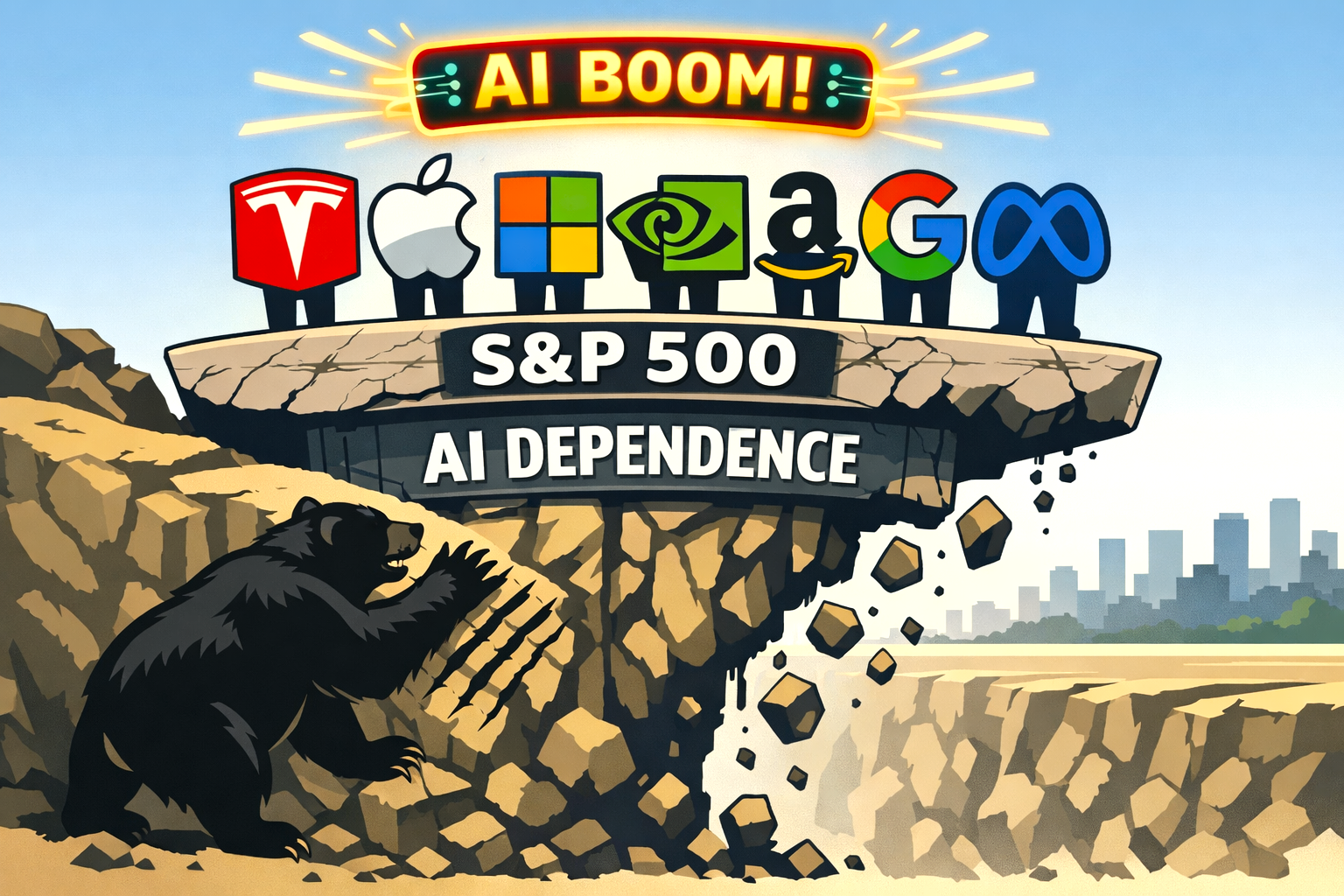
If the Magnificent Seven were to fall short of the AI and tech transformation investors have priced in, the S&P 500 would face one of the most severe valuation resets in its modern history.
With the group now representing roughly one‑third of the entire index, any collective disappointment would ripple far beyond technology and into every sector tied to index‑tracking capital.
The concentration problem
The S&P 500 has never been this top‑heavy. Microsoft, Apple, Nvidia, Alphabet, Amazon, Meta and Tesla have become the gravitational centre of global equity markets.
Their valuations are not merely high; they are explicitly built on the assumption of future dominance in AI infrastructure, cloud, automation, consumer platforms and next‑generation hardware.
If that future fails to materialise — or even arrives more slowly than expected — the index’s structure becomes a liability. A small number of companies would be responsible for a large portion of the downside.
Scenario 1: One or two companies stumble
If a single member — say Apple or Tesla — fails to deliver, the impact is sharp but contained. The S&P 500 would likely see a 3–5% drawdown, driven by index‑weight mechanics rather than systemic panic.
Investors have already priced in uneven performance within the group, and the remaining leaders would absorb some of the shock.
The more dangerous case is if one of the AI‑infrastructure engines — Microsoft, Nvidia or Alphabet — disappoints. These companies sit at the centre of the capex cycle.
A miss on AI demand, margins or utilisation would trigger a broader reassessment of the entire AI investment thesis.
Scenario 2: Several of the Seven disappoint simultaneously
A coordinated earnings miss or guidance reset across multiple names would force a valuation compression across the entire index. Because passive flows mechanically overweight the winners, a reversal would unwind years of momentum.
A realistic outcome:
- S&P 500 correction of 10–15%
- Volatility spike as systematic strategies de‑risk
- Rotation into defensives and energy, sectors less dependent on AI narratives
- Credit spreads widen, reflecting lower confidence in tech‑driven earnings growth
This is the point where the market stops treating AI as inevitability and starts treating it as a risk.
Scenario 3: The AI thesis breaks entirely
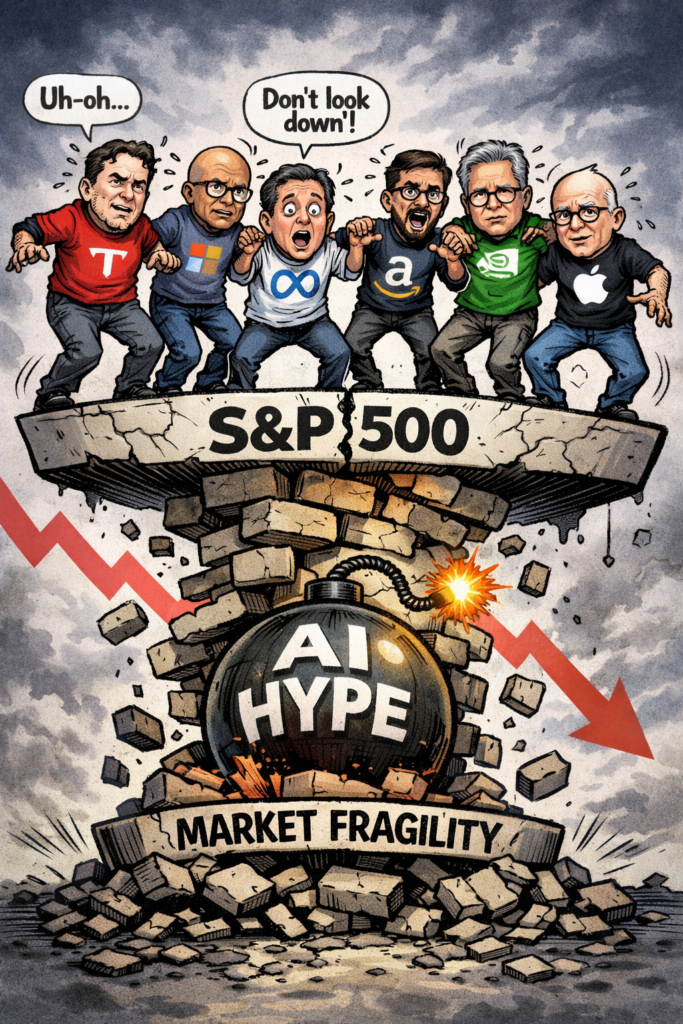
If all seven fail to deliver the productivity, revenue and margin expansion implied by their valuations, the S&P 500 would undergo a structural reset.
The index could fall 20% or more, not because of recessionary conditions but because the market would need to rebuild a new leadership structure from scratch.
The last time leadership collapsed this dramatically was the dot‑com unwind — but today’s concentration is far higher, and passive ownership is far larger. but AI has far more upfront utility, doesn’t it?
The core truth
The S&P 500’s fate is now inseparable from the Magnificent Seven. If they deliver, the index continues to levitate. If they falter, the entire market must reprice what growth, innovation and leadership look like in the post‑AI era.
When the Magnificent Seven Slip: Who Rises Next?
If the AI tide recedes, the market’s leadership will not vanish — it will rotate. The beneficiaries will be the sectors that have quietly compounded earnings while the spotlight stayed fixed on Silicon Valley.
1. Energy and Utilities With AI‑driven data centres consuming vast power, any slowdown in tech expansion would ease pressure on grids and shift investor focus back to traditional producers. Dividend yields and defensive cash flow would regain appeal as growth multiples compress.
2. Industrials and Infrastructure A retreat from speculative tech would redirect capital toward physical productivity — logistics, construction, and manufacturing modernisation. Firms tied to electrification, rail, and defence could see valuation upgrades as investors seek real‑world output rather than digital promise.
3. Healthcare and Pharmaceuticals The sector’s secular growth and pricing power make it a natural refuge when tech falters. Biotech innovation continues independently of AI cycles, and ageing demographics ensure steady demand.
4. Financials Banks and insurers benefit from higher rates and wider spreads when tech valuations deflate. A correction in mega‑caps could even restore balance to passive indices, giving financials a larger share of inflows.
5. Consumer Staples In a post‑AI correction, investors rediscover the comfort of predictable earnings. Food, beverages, and household goods regain their defensive premium as volatility rises.
The narrative shift: The market would move from promise to proof — from speculative AI multiples to tangible earnings. The S&P 500 would not collapse; it would evolve. Leadership would pass from code to concrete, from algorithms to assets.
Key Points — S&P 500 Risk if the Magnificent Seven Falter
1. The S&P 500 is structurally dependent on seven companies
- The Magnificent Seven now make up ~35% of the entire index’s market cap.
- This is the highest concentration in modern history, making the S&P 500 behave more like a mega‑cap tech fund than a diversified benchmark.
2. Their valuations are priced for an AI‑driven future
- Current multiples assume sustained exponential AI demand, cloud capex growth, and productivity gains.
- Any slowdown in AI adoption, monetisation, or enterprise rollout would force a valuation reset across the leaders.
3. A single-company stumble is absorbable — but still painful
- If one member (e.g., Apple or Tesla) disappoints, the index likely sees a 3–5% pullback.
- The remaining leaders can offset the drag, but the psychological impact is non‑trivial.
4. A slowdown in the AI infrastructure core is the real risk
- Microsoft, Nvidia and Alphabet sit at the centre of the global AI capex cycle.
- If cloud AI demand proves slower or less profitable than expected, the S&P 500 could face a 10–15% correction as earnings expectations compress.
5. A broad failure of the AI thesis triggers a structural reset
- If AI productivity gains don’t materialise, or margins erode under cost/regulatory pressure, the index could fall 20%+.
- This would resemble a leadership collapse, not a normal recession — similar to the dot‑com unwind but with far more concentration and passive capital tied to the winners.
6. Passive flows amplify both upside and downside
- With so much capital in index funds, any derating of the top names mechanically drags the entire index lower.
- The S&P 500’s fate is now mathematically tethered to the Magnificent Seven.
7. The uncomfortable conclusion
- The S&P 500’s trajectory is inseparable from the success or failure of the AI narrative.
- If the Magnificent Seven deliver, the index continues to defy gravity.
- If they falter, the market must rebuild a new leadership structure from scratch.
The S&P 500 is fundamentally in the danger zone – be careful!