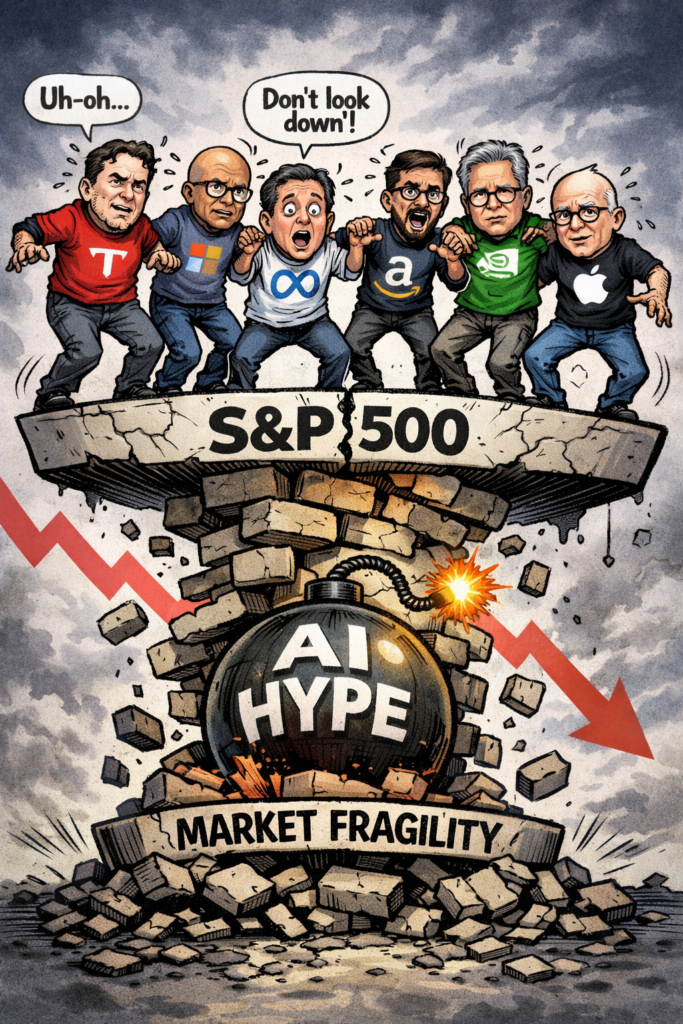

What would happen to the S&P 500 should one or some or all of the Magnificent Seven companies fail to deliver their AI promise – even just a little?

Magnificent Seven and the S&P 500

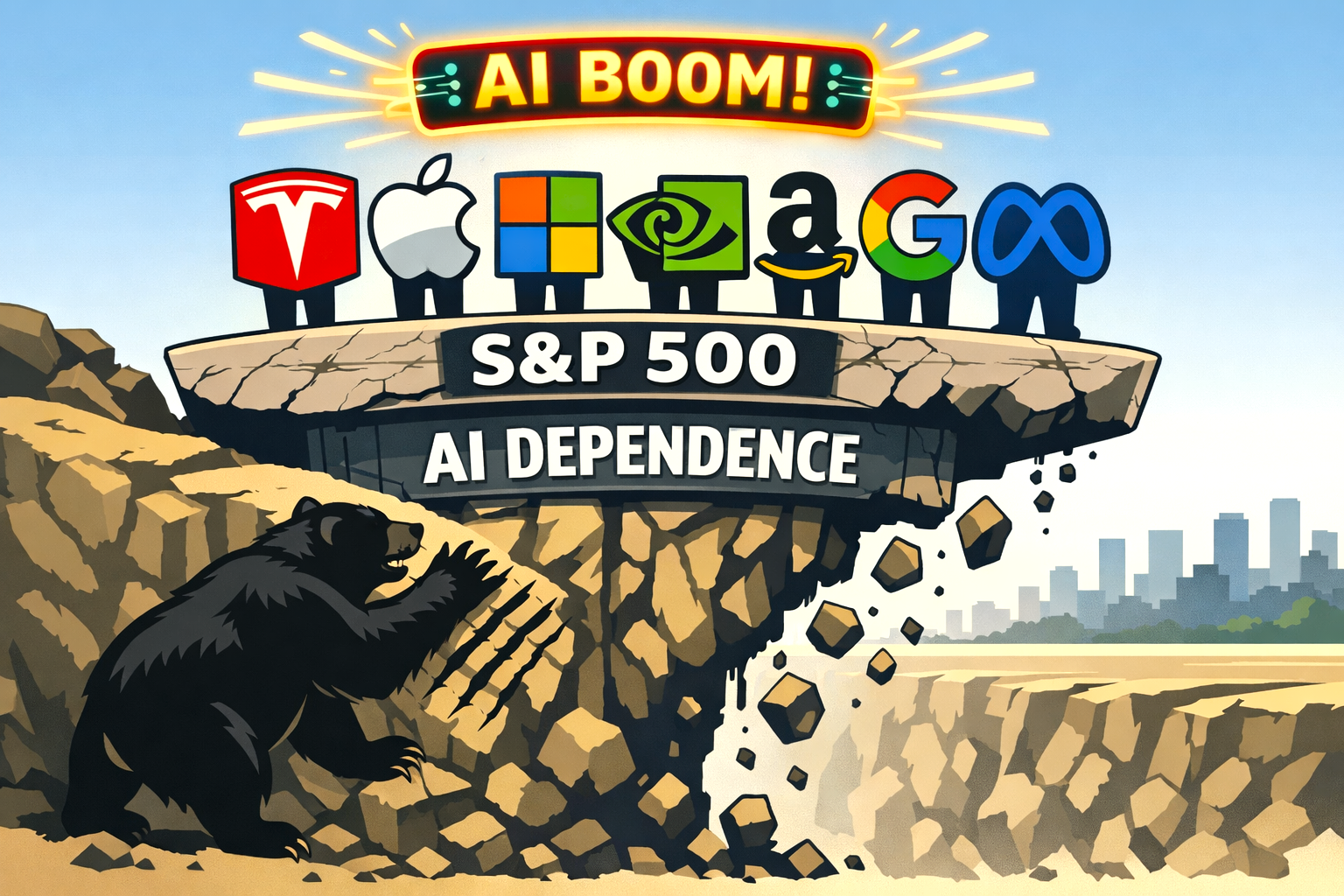
If the Magnificent Seven were to fall short of the AI and tech transformation investors have priced in, the S&P 500 would face one of the most severe valuation resets in its modern history.

With the group now representing roughly one‑third of the entire index, any collective disappointment would ripple far beyond technology and into every sector tied to index‑tracking capital.

The concentration problem

The S&P 500 has never been this top‑heavy. Microsoft, Apple, Nvidia, Alphabet, Amazon, Meta and Tesla have become the gravitational centre of global equity markets.

Their valuations are not merely high; they are explicitly built on the assumption of future dominance in AI infrastructure, cloud, automation, consumer platforms and next‑generation hardware.

If that future fails to materialise — or even arrives more slowly than expected — the index’s structure becomes a liability. A small number of companies would be responsible for a large portion of the downside.

Scenario 1: One or two companies stumble

If a single member — say Apple or Tesla — fails to deliver, the impact is sharp but contained. The S&P 500 would likely see a 3–5% drawdown, driven by index‑weight mechanics rather than systemic panic.

Investors have already priced in uneven performance within the group, and the remaining leaders would absorb some of the shock.

The more dangerous case is if one of the AI‑infrastructure engines — Microsoft, Nvidia or Alphabet — disappoints. These companies sit at the centre of the capex cycle.

A miss on AI demand, margins or utilisation would trigger a broader reassessment of the entire AI investment thesis.

Scenario 2: Several of the Seven disappoint simultaneously

A coordinated earnings miss or guidance reset across multiple names would force a valuation compression across the entire index. Because passive flows mechanically overweight the winners, a reversal would unwind years of momentum.

A realistic outcome:

  • S&P 500 correction of 10–15%
  • Volatility spike as systematic strategies de‑risk
  • Rotation into defensives and energy, sectors less dependent on AI narratives
  • Credit spreads widen, reflecting lower confidence in tech‑driven earnings growth

This is the point where the market stops treating AI as inevitability and starts treating it as a risk.

Scenario 3: The AI thesis breaks entirely

If all seven fail to deliver the productivity, revenue and margin expansion implied by their valuations, the S&P 500 would undergo a structural reset.

The index could fall 20% or more, not because of recessionary conditions but because the market would need to rebuild a new leadership structure from scratch.

The last time leadership collapsed this dramatically was the dot‑com unwind — but today’s concentration is far higher, and passive ownership is far larger. but AI has far more upfront utility, doesn’t it?

The core truth

The S&P 500’s fate is now inseparable from the Magnificent Seven. If they deliver, the index continues to levitate. If they falter, the entire market must reprice what growth, innovation and leadership look like in the post‑AI era.

When the Magnificent Seven Slip: Who Rises Next?

If the AI tide recedes, the market’s leadership will not vanish — it will rotate. The beneficiaries will be the sectors that have quietly compounded earnings while the spotlight stayed fixed on Silicon Valley.

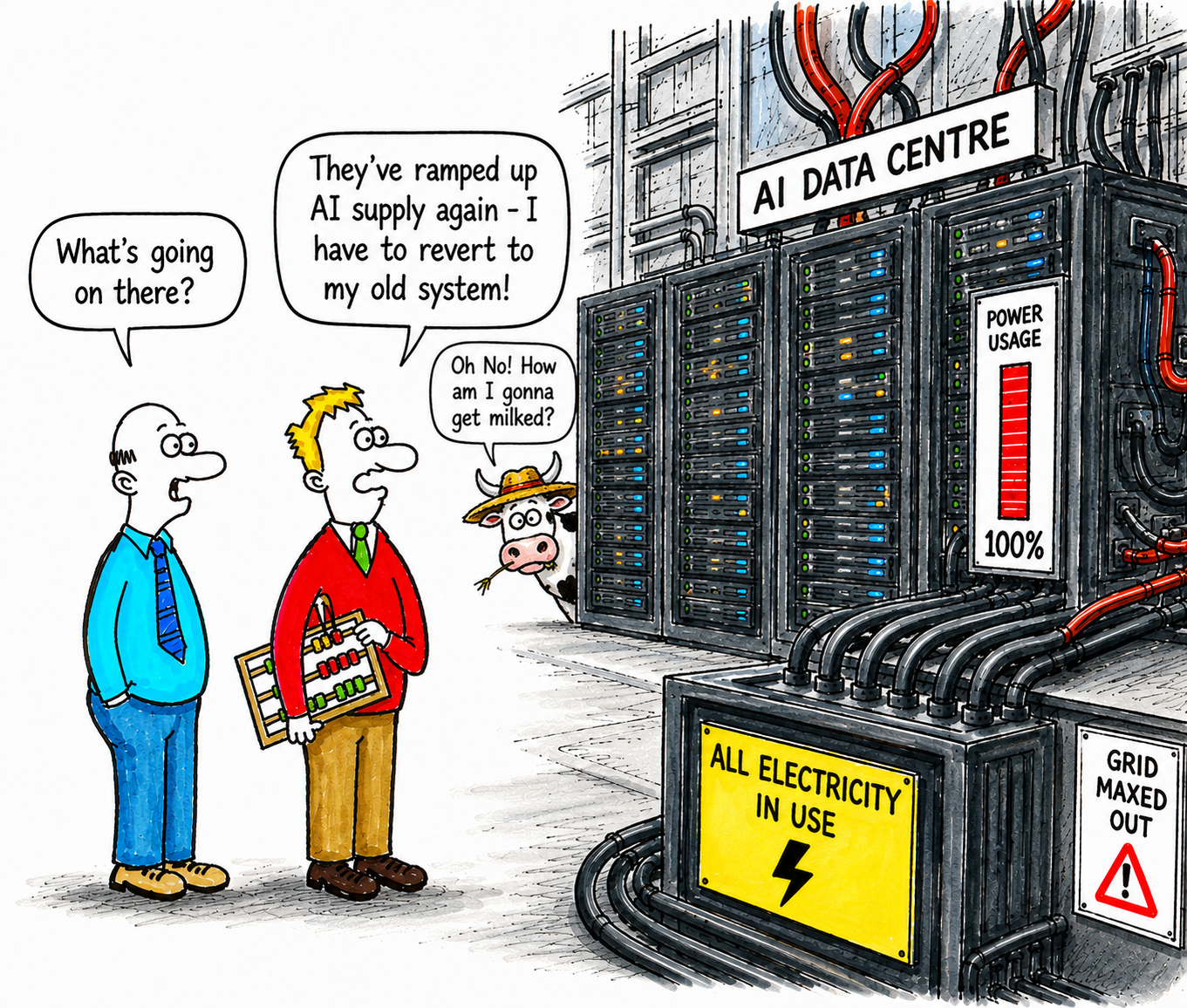
1. Energy and Utilities With AI‑driven data centres consuming vast power, any slowdown in tech expansion would ease pressure on grids and shift investor focus back to traditional producers. Dividend yields and defensive cash flow would regain appeal as growth multiples compress.

2. Industrials and Infrastructure A retreat from speculative tech would redirect capital toward physical productivity — logistics, construction, and manufacturing modernisation. Firms tied to electrification, rail, and defence could see valuation upgrades as investors seek real‑world output rather than digital promise.

3. Healthcare and Pharmaceuticals The sector’s secular growth and pricing power make it a natural refuge when tech falters. Biotech innovation continues independently of AI cycles, and ageing demographics ensure steady demand.

4. Financials Banks and insurers benefit from higher rates and wider spreads when tech valuations deflate. A correction in mega‑caps could even restore balance to passive indices, giving financials a larger share of inflows.

5. Consumer Staples In a post‑AI correction, investors rediscover the comfort of predictable earnings. Food, beverages, and household goods regain their defensive premium as volatility rises.

The narrative shift: The market would move from promise to proof — from speculative AI multiples to tangible earnings. The S&P 500 would not collapse; it would evolve. Leadership would pass from code to concrete, from algorithms to assets.

Key Points — S&P 500 Risk if the Magnificent Seven Falter

1. The S&P 500 is structurally dependent on seven companies

  • The Magnificent Seven now make up ~35% of the entire index’s market cap.
  • This is the highest concentration in modern history, making the S&P 500 behave more like a mega‑cap tech fund than a diversified benchmark.

2. Their valuations are priced for an AI‑driven future

  • Current multiples assume sustained exponential AI demand, cloud capex growth, and productivity gains.
  • Any slowdown in AI adoption, monetisation, or enterprise rollout would force a valuation reset across the leaders.

3. A single-company stumble is absorbable — but still painful

  • If one member (e.g., Apple or Tesla) disappoints, the index likely sees a 3–5% pullback.
  • The remaining leaders can offset the drag, but the psychological impact is non‑trivial.

4. A slowdown in the AI infrastructure core is the real risk

  • Microsoft, Nvidia and Alphabet sit at the centre of the global AI capex cycle.
  • If cloud AI demand proves slower or less profitable than expected, the S&P 500 could face a 10–15% correction as earnings expectations compress.

5. A broad failure of the AI thesis triggers a structural reset

  • If AI productivity gains don’t materialise, or margins erode under cost/regulatory pressure, the index could fall 20%+.
  • This would resemble a leadership collapse, not a normal recession — similar to the dot‑com unwind but with far more concentration and passive capital tied to the winners.

6. Passive flows amplify both upside and downside

  • With so much capital in index funds, any derating of the top names mechanically drags the entire index lower.
  • The S&P 500’s fate is now mathematically tethered to the Magnificent Seven.

7. The uncomfortable conclusion

  • The S&P 500’s trajectory is inseparable from the success or failure of the AI narrative.
  • If the Magnificent Seven deliver, the index continues to defy gravity.
  • If they falter, the market must rebuild a new leadership structure from scratch.

The S&P 500 is fundamentally in the danger zone – be careful!

OpenAI Missed Targets — and creates a mini–AI Shockwave – Will it become a Tsunami?

OpenAI wobble?

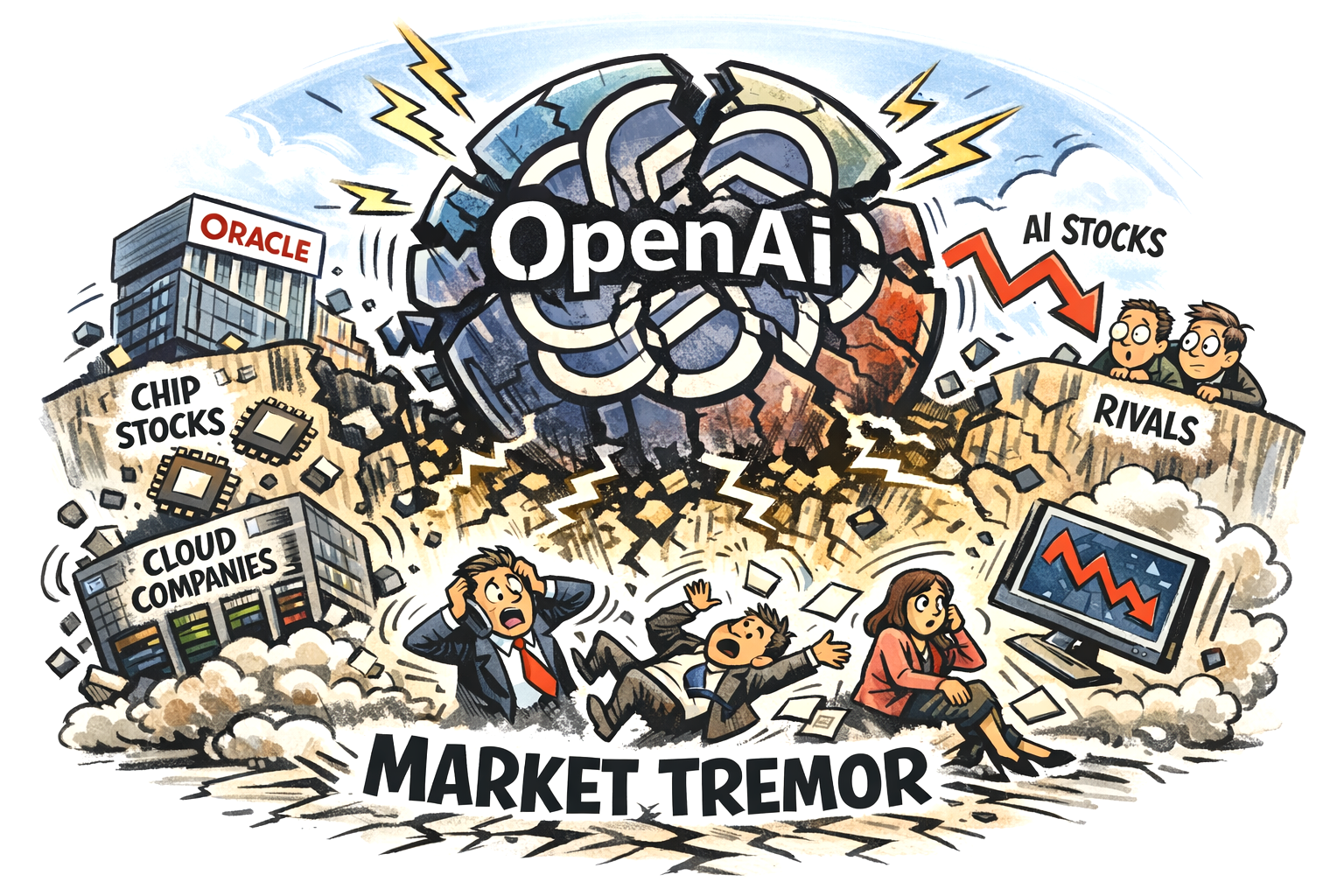
OpenAI’s reported failure to meet internal revenue and user‑growth targets has sent a sharp tremor through global tech markets, exposing just how dependent the wider AI sector has become on a single company’s momentum.

The Wall Street Journal report — which OpenAI has reportedly dismissed as “ridiculous” — suggested the firm is expanding more slowly than its own projections, raising questions about whether its vast compute‑spend commitments can be sustained. That alone was enough to trigger a sell‑off.

Slide

The steepest declines were concentrated among companies most financially tethered to OpenAI’s infrastructure demands. Oracle, which has a colossal $300 billion, five‑year cloud capacity agreement with the firm, fell more than 4%.

After the news story was released chipmakers followed OpenAI: Broadcom dropped over 4%, AMD slid more than 3%, Nvidia dipped around 1.5%, and CoreWeave — the highly leveraged neocloud provider — sank nearly 6%.

Even Qualcomm, which had recently enjoyed a lift from reports of collaboration with OpenAI on smartphone chips, slipped before recovering.

This is the first moment in the current AI cycle where a wobble at OpenAI has produced a synchronised pullback across the entire supply chain.

Investors are now confronting a question they have largely ignored: what if the sector’s flagship growth curve is not perfectly exponential? But my guess is, like all events at the moment, the market will likely overlook it.

Fragile

The reaction also exposes the fragility of AI‑linked valuations. Markets have priced the boom as if demand is both infinite and linear.

Any hint of deceleration — even one disputed by the company — forces a reassessment of the capital intensity underpinning the industry.

With Anthropic and Google’s Gemini gaining enterprise traction, OpenAI’s dominance is no longer assumed.

Still, several fund managers argue the broader AI investment cycle remains intact. The sell‑off looks less like a turning point and more like a reminder: when one company becomes the gravitational centre of an entire narrative, even a rumour can bend the orbit.

Arm’s Bold Pivot: The AGI CPU Signals a New Era for British Chipmaking

ARM Agentic AI CPU

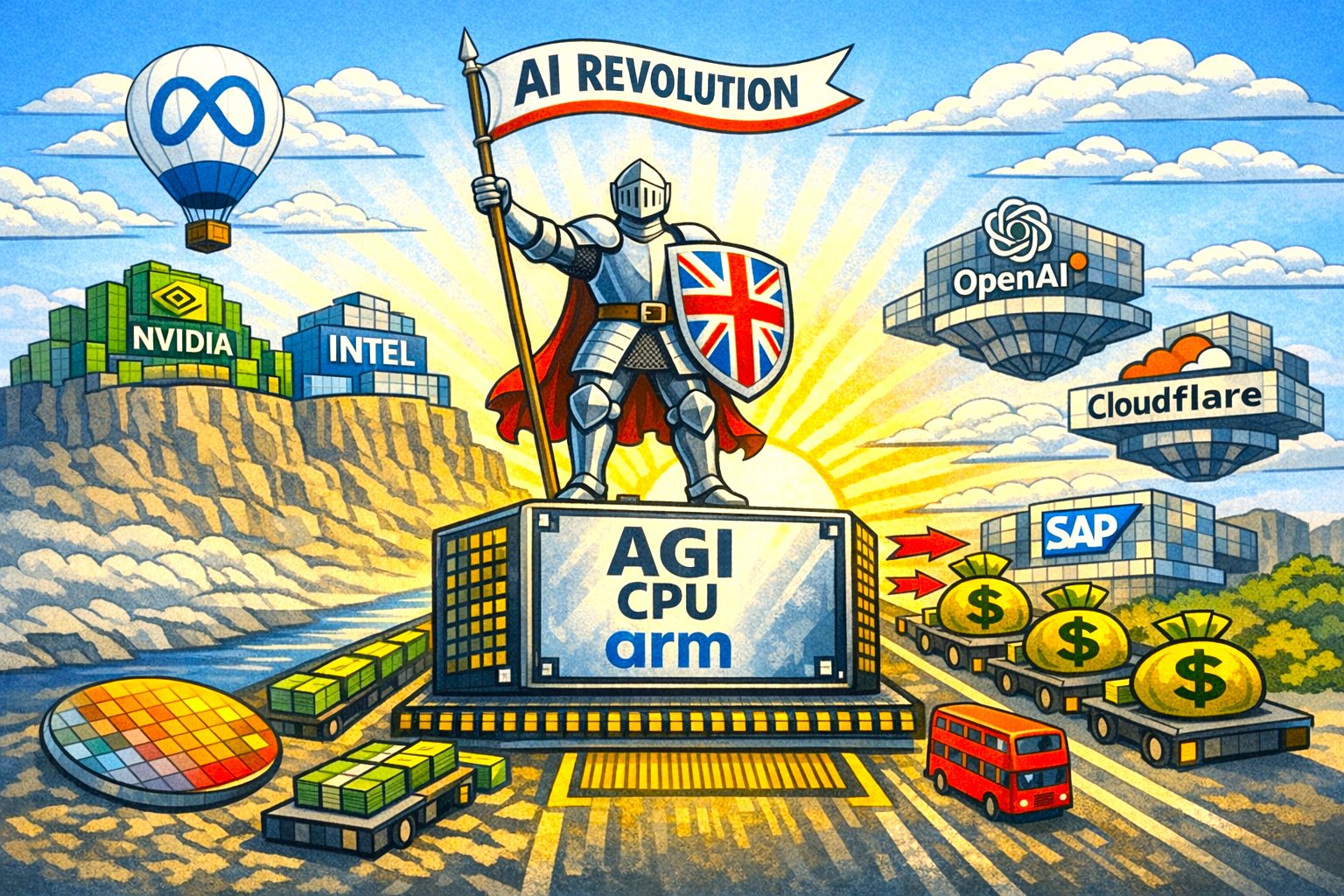
ARM has triggered one of the most dramatic shifts in its 35‑year history with the launch of its first in‑house data‑centre processor, the AGI CPU — a move that sent its shares surging 16% and reshaped expectations for the company’s future.

Long known for licensing energy‑efficient chip designs to the world’s biggest tech firms, ARM is now stepping directly into the silicon market, competing with the very customers that built its empire.

Major Tech Firms Using Arm Designs (AI & Mobile)

CompanyPrimary Use CaseArm-Based Technology
AppleMobile & on‑device AIA‑series (iPhone/iPad) and M‑series (Mac) chips
SamsungMobile, AI, IoTExynos processors
QualcommMobile & automotive AISnapdragon SoCs
GoogleAndroid ecosystem & edge AIPixel phones (Arm cores inside Tensor chips)
Amazon (AWS)Cloud compute & AI inferenceGraviton & Trainium/Inferentia (Arm Neoverse)
MetaAI infrastructureDeploying Arm-based AGI CPU
OpenAIAI inference & orchestrationEarly adopter of Arm AGI CPU
NvidiaAI data‑centre CPUsGrace CPU (Arm architecture)
OPPOMobile AIArm-based SoCs in Find series
vivoMobile AIArm-based SoCs in X‑series

Strong demand

The new AGI CPU is engineered for the rapidly expanding world of AI inference and agentic AI — workloads that demand vast CPU coordination rather than pure GPU horsepower.

Early demand appears strong. Meta has signed on as the first major customer, with OpenAI, Cloudflare and SAP also adopting the chip as they race to expand their AI infrastructure.

The financial implications are striking. ARM expects the AGI CPU alone to generate $15 billion in annual revenue by 2031, a figure that dwarfs the company’s 2025 revenue of $4 billion.

Significant shift

Analysts have described the announcement as the most significant strategic shift ARM has ever undertaken, noting that the revenue projections exceed even the most optimistic market estimates.

By moving into full chip production, ARM is broadening its market to include companies that previously had no interest in its traditional IP‑licensing model.

Executives say the chip will be competitively priced, offering an alternative for firms unable to build their own custom silicon.

For the UK, the launch marks a rare moment of industrial ambition in a sector dominated by American and Asian giants.

If ARM’s forecasts hold, the AGI CPU could become one of the most commercially successful chips ever produced by a British company — and a defining pillar of the AI age.

See more here about the new ARM AGI CPU

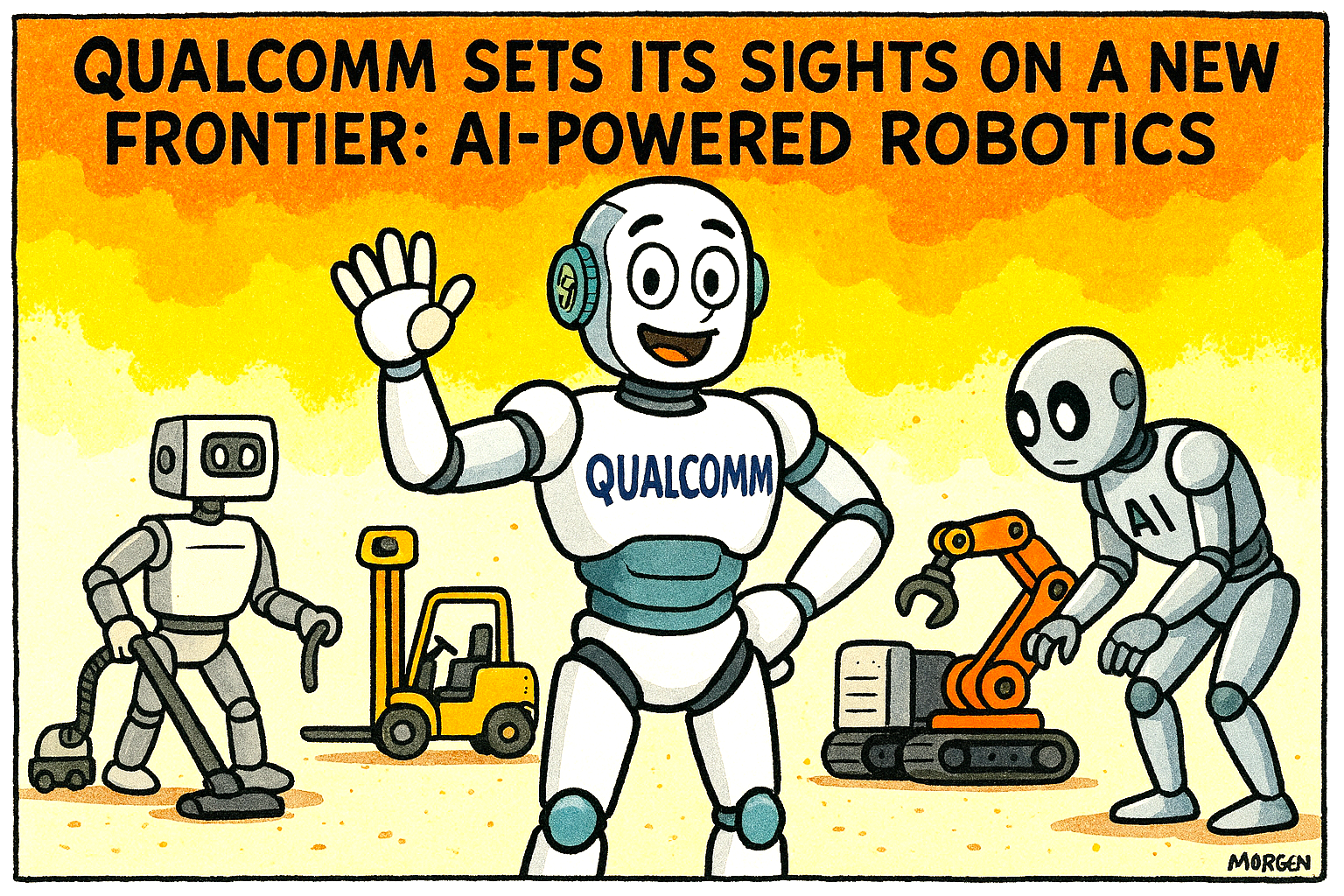
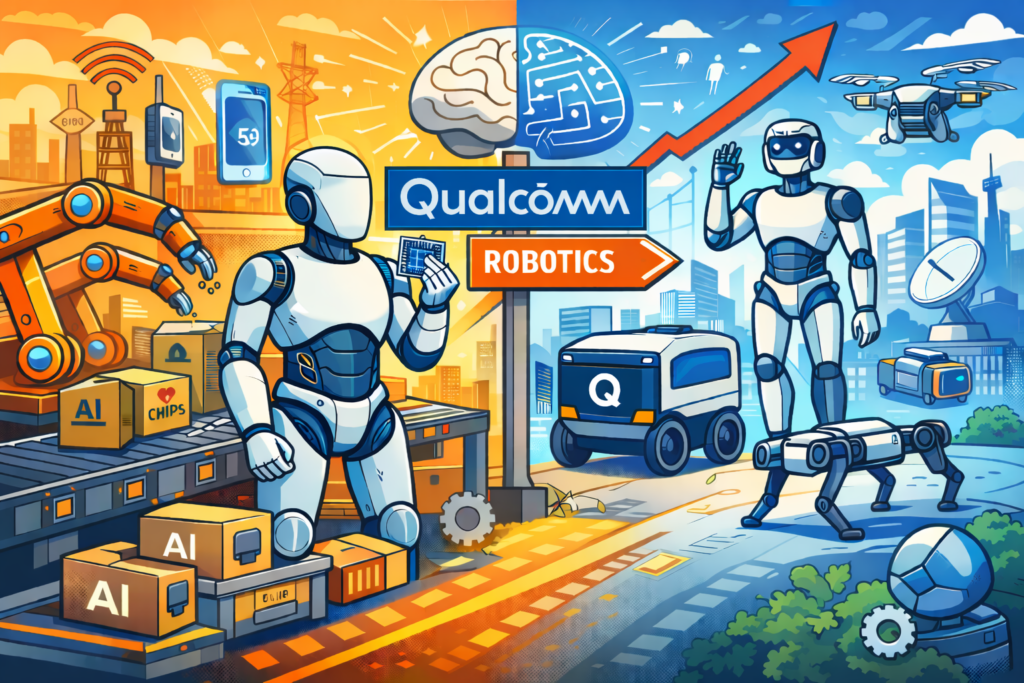
Qualcomm Sets Its Sights on a New Frontier: AI‑Powered Robotics

Qualcomm's Robotic Ambition

Qualcomm is accelerating its push into artificial intelligence and robotics, signalling a strategic shift that could redefine the company’s future beyond smartphones.

Executives now describe robotics as a core growth pillar, with chief executive Cristiano Amon reportedly forecasting that intelligent machines will become a “larger opportunity” for the business within the next two years.

Expanding from Mobile Chips to Physical AI

For decades, Qualcomm’s dominance has rested on its mobile processors, which power much of the global smartphone market.

The company is now repurposing that expertise for what it calls physical AIrobots capable of perceiving, reasoning, and acting autonomously in real‑world environments.

This transition reflects a broader industry trend: as generative AI matures, attention is shifting from digital assistants to embodied systems that can perform physical tasks.

Qualcomm’s new robotics architecture, unveiled recently, is designed as a full‑stack platform. It combines high‑efficiency system‑on‑chips, safety‑certified compute modules, and advanced on‑device AI models.

The aim is to give robot manufacturers a scalable foundation, whether they are building compact consumer devices or full‑size humanoids for industrial use.

Dragonwing Becomes the Flagship

At the centre of this strategy is the Dragonwing line of processors. The latest model, the Dragonwing IQ10, targets industrial automation and advanced humanoid robots.

It has reportedly been engineered to run complex AI models locally, reducing reliance on cloud connectivity and improving safety, responsiveness, and energy efficiency.

Qualcomm showcased these capabilities at recent industry events, where robots powered by Dragonwing chips demonstrated dexterity, mobility, and real‑time decision‑making.

The company’s ambition places it in direct competition with Nvidia, which currently dominates AI compute for robotics, and with a growing cohort of start‑ups building specialised hardware for autonomous machines.

Why Robotics Matters Now

Three factors underpin Qualcomm’s renewed focus

  • Diversifying revenue as smartphone markets plateau and competition intensifies.
  • Leveraging its edge‑AI strengths, particularly in low‑power, high‑performance chips suited to mobile robots.
  • Rising industrial demand, with logistics, retail, and manufacturing sectors adopting automation at scale.

The robotics push also complements Qualcomm’s automotive and PC AI strategies, creating a broader ecosystem of connected, intelligent devices.

A Critical Two Years Ahead

Qualcomm’s challenge now is to convert impressive demonstrations into commercial deployments.

If successful, the company could become a foundational supplier for the emerging era of physical AI—an era in which robots move from novelty to necessity.

Qualcomm intensifies competition with Intel and AMD and others as the company introduces its newest AI PC chip

New AI chip from Qualcomm

Qualcomm has introduced the Snapdragon X Plus 8-core processor, intensifying its venture into the AI PC market and challenging competitors like Intel and AMD

The U.S. semiconductor powerhouse announced that the Snapdragon X Plus 8-core targets PCs priced from $700, aiming to broaden its chip reach to additional devices.

Moreover, Qualcomm has enjoyed backing from Microsoft, which is incorporating Snapdragon processors in its Copilot+ PCs.

Qualcomm says the company is also working on mixed reality smart glasses with Samsung and Google.

Amazon, Intel, Meta, Nintendo, Apple, Snap, Qualcomm and others report – here’s a brief round-up

Reports summary 31st July 2024 -1st August 2024

Amazon offers weak guidance citing Olympics and the Trump assassination attempt as cause (consumers are distracted). However, Amazon’s cloud unit reports 19% revenue growth, topping estimates and a 20% increase in business in Q2. Amazon stocks pull back after guidance update.

Intel endures a 22% share plunge dragging down other global microchip stocks from TSMC, ASML to Samsung. Company to cut 15% of workforce, reports quarterly guidance miss.

Meta shares climb 6% on positive earnings data and good revenue forecast. Zuckerberg enthused over AI and how it’s helping create profits suggesting ‘Meta’s advertising growth is proof that BIG AI spending is already paying off.’ However, Meta’s Reality Labs posts $4.5 billion loss in second quarter.

Nintendo profit falls 55% as sales of its ageing Switch console plunge. Nintendo revenue and profit plunged in Q1 as sales of its ageing Switch console decline. Nintendo sold 2.1 million units of its Switch consoles, down 46% on the year. Investors are seeking news surrounding a successor to the Nintendo Switch console.

Apple sales climbed 5%, topping estimates as iPad and services revenue lift despite ongoing issues with iPhone sales slipping in China. Apple is spending more on AI but remains way behind its peers.

Snap shares plunge more than 20% on weak guidance.

Qualcomm beats estimates as phone microchip sales up 12%.

Samsung Q2 revenue and profit comes in above estimates amid strong AI demand.

AMD jumps 5% as global microchip stocks rally. Data centre sales doubled.

Nvidia $3 trillion market cap propels S&P 500 and Nasdaq to new all-time highs

Nvidia at $3 trillion market cap

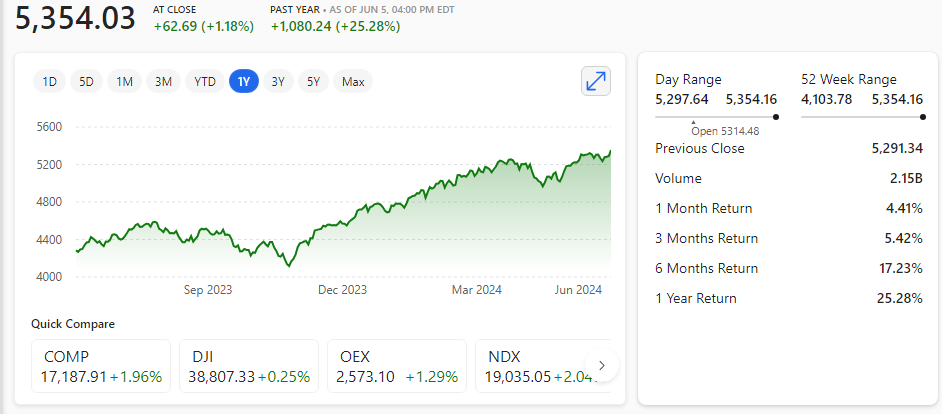
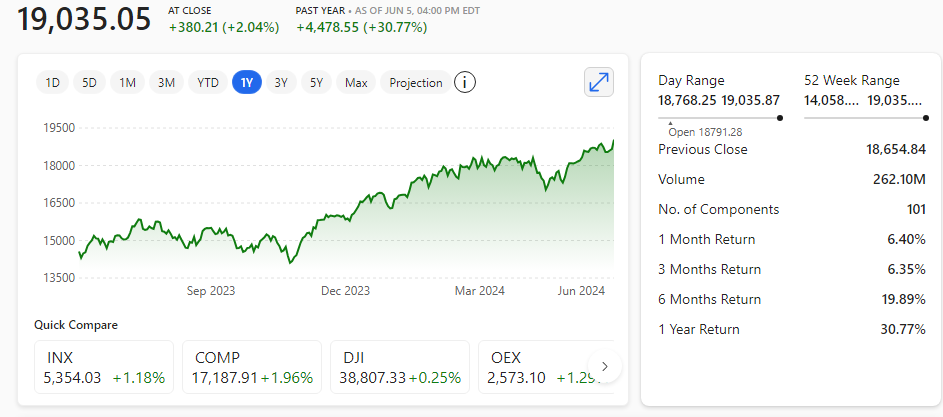
The S&P 500 reached a new high as Nvidia surpassed the $3 trillion mark for the first time, and the anticipation of an interest rate cut grew due to softer-than-expected job data.

S&P 500 all-time high as of 5th June 2024

S&P 500 all-time high as of 5th June 2024

Similarly, the Nasdaq 100 and Nasdaq Composite achieved new record highs

Nasdaq 100 as of 5th June 2024
Nasdaq Comp as of 5th June 2024

AI boom catapults Nvidia passed Apple’s market cap’ valuation

Artificial intelligence (AI) chipmaker Nvidia passed Apple’s market cap’ to become the world’s second most valuable company after Microsoft.

Nvidia’s shares have surged 24% following its impressive earnings report in May, in contrast to Apple’s shares, which have increased by only 5% this year amid a slowdown in sales growth in recent months.

Nvidia one year share price as of 5th June 2024

Nvidia one year share price as of 5th June 2024

Nvidia Market Cap at $3.01 trillion as of 5th June 2024

Nvidia £3.01 trillion market cap’

Microsoft announces new PCs with AI chips

AI art

Microsoft is promoting new computers equipped with advanced chips, engineered to operate the new artificial intelligence (AI) capabilities embedded in the Windows operating system.

On Monday 20th May 2024, Microsoft unveiled a Surface Laptop and a Surface Pro tablet, both featuring a Qualcomm chip capable of executing AI tasks both online and offline.

The new Microsoft Copilot+ PCs feature chips designed by ARM and are powered by Qualcomm’s Snapdragon X Elite and X Plus chips, which are also based on ARM architecture. These Snapdragon-powered PCs represent the initial series of devices under the Copilot+ PC brand, introducing over 20 models from various manufacturers, such as Acer.

The partnership between Microsoft, Qualcomm, and PC manufacturers is focused on providing superior processing and quick response times, with these ARM-based chips being integral to the new AI designs.

In addition, manufacturers like Lenovo, Dell, HP, Asus, Acer, and Samsung are launching AI-ready PCs featuring Qualcomm’s Snapdragon X Elite and X Plus processors. These processors offer extended battery life and compatibility with Microsoft’s Copilot AI chatbot.

Microsoft’s powerful AI vision – some tech information

Windows PCs designed for AI, known as Copilot+ PCs, are fitted with new, powerful chips capable of an astounding 40+ TOPS, ensuring all-day battery life and access to cutting-edge AI models.

Promoted as the fastest and most intelligent Windows PCs ever created, they boast features like Recall, Cocreator, and Live Captions, which can translate audio from over 40 languages into English.

These devices include sleek, lightweight, and elegantly designed models from Microsoft Surface and OEM partners such as Acer, ASUS, Dell, HP, Lenovo, and Samsung. Pre-orders are now open, with availability starting on June 18 and prices reportedly beginning at $999. This represents a major shift in the Windows platform, placing AI at the forefront of PC architecture.

This progress is a big part of Microsoft’s wider initiative to drive AI innovation onto devices, enhancing the AI capabilities that are already present in the cloud through Copilot.

This is a massive development in the deployment of AI to the masses.

Arm reportedly to launch AI chips in 2025 as Softbank plan AI data centres

AI

Arm, with a 90% holding by SoftBank, is reportedly set to establish an AI chip unit with the goal of developing a prototype by spring 2025.

This initiative is aimed at catching up with the booming AI market, currently dominated by Nvidia.

Arm, alongside competitors such as AMD, Intel, and Qualcomm, is accelerating efforts to gain position in the AI sector.

SoftBank is negotiating with contract manufacturers, including Taiwan’s TSMC, to produce the AI chips. Mass production is expected to commence in autumn 2025.

Arm’s shares have surged by nearly 45% this year, bringing its market capitalization to over $113 billion.

The chip designer based in the U.K., plans to create an AI chip unit to develop a prototype by spring 2025.

Discussions are reportedly ongoing with contract manufacturers like Taiwan’s TSMC for the production of the AI chips. It was reported that production is anticipated to start in fall 2025.

Arm is responsible for designing the core architecture for these chips. The company licences its designs to companies including Qualcomm and Nvidia and earning royalty fees from each sale. The company asserts that 99% of high-end smartphones utilize Arm technology.

Ambition

Established by Japanese billionaire Masayoshi Son, SoftBank is heavily investing in AI. The company has new plans to allocate $960 million by the following year to enhance its generative AI computing capabilities. In June 2023, Son expressed SoftBank’s ambition to occupy a leading role in the AI revolution.

Reportedly, SoftBank aims to establish AI data centres equipped with proprietary chips throughout the U.S., Europe, Asia, and the Middle East by 2026.

For the fiscal year concluding in March 2024, SoftBank recorded a 7.24 billion Japanese Yen ($4.6 billion) profit in its Vision Fund.

This was the first profitable year for the principal tech investment division since 2021.