What Happens to the S&P 500 if the Magnificent Seven Fail to Deliver on AI?

Mag 7 holding up the S&P 500 to the tune of almost 35% value of the entire S&P 500

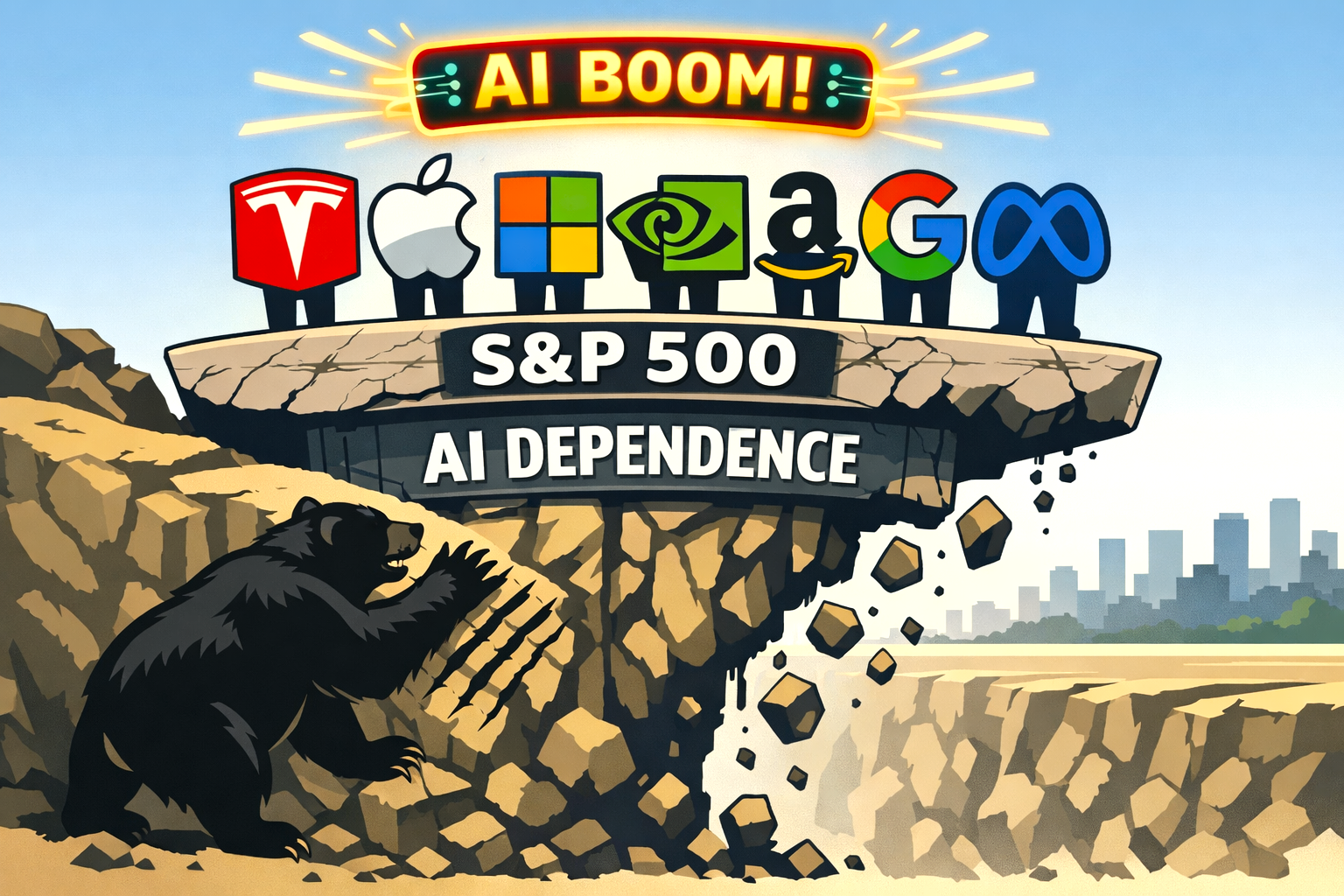
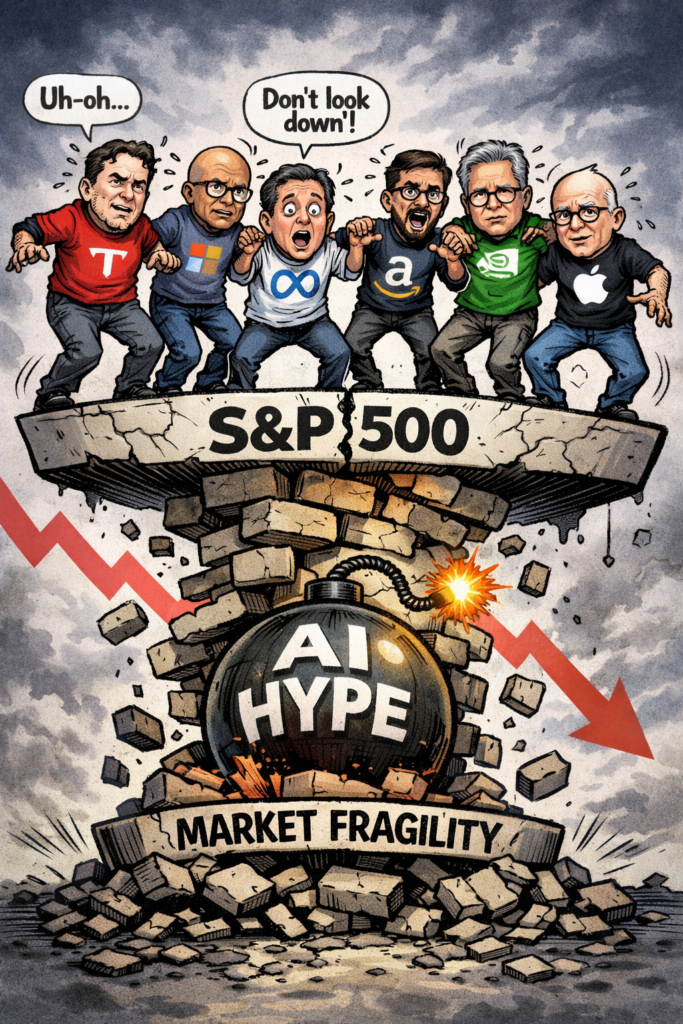
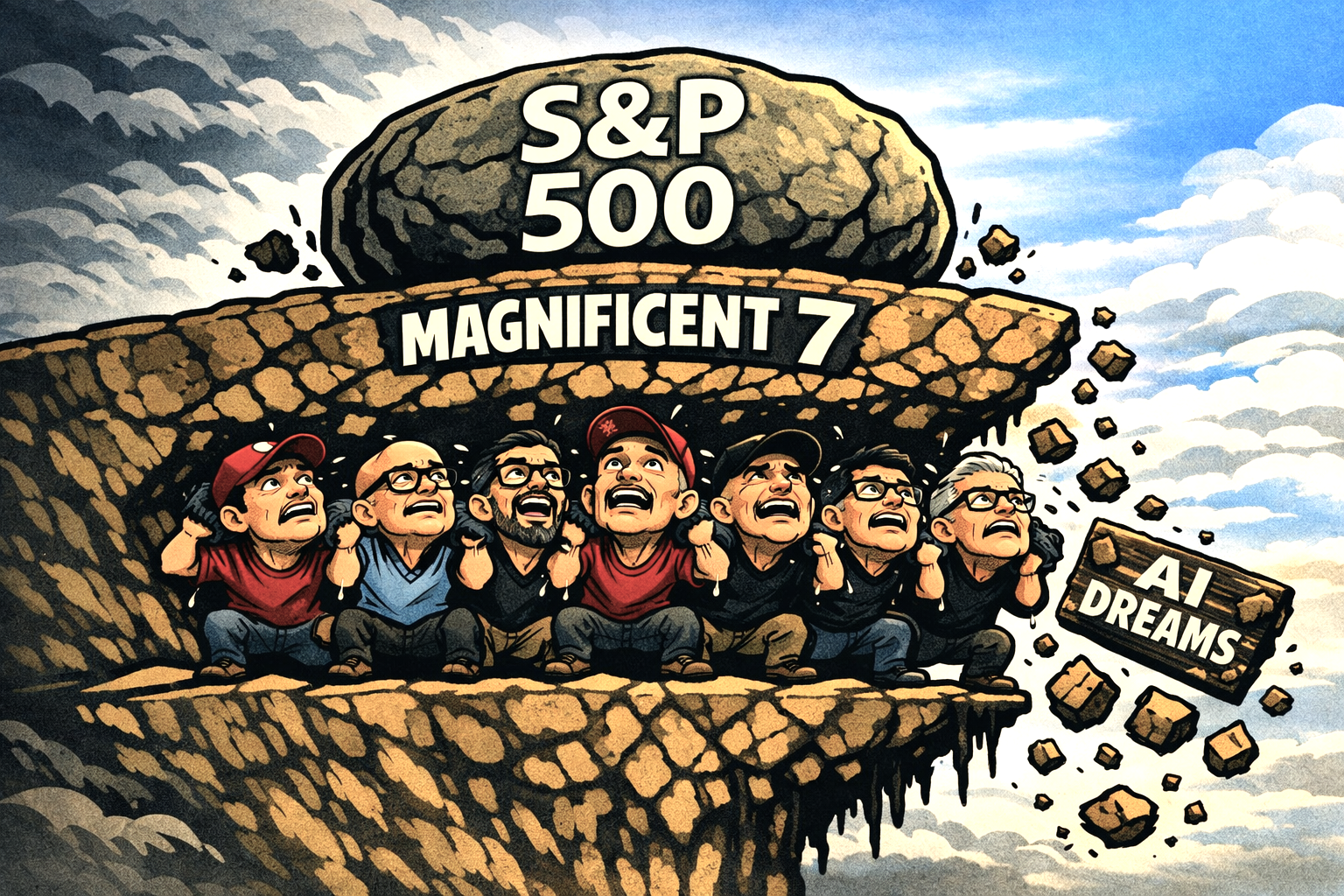
The S&P 500 has never been so dependent on so few companies. The Magnificent Seven — Microsoft, Apple, Nvidia, Alphabet, Amazon, Meta and Tesla — now account for roughly one‑third of the entire index’s value – that’s 33% of the whole S&P 500 vlauation.

Their dominance is not simply a reflection of current earnings power; it is a collective bet on an AI‑centred future that investors assume will transform productivity, reshape industries and justify valuations that stretch far beyond historical norms.

If one, several, or all of these companies fail to deliver the AI revolution that markets have priced in, the consequences for the S&P 500 would be immediate, structural and potentially severe.

Mild

The mildest scenario is a stumble by one or two members. If Apple’s device strategy falters, or Tesla’s autonomy narrative weakens further for instance, the index absorbs the shock.

A 3–5% pullback is plausible, driven by mechanical index weighting rather than systemic fear. Investors already expect uneven performance within the group, and the remaining leaders could offset the disappointment.

Major

The more destabilising scenario is a collective slowdown among the AI infrastructure leaders – Microsoft, Nvidia and Alphabet. These firms sit at the centre of the global capex cycle.

If cloud AI demand proves slower, less profitable or more niche than expected, the market would be forced to reassess the entire economic promise of generative AI.

In this case, the S&P 500 could see a 10–15% correction as valuations compress, volatility spikes and passive flows unwind years of momentum.

Dramatic

The most dramatic outcome is a broad failure of the AI ‘sector’ itself. If the promised productivity gains do not materialise, if enterprise adoption stalls, or if regulatory and cost pressures erode margins, the S&P 500 would face a structural reset.

With a third of the index priced for exponential growth, a collective disappointment could trigger a decline of 20% or more.

This would not resemble a cyclical recession; it would be a leadership collapse similar to the dot‑com unwind, but with far greater concentration and far more passive capital tied to the winners.

The uncomfortable truth is that the S&P 500’s trajectory is now inseparable from the Magnificent Seven. If they deliver, the index continues to defy gravity. If they falter, the market must rebuild a new narrative — and a new set of leaders — from the ground up.

If the Magnificent Seven Lose Their Grip, Who Rises Next?

For years, the S&P 500 has been defined by the gravitational pull of the Magnificent Seven. Their dominance has shaped index performance, investor psychology and the entire narrative arc of global markets.

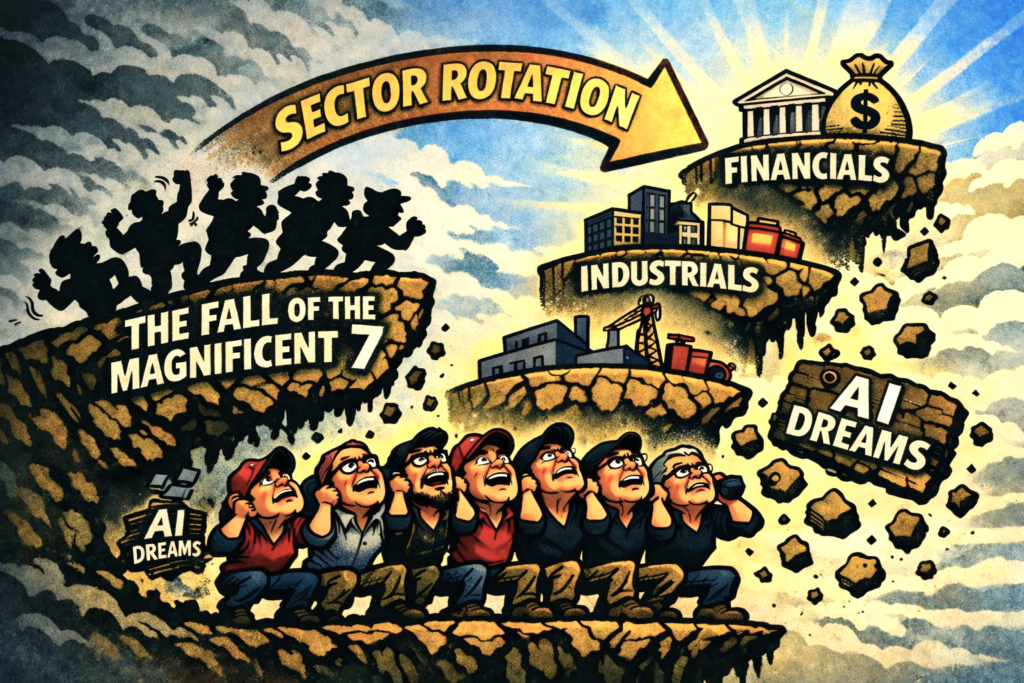
If these companies lose momentum — whether through slower AI adoption, regulatory pressure, margin compression or simple over‑expectation — leadership will not disappear.

It will rotate. And the beneficiaries are already hiding in plain sight.

Alternative investment to AI

The first and most obvious winners would be Energy and Utilities. As AI enthusiasm cools, investors tend to rediscover the appeal of tangible cash flow. Energy companies, with their dividends and pricing power, become natural refuges.

Utilities, often dismissed as dull, regain relevance as defensive anchors in a more volatile market. If AI‑driven data‑centre demand slows, the sector’s cost pressures ease, improving margins.

Next in line are Industrials and Infrastructure. A retreat from speculative tech would likely redirect capital towards physical productivity — logistics, construction, defence, electrification and manufacturing modernisation.

These sectors have been quietly compounding earnings while Silicon Valley has monopolised attention. If the market shifts from promise to proof, industrials become the new growth story.

Healthcare and Pharmaceuticals would also rise. Their earnings cycles are largely independent of AI hype, driven instead by demographics, innovation and regulatory frameworks. When tech stumbles, healthcare’s stability becomes a premium rather than an afterthought.

Biotech, in particular, benefits from capital rotation when investors seek uncorrelated growth.

Financials stand to gain as well. A correction in mega‑cap tech would rebalance passive flows, giving banks and insurers a larger share of index‑tracking capital. Higher rates and wider spreads already support the sector; a shift away from tech simply amplifies the effect.

Finally, Consumer Staples would reassert themselves. In a market recalibrating after an AI disappointment, investors gravitate towards predictable earnings. Food, beverages and household goods regain their defensive premium as volatility rises.

The broader truth is simple: if the Magnificent Seven falter, the S&P 500 does not collapse — it redistributes. Leadership moves from code to concrete, from speculative multiples to operational reality. The market has always found new champions. It will again.


Is the Magnificent Seven Trade a little less Magnificent now?

Magnificent Seven Stocks

For much of the past three years, the so‑called Magnificent Seven – Apple, Microsoft, Alphabet, Amazon, Meta, Tesla and Nvidia – have powered US equities to repeated record highs.

Their sheer scale, earnings strength and centrality to the AI boom turned them into a market narrative as much as an investment theme.

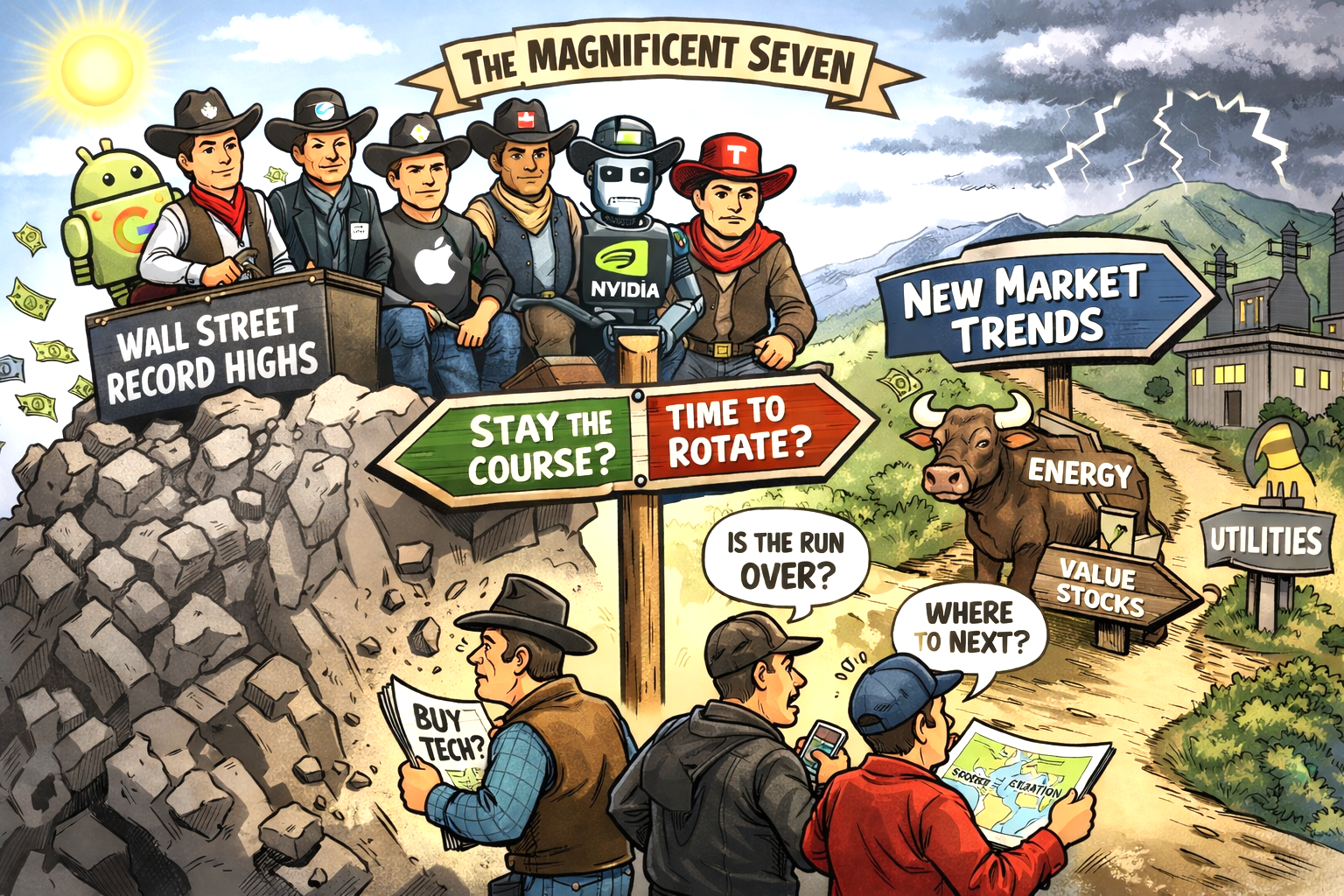
But as 2026 unfolds, the question is no longer whether they can keep leading the market higher, but whether the idea of treating them as a single trade still makes sense.

The short answer is closer to: the trade isn’t dead, but the era of effortless, broad‑based mega‑cap dominance is fading.

Mag 7 fatigue

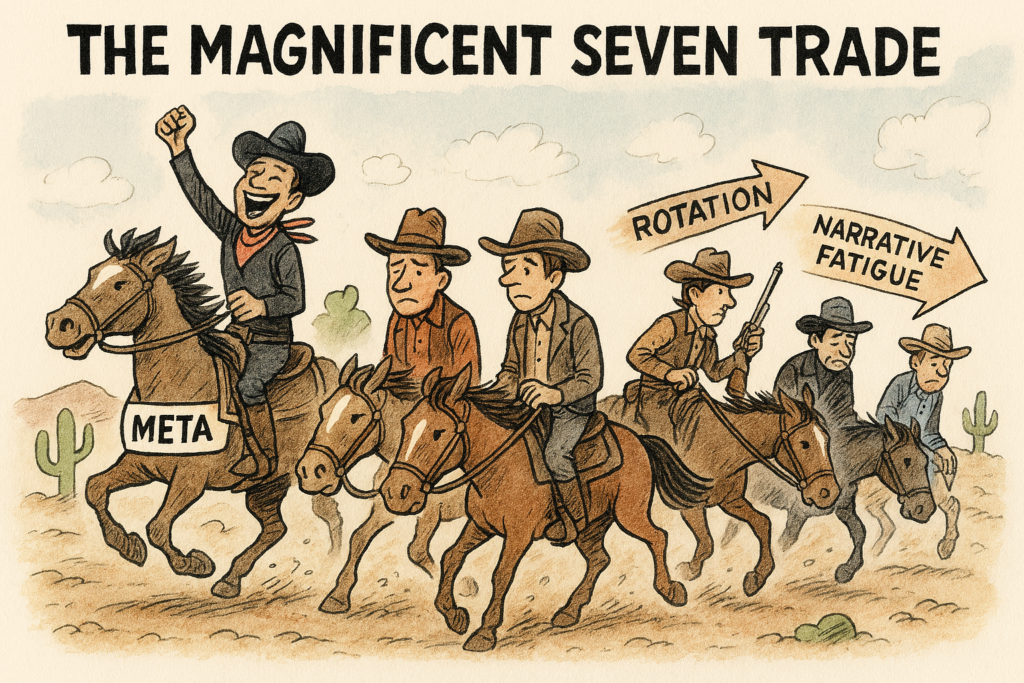
The first sign of fatigue is the breakdown in cohesion. Last year, only a minority of the seven outperformed the wider S&P 500, a sharp contrast to the near‑uniform surges of 2023 and early 2024.

Nvidia and Alphabet continue to benefit from the structural demand for AI infrastructure and cloud‑driven productivity gains. Others, however, appear to be wrestling with slower growth, regulatory pressure or strategic resets.

Apple faces a maturing hardware cycle, Tesla is contending with intensifying global competition, and Meta’s spending plans continue to divide investors.

Mag 7 trade – which company is missing?

Divergence

This divergence matters. For years, investors could simply buy the group and let the rising tide of AI enthusiasm and index concentration do the work.

That simplicity has evaporated. Stock‑picking is back, and the market is finally distinguishing between companies with accelerating earnings power and those relying on past momentum.

At the same time, market breadth is improving. Capital is rotating into industrials and defensive sectors as investors seek exposure to areas that have lagged the mega‑cap rally. However, AI is affecting software stocks, law and financial sectors.

Healthy future

This broadening is healthy: it reduces concentration risk and signals that the U.S. economy is no longer dependent on a handful of tech giants to sustain equity performance.

Yet it would be premature to declare the Magnificent Seven irrelevant. Their combined earnings growth is still expected to outpace the rest of the index, and their role in AI, cloud computing and digital infrastructure remains foundational.

Change

What has changed is the nature of the trade. These are no longer seven interchangeable vehicles for tech exposure; they are seven distinct stories with diverging trajectories.

The Magnificent Seven haven’t left the stage. They have likely stopped performing in unison – and for investors, that marks the beginning of a more nuanced, more selective chapter.

When Markets Lean Too Heavily on High Flyers

The AI trade

The recent rebound in technology shares, led by Google’s surge in artificial intelligence optimism, offered a welcome lift to investors weary of recent market sluggishness.

Yet beneath the headlines lies a more troubling dynamic: the increasing reliance on a handful of mega‑capitalisation firms to sustain broader equity gains.

Breadth

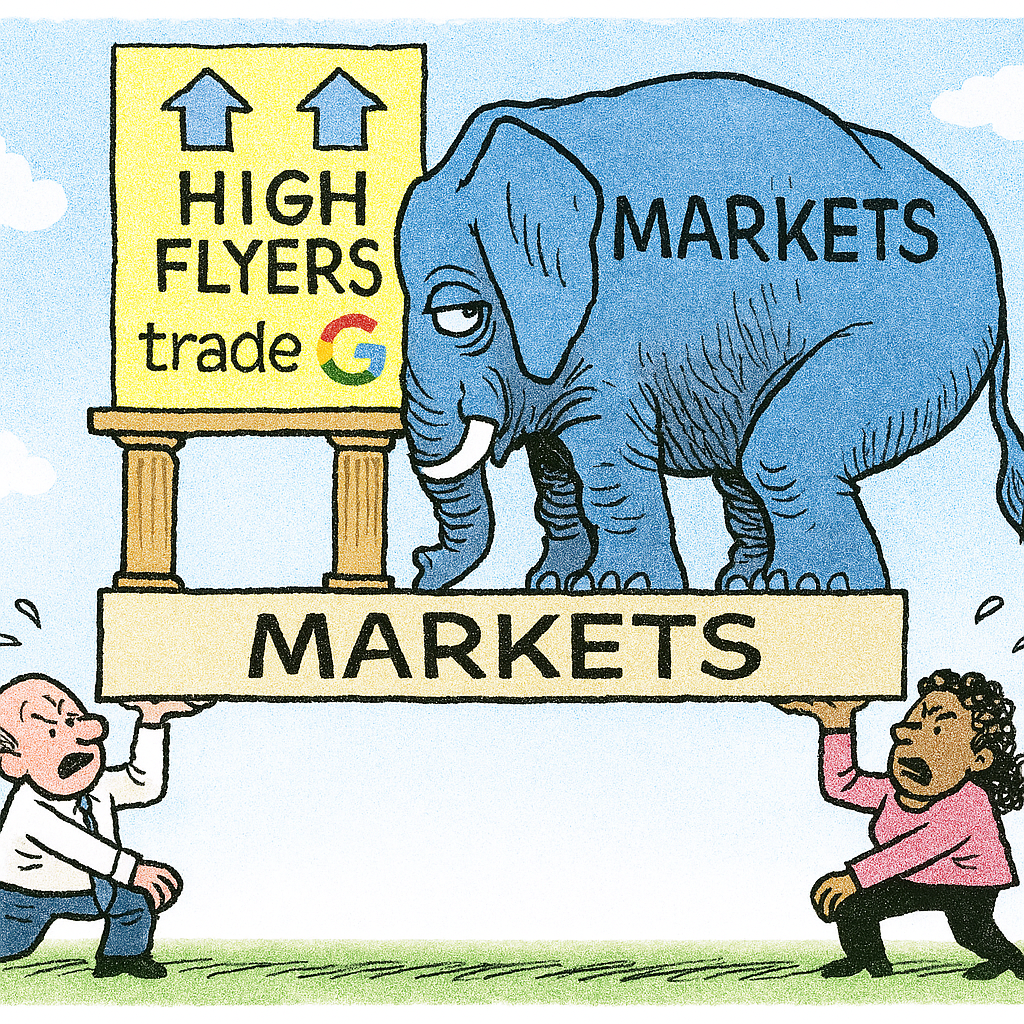
Markets thrive on breadth. A healthy rally is one in which gains are distributed across sectors, signalling confidence in the wider economy. When only one or two companies shoulder the weight of investor sentiment, the picture becomes distorted.

Google’s AI announcements may well justify enthusiasm, but the fact that its performance alone can swing indices highlights a fragility in the current market structure.

This concentration risk is not new. In recent years, the so‑called ‘Magnificent Seven‘ technology giants have dominated returns, masking weakness in smaller firms and traditional industries.

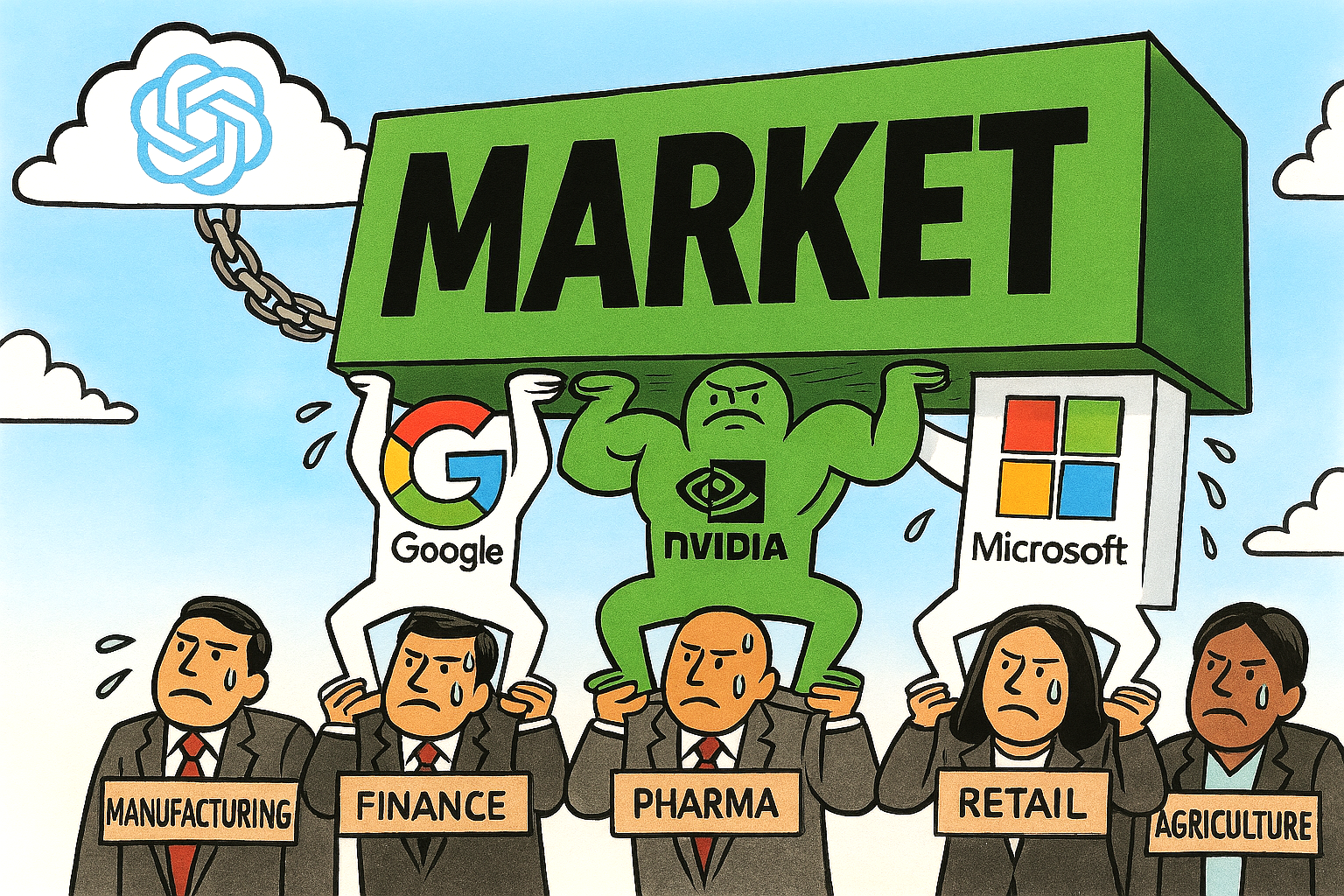
While investors cheer the headline numbers, the underlying reality is that many sectors remain subdued. Manufacturing, retail, and even parts of the financial industry are not sharing equally in the rally.

Over Dependence

Over‑dependence on highflyers creates two problems. First, it exposes markets to sudden shocks: if sentiment turns against one of these giants, indices can tumble disproportionately.

Second, it discourages capital from flowing into diverse opportunities, stifling innovation outside the tech elite.

For long‑term stability, investors and policymakers alike should be wary of celebrating narrow gains. A resilient market requires participation from a broad base of companies, not just the fortunes of a few.

Google’s success in AI is impressive, but true economic strength will only be evident when growth spreads beyond the marquee names.

Until then, the market remains vulnerable, propped up by giants whose shoulders, however broad, cannot carry the entire economy indefinitely.

Are investors saying it’s time to move on from tariffs and if so to what effect on the markets?

Tariffs and the Markets

It looks like investor sentiment is shifting away from obsessing over tariffs—though not because they’ve disappeared.

Instead, there’s a growing sense that tariffs may be settling into a predictable range, especially in the U.S., where President Trump signalled a blanket rate of 15–20% for countries lacking specific trade agreements.

Here’s how that’s playing out

🌐 Why Investors Are Moving On

  • Predictability over Panic: With clearer expectations around tariff levels, markets may no longer treat them as wildcards.
  • Muted Market Reaction: The recent U.S.-EU trade deal barely nudged the S&P 500 or European indexes after moving the futures initially, signalling tariffs aren’t the hot trigger they once were.
  • Economists Cooling Expectations: Revisions to tariff impact estimates suggest future trade deals might not generate outsized optimism on Wall Street.

📈 Effects on the Markets

  • Focus Shift: Investors are turning to earnings—particularly from the ‘Magnificent Seven’ tech giants—and macroeconomic data for momentum.
  • Cautious Optimism: While stocks haven’t rallied hard, they’re not dropping either. Traders seem to be waiting for a new catalyst, like U.S. consumer strength or signs of a bull phase in certain indexes.
  • Geopolitical Undercurrents: A new deadline for Russia to reach a peace deal and threats of ‘secondary tariffs’ could still stir volatility, depending on how global partners react.

So, in short tariffs aren’t gone, but they’ve become background noise. Investors are tuning in to the next big signals.

If you’re keeping an eye on retail, tech earnings, or commodity flows, this shift could have ripple effects worth dissecting.

Market moving events, other than tariffs

DateEvent/CatalystMarket Impact Potential
July 30Meta earnings + possible stock split📈 High (tech sentiment)
July 31Fed meeting📈📉 High (rate guidance)
Aug 1U.S.–EU tariff milestone, not flashpoint📉 Moderate (sector recalibration)
July 22U.S. AI Action Plan (released)📈 Unclear (dependent on execution

S&P 500 enjoyed a 23% gain in 2024 but 2025 may not be so good

The S&P 500 index witnessed big gains right from the start of 2024. In the first quarter of the year, it jumped up 10.20%. That’s around more than 10 times its average gain since 2000.

However, the momentum couldn’t be sustained as the S&P added 3.9% and 5.5% in the second and third quarter of 2024. In any other year, investors might not have been disappointed with those figures. But the index’s first-quarter performance set expectations so high that subsequent quarters seemed to pale in comparison.

In the final quarter of 2024, the S&P limped to a gain of just 1.9%. Making things worse, we did not get a 2024 Santa rally.

Of course, a gain is a good. But it’s hard not to e just a little disappointed when looking back at the highs we enjoyed in early 2024.

That said, a relatively weak end to the year wasn’t enough to dent the gains of the S&P 500 in the early part of 2024, where the index surged 23.30%. The index recorded no fewer than 57 record closes and this on the back of a 24.2% rise in 2023.

Big tech and Artificial intelligence stocks (the Magnificent Seven in particular) were behind much of 2024′s gains. Shares of Nvidia were up by around 171%, while Broadcom jumped 108%. To place this in context – the Magnificent 7’ stocks were responsible for more than half the S&P 500′s 2024 gain. It does beg the question – is the initial AI hype over for now or is there more to come? Has AI settled for the moment?

Uncertainties await the markets in 2025. Investors will have to contend with the incoming Trump administration’s policies, possibly higher-than-expected interest rates for the year, which in turn are keeping Treasury yields elevated, among other headwinds.

Trumps tariffs are on the way.

Happy days on Wall Street for BIG tech companies

Tech

It was a good day of earnings for Big Tech companies. 

Three of the Magnificent 7 results dominated the headlines: Meta, Amazon and Apple. Nasdaq and S&P 500 gained in ‘after the bell’ trading. This after a punishing day for Alphabet and Microsoft, despite good results.

Nasdaq 100 closed at: 17344 but climbed above 17500 in after-hours trading.

Wall Street seemed impressed with Meta’s results.

Meta

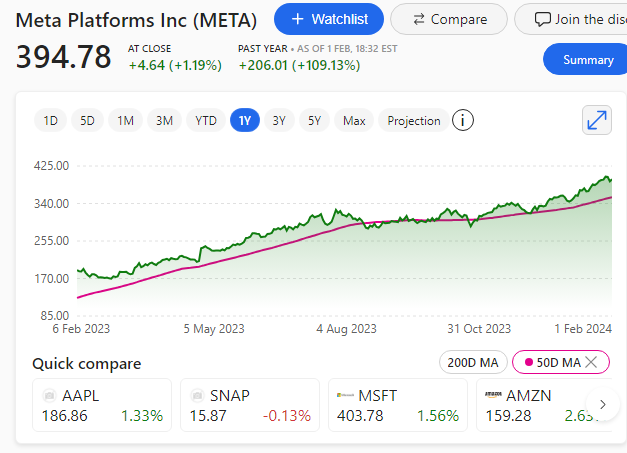
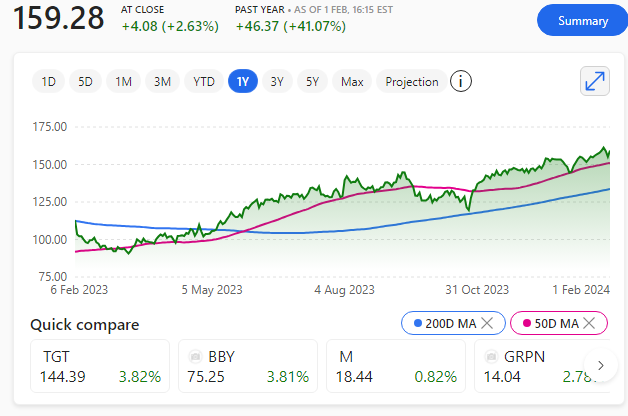
Shares of Meta surged 15% after the social-media giant defied analysts’ estimates. It posted earnings of $5.33 per share on revenue of $40.11 billion. The company also declared its first-ever dividend payment. Share buy-back was also announced.

Meta platforms Inc. One year chart

Meta platforms Inc. One year chart
  • The results show Meta’s online ad business continues to recover well from a terrible 2022.
  • Sales in the Q4 jumped 25% year on year.
  • Expenses decreased 8% year over year to $23.73 billion.

Amazon

Investors also enjoyed Amazon’s earnings, which easily topped Wall Street’s predictions. The ecommerce giant also provided a strong positive outlook. The stock jumped 7% in extended trading.

Amazon.com Inc. One year chart

Amazon.com Inc. One year chart

Q4 was a record-breaking Holiday shopping season in the U.S. and closed out a robust 2023 for Amazon. Amazon has much planned for 2024.

Apple

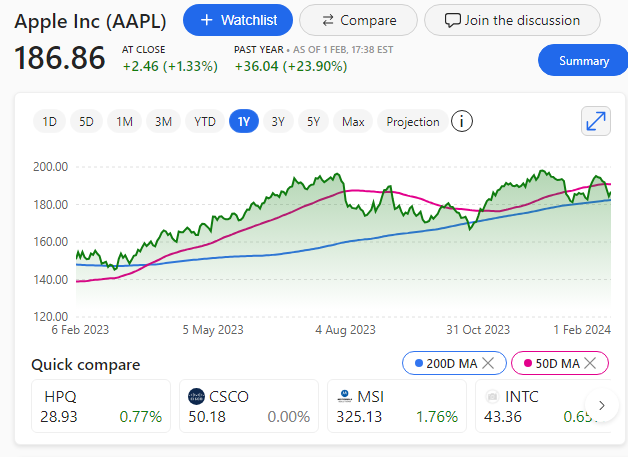
But Apple didn’t benefit from the same treatment despite posting strong results.

Apple Inc. One year chart

Apple Inc. One year chart

Apple also exceeded estimates, reporting revenue growth for the first time in a year. But shares slid more than 2% in extending trading after it posted a 13% decline in sales in China.

Apple’s outlook suggesting weak iPhones sales may have also disappointed investors.

The Magnificent Seven

Magnificent Seven

The Magnificent Seven is a term coined to describe the seven most valuable and popularly owned tech companies in the U.S. stock market.

It was also a 1960’s movie…

The Seven

Apple (AAPL)

The world’s largest software company, known for its iPhone, iPad, Mac, Apple Watch, AirPods, and other devices, as well as its services such as iCloud, Apple Music, Apple TV+, and App Store.

Microsoft (MSFT)

The world’s largest software company, known for its Windows operating system, Azure cloud services, LinkedIn social media platform, Office professional software suite, and Xbox gaming brand.

Alphabet (GOOGL)

The parent company of Google, the world’s leading search engine, as well as other businesses such as YouTube, Google Cloud, Google Maps, Google Ads, and Waymo.

Amazon (AMZN)

The world’s largest online retailer, as well as a leading provider of cloud computing services through Amazon Web Services (AWS), and a major player in digital entertainment through Amazon Prime Video, Amazon Music, and Kindle.

Meta Platforms (META)

The former Facebook, the world’s largest social media network, as well as the owner of other popular platforms such as Instagram, WhatsApp, Messenger, and Oculus.

Nvidia (NVDA)

The world’s leading manufacturer of graphics processing units (GPUs), which are used for gaming, artificial intelligence, cloud computing, and cryptocurrency mining, as well as other products such as Nvidia Shield, GeForce Now, and Omniverse.

Tesla (TSLA)

The world’s most valuable automaker, known for its electric vehicles, battery products, solar panels, and self-driving technology, as well as its visionary founder and CEO, Elon Musk.

Market dominance

These seven companies are not only dominant in their respective fields, but also at the forefront of innovation and growth in the tech sector. They collectively make up some 30% of the S&P 500 index and more than half of the Nasdaq 100 index. 

They have also delivered impressive returns for investors over the past five years, with Nvidia and Tesla leading the pack with more than 800% gains. The Magnificent Seven are often compared to the FAANG stocks, which include four of the seven companies, but exclude Microsoft, Nvidia, and Tesla, and include Netflix instead. 

Magnificent 7 tech stocks

Some analysts suggest that the Magnificent Seven capture the current state and future potential of the tech industry. But is it now time to rotate out of tech into other areas that have been neglected. I wouldn’t be surprised to see the bull market charge on but with other ‘less’ loved companies leading the way.

It has been calculated that the combined market cap value of these seven companies is some $9 trillion.

Magnificent 7 tech’ stocks haven’t been this cheap since 2017

Magnificent 7 tech stocks

The Magnificent Seven tech stocks

These are the seven largest U.S. listed companies in the technology sector.

Apple, Microsoft, Amazon, Alphabet, Nvidia, Tesla and Meta Platforms

According to a report released Monday 2nd October 2023, these tech’ stocks have seen their valuation drop relative to the median stock in the S&P 500, making them more attractive for investors. The report says that the Magnificent 7 trade at 1.3 times their PEG ratio (price-to-earnings-to-long-term growth), versus 1.9 for the median S&P 500 stock. 

This is the cheapest valuation in over six years – time to buy yet?

The report also highlights some positive drivers for these stocks, such as their strong sales growth, their ability to beat expectations, and their resilience to rising interest rates.

However, some analysts also warn that the dominance of these stocks could pose a risk for the broader market if something bad happens to tech’.