
AI Is Breaking Down the Barriers to Starting a Business

The power of AI empowering business start-ups

Artificial intelligence is beginning to reshape the economics of starting and running a business.

AI is easily accessible

What once required substantial financial investment, specialist skills and a team of employees can increasingly be achieved by an individual with a computer, an internet connection and access to AI tools.

The implications could extend well beyond entrepreneurship, potentially changing productivity, employment, competition and economic growth.

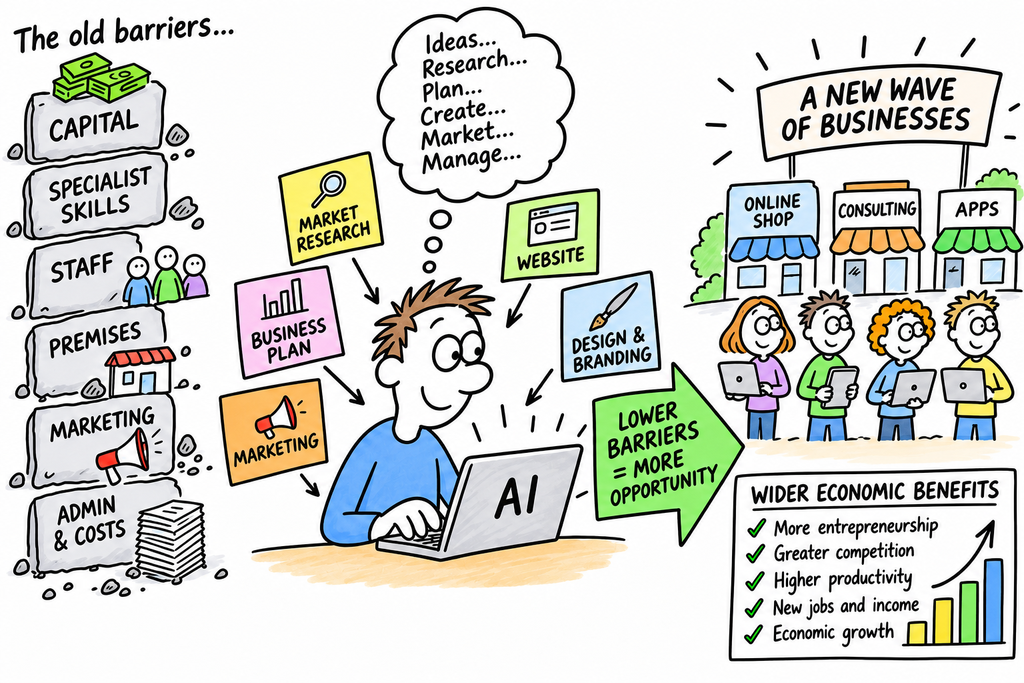
Traditionally, starting a business involved considerable upfront costs. Entrepreneurs needed to invest in staff, premises, marketing, professional services, technology and administration, often before generating their first pound of revenue.

These expenses created significant barriers to entry, particularly for individuals without access to capital or business connections.

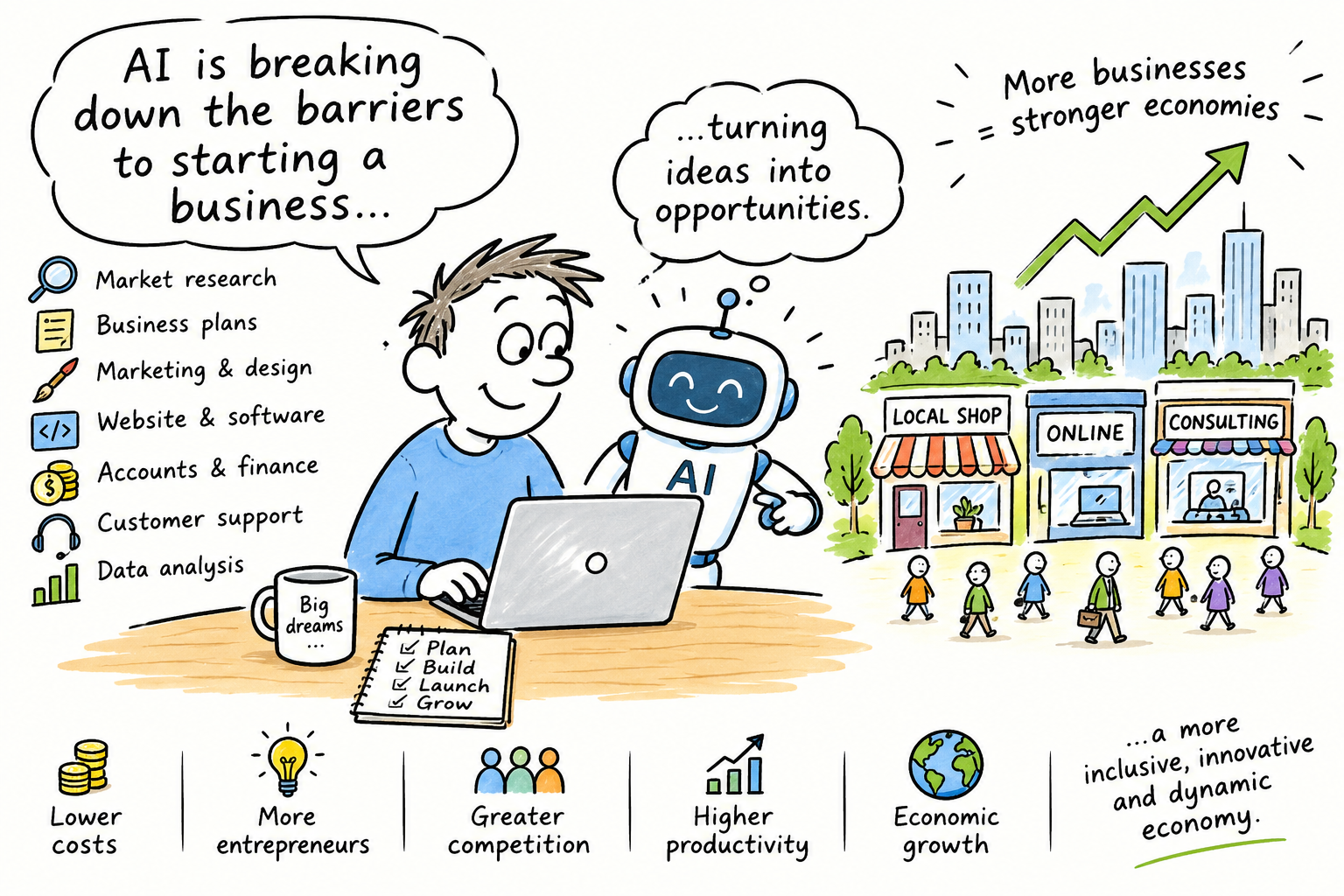
AI is changing this economic equation

An individual can now use AI to conduct market research, develop business plans, build websites, write software, produce marketing campaigns, analyse financial information and manage customer enquiries.

Tasks that previously required several employees or expensive external consultants can increasingly be handled by one person at a fraction of the cost.

This has the potential to create a new generation of micro-businesses, independent entrepreneurs and highly productive one-person companies.

Lower operating costs could allow businesses to become profitable with considerably less revenue than was previously necessary.

For the many

The wider economic consequences could be significant. If millions of individuals can establish businesses with relatively little capital, entrepreneurship could become a much more accessible route to generating income and creating employment.

Smaller businesses may also become more competitive, challenging established corporations that have traditionally benefited from economies of scale, larger workforces and greater financial resources.

But first we will have a period of transition and discovery.

Productive

There is also a potentially important productivity dividend. Businesses able to produce more with fewer employees could reduce operating costs, improve margins and increase output.

At a national level, this could contribute to economic growth without requiring the same expansion in the workforce.

For governments struggling with ageing populations, labour shortages and weak productivity, AI could become an increasingly important economic tool.
Saturation

However, there is another side to the equation. As the cost of establishing a business falls, competition will intensify.

Markets could become saturated with similar products and services, while automation may displace certain administrative, creative and professional roles.

The economic benefits will depend partly on whether new businesses and industries create sufficient opportunities to offset employment lost elsewhere.

Access to AI will also matter. If the technology becomes concentrated among a small number of powerful companies, the savings generated by automation may not be distributed evenly.

Nevertheless, AI could represent a significant democratisation of business ownership. The traditional advantages of capital, staffing and infrastructure may become less important, while creativity, commercial judgement and the ability to identify opportunities become increasingly valuable.

The Next Wave

The next wave of business creation may not come from large corporations investing billions, but from individuals using AI to build businesses that previously would have been financially impossible.

AI is not eliminating the risks of entrepreneurship. It is, however, dramatically reducing the cost of trying. That could have profound implications for the future structure of the global economy.
AI: The Next Great Economic Boom – But at What Financial and Economic Cost?

The artificial intelligence revolution continues to dominate financial markets, attracting extraordinary investment from some of the world’s largest technology companies.

Yet beneath the enthusiasm, a growing number of economic, financial and political concerns are emerging. While technology shares have recently staged a recovery, the fundamental questions surrounding the sustainability of the AI investment boom remain unanswered.

The central issue is becoming increasingly difficult to ignore: can the commercial returns from artificial intelligence justify the enormous cost of building the infrastructure required to support it?

An unprecedented investment programme

Microsoft, Amazon, Alphabet, Meta, Oracle and many others are committing hundreds of billions of dollars to data centres, specialist processors and supporting infrastructure. Their ambitions are substantial, with AI expected to transform productivity, business operations, healthcare, manufacturing and countless other industries.

However, the scale of expenditure is creating growing financial pressures. The Bank of England has highlighted the increasing reliance on borrowing to finance AI infrastructure. Morgan Stanley reportedly estimated that global AI-related debt issuance had reached approximately $450 billion by early September 2026, more than double the total for the whole of 2025.

The Bank has also highlighted the growing involvement of private credit and more complicated financing arrangements. These developments raise questions about where the financial risks ultimately sit, particularly if expected commercial returns fail to materialise.

Debt itself is not necessarily a problem. Large companies routinely borrow to finance expansion. The concern is whether the investment will generate sufficient cash flow to service that borrowing while continuing to fund further development.

The returns question

Technology companies are investing on the assumption that AI adoption will eventually produce enormous commercial opportunities. However, the gap between infrastructure expenditure and demonstrable financial returns remains an important consideration.

Data centres are expensive to construct and operate. Specialist chips require continual investment, while electricity, cooling, water and network infrastructure add further costs.

The industry must also contend with rapidly changing technology. Today’s expensive processors and facilities could become less competitive as more efficient systems emerge.

There is also the possibility that investment is running ahead of commercial demand. Businesses are experimenting with AI, but widespread adoption does not automatically translate into sufficient revenue to justify the enormous infrastructure costs.

Investors will increasingly want evidence that AI-related revenues and productivity improvements are keeping pace with capital expenditure.

Chinese competition adds another complication

Competition from China represents another potential challenge.

Chinese developers have demonstrated that increasingly capable AI models can be produced using more cost-efficient approaches. This could put pressure on the pricing structures of American technology companies.

If businesses can access capable AI systems at considerably lower prices, the commercial returns expected by companies investing heavily in infrastructure could be affected.

The AI industry may ultimately become much larger, but that does not guarantee that every company currently investing in it will generate attractive returns.

The political landscape changes

The U.S. midterm elections have introduced another dimension.

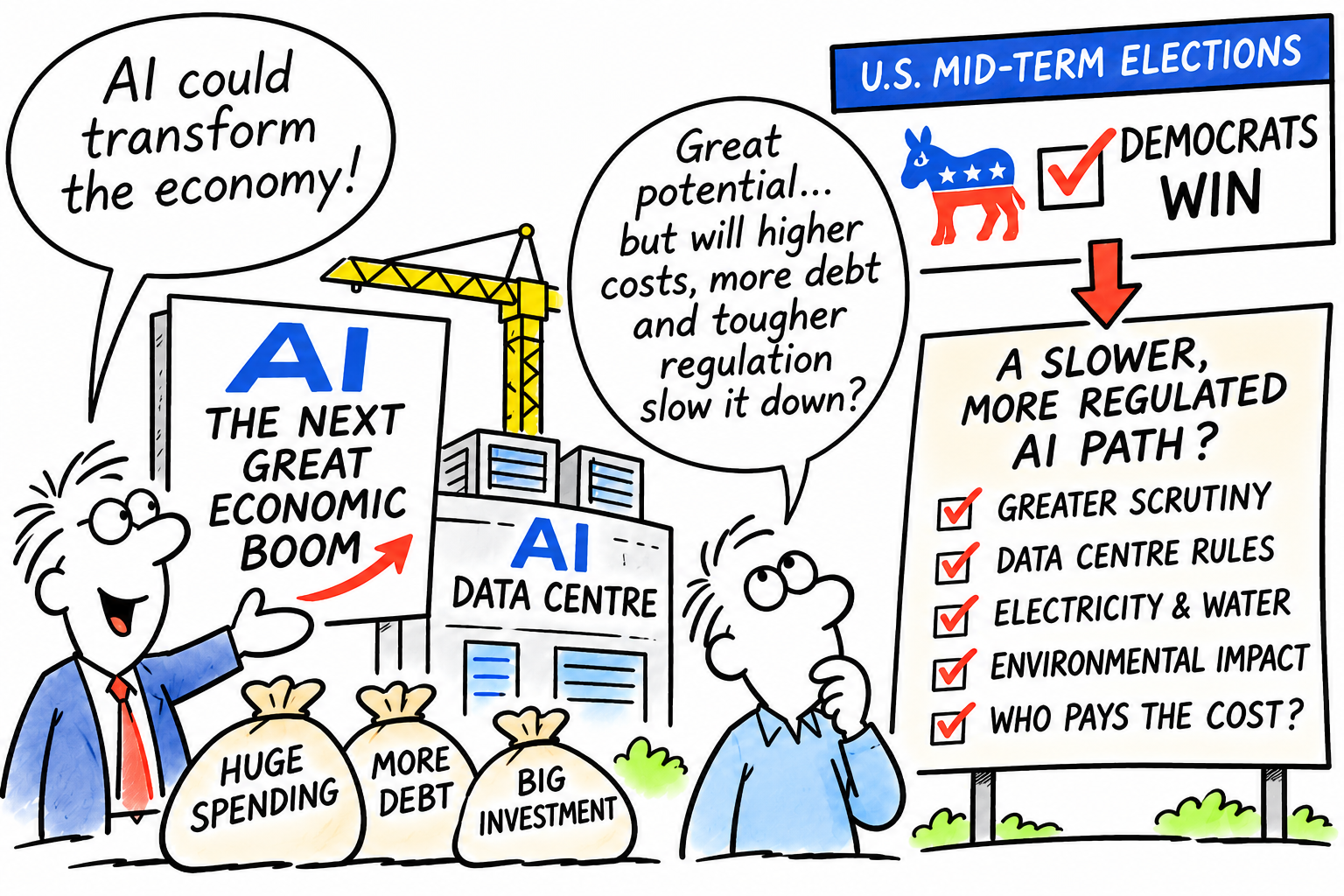
Democrats have secured control of both the House of Representatives and the Senate, creating a more challenging political environment for President Trump during the remainder of his term.

Technology companies could face increased scrutiny over data-centre construction, electricity consumption, environmental considerations, water supplies and AI regulation.

There are already disagreements in Washington over who should pay for the additional electricity infrastructure required by data centres. Some lawmakers want technology companies to shoulder more of the cost rather than passing it on to ordinary electricity consumers.

These concerns are particularly relevant in states such as Texas, where substantial AI infrastructure investment is planned.

Greater political scrutiny does not necessarily mean that AI development will stop. However, additional regulation, planning restrictions and infrastructure costs could slow the expansion or reduce the profitability of some projects.

Why is the Nasdaq recovering?

Despite these concerns, technology shares have recently demonstrated considerable resilience.

On 3rd November 2026, the Nasdaq gained approximately 0.83%, supported by a recovery in major AI and semiconductor shares. Nvidia, Broadcom and Micron were among the beneficiaries.

However, this recovery seemed to start ahead of the full midterm election results. Following the Democratic victories, global markets initially reacted negatively, reflecting concerns about potential regulatory changes and the future pace of AI infrastructure investment.

The recovery in technology shares should therefore not be interpreted as evidence that the underlying problems have disappeared.

Investors may be buying following recent declines, taking advantage of lower valuations or closing short positions. Such activity can produce substantial market recoveries without any corresponding improvement in the industry’s financial fundamentals.

A defining moment for investors

The AI revolution could ultimately prove to be one of the most important technological developments in modern economic history. Its potential should not be underestimated.

However, technological success and investment success are not necessarily the same thing.

The companies building the infrastructure must demonstrate that their investments can generate sustainable revenues, adequate cash flow and acceptable returns. Meanwhile, increasing borrowing, competition, resource constraints and political intervention could complicate that process.

For investors, the next stage of the AI story may be less about excitement surrounding technological possibilities and more about financial discipline.

Capital expenditure, debt issuance, free cash flow, AI-related revenues and institutional investment decisions deserve particularly close attention.

The wider economic consequences also matter. If AI delivers the productivity improvements its supporters anticipate, the benefits could extend well beyond the technology sector.

Conversely, if investment expectations become disconnected from commercial reality, the financial consequences could reach credit markets and the wider economy.

The AI revolution may be gathering momentum, but the investment boom financing it is approaching an important test.

The question is no longer simply how transformative AI might become. It is whether the extraordinary sums being committed today can generate sufficient economic value tomorrow.

For investors, that distinction could become increasingly important.

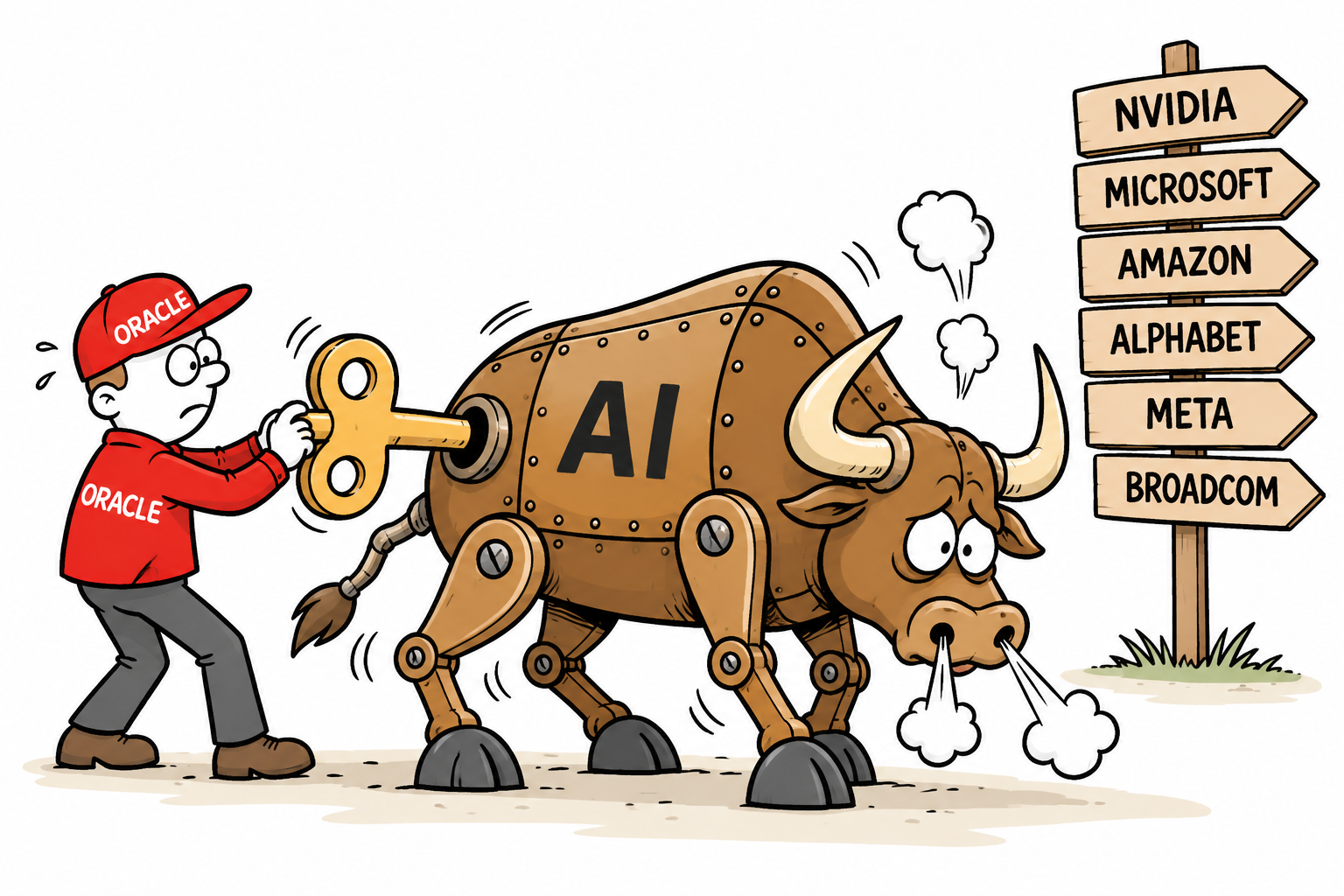
Is Credit Stress Threatening to Unwind the AI Bull Market – Can Oracle and Others Hold the Line?

Credit Stress?

The artificial intelligence boom faces a potentially dangerous turning point. After years of extraordinary investment, soaring valuations and relentless enthusiasm, cracks are emerging in the credit markets that have helped finance America’s AI revolution.

At the centre of the storm stands Oracle, increasingly regarded as a barometer of whether the debt-fuelled AI expansion can continue.

Nervous

Investors are becoming nervous about the enormous borrowing required to construct data centres, purchase advanced chips and develop the infrastructure supporting artificial intelligence.

The warning signs are unmistakable

Oracle’s five-year credit default swap (CDS) spreads, effectively the cost of insuring against debt default, reportedly reached a record 288 basis points on 15th October 2026.

Meanwhile, heavily indebted AI infrastructure provider CoreWeave has seen its spreads exceed 1,000 basis point.

These figures do not indicate imminent defaults, but they reveal growing anxiety about the sustainability of AI financing.

The implications for Wall Street could be substantial

Oracle must convince investors that its enormous infrastructure commitments can generate sufficient revenues and cash flow to justify mounting financial obligations.

Should confidence deteriorate further, borrowing costs could rise, financing could become harder to secure and ambitious AI expansion plans could face delays.

That would threaten companies throughout the AI ecosystem

Nvidia, Broadcom and other semiconductor suppliers depend heavily on continued infrastructure spending. Microsoft, Amazon, Alphabet and Meta could also face increasing scrutiny over their enormous capital expenditure commitments.

The technology-heavy Nasdaq would be particularly vulnerable, while the broader S&P 500 could suffer from its substantial exposure to America’s largest technology companies.

A prolonged credit squeeze could trigger further selling, valuation compression and a rotation towards less capital-intensive sectors.

However, an AI collapse is far from inevitable

Strong earnings, continued demand for computing power and credible financing arrangements could restore confidence. Indeed, American technology stocks rebounded on Monday following the previous week’s sharp declines.

Nevertheless, the balance of risk appears increasingly uncomfortable.

The greatest danger is that a credit crisis develops before AI revenues can justify the investment.

Oracle may not determine the entire AI industry’s future, but its ability to reassure lenders could influence whether Wall Street’s extraordinary technology bull market survives its next major test.

What Could Finally Reverse the U.S. Stock Market Rally?

S&P 500 top heavy companies

The U.S. stock market continues to defy those warning that valuations, concentration and excessive optimism have created a dangerous combination.

Yet the question is no longer simply whether American shares are expensive. It is whether the assumptions supporting those valuations can continue to hold.

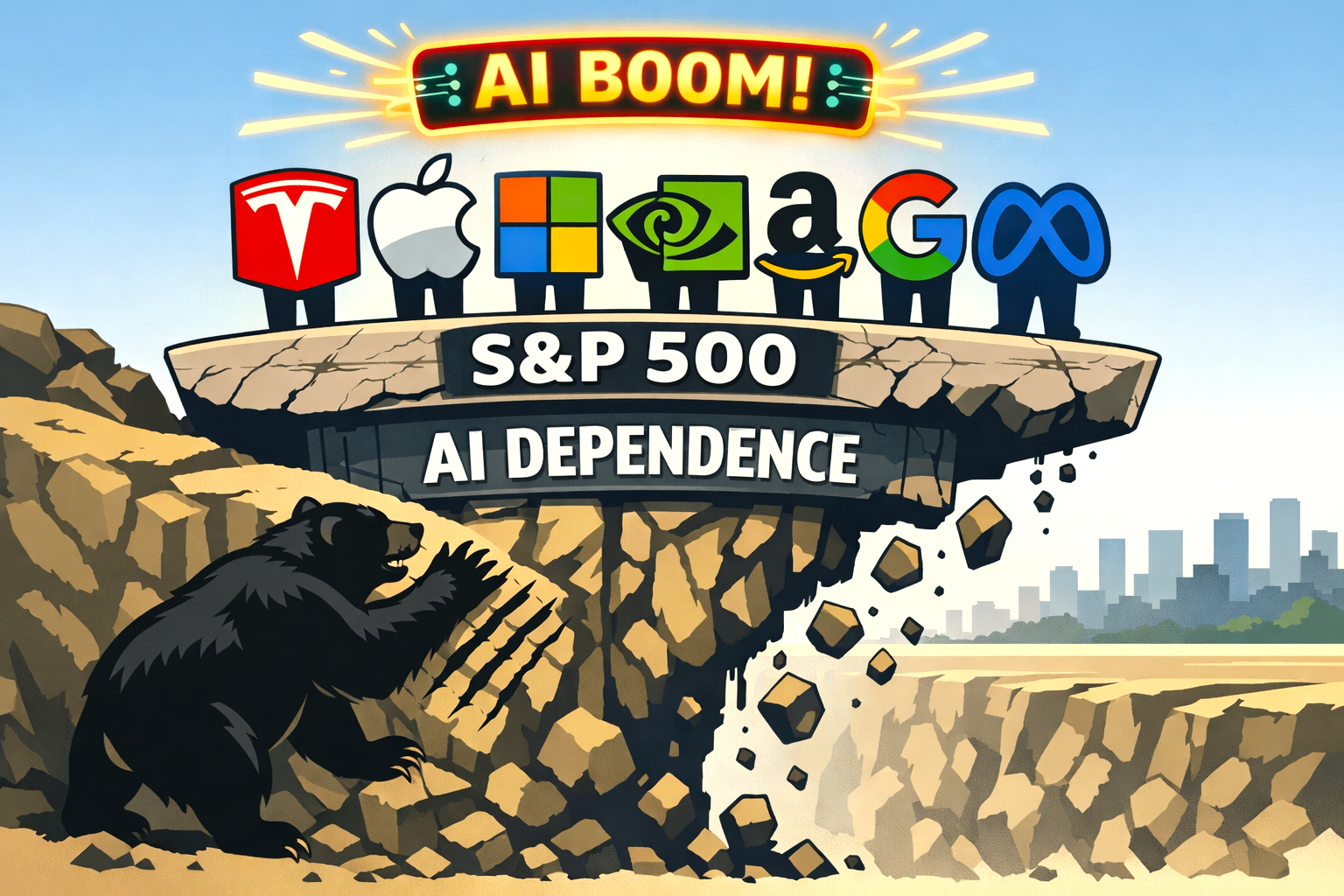
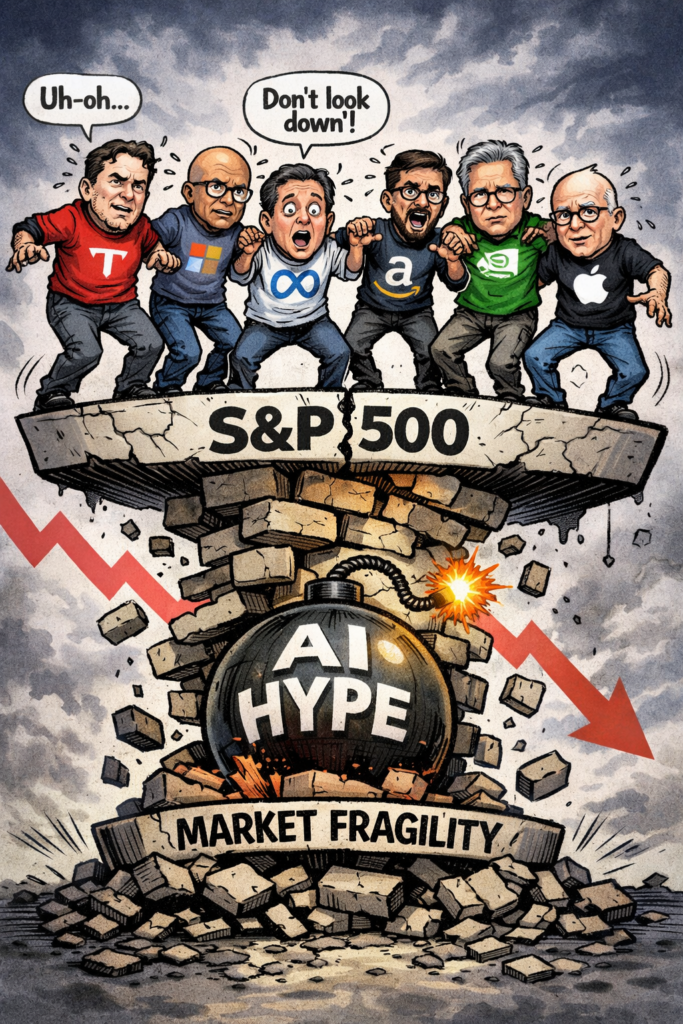
The S&P 500 has become increasingly dependent on a relatively small number of giant companies, many of which are at the centre of the artificial intelligence boom.

That concentration has become one of the most important — and potentially overlooked — risks facing investors.

A market increasingly dominated by a handful of companies

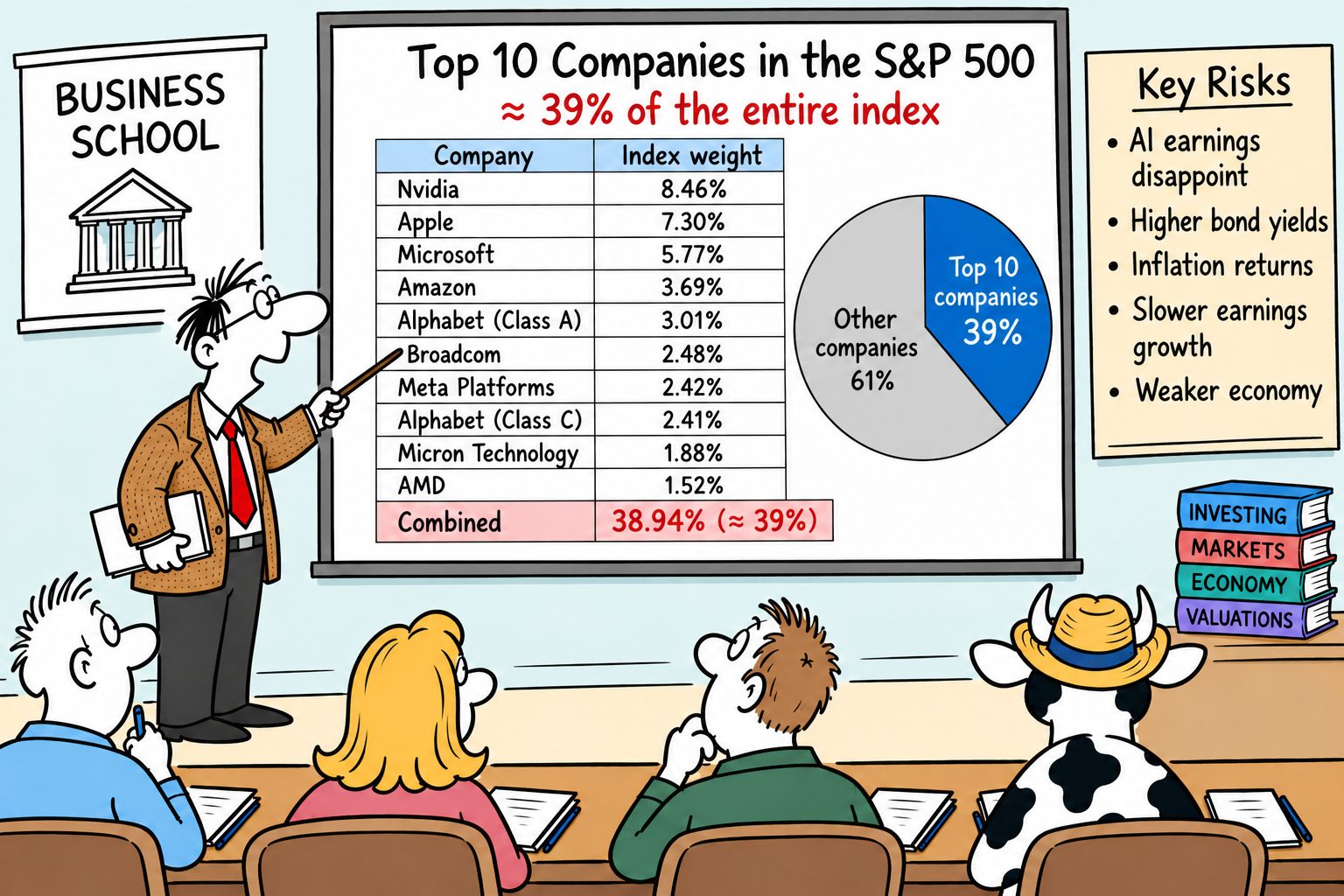
The ten largest holdings account for approximately 39% of the entire S&P 500 index, according to the holdings figures used for this analysis. Alphabet appears twice because its Class A and Class C shares are separate index constituents.

CompanyApprox. index weighting
Nvidia8.46%
Apple7.30%
Microsoft5.77%
Amazon3.69%
Alphabet Class A3.01%
Broadcom2.48%
Meta Platforms2.42%
Alphabet Class C2.41%
Micron Technology1.88%
AMD1.52%
Combined38.94% (≈39%)

Note: These are the approximate holdings weights used in the original analysis, dated 1st October 2026. Index weightings change as share prices move.

Look beyond the individual names and the concentration becomes even more striking. Nvidia alone represents more than 8% of the index, while Alphabet’s two share classes together account for more than 5%. These companies also have enormous exposure to the AI investment boom.

That matters because a correction in one or two companies would not necessarily threaten the wider market. But if investors simultaneously lose confidence in the AI trade, the consequences could be considerably larger.

The AI assumption

Investors have poured enormous amounts of money into companies expected to benefit from artificial intelligence, while the world’s largest technology companies are committing vast sums to data centres, semiconductors and computing infrastructure.

For now, strong corporate earnings have provided justification for much of the optimism. But this is where the greatest risk may lie.

The market does not necessarily need AI to fail. Investors simply need to become less convinced that the enormous capital being committed today will generate sufficiently large profits in the future.

If the returns from AI investment take longer to materialise, or if competition forces companies to spend more to maintain their position, valuations could come under pressure.

Are valuations too high?

Valuations are certainly elevated by historical standards.

That does not automatically mean a crash is imminent. Expensive markets can remain expensive for years if corporate earnings continue to grow strongly.

The more important question is whether earnings can grow quickly enough to justify today’s prices.

This distinction is particularly important because the S&P 500 is a market-capitalisation-weighted index. When Nvidia, Apple and Microsoft rise sharply, they have a much greater influence on the index than hundreds of smaller companies.

In other words, the S&P 500 can appear remarkably strong even when performance underneath the surface is considerably less impressive.

That creates a potential vulnerability.

Treasury yields could become the trigger

Bond yields represent another major threat.

Higher Treasury yields give investors an increasingly attractive alternative to equities. They also reduce the present value of future corporate profits, which particularly affects companies whose valuations depend heavily on strong growth many years into the future.

If U.S. Treasury yields remain elevated, investors may eventually become less willing to pay premium prices for technology and AI companies.

The problem is that higher yields can put pressure on share prices even when companies continue to report rising profits. Investors may simply decide that those profits are worth less today.

Then there is inflation

A renewed rise in energy prices could make the situation considerably more difficult.

Higher oil prices can feed directly into inflation, making it harder for the Federal Reserve to cut interest rates. That could keep borrowing costs and Treasury yields higher for longer.

The combination of higher inflation, higher bond yields and slowing earnings growth would be particularly uncomfortable for a market trading at elevated valuations.

Geopolitical tensions, tariffs and disruptions to energy supplies could add to the pressure, while higher borrowing costs would affect businesses and households alike.

What would actually reverse the bull market?

The most dangerous scenario would not necessarily be a single event. It could be a combination of several developments:

  • AI investment disappoints: expected returns fail to justify the enormous sums being spent.
  • Corporate earnings growth slows: companies deliver less than investors have priced in.
  • Treasury yields remain high: bonds become more competitive with equities.
  • Inflation returns: energy prices or other costs prevent interest rates from falling.
  • The economy weakens: consumers spend less and corporate revenues come under pressure.
  • Valuations contract: investors become unwilling to pay such high multiples for future earnings.

Any one of these could cause volatility. Several occurring together could turn a normal correction into something much more serious.

The S&P 500 does not necessarily need a recession to fall sharply. If investors simply decide that today’s earnings forecasts are too optimistic, valuations could contract significantly.

Because almost four-tenths of the index is concentrated in just ten holdings, a simultaneous sell-off in major technology and AI-related shares could have an outsized effect on the entire market.

A correction without a recession?

Consider a simplified illustration. If the S&P 500 were trading at 7,800, earnings expectations subsequently fell by 10%, and investors reduced the valuation multiple from 19 times earnings to 16 times, the index could theoretically fall to around 5,900.

That would represent a decline of approximately 24%, without requiring an economic catastrophe.

This is an illustration rather than a market forecast, but it demonstrates how falling earnings expectations and lower valuations can reinforce each other.

And finally

The U.S. stock market is not necessarily a bubble simply because valuations are high. These are profitable, enormously successful companies with genuine earnings and powerful businesses.

But the market has increasingly priced in an exceptionally good future.

The bull market can therefore continue if earnings keep delivering. AI investment may generate substantial returns, inflation may remain contained, and Treasury yields may eventually fall.

However, if those assumptions begin to unravel, investors may discover that the market has been priced for very little disappointment.

The greatest threat to the U.S. bull market may therefore not be that AI is over — but that expectations for AI have simply become too high.

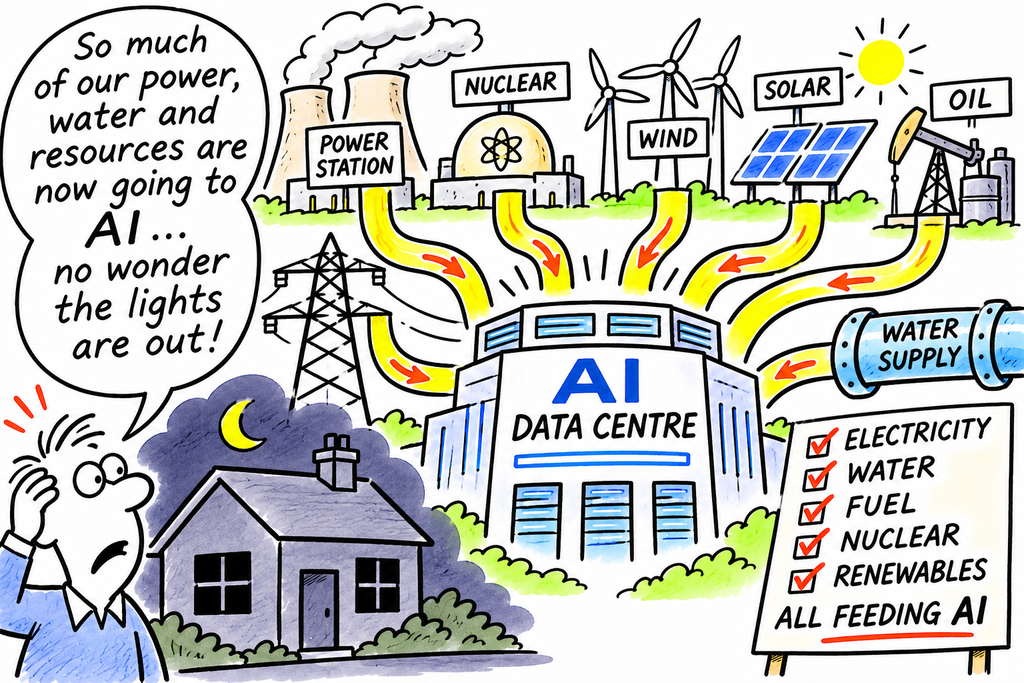
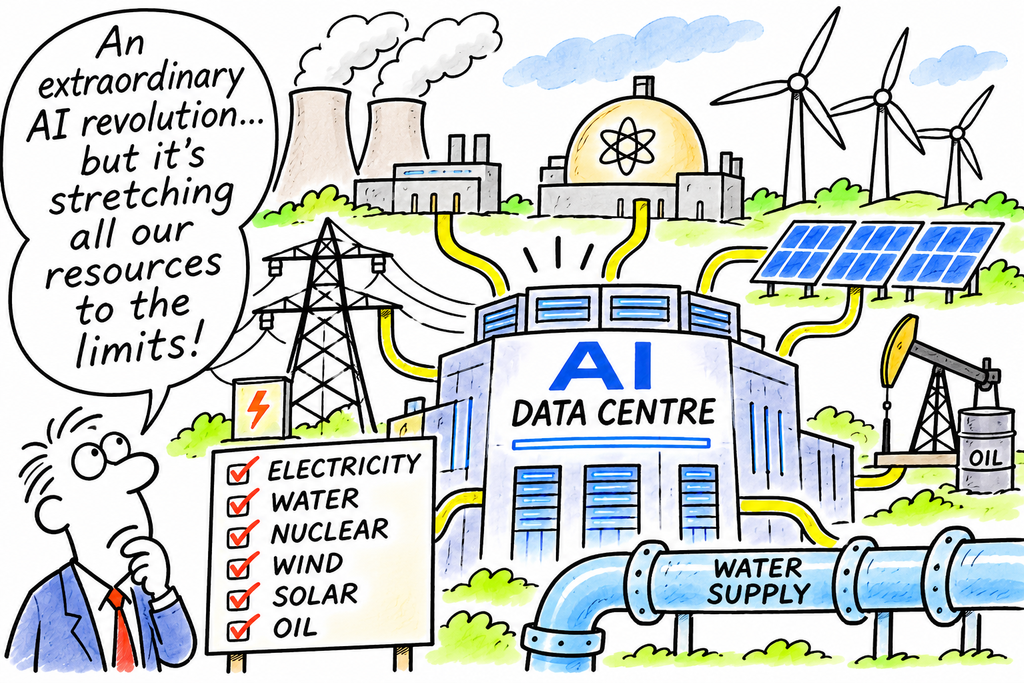
AI’s Energy Crisis: The Power Problem Behind the Tech Boom

AI power Surge

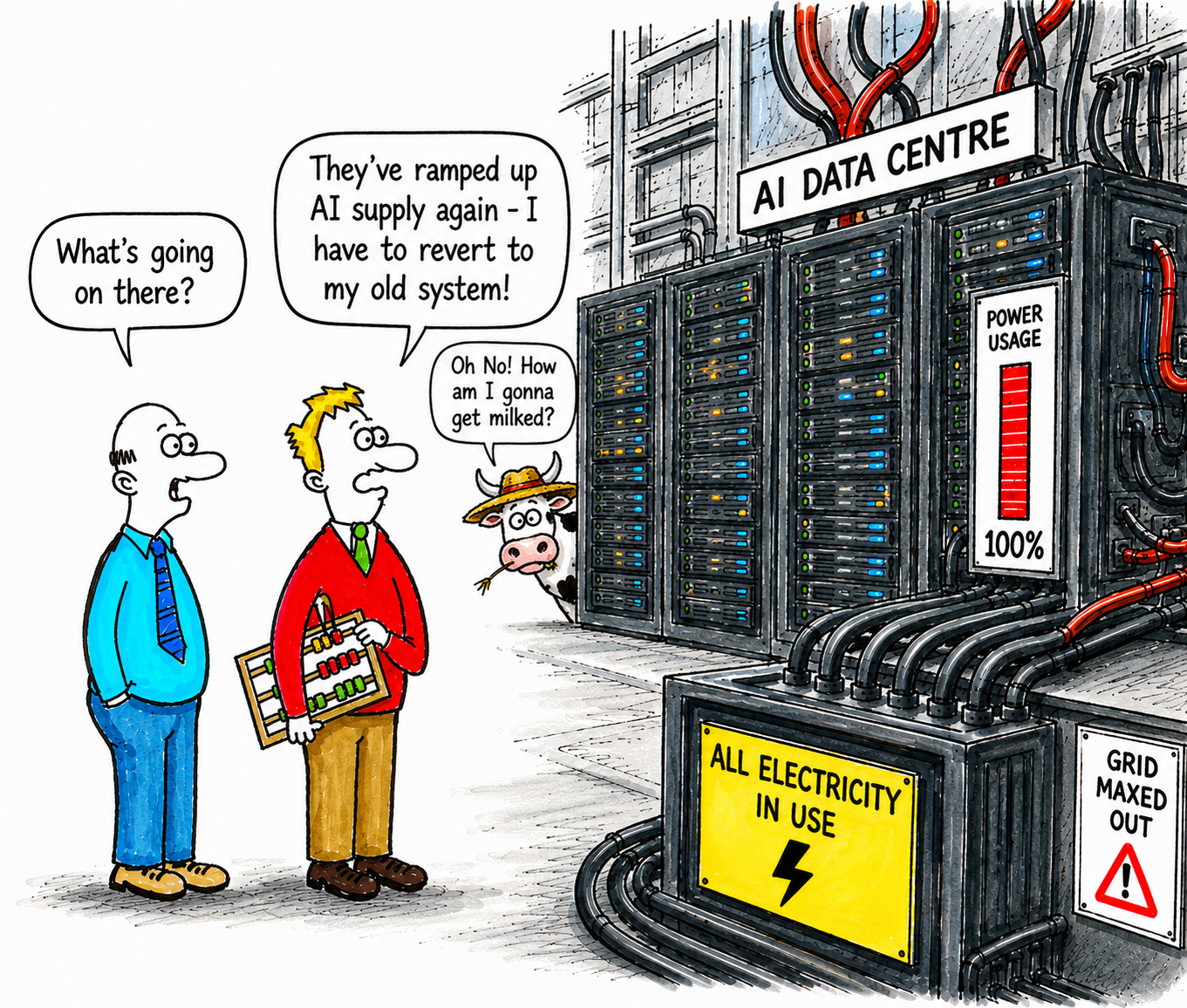
Artificial intelligence is facing a problem that cannot be solved by buying more chips: there may not be enough electricity to power the machines.

AI data centres are expanding rapidly. Training and running models requires enormous computing power, while the facilities themselves need electricity for cooling.

IEA

The International Energy Agency estimates data-centre electricity consumption could reportedly more than double, from about 415 terawatt-hours in 2024 to roughly 945 TWh by 2030. That would make data centres one of the fastest-growing sources of electricity demand.

Old Infrastructure is a big problem

The problem is not necessarily a global shortage of energy. It is a shortage of electricity generation and grid infrastructure in the right places, at the right time.

Data centres can require hundreds of megawatts, yet connecting new generation to the grid can take years. Ageing transmission networks, lengthy planning processes, transformer shortages and grid-connection queues are becoming bottlenecks.

So how is the industry going to fix it?

The short-term answer is likely to be a mixture of natural gas, renewable energy, batteries and existing nuclear plants. Gas can be deployed relatively quickly and provides reliable power, although it increases carbon emissions.

Renewables are cheaper and cleaner but need transmission and storage to provide reliable power. The IEA expects gas and coal together to supply more than 40% of the additional electricity required by data centres through 2030.

Further ahead, nuclear power could become important, including small modular reactors, alongside geothermal energy and improved battery storage. AI companies are also exploring dedicated power plants and locating data centres closer to abundant electricity.

No quick fix

But there is no instant solution. New gas generation and grid upgrades can take several years; major transmission projects can take much longer, while new nuclear facilities can take a decade or more.

The AI revolution is therefore becoming an energy race. Chips may determine how intelligent AI becomes, but electricity may determine how quickly it can grow.

And the effect for you and me?

For the general population, the AI energy crunch could eventually mean higher electricity bills, greater pressure on national power grids and tougher competition for available energy.

As technology companies build enormous data centres, they may compete with households and traditional industries for electricity, particularly in areas where grid capacity is already limited.

Governments could be forced to spend billions upgrading power networks and building new generation, with some of those costs potentially passed on to consumers through taxes or energy bills.

There is also a risk that greater reliance on gas-fired generation could slow efforts to cut emissions.

However, the picture is not entirely negative: investment in new renewable energy, nuclear power, batteries and upgraded grids could ultimately create a more reliable and modern electricity system.

The real question is who pays for the huge infrastructure needed to power the AI boom — and who benefits from it?

Water?

Water could become another major pressure point. AI data centres generate enormous amounts of heat and many rely on water-based cooling systems, meaning their expansion can increase demand for local water supplies.

This could become particularly problematic in areas already facing drought or water shortages, where data centres may be competing with households, agriculture and industry for a limited resource.

Supply issues

The issue is not simply the amount of water consumed, but where and when it is consumed. A data centre built in a water-stressed region could place significant additional pressure on local supplies.

New cooling technologies, including closed-loop systems, liquid cooling and air cooling, can reduce consumption, while locating data centres near plentiful water supplies can also help. These closed systems need cooling too and likely will add to power consumption.

Compete

But, just as with electricity, the rapid expansion of AI means infrastructure and resource planning must catch up — otherwise the technology boom could increasingly compete with the basic resources people depend upon.

Memory shortage shaking Apple to the core

Memory shortage shakes Apple to the core

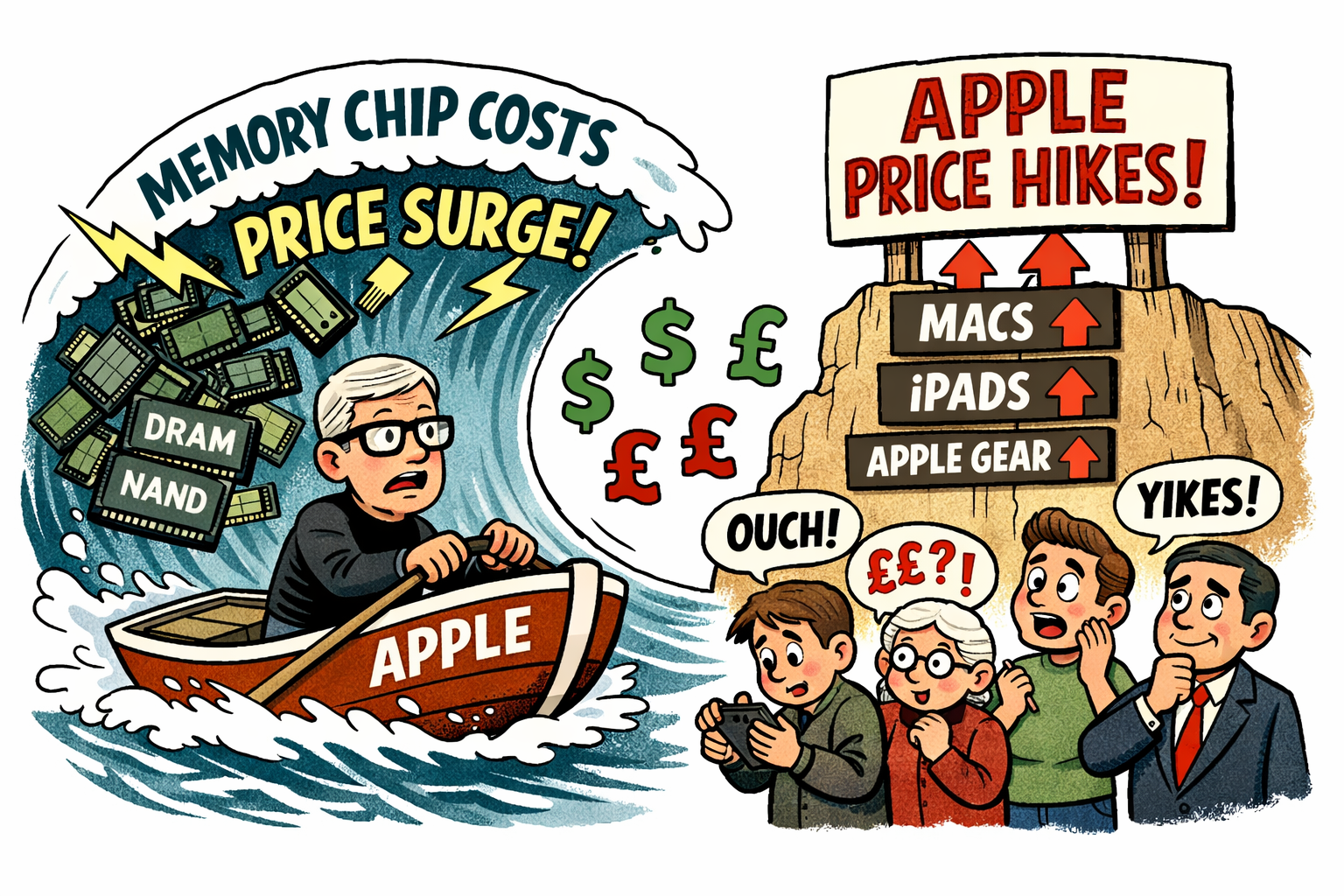
Apple’s sharp share-price drop recently (June 2026) wasn’t the result of a single misstep, but a sudden collision between global supply‑chain pressure and investor expectations.

The company’s stock slid roughly 6% in one session – its steepest fall in more than a year – after Apple pushed through sweeping price increases across Macs, iPads, HomePods, Apple TV and even Vision Pro.

For a company that normally adjusts pricing with surgical caution, the breadth and scale of these rises jolted the market.

Unprecedented price surge

The trigger sits outside Cupertino. Memory‑chip prices have surged at a pace industry veterans describe as unprecedented, driven by AI data‑centre expansion that is consuming vast quantities of DRAM and NAND.

Apple’s suppliers have passed on extraordinary cost increases, and Apple, unusually, has chosen not to absorb them.

Some Mac configurations rose by hundreds of pounds; certain high‑end models jumped by more than a thousand. Investors interpreted this as a sign that Apple’s margins – already under scrutiny given its premium valuation – are being squeezed harder than expected.

Concerning

The concern is not simply higher prices, but what they imply. If Apple is forced to raise hardware prices now, analysts fear the same pressure could extend to the iPhone later this year.

That would test the limits of consumer tolerance at a time when upgrade cycles are already lengthening. The market’s reaction reflects a deeper anxiety: Apple’s pricing power is formidable, but not infinite.

A modest rebound followed the initial sell‑off, suggesting the drop may have been an overreaction. But prices for Apple products have increased whatever the markets tell us.

Even so, the episode underscores how sensitive Apple’s valuation is to any hint of margin compression in its hardware business.

The Great Memory Squeeze: Why the AI Boom Is Reshaping the Entire Hardware Industry

AI memory RAM shortage

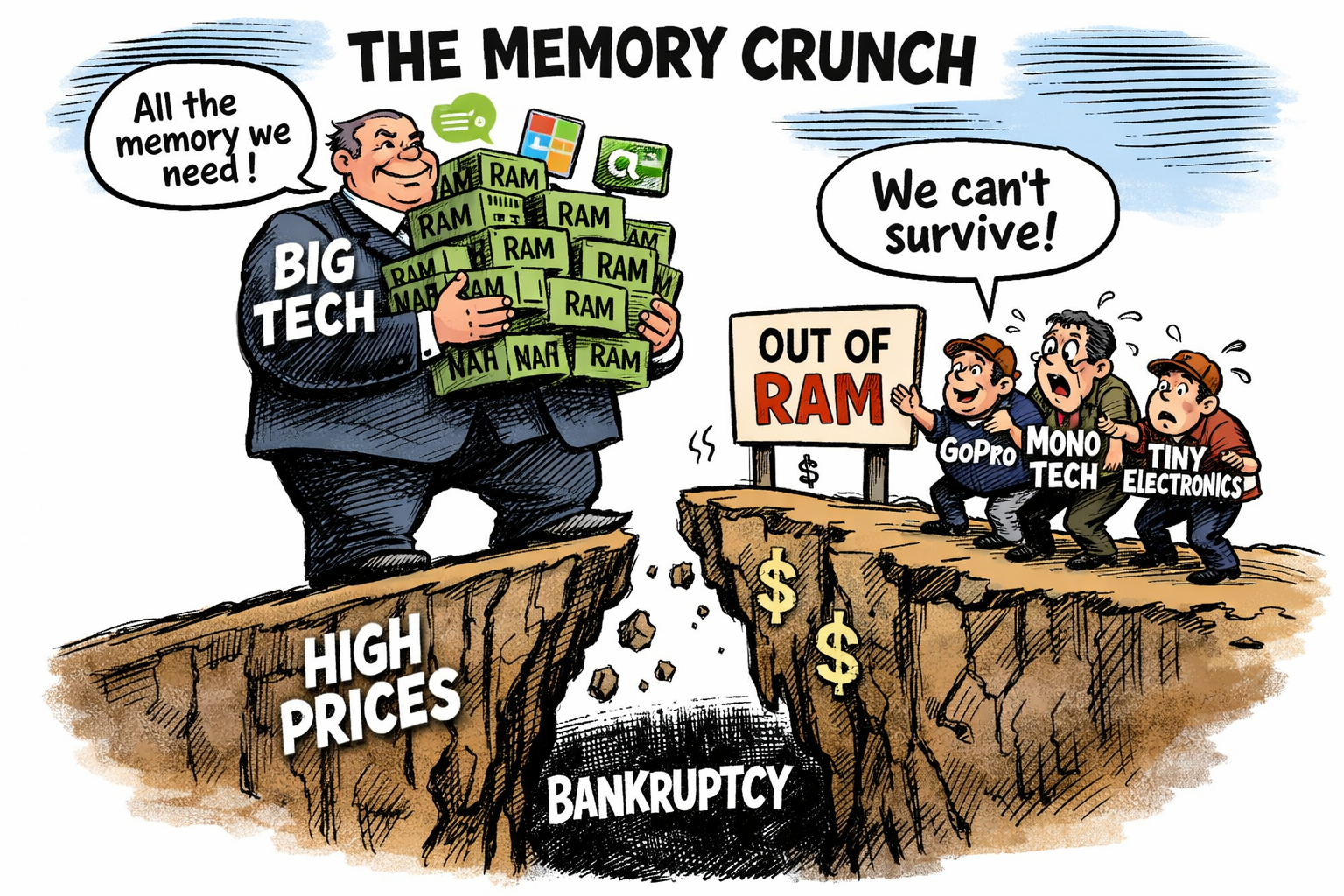
A global shortage of DRAM is rippling through the technology sector, exposing a stark divide between the giants of consumer electronics and the smaller firms that rely on stable component pricing to survive.

What was once a cheap, predictable commodity has become the industry’s most volatile input, with prices rising several hundred per cent in under a year.

Feeding AI

The cause is simple: artificial intelligence systems now consume extraordinary volumes of high‑performance memory, and suppliers are prioritising the biggest buyers.

For companies like Apple, Microsoft and Samsung, the surge in memory costs is disruptive but manageable. These firms have the scale, cash reserves and supply‑chain leverage to secure allocation and pass higher costs on to consumers.

Apple has already raised prices across several product lines, while Microsoft has increased the price of its Xbox Series S and warned that memory costs may double again by 2027. Their margins will tighten, but their market positions remain secure.

Smaller manufacturers face a far harsher reality. Start‑ups, niche hardware makers and mid‑tier consumer electronics brands are being pushed to the back of the queue, forced to pay inflated prices or accept long delays. Some may simply be unable to ship products at all

Pressure.

Companies such as GoPro have already warned investors of existential pressure, and others in the audio, camera and budget‑device sectors are quietly preparing for cancelled launches or reduced specifications.

The stock market has responded unevenly. Memory suppliers like Micron and SK Hynix have seen extraordinary rallies, with margins soaring and investors betting on prolonged demand.

Meanwhile, smaller hardware firms are experiencing sharp declines as profitability evaporates.

Longer term, the memory crunch may accelerate consolidation. If supply remains tight, the industry could tilt even further towards a handful of dominant players, with innovation increasingly concentrated among those able to afford the rising cost of participation.

IBM’s ‘block of flats’ chip design pushes Moore’s Law into new territory

IBM chip stack design

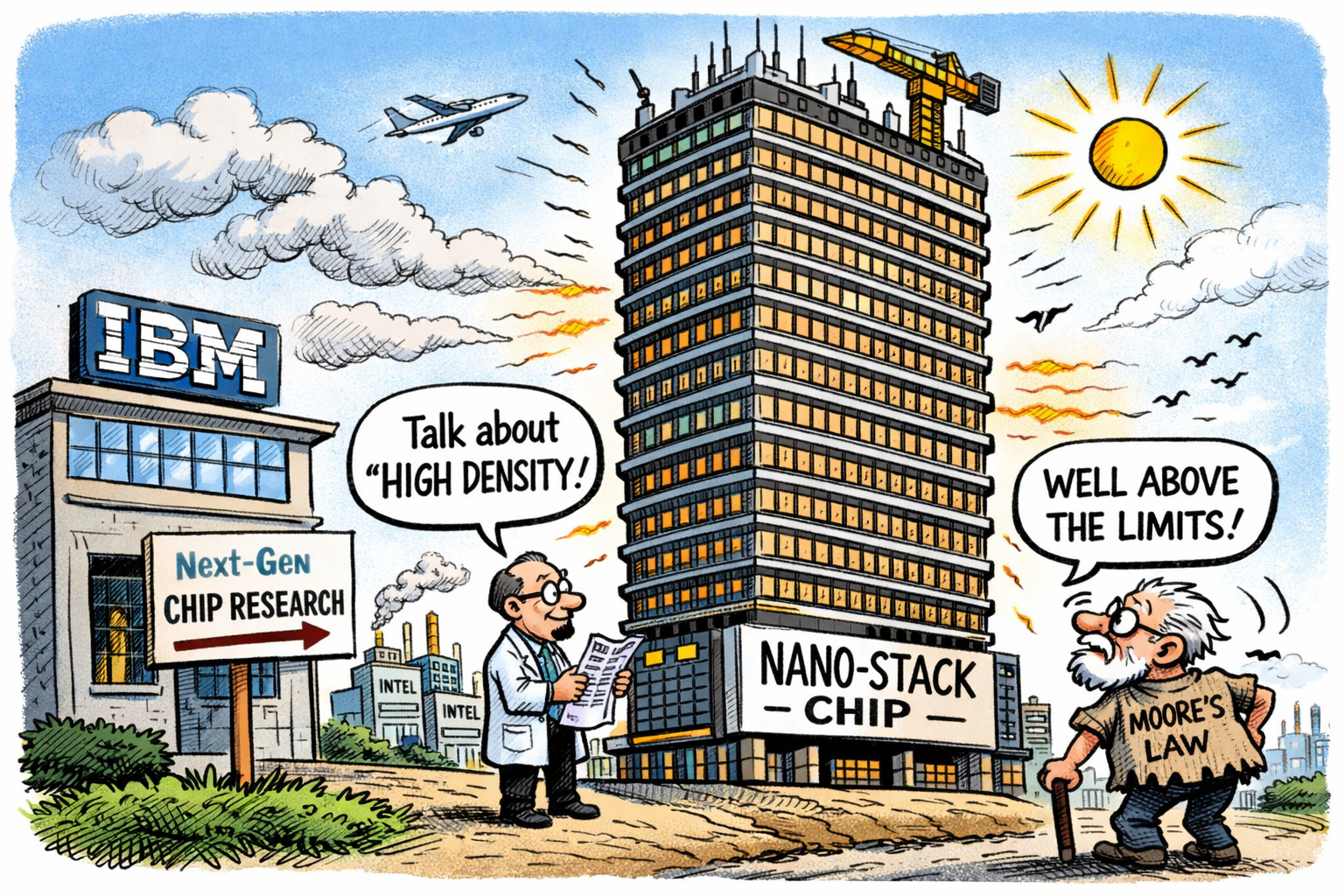
IBM’s latest research breakthrough – a sub‑1nm chip architecture built like a “block of flats” – marks one of the most ambitious attempts yet to stretch Moore’s Law beyond its natural limits.

The company claims its new NanoStack design can pack almost 100 billion transistors onto a fingernail‑sized chip, a density that would have been unthinkable even a decade ago.

In early tests, the prototype delivered 50% higher performance and 70% better energy efficiency than IBM’s own 2nm technology, signalling a potential generational leap in computing power.

Moore’s Law at 50 years

For more than half a century, Moore’s Law – the observation that transistor counts double roughly every two years – has shaped the trajectory of the semiconductor industry.

But as transistors approach atomic scales, the physics has become unforgiving. Leakage, heat, and quantum effects increasingly threaten the neat exponential curve that once defined progress.

The industry’s response has been to move vertically: instead of squeezing more transistors across a flat surface, designers are now building upwards.

Verical stacking

IBM’s NanoStack takes this vertical shift to an extreme. Rather than simply elongating transistor structures, the company has begun stacking entire sheets of transistors on top of one another, creating a skyscraper‑like arrangement.

Professor Alan Woodward of the University of Surrey reportedly likens the shift to replacing a city of houses with a 100‑storey tower block – a vivid contrast to the 30–50‑storey equivalents being pursued by rivals such as Samsung and Intel.

The approach is bold, but it comes with engineering hazards. Heat rises through the stack, threatening performance and reliability. Layers that are too thin risk transistors failing to switch off cleanly, undermining the chip’s logic.

Obstacles

These are not trivial obstacles, and IBM acknowledges that commercial production remains several years away.

Yet the company argues that the architectural shift is essential if computing is to keep pace with the demands of AI, cloud workloads, and energy‑constrained data centres.

If NanoStack proves manufacturable at scale, it could represent the most significant extension of Moore’s Law since the industry moved from planar to FinFET designs.

The broader question is whether this vertical strategy can deliver multiple generations of improvement, or whether it is the final flourish before the industry must abandon transistor‑count metrics altogether.

For now, IBM has injected fresh momentum into a field long assumed to be running out of road – and reminded the industry that Moore’s Law may bend, but it is not yet broken.

Moore’s Law states

Moore’s Law is the principle that the number of transistors on a microchip doubles roughly every two years, leading to continual increases in computing power and efficiency.

Qualcomm suggests AI Agents will replace apps soon

The future is Agentic AI not apps

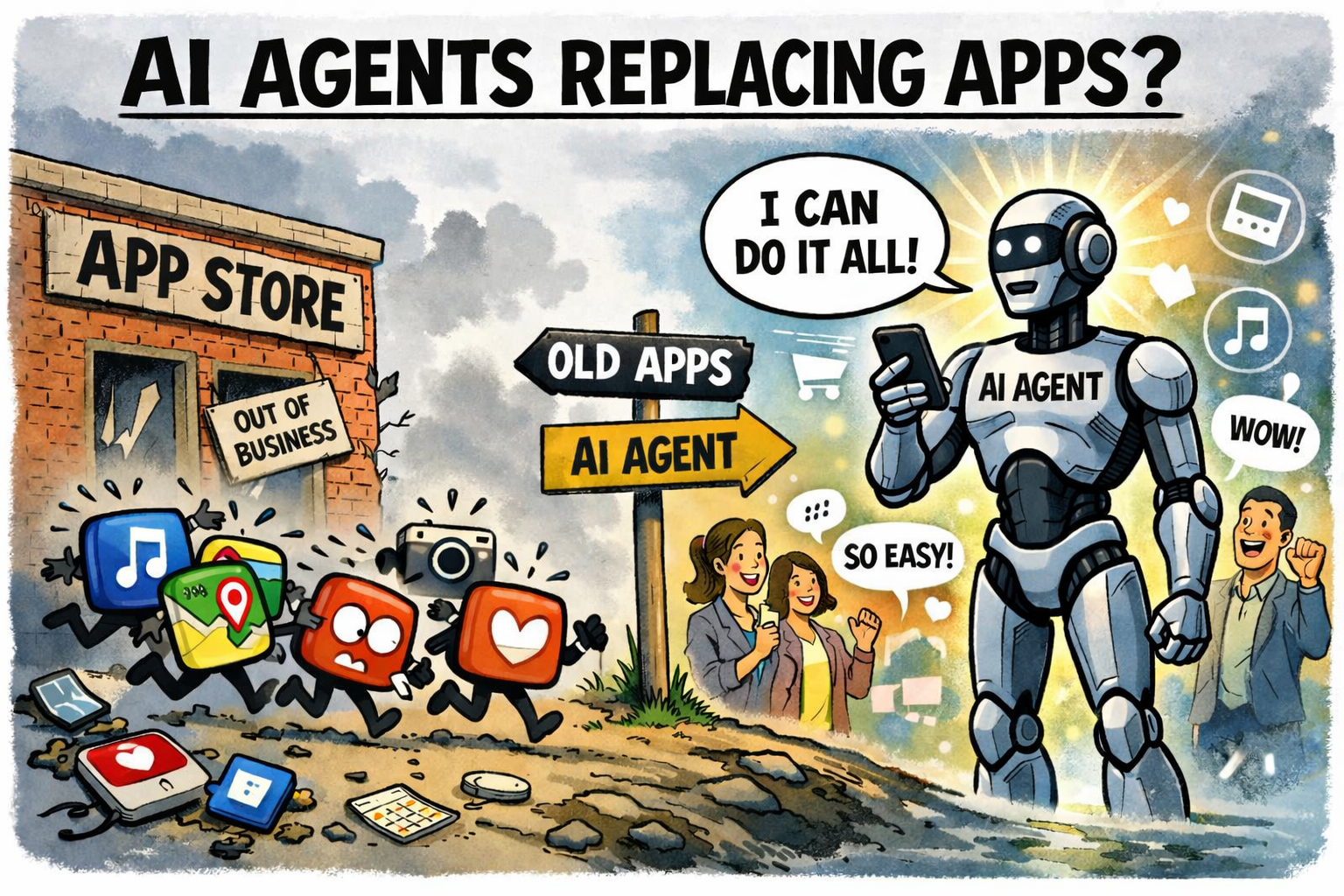
Qualcomm’s latest pitch is blunt: the age of standalone apps is fading, and AI agents are about to take their place.

It’s a bold claim, but it reflects a wider shift sweeping through the tech industry as on‑device AI becomes powerful enough to handle tasks that once required entire software ecosystems.

Delegating Intent

Qualcomm argues that future smartphones will rely less on tapping icons and more on delegating intent. Instead of opening an app to book travel, edit photos, or manage finances, users will instruct an AI agent that understands context, preferences, and history.

The agent will then orchestrate the work across services in the background. In Qualcomm’s view, this makes the traditional app model feel increasingly rigid and outdated.

The company’s latest Snapdragon platforms are designed around this idea: fast local processing, persistent personal models, and low‑latency agentic behaviour that doesn’t rely solely on the cloud.

It’s a strategic move to keep mobile hardware relevant as AI shifts the centre of gravity away from apps and towards continuous, conversational computing.

Sceptics will note that apps won’t vanish overnight. But the direction of travel is clear. If Qualcomm is right, the next major platform shift won’t be about bigger screens or faster chips.

It will be about replacing the app grid with an intelligent layer that simply gets things done.

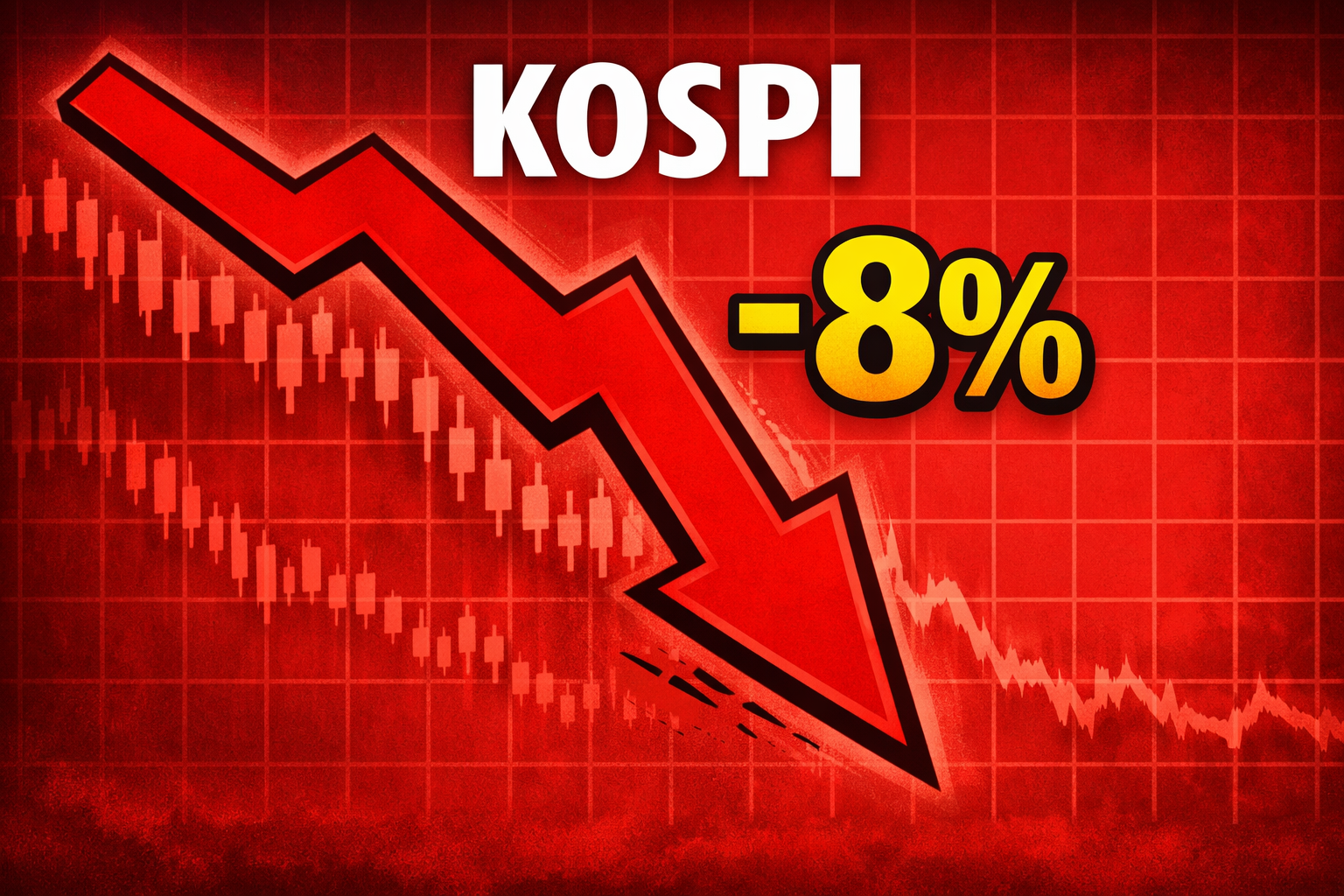
South Korea’s KOSPI plunges 8%!

Kospi Index falls again

South Korea’s KOSPI index suffered a severe shock on Monday, 8th June, plunging more than 8% in early trading and triggering an automatic 20‑minute circuit breaker as panic selling swept through the market.

The index briefly fell to the mid‑7,400s, marking its third circuit‑breaker event of the year and underscoring the fragility of sentiment after a sharp global tech sell‑off.

Semiconductor heavyweights led the rout. Samsung Electronics slumped more than 8.5%, while SK Hynix dropped over 7%, with additional steep losses across major industrial names including LG Electronics, Hyundai Motor and Samsung SDI.

The sell‑off mirrored a sharp downturn in U.S. markets the previous Friday 5th June 2026, where semiconductor giants such as Nvidia, Broadcom and Micron were hit hard, fuelling fears that the AI‑driven rally had overheated.

A hotter‑than‑expected U.S. jobs report also stoked concerns that the Federal Reserve may lean towards further rate hikes, adding to the risk‑off mood.

Currency markets reflected the stress: the Korean won weakened sharply to around 1,554 per dollar as foreign investors accelerated withdrawals.

Although local institutions and retail investors later stepped in to “buy the dip,” helping trim some losses, the episode highlighted the market’s vulnerability to global tech sentiment and shifting U.S. rate expectations.

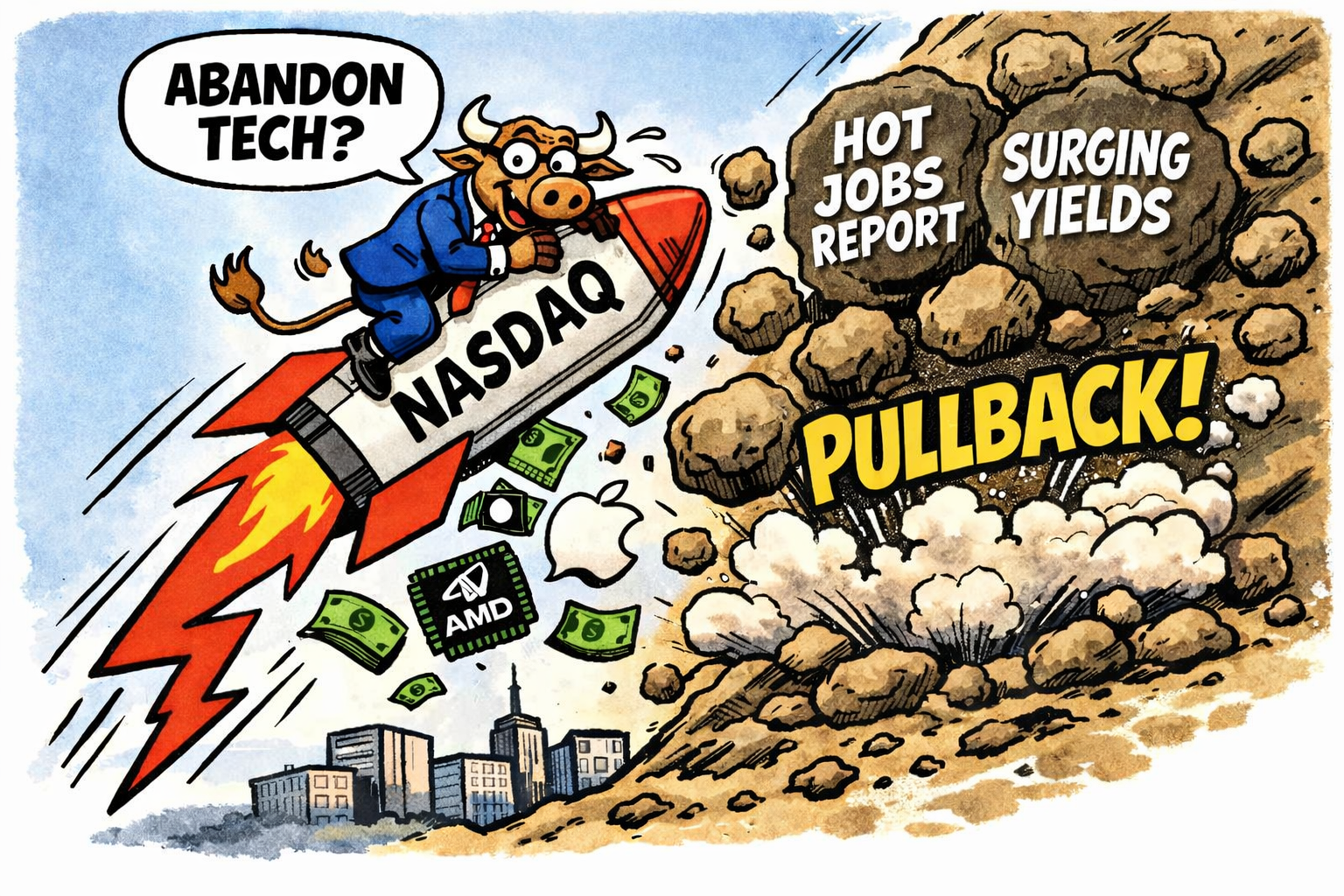
Nasdaq’s Rally Snaps as Hot Jobs Data Slams Tech

Nasdaq drops

The Nasdaq Composite endured a bruising session on Friday, 5th June 2026, tumbling more than 4% in its steepest single‑day decline since April 2025.

The sell‑off was triggered by a powerful combination of surging Treasury yields and a violent unwinding in semiconductor and mega‑cap technology stocks, following a far stronger‑than‑expected U.S. jobs report.

Employers added 172,000 jobs in May 2026, more than double economists’ forecasts, a result that swiftly erased hopes of near‑term Federal Reserve rate cuts and instead fuelled expectations of tighter policy for longer.

Chipmakers bore the brunt of the rout. Broadcom, Nvidia, Micron, Marvell and AMD all suffered heavy losses, with the sector’s slump wiping out well over a trillion dollars in market value across the week.

The Nasdaq closed at 25,709.43, down around 4.18%, while the S&P 500 fell 2.6% and the Dow Jones Industrial Average dropped 695 points.

The broader risk‑off mood extended beyond equities. Bitcoin slid below $60,000 for the first time since 2024, while gold and silver also weakened as investors recalibrated expectations for monetary policy.

With Treasury yields climbing above 4.5%, markets ended the week facing renewed questions about valuations, positioning, and the durability of the two‑year AI‑driven rally.

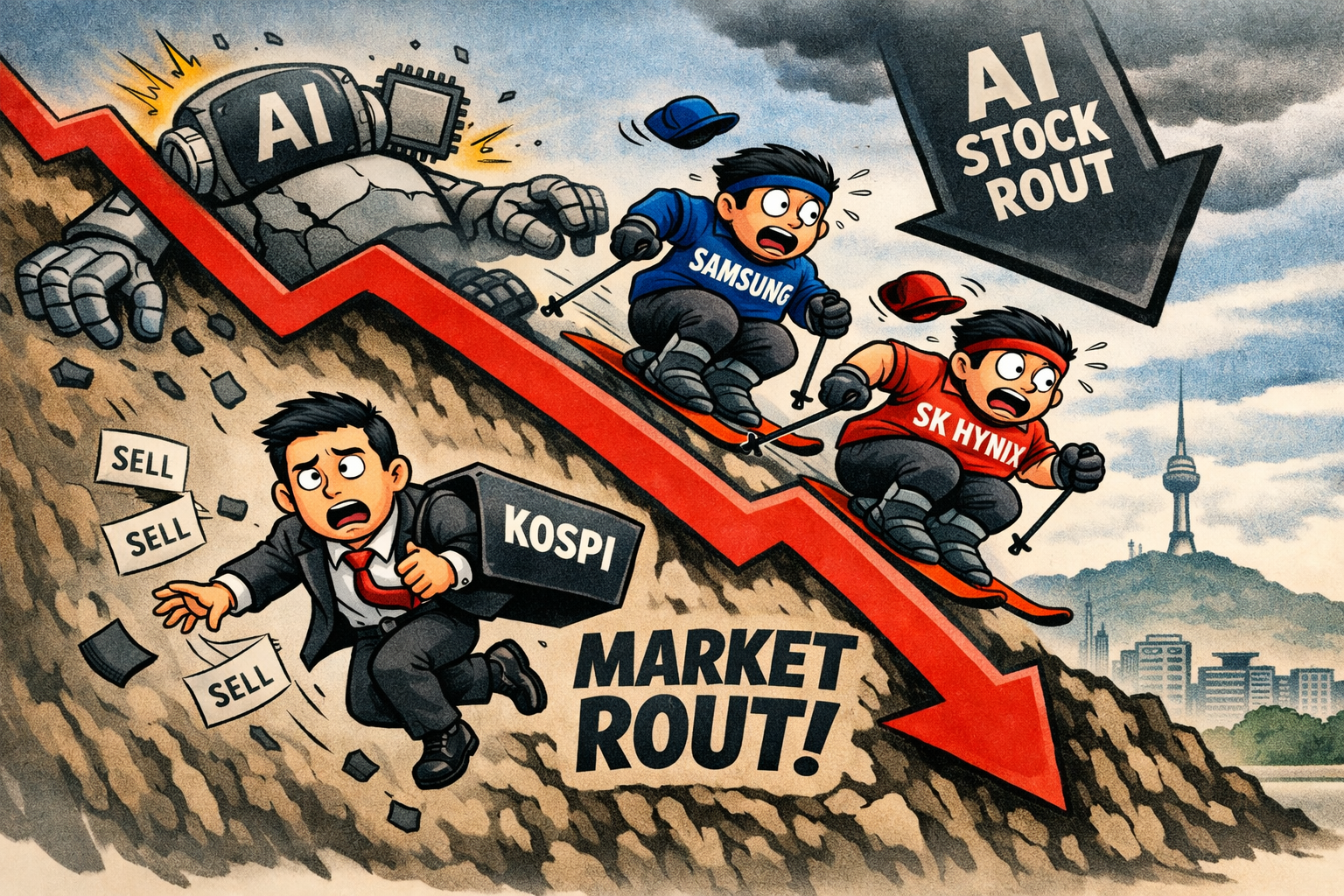
AI Rout Hits Seoul: Kospi Sinks Over 5% as Chip Giants Slide

AI chip stock fall

South Korea’s markets were hit hard on Friday 5th June 2026, with AI‑linked stocks leading a sharp regional sell‑off after Wall Street’s tech slump rippled across Asia.

The Kospi tumbled 5.54%, closing at 8,160.59, its steepest one‑day fall in months, as investors rapidly unwound positions in semiconductor and AI beneficiaries.

Heavyweights Samsung Electronics and SK Hynix were at the centre of the decline, sliding 6.40% and 9.92% respectively. This demonstrates how tightly exposed Seoul’s market has become to the global AI cycle.

The pullback followed a sharp rotation out of chipmakers in the United States, triggered by disappointing revenue data from Broadcom. This shook confidence in the sector’s near‑term momentum.

With AI names having powered much of 2026’s rally, even a modest earnings wobble proved enough to spark a broader de‑risking.

Domestic strain

Domestic pressures added to the strain. South Korea’s labour minister urged major tech firms to share more of their AI‑driven semiconductor profits with workers and suppliers. This is a signal that political scrutiny of the sector is rising just as global sentiment cools.

For now, the sell‑off looks like a reminder of how tightly South Korea’s market is tethered to global AI expectations.

If Wall Street’s AI led enthusiasm falters, Seoul’s tech giants may face a more prolonged test.

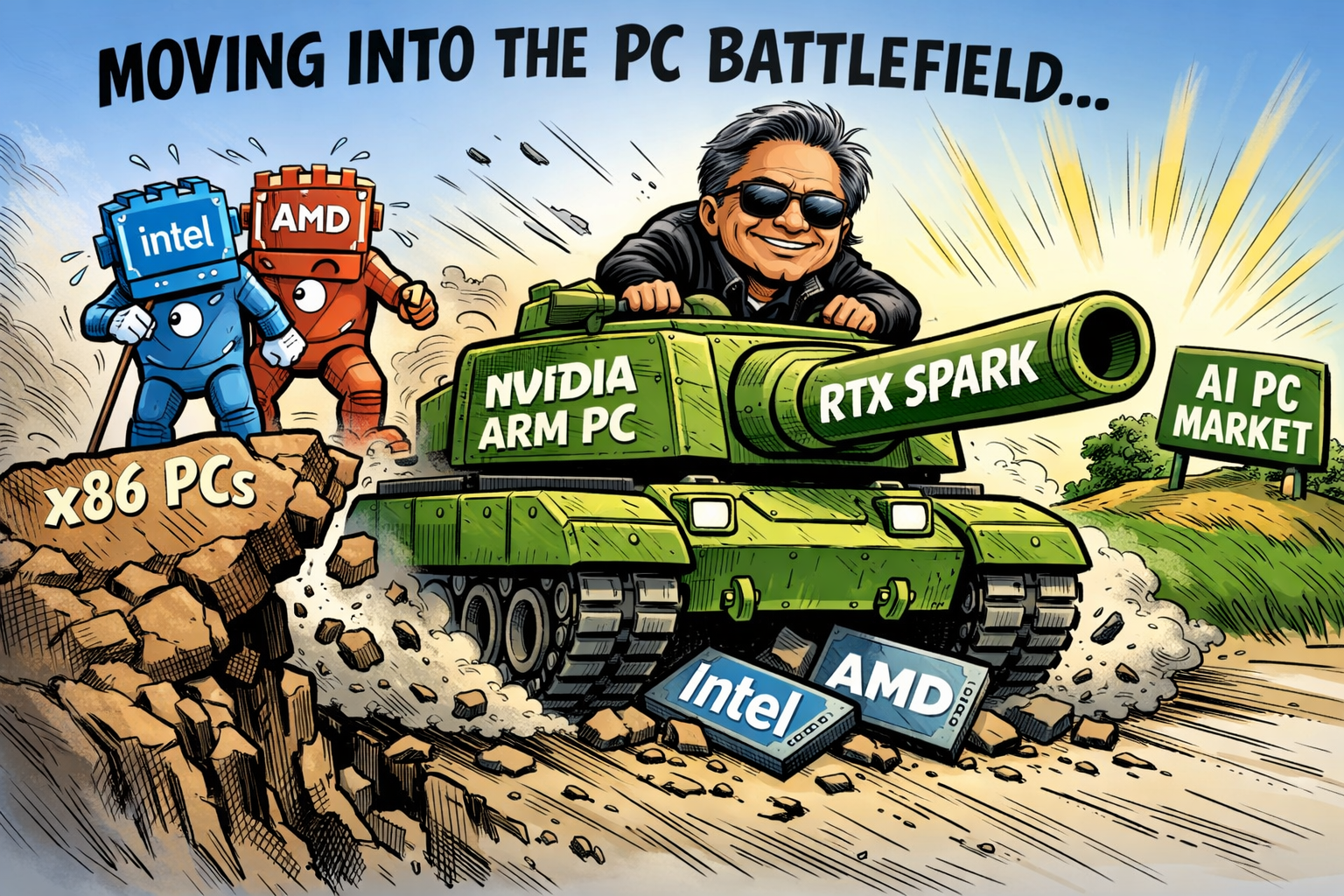
Nvidia moves into PCs – All hail Nvidia!

New AI PC chips from Nvidia

Nvidia’s long‑anticipated push into the PC market has finally materialised — and it marks the company’s most aggressive attempt yet to extend its dominance beyond the data centre.

At Computex in Taipei, Jensen Huang unveiled the N1X, an Arm‑based CPU fused with a Blackwell‑class GPU into a new RTX Spark superchip, set to appear this autumn in premium Windows laptops from Microsoft, Dell, HP, ASUS, Lenovo and MSI .

The move is strategically significant. For decades, the PC’s central processor has been the guarded territory of Intel and AMD, with Apple’s M‑series proving the only major Arm‑based disruption.

Nvidia is now entering that arena with a design built explicitly for the age of agentic AI — machines that run multiple AI processes simultaneously, shifting huge volumes of data between GPU and CPU.

Nvidia has argued for months that CPUs have become the bottleneck in modern AI workflows, and the N1X is its answer: a custom Arm design, co‑developed with Microsoft and manufactured on TSMC’s 3‑nanometre process, paired with 128GB of unified memory for high‑bandwidth compute.

Huang framed the launch as a generational reset: “the first completely re‑engineered, reinvented line of PCs in 40 years.” It’s hyperbole with intent.

Nvidia wants to define the AI PC in the same way it defined the AI data centre — not as an incremental upgrade, but as a new category.

More than 30 laptops and 10 desktops are reportedly planned over time, with early models aimed at creators, AI developers and high‑end gamers seeking thin, light machines with workstation‑level capability.

The competitive implications are profound. Arm‑based computing is accelerating across the industry, and Nvidia’s arrival puts direct pressure on Intel and AMD just as both are scrambling to articulate their own AI‑centric roadmaps.

If RTX Spark delivers the performance uplift Nvidia promises, the centre of gravity in the PC market could shift rapidly — from x86 incumbents to a company that has already rewritten the rules of modern computing once.

All hail Nvidia.

The Coming Shockwave: How Three Mega‑IPOs Could Reshape the S&P 500 and Nasdaq – Opinion

IPOs for SpaceX, OpenAI and Anthropic

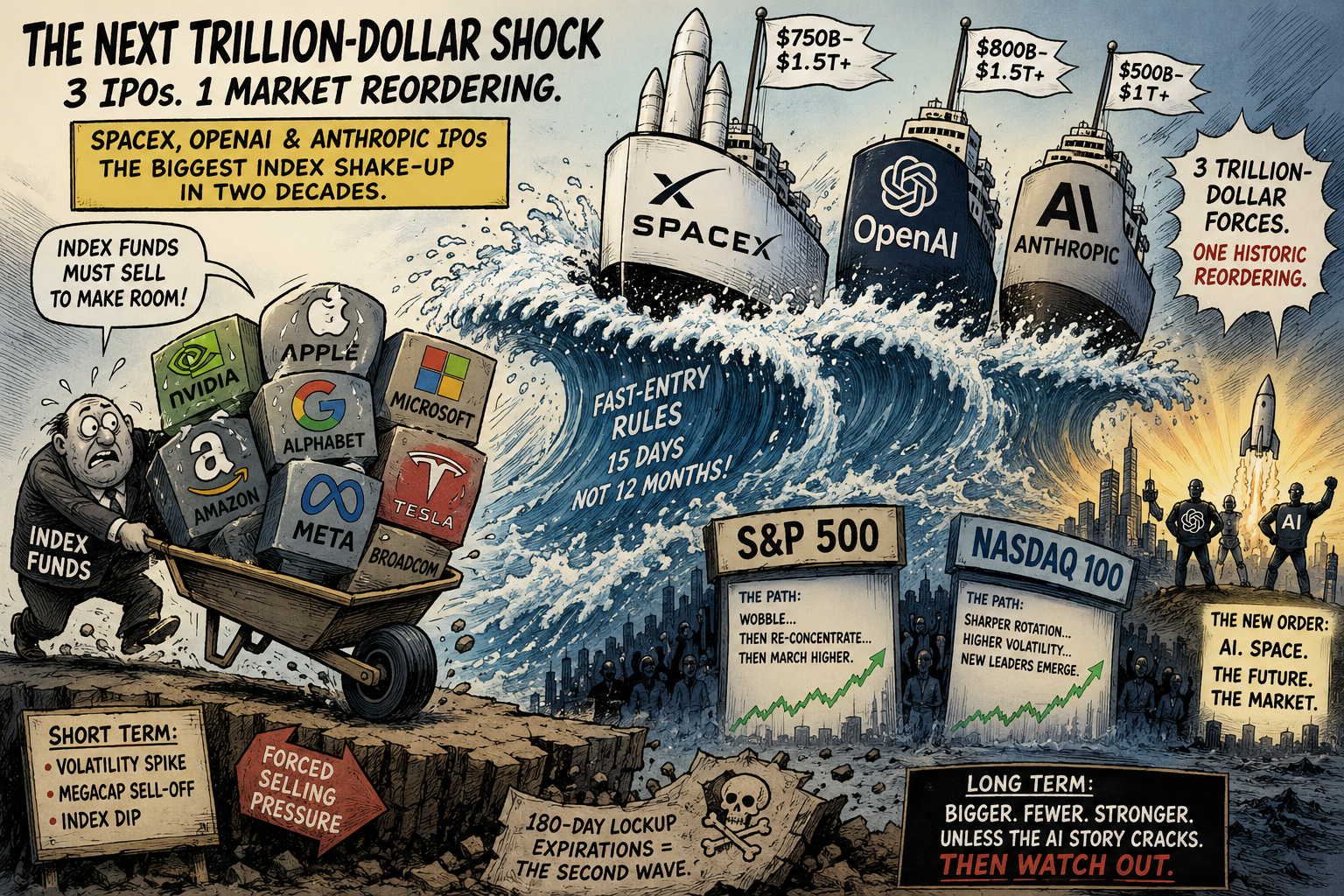
The expected public listings of SpaceX, OpenAI and Anthropic represent the most consequential cluster of IPOs in two decades.

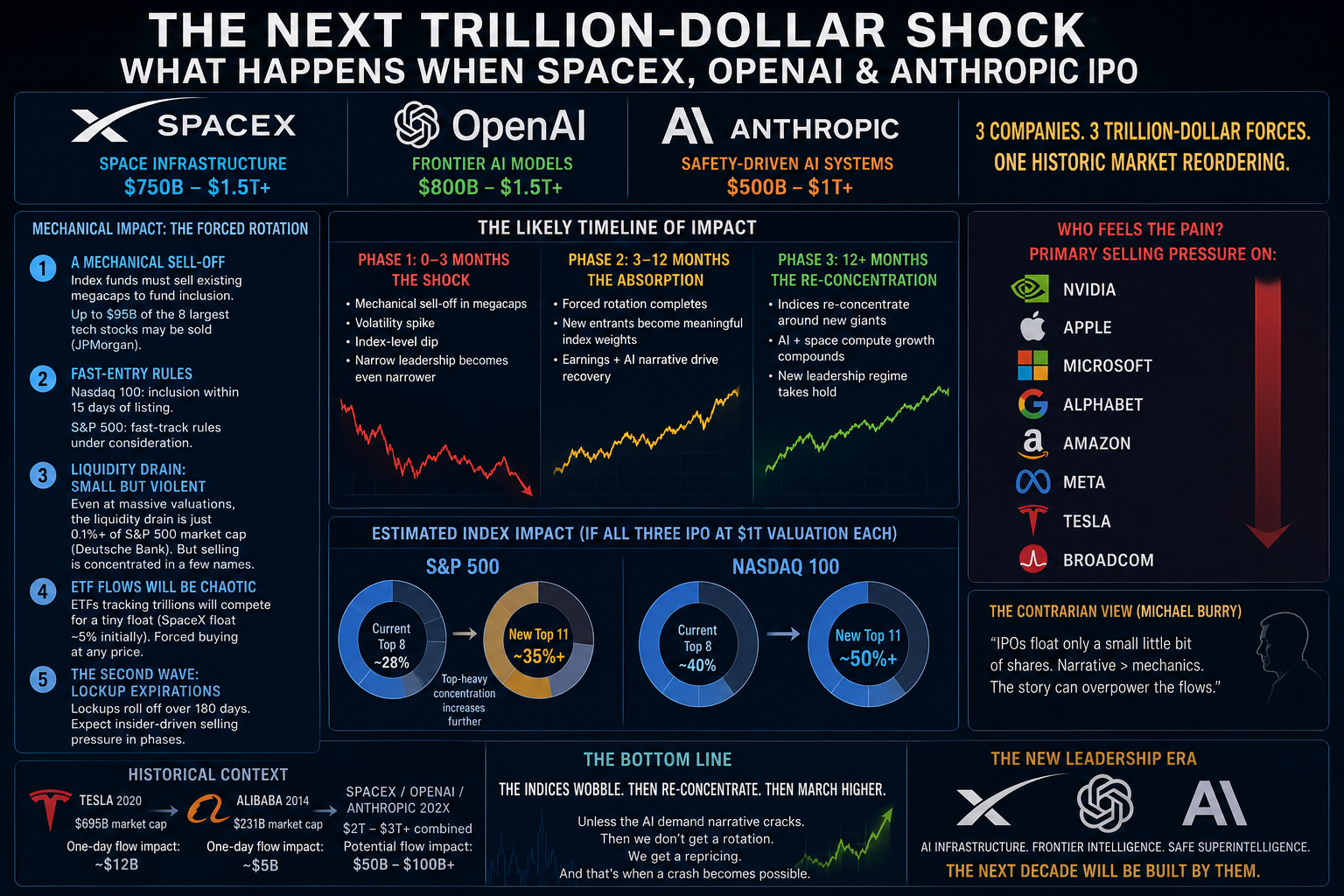
Each company sits at the centre of a structural shift—space infrastructure, frontier AI models and safety‑driven AI systems—and each is likely to command a valuation in the high hundreds of billions, if not beyond.

Their arrival on public markets will not be a routine liquidity event. It will be a reordering of index composition, capital flows and investor psychology.

At the mechanical level, the impact on the S&P 500 and Nasdaq will be immediate. Index providers now operate fast‑entry rules that allow very large IPOs to join major benchmarks within days rather than months.

This compresses the adjustment period and forces passive funds to sell existing constituents to make room for the newcomers.

The selling pressure will fall disproportionately on the current megacap cohort—Microsoft, Apple, Alphabet, Amazon, Meta, Nvidia and Tesla—because these names dominate index weightings and therefore become the primary source of liquidity for rebalancing.

The indices themselves may not fall sharply, but the internal rotation will be violent.

The Nasdaq will feel the shock most acutely. Its concentration in technology means the inclusion of three new giants will trigger a scramble for weight, with ETFs forced to buy limited‑float shares at whatever price the market sets.

The S&P 500, broader and more liquid, will absorb the change more smoothly, but even there the effect will be visible: a temporary dip in existing leaders, a spike in volatility and a rapid reshaping of the top‑ten constituents.

The S&P 500 and Nasdaq will almost certainly experience a temporary liquidity shock, a forced rotation out of existing megacaps, and then—once the dust settles—a re‑concentration around the new AI/space giants.

The scale of SpaceX, OpenAI and Anthropic means the indices will not be able to absorb them quietly.

What will likely happen when SpaceX, OpenAI and Anthropic list their IPOs?

1. A mechanical sell‑off in today’s biggest tech names

Index funds must sell existing holdings to make room for the new entrants.

  • Goldman Sachs notes passive funds will need to rebalance as soon as these mega‑caps are added.
  • JPMorgan estimates that at a $2T valuation, up to $95bn of the eight largest tech stocks may need to be sold to rebalance portfolios.

This means pressure on Nvidia, Apple, Microsoft, Alphabet, Amazon, Meta, Tesla, Broadcom—the very names currently carrying the indices.

2. Fast‑entry rules accelerate the shock

Nasdaq’s new “fast entry” rules allow these companies to join the Nasdaq 100 within 15 days of listing. S&P Dow Jones is considering similar fast‑track inclusion for mega‑caps. The Motley Fool

This compresses what used to be a 12‑month absorption period into weeks.

3. Liquidity drain is real—but limited in absolute terms

Deutsche Bank estimates that even the largest IPOs would still represent just over 0.1% of S&P 500 market cap. So the market‑wide liquidity drain is modest, but the rotation effect is violent because it concentrates selling in a handful of megacaps.

4. ETF flows will be chaotic

Strategas warns that ETFs tracking trillions will compete for a tiny float, making inclusion “frantic.” SpaceX is reportedly floating only ~5% of shares initially. That means forced buying at any price, followed by forced selling elsewhere.

5. After lockups expire (180 days), the second wave hits

SpaceX’s prospectus notes that selling pressure increases as lockups roll off in phases over 180 days. Expect a two‑stage impact:

  • Stage 1: violent index rebalancing
  • Stage 2: insider‑driven supply shock

So what happens to the S&P 500?

Short-term (0–3 months after IPOs):

  • Mild index-level dip as megacaps are sold to fund inclusion.
  • Volatility spike around rebalance windows.
  • Narrow leadership becomes even narrower temporarily.

This is consistent with historical mega‑IPO patterns (e.g., Tesla’s inclusion forced tens of billions in one-day flows).

Medium-term (3–12 months):

  • The S&P 500 becomes more top‑heavy, not less.
  • SpaceX, OpenAI, Anthropic quickly become meaningful index weights due to their trillion‑dollar valuations.
  • If AI earnings continue to dominate, the index likely recovers and re‑concentrates around the new entrants.

HSBC reportedly notes that stronger tech valuations—especially from high‑valuation IPOs—could push the S&P 500 above 8,000 if earnings broaden.

What about the Nasdaq?

The Nasdaq 100 is hit harder because:

  • It is more tech‑concentrated.
  • Fast‑entry rules force inclusion within 15 days.

Expect:

  • Sharper rotation, especially out of semiconductor and hyperscaler names.
  • Higher volatility as QQQ must buy the new entrants aggressively.
  • A structural reshaping: SpaceX, OpenAI and Anthropic could become low‑ to mid‑single‑digit weights almost immediately.

The contrarian view (Michael Burry)

Burry argues the IPOs won’t break the bull market, because IPOs float only a “small little bit” of shares, limiting true supply impact. He believes narrative > mechanics.

There’s truth in that: the story of AI and space‑compute may ultimately lift the indices after the initial turbulence.

My Opinion

Short-term: Expect a sell‑off in existing megacaps, a volatility spike, and mechanical downward pressure on both S&P 500 and Nasdaq.

Medium-term: Once the forced rotation is complete, the indices likely resume their upward trend, now with three new trillion‑dollar engines powering them.

Long-term: This is the biggest index‑composition shock since the dot‑com era. The S&P 500 and Nasdaq will become even more dominated by AI‑infrastructure and space‑compute giants.

In other words: the indices wobble, then re‑concentrate, then march higher—unless AI demand itself cracks.

If that happens then we’ll most likely witness a crash!

S&P 500 and Nasdaq Composite and 100 All Hit Fresh Record Highs as Tech Momentum Intensifies – 26th May 2026

New record all-time highs for U.S. indices

The S&P 500 and Nasdaq Composite surged to new all‑time highs yesterday, extending a rally that shows little sign of fatigue as investors continue to pile into megacap technology and AI‑linked names.

The move higher came despite a patchy run of U.S. macro data, underscoring how dominant earnings strength and sector‑specific momentum have become in driving equity sentiment.

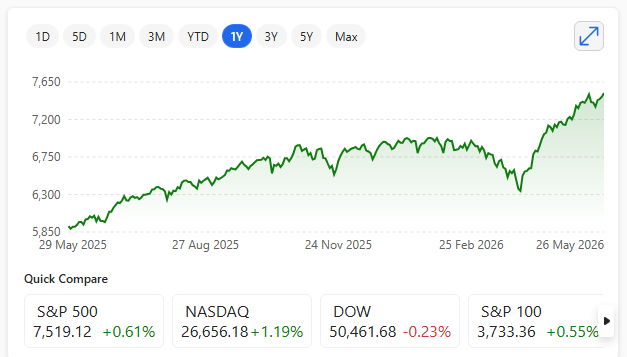
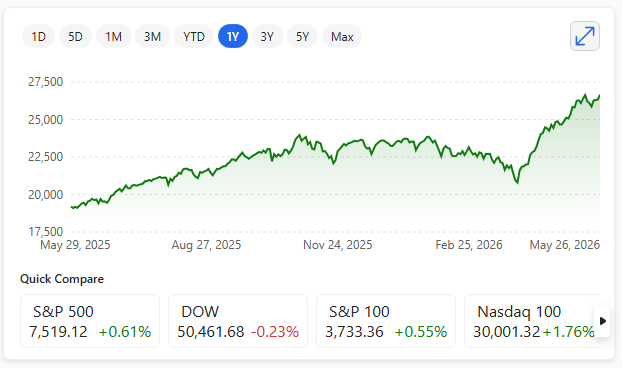
S&P 500: 7,519.12, up 45.65 points (+0.61%) — a record closing high.

S&P 500 26th May 2026

The S&P 500’s climb was supported by broad participation across technology, communication services and consumer discretionary, with investors rewarding companies delivering consistent revenue and margin expansion.

Market breadth has improved modestly in recent weeks, helping reinforce confidence that the rally is not solely dependent on a handful of giants.

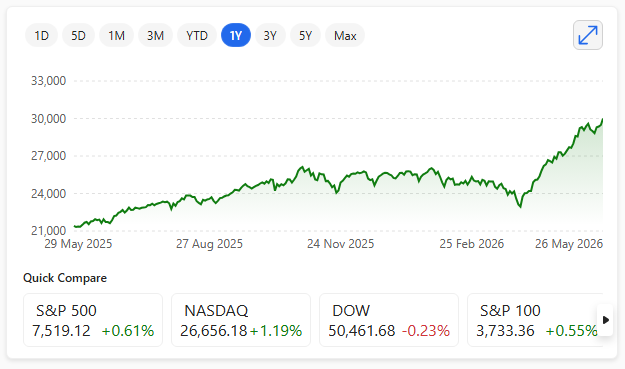
Nasdaq Composite: 26,656.18, up 312.21 points (+1.19%) — also a record closing high, with an intraday peak of 26,725.29.

Nasdaq Composite 26th May 2026

Nasdaq‑100 (NDX): 30,001.32 – Up: +519.68 points (+1.76%) Intraday high: 30,044.49 – a new record high.

Nasdaq 100 26th May 2026

The Nasdaq once again outperformed, propelled by heavy demand for semiconductor, cloud and AI infrastructure stocks.

Upbeat guidance from several major tech firms earlier this month has strengthened the view that the sector’s earnings cycle still has room to run.

While valuations remain elevated and leave the market exposed to any negative surprise, investors have so far shown little inclination to rotate away from the winners.

Yesterday’s triple records highlight the market’s conviction that the AI‑driven profit cycle remains intact.

What would happen to the S&P 500 should one or some or all of the Magnificent Seven companies fail to deliver their AI promise – even just a little?

Magnificent Seven and the S&P 500

If the Magnificent Seven were to fall short of the AI and tech transformation investors have priced in, the S&P 500 would face one of the most severe valuation resets in its modern history.

With the group now representing roughly one‑third of the entire index, any collective disappointment would ripple far beyond technology and into every sector tied to index‑tracking capital.

The concentration problem

The S&P 500 has never been this top‑heavy. Microsoft, Apple, Nvidia, Alphabet, Amazon, Meta and Tesla have become the gravitational centre of global equity markets.

Their valuations are not merely high; they are explicitly built on the assumption of future dominance in AI infrastructure, cloud, automation, consumer platforms and next‑generation hardware.

If that future fails to materialise — or even arrives more slowly than expected — the index’s structure becomes a liability. A small number of companies would be responsible for a large portion of the downside.

Scenario 1: One or two companies stumble

If a single member — say Apple or Tesla — fails to deliver, the impact is sharp but contained. The S&P 500 would likely see a 3–5% drawdown, driven by index‑weight mechanics rather than systemic panic.

Investors have already priced in uneven performance within the group, and the remaining leaders would absorb some of the shock.

The more dangerous case is if one of the AI‑infrastructure engines — Microsoft, Nvidia or Alphabet — disappoints. These companies sit at the centre of the capex cycle.

A miss on AI demand, margins or utilisation would trigger a broader reassessment of the entire AI investment thesis.

Scenario 2: Several of the Seven disappoint simultaneously

A coordinated earnings miss or guidance reset across multiple names would force a valuation compression across the entire index. Because passive flows mechanically overweight the winners, a reversal would unwind years of momentum.

A realistic outcome:

  • S&P 500 correction of 10–15%
  • Volatility spike as systematic strategies de‑risk
  • Rotation into defensives and energy, sectors less dependent on AI narratives
  • Credit spreads widen, reflecting lower confidence in tech‑driven earnings growth

This is the point where the market stops treating AI as inevitability and starts treating it as a risk.

Scenario 3: The AI thesis breaks entirely

If all seven fail to deliver the productivity, revenue and margin expansion implied by their valuations, the S&P 500 would undergo a structural reset.

The index could fall 20% or more, not because of recessionary conditions but because the market would need to rebuild a new leadership structure from scratch.

The last time leadership collapsed this dramatically was the dot‑com unwind — but today’s concentration is far higher, and passive ownership is far larger. but AI has far more upfront utility, doesn’t it?

The core truth

The S&P 500’s fate is now inseparable from the Magnificent Seven. If they deliver, the index continues to levitate. If they falter, the entire market must reprice what growth, innovation and leadership look like in the post‑AI era.

When the Magnificent Seven Slip: Who Rises Next?

If the AI tide recedes, the market’s leadership will not vanish — it will rotate. The beneficiaries will be the sectors that have quietly compounded earnings while the spotlight stayed fixed on Silicon Valley.

1. Energy and Utilities With AI‑driven data centres consuming vast power, any slowdown in tech expansion would ease pressure on grids and shift investor focus back to traditional producers. Dividend yields and defensive cash flow would regain appeal as growth multiples compress.

2. Industrials and Infrastructure A retreat from speculative tech would redirect capital toward physical productivity — logistics, construction, and manufacturing modernisation. Firms tied to electrification, rail, and defence could see valuation upgrades as investors seek real‑world output rather than digital promise.

3. Healthcare and Pharmaceuticals The sector’s secular growth and pricing power make it a natural refuge when tech falters. Biotech innovation continues independently of AI cycles, and ageing demographics ensure steady demand.

4. Financials Banks and insurers benefit from higher rates and wider spreads when tech valuations deflate. A correction in mega‑caps could even restore balance to passive indices, giving financials a larger share of inflows.

5. Consumer Staples In a post‑AI correction, investors rediscover the comfort of predictable earnings. Food, beverages, and household goods regain their defensive premium as volatility rises.

The narrative shift: The market would move from promise to proof — from speculative AI multiples to tangible earnings. The S&P 500 would not collapse; it would evolve. Leadership would pass from code to concrete, from algorithms to assets.

Key Points — S&P 500 Risk if the Magnificent Seven Falter

1. The S&P 500 is structurally dependent on seven companies

  • The Magnificent Seven now make up ~35% of the entire index’s market cap.
  • This is the highest concentration in modern history, making the S&P 500 behave more like a mega‑cap tech fund than a diversified benchmark.

2. Their valuations are priced for an AI‑driven future

  • Current multiples assume sustained exponential AI demand, cloud capex growth, and productivity gains.
  • Any slowdown in AI adoption, monetisation, or enterprise rollout would force a valuation reset across the leaders.

3. A single-company stumble is absorbable — but still painful

  • If one member (e.g., Apple or Tesla) disappoints, the index likely sees a 3–5% pullback.
  • The remaining leaders can offset the drag, but the psychological impact is non‑trivial.

4. A slowdown in the AI infrastructure core is the real risk

  • Microsoft, Nvidia and Alphabet sit at the centre of the global AI capex cycle.
  • If cloud AI demand proves slower or less profitable than expected, the S&P 500 could face a 10–15% correction as earnings expectations compress.

5. A broad failure of the AI thesis triggers a structural reset

  • If AI productivity gains don’t materialise, or margins erode under cost/regulatory pressure, the index could fall 20%+.
  • This would resemble a leadership collapse, not a normal recession — similar to the dot‑com unwind but with far more concentration and passive capital tied to the winners.

6. Passive flows amplify both upside and downside

  • With so much capital in index funds, any derating of the top names mechanically drags the entire index lower.
  • The S&P 500’s fate is now mathematically tethered to the Magnificent Seven.

7. The uncomfortable conclusion

  • The S&P 500’s trajectory is inseparable from the success or failure of the AI narrative.
  • If the Magnificent Seven deliver, the index continues to defy gravity.
  • If they falter, the market must rebuild a new leadership structure from scratch.

The S&P 500 is fundamentally in the danger zone – be careful!

OpenAI Missed Targets — and creates a mini–AI Shockwave – Will it become a Tsunami?

OpenAI wobble?

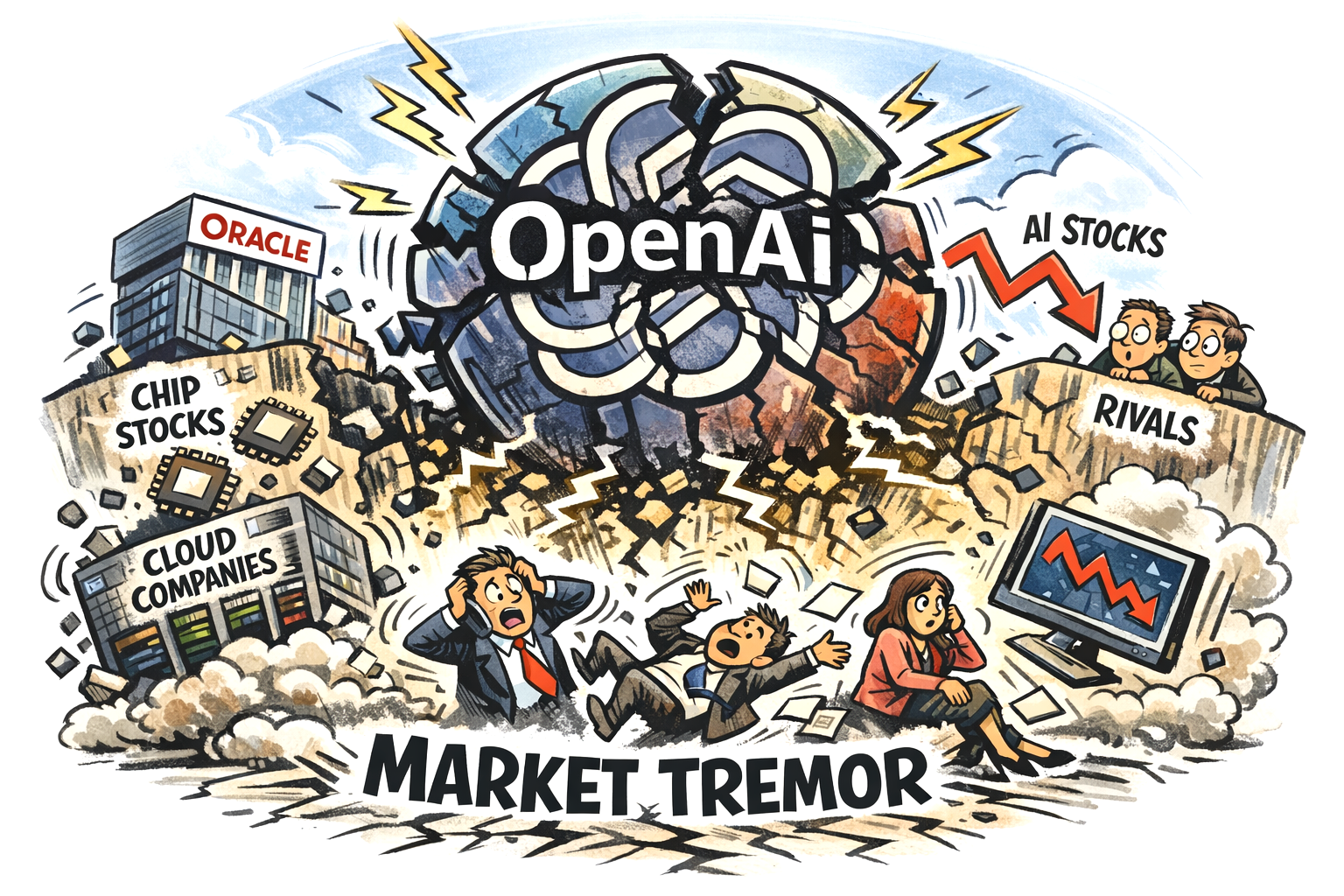
OpenAI’s reported failure to meet internal revenue and user‑growth targets has sent a sharp tremor through global tech markets, exposing just how dependent the wider AI sector has become on a single company’s momentum.

The Wall Street Journal report — which OpenAI has reportedly dismissed as “ridiculous” — suggested the firm is expanding more slowly than its own projections, raising questions about whether its vast compute‑spend commitments can be sustained. That alone was enough to trigger a sell‑off.

Slide

The steepest declines were concentrated among companies most financially tethered to OpenAI’s infrastructure demands. Oracle, which has a colossal $300 billion, five‑year cloud capacity agreement with the firm, fell more than 4%.

After the news story was released chipmakers followed OpenAI: Broadcom dropped over 4%, AMD slid more than 3%, Nvidia dipped around 1.5%, and CoreWeave — the highly leveraged neocloud provider — sank nearly 6%.

Even Qualcomm, which had recently enjoyed a lift from reports of collaboration with OpenAI on smartphone chips, slipped before recovering.

This is the first moment in the current AI cycle where a wobble at OpenAI has produced a synchronised pullback across the entire supply chain.

Investors are now confronting a question they have largely ignored: what if the sector’s flagship growth curve is not perfectly exponential? But my guess is, like all events at the moment, the market will likely overlook it.

Fragile

The reaction also exposes the fragility of AI‑linked valuations. Markets have priced the boom as if demand is both infinite and linear.

Any hint of deceleration — even one disputed by the company — forces a reassessment of the capital intensity underpinning the industry.

With Anthropic and Google’s Gemini gaining enterprise traction, OpenAI’s dominance is no longer assumed.

Still, several fund managers argue the broader AI investment cycle remains intact. The sell‑off looks less like a turning point and more like a reminder: when one company becomes the gravitational centre of an entire narrative, even a rumour can bend the orbit.