

The U.S. stock market continues to defy those warning that valuations, concentration and excessive optimism have created a dangerous combination.
Yet the question is no longer simply whether American shares are expensive. It is whether the assumptions supporting those valuations can continue to hold.
The S&P 500 has become increasingly dependent on a relatively small number of giant companies, many of which are at the centre of the artificial intelligence boom.
That concentration has become one of the most important — and potentially overlooked — risks facing investors.
A market increasingly dominated by a handful of companies
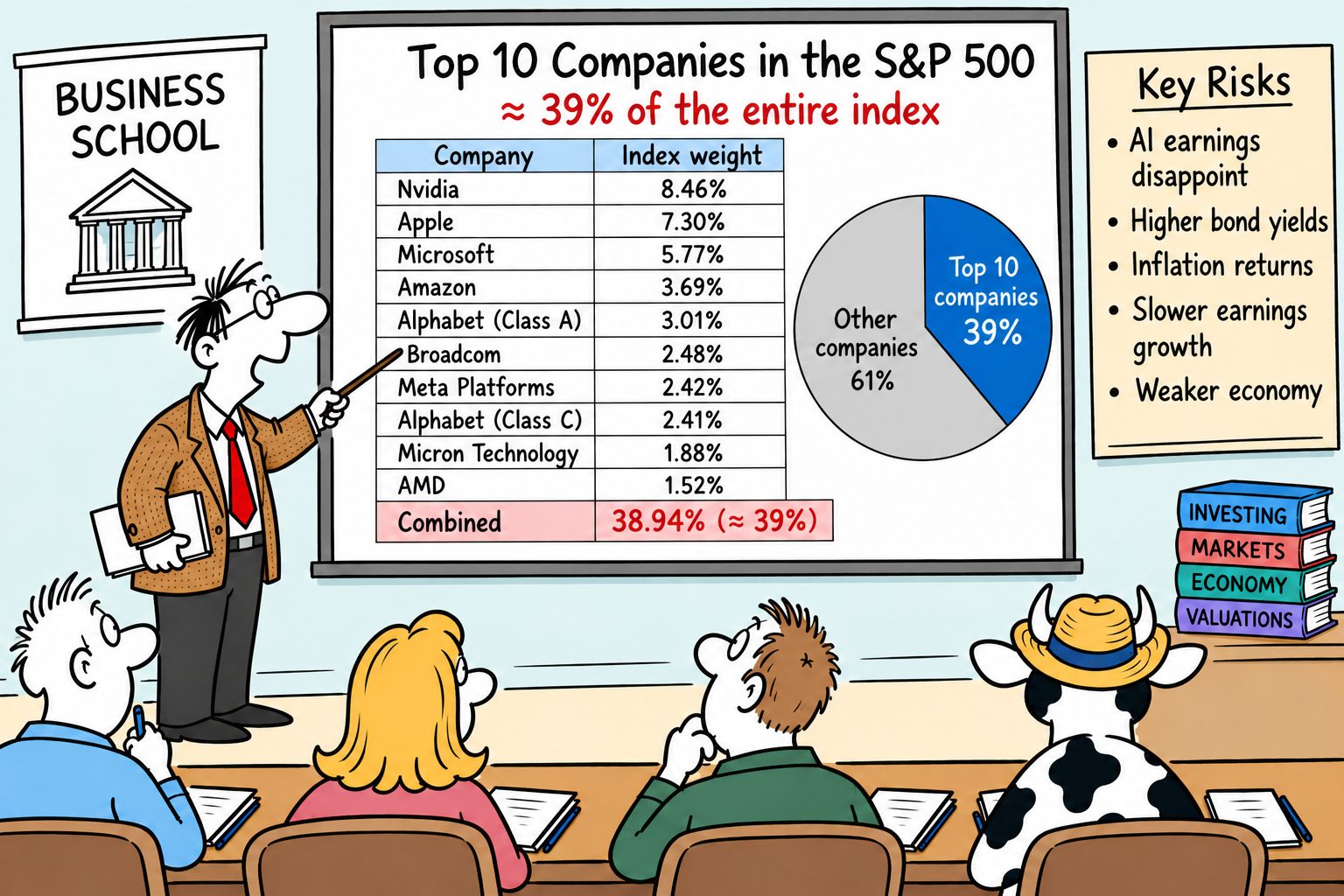
The ten largest holdings account for approximately 39% of the entire S&P 500 index, according to the holdings figures used for this analysis. Alphabet appears twice because its Class A and Class C shares are separate index constituents.
| Company | Approx. index weighting |
|---|---|
| Nvidia | 8.46% |
| Apple | 7.30% |
| Microsoft | 5.77% |
| Amazon | 3.69% |
| Alphabet Class A | 3.01% |
| Broadcom | 2.48% |
| Meta Platforms | 2.42% |
| Alphabet Class C | 2.41% |
| Micron Technology | 1.88% |
| AMD | 1.52% |
| Combined | 38.94% (≈39%) |
Note: These are the approximate holdings weights used in the original analysis, dated 1st October 2026. Index weightings change as share prices move.
Look beyond the individual names and the concentration becomes even more striking. Nvidia alone represents more than 8% of the index, while Alphabet’s two share classes together account for more than 5%. These companies also have enormous exposure to the AI investment boom.
That matters because a correction in one or two companies would not necessarily threaten the wider market. But if investors simultaneously lose confidence in the AI trade, the consequences could be considerably larger.
The AI assumption
Investors have poured enormous amounts of money into companies expected to benefit from artificial intelligence, while the world’s largest technology companies are committing vast sums to data centres, semiconductors and computing infrastructure.
For now, strong corporate earnings have provided justification for much of the optimism. But this is where the greatest risk may lie.
The market does not necessarily need AI to fail. Investors simply need to become less convinced that the enormous capital being committed today will generate sufficiently large profits in the future.
If the returns from AI investment take longer to materialise, or if competition forces companies to spend more to maintain their position, valuations could come under pressure.
Are valuations too high?
Valuations are certainly elevated by historical standards.
That does not automatically mean a crash is imminent. Expensive markets can remain expensive for years if corporate earnings continue to grow strongly.
The more important question is whether earnings can grow quickly enough to justify today’s prices.
This distinction is particularly important because the S&P 500 is a market-capitalisation-weighted index. When Nvidia, Apple and Microsoft rise sharply, they have a much greater influence on the index than hundreds of smaller companies.
In other words, the S&P 500 can appear remarkably strong even when performance underneath the surface is considerably less impressive.
That creates a potential vulnerability.
Treasury yields could become the trigger
Bond yields represent another major threat.
Higher Treasury yields give investors an increasingly attractive alternative to equities. They also reduce the present value of future corporate profits, which particularly affects companies whose valuations depend heavily on strong growth many years into the future.
If U.S. Treasury yields remain elevated, investors may eventually become less willing to pay premium prices for technology and AI companies.
The problem is that higher yields can put pressure on share prices even when companies continue to report rising profits. Investors may simply decide that those profits are worth less today.
Then there is inflation
A renewed rise in energy prices could make the situation considerably more difficult.
Higher oil prices can feed directly into inflation, making it harder for the Federal Reserve to cut interest rates. That could keep borrowing costs and Treasury yields higher for longer.
The combination of higher inflation, higher bond yields and slowing earnings growth would be particularly uncomfortable for a market trading at elevated valuations.
Geopolitical tensions, tariffs and disruptions to energy supplies could add to the pressure, while higher borrowing costs would affect businesses and households alike.
What would actually reverse the bull market?
The most dangerous scenario would not necessarily be a single event. It could be a combination of several developments:
- AI investment disappoints: expected returns fail to justify the enormous sums being spent.
- Corporate earnings growth slows: companies deliver less than investors have priced in.
- Treasury yields remain high: bonds become more competitive with equities.
- Inflation returns: energy prices or other costs prevent interest rates from falling.
- The economy weakens: consumers spend less and corporate revenues come under pressure.
- Valuations contract: investors become unwilling to pay such high multiples for future earnings.
Any one of these could cause volatility. Several occurring together could turn a normal correction into something much more serious.
The S&P 500 does not necessarily need a recession to fall sharply. If investors simply decide that today’s earnings forecasts are too optimistic, valuations could contract significantly.
Because almost four-tenths of the index is concentrated in just ten holdings, a simultaneous sell-off in major technology and AI-related shares could have an outsized effect on the entire market.
A correction without a recession?
Consider a simplified illustration. If the S&P 500 were trading at 7,800, earnings expectations subsequently fell by 10%, and investors reduced the valuation multiple from 19 times earnings to 16 times, the index could theoretically fall to around 5,900.
That would represent a decline of approximately 24%, without requiring an economic catastrophe.
This is an illustration rather than a market forecast, but it demonstrates how falling earnings expectations and lower valuations can reinforce each other.
And finally
The U.S. stock market is not necessarily a bubble simply because valuations are high. These are profitable, enormously successful companies with genuine earnings and powerful businesses.
But the market has increasingly priced in an exceptionally good future.
The bull market can therefore continue if earnings keep delivering. AI investment may generate substantial returns, inflation may remain contained, and Treasury yields may eventually fall.
However, if those assumptions begin to unravel, investors may discover that the market has been priced for very little disappointment.
The greatest threat to the U.S. bull market may therefore not be that AI is over — but that expectations for AI have simply become too high.