Anthropic’s Fable: The Mythos-Class Model That Finally Goes Public

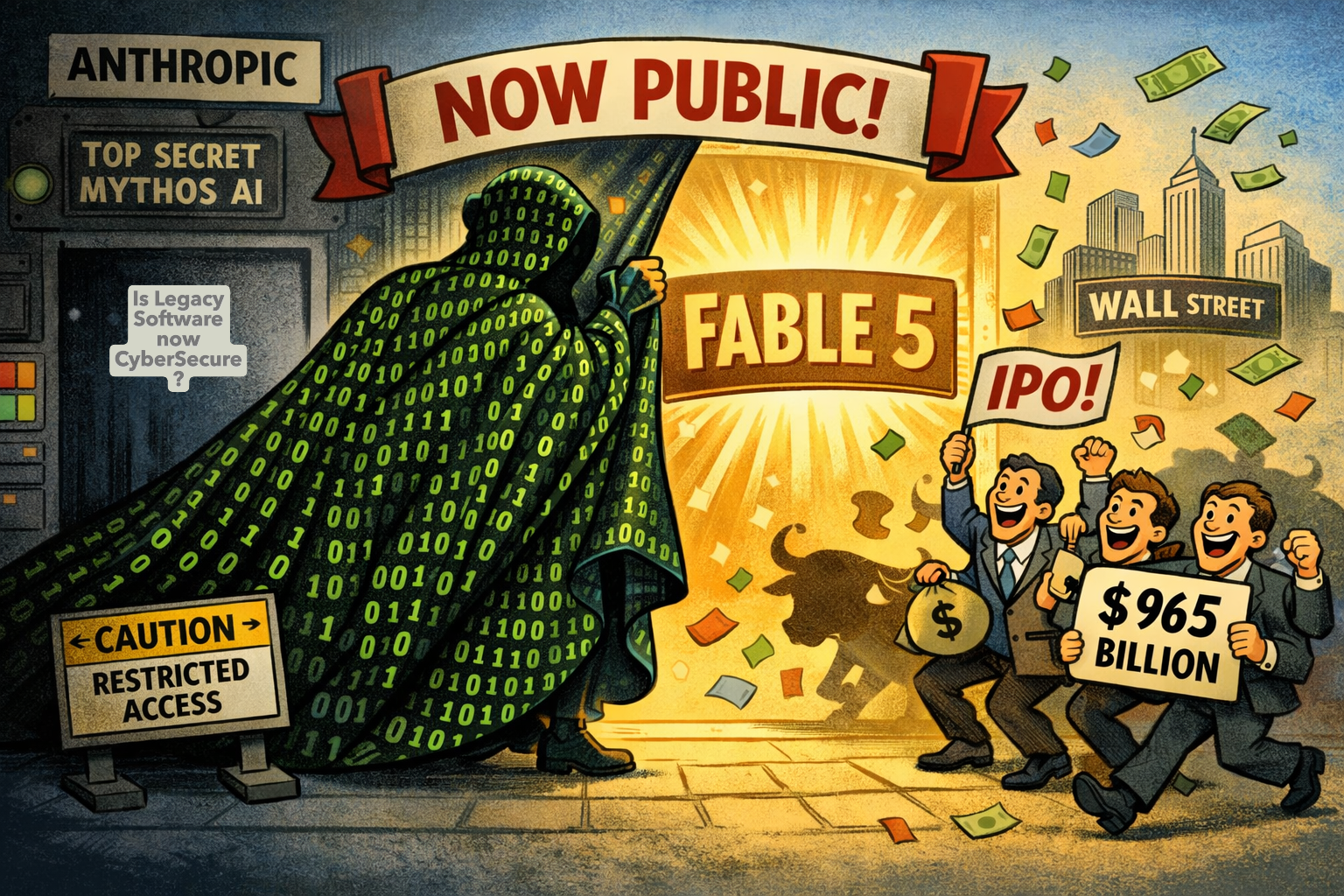
Anthropic has taken a decisive step in its race to dominate the frontier‑model market, releasing Claude Fable 5 to the public just two months after its private sibling, Mythos, sent Wall Street into a frenzy.

The move marks the company’s most assertive attempt yet to commercialise Mythos‑level capability while reassuring regulators and investors that safety, not speed, is steering the rollout.

Mythos, unveiled in April 2026, stunned both the cybersecurity world and financial markets with its ability to identify software vulnerabilities at a level previously associated with specialist security tools.

Anthropic restricted access, citing the model’s potential for misuse and limiting deployment to vetted partners under Project Glasswing.

That scarcity — and the model’s almost uncanny diagnostic power — helped fuel a surge in Anthropic’s valuation and contributed to the broader AI‑driven market rally.

Fable 5

Fable 5 is the company’s answer to the question Mythos raised: Can a model this capable ever be released at scale? According to Anthropic, the answer is yes — but only with a redesigned safety architecture.

The company says Fable 5 includes new classifiers and guardrails that automatically block responses in high‑risk domains such as cybersecurity and biological threat modelling.

When a query crosses those boundaries, the system falls back to the safer Claude Opus 4.8, ensuring continuity without exposing dangerous capabilities.

Despite these constraints, Fable 5 is no diluted product. Anthropic claims it outperforms Opus 4.8 by more than 10% on key engineering and knowledge‑work benchmarks, offering enterprises a model that is both more capable and more predictable.

Early customers, the company says, are reporting better return on spend due to higher accuracy and reduced task repetition.

IPO

The timing is strategic. Anthropic has just confidentially filed for its IPO, with revenues ballooning from roughly $10 billion last year to a run rate of $47 billion.

Its latest funding round valued the company at $965 billion, surpassing OpenAI’s March valuation.

With OpenAI and SpaceX/xAI also preparing for blockbuster listings, Anthropic needs a flagship product that demonstrates both capability and commercial maturity.

Fable 5 is that product: a Mythos‑class model built for the real world rather than the lab. By releasing it now — powerful, constrained, and priced at a premium — Anthropic is signalling that the era of frontier‑model scarcity is ending, and the era of industrial‑scale AI deployment has begun.

Markets in Asia continue volatility as Softbank falls 10%

Softbank down 10%

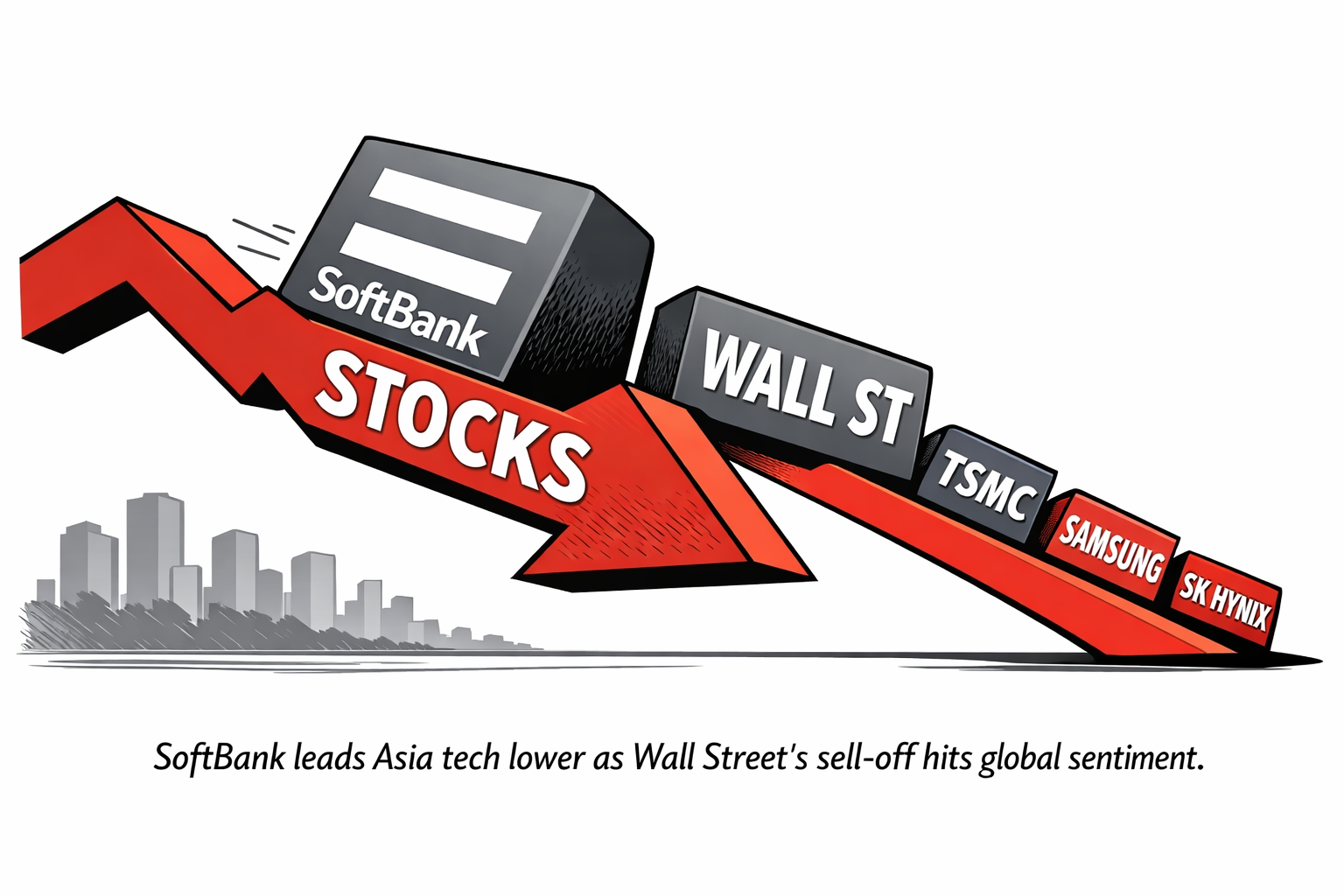
SoftBank’s sharp 10% slide on Wednesday became the defining symbol of a broader rout across Asia’s technology markets, as the region absorbed the full force of Wall Street’s overnight tech sell‑off.

The reversal ended a brief rebound in chipmakers and reignited concerns that valuations across the artificial‑intelligence complex have run too hot for too long.

The immediate pressure on SoftBank stemmed from reports that its attempt to raise at least $6 billion through a margin loan backed by its OpenAI stake had stalled.

That setback landed at a moment when sentiment toward high‑growth tech names was becoming more fragile, amplifying the downside.

Investors rotated out of risk, hitting Japan’s semiconductor ecosystem: Advantest and Renesas both fell more than 3%, while South Korea’s SK Hynix plunged over 8% and Samsung Electronics dropped 7.45%.

Taiwan’s TSMC and Hon Hai were also dragged lower.

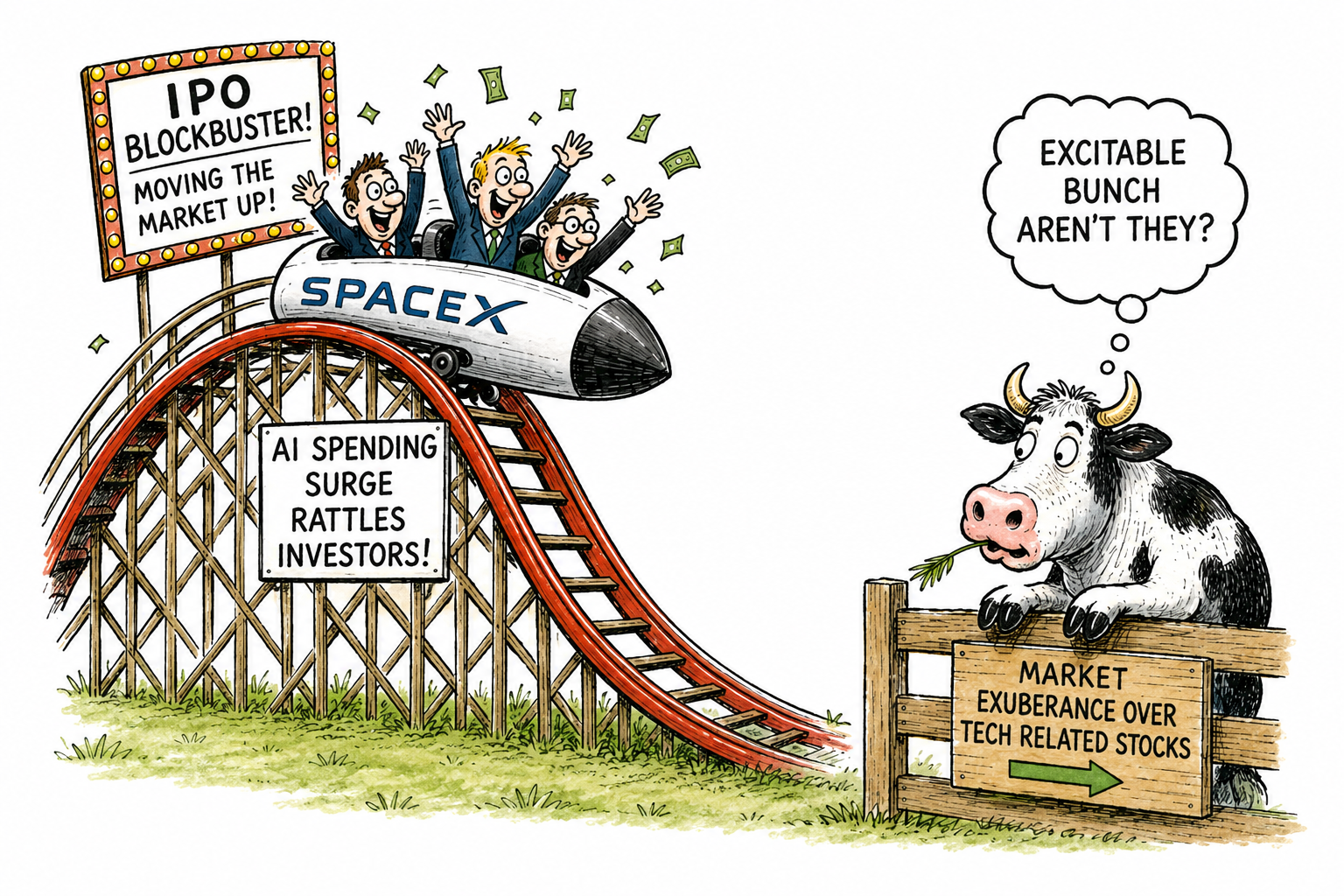
A deeper structural worry is now taking hold. Massive AI‑related fundraising — including upcoming listings for SpaceX, Anthropic and OpenAI — appears to be siphoning capital away from publicly traded tech stocks.

Some investors see this as the early stage of a rotation; others fear it signals overheating. For Japan, one unexpected beneficiary could be defence contractors, with strategists suggesting a shift toward “heavies” as retail traders search for stability.

The Coming Shockwave: How Three Mega‑IPOs Could Reshape the S&P 500 and Nasdaq – Opinion

IPOs for SpaceX, OpenAI and Anthropic

The expected public listings of SpaceX, OpenAI and Anthropic represent the most consequential cluster of IPOs in two decades.

Each company sits at the centre of a structural shift—space infrastructure, frontier AI models and safety‑driven AI systems—and each is likely to command a valuation in the high hundreds of billions, if not beyond.

Their arrival on public markets will not be a routine liquidity event. It will be a reordering of index composition, capital flows and investor psychology.

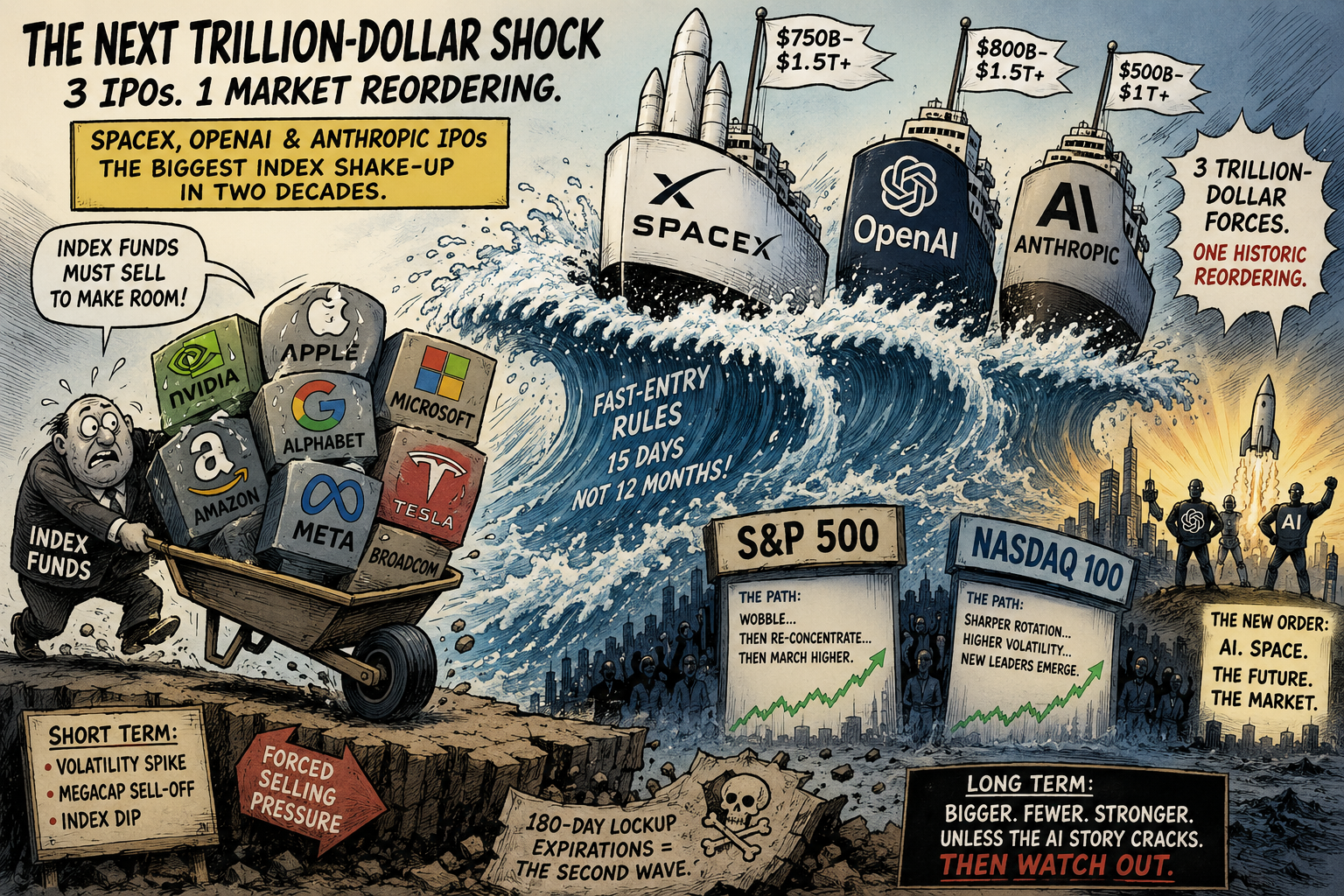
At the mechanical level, the impact on the S&P 500 and Nasdaq will be immediate. Index providers now operate fast‑entry rules that allow very large IPOs to join major benchmarks within days rather than months.

This compresses the adjustment period and forces passive funds to sell existing constituents to make room for the newcomers.

The selling pressure will fall disproportionately on the current megacap cohort—Microsoft, Apple, Alphabet, Amazon, Meta, Nvidia and Tesla—because these names dominate index weightings and therefore become the primary source of liquidity for rebalancing.

The indices themselves may not fall sharply, but the internal rotation will be violent.

The Nasdaq will feel the shock most acutely. Its concentration in technology means the inclusion of three new giants will trigger a scramble for weight, with ETFs forced to buy limited‑float shares at whatever price the market sets.

The S&P 500, broader and more liquid, will absorb the change more smoothly, but even there the effect will be visible: a temporary dip in existing leaders, a spike in volatility and a rapid reshaping of the top‑ten constituents.

The S&P 500 and Nasdaq will almost certainly experience a temporary liquidity shock, a forced rotation out of existing megacaps, and then—once the dust settles—a re‑concentration around the new AI/space giants.

The scale of SpaceX, OpenAI and Anthropic means the indices will not be able to absorb them quietly.

What will likely happen when SpaceX, OpenAI and Anthropic list their IPOs?

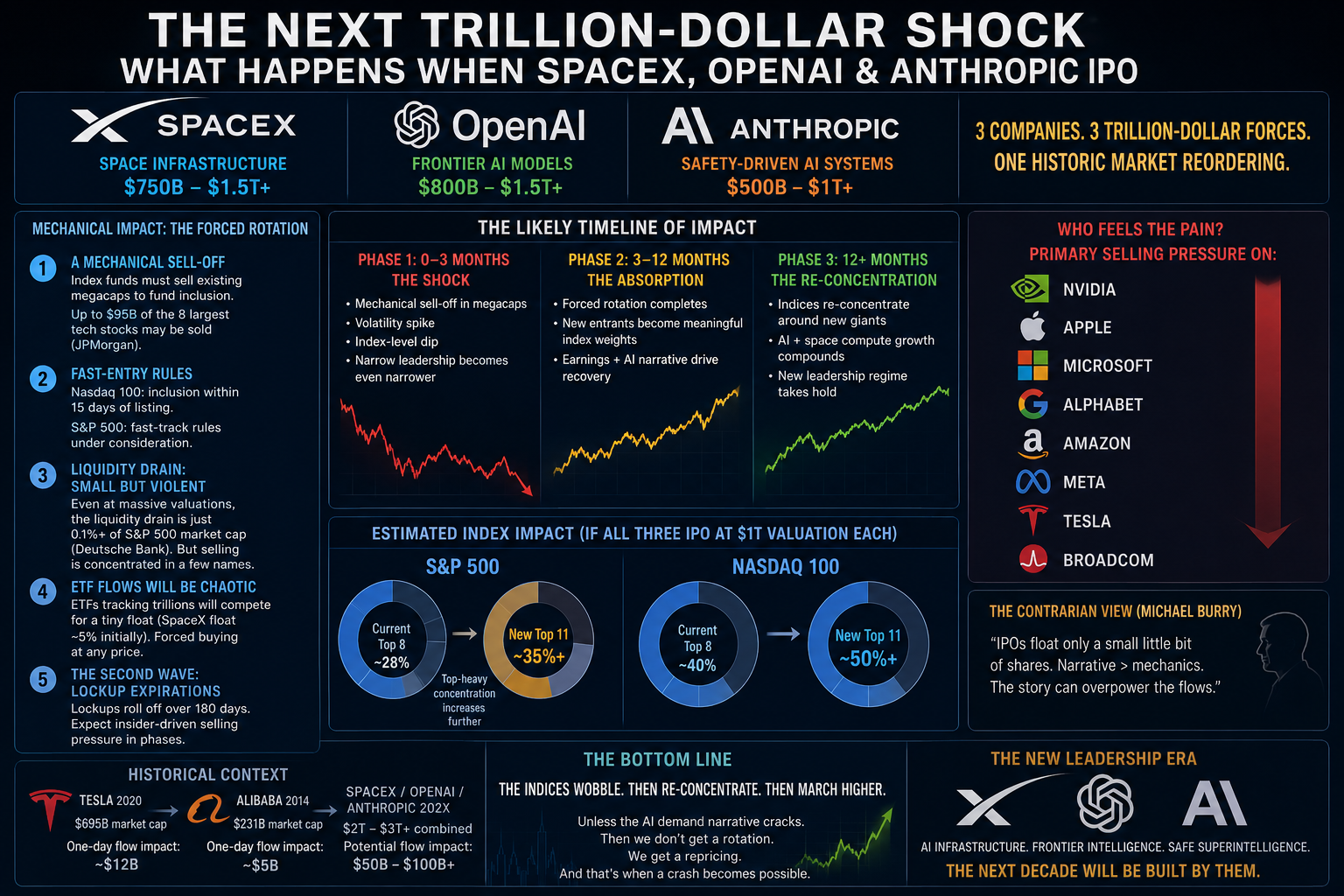
1. A mechanical sell‑off in today’s biggest tech names

Index funds must sell existing holdings to make room for the new entrants.

  • Goldman Sachs notes passive funds will need to rebalance as soon as these mega‑caps are added.
  • JPMorgan estimates that at a $2T valuation, up to $95bn of the eight largest tech stocks may need to be sold to rebalance portfolios.

This means pressure on Nvidia, Apple, Microsoft, Alphabet, Amazon, Meta, Tesla, Broadcom—the very names currently carrying the indices.

2. Fast‑entry rules accelerate the shock

Nasdaq’s new “fast entry” rules allow these companies to join the Nasdaq 100 within 15 days of listing. S&P Dow Jones is considering similar fast‑track inclusion for mega‑caps. The Motley Fool

This compresses what used to be a 12‑month absorption period into weeks.

3. Liquidity drain is real—but limited in absolute terms

Deutsche Bank estimates that even the largest IPOs would still represent just over 0.1% of S&P 500 market cap. So the market‑wide liquidity drain is modest, but the rotation effect is violent because it concentrates selling in a handful of megacaps.

4. ETF flows will be chaotic

Strategas warns that ETFs tracking trillions will compete for a tiny float, making inclusion “frantic.” SpaceX is reportedly floating only ~5% of shares initially. That means forced buying at any price, followed by forced selling elsewhere.

5. After lockups expire (180 days), the second wave hits

SpaceX’s prospectus notes that selling pressure increases as lockups roll off in phases over 180 days. Expect a two‑stage impact:

  • Stage 1: violent index rebalancing
  • Stage 2: insider‑driven supply shock

So what happens to the S&P 500?

Short-term (0–3 months after IPOs):

  • Mild index-level dip as megacaps are sold to fund inclusion.
  • Volatility spike around rebalance windows.
  • Narrow leadership becomes even narrower temporarily.

This is consistent with historical mega‑IPO patterns (e.g., Tesla’s inclusion forced tens of billions in one-day flows).

Medium-term (3–12 months):

  • The S&P 500 becomes more top‑heavy, not less.
  • SpaceX, OpenAI, Anthropic quickly become meaningful index weights due to their trillion‑dollar valuations.
  • If AI earnings continue to dominate, the index likely recovers and re‑concentrates around the new entrants.

HSBC reportedly notes that stronger tech valuations—especially from high‑valuation IPOs—could push the S&P 500 above 8,000 if earnings broaden.

What about the Nasdaq?

The Nasdaq 100 is hit harder because:

  • It is more tech‑concentrated.
  • Fast‑entry rules force inclusion within 15 days.

Expect:

  • Sharper rotation, especially out of semiconductor and hyperscaler names.
  • Higher volatility as QQQ must buy the new entrants aggressively.
  • A structural reshaping: SpaceX, OpenAI and Anthropic could become low‑ to mid‑single‑digit weights almost immediately.

The contrarian view (Michael Burry)

Burry argues the IPOs won’t break the bull market, because IPOs float only a “small little bit” of shares, limiting true supply impact. He believes narrative > mechanics.

There’s truth in that: the story of AI and space‑compute may ultimately lift the indices after the initial turbulence.

My Opinion

Short-term: Expect a sell‑off in existing megacaps, a volatility spike, and mechanical downward pressure on both S&P 500 and Nasdaq.

Medium-term: Once the forced rotation is complete, the indices likely resume their upward trend, now with three new trillion‑dollar engines powering them.

Long-term: This is the biggest index‑composition shock since the dot‑com era. The S&P 500 and Nasdaq will become even more dominated by AI‑infrastructure and space‑compute giants.

In other words: the indices wobble, then re‑concentrate, then march higher—unless AI demand itself cracks.

If that happens then we’ll most likely witness a crash!

SpaceX’s Trillion‑Dollar IPO: A New Era in Market History

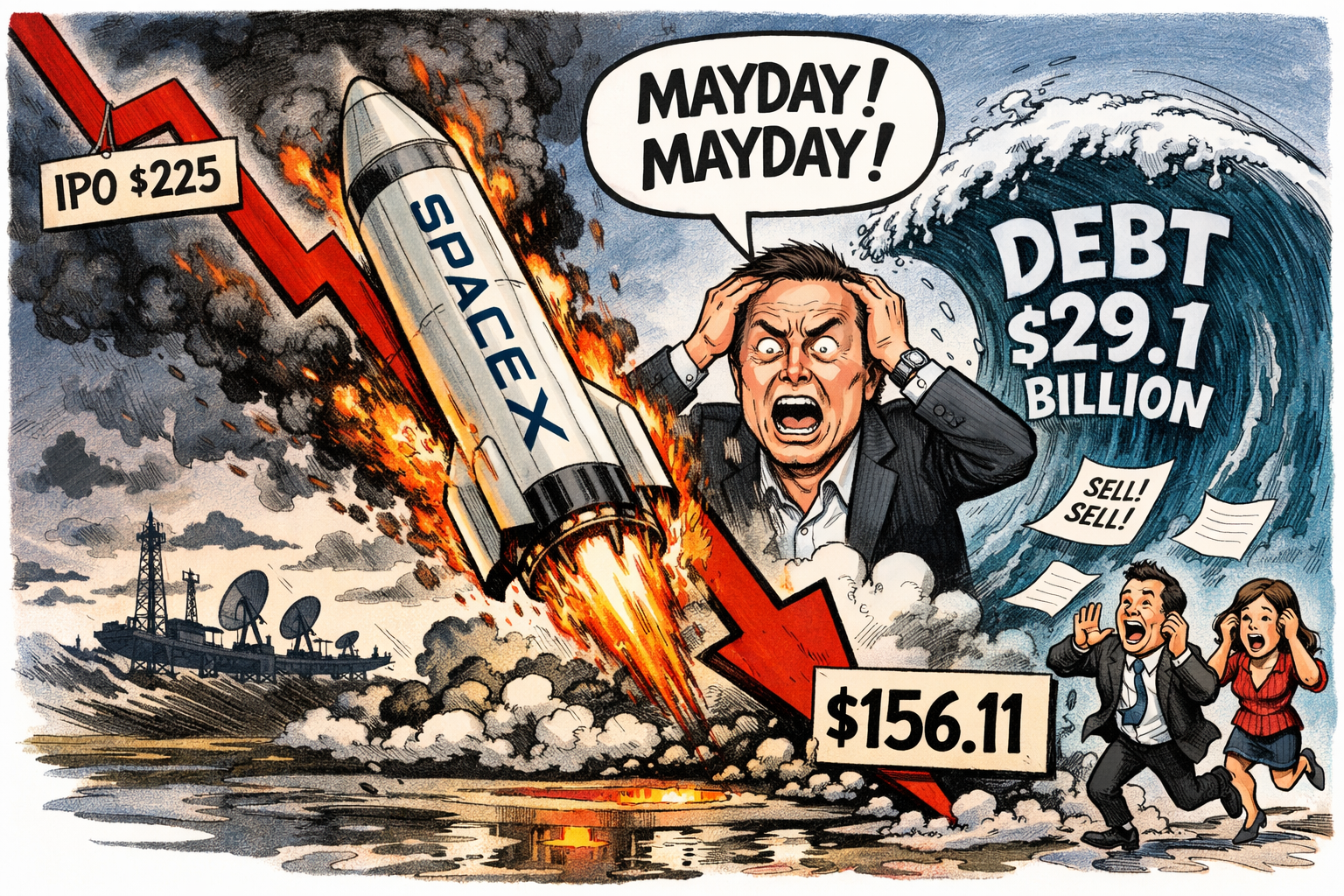
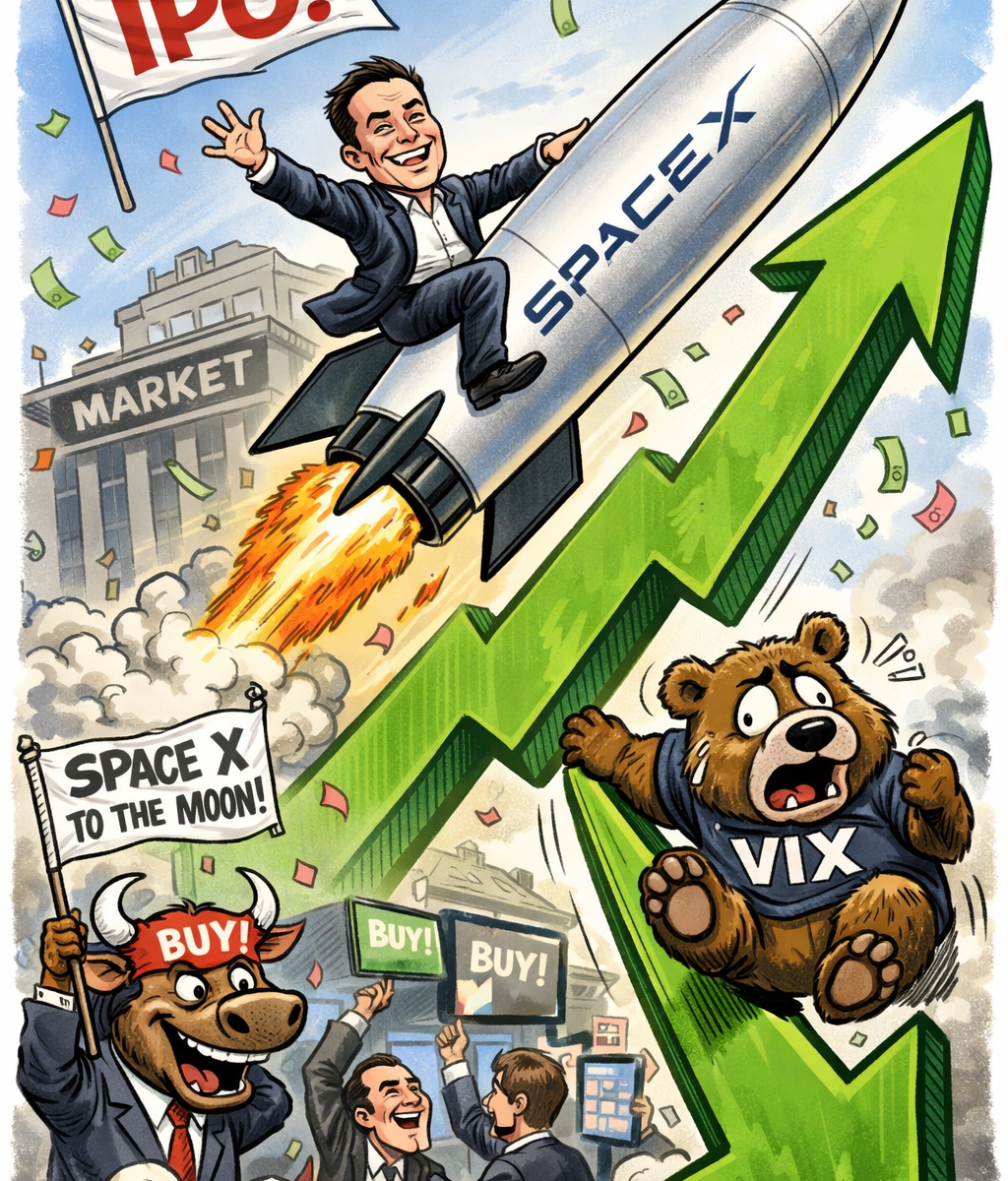
SpaceX IPO valued at $1 trillion

SpaceX is edging towards what could become the most significant stock market debut in modern history, with expectations that its initial public offering may surpass a valuation of $1 trillion.

A confidential filing with U.S. regulators marks a pivotal moment for the company, signalling its readiness to transition from a privately held aerospace leader to one of the world’s most valuable publicly traded firms.

Record breaking valuation

The anticipated valuation reflects SpaceX’s dominance in commercial spaceflight, satellite deployment and global broadband through its rapidly expanding Starlink network.

Its reusable rocket technology has already reshaped launch economics, and the company’s growing influence across defence, communications and space infrastructure has strengthened investor confidence.

Analysts suggest the timing of the IPO is driven by the escalating cost of SpaceX’s long‑term ambitions, including deep‑space exploration and large‑scale satellite expansion.

Company integration

The recent integration of Elon Musk’s AI venture, xAI, into SpaceX has further broadened the company’s technological footprint, reinforcing expectations that substantial new capital will be required to sustain its momentum.

If market appetite matches current projections, SpaceX’s listing could set a new benchmark for tech‑driven valuations — and potentially position Musk as the first individual to see their net worth approach the trillion‑dollar threshold.

SpaceX–xAI: A New Age Industrial Giant

IPO for SpaceX and xAI

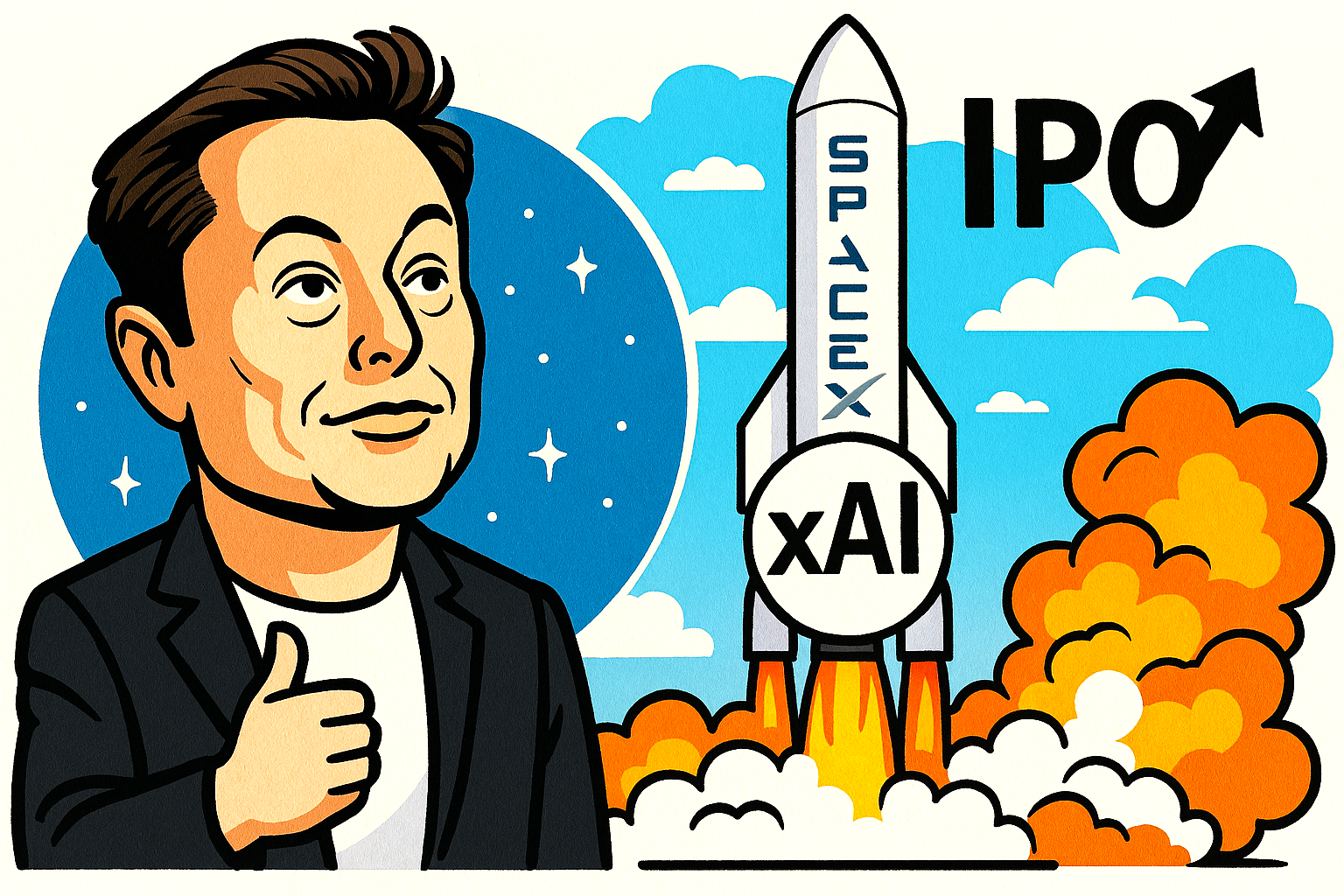
Elon Musk’s decision to fold xAI into SpaceX has set the stage for what could become one of the largest and most closely watched IPOs in market history.

The move signals a bold attempt to fuse advanced artificial intelligence with orbital infrastructure, satellite communications, and Musk’s wider technological ecosystem.

Elon Musk’s merger of SpaceX with his artificial intelligence venture xAI marks a decisive shift in the trajectory of both companies.

Integrated power

The combined entity is now positioned as a vertically integrated powerhouse spanning rockets, space‑based internet, direct‑to‑mobile communications, and frontier AI research.

Musk has described the unified structure as an ‘innovation engine’ capable of accelerating progress both on Earth and beyond.

The strategic logic is clear: AI requires immense computational resources, and Musk believes space‑based compute will become the most cost‑effective solution within a few years.

By bringing xAI under SpaceX’s umbrella, he gains the ability to scale AI training using satellite infrastructure while consolidating governance, data flows, and long‑term capital planning.

A Trillion‑Dollar Listing on the Horizon

The merged company is expected to pursue an IPO valued at roughly $1.25 trillion, with share pricing estimates placing it among the most valuable listings ever attempted.

Early reports suggest the offering could raise as much as $50 billion, instantly making it one of the largest capital‑market events in history.

Such a valuation reflects not only SpaceX’s dominance in commercial launch and satellite internet, but also the rapid rise of xAI’s Grok chatbot and its integration with Musk’s social platform, X.

The consolidation also concentrates financial scrutiny, with analysts noting that the new structure brings unprecedented transparency demands for a company that has historically operated privately.

Innovation

One of the most radical implications of SpaceX absorbing xAI is the potential to relocate data centres into orbit.

Musk has long argued that space-based compute could dramatically reduce cooling costs, thanks to the natural vacuum and thermal dissipation of low Earth orbit.

By leveraging Starlink’s satellite mesh and SpaceX’s launch cadence, the merged entity could deploy AI training clusters above the atmosphere—sidestepping terrestrial energy constraints and redefining the economics of large-scale artificial intelligence.

This vision, while technically ambitious, aligns with Musk’s broader strategy of vertical integration and frontier infrastructure.

The Stakes

If successful, the IPO will redefine the market landscape for both aerospace and artificial intelligence.

It represents a bet that the future of AI will be built not just in data centres, but in orbit—an audacious vision even by Musk’s standards.

China’s rival to Elon Musk’s Starlink internet launches satellites to low Earth orbit

Internet satellites

On Tuesday 6th August 2024, China launched its inaugural batch of internet satellites, which are expected to be part of a constellation designed to compete with SpaceX’s Starlink.

The constellation, named “Thousand Sails,” comprises over 15,000 satellites in low-Earth orbit that are anticipated to provide worldwide internet coverage.

China plans to have 648 satellites in orbit by 2025 as part of the first phase of the constellation’s deployment, aiming to establish a global internet network, as reported by state media CCTV.

The satellite system will be in direct competition with Elon Musk’s Starlink.

Elon Musk’s wealth is just crazy!

Wealth

According to the Bloomberg Billionaires Index, Elon Musk is the wealthiest person in the world, with an estimated net worth of $243.46 billion USD as of 8th Jan 2024.

Musk is the founder and CEO of Tesla and SpaceX, X and X.ai as well as the co-founder of PayPal and Neuralink. He made his fortune from various business ventures, starting from a web software company called Zip 2 that he sold in 1999 for around $307 million. He also inherited some wealth from his father, who owned an emerald mine in South Africa.

Think about this for a moment

It’s a little difficult to imagine such wealth so, maybe think of it like this… If you had been given $10,000 every day since the birth of Jesus Christ, 2024 years ago – you would have accumulated some $7.4 billion (without interest and leap years etc).

So, Mr Elon Musk has a net worth of around $243 billion and you would have $7.4 billion and that equates to only 3% of his current wealth.

Or, if you had been given $10,000 every day since the pyramids were built in Egypt around 4500 years ago – you would have accumulated $16.4 billion. That’s still only 6.75% of Elon Musk’s current wealth.

One last thought

A recent report conducted by Oxfam calculated that just 5 of the world’s richest men (including Musk) are worth $869 billion between them.

Your $16.4 billion accumulated over 4500 years would equate to less than 2% of that combined wealth.

Now that’s crazy!

Final thought

8 of the top 10 current billionaires made their money in… technology.

Please note: figures are estimated, but it perfectly demonstrates my point.