
Jensen Huang: Nvidia’s Poster Boy Caught in a Potential Alleged Chinese Spy Scandal

Nvidia and the Alleged Spy

Jensen Huang, Nvidia’s charismatic chief executive and a leading figure in the artificial intelligence boom, is facing an unwelcome spotlight, and intense scrutiny from Washington to global markets.

Allegations – Innocent till proven guilty

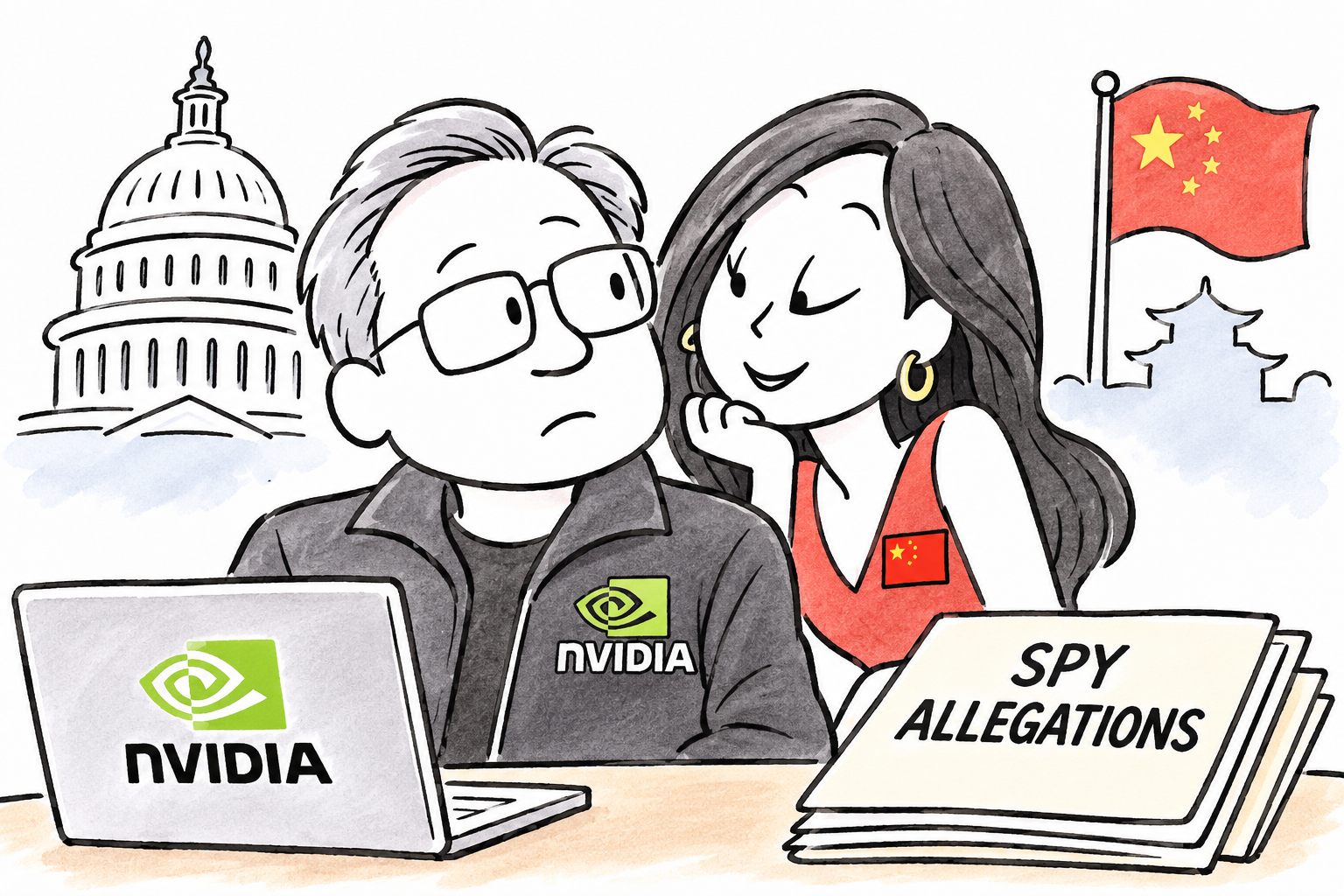
At the centre is Alice Huang, a former executive at Megaspeed International, a Singapore-based company that buys Nvidia chips.

U.S. intelligence agencies reportedly concluded she was working as an asset for China, passing commercial information to Beijing. But this is unproven at this stage.

Megaspeed had already faced scrutiny over suspicions it helped restricted Nvidia chips reach China.

The New York Times and other media have reported that Alice Huang developed a close, reportedly romantic, relationship with Jensen Huang.

The allegation is that Chinese intelligence reportedly sought access to Nvidia’s chief to gather information and potentially influence his position on U.S. restrictions on chip exports to China.

This is an allegation and and as such is NOT a publicly proven known fact.

These claims have not been established publicly in court, and what information may have been exchanged (if any) remains unclear.

Family

Huang has acknowledged being unfaithful to his wife and apologised to his family and colleagues. That admission is separate from the espionage allegations and does not demonstrate that he knowingly assisted a foreign power.

Nvidia says his contact with customer executives was routine, customers received ordinary business information rather than sensitive trade secrets, and it has no reason to believe national security or company secrets were compromised.

Nvidia’s board has launched an independent investigation into whether Huang was targeted by foreign intelligence. U.S. lawmakers have also sought a briefing on his contacts and the company’s safeguards against espionage.

Beijing has reportedly rejected the accusations outright, while Chinese state media have dismissed the reports as speculation.

Implications

The implications extend beyond one executive’s private life. Nvidia sits at the centre of the global AI race, supplying processors that power data centres and underpin enormous industry investment.

Its chief executive is also a prominent advocate for the company’s interests in Washington and internationally.

For investors, the immediate concern is uncertainty: whether the investigation uncovers a security breach, whether export policy tightens, and whether Huang’s position is affected.

Nvidia’s extraordinary success has been closely associated with its founder’s leadership and public profile.

For now, allegations must remain allegations. But when the world’s most influential AI chipmaker is involved, even the possibility of an intelligence operation raises uncomfortable questions about corporate security, political influence and the vulnerability of technology shaping the future.

Note

Allegations, judgment and embarrassment

The article reflects the position as of 9th November 2026. The central distinction is that being allegedly targeted by espionage is not the same as knowingly participating in it.

Too big to fall?

A long way down?

Nvidia is pivotal to the AI industry buildout – is too big to be affected?
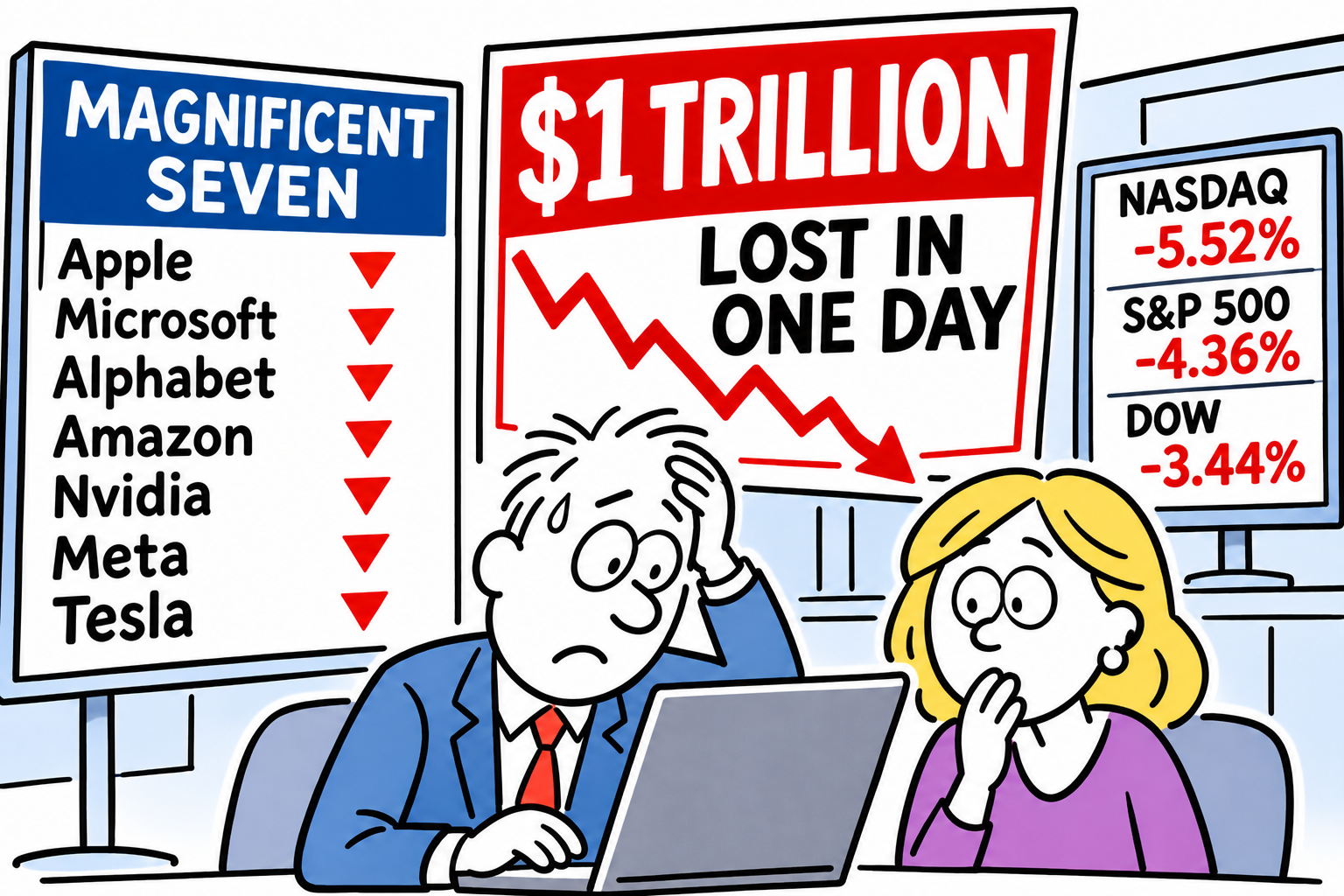
$1 TRILLION WIPED OFF MAGNIFICENT SEVEN IN ONE DAY

Graph showing the Magnificent Seven tech companies’ combined market value dropping by approximately $1 trillion during the Wall Street sell-off on 6th November 2026.

The Magnificent Seven, America’s seven technology companies, lost around $1 trillion in market value during Thursday’s Wall Street sell-off on 5th November 2026.

The figure is broadly correct: estimates put the decline at approximately $1.0 trillion to $1.04 trillion, although calculations vary between sources and market snapshots.

Magnificent Seven

The group comprises Apple, Microsoft, Alphabet, Amazon, Nvidia, Meta Platforms and Tesla. All seven fell as investors reduced exposure to technology and artificial-intelligence shares. Nvidia was among the hardest hit.

One estimate put its lost market value at $431 billion, while Tesla suffered the group’s steepest decline, falling almost 12 per cent. Microsoft reportedly lost about $123 billion in market capitalisation.

Retreat

The rout formed part of a wider market retreat. The Nasdaq Composite fell 5.5 per cent, its sharpest one-day decline in 19 months, and entered correction territory, meaning it had fallen at least 10 per cent from its record closing high.

The S&P 500 dropped 4.4 per cent and the Dow Jones Industrial Average fell 3.4 per cent.

Several concerns converged. Investors questioned whether sums committed to AI data centres, chips and infrastructure would generate sufficient returns.

U.S. Midterm Elections

Midterm election victories for candidates critical of data centre expansion raised the prospect of tighter regulation and planning restrictions.

Disappointing chip-sector results added to anxiety, while high valuations left technology shares vulnerable when sentiment turned.

It is important to understand what the trillion-dollar figure means. It is not cash withdrawn from company bank accounts, nor money physically disappearing.

It represents the fall in the stock-market value investors assign to the seven businesses.

More to come?

The immediate question is whether this is a sharp correction or the beginning of a deeper reassessment of the AI boom. Much will depend on company results, investment plans and evidence that AI spending can deliver lasting profits.

For now, confidence has suffered a shock.

Note: A particularly important distinction: The $1 trillion represents lost stock-market valuation, not $1 trillion of cash disappearing from these companies.

I think the underlying story is bigger than a dramatic one-day fall. It raises serious questions about whether the enormous valuations attached to AI companies and their supporting infrastructure can be justified by future earnings.

Money Can’t Buy the People’s Vote: Musk’s Costly Midterm Gamble

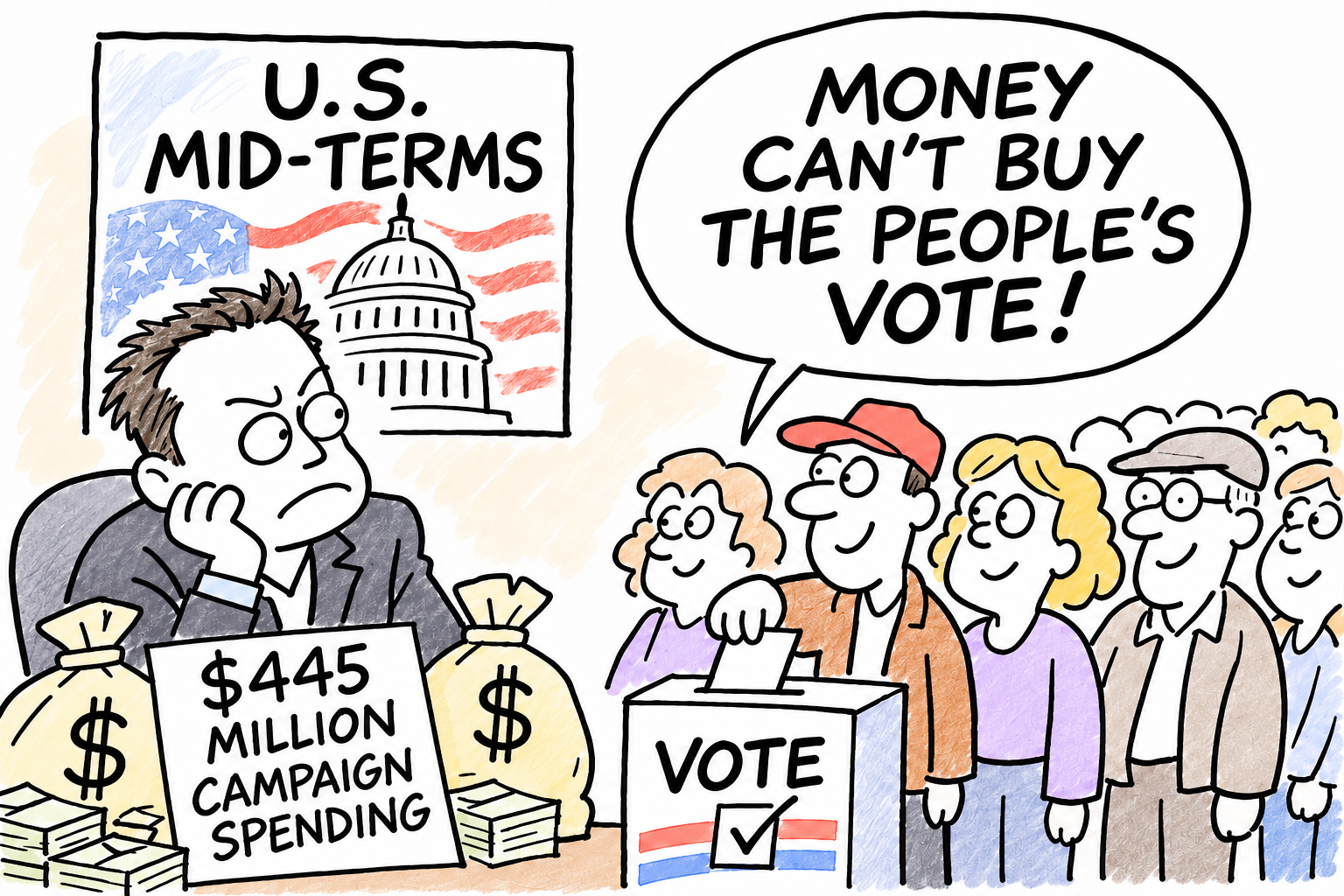
A chart illustrating campaign spending by top political donors in the 2026 US midterm elections, showing high expenditures failing to secure proportional voter support.

The 2026 US midterm elections have delivered a powerful reminder to America’s wealthiest political donors: money can buy advertising, influence and political access, but it cannot guarantee the one thing that matters most – the support of the electorate.

Musk’s Money

Few individuals demonstrated this more dramatically than billionaire Elon Musk, who reportedly poured at least $445 million (£334 million) into Republican-aligned political campaigns in an extraordinary attempt to help the party retain control of Congress.

Despite the unprecedented financial backing, the results proved disastrous for many of the candidates he supported.

Musk’s spending was channelled through political action committees and other organisations, funding advertising campaigns, voter outreach and attacks on Democratic opponents.

His involvement was particularly significant in several closely contested Senate races, including Texas, where Republican candidate Ken Paxton ultimately lost to Democrat James Talarico.

Setback

For Musk, the outcome represented an extraordinary political setback. Despite spending tens of millions supporting Republican candidates, many failed to secure election victories.

Across the country, Democratic candidates made substantial gains, with Republicans losing control of both chambers of Congress.

The results raise important questions about the growing influence of billionaire donors in American politics.

When individuals can contribute hundreds of millions of dollars to influence election campaigns, concerns inevitably arise about whether political power is becoming increasingly concentrated in the hands of the extremely wealthy.

However, the American electorate has delivered its own response. Voters are not simply advertising targets, nor can their political opinions necessarily be changed by an endless stream of campaign funding.

Economic pressures, living costs, employment, healthcare, immigration and dissatisfaction with government policies all influence voting decisions.

A candidate may have enormous financial backing, but if voters believe their priorities and concerns are being ignored, no advertising budget can easily overcome that dissatisfaction.

Political Disadvantage

There is also a danger that excessive spending and the involvement of high-profile billionaires can become a political liability.

Rather than attracting support, wealthy outsiders can become symbols of the very political influence that voters are rejecting.

Musk‘s experience is a particularly expensive lesson. His fortune may be enormous, but his electoral influence has proved far less predictable.

Ultimately, democracy rests on the principle that every voter has a choice. Campaigns can spend billions trying to shape that choice, but when people enter the polling booth, the final decision belongs to them.

Money can buy a louder political voice. It cannot buy the people’s trust – or their vote.