

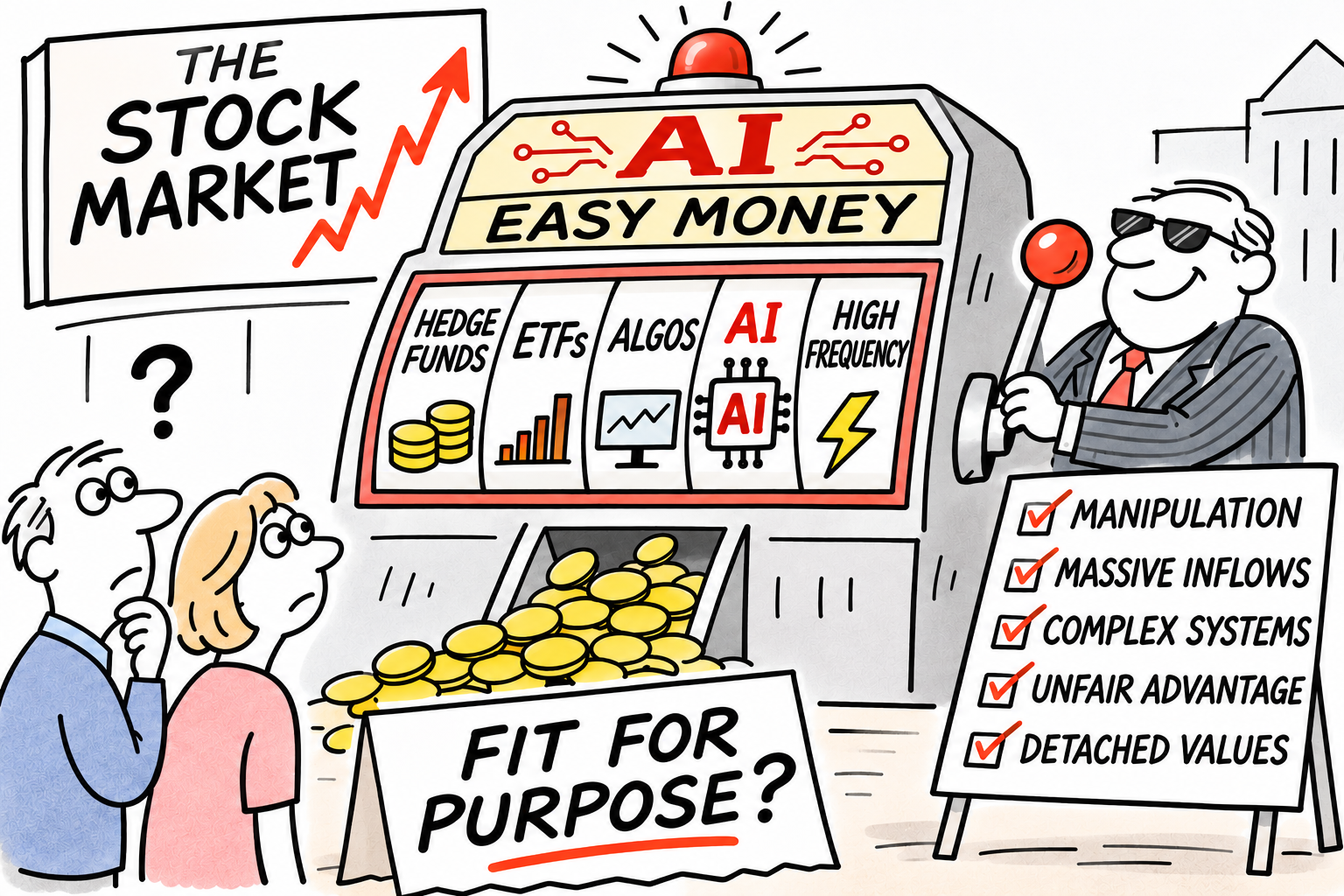
There was a time when the stock market was supposed to serve a relatively straightforward purpose: bring companies and investors together, provide a mechanism for raising capital and allow people to buy and sell shares based on their assessment of a company’s value and prospects.
But somewhere along the way, something has changed. Increasingly, it is difficult to escape the feeling that the market is no longer working as it was intended.
Is the stock market broken?
The sheer volume of money now flowing through financial markets is unprecedented. Hedge funds, institutional investors, exchange-traded funds (ETFs), algorithmic trading systems and increasingly sophisticated financial instruments have created an environment where enormous sums can move in and out of markets at astonishing speed.
Price movements are no longer necessarily driven by company performance, profitability or long-term prospects.
Instead, momentum, automated strategies, speculation and the positioning of large financial players can dominate proceedings.
ETFs
ETFs, for example, have made investing easier and cheaper for millions of people. However, the enormous growth of passive investment also raises questions.
When billions are channelled into funds tracking an index, individual companies can receive investment simply because they are included in that index, rather than because investors have independently assessed their value.
Money flows into the market, pushing valuations higher, sometimes regardless of the underlying fundamentals.
Hedge Funds
Then there are hedge funds and algorithmic trading operations, where sophisticated systems can exploit tiny price movements, market imbalances and investor behaviour.
Leveraged Products
High-frequency trading, derivatives, short selling and leveraged positions add further layers of complexity.
Those with the technology, information and financial resources to operate at this level enjoy advantages that ordinary investors simply cannot match.
None of these activities is necessarily illegal or inherently improper. Markets need liquidity, sophisticated investors and efficient trading mechanisms.
Influence
But when the system becomes dominated by those capable of influencing movements, exploiting weaknesses and generating profits from volatility itself, questions about fairness become unavoidable.
The problem is not simply that markets go up and down. It is that prices can become increasingly detached from economic reality.
Expectations and not Earnings
Companies can achieve extraordinary valuations on expectations rather than earnings, while perfectly sound businesses can suffer dramatic falls because of wider market movements, automated selling or changes in institutional positioning.
For the ordinary investor, understanding what is happening becomes increasingly difficult. Is a share price rising because the business is performing well, because a fund is buying, because algorithms have identified a trading opportunity, or simply because everyone else is buying?
Equally, when markets fall, is it a genuine reassessment of value or a chain reaction triggered by automated systems?
What will happen when AI takes control of the algorithms or writes its own!
Integrity
There is also a fundamental question about market integrity. If making money increasingly depends on speed, scale, leverage and exploiting market mechanics rather than identifying good businesses and investing in them, what exactly are investors participating in?
Markets will always involve risk, speculation and competing interests. But they should also provide transparency, fairness and confidence.
Perhaps the stock market isn’t broken in the technical sense. It continues to function; billions of shares change hands and fortunes are made every day.
But functioning and functioning properly are two very different things.
If the playing field is increasingly tilted towards those with the deepest pockets, the fastest computers and the most sophisticated strategies, perhaps it is time to ask whether today’s stock market remains fit for purpose.
Anything goes, almost. And that should concern everyone.
A casino, where it’s very hard to lose – especially if you know the system, or better still control it!