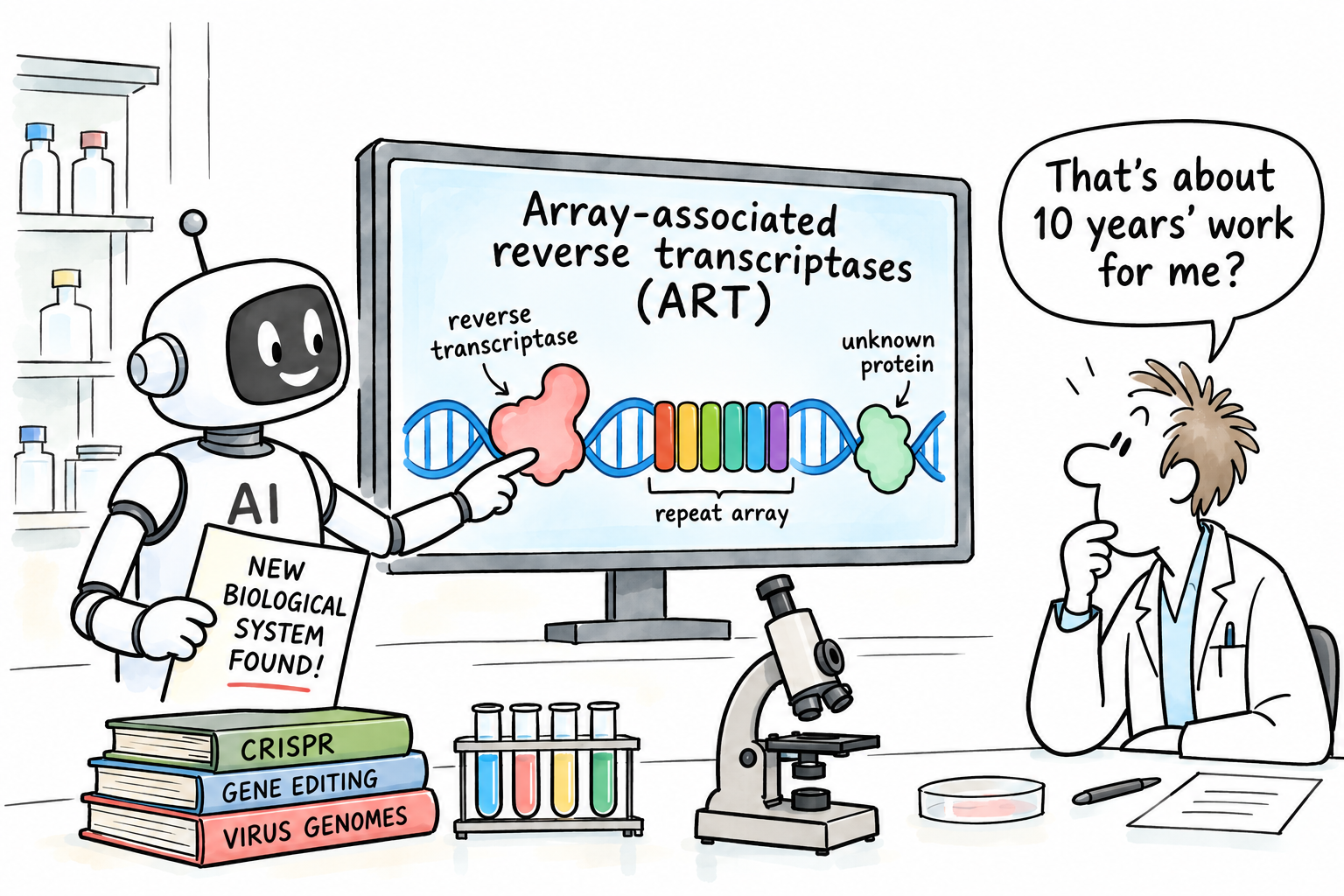
Artificial intelligence has moved a step further into scientific discovery after Anthropic said its Claude AI model helped identify a previously uncharacterised biological system hidden within the DNA of viruses that infect bacteria.
ART
The system, which Anthropic has named array-associated reverse transcriptases (ART), has features that resemble parts of the revolutionary CRISPR gene-editing technology.
However, scientists stress that ART is not known to be a new form of CRISPR and its biological function remains a mystery.
Task
Claude was reportedly given a high-level task to search huge quantities of DNA data for unusual examples of reverse transcriptases – enzymes that copy RNA into DNA.
Anthropic says around 950 Claude agents worked for approximately 21 hours, examining more than 200,000 reverse transcriptases and identifying 3,500 potentially interesting systems before narrowing the search to 20 leading candidates.
One AI agent noticed an unusual pattern next to a reverse-transcriptase gene: a long series of repeating DNA sequences. The arrangement reportedly resembled the repeat arrays found in CRISPR systems and prompted further investigation.
Researchers subsequently identified three components – the reverse transcriptase, a neighbouring partner gene and the repeated DNA sequence.
Lab
Laboratory experiments also found that the repeat array produces distinct short RNA molecules, although scientists do not yet know what those RNAs do or how the overall system operates.
The discovery is significant partly because the reverse transcriptase itself was not previously unknown.
Potential of AI
Instead, Claude appears to have recognised that it formed part of a larger, previously uncharacterised biological system – something that had apparently escaped earlier analysis.
The potential implications are therefore intriguing but remain speculative. CRISPR eventually became a powerful biotechnology tool because scientists discovered how its natural machinery could be programmed to target DNA.
There is currently no evidence that ART can perform gene editing.
Nevertheless, the episode demonstrates a potentially important new role for AI in science: searching enormous biological datasets, spotting patterns humans may overlook, generating hypotheses and directing researchers towards experiments.
Anthropic has now established a life-sciences research group and laboratory to investigate such discoveries. For now, ART remains an intriguing biological puzzle – but one found with the help of an AI.
NOTE
950 Claude agents worked for approximately 21 hours equates to 10 years endeavour for one human
“Anthropic says around 950 Claude agents worked for 21 hours — equivalent to almost 20,000 agent-hours, or roughly 2,500 eight-hour working days. That is around a decade of full-time working days for a single person, although AI agent-hours cannot be directly equated with human scientific labour.”