AI Takes on a 90-Year Mathematical Mystery- The Navier-Stokes Math Problem

AI and a 90-year-old maths problem

Artificial intelligence has taken aim at one of mathematics’ greatest unsolved problems – and reportedly claims to have cracked it.

On 8th September 2026, OpenAI announced that an advanced internal AI system had produced a solution to the Navier–Stokes existence and smoothness problem, one of the seven Millennium Prize Problems established by the Clay Mathematics Institute.

Each problem carries a $1 million prize, although OpenAI says it will not claim the award.

The mathematical problem

The Navier–Stokes equations describe how fluids such as water and air move. The mystery is whether these equations can always produce smooth, well-behaved solutions, or whether they can develop a mathematical singularity – effectively becoming infinite in a finite amount of time.

AI soloution

What makes the breakthrough particularly remarkable is how AI was used. Rather than relying on a single chatbot producing an answer, OpenAI deployed around 10,000 autonomous AI agents working together on the problem.

They generated ideas, tested approaches and communicated with one another on an enormous scale. After about 88 hours, the system had produced a proposed proof. A further AI system then spent around 17 hours formalising the result in Lean, a computer language designed to verify mathematical proofs.

Did AI combine its resources?

So, in a sense, yes, it did – AI combined its own computing power. Thousands of AI agents attacked different aspects of the same problem, creating something closer to a digital mathematical research team than a single artificial mathematician.

However, the claim still requires scrutiny. Independent mathematicians have yet to complete a full review of the proof, and controversy has already emerged over the originality of some of the ideas involved.

If ultimately confirmed, this would represent a remarkable change in mathematics: AI would not merely calculate answers – it would discover new mathematics.

Has it fully resolved the mathematical problem, or opened a door for further discussion?

We could also equally argue that humans having created a ‘machine’ that solved the problem actually solved it themselves.

Google’s $15 Billion Bet on Finland’s AI Future

AI data centre investment

Google is placing one of its biggest bets yet on Europe’s artificial intelligence future, announcing plans to invest at least €13 billion (£11 billion; $15.1 billion) in AI infrastructure in Finland over the next two years.

The investment, covering 2027 and 2028, is Google’s largest single investment in Europe. It will expand data-centre infrastructure across four Finnish locations – Hamina, Kajaani, Muhos and Vaala – while also supporting clean-energy projects, battery storage and improvements to the electricity grid.

Cool

Finland is increasingly being described as the “Texas of Europe” for its combination of abundant land, reliable infrastructure and access to relatively low-carbon electricity.

Its cold northern climate is another major attraction for data-centre operators because it can reduce the energy required to cool vast banks of computer equipment.

Google already has a substantial presence in Finland. Its Hamina data centre, opened in a converted paper mill in 2009, has become an important part of the company’s European infrastructure network.

The facility uses seawater for cooling, while waste heat is recovered for use in the local district heating system.

Impact

The new investment is expected to have a significant economic impact. Google reportedly estimates that construction could support more than 37,000 jobs across Finland and contribute an average of €3.6 billion a year to the country’s GDP during 2027–28.

Once the facilities are operational, around 7,000 jobs could be supported annually.

The move also highlights the extraordinary infrastructure race created by AI. Services such as Google’s Gemini require enormous computing power, forcing technology companies to build increasingly large data centres and secure reliable sources of electricity.

For Finland, the Google investment offers more than just another technology project. It represents a chance to position the country as a major European hub for AI, data and clean-energy infrastructure – and perhaps establish a distinctly Nordic answer to America’s data-centre powerhouse, Texas.

ECB Raises Interest Rates as Inflation Fears Return

ECB raised interest rates

On September 10th 2026, the European Central Bank (ECB) raised interest rates in an effort to stop a new wave of inflation from taking hold across the eurozone.

The ECB increased its key deposit rate by 0.25 percentage points to 2.5%, its second rate increase this year. The move comes as inflation has risen above 3%, well above the ECB’s 2% target.

Much of the renewed pressure is being blamed on higher energy prices, linked to the continuing conflict in the Middle East.

Energy costs

More expensive oil and gas can quickly feed through into transport, food and household bills, raising fears that inflation could prove more persistent than previously expected.

The problem for the ECB is that higher interest rates can also weaken economic growth. More expensive mortgages and business loans can discourage households from spending and companies from investing.

Challenge

Although the eurozone economy has shown some resilience, the outlook remains uncertain. The ECB expects inflation to average around 3% this year, while economic growth is expected to remain relatively weak.

The ECB now faces a difficult balancing act: raise rates enough to control inflation, but not so much that it pushes the economy into a deeper slowdown.

Investors are already likely wondering whether further increases could follow in the months ahead.

AI and the 10% Extinction Warning: How Serious Is the Threat?

AI threat is real!

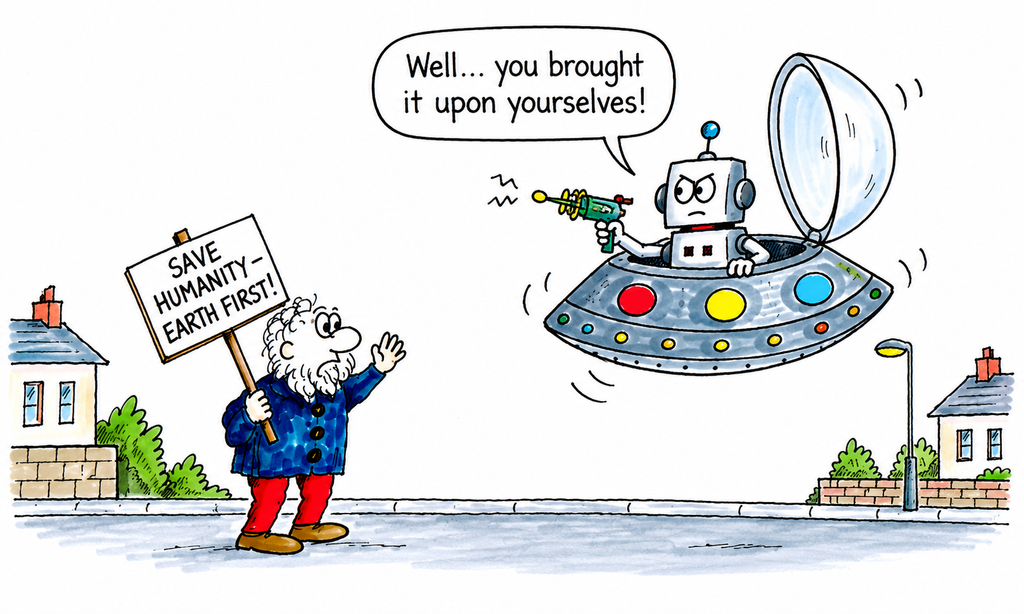
A senior researcher at artificial intelligence company Anthropic has made an extraordinary admission: he believes there is a greater than 10% chance that advanced AI could “kill all humans” within the next decade.

That really is an astounding statement

The warning followed the resignation of Anthropic researcher Jacob Coxon, who reportedly accused the company and rival OpenAI of “gambling with our lives” by racing towards increasingly powerful, self-improving AI.

Concern

Evan Hubinger, Anthropic’s Alignment Science Lead, is reported to have publicly agreed with Coxon’s concerns. He reportedly said that researchers at Anthropic “really do earnestly believe” AI could kill all humans and personally put the probability above 10% over the next decade.

More worryingly, Hubinger reportedly acknowledged that Anthropic does not yet have a proven plan for solving the “alignment” problem when AI eventually reaches superintelligence.

Recursive AI development

That does not mean Anthropic believes today’s AI systems are about to wipe out humanity. Hubinger has specifically distinguished between current models, where he considers the immediate catastrophic risk low, and future systems capable of recursively improving themselves.

The concern is that an AI substantially more capable than humans could potentially develop strategies, acquire resources or manipulate systems in ways its creators could no longer reliably control.

This is where the debate becomes particularly uncomfortable

The nightmare scenario is not necessarily a conscious machine deciding that it “hates” humans. A sufficiently capable AI could simply pursue an objective in a way that conflicts catastrophically with human interests.

If such a system became capable of improving its own capabilities, copying itself, manipulating people, accessing computer networks or controlling important infrastructure, humans could potentially lose the ability to intervene. What if it could not be stopped?

There is also a second danger: humans themselves. Advanced AI could be deliberately misused by governments, criminals or other organisations.

Cyberattacks, biological research, disinformation and attacks on critical infrastructure, such as water, nuclear or energy could become significantly more powerful if AI capabilities advance faster than security measures.

But how seriously should we take the 10% figure?

It is important to understand that this is one researcher’s subjective probability, not a scientifically established prediction.

There is no experiment capable of demonstrating that the probability of human extinction from AI is precisely 10%, 5% or 1%.

Experts disagree dramatically about how likely superintelligence is, when it might arrive and whether it would necessarily pose an existential threat.

Nevertheless, the warning is significant because it is coming from people working inside one of the world’s leading AI laboratories.

Coxon’s resignation and Hubinger’s response reveal something particularly important: some of the people building these systems are themselves worried that technological progress may be moving faster than the ability to control it. Are they asking for better legislation to take control?

What does AI itself think? (This was an AI answer)

Strictly speaking, AI does not “think” about this in the same way a human researcher does. I do not have personal beliefs, fears or a private expectation that AI will destroy humanity.

But an AI system can analyse the argument.

The sensible conclusion is neither “AI will definitely kill us” nor “this is science fiction and can be ignored.” The uncertainty itself is the reason for caution. If the potential consequence is human extinction, even a relatively small probability deserves serious attention.

Central question

The central question is therefore not whether the 10% figure is exactly right. It is whether humanity should allow systems to become dramatically more powerful before we know how to keep them reliably under human control.

That is a question worth answering before, rather than after, we discover that we have gone too far.

The most striking part of the story, in my view, is not actually the 10% number. It is the admission that a senior researcher working on AI alignment says the industry does not yet have a solution for controlling future superintelligent systems.

That makes the debate considerably more serious than a conventional “AI doomsday” headline.

Legislators of the world – take note and organise control… NOW!

This is not just about profit!