


U.S. 10-Year Treasury Yield Hits 5%: A New Problem for Markets

U.S. Yields Up!

The U.S. bond market is flashing an increasingly uncomfortable warning signal. The yield on the benchmark 10-year Treasury has climbed above 5%, reaching its highest level since 2007 as investors brace for potentially higher interest rates from the Federal Reserve.

The yield subsequently moved above 5.04%, highlighting the severity of the bond sell-off.

Stubborn

Several forces are pushing yields higher. Inflation remains stubborn, while oil prices have surged above $100 a barrel amid geopolitical tensions, raising fears that another energy shock could feed directly into consumer prices.

Borrowing cost

At the same time, investors are demanding greater returns to hold U.S. government debt because of enormous borrowing requirements and concerns about the country’s long-term fiscal position.

This creates a difficult problem for the Federal Reserve. Higher Treasury yields are already tightening financial conditions, yet persistent inflation could force the Fed to raise interest rates further.

Markets are increasingly pricing in the possibility of another rate increase, potentially taking short-term rates towards or above 5%.

Consequence

The consequences could be significant. The 10-year Treasury is a benchmark for mortgages, corporate borrowing and many other financial products.

As its yield rises, borrowing becomes more expensive across the economy. Businesses may postpone investment, consumers may reduce spending and highly indebted companies could come under increasing pressure.

Debt concern

There is also a problem for government finances. Higher yields mean the U.S. Treasury must pay more to refinance its enormous debt pile, potentially creating a vicious circle: more borrowing leads to greater interest costs, which can require still more borrowing.

For investors, a 5% Treasury yield also makes government bonds increasingly attractive compared with riskier assets.

That could put further pressure on highly valued shares, particularly technology and growth companies.

The danger is therefore not simply a higher interest rate. It is the possibility that 5% becomes the new normal.
Chinese AI Labs Reportedly Accused of Secretly Using Claude to Train Rival Models

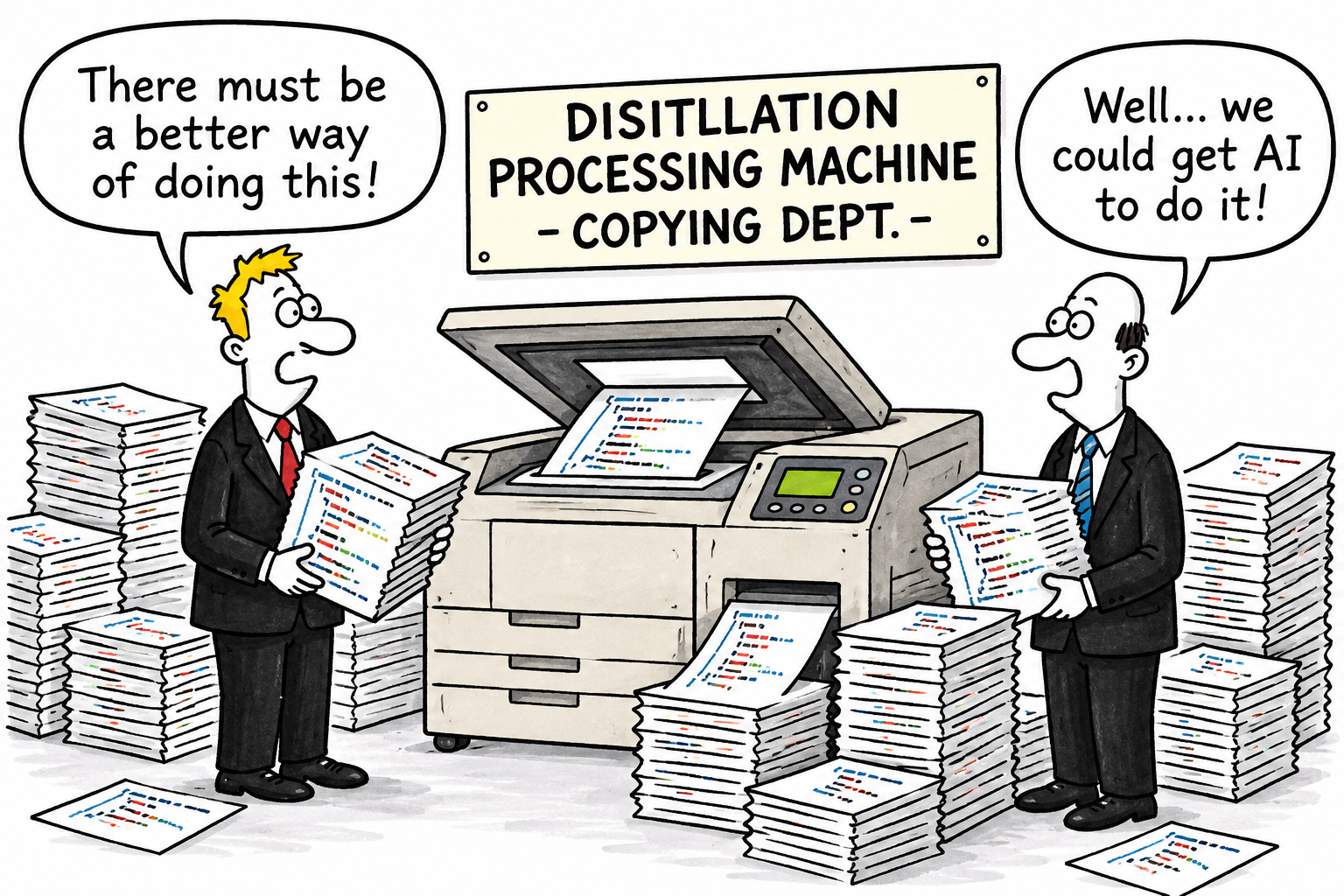
Distillation in progress

Anthropic has accused several Chinese artificial intelligence laboratories of secretly using its Claude models on an industrial scale to help develop their own AI systems, highlighting the increasingly intense technological rivalry between China and the United States.

Claude

According to Anthropic, three Chinese AI companies — DeepSeek, Moonshot and MiniMax — generated more than 16 million exchanges with Claude through approximately 24,000 fraudulent accounts.

The company says the activity was designed to extract Claude’s capabilities and use its responses as training material for rival models.

Distillation

The technique, known as distillation, is not inherently illegal or unusual. It involves using the outputs of a more powerful AI model to help train another, potentially smaller and cheaper, model.

AI companies themselves use distillation for legitimate purposes. Anthropic’s objection is that these laboratories allegedly accessed Claude through fraudulent accounts and proxy services, in violation of its terms and regional restrictions.

Exchanges

Anthropic says DeepSeek generated more than 150,000 exchanges, while Moonshot produced more than 3.4 million and MiniMax more than 13 million.

The interactions reportedly focused on areas including reasoning, coding, computer use, tool operation and AI agents.

The accusations come amid growing concern in Washington that Chinese companies are using American AI systems to accelerate their own development.

Dispute

Earlier this month, U.S. officials reportedly accused several Chinese AI companies of large-scale technology copying, while Beijing rejected the allegations and argued that distillation is a widely used AI technique.

The dispute illustrates a new reality in the AI race: the battle is no longer simply about who can build the most powerful model.

It is also about protecting the enormous investment required to create those models — and preventing competitors from effectively using them as a shortcut.

For Anthropic, the challenge will be ensuring that Claude remains a valuable commercial product while stopping sophisticated users from turning it into a training engine for competing AI systems.