
The U.S. 10-Year Treasury Has Crossed a Line Investors Cannot Ignore

U.S. Treasury yields on the rise

The yield on the U.S. 10-year Treasury has broken above 4.75%, reaching its highest level since early 2025 and moving into territory that is increasingly difficult for investors to dismiss.

On Tuesday 1st September 2026, the yield climbed to around 4.78% as rising oil prices and renewed geopolitical tensions intensified concerns about inflation and interest rates.

Why does 4.75% matter?

The 10-year Treasury is effectively the world’s benchmark risk-free interest rate.

It influences mortgage rates, corporate borrowing costs and the valuation investors place on shares.

As yields rise, future corporate profits become less valuable in today’s money, potentially putting pressure on richly valued equities.

The bigger concern is 5%

Market analysts have increasingly identified the area between 4.75% and 5% as a critical zone.

A sustained move through 5% could represent a significant change in the financial environment, particularly for technology stocks whose valuations depend heavily on expectations of strong future earnings.

There are several forces pushing yields higher. Oil has surged above $90 a barrel amid renewed U.S.-Iran tensions, raising fears that energy costs could reignite inflation.

At the same time, investors are questioning whether the Federal Reserve may need to keep rates higher — or even resume raising them.

And yet, Wall Street isn’t panicking — yet. The S&P 500 has remained remarkably strong, helped by robust corporate earnings and continued enthusiasm surrounding artificial intelligence.

BlackRock reportedly argues that equities are approaching a point where higher rates could become increasingly difficult to ignore.

So, are investors taking notice? This time, YES!

And 5% could be the level that forces everyone to pay much closer attention.

France’s Debt Problem: Borrowing Costs Are Becoming a Big Concern

France and Debt

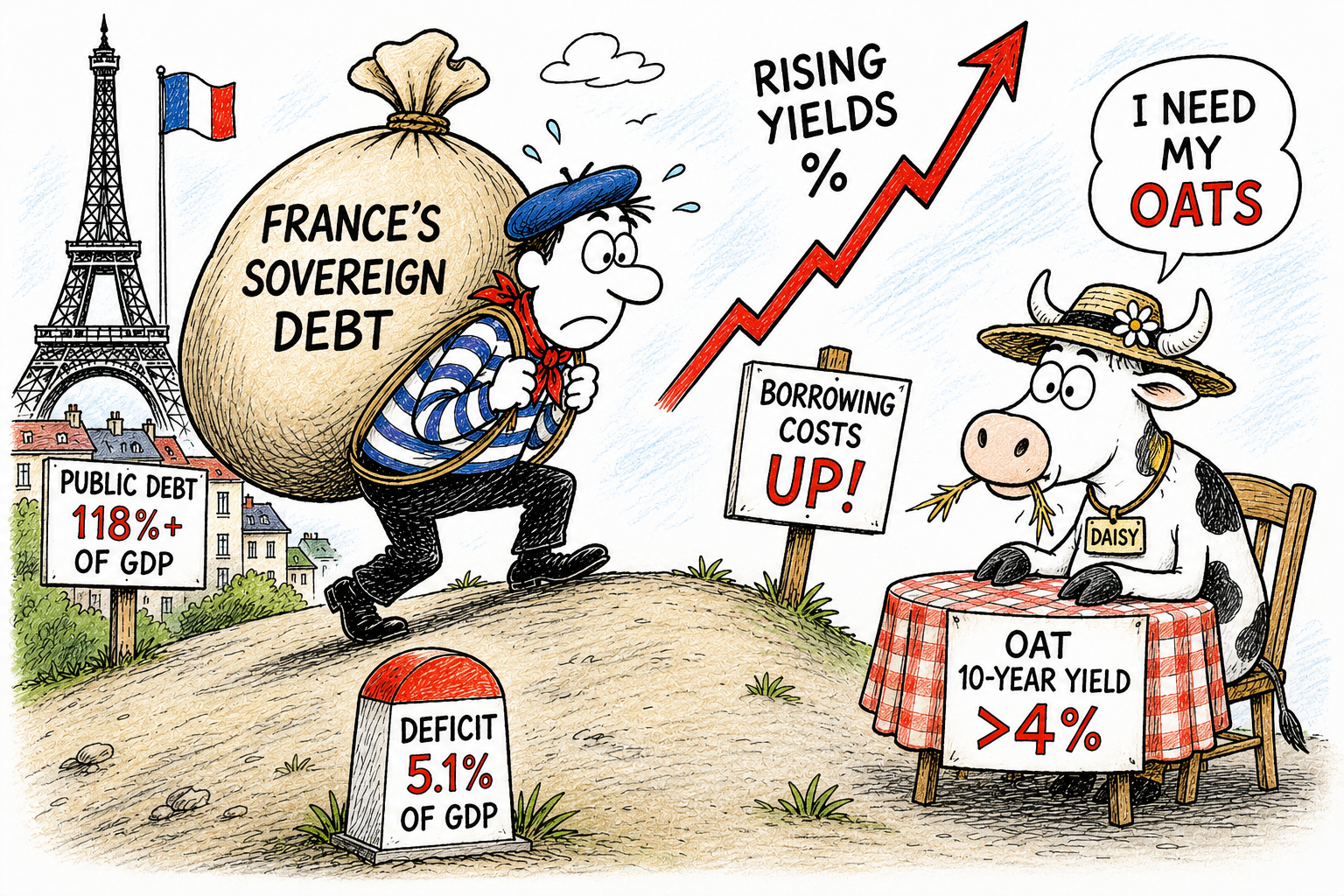
France is facing growing pressure from financial markets as the cost of servicing its enormous public debt continues to rise.

The problem is not simply the size of the debt, but the combination of high borrowing requirements, weak economic growth, political uncertainty and increasingly expensive interest payments.

France’s debt

France’s public debt is expected to reach around 118% of GDP in 2026, rising above 120% in 2027, according to the European Commission.

Meanwhile, the budget deficit is forecast to remain at around 5.1% of GDP this year, well above the European Union’s 3% limit.

Investors are now demanding higher returns to hold French government bonds. The yield on the benchmark 10-year French OAT recently moved above 4%, reaching levels not seen since the late 2000s.

Yields

At the end of August 2026, the yield remained around 4.1%, while the equivalent German Bund was closer to 3.25%.

That difference matters. The wider the gap between French and German borrowing costs, the greater the risk premium investors are demanding from Paris.

France’s spread has recently approached 90 basis points, reflecting concerns over its fiscal position and political uncertainty ahead of next year’s presidential election.

Danger signs

The danger is a potential “debt snowball”. As older, cheaper bonds mature, France must refinance them at today’s higher rates.

Interest payments therefore consume an increasing share of government revenue, potentially forcing Paris to borrow even more.

The European Commission reportedly expects French interest payments to rise from 2.2% of GDP in 2025 to 2.6% in 2026 and 2.8% in 2027.

France is not facing an immediate sovereign default, but markets are clearly demanding greater fiscal discipline.

The crucial question is whether politicians can agree on spending cuts and tax measures before rising interest costs become a much larger problem.