

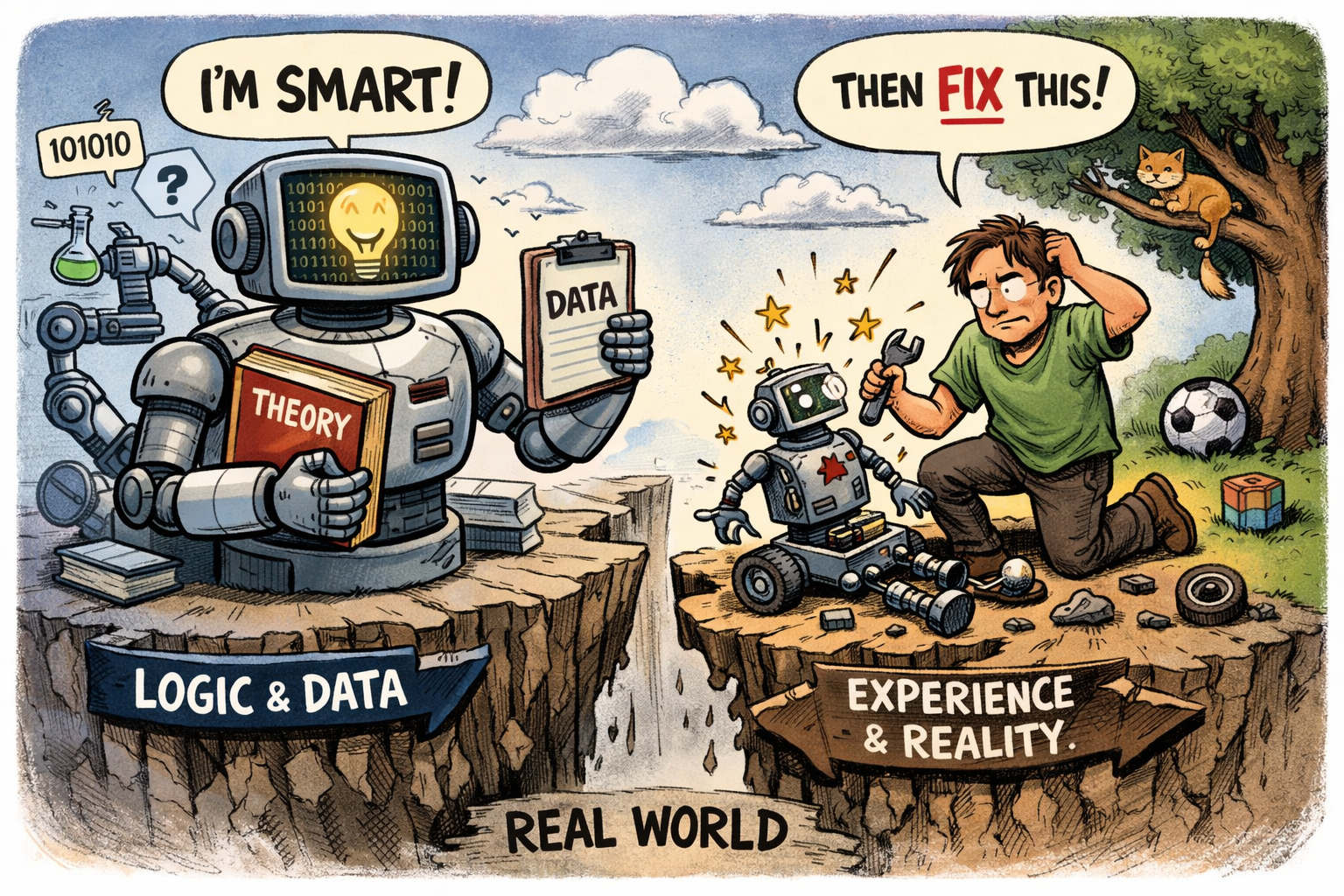
Artificial intelligence is often described as “smart”, but that word hides more than it reveals. What we call AI today—whether it’s ChatGPT, Claude, Copilot or any other model—is undeniably clever.
It can generate text, analyse patterns, summarise documents, write code and imitate expertise with startling fluency. But cleverness is not the same as intelligence, and certainly not the same as human intelligence.
Machines
The systems we use now are brilliant pattern machines. They excel at recognising structure, predicting the next likely word, and recombining information in ways that feel insightful.
Yet they do not understand in the human sense. They do not form intentions, build mental models of the world, or experience consequences. Their “knowledge” is statistical, not grounded in physical reality.
This is where the gap becomes obvious. Human intelligence is embodied. We learn by touching, moving, failing, navigating space, and interacting with other minds.
Child intelligence
A child understands gravity not because someone explained it, but because they dropped a toy and watched it fall. AI, by contrast, has no such lived experience. It has no body, no sensory grounding, and no direct engagement with the physical world.
Robotics is the frontier that exposes this difference most clearly. Getting a robot to pick up a cup reliably is far harder than generating a convincing essay about picking up a cup. Real-world intelligence requires perception, adaptation, and resilience.
It demands the ability to cope with uncertainty, noise, and unexpected events. Current AI systems struggle here because they lack the flexible, general-purpose reasoning that humans deploy effortlessly.
Extension of human intelligence
Still, something important has changed. AI is becoming a powerful cognitive tool—an amplifier of human capability. It can scan millions of documents, detect patterns invisible to us, and automate tasks that once consumed hours.
In that sense, AI is not replacing human intelligence; it is extending it. The real transformation will come when these systems are integrated more deeply into physical agents—robots, autonomous machines, and adaptive systems that can act in the world rather than merely describe it.
Capable but not intelligent
Right now, AI is clever, fast, and increasingly useful. But intelligence, in the full human sense, remains a broader, richer, more embodied phenomenon.
The next decade will determine whether machines can move beyond cleverness and begin to acquire something closer to genuine understanding.