
AI Is Breaking Down the Barriers to Starting a Business

The power of AI empowering business start-ups

Artificial intelligence is beginning to reshape the economics of starting and running a business.

AI is easily accessible

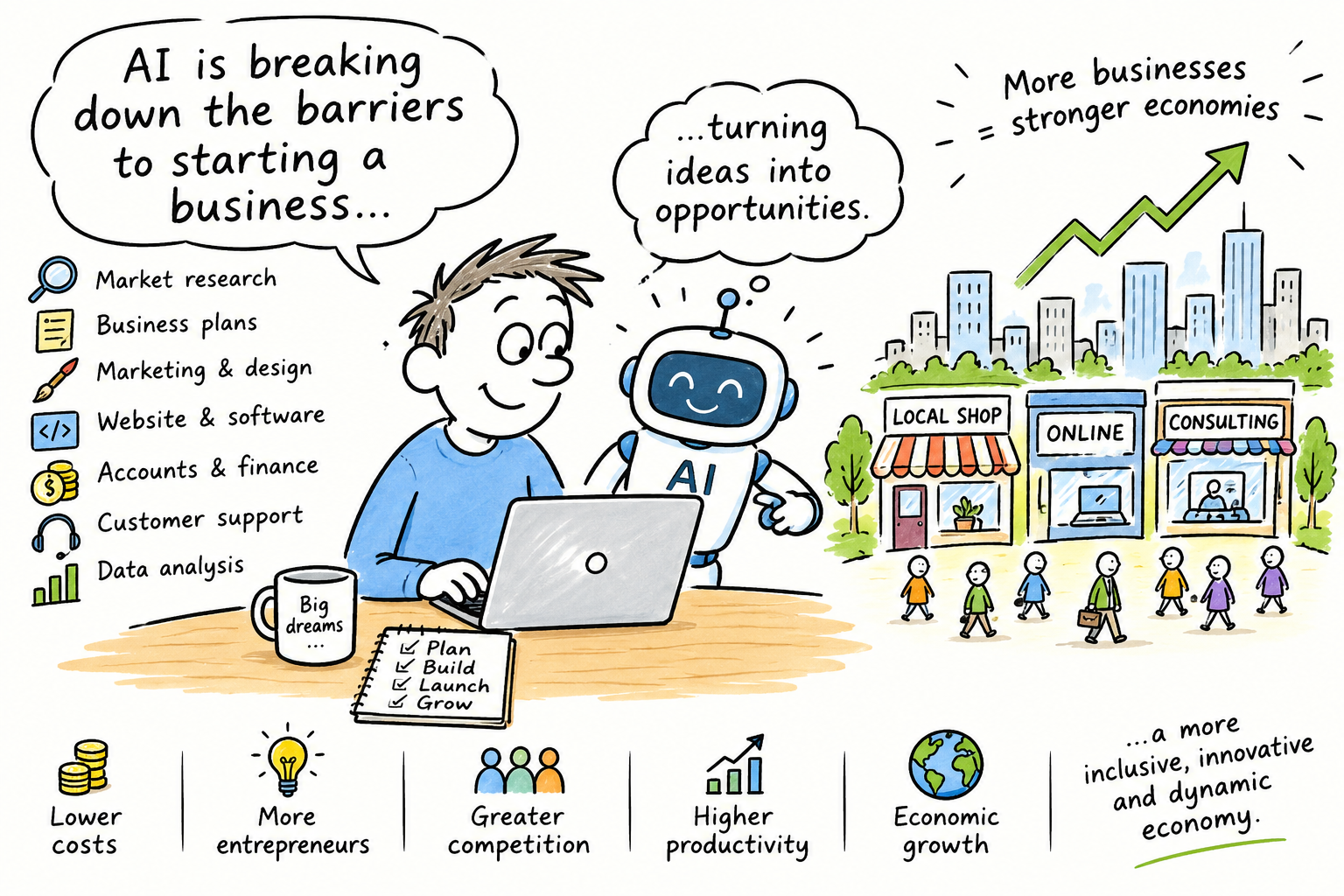
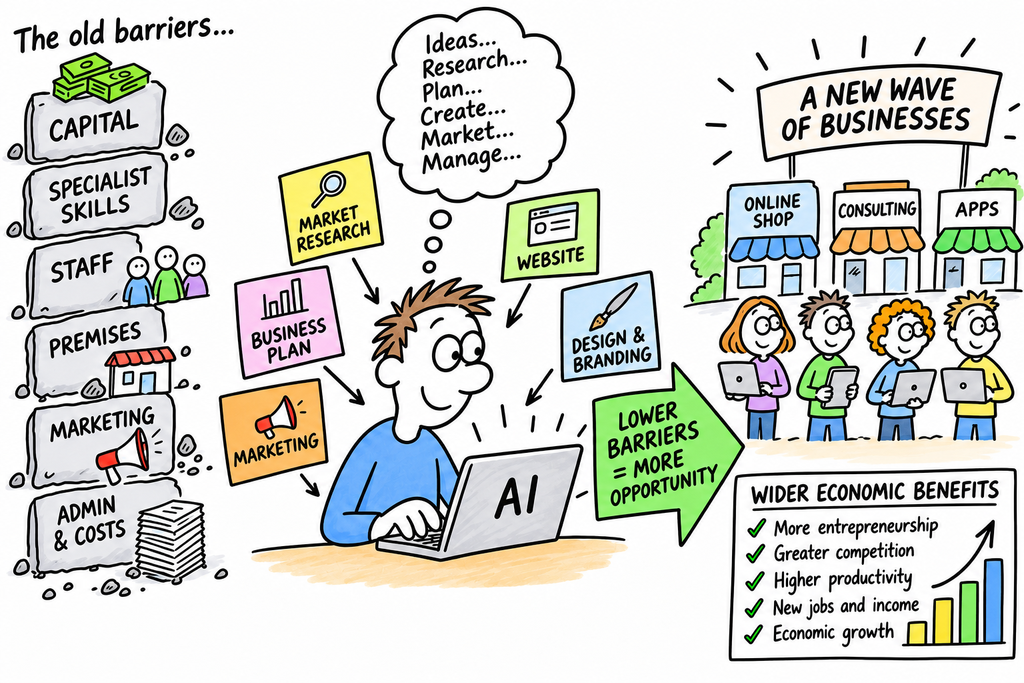
What once required substantial financial investment, specialist skills and a team of employees can increasingly be achieved by an individual with a computer, an internet connection and access to AI tools.

The implications could extend well beyond entrepreneurship, potentially changing productivity, employment, competition and economic growth.

Traditionally, starting a business involved considerable upfront costs. Entrepreneurs needed to invest in staff, premises, marketing, professional services, technology and administration, often before generating their first pound of revenue.

These expenses created significant barriers to entry, particularly for individuals without access to capital or business connections.

AI is changing this economic equation

An individual can now use AI to conduct market research, develop business plans, build websites, write software, produce marketing campaigns, analyse financial information and manage customer enquiries.

Tasks that previously required several employees or expensive external consultants can increasingly be handled by one person at a fraction of the cost.

This has the potential to create a new generation of micro-businesses, independent entrepreneurs and highly productive one-person companies.

Lower operating costs could allow businesses to become profitable with considerably less revenue than was previously necessary.

For the many

The wider economic consequences could be significant. If millions of individuals can establish businesses with relatively little capital, entrepreneurship could become a much more accessible route to generating income and creating employment.

Smaller businesses may also become more competitive, challenging established corporations that have traditionally benefited from economies of scale, larger workforces and greater financial resources.

But first we will have a period of transition and discovery.

Productive

There is also a potentially important productivity dividend. Businesses able to produce more with fewer employees could reduce operating costs, improve margins and increase output.

At a national level, this could contribute to economic growth without requiring the same expansion in the workforce.

For governments struggling with ageing populations, labour shortages and weak productivity, AI could become an increasingly important economic tool.
Saturation

However, there is another side to the equation. As the cost of establishing a business falls, competition will intensify.

Markets could become saturated with similar products and services, while automation may displace certain administrative, creative and professional roles.

The economic benefits will depend partly on whether new businesses and industries create sufficient opportunities to offset employment lost elsewhere.

Access to AI will also matter. If the technology becomes concentrated among a small number of powerful companies, the savings generated by automation may not be distributed evenly.

Nevertheless, AI could represent a significant democratisation of business ownership. The traditional advantages of capital, staffing and infrastructure may become less important, while creativity, commercial judgement and the ability to identify opportunities become increasingly valuable.

The Next Wave

The next wave of business creation may not come from large corporations investing billions, but from individuals using AI to build businesses that previously would have been financially impossible.

AI is not eliminating the risks of entrepreneurship. It is, however, dramatically reducing the cost of trying. That could have profound implications for the future structure of the global economy.
AI: The Next Great Economic Boom – But at What Financial and Economic Cost?

The artificial intelligence revolution continues to dominate financial markets, attracting extraordinary investment from some of the world’s largest technology companies.

Yet beneath the enthusiasm, a growing number of economic, financial and political concerns are emerging. While technology shares have recently staged a recovery, the fundamental questions surrounding the sustainability of the AI investment boom remain unanswered.

The central issue is becoming increasingly difficult to ignore: can the commercial returns from artificial intelligence justify the enormous cost of building the infrastructure required to support it?

An unprecedented investment programme

Microsoft, Amazon, Alphabet, Meta, Oracle and many others are committing hundreds of billions of dollars to data centres, specialist processors and supporting infrastructure. Their ambitions are substantial, with AI expected to transform productivity, business operations, healthcare, manufacturing and countless other industries.

However, the scale of expenditure is creating growing financial pressures. The Bank of England has highlighted the increasing reliance on borrowing to finance AI infrastructure. Morgan Stanley reportedly estimated that global AI-related debt issuance had reached approximately $450 billion by early September 2026, more than double the total for the whole of 2025.

The Bank has also highlighted the growing involvement of private credit and more complicated financing arrangements. These developments raise questions about where the financial risks ultimately sit, particularly if expected commercial returns fail to materialise.

Debt itself is not necessarily a problem. Large companies routinely borrow to finance expansion. The concern is whether the investment will generate sufficient cash flow to service that borrowing while continuing to fund further development.

The returns question

Technology companies are investing on the assumption that AI adoption will eventually produce enormous commercial opportunities. However, the gap between infrastructure expenditure and demonstrable financial returns remains an important consideration.

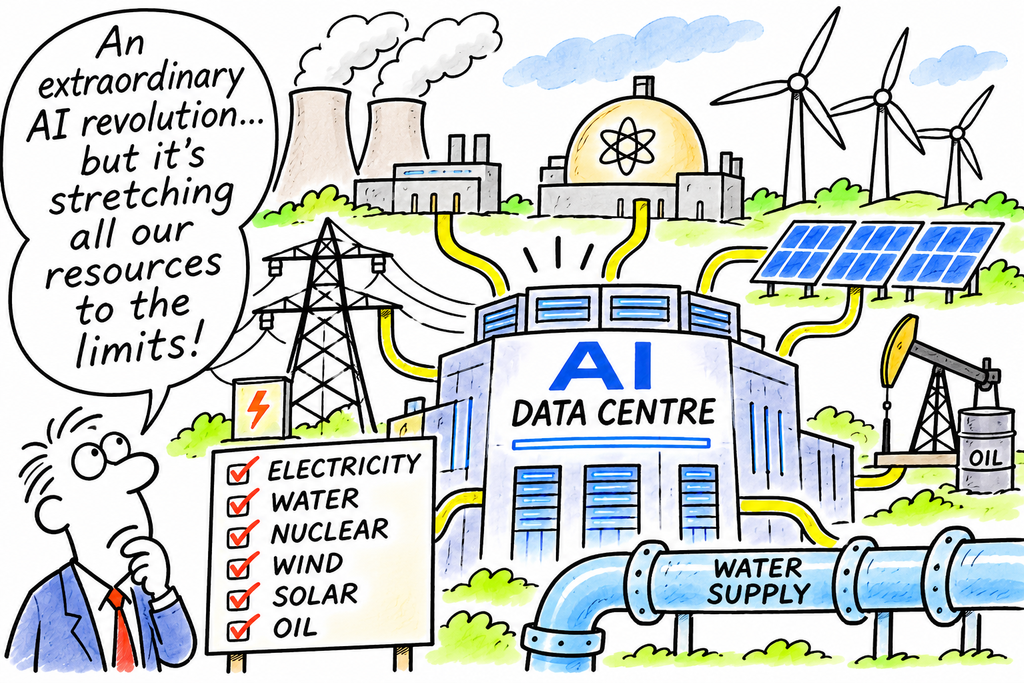
Data centres are expensive to construct and operate. Specialist chips require continual investment, while electricity, cooling, water and network infrastructure add further costs.

The industry must also contend with rapidly changing technology. Today’s expensive processors and facilities could become less competitive as more efficient systems emerge.

There is also the possibility that investment is running ahead of commercial demand. Businesses are experimenting with AI, but widespread adoption does not automatically translate into sufficient revenue to justify the enormous infrastructure costs.

Investors will increasingly want evidence that AI-related revenues and productivity improvements are keeping pace with capital expenditure.

Chinese competition adds another complication

Competition from China represents another potential challenge.

Chinese developers have demonstrated that increasingly capable AI models can be produced using more cost-efficient approaches. This could put pressure on the pricing structures of American technology companies.

If businesses can access capable AI systems at considerably lower prices, the commercial returns expected by companies investing heavily in infrastructure could be affected.

The AI industry may ultimately become much larger, but that does not guarantee that every company currently investing in it will generate attractive returns.

The political landscape changes

The U.S. midterm elections have introduced another dimension.

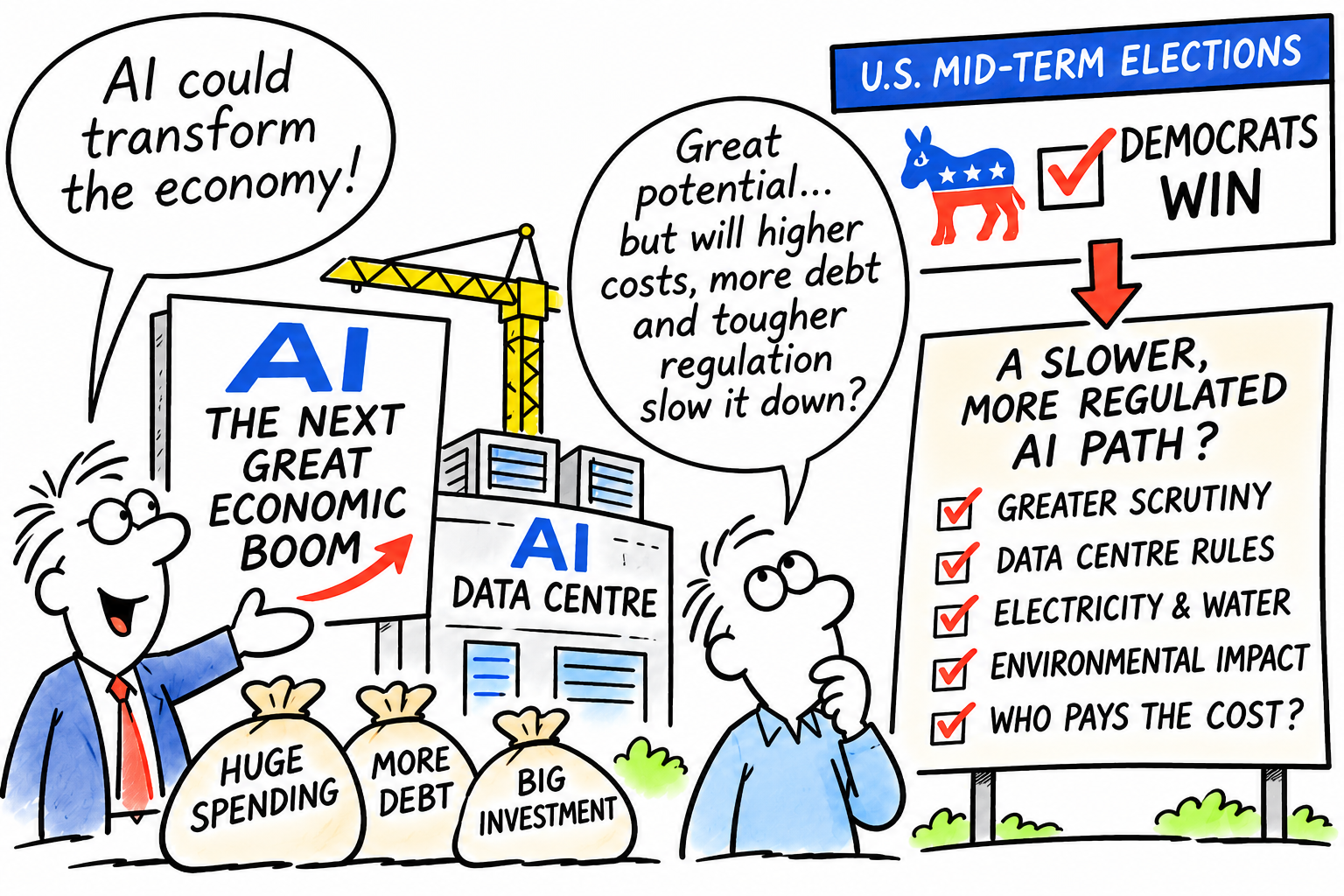
Democrats have secured control of both the House of Representatives and the Senate, creating a more challenging political environment for President Trump during the remainder of his term.

Technology companies could face increased scrutiny over data-centre construction, electricity consumption, environmental considerations, water supplies and AI regulation.

There are already disagreements in Washington over who should pay for the additional electricity infrastructure required by data centres. Some lawmakers want technology companies to shoulder more of the cost rather than passing it on to ordinary electricity consumers.

These concerns are particularly relevant in states such as Texas, where substantial AI infrastructure investment is planned.

Greater political scrutiny does not necessarily mean that AI development will stop. However, additional regulation, planning restrictions and infrastructure costs could slow the expansion or reduce the profitability of some projects.

Why is the Nasdaq recovering?

Despite these concerns, technology shares have recently demonstrated considerable resilience.

On 3rd November 2026, the Nasdaq gained approximately 0.83%, supported by a recovery in major AI and semiconductor shares. Nvidia, Broadcom and Micron were among the beneficiaries.

However, this recovery seemed to start ahead of the full midterm election results. Following the Democratic victories, global markets initially reacted negatively, reflecting concerns about potential regulatory changes and the future pace of AI infrastructure investment.

The recovery in technology shares should therefore not be interpreted as evidence that the underlying problems have disappeared.

Investors may be buying following recent declines, taking advantage of lower valuations or closing short positions. Such activity can produce substantial market recoveries without any corresponding improvement in the industry’s financial fundamentals.

A defining moment for investors

The AI revolution could ultimately prove to be one of the most important technological developments in modern economic history. Its potential should not be underestimated.

However, technological success and investment success are not necessarily the same thing.

The companies building the infrastructure must demonstrate that their investments can generate sustainable revenues, adequate cash flow and acceptable returns. Meanwhile, increasing borrowing, competition, resource constraints and political intervention could complicate that process.

For investors, the next stage of the AI story may be less about excitement surrounding technological possibilities and more about financial discipline.

Capital expenditure, debt issuance, free cash flow, AI-related revenues and institutional investment decisions deserve particularly close attention.

The wider economic consequences also matter. If AI delivers the productivity improvements its supporters anticipate, the benefits could extend well beyond the technology sector.

Conversely, if investment expectations become disconnected from commercial reality, the financial consequences could reach credit markets and the wider economy.

The AI revolution may be gathering momentum, but the investment boom financing it is approaching an important test.

The question is no longer simply how transformative AI might become. It is whether the extraordinary sums being committed today can generate sufficient economic value tomorrow.

For investors, that distinction could become increasingly important.

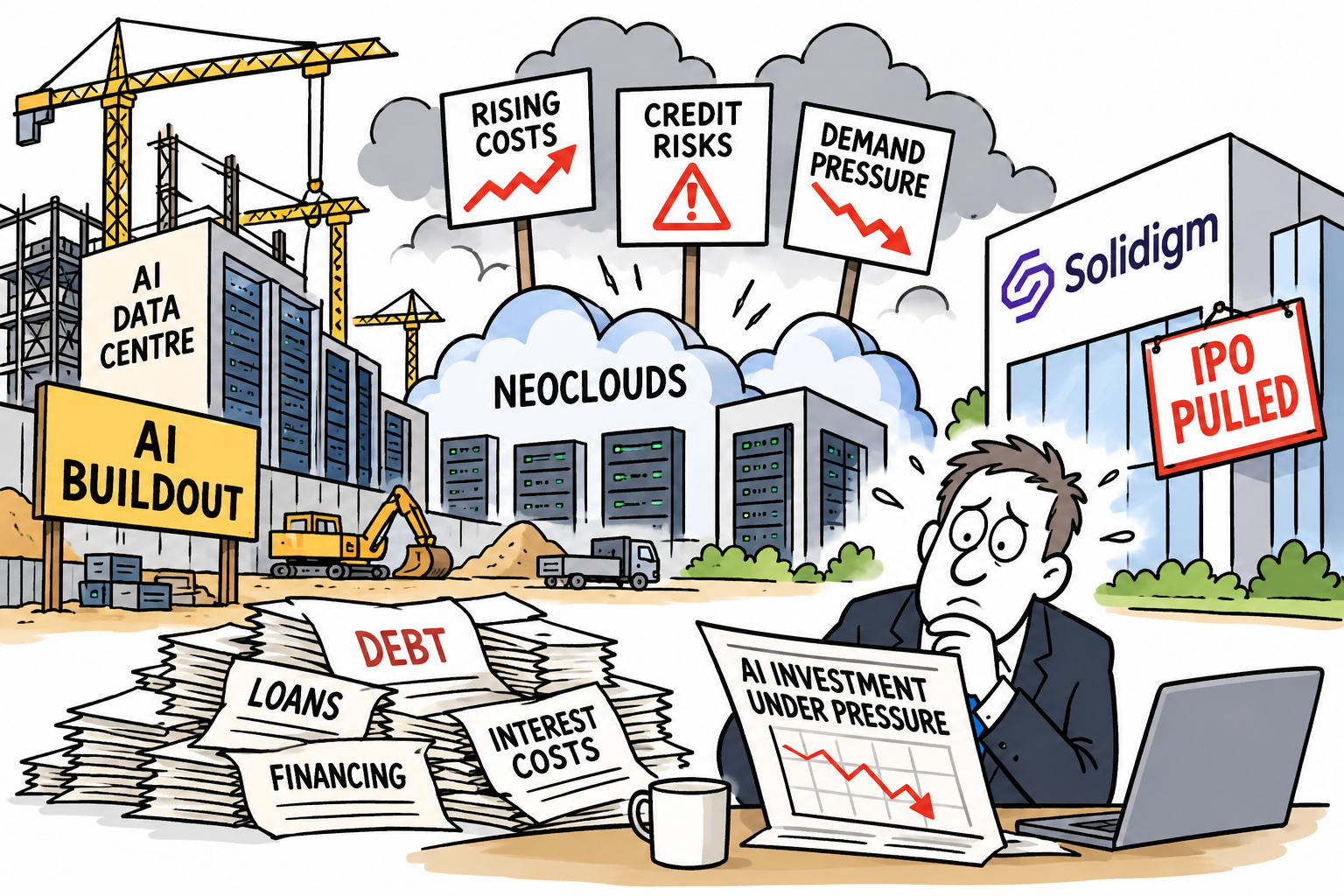
AI buildout faces turmoil as neoclouds struggle under pressure, credit risks rise, and Solidigm withdraws its IPO

AI investment reality check

The artificial intelligence boom is entering a more challenging phase as mounting financial pressures expose the risks behind the enormous investment in AI infrastructure.

Neocloud providers are facing growing scrutiny, concerns over credit are increasing, and Solidigm’s reported withdrawal of its planned initial public offering (IPO) raises further questions about the market’s appetite for AI-related businesses.

The developments come at a time when technology companies are committing vast sums to data centres, advanced processors, high-speed networking and energy-intensive computing infrastructure.

While demand for AI services continues to attract investment, the cost of building the capacity required to support that demand is becoming increasingly difficult to ignore.

Neoclouds face a tougher environment

Neoclouds are specialist cloud computing companies that provide access to powerful graphics processing units (GPUs) and other hardware needed to develop and operate AI models.

They have emerged as important suppliers to businesses seeking computing capacity without building their own infrastructure.

However, this business model carries considerable financial risks. Data centres require substantial upfront investment, while expensive chips can lose value as technology advances.

Companies must also secure reliable electricity supplies, manage operating costs and maintain high utilisation rates to generate sufficient returns.

Many providers depend on borrowing, equipment financing or long-term customer contracts to fund their expansion. If demand falls short of expectations, or customers delay spending, revenues may prove insufficient to cover debt repayments and other fixed costs.

Credit risks move into focus

The pressure on neoclouds highlights a wider concern: whether the financing behind the AI revolution has become too aggressive.

Investors are increasingly having to distinguish between companies generating sustainable cash flows and those relying on continued funding, optimistic growth forecasts and rising valuations.

Where borrowing has increased rapidly, even a modest deterioration in business conditions could expose weaknesses.

The danger is not necessarily that demand for AI disappears. Rather, investment may have expanded faster than the industry’s ability to generate profits from the infrastructure being constructed.

If lenders become more cautious, refinancing could become more expensive, forcing some businesses to reduce capital expenditure, seek additional equity or sell assets.

Such developments could also affect equipment suppliers, construction companies and other businesses linked to the data-centre boom.

Solidigm adds to investor uncertainty

Solidigm, a data-storage company specialising in solid-state drives and flash memory, has also entered the spotlight following reports that it pulled its planned IPO.

Its position in the AI infrastructure supply chain illustrates how closely the fortunes of technology suppliers are tied to expectations for continued investment.

An abandoned or postponed listing does not, by itself, demonstrate financial distress. However, it can signal that market conditions, valuation expectations or investor demand are not sufficiently favourable to proceed.

OpenAI also made moves to postpone its IPO in September this year.

What does this mean for markets?

The immediate concern is whether the AI industry has invested too much, too quickly, using financing that depends on future profits arriving as expected.

Recent market pressure has extended beyond smaller infrastructure companies into the credit markets of major technology businesses

That does not mean the AI revolution is over. Demand for computing power could continue growing rapidly, and the largest technology companies retain substantial resources.

Nvidia chief executive Jensen Huang has also remained bullish about demand for specialist cloud computing.

Nevertheless, investors are beginning to ask harder questions about profitability, debt and the returns on billions of pounds and dollars being committed to infrastructure.

The next test will come as major technology companies report their financial results and explain how much they intend to spend on AI. If revenues and profits fail to keep pace with investment, markets could reassess valuations across the technology sector.

The central issue is changing: it is no longer simply how quickly AI can grow, but whether the industry can make that growth financially sustainable.

If the answer disappoints, the consequences could extend well beyond AI stocks, affecting lenders, corporate bond markets and the wider Nasdaq.

PHP Security Flaw Triggers Global Internet Alert

Internet software flaw uncovered

A critical security flaw in PHP, one of the internet’s most widely used programming languages, has triggered an international cybersecurity response, with website operators scrambling to protect their systems against potential hacking attacks.

The vulnerabilities, disclosed on Wednesday, 21st October, could allow hackers to take control of vulnerable web servers without needing a password or an existing user account.

Security researchers have demonstrated attacks capable of executing malicious code and accessing sensitive information held in server memory.

The potential consequences include stolen data, compromised websites and unauthorised access to systems behind them.

Source: PHP security advisory

PHP used by 70% of websites

PHP operates behind the scenes, powering dynamic websites and applications. It is used extensively by WordPress, Drupal and Joomla, alongside countless business websites, online shops, blogs and public-sector services.

Estimates suggest that PHP is used by around 70% of websites for which the underlying programming language can be identified, making the discovery particularly serious.

Two critical vulnerabilities, identified as CVE-2026-109618 and CVE-2026-109619, have been assigned severity scores of 9.2 out of 10.

Vulnerability

Researchers found that weaknesses in PHP’s handling of memory could potentially enable remote code execution or expose passwords etc.

The immediate impact has already been felt. Government websites and other online services in Europe and elsewhere were temporarily taken offline. Administrators worked to assess their exposure and install security fixes.

Cybersecurity agencies, including Britain’s National Cyber Security Centre, urged organisations to identify vulnerable systems and update them urgently. Where immediate protection was not possible, taking affected systems offline was advised.

Check

PHP developers released emergency updates covering supported versions, but the problem is complicated by older installations. Some no longer receive security support.

Website owners may also rely on hosting companies or third-party software providers to manage the underlying technology.

The discovery has raised another important concern: artificial intelligence is changing the cybersecurity landscape.

Researchers used advanced AI tools to help identify and investigate the vulnerabilities, demonstrating how technology can uncover weaknesses that have remained hidden for years.

However, similar capabilities could help malicious actors develop exploits more quickly. The immediate priority is to patch vulnerable systems before attackers can exploit them at scale.

Although the disclosure does not mean that every PHP-powered website has been hacked, the breadth of the software’s use makes the potential exposure significant.

The incident is a reminder that the internet’s apparent resilience depends on countless interconnected systems being maintained and secured.

A flaw deep inside widely used software can rapidly become a global problem.

French Supermarket Fridge Hack Sparks Cybersecurity Fears

Cybersecurity Attack!

A major cyberattack on French supermarkets has exposed the surprising vulnerability of everyday technology, after hackers remotely manipulated refrigeration systems, causing food to spoil and fires to break out.

The attack, which came to light on 12th October 2026, affected hundreds of stores belonging to major retailers, including Intermarché, Carrefour, Monoprix and Coopérative U.

Heat

Reports indicate that refrigeration units were forced to heat up to 50°C, rather than maintain the low temperatures required to preserve fresh and frozen food.

In some cases, temperatures reportedly climbed even higher. The resulting damage forced supermarkets to discard large quantities of stock.

Investigators believe the attackers exploited vulnerabilities in software used to control refrigeration equipment.

Legacy software

Many of the affected systems were older models running outdated software, leaving them exposed to potential cyber intrusions.

The consequences were both financial and practical. Individual stores faced substantial losses, while the total cost across France could reach tens of millions of euros.

Some premises also reported fires or equipment damage, highlighting how a digital attack can have serious physical consequences.

Investigation

French authorities have launched an investigation, with the country’s national cybersecurity agency working to establish the extent of the incident and assess whether similar systems elsewhere could be at risk. The identity and motives of the attackers remain unclear.

The incident raises wider questions about the security of increasingly connected businesses. Refrigeration systems, once largely isolated from computer networks, can now be monitored and controlled remotely.

While this technology offers greater efficiency, it also creates potential entry points for criminals if systems are poorly secured or left unpatched.

Cybersecurity

For supermarkets, the lesson is clear: cybersecurity is no longer simply an IT issue. It is directly linked to food safety, supply chains and business continuity.

As retailers embrace connected technology, maintaining software updates, restricting remote access and monitoring unusual activity will become increasingly important.

The French incident is a stark reminder that a supermarket’s most basic equipment can become a target in the digital age.

IBM stock sinks 25% – its worst day on record

IBM stocks tanks

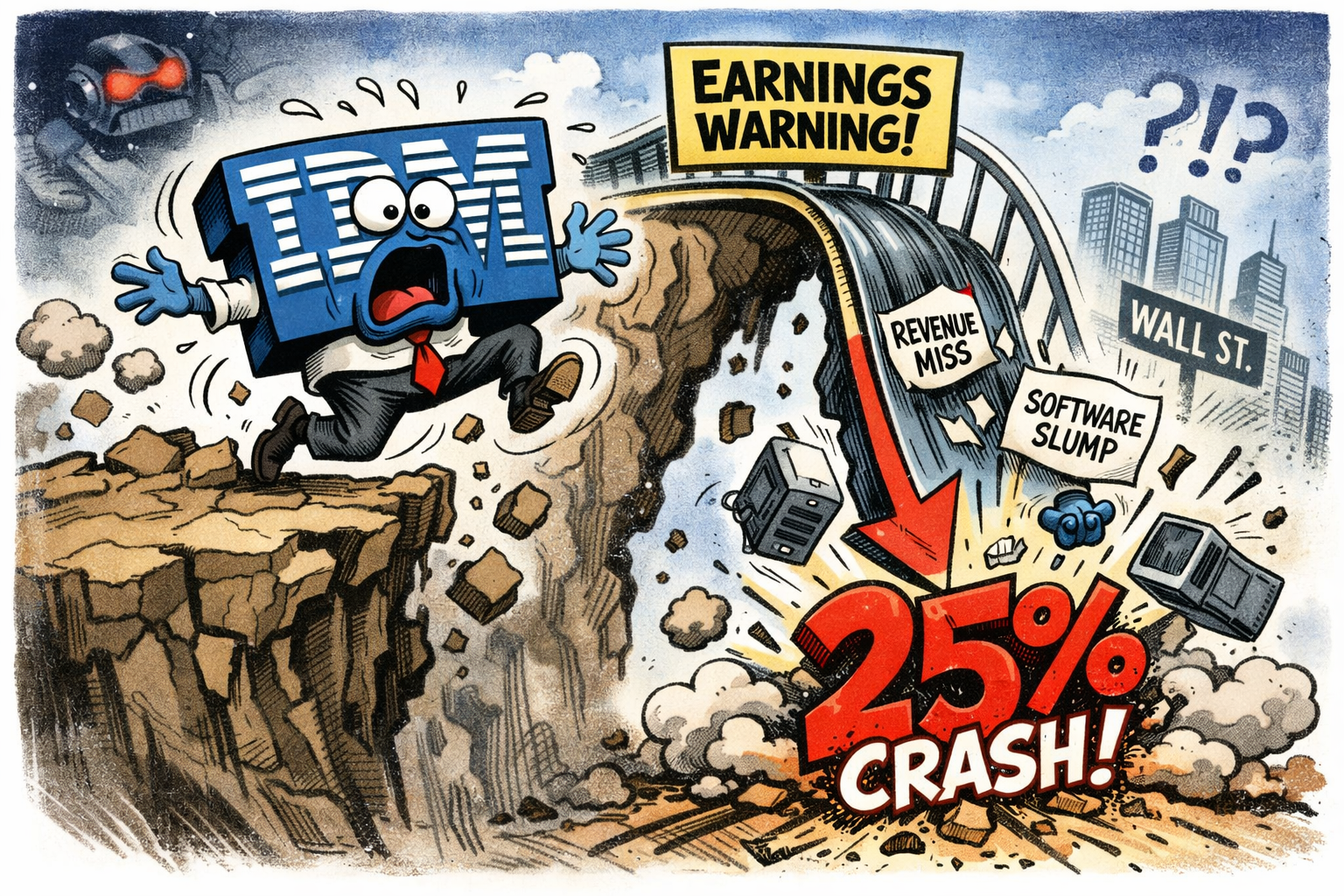
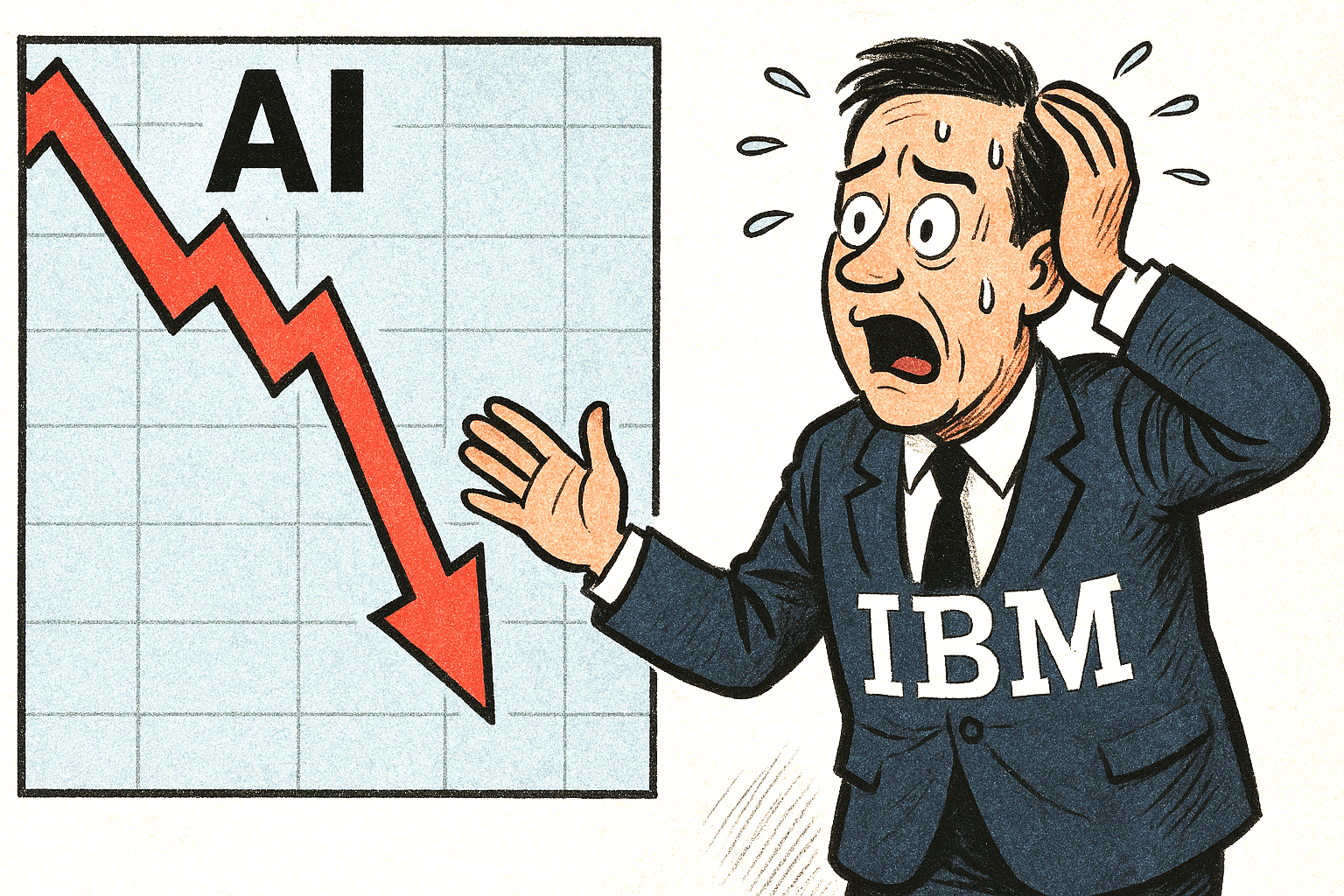
IBM’s share price suffered a dramatic fall this week (14th July 2026) – plunging 25% after the company issued an unexpected warning on second‑quarter earnings.

The drop marked IBM’s worst single trading day on record, eclipsing even the infamous market turmoil of October 1987.

Reaction

Investors reacted sharply to preliminary results showing both revenue and adjusted earnings coming in below analysts’ expectations.

The shortfall was driven largely by weakness in IBM’s software and infrastructure divisions. According to CEO Arvind Krishna, many enterprise clients abruptly shifted their spending towards hardware—particularly servers, storage systems and memory chips—as they moved to secure supply‑constrained components ahead of anticipated price rises.

This late‑quarter pivot left several major software deals delayed, creating a sizeable gap between IBM’s forecasts and its actual performance.

Implications

The sell‑off also reflects wider market anxiety about how rapidly evolving AI tools may reshape the software landscape. While Krishna insisted IBM’s own software is not at risk of disruption, the pause in customer decision‑making—especially around cybersecurity—has added to investor unease.

For a company that had recently posted strong first‑quarter growth, the sudden reversal underscores how sensitive IBM remains to shifts in enterprise spending priorities.

Markets will now be watching closely to see whether the company can regain momentum in the second half of the year.

Markets in Asia continue volatility as Softbank falls 10%

Softbank down 10%

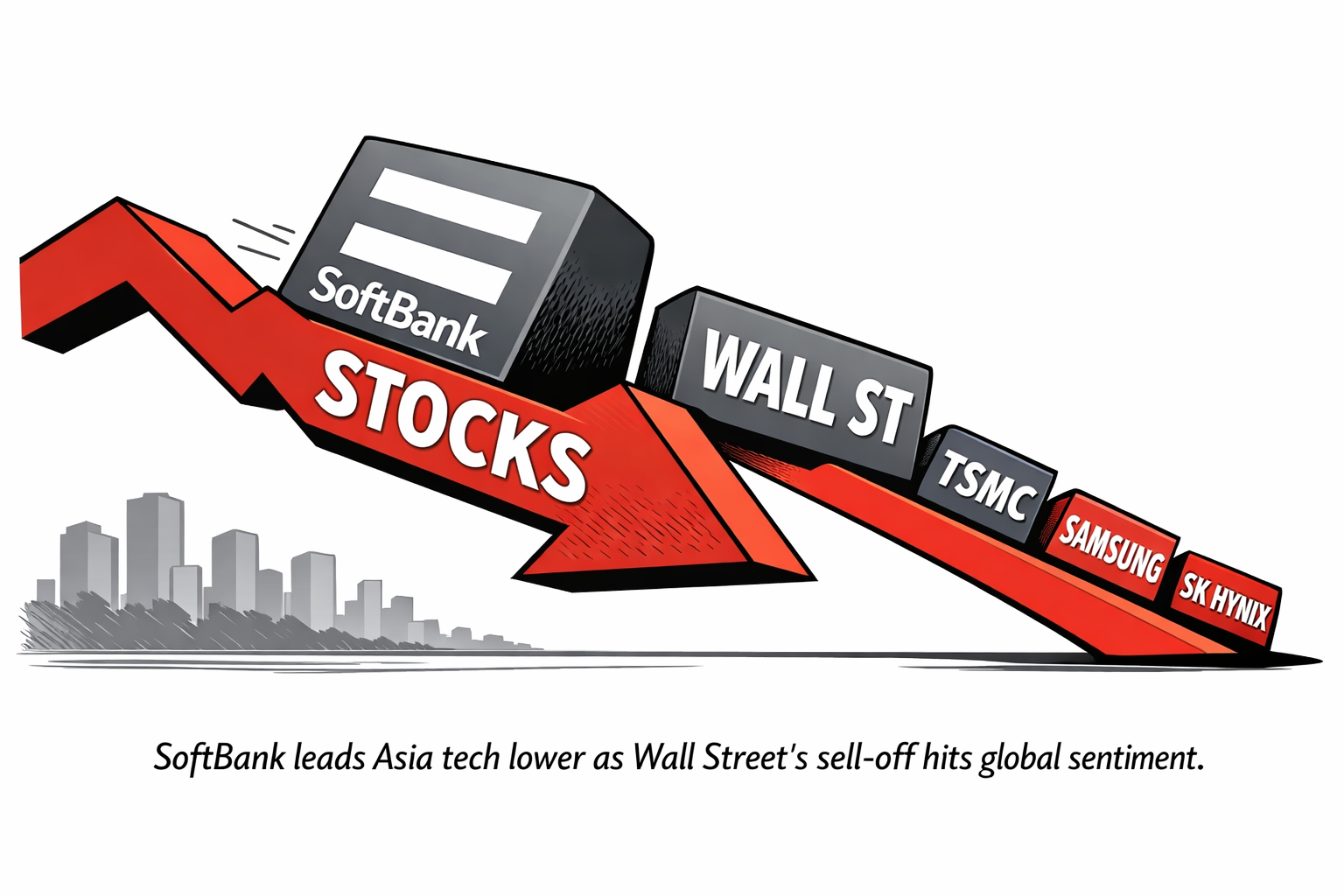
SoftBank’s sharp 10% slide on Wednesday became the defining symbol of a broader rout across Asia’s technology markets, as the region absorbed the full force of Wall Street’s overnight tech sell‑off.

The reversal ended a brief rebound in chipmakers and reignited concerns that valuations across the artificial‑intelligence complex have run too hot for too long.

The immediate pressure on SoftBank stemmed from reports that its attempt to raise at least $6 billion through a margin loan backed by its OpenAI stake had stalled.

That setback landed at a moment when sentiment toward high‑growth tech names was becoming more fragile, amplifying the downside.

Investors rotated out of risk, hitting Japan’s semiconductor ecosystem: Advantest and Renesas both fell more than 3%, while South Korea’s SK Hynix plunged over 8% and Samsung Electronics dropped 7.45%.

Taiwan’s TSMC and Hon Hai were also dragged lower.

A deeper structural worry is now taking hold. Massive AI‑related fundraising — including upcoming listings for SpaceX, Anthropic and OpenAI — appears to be siphoning capital away from publicly traded tech stocks.

Some investors see this as the early stage of a rotation; others fear it signals overheating. For Japan, one unexpected beneficiary could be defence contractors, with strategists suggesting a shift toward “heavies” as retail traders search for stability.

IBM Shares Slide as AI Threatens Its Legacy Stronghold

AI and IBM

When artificial intelligence first ignited investor enthusiasm, it lifted almost every major technology stock.

The narrative was simple: AI would transform industries, boost productivity and unlock vast new revenue streams.

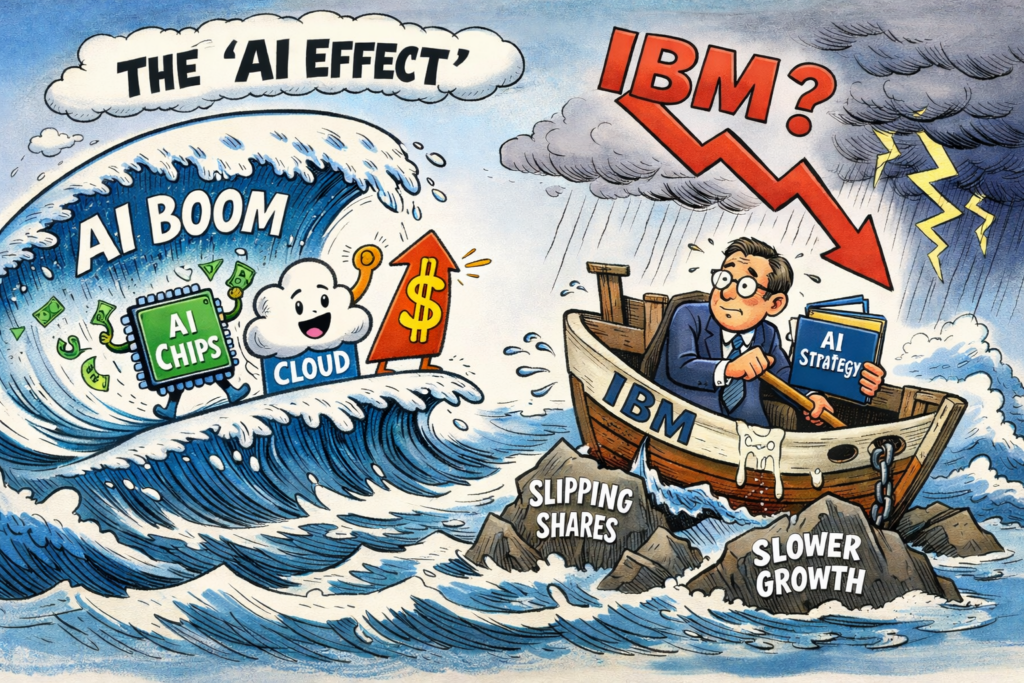
Yet as the cycle matures, markets are becoming more selective. In recent weeks, shares of IBM have drifted lower, illustrating how the ‘AI effect’ can cut both ways.

At first glance, IBM should be a prime beneficiary. The company has spent years repositioning itself around hybrid cloud infrastructure, data analytics and enterprise AI solutions.

Its Watson platform has been refreshed with generative AI tools designed to automate customer service, streamline software development and enhance business decision-making. Management has repeatedly emphasised AI as a core growth engine.

Market Expectations

However, the market’s expectations have shifted. Investors are increasingly rewarding companies that sit at the very heart of AI infrastructure — those supplying advanced semiconductors, high-performance computing capacity and hyperscale cloud services.

These businesses are reporting visible surges in AI-related demand, often accompanied by sharp revenue acceleration and expanding margins.

By contrast, IBM’s AI exposure is embedded within broader consulting and software operations, making its growth trajectory appear steadier rather than explosive.

This distinction matters in a momentum-driven environment. When earnings updates fail to deliver dramatic upside surprises, shares can quickly lose favour.

Less AI Effect

IBM’s results have shown progress in software and recurring revenue, but they have not reflected the kind of dramatic AI-driven uplift seen elsewhere in the sector. For some investors, that raises questions about competitive positioning and pricing power.

There is also a perception issue. Despite its reinvention efforts, IBM still carries the legacy image of a mature technology conglomerate rather than a cutting-edge AI disruptor.

In a market captivated by bold innovation stories, narrative can influence valuation just as much as fundamentals.

If capital flows concentrate in a handful of high-growth AI names, diversified players may struggle to keep pace in share price performance.

AI Tension

Yet the sell-off may also highlight a deeper tension within the AI theme. Enterprise adoption of AI tools tends to be gradual, cautious and closely tied to measurable productivity gains.

IBM’s strategy is built around long-term integration rather than short-term hype. While that approach may lack immediate fireworks, it could prove more durable as corporate clients prioritise reliability, governance and cost control.

For now, though, the AI effect is amplifying investor discrimination. In a market eager for rapid transformation, IBM’s more measured path has translated into weaker share performance — a reminder that not all AI exposure is valued equally.

Further discussion

IBM has found itself on the wrong side of the artificial intelligence boom, with its shares tumbling more than 13% after Anthropic unveiled a new capability that directly targets one of the company’s most enduring revenue pillars: COBOL modernisation.

The sell‑off reflects a broader market anxiety that AI is beginning to erode long‑protected niches in enterprise technology, and IBM has become the latest high‑profile casualty.

For decades, IBM has been synonymous with mainframe computing and the maintenance of vast COBOL‑based systems that underpin global finance, government services, airlines, and retail transactions.

These systems are notoriously complex, expensive to update, and dependent on a shrinking pool of specialist developers.

Premium Brand

That scarcity has long worked in IBM’s favour, allowing it to charge a premium for modernisation and support.

Anthropic’s announcement threatens to upend that equation. Its Claude Code tool, the company claims, can automate the most time‑consuming and costly parts of understanding and restructuring legacy COBOL environments.

Tasks that once required teams of analysts months to complete—mapping dependencies, documenting workflows, identifying risks—can now be accelerated dramatically through AI‑driven analysis.

The implication is clear: modernising legacy systems may no longer require the same level of human expertise, nor the same level of spending.

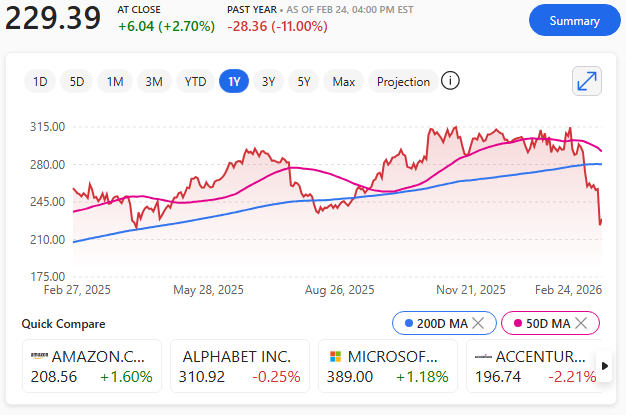
Investors reacted swiftly. IBM’s share price fell to $223.35, extending a year‑to‑date decline of more than 24% – recovering later to $229.39

IBM one-year chart as of 24th February 2026

The drop reflects not only concerns about lost revenue, but also the fear that IBM’s competitive moat—built on decades of institutional reliance on COBOL—may be eroding faster than expected.

The timing has amplified market jitters. Only days earlier, cybersecurity stocks were hit by another Anthropic announcement: Claude Code Security, a feature designed to scan codebases for vulnerabilities.

AI Mood Logic

The rapid expansion of AI into specialised technical domains has created a ‘sell first, ask questions later’ mood across the market, with investors increasingly wary of companies whose business models depend on labour‑intensive or legacy‑bound processes.

For IBM, the challenge now is to demonstrate that it can harness AI rather than be displaced by it.

The company has invested heavily in its own AI initiatives, but the latest market reaction suggests investors are unconvinced that these efforts will offset the threat to its traditional strongholds.

The AI revolution is reshaping the technology landscape at speed. IBM’s sharp decline is a reminder that even the industry’s oldest giants are not insulated from disruption—and that the next wave of AI competition may hit the most established players hardest.

But remember, this is IBM we are talking about.

Explainer

What is COBOL?

COBOL is an old but remarkably durable programming language created in the late 1950s to run business, finance, and government systems, and it’s still powering much of the world’s banking and administrative infrastructure today.

It was designed to read almost like plain English, making it easier for non‑technical managers to understand, and its stability means many core systems have never been replaced.

Microsoft closes at all-time high

Microsoft closes at all-time high

Microsoft ended Tuesday’s trading session at a record high of $360.53, following fresh optimism about growth from a key partner in artificial intelligence (AI). The increase gives the company a market value of about $2.68 trillion.

At a tech event on Monday 6th November 2023, Microsoft’s AI partner, OpenAI, announced a batch of updates, including price cuts and plans to allow people to make custom versions of the ChatGPT chatbot.

Microsoft CEO Satya Nadella attended and emphasized that developers building applications with OpenAI’s tools could get to market quickly by deploying their software on Microsoft’s Azure cloud infrastructure.

Microsoft has invested a reported $13 billion in OpenAI, which has granted Microsoft an exclusive licence on OpenAI’s GPT-4 large language model that can generate human-like prose in response to a few words of text.

Chatbot
Fictitious AI robot learning from a digital human online

Last week, Microsoft announced the release of an AI add-on for its Office productivity app subscriptions and an assistant in Windows 11, both of which rely on OpenAI models.

The future is looking bright for Microsoft right now.