

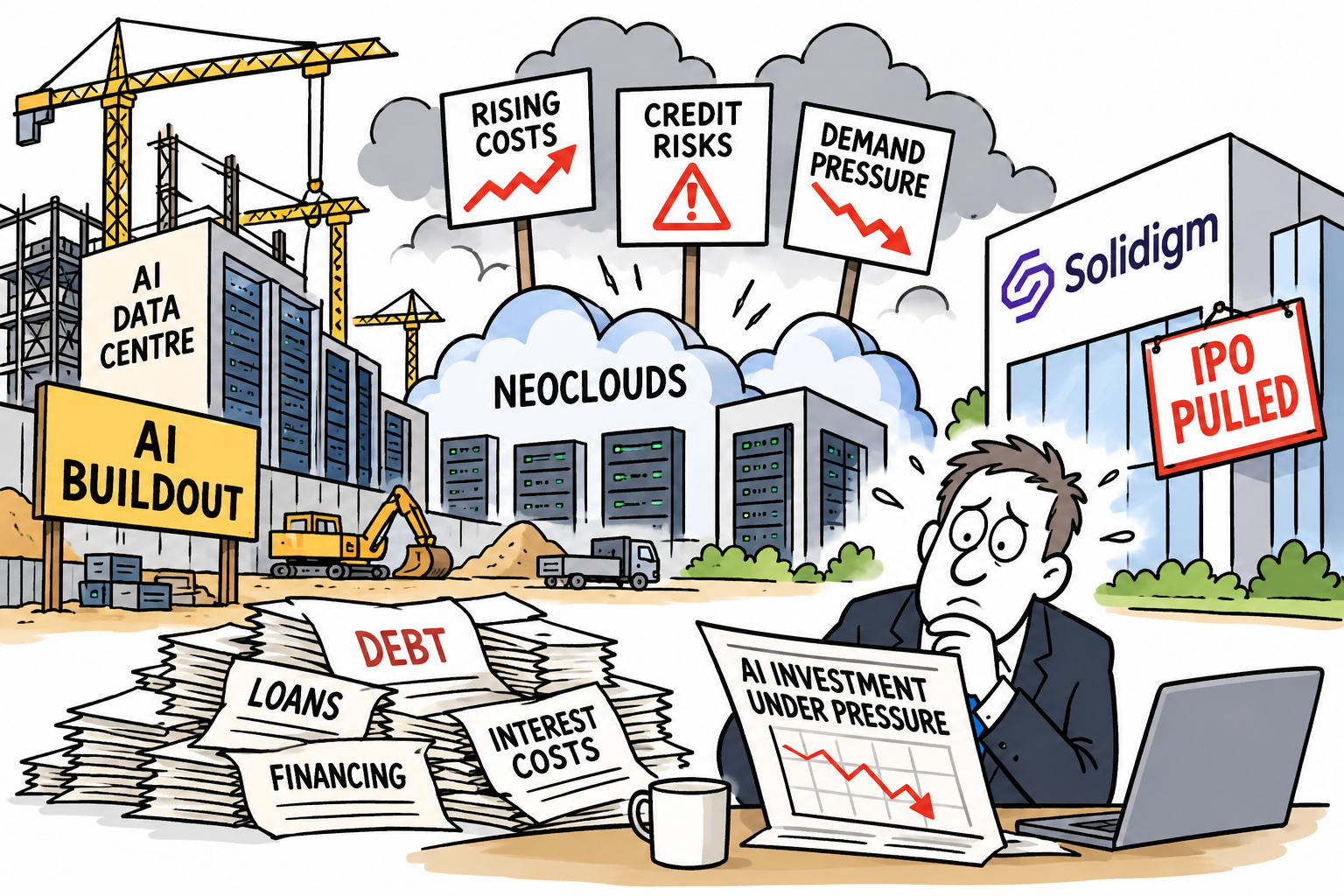
The artificial intelligence boom is entering a more challenging phase as mounting financial pressures expose the risks behind the enormous investment in AI infrastructure.
Neocloud providers are facing growing scrutiny, concerns over credit are increasing, and Solidigm’s reported withdrawal of its planned initial public offering (IPO) raises further questions about the market’s appetite for AI-related businesses.
The developments come at a time when technology companies are committing vast sums to data centres, advanced processors, high-speed networking and energy-intensive computing infrastructure.
While demand for AI services continues to attract investment, the cost of building the capacity required to support that demand is becoming increasingly difficult to ignore.
Neoclouds face a tougher environment
Neoclouds are specialist cloud computing companies that provide access to powerful graphics processing units (GPUs) and other hardware needed to develop and operate AI models.
They have emerged as important suppliers to businesses seeking computing capacity without building their own infrastructure.
However, this business model carries considerable financial risks. Data centres require substantial upfront investment, while expensive chips can lose value as technology advances.
Companies must also secure reliable electricity supplies, manage operating costs and maintain high utilisation rates to generate sufficient returns.
Many providers depend on borrowing, equipment financing or long-term customer contracts to fund their expansion. If demand falls short of expectations, or customers delay spending, revenues may prove insufficient to cover debt repayments and other fixed costs.
Credit risks move into focus
The pressure on neoclouds highlights a wider concern: whether the financing behind the AI revolution has become too aggressive.
Investors are increasingly having to distinguish between companies generating sustainable cash flows and those relying on continued funding, optimistic growth forecasts and rising valuations.
Where borrowing has increased rapidly, even a modest deterioration in business conditions could expose weaknesses.
The danger is not necessarily that demand for AI disappears. Rather, investment may have expanded faster than the industry’s ability to generate profits from the infrastructure being constructed.
If lenders become more cautious, refinancing could become more expensive, forcing some businesses to reduce capital expenditure, seek additional equity or sell assets.
Such developments could also affect equipment suppliers, construction companies and other businesses linked to the data-centre boom.
Solidigm adds to investor uncertainty
Solidigm, a data-storage company specialising in solid-state drives and flash memory, has also entered the spotlight following reports that it pulled its planned IPO.
Its position in the AI infrastructure supply chain illustrates how closely the fortunes of technology suppliers are tied to expectations for continued investment.
An abandoned or postponed listing does not, by itself, demonstrate financial distress. However, it can signal that market conditions, valuation expectations or investor demand are not sufficiently favourable to proceed.
OpenAI also made moves to postpone its IPO in September this year.
What does this mean for markets?
The immediate concern is whether the AI industry has invested too much, too quickly, using financing that depends on future profits arriving as expected.
Recent market pressure has extended beyond smaller infrastructure companies into the credit markets of major technology businesses
That does not mean the AI revolution is over. Demand for computing power could continue growing rapidly, and the largest technology companies retain substantial resources.
Nvidia chief executive Jensen Huang has also remained bullish about demand for specialist cloud computing.
Nevertheless, investors are beginning to ask harder questions about profitability, debt and the returns on billions of pounds and dollars being committed to infrastructure.
The next test will come as major technology companies report their financial results and explain how much they intend to spend on AI. If revenues and profits fail to keep pace with investment, markets could reassess valuations across the technology sector.
The central issue is changing: it is no longer simply how quickly AI can grow, but whether the industry can make that growth financially sustainable.
If the answer disappoints, the consequences could extend well beyond AI stocks, affecting lenders, corporate bond markets and the wider Nasdaq.