

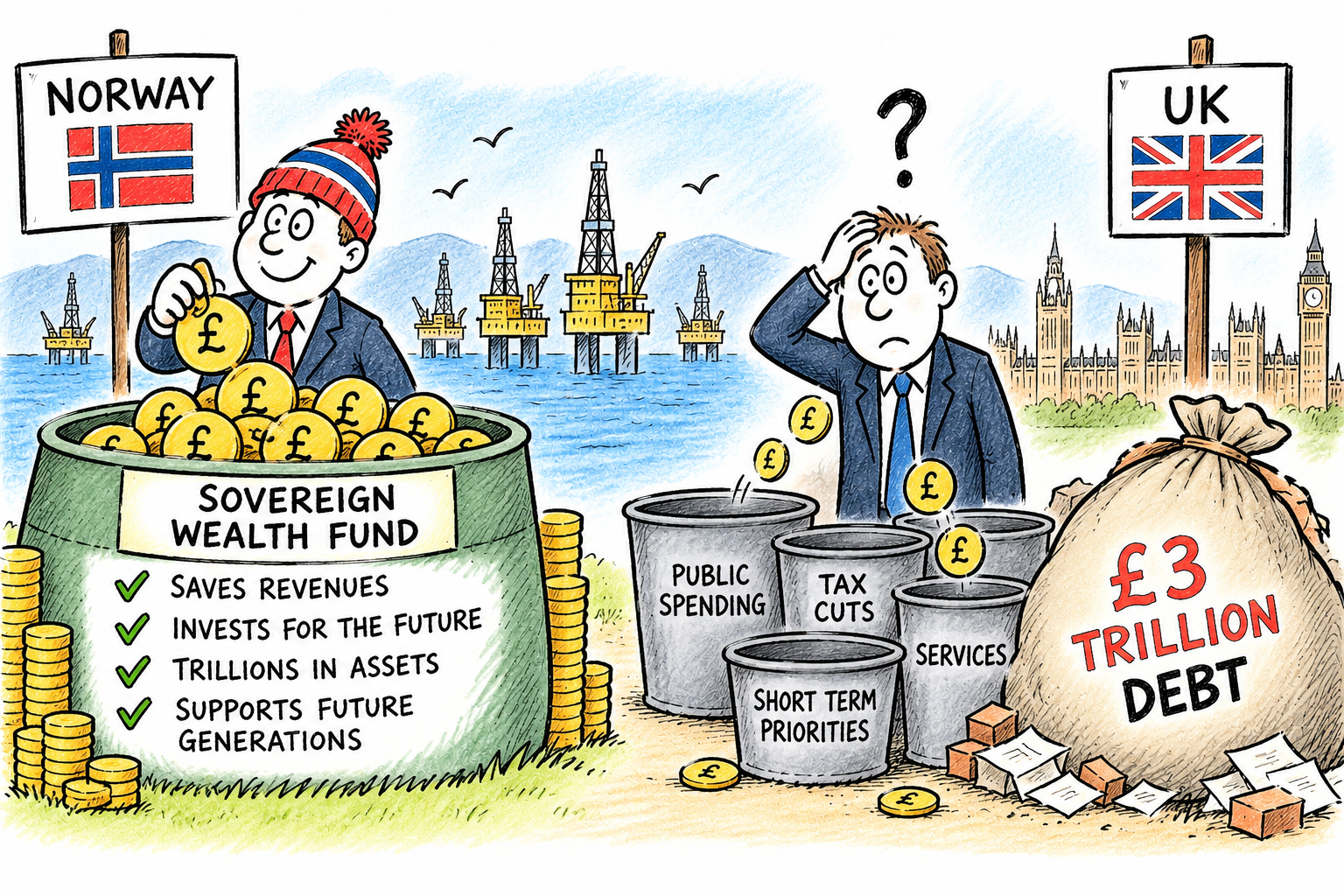
Britain sits on a mountain of public debt approaching £3 trillion, yet decades ago it discovered a resource that could have transformed the nation’s financial future.
North Sea oil generated enormous revenues, but unlike Norway, Britain failed to turn its petroleum wealth into a lasting national investment fund.
The missed opportunity remains one of the most striking examples of short-term political thinking in modern economic history.
Oil production sideline
When North Sea oil production expanded during the 1970s and 1980s, the UK government received substantial revenues from petroleum taxes and royalties.
Norway, whose North Sea oil industry developed around the same period, took a different approach. It established a sovereign wealth fund in 1990, subsequently investing much of its petroleum wealth in international financial markets for the benefit of future generations.
Norway’s Government Pension Fund Global
Today, Norway’s Government Pension Fund Global is worth trillions of pounds. Its investments span thousands of companies, bonds and other assets worldwide, generating returns that help support Norway’s public finances.
The fund has become a financial buffer against economic shocks and the eventual decline of oil and gas production.
Spend
Britain, by contrast, largely spent its oil revenues as they arrived. They helped support government finances during a period of economic restructuring, tax reductions and changing public spending priorities.
The revenues also contributed to the wider economy, while North Sea production helped improve the UK’s balance of payments.
The argument is not that every pound of British oil revenue simply disappeared. Rather, the country failed to preserve a substantial share of this finite natural resource wealth in a dedicated, long-term investment fund.
Why?
Why did Britain make such a different choice? Politics was central. Successive governments faced immediate demands to control borrowing, finance public services, manage unemployment and respond to economic difficulties.
Creating a fund would have required the political discipline to save revenues rather than use them to meet current priorities.
There was also no lasting national consensus that oil wealth should be treated as capital belonging to future generations. Norway built institutions and rules around that principle. Britain never established an equivalent framework on a comparable scale.
Consequnce
The consequences are difficult to quantify precisely. A British sovereign wealth fund would not automatically have accumulated the same returns as Norway’s, and its performance would have depended on how much was invested, when investments were made and how they were managed.
Nevertheless, even a smaller fund could have provided valuable national assets and an additional source of investment income.
With public debt now approaching £3 trillion, the contrast is uncomfortable. Britain extracted a finite resource but did not convert enough of its proceeds into lasting financial wealth.
Norway saved a significant share of its oil windfall. Britain largely consumed its own. The question is whether future generations will repeat that mistake.
Note:
The £1 trillion figure is a hypothetical Treasury estimate based on investing roughly £200 billion in historical North Sea revenues and allowing the money to grow at a rate comparable to Norway’s fund. It is not a guaranteed amount Britain would have accumulated.
The UK’s public sector net debt was provisionally estimated at £3.005 trillion at the end of September 2026, according to the Office for National Statistics.