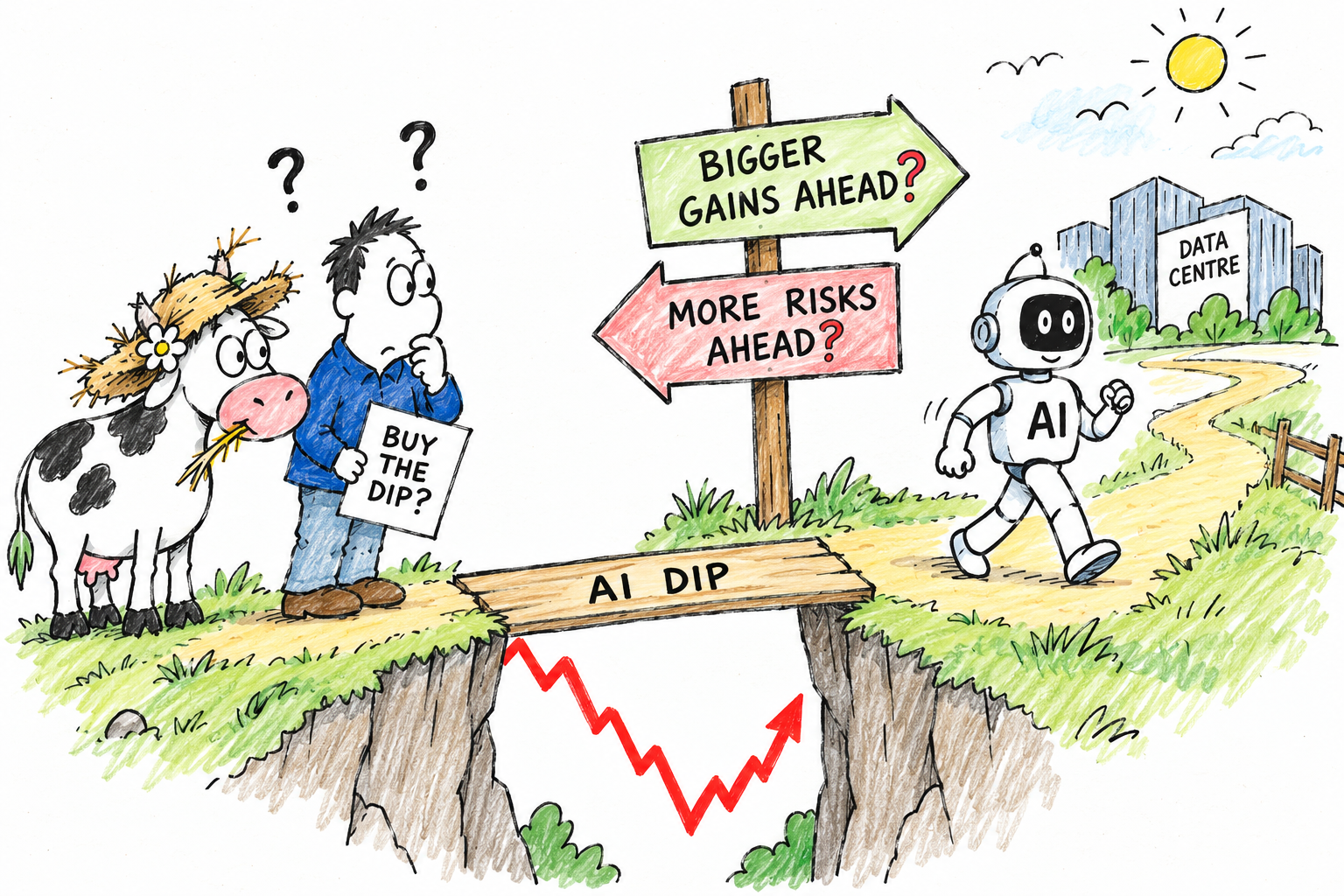
The recent dip in U.S. artificial intelligence shares has raised the familiar question of whether investors should use weakness to buy into the sector.
Pullback?
However, the pullback has so far been relatively small compared with the gains made during the AI rally. Rather than signalling the end of the boom, it could simply represent a pause in an extraordinary bull market.
Yet there are reasons to remain cautious. A modest decline does not necessarily mean shares have become cheap, particularly when valuations already reflect ambitious expectations for future growth.
Powerful Argument
The bullish case for AI remains powerful. Major technology companies continue to invest heavily in data centres, advanced semiconductors and computing infrastructure.
AI adoption is spreading across industries, with the potential to improve productivity, reduce costs and create entirely new revenue streams.
Companies capable of converting this demand into sustained earnings growth could continue to reward investors over the longer term.
To dip or not to dip?
For those who missed the earlier rally, a market dip may offer an opportunity to establish or increase positions. If corporate earnings continue to expand and AI spending remains robust, today’s prices could eventually look attractive. But only if company earnings accommodate.
However, the risks have not disappeared. The sums being committed to AI infrastructure are enormous, and investors must consider whether the eventual returns will justify the expenditure.
It’s all about the data
Data centres require vast amounts of electricity, while borrowing costs, infrastructure constraints and intensifying competition could affect profitability.
There is also the question of valuation. Even if AI transforms the global economy, shareholders can still lose money if they pay too much for that growth.
Companies may deliver impressive results yet disappoint markets if those results fall short of increasingly demanding forecasts.
Higher bond yields could add another complication, putting pressure on highly valued growth shares.
Meanwhile, if technology companies begin to question the returns from their spending, investment plans could be scaled back, affecting chipmakers and other suppliers throughout the AI ecosystem.
Premature?
For now, it would be premature to interpret a relatively small pullback as evidence that the AI boom is unravelling. Equally, investors should not assume that every dip represents a bargain.
The coming months will test whether AI spending translates into sustainable profits rather than simply higher capital expenditure and increasingly ambitious promises.
The AI revolution may still have considerable room to run. But the real investment opportunity lies not in buying every dip, but in identifying which companies can turn technological promise into lasting financial returns.
Investors who believe the artificial intelligence (AI) boom can only go one way may need to think again.
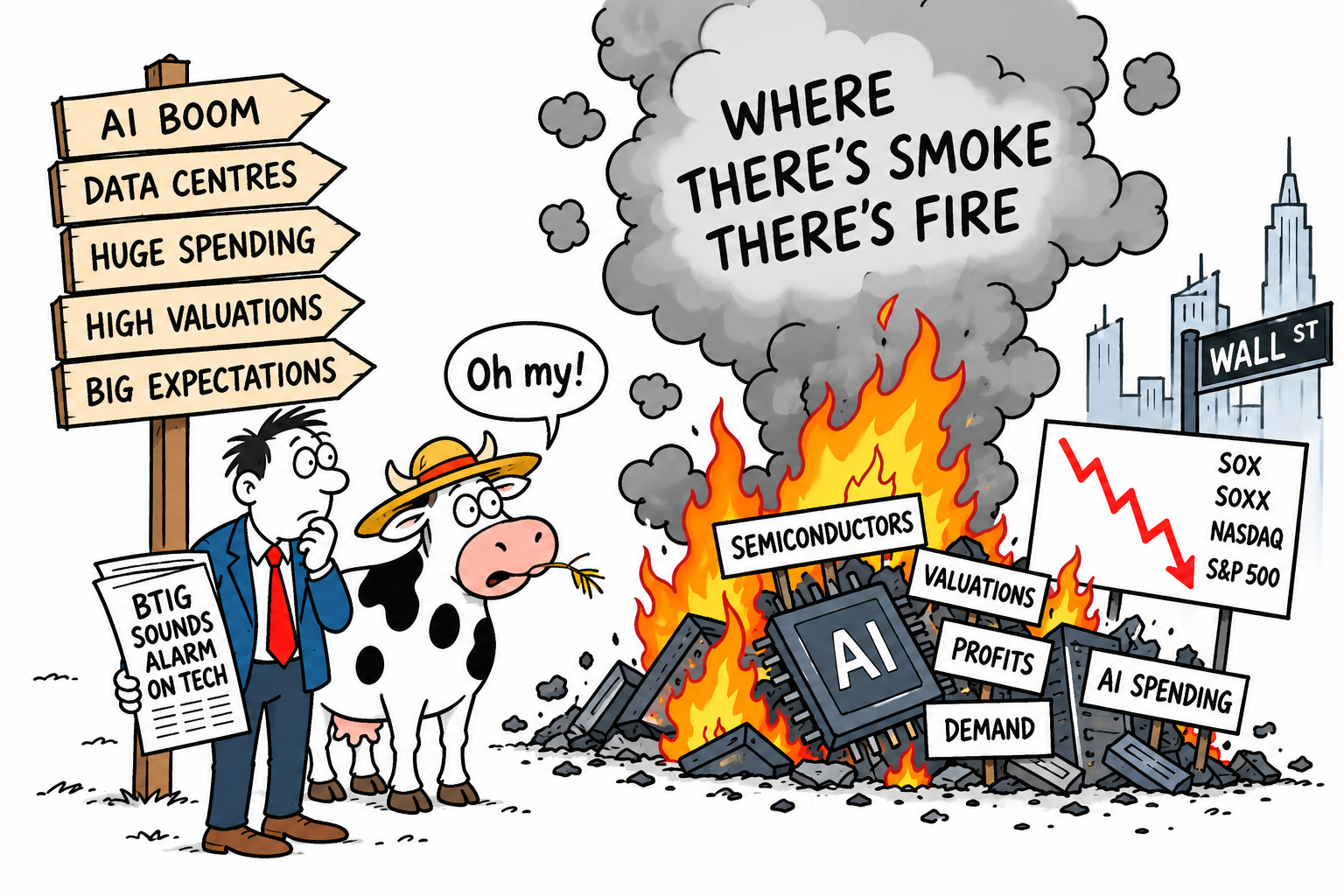
BTIG, the financial services and research firm, is warning that growing weakness in technology shares could signal deeper problems for a market that has become heavily dependent on expectations of continued AI-driven growth.
Warning
The warning follows a sharp sell-off in semiconductor stocks. The Philadelphia Semiconductor Index fell 11.4% in the previous week, its worst weekly performance since April 2025.
Meanwhile, the iShares Semiconductor ETF reportedly suffered nine consecutive daily losses. For BTIG’s chief market technician, Jonathan Krinsky, these developments raise questions about whether the weakness is simply a temporary correction or the beginning of a more prolonged downturn.
Smoke and Fire
The expression ‘where there’s smoke, there’s fire’ captures the concern. Falling share prices do not necessarily mean that the AI investment boom is ending, but they can indicate that investors are becoming less confident about the returns that enormous technology investments will ultimately deliver.
Billions of pounds and dollars are being committed to data centres, advanced processors and supporting infrastructure. Technology companies are spending aggressively to establish themselves as leaders in AI.
However, the crucial question is whether the resulting revenues and profits will justify the expenditure and the lofty valuations attached to many of these businesses.
There is also a wider market concern. The performance of major U.S. indices can disguise significant weakness among individual companies and sectors.
If semiconductor shares continue to struggle, pressure could spread to other technology stocks and weigh on the Nasdaq and S&P 500.
BTIG
BTIG has identified important technical levels for the semiconductor ETF, including support around $490 and its 200-day moving average near $468.
A sustained break below these levels could reinforce concerns about further losses, although neither level guarantees where prices will stop falling.
Investors should also remember that a sharp decline can create opportunities. If AI demand remains strong and companies demonstrate that their investments are generating healthy profits, technology shares could recover.
Earnings watch
Equally, if earnings disappoint or spending proves excessive, valuations may have further to fall.
The warning deserves attention, particularly after a period in which enthusiasm for AI has helped support stock market valuations.
Investors should examine earnings, cash flow, capital expenditure and the broader health of the market rather than relying solely on headline index performance.
BTIG is not necessarily predicting an imminent crash. Its message is that the warning signs should not be ignored.
Whether the smoke signals a temporary setback or a more serious problem will depend on what happens next to corporate profits, AI spending and investor confidence.
The artificial intelligence boom faces a potentially dangerous turning point. After years of extraordinary investment, soaring valuations and relentless enthusiasm, cracks are emerging in the credit markets that have helped finance America’s AI revolution.
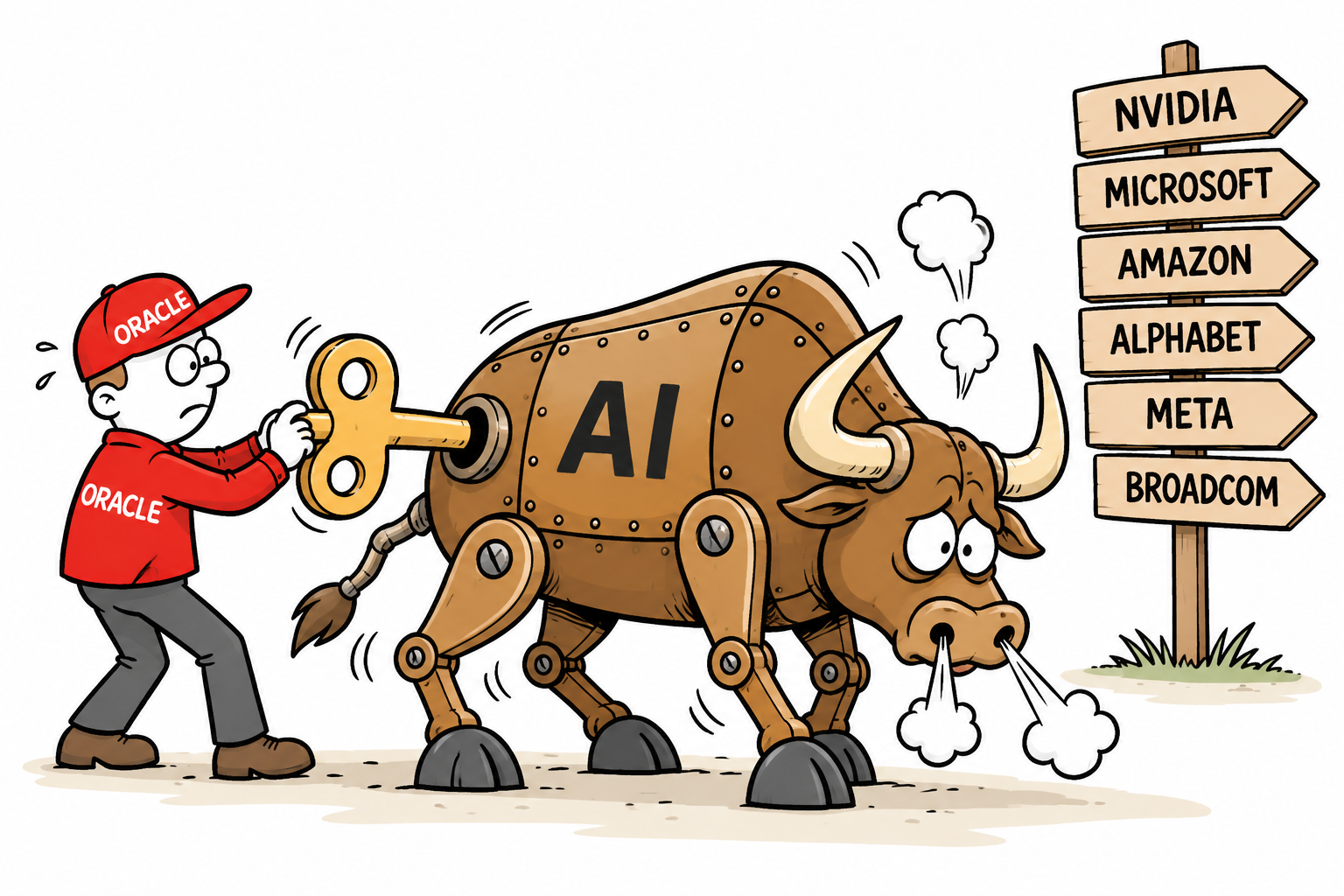
At the centre of the storm stands Oracle, increasingly regarded as a barometer of whether the debt-fuelled AI expansion can continue.
Nervous
Investors are becoming nervous about the enormous borrowing required to construct data centres, purchase advanced chips and develop the infrastructure supporting artificial intelligence.
The warning signs are unmistakable
Oracle’s five-year credit default swap (CDS) spreads, effectively the cost of insuring against debt default, reportedly reached a record 288 basis points on 15th October 2026.
Meanwhile, heavily indebted AI infrastructure provider CoreWeave has seen its spreads exceed 1,000 basis point.
These figures do not indicate imminent defaults, but they reveal growing anxiety about the sustainability of AI financing.
The implications for Wall Street could be substantial
Oracle must convince investors that its enormous infrastructure commitments can generate sufficient revenues and cash flow to justify mounting financial obligations.
Should confidence deteriorate further, borrowing costs could rise, financing could become harder to secure and ambitious AI expansion plans could face delays.
That would threaten companies throughout the AI ecosystem
Nvidia, Broadcom and other semiconductor suppliers depend heavily on continued infrastructure spending. Microsoft, Amazon, Alphabet and Meta could also face increasing scrutiny over their enormous capital expenditure commitments.
The technology-heavy Nasdaq would be particularly vulnerable, while the broader S&P 500 could suffer from its substantial exposure to America’s largest technology companies.
A prolonged credit squeeze could trigger further selling, valuation compression and a rotation towards less capital-intensive sectors.
However, an AI collapse is far from inevitable
Strong earnings, continued demand for computing power and credible financing arrangements could restore confidence. Indeed, American technology stocks rebounded on Monday following the previous week’s sharp declines.
Nevertheless, the balance of risk appears increasingly uncomfortable.
The greatest danger is that a credit crisis develops before AI revenues can justify the investment.
Oracle may not determine the entire AI industry’s future, but its ability to reassure lenders could influence whether Wall Street’s extraordinary technology bull market survives its next major test.
The U.S. stock market continues to defy those warning that valuations, concentration and excessive optimism have created a dangerous combination.
Yet the question is no longer simply whether American shares are expensive. It is whether the assumptions supporting those valuations can continue to hold.
The S&P 500 has become increasingly dependent on a relatively small number of giant companies, many of which are at the centre of the artificial intelligence boom.
That concentration has become one of the most important — and potentially overlooked — risks facing investors.
A market increasingly dominated by a handful of companies
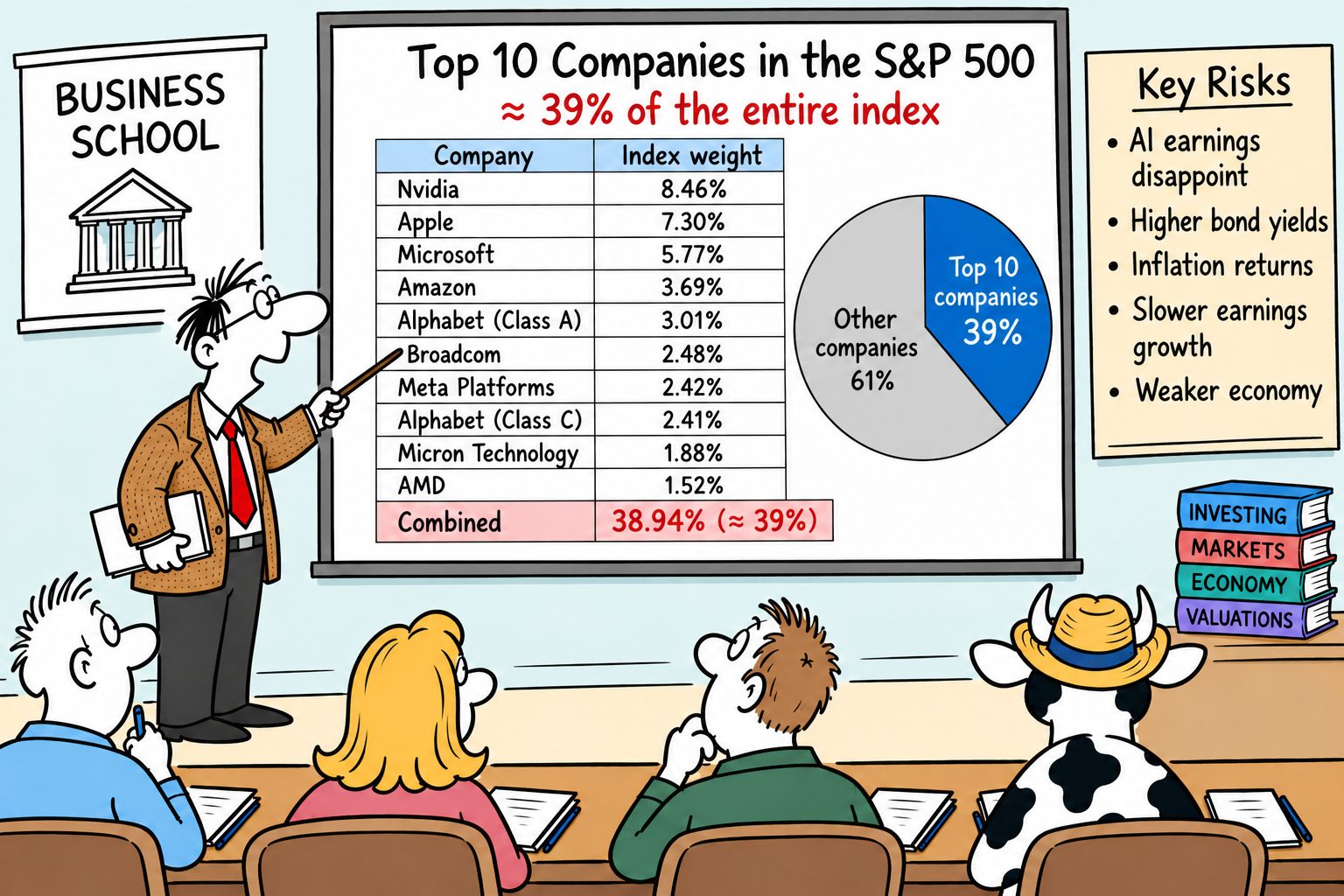
The ten largest holdings account for approximately 39% of the entire S&P 500 index, according to the holdings figures used for this analysis. Alphabet appears twice because its Class A and Class C shares are separate index constituents.
Company
Approx. index weighting
Nvidia
8.46%
Apple
7.30%
Microsoft
5.77%
Amazon
3.69%
Alphabet Class A
3.01%
Broadcom
2.48%
Meta Platforms
2.42%
Alphabet Class C
2.41%
Micron Technology
1.88%
AMD
1.52%
Combined
38.94% (≈39%)
Note: These are the approximate holdings weights used in the original analysis, dated 1st October 2026. Index weightings change as share prices move.
Look beyond the individual names and the concentration becomes even more striking. Nvidia alone represents more than 8% of the index, while Alphabet’s two share classes together account for more than 5%. These companies also have enormous exposure to the AI investment boom.
That matters because a correction in one or two companies would not necessarily threaten the wider market. But if investors simultaneously lose confidence in the AI trade, the consequences could be considerably larger.
The AI assumption
Investors have poured enormous amounts of money into companies expected to benefit from artificial intelligence, while the world’s largest technology companies are committing vast sums to data centres, semiconductors and computing infrastructure.
For now, strong corporate earnings have provided justification for much of the optimism. But this is where the greatest risk may lie.
The market does not necessarily need AI to fail. Investors simply need to become less convinced that the enormous capital being committed today will generate sufficiently large profits in the future.
If the returns from AI investment take longer to materialise, or if competition forces companies to spend more to maintain their position, valuations could come under pressure.
Are valuations too high?
Valuations are certainly elevated by historical standards.
That does not automatically mean a crash is imminent. Expensive markets can remain expensive for years if corporate earnings continue to grow strongly.
The more important question is whether earnings can grow quickly enough to justify today’s prices.
This distinction is particularly important because the S&P 500 is a market-capitalisation-weighted index. When Nvidia, Apple and Microsoft rise sharply, they have a much greater influence on the index than hundreds of smaller companies.
In other words, the S&P 500 can appear remarkably strong even when performance underneath the surface is considerably less impressive.
That creates a potential vulnerability.
Treasury yields could become the trigger
Bond yields represent another major threat.
Higher Treasury yields give investors an increasingly attractive alternative to equities. They also reduce the present value of future corporate profits, which particularly affects companies whose valuations depend heavily on strong growth many years into the future.
If U.S. Treasury yields remain elevated, investors may eventually become less willing to pay premium prices for technology and AI companies.
The problem is that higher yields can put pressure on share prices even when companies continue to report rising profits. Investors may simply decide that those profits are worth less today.
Then there is inflation
A renewed rise in energy prices could make the situation considerably more difficult.
Higher oil prices can feed directly into inflation, making it harder for the Federal Reserve to cut interest rates. That could keep borrowing costs and Treasury yields higher for longer.
The combination of higher inflation, higher bond yields and slowing earnings growth would be particularly uncomfortable for a market trading at elevated valuations.
Geopolitical tensions, tariffs and disruptions to energy supplies could add to the pressure, while higher borrowing costs would affect businesses and households alike.
What would actually reverse the bull market?
The most dangerous scenario would not necessarily be a single event. It could be a combination of several developments:
AI investment disappoints: expected returns fail to justify the enormous sums being spent.
Corporate earnings growth slows: companies deliver less than investors have priced in.
Treasury yields remain high: bonds become more competitive with equities.
Inflation returns: energy prices or other costs prevent interest rates from falling.
The economy weakens: consumers spend less and corporate revenues come under pressure.
Valuations contract: investors become unwilling to pay such high multiples for future earnings.
Any one of these could cause volatility. Several occurring together could turn a normal correction into something much more serious.
The S&P 500 does not necessarily need a recession to fall sharply. If investors simply decide that today’s earnings forecasts are too optimistic, valuations could contract significantly.
Because almost four-tenths of the index is concentrated in just ten holdings, a simultaneous sell-off in major technology and AI-related shares could have an outsized effect on the entire market.
A correction without a recession?
Consider a simplified illustration. If the S&P 500 were trading at 7,800, earnings expectations subsequently fell by 10%, and investors reduced the valuation multiple from 19 times earnings to 16 times, the index could theoretically fall to around 5,900.
That would represent a decline of approximately 24%, without requiring an economic catastrophe.
This is an illustration rather than a market forecast, but it demonstrates how falling earnings expectations and lower valuations can reinforce each other.
And finally
The U.S. stock market is not necessarily a bubble simply because valuations are high. These are profitable, enormously successful companies with genuine earnings and powerful businesses.
But the market has increasingly priced in an exceptionally good future.
The bull market can therefore continue if earnings keep delivering. AI investment may generate substantial returns, inflation may remain contained, and Treasury yields may eventually fall.
However, if those assumptions begin to unravel, investors may discover that the market has been priced for very little disappointment.
The greatest threat to the U.S. bull market may therefore not be that AI is over — but that expectations for AI have simply become too high.