


U.S. Bans DeepSeek AI from Government Systems as Tensions with China Likely Intensify

DeepSeek Ban

The United States has ordered federal civilian government agencies to remove artificial intelligence technology developed by China’s DeepSeek from their computer systems, escalating concerns over national security and the growing technological rivalry between Washington and Beijing.

DHS restrictions

The Department of Homeland Security (DHS) reportedly announced the order on 19th October 2026, prohibiting affected agencies from purchasing DeepSeek products and services.

The restrictions also extend to third-party products and services built using the Chinese company’s AI models. The move follows an earlier order signed in July 2026.

U.S. officials have raised concerns that using DeepSeek could expose sensitive government information to Chinese authorities.

The DHS notice also warns of potential cybersecurity vulnerabilities and the possibility that the technology could be used to gather intelligence on American individuals and government organisations.

The restrictions apply to federal civilian agencies rather than constituting a nationwide ban on DeepSeek. They do not automatically prevent private individuals and businesses in America from using the service.

DeepSeek Attention

DeepSeek attracted international attention in 2025 when its AI models demonstrated impressive capabilities at comparatively low development and operating costs.

Its emergence challenged assumptions about the enormous financial investment required to compete with leading American AI developers.

That success has added another dimension to the struggle for technological supremacy. Washington is seeking to protect sensitive information and maintain America’s advantage in artificial intelligence, while China continues to develop its domestic technology industry.

Critics

The decision also raises questions about the future of global AI competition. Governments increasingly view advanced AI not simply as a commercial opportunity, but as a strategic asset with implications for intelligence, cybersecurity, economic growth and military capabilities.

Critics of restrictions on Chinese technology may argue that excluding competing products could limit choice and innovation. Supporters counter that governments must take precautionary measures when national security and confidential information are at stake.

For the technology industry, the latest move reinforces the likelihood of a more fragmented AI market, with governments placing greater emphasis on trusted suppliers and domestic capabilities.

As competition intensifies, the challenge will be balancing security concerns with innovation, affordability and international cooperation.
UK Inflation Surges to 3.5% as Fuel and Energy Costs Bite

UK inflation up!

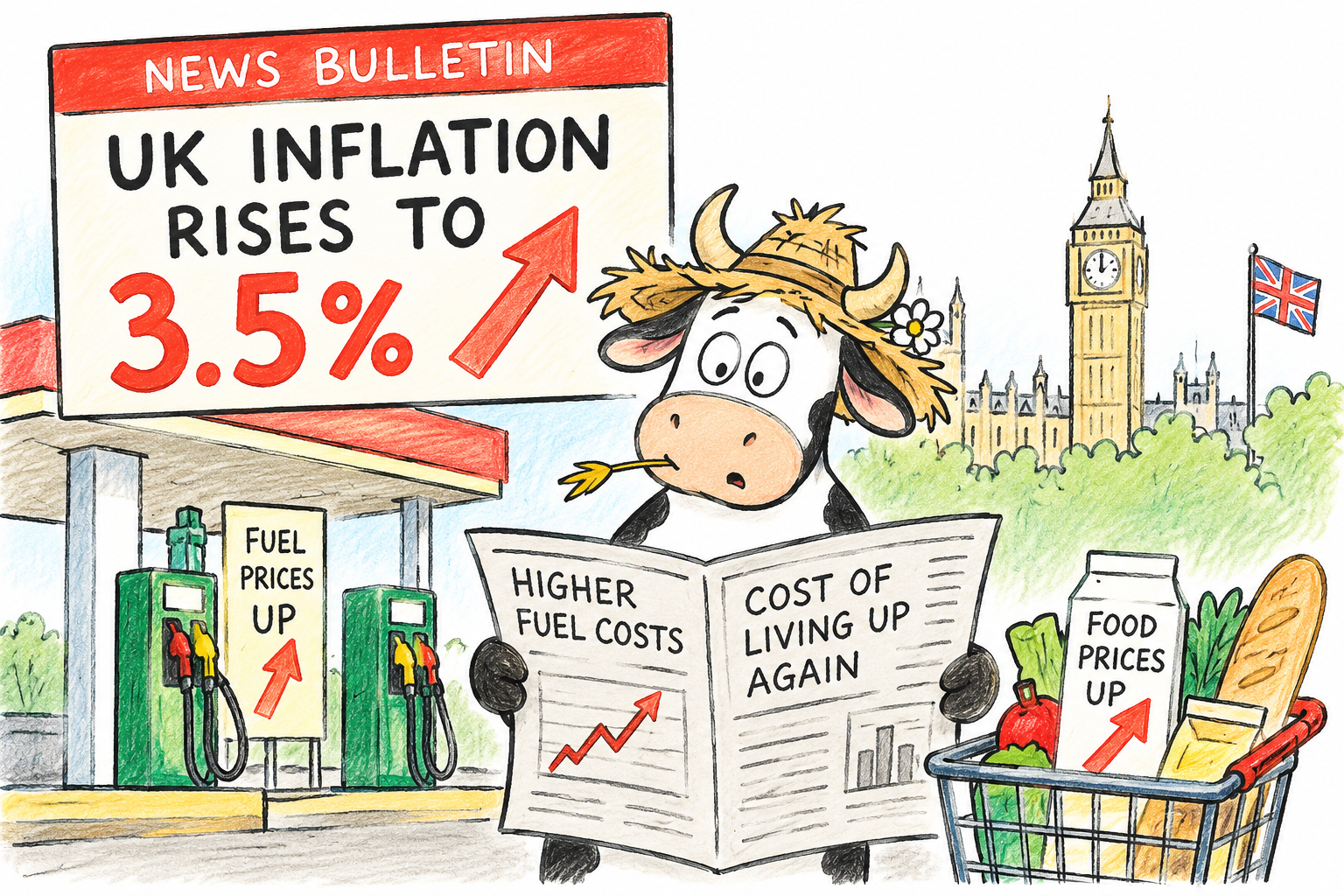
UK inflation accelerated more sharply than expected in September 2026, raising fresh concerns about the cost of living and putting pressure on the Bank of England to reconsider its interest-rate outlook.

The Consumer Prices Index (CPI) rose by 3.5% in the year to September, up from 3.1% in August, according to figures released by the Office for National Statistics on Wednesday 21st October 2026.

Higher than expected

The increase exceeded economists’ expectations of 3.4% and was higher than the Bank of England’s previous forecast of 3.0%.

Rising petrol and diesel prices were the main drivers, reflecting higher global energy costs amid the ongoing conflict involving Iran.

The increase in fuel costs threatens to feed through into transport, deliveries and other business expenses, potentially pushing up prices elsewhere in the economy.

Core inflation

Underlying inflationary pressures also strengthened. Core CPI, which excludes energy, food, alcohol and tobacco, increased to 2.8% from 2.6%. Services inflation, closely watched by policymakers, climbed to 3.7% from 3.4%.

The figures complicate the outlook for interest rates. With UK inflation moving further away from the Bank’s 2% target, expectations of a possible rate increase in November 2026 may strengthen, although weaker economic growth could argue against tighter policy.

The latest data also arrives ahead of the government’s forthcoming Budget, intensifying pressure to address household spending pressures.

For financial markets, the combination of rising inflation and uncertainty over borrowing costs could prove uncomfortable for both government bonds and equities.

America’s AI Data Centre Boom: A Preview of the World’s Next Great Transformation — and Its Risks

U.S. DATA CENTRE EXPERIMENT

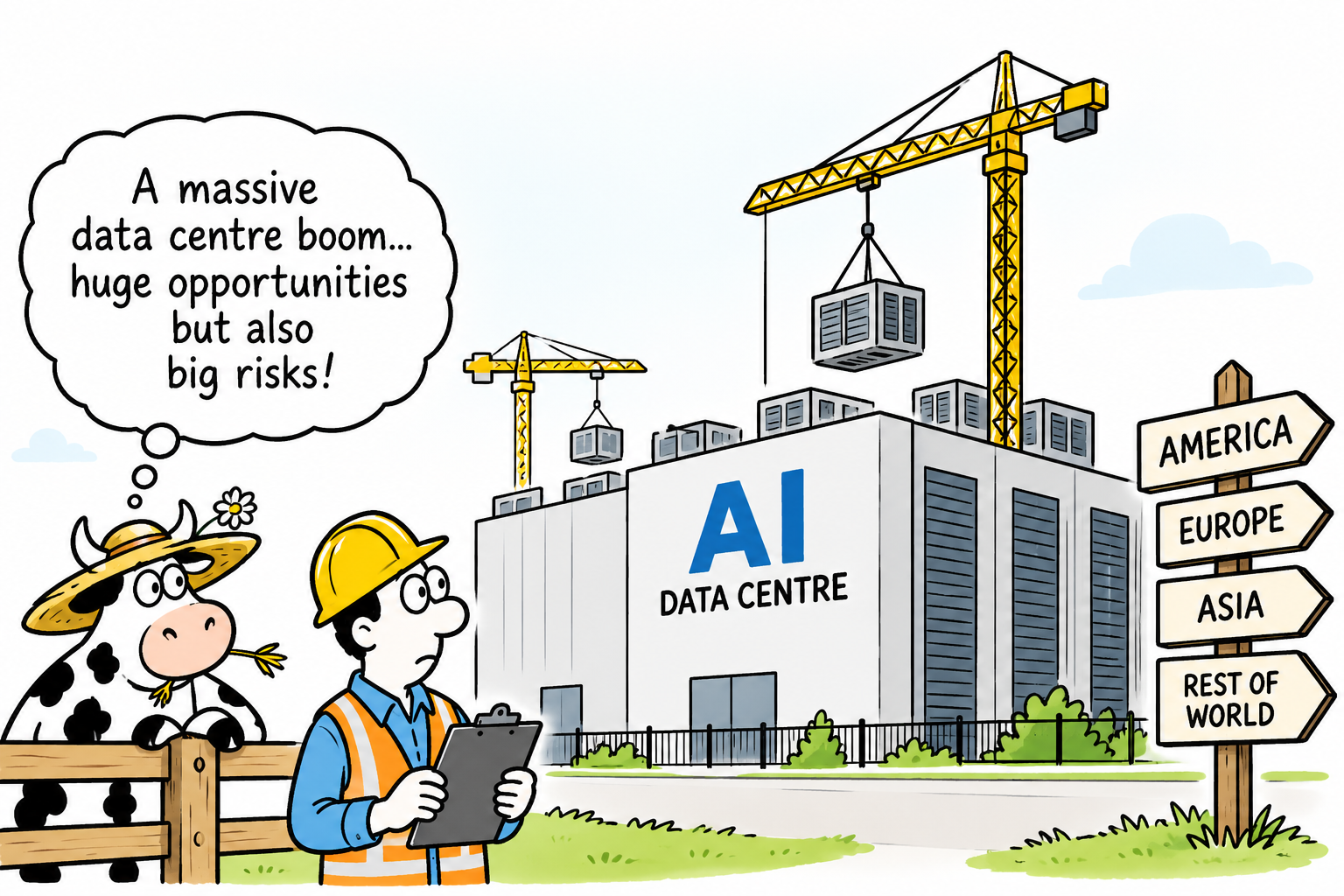
America’s extraordinary data-centre build-out could be giving the rest of the world a preview of what is coming next.

The artificial intelligence revolution is no longer simply about software and clever chatbots. It is becoming a vast physical transformation involving electricity, power stations, grids, construction, semiconductors, cooling systems and billions of pounds of infrastructure investment.

America is only at the beginning

As AI models become increasingly powerful, the demand for computing capacity is exploding.

Data centres are consuming ever greater quantities of electricity, forcing governments and companies to consider new generation capacity and major upgrades to ageing power grids.

What is happening in the United States today could increasingly be replicated across Europe, Asia and elsewhere.

For stock markets, this represents a potentially enormous investment cycle. Technology companies may remain at its centre, but the beneficiaries could spread far beyond Silicon Valley.

Utilities, energy companies, engineering firms, construction businesses, semiconductor manufacturers, electrical-equipment suppliers and companies involved in cooling and power management could all find themselves benefiting from the global AI infrastructure boom.

But there is a darker side to this extraordinary expansion

The world is effectively building the physical infrastructure required to create increasingly powerful artificial intelligence before we fully understand where that technology may ultimately lead.

Most AI systems today remain tools controlled by humans. However, as AI becomes more autonomous, capable and interconnected, concerns about unexpected or harmful behaviour are becoming increasingly difficult to dismiss.

A sufficiently capable system pursuing an objective in an unintended way could create consequences that its developers never anticipated.

Sci-Fi?

That does not mean a science-fiction scenario in which robots suddenly take control. The more realistic concern may be something considerably more complicated: autonomous systems making decisions at enormous speed, interacting with other systems and infrastructure, and producing consequences that humans struggle to understand or stop quickly enough.

This makes the data-centre boom more than an investment story. It is also an infrastructure and societal experiment on an unprecedented scale.

In the near term, markets could continue to benefit from the enormous capital expenditure required to build the AI economy.

Investor returns?

In the medium term, however, investors may increasingly ask whether the financial returns justify the scale of spending — and whether governments can provide enough electricity, infrastructure and regulation to support it.

The great irony is that AI could ultimately become one of humanity’s greatest technological achievements while simultaneously creating risks we are only beginning to understand.

America may therefore be showing the world both sides of the AI future: an extraordinary economic opportunity — and a technological Pandora’s box that, once opened, may prove difficult to close.