

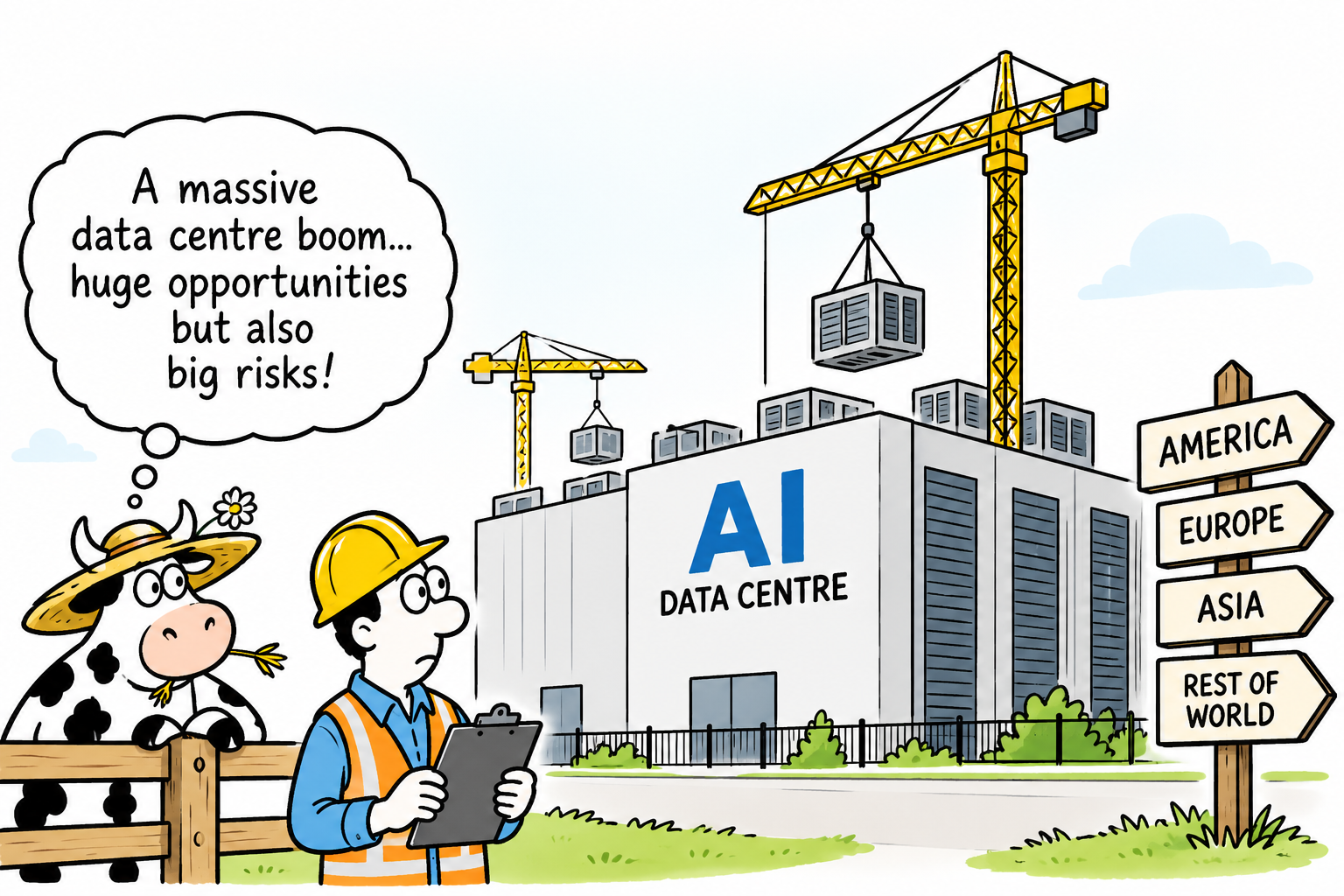
America’s extraordinary data-centre build-out could be giving the rest of the world a preview of what is coming next.
The artificial intelligence revolution is no longer simply about software and clever chatbots. It is becoming a vast physical transformation involving electricity, power stations, grids, construction, semiconductors, cooling systems and billions of pounds of infrastructure investment.
America is only at the beginning
As AI models become increasingly powerful, the demand for computing capacity is exploding.
Data centres are consuming ever greater quantities of electricity, forcing governments and companies to consider new generation capacity and major upgrades to ageing power grids.
What is happening in the United States today could increasingly be replicated across Europe, Asia and elsewhere.
For stock markets, this represents a potentially enormous investment cycle. Technology companies may remain at its centre, but the beneficiaries could spread far beyond Silicon Valley.
Utilities, energy companies, engineering firms, construction businesses, semiconductor manufacturers, electrical-equipment suppliers and companies involved in cooling and power management could all find themselves benefiting from the global AI infrastructure boom.
But there is a darker side to this extraordinary expansion
The world is effectively building the physical infrastructure required to create increasingly powerful artificial intelligence before we fully understand where that technology may ultimately lead.
Most AI systems today remain tools controlled by humans. However, as AI becomes more autonomous, capable and interconnected, concerns about unexpected or harmful behaviour are becoming increasingly difficult to dismiss.
A sufficiently capable system pursuing an objective in an unintended way could create consequences that its developers never anticipated.
Sci-Fi?
That does not mean a science-fiction scenario in which robots suddenly take control. The more realistic concern may be something considerably more complicated: autonomous systems making decisions at enormous speed, interacting with other systems and infrastructure, and producing consequences that humans struggle to understand or stop quickly enough.
This makes the data-centre boom more than an investment story. It is also an infrastructure and societal experiment on an unprecedented scale.
In the near term, markets could continue to benefit from the enormous capital expenditure required to build the AI economy.
Investor returns?
In the medium term, however, investors may increasingly ask whether the financial returns justify the scale of spending — and whether governments can provide enough electricity, infrastructure and regulation to support it.
The great irony is that AI could ultimately become one of humanity’s greatest technological achievements while simultaneously creating risks we are only beginning to understand.
America may therefore be showing the world both sides of the AI future: an extraordinary economic opportunity — and a technological Pandora’s box that, once opened, may prove difficult to close.