

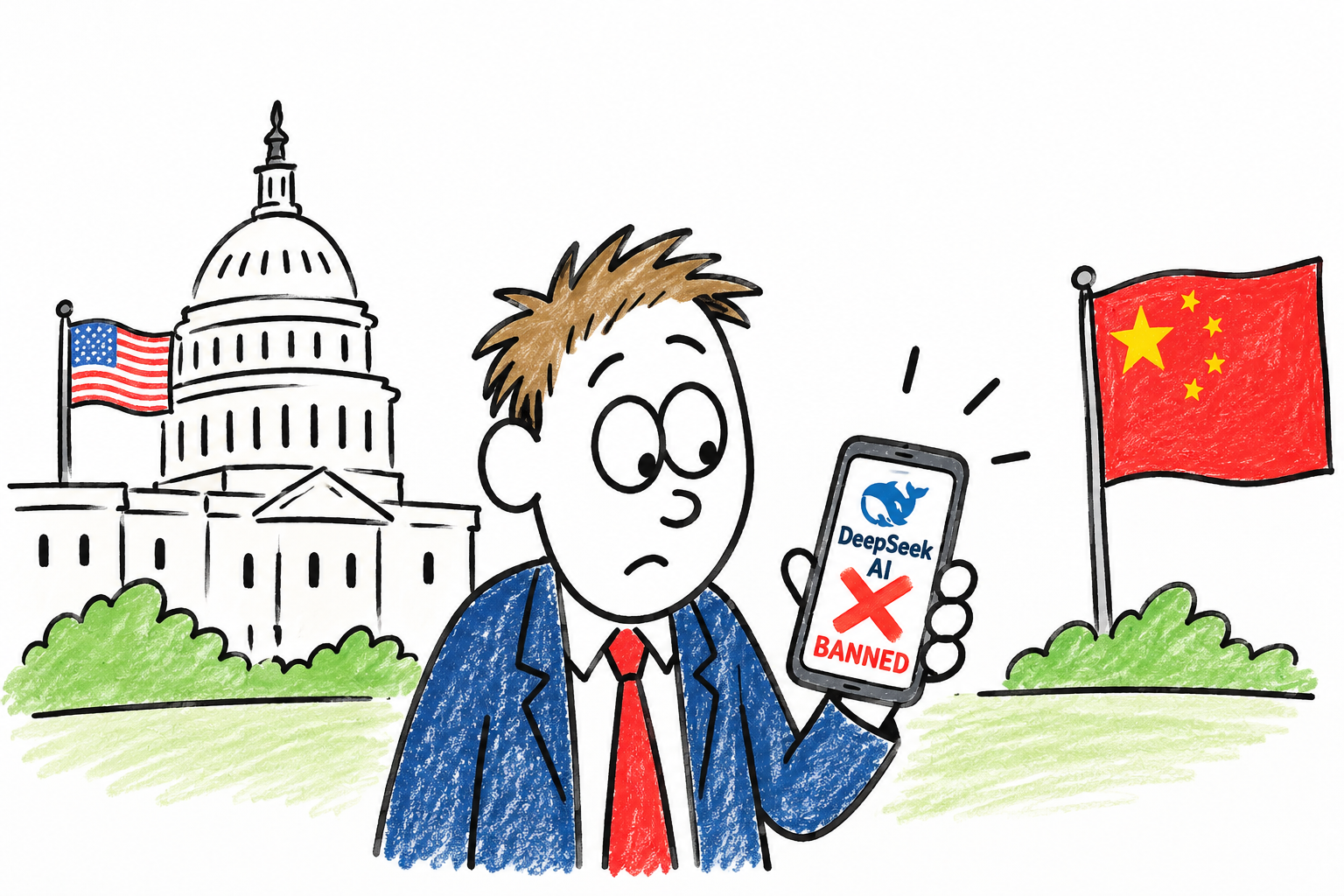
The United States has ordered federal civilian government agencies to remove artificial intelligence technology developed by China’s DeepSeek from their computer systems, escalating concerns over national security and the growing technological rivalry between Washington and Beijing.
DHS restrictions
The Department of Homeland Security (DHS) reportedly announced the order on 19th October 2026, prohibiting affected agencies from purchasing DeepSeek products and services.
The restrictions also extend to third-party products and services built using the Chinese company’s AI models. The move follows an earlier order signed in July 2026.
U.S. officials have raised concerns that using DeepSeek could expose sensitive government information to Chinese authorities.
The DHS notice also warns of potential cybersecurity vulnerabilities and the possibility that the technology could be used to gather intelligence on American individuals and government organisations.
The restrictions apply to federal civilian agencies rather than constituting a nationwide ban on DeepSeek. They do not automatically prevent private individuals and businesses in America from using the service.
DeepSeek Attention
DeepSeek attracted international attention in 2025 when its AI models demonstrated impressive capabilities at comparatively low development and operating costs.
Its emergence challenged assumptions about the enormous financial investment required to compete with leading American AI developers.
That success has added another dimension to the struggle for technological supremacy. Washington is seeking to protect sensitive information and maintain America’s advantage in artificial intelligence, while China continues to develop its domestic technology industry.
Critics
The decision also raises questions about the future of global AI competition. Governments increasingly view advanced AI not simply as a commercial opportunity, but as a strategic asset with implications for intelligence, cybersecurity, economic growth and military capabilities.
Critics of restrictions on Chinese technology may argue that excluding competing products could limit choice and innovation. Supporters counter that governments must take precautionary measures when national security and confidential information are at stake.
For the technology industry, the latest move reinforces the likelihood of a more fragmented AI market, with governments placing greater emphasis on trusted suppliers and domestic capabilities.
As competition intensifies, the challenge will be balancing security concerns with innovation, affordability and international cooperation.