

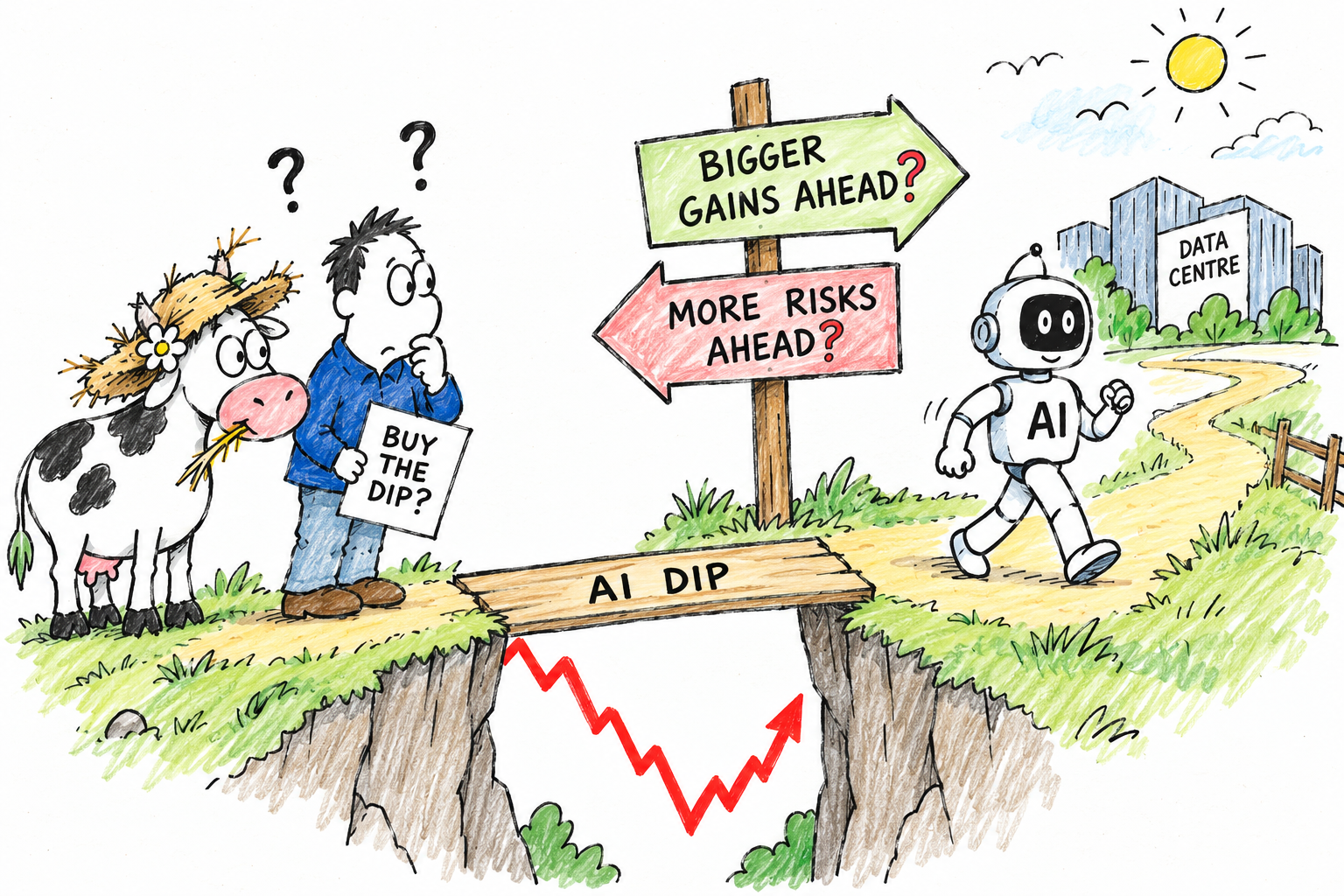
The recent dip in U.S. artificial intelligence shares has raised the familiar question of whether investors should use weakness to buy into the sector.
Pullback?
However, the pullback has so far been relatively small compared with the gains made during the AI rally. Rather than signalling the end of the boom, it could simply represent a pause in an extraordinary bull market.
Yet there are reasons to remain cautious. A modest decline does not necessarily mean shares have become cheap, particularly when valuations already reflect ambitious expectations for future growth.
Powerful Argument
The bullish case for AI remains powerful. Major technology companies continue to invest heavily in data centres, advanced semiconductors and computing infrastructure.
AI adoption is spreading across industries, with the potential to improve productivity, reduce costs and create entirely new revenue streams.
Companies capable of converting this demand into sustained earnings growth could continue to reward investors over the longer term.
To dip or not to dip?
For those who missed the earlier rally, a market dip may offer an opportunity to establish or increase positions. If corporate earnings continue to expand and AI spending remains robust, today’s prices could eventually look attractive. But only if company earnings accommodate.
However, the risks have not disappeared. The sums being committed to AI infrastructure are enormous, and investors must consider whether the eventual returns will justify the expenditure.
It’s all about the data
Data centres require vast amounts of electricity, while borrowing costs, infrastructure constraints and intensifying competition could affect profitability.
There is also the question of valuation. Even if AI transforms the global economy, shareholders can still lose money if they pay too much for that growth.
Companies may deliver impressive results yet disappoint markets if those results fall short of increasingly demanding forecasts.
Higher bond yields could add another complication, putting pressure on highly valued growth shares.
Meanwhile, if technology companies begin to question the returns from their spending, investment plans could be scaled back, affecting chipmakers and other suppliers throughout the AI ecosystem.
Premature?
For now, it would be premature to interpret a relatively small pullback as evidence that the AI boom is unravelling. Equally, investors should not assume that every dip represents a bargain.
The coming months will test whether AI spending translates into sustainable profits rather than simply higher capital expenditure and increasingly ambitious promises.
The AI revolution may still have considerable room to run. But the real investment opportunity lies not in buying every dip, but in identifying which companies can turn technological promise into lasting financial returns.