
Nvidia’s shares have reached a record peak as the company continues to benefit from the surging demand for its AI chips
Tech giants such as Microsoft, Meta, Google, and Amazon are acquiring Nvidia’s GPUs in large volumes to create extensive AI computing clusters.
Nvidia, with a market capitalisation of around $3.4 trillion, ranks as the second most valuable publicly traded company in the U.S., trailing behind Apple, which has a market cap of approximately $3.55 trillion.
Oh, the volatility of tech stocks, don’t you just love it?
The company’s stock rose by 2.4% to close at $138.07, exceeding the previous high of $135.58 set on 18th June 2023. The shares have increased by nearly 180% this year and have experienced a more than ninefold increase since early 2023.
Regarded as the leading supplier in the AI revolution, Nvidia has gained significantly from the generative AI surge initiated by OpenAI’s ChatGPT release in November 2022. Nvidia’s GPUs are instrumental in developing and running sophisticated AI models, including those that operate ChatGPT and related platforms.
You can’t go far wrong when big players such as Microsoft, Meta, Google and Amazon are buying your stuff.
According to the Bloomberg Billionaires Index, Meta CEO Mark Zuckerberg has overtaken Jeff Bezos as the world’s second-richest person
Zuckerberg’s wealth surged by $78 billion in 2024, a rise unmatched by any other member of the index’s 500 richest individuals, thanks to his 13% stake in Meta.
Throughout the year, Wall Street has applauded Meta as the company’s quarterly earnings have consistently exceeded analysts’ expectations.
On Thursday 3rd October 2024, Zuckerberg’s net worth hit $206.2 billion, as per the Bloomberg Billionaires Index, surpassing the $205.1 billion fortune of the ex-Amazon CEO and president. The co-founder of Facebook is now approximately $50 billion behind Tesla’s Elon Musk, according to the index.
Bloomberg Billionaires Index as of 3rd October 2024
Fact: Apparently Mark Zuckerberg says he plans to give away 99% of his Facebook shares.
Meta, the parent company of Instagram, has announced that voices of Dame Judi Dench and John Cena will be available as options for its AI chatbot.
Moreover, users can access information through AI representations of celebrities such as Awkwafina, Keegan-Michael Key, and Kristen Bell. Meta is hopeful that this new endeavour with celebrity chatbots will surpass the success of its previous attempts. In September 2023, Meta introduced AI chatbots featuring the ‘personalities’ of celebrities including Kendall Jenner and Snoop Dogg, but the project was terminated within a year.
At Meta’s annual Connect conference, CEO Mark Zuckerberg announced the new celebrity chatbot project, remarking, ‘Interacting with AI through voice will be more intuitive than through text.‘ The enhanced ChatGPT-style chatbot will also be capable of recognizing objects in images and providing relevant details. Additionally, a novel image editing tool will allow users to alter photos by simply directing the Meta AI with their requests.
Meta has disclosed that its AI now reaches over 400 million people monthly, with 185 million engaging weekly.
Artificial Intelligence (AI) has become a pivotal battleground in the technological race between China and the United States.
“AI is expected to become a crucial component of economic and military power in the near future,” Stanford University’s Artificial Intelligence Index Report 2023 stated.
Both countries are significantly investing in AI research and development, striving to achieve a leading role in this revolutionary sector. This post looks at the major figures in China’s AI scene, their progress, and their comparison with their American counterparts.
China’s AI Landscape
China’s AI aspirations are propelled by a number of significant technology firms, each forging their own AI models and applications.
Baidu: Often referred to as the ‘Google of China,’ Baidu leads in AI development. Its premier AI model, ERNIE (Enhanced Representation through Knowledge Integration), fuels the Ernie Bot, a chatbot aimed to compete with OpenAI’s ChatGPT. Baidu asserts that ERNIE 4.0 matches GPT-4’s capabilities, demonstrating sophisticated understanding and reasoning abilities.
Alibaba: Alibaba’s AI model, Tongyi Qianwen (commonly known as Qwen), is a comprehensive set of foundational models adept at a range of tasks, from generating content to solving mathematical problems. Select versions of Qwen are open-source, enabling developers to utilize and modify them for various uses. Alibaba has announced that Qwen models are in use by over 90,000 enterprise clients.
Tencent: The Hunyuan model from Tencent is a prominent component of China’s AI landscape. Offered through Tencent’s cloud computing division, Hunyuan is tailored to facilitate a broad spectrum of applications, encompassing natural language processing and computer vision.
Huawei: In spite of considerable obstacles stemming from U.S. sanctions, Huawei persists in AI innovation. The firm has created its own AI processors, like the Kunlun series, to diminish dependence on international technology. Huawei’s AI features are incorporated into a diverse array of products, including smartphones and cloud solutions.
Comparison to the U.S.
The U.S. continues to be a dominant force in AI, with leading companies such as OpenAI,Microsoft, Google, Anthropic and Meta spearheading advancements.
Generative AI: U.S. firms have advanced significantly in generative AI, with OpenAI’s GPT-4 and Google’s Gemini at the forefront. These models excel in creating text, images, and videos from user inputs. Although Chinese models like ERNIE and Qwen are strong contenders, the U.S. maintains a slight lead in capabilities and market penetration.
Semiconductor Design: The U.S. leads the semiconductor design industry, vital for AI progress. U.S. companies command an 85% global market share in chip design, crucial for AI model training and system operation. China’s dependence on imported semiconductors is a notable obstacle, but there are ongoing efforts to create homegrown solutions.
Research and Innovation: Both nations boast strong AI research sectors, yet the U.S. edges out slightly in generating state-of-the-art AI products. U.S. tech giants frequently introduce AI breakthroughs to the market, with Chinese firms quickly gaining ground.
Government Support: The Chinese government ardently backs AI advancement, enacting strategies to spur innovation and lessen foreign tech reliance. Such support has spurred China’s AI industry’s rapid expansion, positioning it as a strong rival to the U.S.
Conclusion
The competition in AI development between China and the U.S. is escalating, as both countries achieve significant breakthroughs. Although the U.S. maintains a marginal lead in some respects, China’s swift advancement and state backing indicate that the disparity might keep closing. The quest for AI dominance by these nations is set to influence the worldwide technological and innovative landscape profoundly.
As of September 2024, it is estimated that China’s AI development is approximately nine months behind that of the U.S.
Major technology corporations such as Microsoft, Alphabet, and Meta are channelling billions into data centre infrastructures to bolster generative AI, which is causing a spike in energy demand.
Sustainable Metal Cloud has announced that its immersion cooling technology is 28% less expensive to install compared to other liquid-based cooling methods and can cut energy use by up to 50%.
The surge in artificial intelligence has increased the need for more robust processors and the energy to cool data centres.
This presents an opportunity for Sustainable Metal Cloud, which runs ‘sustainable AI factories’ consisting of HyperCubes located in Singapore and Australia.
These HyperCubes house servers equipped with Nvidia processors immersed in a synthetic oil known as polyalphaolefin, which is more effective at dissipating heat than air. The company claims this technology can reduce energy consumption by as much as 50% when compared to the conventional air-cooling systems found in most data centres.
Additionally, the Singapore-based company states that its immersion cooling technology is more cost-effective to install by 28% than other liquid cooling options. The HyperCubes are modular and can be integrated into any data centre, utilising spaces that are currently unoccupied within existing facilities.
What is a Hypercube?
Structure: A hypercube topology connects nodes in a way that each node is connected to others in a manner similar to the geometric hypercube. For example, in a 3-dimensional hypercube (a cube), each node is connected to three other nodes.
Scalability: This structure allows for efficient scaling. As the number of dimensions increases, the number of nodes that can be connected grows exponentially.
Fault Tolerance: Hypercube networks are known for their robustness. If one connection fails, there are multiple alternative paths for data to travel, ensuring reliability.
Benefits in data centres
High Performance: The multiple pathways in a hypercube network reduce latency and increase data transfer speeds, which is crucial for big tech companies handling vast amounts of data.
Efficient Resource Utilisation: The topology allows for better load balancing and resource allocation, optimising the performance of data centres.
Flexibility: Hypercube networks can easily adapt to changes in the network, such as adding or removing nodes, without significant reconfiguration.
Big Tech Companies: Companies like Google, Amazon, and Microsoft likely use hypercube topologies in their data centres to ensure high performance and reliability.
High-Performance Computing (HPC): Hypercube networks are also used in supercomputers and other HPC environments where efficient data transfer is critical.
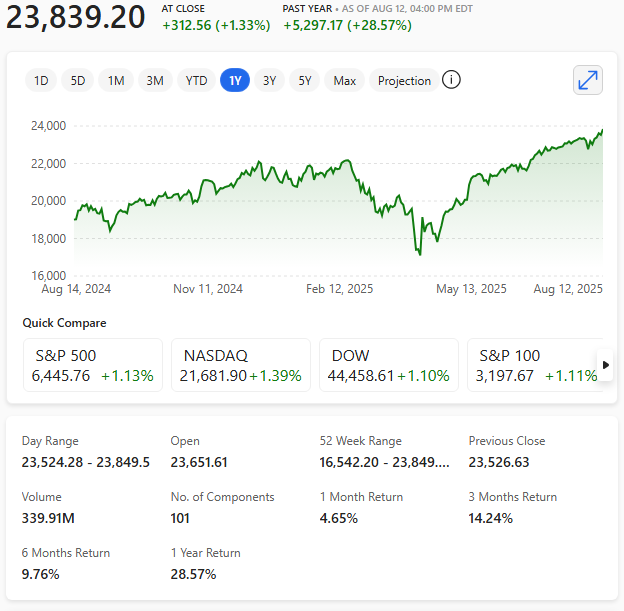
During the day, the Dow had surged around 480 points, the S&P 500 had climbed 1.73%, and the Nasdaq had risen over 2%.
Dow Jones one day chart 7th August 2024
S&P 500 one day chart 7th August 2024
Nasdaq Composite one day chart 7th August 2024
However, a downturn in Nvidia and other major tech stocks, after an initial rise, led to a significant drop in the afternoon. Nvidia retracted by 5.1%, Super Micro Computer plummeted 20.1% following its fiscal Q4 earnings missing analyst predictions, Tesla fell 4.4%, and Meta Platforms decreased by 1%.
Nvidia one day chart 7th August 2024
One month chart Super Micro Computer 7th August 2024
Nvidia one day chart 7th August 2024
The U.S.10-year Treasury yield continued to rise, increasing by about six basis points to 3.95%, returning to its level before the disappointing job figures last Friday, which had sparked concerns of an economic slowdown.
The Volatility Index (CBOE), the so called ‘fear gauge‘ was trading at around 29, having dropped to as low as 22 earlier in the day. This sharp decrease from Monday 5th August 2024 suggests that investor fears are subsiding, however, they remain higher than at the beginning of the month.
A U.S. judge has ruled that Google illegally maintained a monopoly in online searches and related advertising. The lawsuit, brought by the Department of Justice, charged Google with controlling around 90% of the online search market.
It was reportedly noted by the judge that Google’s billions of dollars in investments to become the default search engine on smartphones and browsers could be anticompetitive.
The decision, issued on Monday 5th August 2024, could potentially change how tech giants operate.
It was reported that in his extensive 277-page decision, Judge Mehta remarked, “Google has acted as a monopolist and engaged in anticompetitive practices to maintain its monopoly.”
This represents a significant victory for federal antitrust enforcers who have pursued similar cases against other leading technology companies for illegal monopolistic behaviours.
Companies like Meta Platforms, which operate Facebook and WhatsApp, as well as companies like Amazon and Apple., have also faced lawsuits from federal regulators.
The judgment comes after a 10-week trial where it was argued that Google’s substantial payments to remain the primary search engine have impeded the competition’s ability to challenge effectively.
This is a seismic shift in the way search engines and advertising may operate in the future. Already with the advent of AI, search engines look and feel different.
The seven most valuable U.S. tech companies experienced a combined loss of $1 trillion in market value at the start of Monday’s trading session – 5th August 2024
The Nasdaq declined over 3% following its sharpest three-week drop in two years.
Nvidia’s shares fell approximately 6%, while Apple’s dropped more than 4%.
On Monday, as the U.S. markets commenced trading, the market capitalization of the largest tech companies plummeted by about $1 trillion, exacerbating a decline that pushed the Nasdaq into correction territory the previous week.
Markets go up and markets go down
In early trade Nvidia’s market cap decreased by over $300 billion, but it swiftly regained about half of that loss. The chipmaker’s shares ultimately closed down 6.4%, equating to a $168 billion loss. Apple and Amazon saw their valuations fall by $224 billion and $109 billion at market open. Apple’s market cap finished 4.8% lower, a $162 billion decrease. Amazon’s valuation fell by 4.1% at closing, a $72 billion reduction.
Including significant drops in Meta, Microsoft, Alphabet, and Tesla, the top seven tech giants saw a $995 billion loss in market value in the initial moments of trading, although they did recover somewhat as the day went on.
Amazon offers weak guidance citing Olympics and the Trump assassination attempt as cause (consumers are distracted). However, Amazon’s cloud unit reports 19% revenue growth, topping estimates and a 20% increase in business in Q2. Amazon stocks pull back after guidance update.
Intelendures a 22% share plunge dragging down other global microchip stocks from TSMC, ASML to Samsung. Company to cut 15% of workforce, reports quarterly guidance miss.
Meta shares climb 6% on positive earnings data and good revenue forecast. Zuckerberg enthused over AI and how it’s helping create profits suggesting ‘Meta’s advertising growth is proof that BIG AI spending is already paying off.’ However, Meta’s Reality Labs posts $4.5 billion loss in second quarter.
Nintendo profit falls 55% as sales of its ageing Switch console plunge. Nintendo revenue and profit plunged in Q1 as sales of its ageing Switch console decline. Nintendo sold 2.1 million units of its Switch consoles, down 46% on the year. Investors are seeking news surrounding a successor to the Nintendo Switch console.
Apple sales climbed 5%, topping estimates as iPad and services revenue lift despite ongoing issues with iPhone sales slipping in China. Apple is spending more on AI but remains way behind its peers.
Snap shares plunge more than 20% on weak guidance.
Qualcomm beats estimates as phone microchip sales up 12%.
Samsung Q2 revenue and profit comes in above estimates amid strong AI demand.
AMDjumps 5% as global microchip stocks rally. Data centre sales doubled.
To put this figure into some perspective, the loss is comparable to the GDP output of a small country, such as Norway, Singapore, or the UAE, for example.
Global semiconductor stocks experienced volatility on Tuesday following a decline in Nvidia’s shares from the previous trading sessions.
Shares of chip firms in Europe and Asia fell in early trade as investors reacted to Nvidia losing more than $500 billion in market capitalization over three trading days. Some of the stocks recouped losses, however, as shares in the U.S. chipmaking giant recovered around 6 – 6.5% as of Tuesday 25th June 2024.
This follows a significant drop in Nvidia’s share value, which fell 13% over three consecutive sessions from the record highs achieved on Thursday 20th June 2024.
On Monday 24th June 2024, Nvidia’s stock closed down 6.7%, marking its second-largest decline of the year, yet the shares began to recover in early trading on Tuesday 25th June 2024.
Last week, the company surpassed Apple and Microsoft to become the most valuable U.S. company, achieving a market capitalization of over $3.4 trillion. However, by the end of Monday, Nvidia’s market value had declined by more than $540 billion from its intraday record on Thursday 20th June 2024.
Nvidia reported that the demand for its highly sought-after artificial intelligence graphics processing units (GPUs) continues to be strong.
Companies such as Microsoft, Google, Amazon, and Meta are investing billions of dollars in these chips to enhance their data centres and cloud services.
Nvidia, traditionally recognised within the gaming community for its graphics chips, has become the world’s most valuable publicly traded company.
On Tuesday 18th June 2024, Nvidia’s shares rose by 3.6%, increasing its market cap to $3.34 trillion and overtaking Microsoft, now valued at $3.32 trillion. Earlier in the month, Nvidia’s valuation reached $3 trillion for the first time, surpassing Apple.
Nvidia $3.34 trillion market cap
So far this year, Nvidia’s shares have surged over 170% and saw further gains after announcing first-quarter earnings in May 2024. Since the close of 2022, the stock has increased more than ninefold, paralleling the rise of generative artificial intelligence.
Apple’s shares dropped by 1.1% on Tuesday, resulting in a market value of $3.29 trillion for the tech giant.
Nvidia commands roughly 80% of the market share for AI chips in data centres, a sector that has expanded rapidly as companies like OpenAI, Microsoft, Alphabet, Amazon, and Meta have competed to acquire the necessary processors for constructing AI models and managing growing workloads.
In the latest quarter, Nvidia’s data centre business saw a 427% increase in revenue from the previous year, reaching $22.6 billion and comprising approximately 86% of the company’s total sales.
Established in 1991, Nvidia initially focused on hardware, selling gaming chips for running 3D games. The company has also ventured into cryptocurrency mining chips and cloud gaming services.
However, in the last two years, Nvidia’s stock has soared as investors recognised its pivotal role in the AI boom, a trend that continues to accelerate. This surge has increased the net worth of co-founder and CEO Jensen Huang to an estimated $117 billion, ranking him as the 11th richest individual globally, according to Forbes.
But is the rise too fast and is it time for a share price valuation adjustment in its meteoric rise, to bring it back down to Earth?
Intel announced its new Xeon 6 processors at the Computex tech conference in Taiwan on Tuesday 4th June 2024.
This announcement coincides with the recent launches of new artificial intelligence chips by rivals Nvidia and AMD on Sunday and Monday 2nd and 3rd June 2024 – as they compete for dominance in the rapidly growing industry.
Intel is making efforts to catch up with Nvidia and AMD, having been relatively absent from the AI surge that led tech giants such as Meta, Microsoft, and Google to purchase a significant number of Nvidia chips.
This comes half a year after Intel’s release of its 5th Gen Intel Xeon processors for data centre workloads and a couple of months following the announcement of the Gaudi 3 processor for AI model training and deployment.
Intel also disclosed that the Gaudi 2 and Gaudi 3 AI accelerators are priced lower than those of its competitors.
Furthermore, Intel shared architectural details of its forthcoming Lunar Lake processors, aimed at expanding the AI PC category. These processors, slated for release in the third quarter, are set to rival Nvidia’s and AMD’s offerings tailored for AI PCs.
While Nvidia and AMD focus on chip design, Intel stands out by both designing and manufacturing its chips. Nevertheless, Intel’s foundry business has faced challenges, with its operating loss widening to $7 billion in 2023 compared to the previous year.
AMD announced new artificial intelligence chips on Monday 3rd June 2024, aiming to position itself as a leader in the market alongside competitors such as Nvidia and Intel.
“AI is our number one priority and we’re at the beginning of an incredibly exciting time for the industry as AI transforms virtually every business, improves our quality of life, and reshapes every part of the computing market,” chair and CEO Lisa Su reportedly commented during the Computex tech conference.
The company unveiled the Ryzen AI 300 series for next-generation AI laptops. The line is anticipated to compete directly with Intel’s upcoming Lunar Lake and Qualcomm’s Snapdragon X. And in partnership with Microsoft, these new AI chips will power laptops equipped with the tech giant’s AI chatbot Copilot.
AMD has unveiled the new Ryzen 9000 series for desktops, inferred as ‘the world’s fastest consumer PC processors’ for gaming and content creation.
The series is due for release in July 2024, following closely on the heels of AMD’s April announcement of new processors capable of running AI workloads – the Ryzen Pro 8040 for laptops and the Ryzen Pro 8000 for desktops.
Meta Platforms Inc. suffered a serious loss, witnessing its market value plummet by $200 billion.
The decline happened following the company’s first-quarter earnings call, during which CEO Mark Zuckerberg highlighted the company’s substantial investments in artificial intelligence (AI) and the Metaverse, instead of concentrating on immediate revenue streams.
Despite a 27% increase in revenue to $36.46 billion and a net income that more than doubled to a $12.37 billion (rounded), investors were unsettled by the company’s projections for future expenses.
Shares dropped by 15.5% as Zuckerberg outlined expensive future projects, including the expansion of business messaging and the integration of ads into AI interactions.
Meta’s stock took a 15% hit in extended trading, bringing its market capitalization down to around $1.2 trillion, still a high valuation. This highlights the unpredictable nature of tech stocks, especially during significant, unmonetized product development stages.
Meta 1 day chart 24th April 2024
Zuckerberg’s prioritization of long-term growth over immediate profits is a gamble, placing a bet on AI and the Metaverse to transform digital interactions.
This strategy carries considerable financial risks, as the recent market reaction has shown. Meta’s future now depends on the successful deployment and monetization of these cutting-edge technologies.
Meta’s complimentary artificial intelligence (AI) assistant, known as Meta AI, is being introduced across its social media platforms, including WhatsApp, Instagram, Facebook, and Messenger.
The assistant is reportedly designed to respond to queries, craft animations, and produce ‘high-quality’ images, according to Meta CEO Mark Zuckerberg in a recent video posting.
Zuckerberg also noted that the company has integrated ‘real-time knowledge’ from Google and Microsoft’s Bing to enhance the assistant’s responses.
The development of MetaAI is based on the company’s most advanced large language model, Meta Llama 3, which was unveiled on the same day – Thursday 18th April 2024.
On Monday, 25th March 2024, the European Union initiated its first investigation under the new Digital Markets Act, targeting Apple, Alphabet, and Meta for potential tech legislation breaches.
Statement
“Today, the Commission has opened non-compliance investigations under the Digital Markets Act (DMA) into Alphabet’s rules on steering in Google Play and self-preferencing on Google Search, Apple’s rules on steering in the App Store and the choice screen for Safari and Meta’s ‘pay or consent model” – the Commission said in a statement.
The Magnificent Seven, or MAMA ANT, is a term coined by Bank of America to describe the seven most dominant tech companies in the world
The Seven are: Microsoft, Amazon, Meta Platforms, Apple, Nvidia, Tesla, and Alphabet. These companies have not only led the tech sector in terms of innovation, growth, and profitability, but have also become some of the most valuable entities in the world by market capitalization.
Valuation at $15 trillion
Market capitalization, or market cap, is the total value of all the shares of a company that are traded on the stock market. It reflects the market’s perception of the company’s future prospects and earnings potential.
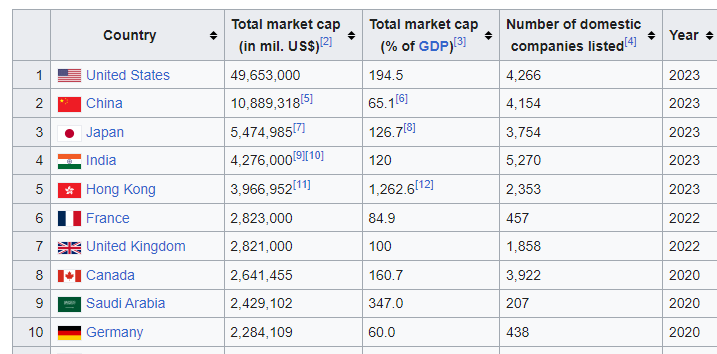
As of January 2023, the Magnificent Seven had a combined market cap of about $15 trillion, which was more than the gross domestic product (GDP) of almost every country in the world, except for the United States, China and Japan (just).
Magnificent Seven
The Magnificent Seven have achieved such a remarkable feat by leveraging their core competencies in various fields of technology, such as artificial intelligence (AI), cloud computing, social media, e-commerce, gaming, electric vehicles, and online advertising. They have also diversified their revenue streams by acquiring or developing new products and services, such as Activision Blizzard, AWS, Oculus, iPhone, GeForce, SpaceX, and YouTube. They have also benefited from the increased demand for digital solutions amid the Covid-19 pandemic, which accelerated the adoption of online platforms, remote work, and entertainment.
Challenges
However, the Magnificent Seven also face some challenges and risks that could threaten their dominance and valuation. These include increasing competition from other tech companies, especially from China, such as Alibaba, Tencent, Baidu, and Huawei.
They also face regulatory scrutiny and pressure from governments and consumers over issues such as antitrust, privacy, taxation, content moderation, and environmental impact. Furthermore, they may encounter technical difficulties, security breaches, or ethical dilemmas that could damage their reputation and customer trust.
Conclusion
In conclusion, the Magnificent Seven are the most powerful and influential tech companies in the world, and their market cap surpasses that of almost every country in the world.
List of 10 countries by stock market capitalization
List of 10 countries by stock market capitalisation
The meteoric rise in the profits and market capitalisations of the Magnificent 7 U.S. tech giants: Apple, Amazon, Alphabet, Meta, Microsoft, Nvidia and Tesla – outstrip those of all listed companies in almost every G20 country. Of the non-U.S. G20 countries, only China and Japan (and the latter, only just) have greater profits when their listed companies are combined.
They have achieved this by exploiting their competitive advantages in various domains of technology and expanding their offerings and markets. However, they also need to overcome some challenges and risks that could hamper their growth and value in the future.
A forced size reduction to stop the monopolising of market share could help tame these beasts too and open up fairer competition.
Should we worry?
Basically, yes, we should be concerned about the size and dominance of these companies.
This level of wealth and power concentrated in just a handful of companies has led some analysts to voice concerns over related risks in the U.S. and global stock markets.
Economists and stock market analysts have cautioned that the U.S. stock market is rivalling 2000 and 1929 in terms of being at its most concentrated in history.
Facebook, the social media giant that connects billions of people around the world, celebrated its 20th anniversary on February 4, 2024.
Founded by Mark Zuckerberg and his fellow Harvard students in 2004, Facebook has grown from a college network to a global phenomenon, with over 3 billion monthly users and counting.
Facebook has also changed the way we communicate, share, and connect with each other online, enabling us to keep in touch with friends and family, discover new content and communities, and express ourselves freely.
Controversy
However, Facebook has also faced many controversies and challenges over the years, such as privacy issues, misinformation, child safety, and political scrutiny. Facebook has been accused of violating user data, spreading fake news and hate speech, enabling cyberbullying and online abuse, and influencing elections and public opinion.
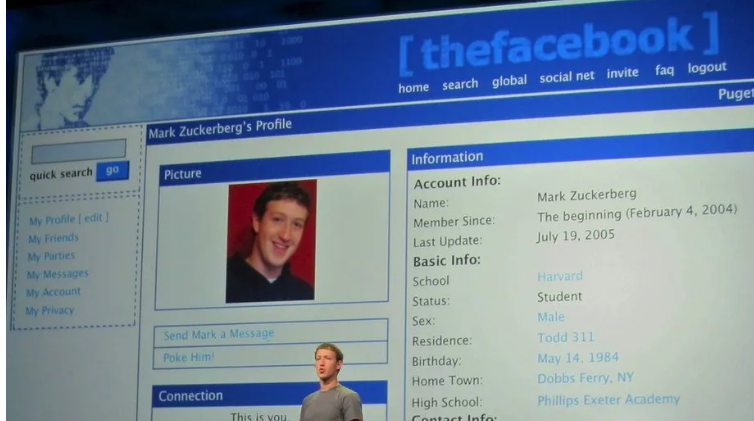
How ‘the’ facebook looked 20 years ago
Facebook has also faced competition from other platforms, such as TikTok, Snapchat, and X, as well as regulatory pressure from governments and activists.
Evolving
As Facebook turns 20, it is still evolving and expanding under its parent company Meta, which also owns Instagram and WhatsApp. Meta’s vision is to create a metaverse, a virtual reality where people can interact and experience immersive digital worlds. Meta also aims to invest in artificial intelligence, blockchain, and cloud computing, as well as social good initiatives, such as connectivity, education, and health.
Facebook’s future is uncertain, but it is undeniable that it has shaped the history and culture of the internet and the world, for good and bad.
See BIG tech results here as Meta share price gains 20% after positive earnings impress Wall Street.
Mark Zuckerberg is currently the third richest person in the work coming with a wealth of $161 billion. Not a bad income for 20 years’ work.
It was a good day of earnings for Big Tech companies.
Three of the Magnificent 7 results dominated the headlines: Meta, Amazon and Apple. Nasdaq and S&P 500 gained in ‘after the bell’ trading. This after a punishing day for Alphabet and Microsoft, despite good results.
Nasdaq 100 closed at: 17344 but climbed above 17500 in after-hours trading.
Wall Street seemed impressed with Meta’s results.
Meta
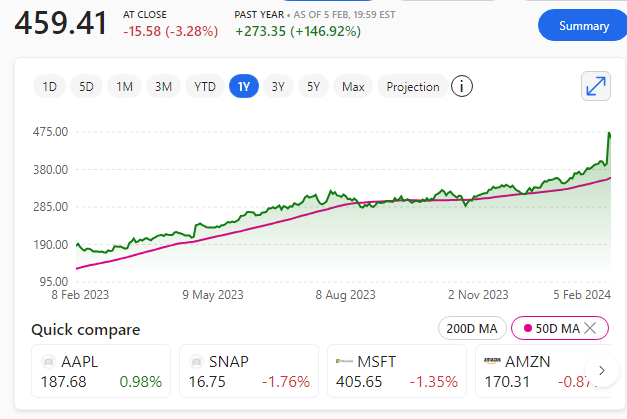
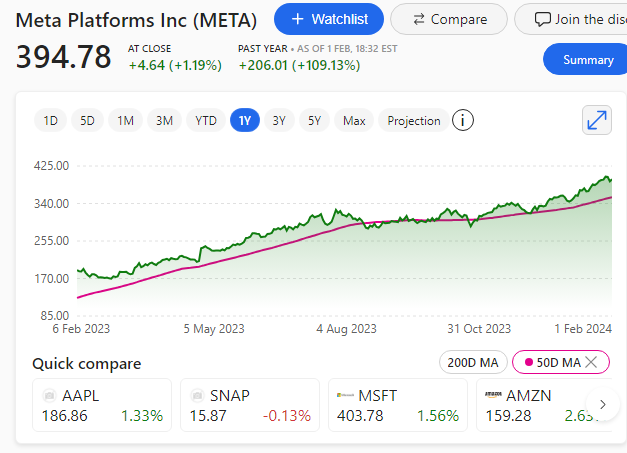
Shares of Meta surged 15% after the social-media giant defied analysts’ estimates. It posted earnings of $5.33 per share on revenue of $40.11 billion. The company also declared its first-ever dividend payment. Share buy-back was also announced.
Meta platforms Inc. One year chart
The results show Meta’s online ad business continues to recover well from a terrible 2022.
Sales in the Q4 jumped 25% year on year.
Expenses decreased 8% year over year to $23.73 billion.
Amazon
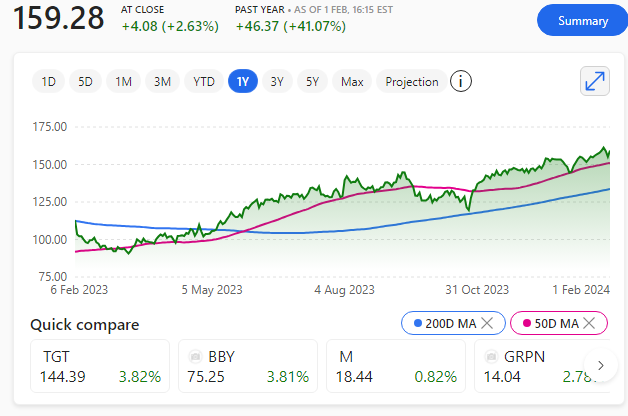
Investors also enjoyed Amazon’s earnings, which easily topped Wall Street’s predictions. The ecommerce giant also provided a strong positive outlook. The stock jumped 7% in extended trading.
Amazon.com Inc. One year chart
Q4 was a record-breaking Holiday shopping season in the U.S. and closed out a robust 2023 for Amazon. Amazon has much planned for 2024.
Apple
But Apple didn’t benefit from the same treatment despite posting strong results.
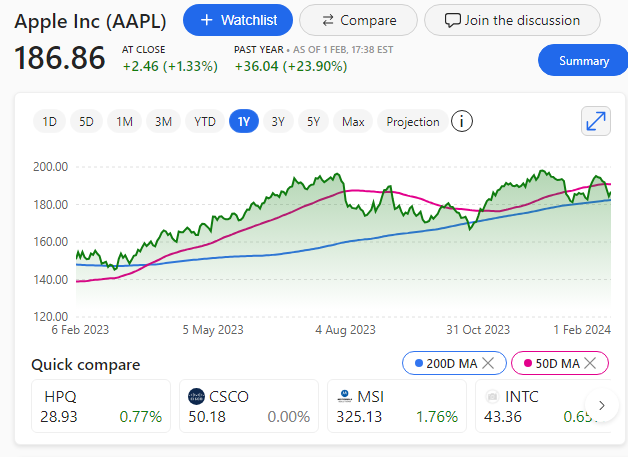
Apple Inc. One year chart
Apple also exceeded estimates, reporting revenue growth for the first time in a year. But shares slid more than 2% in extending trading after it posted a 13% decline in sales in China.
Apple’s outlook suggesting weak iPhones sales may have also disappointed investors.
U.S. microchip giant Advanced Micro Devices (AMD) is investing in AI PCs to take on the likes of Nvidia and Intel and Arm as the AI race gains momentum.
As the AI market expands so too will AI powered personal computer (PC). These are personal computers embedded with processors specifically designed to perform AI functions such as real-time language translation. Intel has already announced its AI powered chip for the PC.
Tech research firm Canalys in a December report said the boom in generative AI is expected to boost PC sales as consumers are seeking devices with AI features, predicting that 60% of the PCs shipped in 2027 will be AI-capable.
AI tech interest explodes
An explosion of interest in AI was sparked by the launch of ChatGPT in November 2022 as the chatbot went viral for its ability to generate human-like responses to users’ prompts.
Microsoft was quick to adopt the Technolgy and incorporate AI into its Bing search engine. Other companies such as Amazon, Alphabet (Google), Arm, Meta, Tesla and Apple are all heavily involved in AI development too.
The Magnificent Seven is a term coined to describe the seven most valuable and popularly owned tech companies in the U.S. stock market.
It was also a 1960’s movie…
The Seven
Apple (AAPL)
The world’s largest software company, known for its iPhone, iPad, Mac, Apple Watch, AirPods, and other devices, as well as its services such as iCloud, Apple Music, Apple TV+, and App Store.
Microsoft (MSFT)
The world’s largest software company, known for its Windows operating system, Azure cloud services, LinkedIn social media platform, Office professional software suite, and Xbox gaming brand.
Alphabet (GOOGL)
The parent company of Google, the world’s leading search engine, as well as other businesses such as YouTube, Google Cloud, Google Maps, Google Ads, and Waymo.
Amazon (AMZN)
The world’s largest online retailer, as well as a leading provider of cloud computing services through Amazon Web Services (AWS), and a major player in digital entertainment through Amazon Prime Video, Amazon Music, and Kindle.
Meta Platforms (META)
The former Facebook, the world’s largest social media network, as well as the owner of other popular platforms such as Instagram, WhatsApp, Messenger, and Oculus.
Nvidia (NVDA)
The world’s leading manufacturer of graphics processing units (GPUs), which are used for gaming, artificial intelligence, cloud computing, and cryptocurrency mining, as well as other products such as Nvidia Shield, GeForce Now, and Omniverse.
Tesla (TSLA)
The world’s most valuable automaker, known for its electric vehicles, battery products, solar panels, and self-driving technology, as well as its visionary founder and CEO, Elon Musk.
Market dominance
These seven companies are not only dominant in their respective fields, but also at the forefront of innovation and growth in the tech sector. They collectively make up some 30% of the S&P 500 index and more than half of the Nasdaq 100 index.
They have also delivered impressive returns for investors over the past five years, with Nvidia and Tesla leading the pack with more than 800% gains. The Magnificent Seven are often compared to the FAANG stocks, which include four of the seven companies, but exclude Microsoft, Nvidia, and Tesla, and include Netflix instead.
Some analysts suggest that the Magnificent Seven capture the current state and future potential of the tech industry. But is it now time to rotate out of tech into other areas that have been neglected. I wouldn’t be surprised to see the bull market charge on but with other ‘less’ loved companies leading the way.
It has been calculated that the combined market cap value of these seven companies is some $9 trillion.
The metaverse is a hypothetical concept that has not yet been fully realized, but many experts and companies are working on developing it. Mark Zuckerberg is one of these ‘believers’.
Future challenge
The metaverse is quite likely to happen in the future, as technology advances and demand for immersive and interactive online experiences grows. Ai will help develop the metaverse at a greater speed.
However, there are also many challenges and uncertainties that could affect the development and adoption of the metaverse, such as interoperability, privacy, regulation, social issues, and user safety. Therefore, it is hard to predict when and how the metaverse will become a mainstream platform. Some estimates suggest that it could take another 10 to 15 years for the metaverse to reach its full potential.
What does Meta have to say about the Metaverse?
Meta and Mark Zuckerberg think that the metaverse is the next evolution of social technology and the successor to the mobile internet. They believe that the metaverse will enable people to feel present and connected with others in immersive and interactive digital spaces, where they can socialize, learn, work, play, and create. They also think that the metaverse will be a collaborative and open platform, where different companies and creators can build and interoperate with each other.
Product investment
Meta is investing heavily in developing the technologies and tools that will power the metaverse, such as virtual and augmented reality devices, software, and content.
Mark Zuckerberg has shared his vision and enthusiasm for the metaverse in various interviews and events, such as the Protocol interview, Connect 2021 keynote and the Lex Fridman podcast.
He has also demonstrated some of the impressive features and capabilities of the metaverse, such as photorealistic avatars, mixed reality experiences, and NFTs. He has said that he wants Meta to be a social technology company that helps bring the metaverse to life together with the community.
Time will tell if the Metaverse really is the future. So far it has failed to fully establish the following as Facebook enjoyed in its early days.
Mark Zuckerberg and Meta will not give up and will likely make his version of the Metaverse a success, one way or another.
‘Jimi, don’t forget to take the headset off if you go out again!’
Mark Zuckerberg, the CEO and cofounder of Meta Platforms Inc., sold some $190 million worth of Meta shares in November 2023, and another $238 million in December 2023.
These were his first stock sales since 2021, when he sold $2.9 billion worth of shares.
Meta Platforms is one of the leading social media and technology companies in the world with its flagship platform Facebook.
Its stock price has surged by 166% in 2023, making it one of the best-performing stocks among the so-called ‘Magnificent Seven’ group of tech giants. Meta has also rebranded itself as a metaverse company, aiming to create a virtual reality platform that connects people across its various apps and devices.
Philanthropic – The Giving Pledge
Zuckerberg and his wife, Priscilla Chan, have pledged to donate 99% of their Meta shares to charitable causes during their lifetimes, as part of the Giving Pledge initiative started by Warren Buffett and Bill Gates.
They have also established the Chan Zuckerberg Initiative, a philanthropic organization that focuses on education, health, science, and justice.
Intel’s new chip will go head-to-head with Nvidia and AMD
Intel unveiled new computer microchips on Thursday 14th December 2023, including Gaudi3, a chip for generative AI software.
Intel also announced Core Ultra chips, designed for Windows laptops and PCs, and new fifth-generation Xeon server chips. Intel’s server and PC processors include specialized AI parts called NPUs that can be used to run AI programs faster.
AI race
AI models, like OpenAI’s ChatGPT, run on Nvidia GPUs in the cloud. It’s one reason Nvidia stock has been up nearly 230% year to date while Intel shares have risen 68%. And it’s why companies like AMD and, now Intel, have announced chips that they hope will attract AI companies away from Nvidia’s dominant position in the market.
Gaudi3 will compete with Nvidia’s H100, the main choice among companies that build huge factories of the chips to power AI applications, and AMD’s forthcoming MI300X, when it starts shipping to customers in 2024.
CEO Gelsinger
‘We’ve been seeing the excitement with generative AI, the star of the show for 2023,’ Intel CEO Pat Gelsinger reportedly said at a launch event in New York where he announced Gaudi3 along other chips focused on AI applications.
Intel upping the anti with its Gaudi AI chip. The AI PC to become the new AI start of 2024 and beyond!
‘We think the AI PC will be the star of the show for the upcoming year,’ Gelsinger added. And that’s where Intel’s new Core Ultra processors, also announced on Thursday, will come into play.
Meta, OpenAI, and Microsoft said they will use AMD’s newest AI chip, the Instinct MI300X.
An indication that tech companies want alternatives to the expensive Nvidia graphics processors that have been essential for artificial intelligence (AI).
If the MI300X is good enough and inexpensive enough when it starts shipping early next year, it will likely lower costs for developing AI models.
AMD CEO Lisa Su projected the market for AI chips will amount to $400 billion or more in 2027, and she said she hopes AMD has a sizable part of that market.
Wall Street rallies on AMD and Google AI news
Wall Street resumed its rally after a short break as technology giants intensified their AI race, pushing up tech stocks.
When you witness Google launching a new AI model (Gemini) and AMD chasing a slice of the hot AI chip market, you know a pre-Christmas cheer will wash over investors.
To think, just a handful of years ago, other than in Science Fiction novels, the term ‘artificial intelligence’ didn’t exist in our vocabulary and now it is becoming more and more integrated with our day-to-day lives.
Stockmarkets love it. AI is fast becoming a business necessity and not just an option.
Wall Streets love affair with AI – how long will it last?
These are the seven largest U.S. listed companies in the technology sector.
Apple, Microsoft, Amazon, Alphabet, Nvidia, Tesla and Meta Platforms.
According to a report released Monday 2nd October 2023, these tech’ stocks have seen their valuation drop relative to the median stock in the S&P 500, making them more attractive for investors. The report says that the Magnificent 7 trade at 1.3 times their PEG ratio (price-to-earnings-to-long-term growth), versus 1.9 for the median S&P 500 stock.
This is the cheapest valuation in over six years – time to buy yet?
The report also highlights some positive drivers for these stocks, such as their strong sales growth, their ability to beat expectations, and their resilience to rising interest rates.
However, some analysts also warn that the dominance of these stocks could pose a risk for the broader market if something bad happens to tech’.