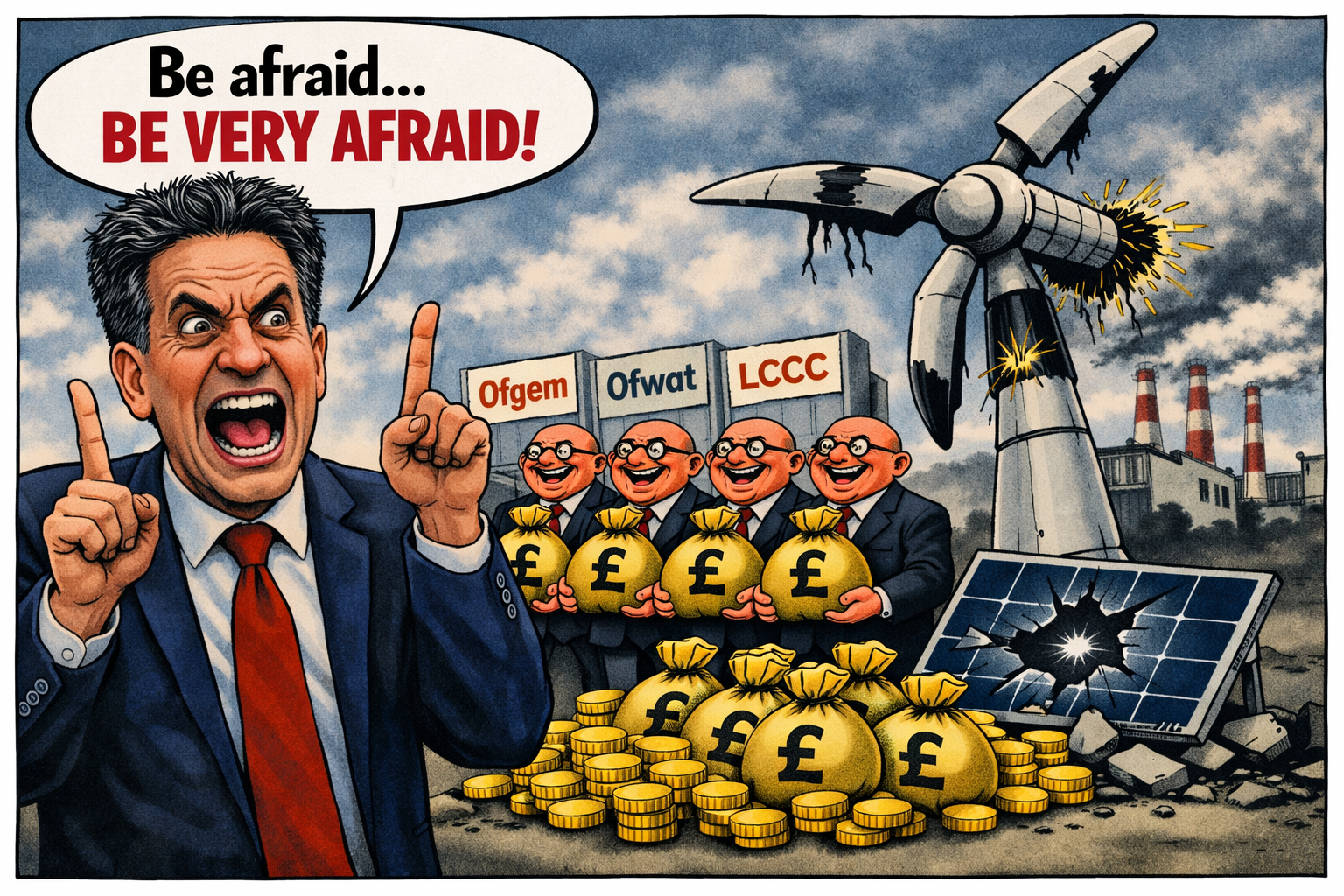
The Ed Miliband energy paradox: how Britain ended up paying France to take its power

UK energy paradox

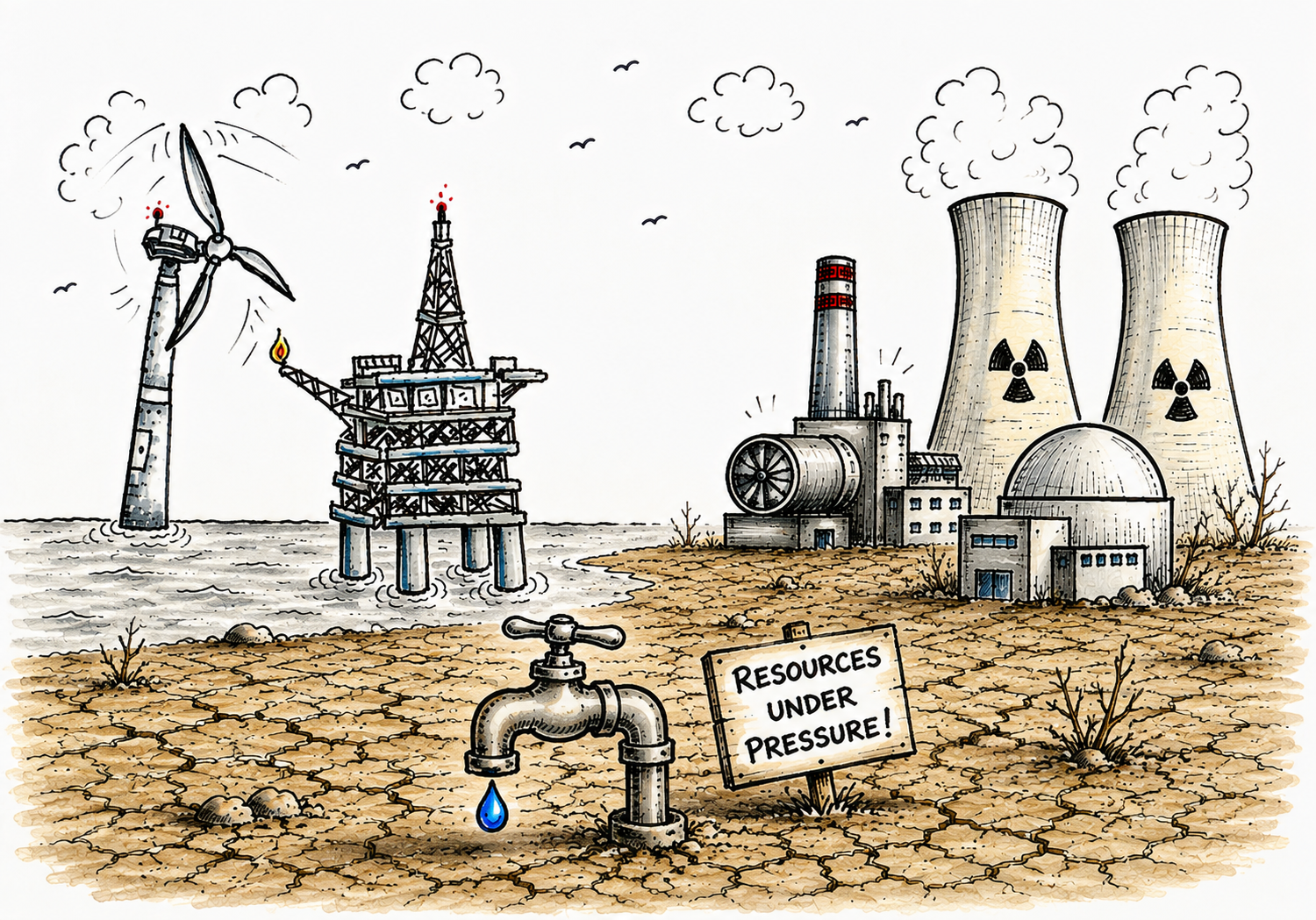
If you are anything like me, you’re not wrong to feel that this is insane. On the face of it, Britain has:

  • Among the highest electricity prices in the developed world, especially for industry.
  • Growing periods of negative wholesale prices, where generators pay others to take power.

That combination is not just a glitch; it’s the product of how the UK has chosen to do net zero—through a tangle of subsidies, rigid contracts and a grid that was never upgraded to match the political ambition.

This is the Ed Miliband paradox: a “cheap renewables” story that somehow delivers some of the world’s most expensive power, and then occasionally becomes so oversupplied that we literally pay France and others to take it away.

What is actually happening when prices go negative?

Negative prices are not a metaphor. For several dozen hours already this year, the wholesale price of electricity in Britain has dropped below zero.

Generators effectively pay the system to keep running, and interconnectors export that surplus to countries like France, Holland and Belgium—sometimes with a “chunky payment” attached.

This happens when:

  • Supply massively exceeds demand—typically on windy, sunny, mild days when heating and cooling demand is low.
  • Certain generators cannot or will not switch off—because of technical constraints (nuclear, some gas) or because their subsidy contracts reward them for generating regardless of price.
  • The grid cannot move or store the surplus—limited storage, constrained transmission, and slow grid reinforcement mean power piles up in the wrong place at the wrong time.

In that moment, electricity stops being a valuable commodity and becomes a waste product that must be disposed of. Interconnectors to France and others are the “sewer pipe” for that surplus.

Why the UK is uniquely bad at this

Negative prices are not just a British phenomenon—Germany, Spain, the Netherlands and others have also seen record hours of sub‑zero prices as renewables surge. But the UK has managed to combine:

  • High average prices, especially for industry;
  • Frequent negative prices at the margin;
  • Huge policy costs loaded onto bills rather than general taxation.

That cocktail is the result of several design choices.

1. Subsidy structures that pay to generate, not to be useful

A big chunk of UK renewables is supported by:

In a negative price event, the market is screaming “stop generating”. But if your contract still pays you based on output, you have every incentive to keep going. The cost of paying someone else to take the power can be less than the subsidy you’d lose by switching off.

So the system ends up doing something perverse: it pays generators to keep producing power that nobody wants, and then pays other countries to take it away.

2. A grid built for yesterday, not for a renewables surge

The UK has poured money into generation capacity—offshore wind, solar, interconnectors—but has been slow, bureaucratic and under‑invested on:

  • Transmission upgrades—moving power from windy Scotland and the North Sea to demand centres in England.
  • Storage—batteries, pumped hydro, demand‑side response at scale.
  • Flexible backup—fast‑ramping gas, smart tariffs, and industrial load‑shifting.

When you bolt a 21st‑century renewables fleet onto a 20th‑century grid, you get congestion, curtailment and waste.

The system then has to pay wind farms not to generate in some regions, while importing power elsewhere. Negative prices are just the most visible symptom of that mismatch.

3. Political obsession with “headline capacity” over system design

Net zero politics has been sold as a race to headline numbers:

  • X gigawatts of offshore wind by year Y
  • Z per cent of power from renewables
  • “Clean power by 2030”

What has not been sold—or properly designed—is the system architecture that makes that capacity economically coherent: locational pricing, flexible demand, storage, and a planning regime that can actually deliver grid reinforcement on time.

Ed Miliband’s own Electricity Market Review explicitly rejected zonal pricing in favour of a reformed national price, arguing that a single price is “fairest” and better for investment. That sounds nice politically, but it hides the real cost of congestion and mis‑location.

Instead of prices signalling “don’t build another wind farm here until the grid is upgraded”, the system socialises the pain across everyone’s bills.

Why are we paying France?

Interconnectors are not inherently stupid. In a rational system, they:

  • Smooth out volatility—import when you’re short, export when you’re long.
  • Share capacity—you don’t need to build as much domestic backup if you can lean on neighbours.

The problem is that the UK has created a structure where:

  • We over‑generate at certain times because of rigid contracts and inflexible plant.
  • We lack storage and flexible demand to soak up that surplus domestically.
  • We then use interconnectors as a dumping ground, paying others to take power that our own consumers have already funded through subsidies and levies.

France, with its large nuclear fleet and different cost structure, can happily take that cheap or even “paid‑to-take” power, displacing its own generation and lowering its average costs.

Meanwhile, UK industry is paying power prices around 60 per cent higher than in France on average.

So, we (the UK) socialise the cost of building and subsidising the capacity, then export the benefit at a discount.

How did this policy architecture even get created?

This isn’t one bad decision; it’s a stack of incentives and political choices that line up in the worst possible way.

1. Short‑term politics, long‑term contracts

Governments of all colours wanted:

  • Quick, visible progress on renewables.
  • Private capital to fund it, not the state balance sheet.
  • Minimal upfront tax rises.

The answer was long‑term, legally binding contracts (RO, CfDs, capacity market) that shifted risk onto consumers via bills. Once signed, these contracts are hard to change without spooking investors or triggering compensation claims.

So ministers get the photo‑ops—“world‑leading offshore wind”, “clean power by 2030”—while the structural costs and distortions are baked in for decades.

2. Ideological framing: net zero as a moral crusade, not an engineering project

Net zero has been framed as a moral imperative first, an engineering challenge second. That has consequences:

  • Questioning the design is painted as questioning the goal.
  • Complex system trade‑offs are reduced to slogans about “cheap renewables” and “green jobs”.
  • Uncomfortable truths—like the need for gas backup, storage, and grid reform—are pushed into the technical long grass.

The result is a policy environment where it is easier to announce another offshore wind auction than to confront the messy, expensive business of rewiring the grid and redesigning market signals.

3. Regulatory fragmentation and institutional cowardice

Ofgem, National Grid ESO, the Department for Energy Security and Net Zero, the Treasury—each has a slice of the problem, but no one owns the whole system outcome.

  • Ofgem focuses on consumer protection and network costs, often slowing investment.
  • Treasury resists big upfront public spending on grid and storage, preferring “market‑based” fixes.
  • Ministers chase announcements that look good in manifestos.

No one is politically rewarded for saying: “We need to spend billions on grid reinforcement and storage now, or we’ll be paying France to take our power in five years.” So it doesn’t happen at the necessary scale.

Is this fixable, or are we stuck paying others to take our power?

It is fixable—but not with more of the same.

An honest, grown‑up approach would mean:

  • Rewriting incentives so generators are paid for being useful to the system, not just for raw output. That means tighter rules on when subsidies are paid during negative prices, and contracts that reward flexibility.
  • Accelerating grid and storage investment as national infrastructure, not an afterthought. That likely means more state involvement and faster planning, not just hoping private investors will do it.
  • Introducing stronger locational signals—whether full zonal pricing or something close to it—so that the cost of building in the wrong place is visible, not smeared across everyone’s bills.
  • Using interconnectors intelligently, not as a dumping ground: export surplus when it’s genuinely cheap, but don’t subsidise over‑generation just to keep contracts happy.

So how stupid is this policy?

On a technical level, the engineers keeping the lights on are doing miracles with the system they’ve been given. The stupidity sits higher up:

  • Designing a net zero pathway around rigid subsidies and under‑built infrastructure.
  • Refusing to confront the trade‑offs, then acting surprised when the physics bites back.
  • Allowing a political narrative of “cheap green power” to coexist with some of the highest industrial prices in the world and growing episodes of negative pricing.

The real scandal isn’t just that we pay France to take our power. It’s that British households and firms have already paid once—through levies and high tariffs—to build that surplus, and then pay again when the system has to bribe someone else to use it.

Work that one out…!

UK economy will be hit hardest by the U.S.-Israel Iran war warns the IMF

UK Economy damaged by U.S. Iran War

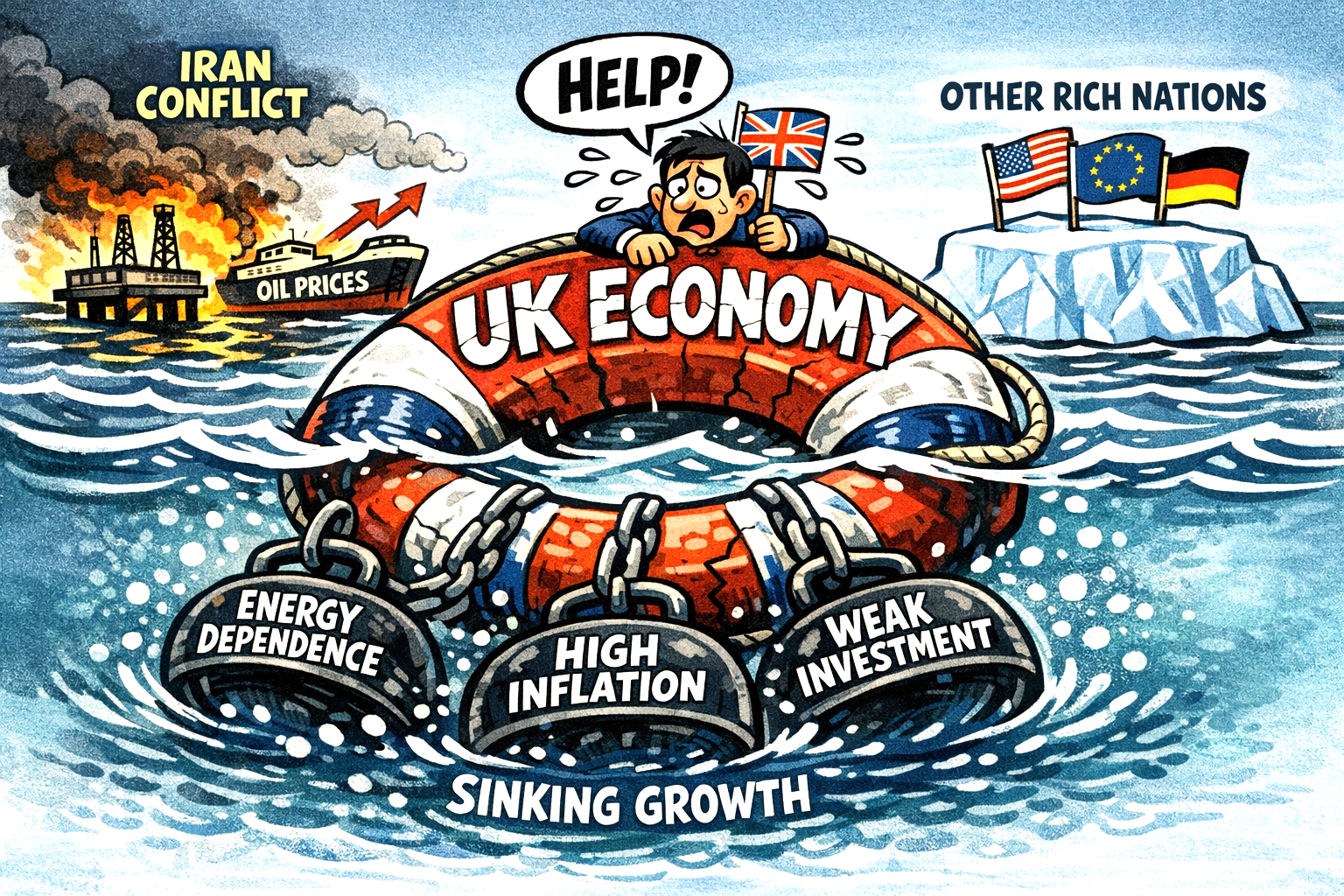
The IMF’s warning that the UK would suffer the sharpest growth hit among rich economies from an Iran‑related war is rooted in a simple structural reality.

Britain is unusually exposed to energy‑price shocks, yet unusually weak in the buffers that normally absorb them according to the IMF.

Why the UK will be hit harder than its peers

The UK enters this crisis with three vulnerabilities

  • High dependence on imported energy. North Sea output has declined for years, leaving Britain reliant on global LNG markets. When Middle Eastern supply is disrupted, LNG prices spike first and hardest. The U.S. and eurozone have deeper domestic energy bases or cheaper pipeline access.
  • A structurally fragile inflation profile. The UK’s inflation has been stickier than that of other G7 economies, driven by food, energy and services. A renewed oil shock feeds directly into household bills and transport costs, forcing the Bank of England to keep rates higher for longer.
  • Weak productivity and stagnant investment. Britain has less momentum to absorb an external shock. When energy prices rise, UK firms cut back faster, and consumers retrench more sharply.
  • UK Government policy. Ed Miliband and his ‘likely’ misguided staunch defence of Net Zero policies and expensive energy costs have left the UK seriously exposed to shocks – such as this.

The IMF’s logic

The Fund argues that a prolonged disruption in the Strait of Hormuz would push global oil prices sharply higher.

For the UK, this translates into

  • Higher wholesale gas costs, because LNG markets reprice off oil‑linked benchmarks.
  • A renewed inflation surge, delaying rate cuts and tightening financial conditions.
  • A squeeze on real incomes, hitting consumption—the UK’s main growth engine.
  • A fall in business investment, already one of the weakest in the OECD.

The IMF’s modelling suggests that the UK’s growth rate could fall more steeply than that of the U.S., Germany or France because those economies either have stronger industrial bases, more resilient energy systems or more fiscal space to cushion the blow.

The broader picture

This is less about geopolitics and more about structural brittleness. A global energy shock exposes the UK’s unresolved weaknesses: high import dependence, fragile inflation dynamics and a decade of under‑investment.

Nvidia briefly surpassed the individual stock market values of Germany, France and the UK

Market Cap up

The little-known company, Nvidia, now stands alongside Apple and Microsoft in market cap valuation thanks to AI.

In just a little over a year it has all but tripled its market valuation and become a go to investment on Wall Street and around the world.

Nvidia’s market capitalization has recently individually surpassed the total value of the German, French, and U.K. stock markets.

With a market cap exceeding $3.4 trillion, Nvidia now stands above these significant European stock markets in valuation.

Chinese EV makers continue their BIG push into European markets

EV

This expansion occurs as the European Union investigates subsidies provided to Chinese electric vehicle manufacturers, a situation that may lead to the imposition of tariffs.

In May 2024 Nio opened a new EV showroom in Amsterdam, while Xpeng introduced its G9 and G6 sports utility vehicles in France.

Over the years, China’s electric vehicle industry has flourished due to the government’s incentives and support, raising concerns among politicians in Europe and the U.S.

Public marketing campaigns are unfolding against the backdrop of a European Commission investigation into subsidies provided to Chinese electric vehicle manufacturers. The outcome of this inquiry may result in EU tariffs being imposed on Chinese EV imports.

The United States has preempted such measures, with the Biden administration enacting a 100% tariff on Chinese EV imports.

Meanwhile, Chinese EV producers are intensifying their international expansion efforts, aiming to compete with Elon Musk’s Tesla on a global scale and secure an early advantage over traditional car manufacturers.

Big tech companies pledge AI safety commitments

AI Kill Switch!

Leading technology companies, such as Microsoft, Amazon, and OpenAI, have united under a significant international accord for artificial intelligence (AI) safety measures, established at the Seoul AI Safety Summit on Tuesday 21st May 2024.

Following the agreement, firms from various nations, including the UK, China, Canada, the U.S., France, South Korea, and the United Arab Emirates, have pledged to voluntarily commit to the secure development of their cutting-edge AI models.

Framework

AI model developers who have not already done so agreed to issue safety frameworks that detail how they will address the challenges posed by their advanced models, including the prevention of technology misuse by malicious entities.

These frameworks will feature ‘red lines’ that tech companies will establish to delineate the types of risks associated with advanced AI systems that are deemed ‘unacceptable.’ These risks encompass, but are not limited to, automated cyberattacks and the potential for bioweapons.

Kill switch

In the event of such dire scenarios, companies have declared their intention to introduce a ‘kill switch’ that would halt the development of their AI models should they be unable to ensure the mitigation of these risks.

“It is unprecedented for so many prominent AI firms from diverse regions of the world to concur on identical commitments regarding AI safety,” Rishi Sunak, the UK Prime Minister reportedly said on Tuesday 21st May 2024.

He further noted that these commitments would guarantee that the world’s foremost AI companies will maintain transparency and accountability concerning their safe AI development strategies.

This agreement builds upon a prior set of pledges made in November 2023 by entities engaged in the creation of generative AI software.

The involved companies have consented to seek feedback on these standards from ‘trusted actors,’ which include their respective national governments when suitable, prior to their publication in anticipation of the forthcoming AI summit – the AI Action Summit scheduled to take place in France in early 2025.

IMF says Russia is expected to grow faster than all advanced economies in 2024

Oil

The International Monetary Fund calculates that Russia’s economy will expand more rapidly than all advanced economies this year.

According to the latest World Economic Outlook released by the IMF, Russia’s economy is projected to expand by 3.2% in 2024.

This growth outpaces the anticipated growth rates for the U.S. at 2.7%, the U.K. at 0.5%, Germany at 0.2%, and France at 0.7%.

G7 growth percentages

  • Russia at 3.2%
  • U.S. at 2.7%
  • France at 0.7%
  • U.K. at 0.5%
  • Germany at 0.2%

The forecast may be galling for Western countries that have endeavoured to economically isolate, restrict and punish Russia for its invasion of Ukraine in 2022.

Russia has demonstrated that Western sanctions on its industries have made it more self-sufficient and that private consumption and domestic investment remain resilient.

Oil exports

Oil and commodity exports to nations such as India and China, (two of the largest countries in the world by population) – as well as alleged sanction evasion and high oil prices, have allowed Russia to maintain strong oil export incomes streams.

UK and Europe growth

Outside of Russia, the IMF has revised its forecasts for Europe and the UK, projecting a growth of 0.5% for this year. This positions the UK as the second-lowest performer within the G7 group of advanced economies, trailing behind Germany.

The G7 also includes France, Italy, Japan, Canada and the U.S.

However, UK growth is expected to improve to 1.5% in 2025, placing the UK in the top three best G7 performers, according to the IMF.

The IMF also reported said that interest rates in the UK will remain higher than other advanced nations, close to 4% until 2029.

London regains Europe’s stock market crown

FTSE100 crown

London has regained its status as Europe’s largest stock market from Paris, boosted by rising crude oil prices.

The combined market capitalization of primary listings in London but excluding ETFs and ADRs, is now $2,888.4 billion versus Paris’s $2,887.5 billion, as of 19th October, 2023.

London had lost its position as Europe’s biggest stock market in November 2022, extending a decline that started with Britain’s vote to leave the European Union in 2016.

London market

The London market, which has a large exposure to commodity stocks, such as Shell and BP, has outperformed recently due to the surge in oil prices, which reached a seven-year high this month.

Paris, on the other hand, has been weighed down by the slump in luxury stocks, such as LVMH and Kering, which have been hit by China’s crackdown on consumption and corruption.

Excessive radiation fears for iphone 12

Apple iphone 12

France ban Apple iphone 12

According to news reports, France has banned the Apple iPhone 12 because it emits too much electromagnetic radiation, which could be harmful to human health. 

The French watchdog (ANFR) said that the iPhone 12’s specific absorption rate (SAR), which measures the rate of radio frequency energy absorbed by the body, was above the legal limit of 4.0 watts per kilogram in tests simulating the phone being held in the hand or kept in a pocket. 

Dispute

Apple disputed the tests and said that the iPhone 12 was certified by multiple international bodies and compliant with all global radiation standards. The French digital minister said that Apple had two weeks to respond and fix the issue, or else he would order a recall of all iPhone 12 devices sold in the country. 

The minister also said that France would share its findings with other regulators in the European Union, which could lead to a wider ban of the phone.

France ban Apple iPhone 12 due to excessive radiation fears

What is electromagnetic radiation?

Radiation from mobile phones is a type of electromagnetic radiation that is emitted by cell phones and cordless phones when they send and receive signals. Electromagnetic radiation is a form of energy that travels in waves or particles through space.

It can be classified into two types: ionizing and non-ionizing radiation. Ionizing radiation has high energy and can damage DNA, which may increase the risk of cancer such as; x-rays, radon, and cosmic rays. Non-ionizing radiation has low energy and cannot damage DNA directly – such as; radio waves, microwaves, infrared, visible light, and ultraviolet light.

Cell phone radiation

Cell phones use radiofrequency (RF) waves, which are a type of non-ionizing radiation, to communicate with cell towers and other devices. RF waves have frequencies ranging from 0.7 to 80 GHz, depending on the generation of the cell phone (2G, 3G, 4G, or 5G). The human body can absorb some of the RF energy from cell phones, which may cause some heating to the area of the body where the phone is held (e.g., the ear and head). However, it is suggested this heating is not enough to raise the core body temperature or cause any harmful effects.

Research

There has been a lot of research on whether cell phone use can cause health problems, such as cancer, in humans. However, it has been reported that the evidence so far is not conclusive and does not show a clear link between cell phone use and cancer risk. There could be a link but we do not know 100%… yet?

Some studies have suggested that there may be a small increase in the risk of certain types of brain tumors (such as acoustic neuromas) for people who use cell phones for a long time or frequently. However, other studies have not found any consistent evidence to support this.

The incidence of brain and central nervous system cancers has not changed significantly during the time that cell phone use has increased dramatically. Therefore, more research is needed to understand the possible effects of cell phone use on human health.