Polluting coal users and renewable producers

Coal fired power

The highest coal using countries in the world

  • China, which consumes over half of the global coal demand and produces over 4 billion tonnes of coal per year.
  • India, which consumes about 14% of the global coal demand and produces over 900 million tonnes of coal per year.
  • The United States, which consumes about 9% of the global coal demand and produces over 600 million tonnes of coal per year.
  • Japan, which consumes about 3% of the global coal demand but imports most of its coal.

These countries accounted for about 82% of the global coal production in 2021 according to 2021 data set. China alone produced more than half of the world’s coal, followed by India with nearly 10%.

Global coal use in 2023 hits few high

Global coal use in 2023 has hit a record high, surpassing 8.5 billion tons for the first time, on the back of strong demand in countries like India and China, said IEA. These countries are the world’s largest consumers of the dirtiest fossil fuel, and continued modernization puts their energy consumption on a rapid growth trajectory.

China

China and India’s growing economies will continue to fuel demand for coal even as they set ambitious renewable energy targets, according to experts.

While China is the world’s largest energy consumer, India is ranked third globally, and both countries are the top consumers of coal as they strive to fuel economic growth. 

China’s share of global electricity consumption, 60% of which is coal, is set to jump to one-third by 2025, compared with a quarter in 2015, according to projections by energy watchdog International Energy Agency (IEA).

Global coal usage in 2023 hit a record high, surpassing 8.5 billion tons for the first time, on the back of strong demand in emerging and developing countries such as India and China, IEA noted in a recent report

China’s electricity sector has been in the throes of a clean revolution over the past few years, with an almost five-fold growth in wind and solar generation since 2015. As a result, the share of coal generation has fallen by 17 percentage points, from 78% in 2000 to 61% in 2022. 

China has suffered from drought in recent years, which reduced hydroelectric power generation in its southern provinces. To maintain the necessary power output, the country had to turn to coal. 

United States

By contrast, U.S., which is the world’s second largest consumer of coal, has seen a decrease in its usage of the fuel. According to the Institute for Energy Economics and Financial Analysis, the amount of coal that the superpower consumes each day recorded a 62% drop from 2.8 million to 1.1 million tons a day.

75% of India’s power is derived via coal-fired plants. Coal accounts for 61% of China’s power generation, even though the country is recognized as the indisputable leader in renewable energy expansion. It has been adding new projects to the grid almost as fast as the rest of the world combined in 2022 and has ambitions of becoming carbon neutral by 2060.

Annual average capacity additions by country and region, 2016-2023

See IEA report

India’s coal production rose to 893 million tons during the financial year ending March 2023, jumping nearly 15% from a year earlier. China’s raw coal production in 2023 went up by 2.9% compared with the same period in 2022.

There are no signs of a slowdown, with the IEA saying coal consumption in India and Southeast Asia is projected to grow significantly.

Coal won’t go!

But the lack of reliability of renewables means coal has still very much been a critical fallback option for the two countries.

Top five coal producing countries in the world

  • China: 4,126.0 million tonnes
  • India: 762.0 million tonnes
  • Indonesia: 614.0 million tonnes
  • United States: 523.8 million tonnes
  • Australia: 467.1 million tonnes

Five of the Greenest energy producers in the world

  • Sweden
  • Norway
  • Denmark
  • Finland
  • Switzerland

The greenest were based on these five criteria: carbon emissions, energy transition, green society, clean innovation, and climate policy.

Top countries by renewable energy production

  • China: 2,271.9 TWh (28.2% of total electricity)
  • United States: 804.8 TWh (20.5% of total electricity)
  • Brazil: 491.9 TWh (83.3% of total electricity)
  • Canada: 433.6 TWh (66.9% of total electricity)
  • India: 303.5 TWh (24.5% of total electricity)

Note: three of the world’s worst offenders of fossil fuel use are also in the top five for energy production by renewables – China, U.S. and India.

So, are things changing slowly?

Bitcoin jumps above $49000 only to fizzle out

Bitcoin ETF

Bitcoin rose in volatile trading on Thursday 11th January 2024 after the Securities and Exchange Commission gave the green light for the first-ever spot Bitcoin ETFs to trade in the U.S.

Approval

The Bitcoin ETF approval is a massive achievement for the crypto industry as a whole, which first attempted to launch a Bitcoin ETF some 10 years ago.

Grayscale’s big legal win against the SEC in August 2023 over the regulator’s refusal to let it convert its popular Bitcoin Trust (GBTC) into an ETF breathed fresh optimism into the idea.

Volatile

Following the SEC’s decision, Bitcoin’s value fell then gained some traction, as expected by traders. However, the volume of inflows into the new funds remains to be seen, Bitcoin ETFs are still widely expected to increase demand for the cryptocurrency and drive Bitcoin higher.

It would be unwise to make too much of these Bitcoin price moves in the short-term, but the approval is likely going to lead to some longer-term price increases. Now that the bitcoin ETF speculation has come to fruition it looks like traders may rotate to alternative cryptocurrencies such as Ether to prepare for future market developments.

Altcoin ETFs

The SEC is due to give decisions on spot ETH ETF applications beginning in May 2024. BlackRockInvesco and Ark Invest are among the firms in line for approval, as well as Grayscale.

The opportunity to be in at the beginning will not want to be missed by these companies.

Bitcoin 7-day chart 6th January – 12th January 2024

Bitcoin 7-day chart from 6th January – 12th January 2024

Cathie Wood of Ark Invest argues case for Bitcoin reaching $1.5 million

Bitcoin ETF

Cathie Wood says $1.5 million Bitcoin bull case is now more likely

Ark’s Invests Cathie Wood said the approval of Bitcoin Exchange-Traded Funds (ETF) in the U.S. convinced her even more that the world’s largest cryptocurrency ‘Bitcoin’ could hit her crazy bullish target of $1.5 million.

For her bull case, the ARK Invest boss sees Bitcoin hitting $1.5 million by 2030. Her base case is in the $600,000 range, she reportedly said.

‘We think the probability of the bull case has increased with this SEC approval. This is a green light.’ ‘It is the first global decentralized digital rules based … monetary system in history.

It is a very big idea.

Win! Win! then…?

Bitcoin 7-day chart from 6th January – 12th January 2024

Bitcoin 7-day chart from 6th January – 12th January 2024

December 2023 U.S. inflation data came in higher-than-expected

U.S. December inflation

Stocks moved lower Thursday 11th January 2024, reflecting the higher-than-expected December 2023 inflation data.

The S&P 500 in early trade edged lower by around 0.7%, while the Nasdaq Composite dropped nearly 0.8%. The Dow Jones Industrial Average dropped by 0.6%. The S&P 500 briefly touched 4800 after climbing above its record high of 4,796.

Higher than expected

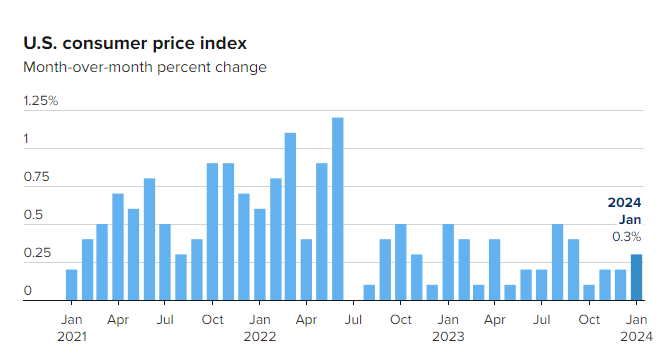
December’s consumer price index figure came out slightly higher-than-expected, reflecting a 0.3% increase in consumer prices for the month, pushing the annual rate to 3.4%.

Core CPI, excluding volatile food and energy prices, came out in line with expectations, however, pointing to persistent, but easing inflation pressures. The new inflation data figures suggests that future interest rate cuts may be slower to come.

This move up in CPI is an absolute reminder of the unpredictable nature of economic recovery.

Bitcoin ETF announcement by SEC was FAKE news via an erroneous post on ‘X’

Bitcoin ETF

Bitcoin jumped briefly on Tuesday 9th January 2024 after a post on the U.S. markets SEC regulator’s ‘X’ account post said it had approved the Exchange-Traded Funds (ETF’s) in the cryptocurrency.

This was a big news event for the cryptocurrency community and for the wider investment world. Large and small investors have been eagerly awaiting this news for months. When it finally arrived, it turned out to be fake.

U.S. regulators are expected to make an announcement on the new ETF’s this week.

The Securities and Exchange Commission (SEC) later deleted the erroneous post and said its account had been ‘compromised’.

The social media platform ‘X’ refuted the accusation that its systems had been the reason for the ‘compromise’.

Fake post

The fake news post appeared on the SEC’s official X account shortly after 16:00 Washington time (21:00 GMT). It said the regulator ‘grants approval for #Bitcoin ETFs for listing on all registered national securities exchanges.’ The post was immediately on the general social media radar and business news outlets.

SEC’s chair Gary Gensler quickly posted a message correcting the erroneous announcement on his personal ‘X’ account: “The @SECGov twitter account was compromised, and an unauthorized tweet was posted. The SEC has not approved the listing and trading of spot Bitcoin exchange-traded products.”

The SEC has determined that there was unauthorized access to and activity on the @SECGov x.com account by an unknown party for a brief period of time shortly after 4 pm ET. and that the unauthorized access has been terminated,’ it was reported.

Bitcoin jumped

Bitcoin jumped to touch $48,000 (£37,800) immediately after the erroneous post before falling back to around $45,500

Bitcoin jumped to ouch $48,000 (£37,800) immediately after the erroneous post before falling back to around $45,000

Investors are eagerly anticipating an SEC announcement on the potential approval of spot Bitcoin ETFs, which is expected this week.

It would mark a key milestone for the cryptocurrency market in gaining acceptance to mainstream financial markets.

U.S. payrolls increased by 216,000 in December, better than predicted

Work

The U.S. labour market accumulated strong gains as the pace of hiring was greater than expected, dampening the chance of an early rate cut.

December’s jobs report showed that 216,000 jobs were added for the month while the unemployment rate remained steady at 3.7%. Estimates were in the region of 170,000 as analysts were looking for their ‘goldilocks figure.

Job boost from U.S. government

The hiring boost came from a gain of 52,000 in government jobs and another 38,000 in health care-related occupations.

Average hourly earnings rose 0.4% on the month and were up 4.1% from the same period 2023, both higher than the respective estimates for 0.3% and 3.9%.

U.S. unemployment chart Jan 2021 – December 2023

S&P500 and Nasdaq

The S&P500 and Nasdaq recovered some early 2024 losses as the fresh data encouraged the debate and chance of a rate cut again. Later however, the strong U.S. jobs growth dampened the likelihood of rate a cut anytime soon. Yields were on the rise again.

Strong streak

Government hiring drove the gains, which extended one of the strongest streaks of job creation on record. The job growth has confounded forecasters expecting job losses as higher borrowing costs slowed the economy.

Sudden sell-off confounds analysts – is it profit taking or economic woe?

Wall Street

The Nasdaq and Dow hit new all-time highs in recent days and the S&P 500 is hot on their heels.

After nine straight days of gains, Wall Street suddenly reversed an hour and a half before the closing bell on Wednesday 20th December 2023.

The sell-off expanded into Asia overnight, with Japan’s Nikkei 225 leading losses, before stocks across Europe also slid into the red on the Thursday morning, 21st December 2023.

Some indicated Wednesday’s sell-off was as simple as investors taking profits after a nine-day mini bull run, in the absence of any obvious catalyst and with U.S. stocks widely seen as overbought.

Other market analysts pointed to a high volume of zero-day options trading as the death knell for the winning streak.

Time left for a Santa rally?

Markets have been on a tear in recent eeks and months, maybe it’s time for a breather. But some suggest U.S. equities are overbought in general – so, is this something more discerning?

U.S. inflation at 3.1% November 2023

U.S. Inflation

Prices across a wide spectrum of goods and services moved slightly higher in November 2023 but were mostly in line with expectations, thus further easing pressure on the Federal Reserve.

The consumer price index, a closely watched inflation gauge, increased 0.1% in November, and was up 3.1% from a year ago, the U.S. Bureau of Labor Statistics reported Tuesday 12th December 2023.

While the monthly rate indicated a pickup from the flat CPI reading in October 2023, the annual rate showed another decline after hitting 3.2% a month earlier.

U.S. Bureau of Labour Statistics

Latest U.S. job data indicates that job growth accelerated by 199,000

Work

The latest U.S. job data indicates that job growth accelerated in November 2023, with seasonally adjusted non-farm payrolls increasing by 199,000. 

The unemployment rate has dropped to 3.7%, even as more workers entered the labour market. This points to underlying strength in the labour market and is a positive sign for the U.S. economy. 

U.S. job creation chart January 2022 – November 2023

U.S. job creation chart January 2022 – November 2023

Stocks had risen as investors awaited these latest employment figures, which are closely watched as an indicator of potential moves by the central bank on interest rates.

Mixed reaction

Markets showed a mixed reaction to the report, with stock market futures modestly negative while Treasury yields surged. Job creation showed little signs of slowing as payrolls grew even faster than expected and the unemployment rate fell despite signs of a weakening economy.

Good news for the U.S. economy but Treasury yields are on the up again.

America and its $1 trillion credit card debt

Debt

U.S. citizens have accumulated a record-breaking $1 trillion in credit card debt.

The Federal Reserve’s interest rate hikes through 2023 have caused average interest rates for credit cards to spike to more than 22%. Rates on retail credit cards are even higher, nearing 29% on average.

Despite rising costs and higher borrowing rates, a record number of consumers shopped over the Thanksgiving holiday weekend. The National Retail Federation found that more than 200 million consumers went shopping that weekend, more than the 196.7 million shoppers who turned out in 2022.

Retailers Macy’s and other larger retailers have issued warnings about a slowdown in repayments on their credit cards, highlighting a potential risk to retail revenue this holiday season.

The resilience of the American consumer will continue to be tested by the still-rising costs of groceries, fuel, energy and housing.

Interesting fact

The U.S. credit card debt is approximately equal to the size of Apple’s market cap of $1 trillion.

U.S. GDP grew at a 5.2% in Q3, stronger than expected

U.S. GDP revision

U.S. GDP figure better that forecast

The U.S. economy grew even stronger than previously calculated in the third quarter, the result of better than expected business investment and stronger government spending, the Bureau of Economic Analysis reported  Wednesday 29th November 2023.

Gross domestic product (GDP), a measure of all goods and services produced during the three-month period, climbed to 5.2% annualised pace, the department’s second estimate showed. The increase superseded the initial 4.9% figure and was better than the 5% forecast from economists.

Upward revision

Primarily, the upward revision came from increases in non-residential fixed investment, which includes structures equipment and intellectual property. The category showed an increase of 1.3%, which still presented a sharp downward shift from previous quarters. Government spending also helped boost the Q3 estimate, rising 5.5% for the July-through-September 2023 period.

However, consumer spending registered a downward revision, now rising just 3.6%, compared to 4% in the initial estimate.

Inflation

There was some mixed news on the inflation front. The personal consumption expenditures price index, a gauge the Federal Reserve follows closely, increased 2.8% for the period, a 0.1% downward revision.

Corporate profits increased 4.3% during the period, up sharply from the 0.8% gain in the second quarter.

Is the shine returning for gold as investors place bets on rate cuts?

Gold

Gold prices on Monday 27th November 2023 climbed to a more than six-month high as the U.S. dollar weakened.

Investors, it is reported, have placed their bets, suggesting the Federal Reserve is finished with interest rate hikes.

Gold was up around 0.52% at $2,012 per ounce in early afternoon trading (London time). It reached a high of $2,017.82 earlier in the day. Gold futures for December 2023 hit $2,018.90 according to analysts’ data.

CME Fed watch tool

The dollar index, a measure of the greenback against major currencies, was 0.13% lower as markets price in a more than 90% chance the Fed will hold rates at its next two meetings.

Analysts at Goldman Sachs reportedly said that the outlook for 2024 is that gold’s ‘shine is returning’.

The potential upside in gold prices will be closely tied to U.S. real rates and dollar moves.

Fed minutes show no indication of U.S. rate cuts at last meeting

U.S. interest rate

Federal Reserve members, in their most recent meeting, gave little indication of cutting interest rates anytime soon, particularly as inflation remains well above their goal of 2%, according to minutes released Tuesday 21st November 2023. 

The detail of the meeting held 31st October – 1st November 2023, showed that Federal Open Market Committee (FOMC) members are still concerned that inflation could be stubborn or move higher, and that more may need to be done.

They indicated that policy would need to stay ‘restrictive’ at the very least, inflation is on a convincing move back to the central bank’s 2% goal.

Fed next meet 13th December 2023.

Moody’s cuts U.S. outlook to negative

U.S. credit rating stable to negative

Moody’s, a credit rating agency, lowered its ratings outlook on the United States to negative from stable.

This means that Moody’s sees a higher risk of a downgrade in the future, which could affect the borrowing costs and confidence of the U.S. government.

Moody’s actions

The main reasons for Moody’s action are the rising deficits and debt levels of the U.S., as well as the continued political polarization that hampers effective policymaking. Moody’s also cited the impact of the Covid-19 pandemic and the recent failures of some U.S. banks as factors that have worsened the environment for the U.S. government and the banking system in general.

Warning!

Moody’s warned that the U.S.’s deficits are likely to remain ‘very large’. It also warned that ‘continued political turmoil or polarization’ in Congress further increases the risk the U.S. will not be able to reach consensus on a fiscal plan to slow the decline in debt affordability‘.

Moody’s still maintains a triple ‘A’ (AAA) credit rating on the U.S. government debt, which is the highest possible rating, but warns of the challenges and uncertainties that the U.S. faces in restoring its fiscal strength and stability.

The ‘AAA‘ rating is at risk.

U.S. government on brink of shutdown, again

The federal government is on the brink of another shutdown, with just a week left for the Republican-led House, Democratic-led Senate and Biden White House to reach a breakthrough on funding.

U.S. debt is at an all-time high!

The Fed is ‘not confident’ according to Jerome Powell

Fed

Fed Chair Jerome Powell reportedly said he and his colleagues remain steadfast in getting policy in line with their 2% inflation target, but ‘we are not confident that we have achieved such a stance’.

He stressed the Fed nevertheless can be cautious as the risks between doing too much and too little have come into closer balance.

Federal Reserve Chairman Jerome Powell reportedly said Thursday 9th November 2023 that he and his fellow policymakers are encouraged by the slowing pace of inflation but are unsure whether they’ve done enough to keep the momentum going.

Inflation battle

Speaking a little more than a week after the central bank voted to hold rates steady, Powell said in remarks aimed at the International Monetary Fund (IMF) gathering in Washington, D.C., that more work could be ahead in the battle against high prices.

The statement comes with inflation still well above the Fed’s long-standing goal but also considerably below its peak levels in the first half of 2022. After 11 U.S. rate hikes, we have witnessed the most aggressive policy tightening since the early 1980s, the FOMC have increased rates from pretty much zero to a range of 5.25%-5.5%.

Those increases have coincided with the Fed’s preferred inflation gauge, the core personal consumption expenditures price index, to fall to an annual rate of 3.7%, from 5.3% in February 2022. The more widely followed consumer price index peaked above 9% in June of last year.

Progress

Powell referenced the progress the economy has made. Gross domestic product (GDP) accelerated at a ‘quite strong’ 4.9% annualised pace Q3 2023, though Powell also said the expectation is for growth to ‘moderate in coming quarters’. He described the economy as ‘just remarkable’ in 2023 in the face of a broad expectation that a recession was inevitable.

Nothing like a massive ‘self-pat’ on the back for a job well-done? Remember the Fed’s initial analysis? IT was for inflation to be ‘transitory’. They didn’t get that right either.

Futures pricing, according to the CME Group, suggested there’s less than a 10% chance that the FOMC will approve a final rate hike at its Dec. 12-13, 2023, meeting, even though committee members in September pencilled in an additional 0.25% rise before the end of 2023.

Impression drawing of Fed Chair. The Fed is ‘not confident’ according to Jerome Powell.

Traders anticipate the Fed will start cutting rates next year, probably around June 2024.

U.S. credit card balances climbed to a $1.08 trillion record in Q3 2023

U.S. credit card debt

U.S. citizens now owe $1.08 trillion on their credit cards, according to a new report on household debt from the Federal Reserve Bank of New York.

U.S. Household Debt Rises to $17.29 Trillion Led by Mortgage, Credit Card, and Student Loan Balances

Total household debt rose by 1.3% to reach $17.29 trillion in the third quarter of 2023, according to the latest Quarterly Report on Household Debt and Credit.

Mortgage balances increased to $12.14 trillion, credit card balances to $1.08 trillion, and student loan balances to $1.6 trillion.

Auto loan balances increased to $1.6 trillion, continuing the upward trajectory seen since 2011. Other balances, which include retail credit cards and other consumer loans, were effectively flat at $0.53 trillion. Delinquency transition rates increased for most debt types, except for student loans.

See analysis: new report on household debt

U.S. holds interest rates steady

U.S. economic health

The U.S. central bank has held its key interest rate at its current 22-year high as it seeks to stabilise price increases, which had recently reached near-record levels.

The Federal Reserve’s rate remains at 5.25%-5.5%.

The bank has been raising interest rates in an attempt to tame the economy and slow inflation, (the rate at which prices rise). Recent data showed the U.S. economy grew faster than expected.

Raising interest rates is a way for central banks tackle rising inflation. The idea is that by raising interest rates and making it more expensive to borrow, consumers will spend less and that would lead to slower price rises. In the U.S. however, the consumer is not slowing down. This may lead to higher rates, or higher for longer which in turn could push the U.S. into a recession.

The bank had faced criticism, with some suggesting that holding interest rates at higher levels could put the U.S. economy at risk of entering a recession.

U.S. Treasury to borrow $776 billion in last 3 months of 2023

U.S. debt

In an announcement Monday 30th October 2023, the U.S. Treasury Department said it will be looking to borrow $776 billion.

The Treasury said it expects to borrow $816 billion between January and March 2024.

The announcement comes 10 days after the government said the fiscal 2023 budget deficit would be about $1.7 trillion.

U.S. debt

According to the U.S. Treasury Fiscal Data, the national debt of the United States was $33.52 trillion as of 23rd October 2023.

U.S. announces global action on AI safety as UK hosts AI summit

AI robot and human

The White House has announced what it is calling ‘the most significant actions ever taken by any government to advance the field of AI safety’.

Oh really! Coincidence or deliberate attempt to undermine the UK AI safety drive?

This news comes as the UK draws attention hosting a UK led AI summit. The U.S. wants to police and control the AI arena too as it does most other aspects of our life.

Biden order

An executive order from President Biden requires Artificial Intelligence AI developers to share safety results with the U.S. government. It is an attempt to place the U.S, at the centre of the global debate on AI governance.

However, this is a position the UK government has already engineered as the UK AI safety summit gets underway this week. The UK desires to place itself at the centre of AI governance.

U.S. executive order

The U.S. executive order from Biden suggests the U.S. fancies itself as the leader of global AI governance in terms of how to address such threats or does it simply want to stamp its authority in the AI world. It tried to do the same with cryptocurrencies but fundamentally failed.

U.S. measures include

  • Creating new safety and security standards for AI, including measures that require AI companies to share safety test results with the federal government.
  • Protecting consumer privacy, by creating guidelines that agencies can use to evaluate privacy techniques used in AI.
  • Helping to stop AI algorithms discriminate and creating best practices on the appropriate role of AI in the justice system.
  • Creating a program to evaluate potentially harmful AI related healthcare practices and creating resources on how educators can responsibly use AI tools
  • Working with international partners to implement AI standards around the world.

UK AI summit

The UK summit is referenced in the executive order. But it’s mentioned under the heading of ‘advancing American leadership abroad’ – indicating that the U.S. very clearly knows that it is the big player here alongside China.

The UK is determined to position itself as a global leader in the space of trying to minimise the risks posed by this powerful technology.

However, U.S. Vice President Kamala Harris and top executives from the U.S. tech giants are arriving in the UK this week to discuss AI safety at the UK government’s AI Summit, which it has billed as a ‘world first’.

The summit, hosted by UK Prime Minister Rishi Sunak, will focus on the growing fears about the implications of so-called frontier AI. President of the EU Commission Ursula von der Leyen and UN Secretary-General Antonio Guterres will also be in attendance.

The UK is determined to position itself as a global leader in the space of trying to minimise the risks posed by this powerful technology.

But the U.S. as usual, will want to be in control…

U.S. GDP grew at a 4.9% in September 2023

U.S. GDP

According to the latest data from the U.S. Bureau of Economic Analysis, the U.S. GDP grew at a 4.9% annual pace in Q3 of 2023, better than expected. 

This was the fastest quarterly advance in nearly two years, driven by robust consumer spending, increased inventories, exports, residential investment and government spending.

Challenges

The U.S. economy faced several challenges in the third quarter, such as high interest rates, inflation pressures, and global headwinds, but still managed to overcome them and show strong growth. 

However, some analysts expect a slowdown in the fourth quarter and in early 2024, especially if the Federal Reserve implements another interest rate hike and the housing market remains sluggish and if consumer spending shows signs of slowing.

GDP and Inflation

The GDP report also showed that inflation rose 3.7% in September 2023, down from 9.1% in June, but still above the Fed’s 2% target. The Fed is expected to keep its policy tight and may announce a tapering of its bond-buying program next week.

Nasdaq stumbles, descending further into correction

Nasdaq

The Nasdaq is a stock market index that tracks the performance of over 3,000 companies, mostly in the technology sector.

Correction

A correction is a term used to describe a decline of 10% or more from a recent peak in the price of an asset. The Nasdaq entered correction territory on Wednesday 25th October 2023, as it closed at 12,922, which was 10% lower than its previous high of 14,358 on 19th July 2023.

The main reason for the Nasdaq’s correction is believed to be the rise in long-term Treasury yields, which increased the borrowing costs for companies and reduced the attractiveness of growth stocks. The 10-year Treasury yield rose to 4.95% on Wednesday 25th October 2023, the highest level since June 2021. Higher interest rates also make future earnings for tech companies much more difficult.

Disappointing Q3 results

Another factor that contributed to the Nasdaq’s correction was the disappointing third-quarter earnings reports from some of the biggest tech companies, such as Alphabet (Google), Amazon, and Meta (Facebook fame). 

These companies reported lower-than-expected revenue growth, profit margins, and cloud computing performance, which weighed on their stock prices and dragged down the Nasdaq. Investors expect more, especially with AI – now the new kid-on-the-block.

Concerns

The Nasdaq’s correction has raised concerns among investors about the outlook for the tech sector and the broader stock market. However, some analysts have argued that the correction could be a healthy and temporary adjustment that creates buying opportunities for long-term investors. 

They have pointed out that the Nasdaq is still up 22.5% year-to-date as of Wednesday 25th October 2023, and that the fundamentals of the tech industry remain strong despite the challenges posed by inflation, regulation, yields and competition.

U.S multi trillion-dollar debt

U.S. Debt

The amount of U.S. debt is a complex and controversial topic that has different perspectives, implications and opinion.

According to the U.S. Treasury Fiscal Data, the national debt of the United States was $33.52 trillion as of 23rd October 2023.

This includes both the debt held by the public, which is the amount the federal government owes to outside entities such as foreign governments, corporations, and individuals, and the debt held by federal government accounts, which is the amount the federal government owes to itself, such as trust funds and special funds.

Is U.S. debt a problem?

Some argue that the U.S. debt is a problem because it increases the risk of a fiscal crisis, reduces the government’s ability to respond to emergencies, imposes a burden on future generations, and lowers the nation’s creditworthiness.

Others contend that the U.S. debt is not a problem because the U.S. can always print more money, (isn’t this why there is so much debt already)? Borrow at low interest rates, (not easy in the current climate), stimulate economic growth, and benefit from its status as the world’s reserve currency.

So, is U.S. debt a problem or not? It depends on various factors such as the size, composition, and sustainability of the debt, as well as the economic and political context in which it operates.

Most analysts and policymakers agree that the U.S. debt is projected to grow faster than the economy in the long-term, which could pose significant challenges for fiscal policy and economic stability. Therefore, it is important to understand the causes and consequences of the U.S. debt and to find solutions that balance the trade-offs between spending and income.

Debt in relation to GDP

The U.S. debt of GDP was estimated to be around 120% to 130% in 2023.

The U.S. debt of GDP is the ratio of the total public debt of the United States to its gross domestic product (GDP), which measures the size of the economy. 

U.S. ten-year treasury yield breaches 5% for the first time since 2007

Treasury yield

The U.S. Treasury yields are the interest rates that the U.S. government pays to borrow money for different periods of time.

The 10-year Treasury yield is one of the most important indicators of the state of the economy and the expectations of inflation and growth. On 23rd October 2023, the 10-year Treasury yield rose above 5% for the first time since 2007, as investors increasingly accepted that interest rates will stay higher for longer and that the U.S. government will further increase its borrowing to cover its deficits.

Significant

This is a significant milestone, as it reflects the market’s view that the Federal Reserve will maintain elevated interest rates to control inflation and that the U.S. economy will remain resilient despite the challenges posed by the Covid-19 pandemic, geopolitical tensions and environmental issues.

The higher yield also means that the government will have to pay more to service its debt, which could affect its fiscal policy and spending priorities. The higher yield also affects other borrowing costs, such as mortgages, student loans, and corporate bonds, which could have implications for consumers and businesses.

10 Year Yield

The 10-year Treasury yield is influenced by many factors, such as supply and demand, inflation expectations, economic growth, monetary policy, and global events. The yield has been rising steadily since it hit a record low of 0.5% in March 2020, when the pandemic triggered a flight to safety and a massive stimulus from the Fed. Since then, the yield has been driven by the recovery of the economy, the surge in inflation, the reversal of the Fed’s bond-buying program, and the increase in the government’s borrowing needs.

Yield curve

The ten-year yield is closely watched by investors, analysts and policymakers as it provides a benchmark for valuing other assets and assessing the outlook for the economy. The yield is also used to calculate the yield curve, which is the difference between short-term and long-term Treasury yields.

The shape of the yield curve can indicate the market’s expectations of future interest rates and economic activity.

Artwork impression of computer screen: U.S. ten-year treasury yield breaches 5% for the first time since 2007

A steep yield curve means that long-term yields are much higher than short-term yields, which suggests that investors expect higher inflation and growth in the future. A flat or inverted yield curve means that long-term yields are lower than or equal to short-term yields, which implies that investors expect lower inflation and growth or even a recession.

The current yield curve is steepening, as long-term yields are rising faster than short-term yields. This indicates that investors are anticipating higher inflation and growth in the long run, but also that they are concerned about the sustainability of the government’s fiscal position and the impact of higher interest rates on the economy.

Indicators

The 10-year Treasury yield is an important indicator of the state of the economy and the expectations of inflation and growth. It has reached a level that has not been seen since before the global financial crisis of 2008-2009. This reflects the market’s view that interest rates will stay higher for longer and that the government will increase its borrowing to cover its deficits. The higher yield also affects other borrowing costs and asset prices, which could have implications for consumers and businesses.

The yield is influenced by many factors and is closely watched by investors, policymakers, and analysts. A 5% yield is a worry for the market, inflation, interest rates, geo-political risks and recession are the others, that’s enough!

U.S. 10-year Treasury yield hits 5% for the first time since 2007 – Dow closes down nearly 300 points

Dow

Stocks retreated Friday as a surge in the 10-year Treasury yield prompted broader concerns about the state of the economy.

The Dow Jones Industrial Average (DJIA) is one of the most widely followed stock market indices in the world. It tracks the performance of 30 large U.S. companies from various sectors, such as Boeing, Coca-Cola, Apple and Walmart.

The DJIA is often used as a proxy for the overall health of the U.S. economy and investor sentiment.

Market pressure

Lately, the DJIA has been under pressure as U.S. Treasury yields have climbed to their highest levels in over sixteen years.

Treasury yields are the interest rates that the U.S. government pays to borrow money by issuing bonds. When Treasury yields rise, it means that investors are demanding higher returns to lend money to the government, which reflects their expectations of higher inflation and economic growth.

Treasury yields

Higher Treasury yields can have a negative impact on the stock market for several reasons. Firstly, they increase the borrowing costs for companies and consumers, which can affect spending and profits.

Secondly, they make bonds more attractive as an alternative investment to stocks, which can reduce the demand for equities.

Thirdly, they can signal that the Federal Reserve may tighten its monetary policy sooner than expected, which can also dampen the stock market’s momentum.

The DJIA has fallen by more than 300 points in recent days as Treasury yields climbed above 5%, a level not seen since 2007. The rise in yields was driven by strong economic data, such as the September 2023 consumer price index (CPI), which showed that inflation remained elevated at 3.7% year-over-year. But only 1.7% off the Fed target of 2%.

Dow Johns Industrial Average close 20th September 2023

U.S. 10-year Treasury yield hits 5% for the first time since 2007 – Dow closes down nearly 300 points

The S&P 500 lost 1.26% to 4,224. The Nasdaq dropped 1.53% to 12,984. The Dow Jones Industrial Average lost 287 points, or 0.86%, to end at 33,127.28.

The yield on the benchmark 10-year Treasury crossed 5% for the first time in 16 years on Thursday 19th October 2023, a level that could easily spread through the economy by raising rates on mortgages, credit cards, vehicle loans and more. It retreated slightly from this value on Friday 20th October 2023.

Not to mention, it offers investors an attractive alternative to stocks.