
“You’re fired!” – “But I haven’t got YOUR job yet”.


The Producer Price Index (PPI), which tracks the average trajectory of selling prices received by domestic producers for their output, increased by 0.5% in April. It also showed a 2.2% rise on a year-over-year basis, representing the most significant annual gain.
The rise in services prices was a significant contributor to the overall increase in wholesale inflation, with a 0.6% uptick that represented approximately three-quarters of the total headline gain.
The core PPI, excluding volatile food and energy prices, also experienced a 0.5% increase, surpassing the estimate of 0.2%.
Since Ukraine’s invasion, there has been a roughly 12% drop in trade between the blocs, and foreign direct investments have decreased by 20% compared to those within the bloc’s constituents.
If these divisions persist, the IMF forecasts that the economic impact on global GDP could be as high as 7% in the worst-case scenario.
A senior International Monetary Fund official cautioned on Tuesday, 7th May 2024, that the rift between the U.S. led Western and China-aligned economic blocs endangers global trade cooperation and economic growth.
The unemployment rate increased slightly to 3.9%, contrary to expectations that it would remain at 3.8%. Additionally, a broader measure of unemployment rose to 7.4%, marking the highest rate since November 2021.
In line with recent patterns, the health care sector led job gains with an increase of 56,000. Notable growth was also seen in social assistance (31,000), transportation and warehousing (22,000), and retail (20,000).
In response to the job data update, market traders now anticipate a strong chance of two interest rate reductions by the end of 2024.
Stock markets jumped higher on the news.
The U.S. central bank has decided to maintain interest rates, reasoning a ‘lack of further progress’ in reducing inflation. This leaves the Federal Reserve’s key rate at its highest in over two decades, between 5.25% and 5.5%.
By maintaining high borrowing costs, the Federal Reserve seeks to decelerate the economy and reduce inflationary pressures. However, this also increases the financial burden on businesses due to elevated borrowing expenses and on consumers through higher mortgage and loan payments.
However, as U.S. inflation remains more stubborn than anticipated (and that is being generous), the Fed is now being closely scrutinized over its forthcoming actions.
Analysts, who had predicted rate reductions early this year, have had to delay their projections, with some even suggesting a potential rate hike.
Following the declaration, the Fed Chair reportedly expressed his belief that a rate hike is ‘unlikely,’ reiterating the need for more assurance of subsiding inflation before considering a reduction.
‘The decision will truly be data-dependent; it’s going to take longer to reach that point of comfort. I don’t know how long it will take’, he reportedly stated.
The battle against inflation persists, gradually impacting the U.S. economy and presenting substantial challenges for the Federal Reserve.
Despite concerted efforts to control it, inflation remains stubbornly remains, leaving policymakers in a dilemma – to stimulate economic growth or to curb spiraling prices.
Recent data presents a concerning scenario. Indexes from the Commerce Department, used by the Federal Reserve as indicators of inflation, reveal that prices are rising at a rate significantly exceeding the central bank’s annual target of 2%. Consumer spending persists, encouraged by the excessive amount of money circulating in the financial system.
However, this spending spree isn’t sustainable, and consumers are dipping into their savings to fund purchases. The personal savings rate has plummeted to its lowest level since October 2022. Borrowing is up and debt is far too high!
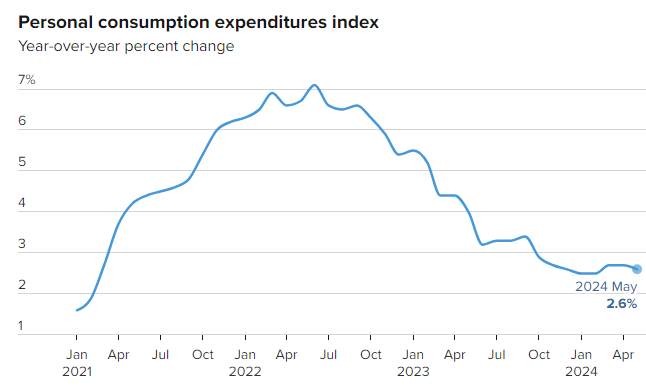
The Federal Reserve’s primary inflation gauge, the personal consumption expenditures price index, rose to 2.7% in March, encompassing all items. The crucial core index, excluding the more volatile food and energy prices, remained constant at 2.8%. These figures highlight the ongoing inflationary pressures.
The Federal Reserve is navigating a precarious inflation situation. Should it shift towards rate reductions prematurely, there’s a risk that inflation might surge back in 2024. Conversely, persistent inflation could compel central bankers to not only sustain the present rates but also ponder additional increases. The aspiration for a gentle economic descent is at stake.
Forecasters anticipate inflation to dip below 2.5% in 2024, yet challenges persist. The Federal Reserve faces the difficult task of steering the economy towards stability and controlling inflation expectations. With the central bank’s policy meeting on the horizon, speculation abounds regarding their forthcoming strategy.
Will they maintain the current interest rates or implement more assertive measures? Their decision is set to influence the economic outlook for the foreseeable future.
U.S. inflation continues to be a persistent challenge, and the Federal Reserve’s efforts are ongoing. The path forward demands cautious steering, as policymakers must achieve a fine equilibrium to sustain economic stability while simultaneously curbing inflation.
And remember, the Fed said inflation was ‘transitory’.
The personal consumption expenditures (PCE) price index, crucial for the Federal Reserve’s inflation assessments, climbed at an annualised rate of 3.4% for the quarter, marking the largest increase in a year.
Meanwhile, consumer spending rose by 2.5% during the quarter, a decrease from the 3.3% rise in the previous quarter and falling short of the 3% expectation.

According to the latest World Economic Outlook released by the IMF, Russia’s economy is projected to expand by 3.2% in 2024.
This growth outpaces the anticipated growth rates for the U.S. at 2.7%, the U.K. at 0.5%, Germany at 0.2%, and France at 0.7%.
The forecast may be galling for Western countries that have endeavoured to economically isolate, restrict and punish Russia for its invasion of Ukraine in 2022.
Russia has demonstrated that Western sanctions on its industries have made it more self-sufficient and that private consumption and domestic investment remain resilient.
Oil and commodity exports to nations such as India and China, (two of the largest countries in the world by population) – as well as alleged sanction evasion and high oil prices, have allowed Russia to maintain strong oil export incomes streams.
Outside of Russia, the IMF has revised its forecasts for Europe and the UK, projecting a growth of 0.5% for this year. This positions the UK as the second-lowest performer within the G7 group of advanced economies, trailing behind Germany.
The G7 also includes France, Italy, Japan, Canada and the U.S.
However, UK growth is expected to improve to 1.5% in 2025, placing the UK in the top three best G7 performers, according to the IMF.
The IMF also reported said that interest rates in the UK will remain higher than other advanced nations, close to 4% until 2029.
This measure tracks services inflation, excluding food, energy, and housing, which has recently surged, rising 4.8% year-over-year in March 2024 and over 8% on a three-month annualised basis.
The situation is further complicated as some of the most persistent elements of services inflation include essential household expenses such as car and housing insurance, along with property taxes. Wall Street was unsettled by a recent consumer price index report that exceeded expectations, yet the focus is on the ‘supercore’ inflation reading within the data.
Economists also analysed the core CPI, which omits the volatile prices of food and energy, to discern the true inflation trend. The ‘supercore’ gauge goes a step further by also removing shelter and rent costs from its services calculation.
Federal Reserve officials find this measure particularly useful in the current environment, viewing the spike in housing inflation as a transient issue rather than a reliable indicator of underlying price trends.
Supercore inflation accelerated to a 4.8% pace year over year in March 2024, the highest in 11 months.
Adding complexity to the situation is the declining consumer savings rate coupled with rising borrowing costs, which may compel the central bank to maintain a restrictive monetary policy “until something breaks,” according to Fitzpatrick.
Analysts warn that the Federal Reserve may struggle to reduce inflation through additional rate hikes, as the prevailing factors are more persistent and less responsive to stringent monetary policy.
On Wednesday 10th April 2024 the CPI data announcement pushed the markets down and on Thursday 11th the markets recovered after the PPI data was better than expected.
PPI increased by 0.6% in February 2024. Expectations persist for June rate cuts by the Federal Reserve.
As the world’s largest economy continues to surge, questions arise about the Federal Reserve’s next move regarding interest rates.
The unemployment rate fell to 3.8%, indicating strong job growth in several sectors such as health care, construction, and government. While economists had predicted job gains of approximately 200,000, the actual numbers have easily exceeded those expectations.
The labour market’s surprising resilience has caught analysts off guard, leading to speculation about the timing of interest rate cuts.
The Federal Reserve has held interest rates in a range of 5.25%-5.5%, the highest level in over two decades. Initially, the Fed raised rates sharply in 2022 to curb inflationary pressures. However, the subsequent cooling of price inflation (down to 3.2% in February) without a significant spike in unemployment has complicated matters. The central bank now faces a delicate balancing act.
The significant increase of 303,000 in non-farm payrolls for March 2024 reinforces the Federal Reserve’s stance that the robustness of the economy permits a gradual approach to interest rate reductions.
The Fed had been expected to initiate rate cuts this year to mitigate the impact of high borrowing costs. However, the stronger-than-anticipated economic performance suggests that rate cuts may not occur until the second half of this year.
U.S. government spending in areas like high-tech manufacturing and infrastructure has bolstered the labor market. Additionally, an influx of more than three million immigrants last year has expanded the workforce, potentially keeping wage pressures in check. In March, average hourly pay rose by 4.1% year-on-year, consistent with expectations and near a three-year low.
President Joe Biden hailed the latest job figures as a “milestone in America’s comeback.” However, some market analysts argue that the strong jobs growth could complicate efforts to return inflation to the Fed’s 2% target. Some analysts even speculate that rate cuts may not materialize until 2025.
Higher U.S. interest rates have ripple effects worldwide, enticing investors to shift capital toward America. While the Fed’s in-tray still has some warnings, the delay in rate cuts reflects the economy’s underlying strength.
The U.S. jobs boom presents a conundrum for policymakers. Balancing economic vitality with inflation control remains a delicate task, and the Fed’s decisions will reverberate far beyond its borders.
Chinese government agencies are now required to choose ‘safe and reliable’ domestic alternatives for these chips. The sanctioned list features processors from Huawei and the state supported firm Phytium, both of which face bans in the U.S.
In addition to processors, China is now also restricting Microsoft Windows on government devices, opting instead for domestically produced operating systems.
These guidelines are part of a broader tech trade battles between China and the U.S. While the impact on Intel and AMD remains to be seen, it’s clear that China is taking aggressive steps to reduce reliance on U.S. built technology.
The global tech landscape continues to evolve, and these decisions have far-reaching implications for both countries and the industry as a whole.
U.S. and China trade tensions are unlikely to recede anytime soon.
The annual rate was marginally higher than expected. The monthly rate was slightly above the forecast of 0.3%. This may likely direct the Federal Reserve to hold off on an interest rate reduction, at least until the summer of 2024. What will Wall Street make of it?
The core Consumer Price Index increased by 0.4% monthly and recorded an annual rise of 3.8%. Both figures exceeded forecasts by one-tenth of a percentage point.
An increase of 2.3% in energy costs contributed to the rise in the overall inflation figure. Food prices remained mostly unchanged for the month, while housing expenses saw a further increase of 0.4%.


To fight inflation, which reached a rate of 9% in the summer of 2022, the central bank has significantly increased interest rates in recent times. However, prices are still stubborn, especially for things like housing and groceries.
Due to the robust economic performance in early 2024, the expected reduction in interest rates has been postponed. Instead of taking place this month, the rate cuts are now more probable in May or June 2024.
Powell reportedly said: ‘The Committee does not expect that it will be appropriate to reduce the target range until it has gained greater confidence that inflation is moving sustainably toward 2 percent.’
He reiterated the pledge to lower inflation to the 2% target and keep long-term inflation expectations stable.
On Thursday 7th March 2024 Powell also said: the Fed is ‘not far’ from the point of cutting interest rates
U.S. debt permanently crossed over $34 trillion on 4th January 2024 according to data from the U.S. Department of the Treasury.
It reached $33 trillion on 15th September 2023, and $32 trillion on 15th June 2023. Before that, the $1 trillion move higher from $31 trillion took about eight months.
The U.S. national debt is the total amount of money that the federal government owes to its creditors. That can include, individuals, other countries and corporation. It is composed of two main components: federal debt held by the public and federal governmental debt.
The national debt has grown over time due to various factors, such as recessions, defense spending, and tax cuts. The debt-to-GDP ratio gives insight into whether the US has the ability to cover all of its debt. It also shows how it affects economic growth.

The national debt increased by 13.3% under President Biden. Up from $27.77 trillion as of 1st March 2020 to $31.46 trillion as of 1st March 2023. The debt also grew by $1.5 trillion, or 5.6%, between the end of 2020 and the end of 2021.
The gross domestic product (GDP) measures the annual economic output of the entire country. The national debt exceeds this amount, which is very high.
As of the end of February 2024, the U.S. debt is almost $34.4 billion. This is the money that the federal government has to borrow to pay for its operating expenses.
The World Bank found that if the debt-to-GDP ratio exceeded 77% for an extended period, it slowed economic growth.
The personal consumption expenditures (PCE) price index, excluding food and energy costs, increased 0.4% for the month and 2.8% from a year ago, as expected according to analyst’s predictions.
Headline PCE, including the volatile food and energy categories, increased 0.3% monthly and 2.4% on a 12-month basis according to the numbers released Thursday 29th February 2024 by the Commerce Department’s Bureau of Economic Analysis.
The data was released amid an unexpected jump in personal income, which rose 1%, well above the forecast for 0.3%. Spending decreased 0.1% vs. the estimate for a 0.2% gain.
U.S. inflation target is 2%.
Intuitive Machines’ Nova-C cargo lander, named ‘Odysseus’ after the mythological Greek hero, is the first U.S. spacecraft to soft land on the lunar surface since 1972.
Japan, India and China have all had recent successful moon mission ahead of the U.S.
Intuitive Machines is the first company to pull off a moon landing – government agencies have carried out all previously successful missions.
The company’s stock surged in extended trading Thursday, after falling 11% in regular trading.

The targeted landing site was a cratered terrain next to a 5km-high mountain complex known as Malapert. It’s the southernmost point on the Moon ever visited by a spacecraft.
It’s on the shortlist of locations where Nasa is considering sending astronauts later this decade as part of its Artemis programme.
It is reported that there are some deep craters in this region that never see any sunlight – they’re permanently in shadow – and scientists believe frozen water could be inside them.
Art illustration on Intuitive Machines luna lander

However, the latest test failed when the missile’s booster rockets didn’t function correctly and plopped into the sea near the launch site.
This is the second time in a row that a Trident missile test has failed, raising concerns over the reliability and safety of the UK’s nuclear weapons system. The defence secretary and the head of the navy were on board the submarine HMS Vanguard when the test went wrong.
The Ministry of Defence said the nuclear deterrent remains ‘safe, secure and effective’ and that the issue was specific to the test and would not affect a real launch. So that’s reassuring to hear then.
However, some critics have called for an inquiry into the incident and questioned the need for spending billions of pounds on renewing the Trident programme.
This is highly embarrassing for both the UK and the U.S. and for the manufacturer of the Trident missile.
That’s the fear spreading through Wall Street as another inflation reading on Friday 16th February 2024 came in hotter-than-expected.
The producer price index rose 0.3% in January 2024. The largest increase since August 2024 and higher than the 0.1% forecast. Excluding food and energy, core PPI jumped 0.5%, again well above consensus.
It is yet another sign of stubborn price pressures across the broader U.S. economy. And it came just days after an unexpectedly hot CPI reading, which gave markets a nasty jolt.
Both data have stoked investor worries on whether inflation is firmly under control. The latest developments also reinforce the Fed’s caution that it will need to see more evidence of disinflation before committing to lower rates.
Mohamed El-Erian, Allianz chief economic advisor, posted on X that like the CPI data, the PPI report was a further indication that the last mile of the inflation battle is more complex than many had assumed (and still assume).
Some economists even argue the jump in Friday’s data will likely push January’s personal consumption expenditures price index, the Fed’s preferred inflation gauge.
The PPI data means we can finalise our core PCE forecast for January, at 0.32%. That would be the biggest increase since September. But the three months since then all saw much smaller gains.
But investors will have to wait until later this month for PCE data when it’s released on 29th February 2024.
The twenty companies have signed an accord committing them to fighting voter-deceiving content. They say they will deploy technology to detect and counter the material.
The Tech Accord to Combat Deceptive Use of AI in 2024 Elections was announced at the Munich Security Conference on Friday 16th February 2024.
The issue has come into sharp focus because it is estimated up to four billion people will be voting this year in countries such as the U.S., UK and India.
Among the accord’s pledges are commitments to develop technology to mitigate risks related to deceptive election content generated by AI, and to provide transparency to the public about the action firms have taken.
Other steps include sharing best practice with one another and educating the public about how to spot when they might be seeing manipulated content.
Signatories include social media platforms X, Snap, Adobe and Meta, the owner of Facebook, Instagram and WhatsApp.
However, the accord has some shortcomings, according to computer scientist Dr Deepak Padmanabhan, from Queen’s University Belfast, who has co-authored a report on elections and AI.
But he reportedly said they needed to take more proactive action instead of waiting for content to be posted before then seeking to take it down.
That could mean that realistic AI content, that may be more harmful, may stay on a platform for longer compared to obvious fakes which are easier to detect and remove, he suggested.
The accord’s signatories say they will target content which deceptively fakes or alters the appearance, voice, or actions of key figures in elections.
It will also seek to deal with audio, images or videos which provide false information to voters about when, where, and how they can vote.
We have a responsibility to help ensure these tools don’t become weaponised in elections, Brad Smith, the president of Microsoft is reported to have said.
These measures, in my opinion, are a sticking plaster and will not stop the spread of dishonest and fake news!
The new inflation figure raised doubts that the Federal Reserve would be able to cut rates several times this year, a key part of the equity market bull run case.
The consumer price index rose 0.3% in January 2024 from December 2023. CPI was up 3.1% year-to-year. Economists expected CPI to have increased by 0.2% month over month in January and 2.9% from a year earlier.

The U.S. economy added 353,000 jobs and average hourly pay jumped, while the unemployment rate held steady at 3.7%, the Labour Department said.
The report extended more job gains that has surprised economists, who have expected a jump in interest rates since 2022 to slow the economy. It hasn’t. No recession or slowdown in the economy so far.
Analysts now say the job market gain and strength make an early interest rate cut less likely.
The U.S. employment data delivered quite a shock, easily beating expectations, with earnings much higher than expected. Stock markets gained and are at elevated levels for the Dow, Nasdaq and the S&P 500. Record highs have been set – are the highs?
Market analysts said these numbers show the U.S. economy is strong and will change the mindsets of those expecting an early interest rate cut.
Expectations of a recession are off the table too, for now.
In the interview and after last week’s Federal Open Market Committee meeting (FOMC), Powell expressed confidence in the economy. However, he promised he wouldn’t be swayed by this year’s presidential election and said the pain he feared from rate hikes never really materialised.
“With the economy strong like that, we feel like we can approach the question of when to begin to reduce interest rates carefully,” he reportedly said.
“We want to see more evidence that inflation is moving sustainably down to 2%,” Powell added. “Our confidence is rising. We just want some more confidence before we take that very important step of beginning to cut interest rates.”
Powell indicated that it was unlikely the FOMC will make that first move in March 2024, which markets have been anticipating.
But a cut anytime soon is unlikely until inflation is brought fully under control and nearer to the Fed’s 2% inflation target.
The Federal Reserve sent a signal that it is finished with raising interest rates but made it clear that it is not ready to start cutting, just yet. It also said there are no plans yet to cut rates with inflation still running above the central bank’s target.


The U.S. easily avoided a recession that many had forecast as inevitable, the U.S. Commerce Department reported Thursday 25th January 2024.
Gross domestic product (GDP), a measure of all the goods and services produced, increased at a 3.3% annualised rate in the final quarter of 2023, according to data from the Commerce Department.
Wall Street consensus was for a figure of 2%.

Core prices for personal consumption expenditures (PCE), a preferred measure by the Federal Reserve as a longer-term inflation calculation, rose 2% for the period, while the rate was 1.7%.
On an annual basis, the PCE price index rose 2.7%, down from 5.9% a year ago, while the core figure excluding food and energy posted a 3.2% increase annually, compared with 5.1%.
Inflation falling, GDP rising, stabilizing interest rates and no recession thus far the U.S. economy is looking rock-solid despite all the negativity.