
U.S. inflation rate hits 2.1% in September 2024

Inflation saw a modest rise in September 2024, edging closer to the Federal Reserve’s target, as reported by the Commerce Department on Thursday 31st October 2024.

The personal consumption expenditures (PCE) price index recorded a seasonally adjusted increase of 0.2% for the month, and the year-over-year inflation rate stood at 2.1%, aligning with predictions. The PCE index is the Fed’s preferred inflation measure, although officials monitor various other indicators as well.

The Fed aims for a 2% yearly inflation rate, a benchmark not met since February 2021.

Despite the main figure indicating that the central bank is approaching its objective, the inflation rate, excluding food and energy, was at 2.7%. This core inflation metric rose by 0.3% monthly, with the annual rate exceeding expectations by 0.1 percentage points.

This report arrives as markets strongly anticipate the Fed will reduce its benchmark short-term interest rate at the upcoming meeting. In September 2024, the Fed made a significant half-percentage-point rate cut, a rare action during an economic upturn.

Officials remain optimistic that inflation will realign with their target, yet they are wary about the labour market’s condition, even as most data suggests steady hiring and low layoff rates.

10-year Treasury yield at 4.25% – highest since July 2024

Treasury yields U.S.

On Wednesday 23rd October 2024, the U.S. 10-year Treasury yield climbed again as traders considered recent remarks from Federal Reserve officials regarding the direction of interest rate reductions

The U.S. 10-year Treasury yield increased by over 0.030% to approximately 4.24%. The benchmark rate peaked at 4.26% during the session, its highest since July 2024. This surge followed a 12-basis point leap on Monday 21st and a rise above 4.2% on Tuesday 22nd.

The U.S. 2-year Treasury yield also rose, reaching 4.06%, up by roughly 0.030%. Earlier in the day, it achieved a high of 4.072%.

Yields and equity prices have an inverse relationship. A single basis point is equivalent to 0.01%

Elevated Treasury yields are exerting pressure on the equity market, causing U.S. stock futures to drop. This downturn follows the S&P 500‘s first consecutive loss since the beginning of September.

Despite a half-point reduction by the Federal Reserve in September 2024, strong economic indicators and concerns about the deficit have contributed to the increase in the 10-year Treasury yield.

Traders are worried that the central bank might be reluctant to lower rates further, even though the Fed predicted additional cuts amounting to half a point by the end of the year.

The jury is out.

Is it job done for the Federal Reserve now?

Federal Reserve

Recent inflation data suggests that the Federal Reserve is fast approaching its goal, if not already there – following the central bank’s significant interest rate reduction of 0.50% a few weeks ago

Both consumer and producer price indexes for September 2024 aligned with forecasts, indicating a decline in inflation towards the central bank’s 2% target.

Economists believe the Fed may have already achieved that target.

Last Friday, it was predicted that the personal consumption expenditures (PCE) price index for September 2024 would reveal an annual inflation rate of 2.04% upon its release later in the month.

Should economists’ estimates prove accurate, the figure would be rounded to 2%, aligning precisely with the Fed’s longstanding goal, marking a significant shift from the 40-year inflation peak over two years ago, which led to a series of substantial interest rate hikes.

The Fed favours the PCE as its measure of inflation, although it considers various factors in its decision-making process.

Inflation has significantly decreased over the past 18 months, and the job market has settled at a level that may represent full employment.

The U.S. economy several obstacles in reaching and sustaining the 2% inflation target

Supply chain disruptions

Persistent supply chain problems can escalate the costs of goods and services, potentially increasing inflation.

Labour market tightness

A constrained labour market may result in rising wages, which companies typically offset by raising prices for consumers.

Global economic factors

International events, like geopolitical conflicts or other countries’ economic statuses, can influence inflation via alterations in trade and commodity costs.

Consumer expectations

Anticipations of higher inflation might prompt consumers to increase spending now, which can elevate prices and lead to a self-fulfilling prophecy.

Monetary policy timing

The economy takes time to respond to monetary policy adjustments, leading to a lag between policy implementation and its effects on inflation.

These elements pose difficulties for the Federal Reserve in precisely managing inflation to meet its goal.

While managing inflation is challenging, recent data suggests that although prices haven’t fallen from their peak levels of a few years ago, the rate of increase is slowing down.

The 12-month consumer price index for all items stood at 2.4% in September, while the producer price index, indicative of wholesale inflation and a precursor to pipeline pressures, was at an annual rate of 1.8%.

The 0.50% cut in September 2024to a federal funds rate range of 4.75% to 5% was extraordinary for a growing economy, and it is anticipated that the Federal Reserve will revert to its standard quarter-point adjustment.

Excessive monetary loosening could trigger a surge in consumer demand just as it begins to reach a manageable rate.

Could we witness deflation if the 2% target is overshot?

The Fed says smaller rate cuts not bigger to come

Federal Reserve

Federal Reserve Chair Jerome Powell recently stated that the latest half-percent reduction in interest rates should not be interpreted as a sign that future measures will be equally as aggressive.

The Fed suggests that subsequent adjustments will likely be more ‘modest’.

In his address, the central bank’s chief highlighted their goal to balance curbing inflation with maintaining a robust labour market, basing future decisions on data insights.

‘Moving forward, should the economy evolve as widely expected, our policy stance will progressively adjust towards neutrality. Yet, we are not bound to a fixed course,‘ he clarified during in his statement. ‘Risks are two-way, and our resolutions will be determined one meeting at a time.‘

The Federal Reserve believe, as noted in a recent update, that they are just millimetres away from that ‘elusive’ economic soft landing.

In August 2024 – U.S. consumer prices increased by 0.2% with core inflation exceeding expectations

U.S. CPI statistics

As anticipated in the U.S., prices rose in August 2024, while the annual inflation rate fell to its lowest point since February 2021, according to a Labor Department report on Wednesday 11th September 2024.

This development likely now paves the way for a Federal Reserve interest rate reduction next week but maybe by only 0.25% and not the 0.50% some pundits have predicted.

The consumer price index, which measures a wide array of goods and services costs throughout the U.S. economy, rose by 0.2% for the month, matching the consensus, as reported by the Bureau of Labor Statistics.

This increase brought the year-on-year inflation rate to 2.5%, a decrease of 0.4 percentage points from July 2024 and slightly below the 2.6% prediction.

Nevertheless, the core CPI, which omits the more fluctuating food and energy prices, saw a 0.3% rise for the month, just above the 0.2% projection. The annual core inflation rate stood at 3.2%, consistent with expectations.

Is the ‘eagerly anticipated’ Fed interest rate cut (due in September 2024) – too little too late?

Federal Reserve

Is the U.S. economy already weaker than the headline data suggests and should the U.S. Federal Reserve already be easing?

In the U.S. recent data (Friday 30th August 2024) showed the personal consumption expenditures (PCE) price index, the Federal Reserve’s favored measure of inflation, ticked up 0.2% last month, as expected. The data seems to back a smaller rate cut.

The question of whether the economy is weaker than headline data suggests and if the U.S. Federal Reserve should already be easing is complex.

The gross domestic product (GDP) increased at an annual rate of 3% in Q2 of 2024, which is a positive indicator. However, the U.S. current-account deficit widened, and personal income and outlays show mixed signals with a slight increase in personal income but a higher increase in personal outlays.

Inflation remains above the Federal Reserve’s 2% target but well below the pandemic-era peak. These factors suggest that while there are positive aspects to the U.S. economy, there are also challenges that may warrant caution from the Federal Reserve.

Is the market too focused on forecasting the size of any possible upcoming cut? “The question no one has asked yet is why is the policy rate is still at 5.5% when inflation is down to almost 2.5%? It would most likely be an error to do a ‘bigger’ rate cut in this kind of environment with all the uncertainty that the U.S. economy is facing.

Jobs data trends are also an important factor and play a major role in decision making. Company performance and future performance predictions are critical to help judge policy direction.

Decisions on monetary policy easing would be based on a comprehensive analysis of all economic indicators and trends.

If the FED go BIG on a rate cut some say it could be very dangerous and spook the markets.

Dow Jones hits new record high

The Dow Jones Industrial Average (DJIA) reached a new record high on Monday 26th August 2024, closing at 41240. 

Investors have responded positively to the Federal Reserve’s recent indications that interest rate cuts are highly probable to commence in September 2024.

Market dynamics and sentiment

The rise of the DJIA was propelled by advances in sectors like materials, utilities, and energy. Conversely, the broader market exhibited mixed outcomes. The S&P 500 declined by 0.3%, and the Nasdaq Composite dropped by 0.8%, contrasting with the Dow’s notable performance. This disparity is largely due to the lagging of technology stocks, especially with significant drops in firms such as Nvidia and Tesla.

Federal Reserve

Federal Reserve Chair Jerome Powell’s recent address at the Jackson Hole Economic Symposium was pivotal in bolstering investor confidence. Powell’s remarks indicated that the Fed is ready to cut interest rates, which many investors believe will foster economic growth and stabilise the markets. The expectation of rate cuts has played a significant role in the recent market rally, with predictions of potential reductions up to 1% by the end of 2024.

Dow Jones one day chart at record high

Dow Jones 1 day chart

Despite varied performances across sectors, the Dow reaching a new high signals a wider optimism in the market. As the year unfolds, the dynamics among Federal Reserve policies, corporate earnings, and economic indicators will continue to influence market directions.

All roads lead to Fed rate cut as minutes point to ‘likely’ September 2024 reduction

Fed prediction

No surprise here then as the Fed have been signalling a cut for some time now

The Fed summary stated: “The vast majority” of participants at the July 30-31 meeting “observed that, if the data continued to come in about as expected, it would likely be appropriate to ease policy at the next meeting.”

Markets have fully factored in a rate cut for September, marking the first such move since the initial emergency reductions during the early stages of the Covid crisis.

See more about Fed rate cut signals here

U.S. inflation slows in July 2024

U.S. inflation

U.S. consumer prices (CPI) increased at the slowest rate in over three years last month, further supporting the argument for the Fed to begin reducing interest rates.

According to the U.S. Labor Department, prices climbed 2.9% in the 12 months leading up to July 2024, marking the smallest yearly rise since March 2021 and a decrease from 3% in June 2024.

The monthly inflation report was under intense scrutiny following indications of weaker-than-anticipated job growth in July, which earlier this month led to upheaval in the stock market and concerns about a recession.

Analysts have suggested that these figures should persuade the Federal Reserve that the elevated borrowing costs are effectively bringing inflation back to its target levels, despite the recent increases in housing and food prices.

Slower and smaller-than-expected rate cuts. A slowing U.S. economy and a potential AI bubble – does this all add up to a coming bear market?

Witches' stocks cauldron

The stock markets mix of toil and trouble is in the cauldron ready for a bear market in 2025, if not before.

Why?

  • Fed to resist reducing rates to the market’s desired 3.50%.
  • Profits unlikely from now on to fulfill expectations, because the U.S. economy is slowing.
  • AI sector is in or close to ‘bubble territory’.
  • Debt.
  • Geopolitical concerns.

These concerns are now all combining, and it will likely add-up to a bear market of around 25% in 2025 (this is my best guess).

Remember – make your own decisions and always, always do your own careful research. Seek professional financial advice if in doubt.

RESEARCH! RESEARCH! RESEARCH!

Is the Fed fighting its own shadow?

Shadow boxing

Has the Fed over-cooked it this time by waiting too long to reduce interest rates?

U.S. stock markets threw a wobbly after the latest employment data and after the Fed delayed its first rate cut… again. September 2024 now looks likely for that first cut – but by how much: 0.25% or as high as 0.50%?

The latest batch of bad news for the U.S. economy has actually became bad news for stocks this time. For too long the ‘bad news’ has been taken as ‘good news’, especially regarding the likelihood of a Fed interest rate cut – and for the markets in general.

The Federal Reserve (Fed) is grappling with several challenges, including inflation, interest rates, and the broader U.S. and global economies.

Inflation

The Fed has been trying to control high inflation rates, which have been a significant concern. To combat inflation, the Fed has raised interest rates multiple times. Higher interest rates can help reduce inflation by slowing down borrowing and spending, but they can also slow economic growth.

Interest rates

By increasing interest rates, the Fed aims to make borrowing more expensive, which can help cool down an overheated economy. However, this can also lead to higher costs for consumers and businesses, potentially leading to reduced investment and spending.

Economic growth

The Fed’s policies are a balancing act. While they aim to control inflation, they also need to ensure that the economy doesn’t slow down too much. This balancing act can be challenging, especially when external factors like global economic conditions and geopolitical events come into play.

In essence, the Fed’s efforts to manage these issues can sometimes feel like ‘fighting its own shadow,’ as the consequences of their actions can create new challenges.

The timing of interest rate adjustments by the Federal Reserve is a topic of much debate among economists and policymakers.

Inflation control

The Fed’s primary goal in raising interest rates has been to control inflation. If inflation remains high, the Fed might be cautious about reducing rates too quickly to avoid a resurgence of inflation.

Economic indicators

The Fed closely monitors various economic indicators, such as employment rates, consumer spending, and GDP growth. If these indicators suggest that the economy is still strong, the Fed might delay reducing rates to ensure that inflation is fully under control.

Market reactions

Rapid changes in interest rates can cause volatility in financial markets. The Fed often aims for a gradual approach to avoid sudden shocks to the economy.

Global factors

The Fed also considers global economic conditions. For example, if other major economies are experiencing slow growth or financial instability, the Fed might be more cautious in adjusting rates.

Ultimately, the decision to reduce interest rates involves balancing the need to support economic growth with the risk of reigniting inflation. It’s a complex decision with significant implications for the U.S. and global economies.

Looks like the Fed overcooked it this time – but by how much?

Markets got to hear exactly what they wanted to hear from Fed chair Jerome Powell

FOMC

FOMC hold rates steady at 5.25% – 5.50%

Federal Reserve Chair Jerome Powell ended a press conference in which he gave markets exactly what they wanted; a strong indication of a September 2024 rate cut.

Powell says September 2024 rate cut ‘on the table’ if inflation continues to cool.

Federal Reserve officials held short-term interest rates steady but observed that inflation is getting closer to its 2% target.

The FOMC did not signal an immediate rate cut; they reiterated that further progress is necessary before considering rate reductions. However, Federal Reserve Chair Powell’s subsequent statement was markedly dovish, hinting at a potential rate cut in September 2024.

Markets were generally happy with the news after moving up all day in anticipation of the confirmation of a September cut. The Dow Jones, Nasdaq, Russell 2000 and S&P 500 all climbed before and after the news.

The Dow closed 650 points higher Friday 26th July 2024 – lifted by a positive inflation data

U.S. stock charts and flag

On Friday 26th July 2024, U.S. stocks surged, and Wall Street concluded a volatile week on an upbeat note as investors considered the latest U.S. inflation data.

The Dow Jones Industrial Average soared 654 points to settle at 40589. The S&P 500 climbed to 5459 while the Nasdaq Composite advanced around 1% to close at 17357.

Dow Jones as at: 26th July 2024 – one day chart

Dow Jones as at: 26th July 2024 – one day chart

The upward movement was attributed to a mix of oversold conditions, a U.S. GDP report on Thursday 25th July 2024 that exceeded expectations, and the anticipation that the Federal Reserve will start reducing rates in response to the economy’s demonstrated resilience.

U.S. rate cut looking more likely as Fed key inflation measure rose 2.5% in June 2024 over the year

U.S. Inflation

The personal consumption expenditures price index (PCE) increased 0.1% in June 2024 and was up 2.5% from a year ago, with the annual rate showing a slight decline from the prior month

Core inflation, which excludes food and energy, showed a monthly increase of 0.2% and 2.6% on the year, both also in line with expectations.

Personal income rose just 0.2%, below the 0.4% estimate. Spending increased 0.3%, meeting the forecast, while the personal savings rate decreased to 3.4%.

This PCE reading may encourage the Fed to cut rates now.

Gold gains again to hit new record high!

Gold price

Gold prices climbed to $2,482 per ounce, hitting an all-time high. 

Gold prices continued to peak at new record highs Tuesday and Wednesday 15th and 16th July 2024.

On Monday 15th July 2024, Powell reportedly said the Fed won’t wait for inflation to reach the central bank’s 2% target before it begins cutting, due to the ‘lag’ in policy effects. He reportedly said the Fed is looking for ‘greater confidence’ that inflation will return to the 2% level. The monthly inflation rate dipped in June 2024 – the first time in over four years.

The price increase has been aided by encouraging comments from the Federal Reserve that it will now more likely cut interest rates in September 2024 following comments from Fed Chair Jerome Powell.

And that has given market investors and traders more confidence. According to the CME FedWatch tool, traders are convinced the FOMC will cut rates by September 2024.

As interest rates fall, gold usually becomes more appealing compared to fixed-income assets such as bonds and general savings accounts.

One year gold chart to 17th July 2024 (am)

What the Fed said

Federal Reserve

Jerome Powell appears to be further paving the way for a rate cut at the next meeting in July 2024.

Federal Reserve Chair Jerome Powell reportedly said Monday 15th July 2024 that the central bank will not wait until inflation hits 2% to cut interest rates.

Powell referenced the idea that central bank policy works with ‘long and variable lags’ to explain why the Fed wouldn’t wait for its target to be hit.

‘The implication of that is that if you wait until inflation gets all the way down to 2%, you’ve probably waited too long, because the tightening that you’re doing, or the level of tightness that you have, is still having effects which will probably drive inflation below 2%,’ Powell reportedly said.

Instead, the Fed is looking for ‘greater confidence’ that inflation will return to the 2% level, Powell remarked.

‘What increases that confidence in that is more good inflation data, and lately here we have been getting some of that,’ he reportedly said.

Powell also said he thinks a ‘hard landing’ for the U.S. economy was not ‘a likely scenario.’

It looks like it is time for that rate cut, he didn’t say that!

Federal Reserve chair Powell says keeping rates high for too long could jeopardize growth

Banker giving a speech

Jerome Powell on Tuesday 9th July 2024 reportedly expressed concern that holding interest rates too high for too long could jeopardize economic growth. This comment came ahead of the consumer price index reading due this week.

Preparing for a two-day session on Capitol Hill, the central bank chief stated that the economy and labour market continue to be robust, even with some recent slowdown. Powell noted a slight reduction in inflation, affirming that policymakers are determined to reduce it to their target of 2%.

“At the same time, in light of the progress made both in lowering inflation and in cooling the labour market over the past two years, elevated inflation is not the only risk we face,” he reportedly said. “Reducing policy restraint too late or too little could unduly weaken economic activity and employment.”

Sounds to me like he is paving the way for the first interest rate reduction.

The comment ties-in with the upcoming one-year period since the Federal Open Market Committee (FOMC) last increased the benchmark interest rates.

The Fed says progress has been made in the fight against inflation

Federal Reserve Inflation

Federal Reserve Chair Jerome Powell has expressed satisfaction with the current progress in the inflation battle but indicated a desire for additional positive data before considering a reduction in interest rates.

“We want to be more confident that inflation is moving sustainably down toward 2% before we start the process of reducing or loosening policy,” he said.

While Powell acknowledges progress in inflation, he remains cautious about acting prematurely and jeopardizing the trend of decreasing prices.

Markets moved up after Powell’s comments.

Update: A Fed statement released after the market closed stated that – Fed says it’s not ready to cut rates until ‘greater confidence’ inflation is moving to 2% goal

Have you heard of the ‘Sahm Rule’ recession indicator?

Rules in a book

The ‘Sahm Rule’ serves as a heuristic indicator employed by the Federal Reserve to ascertain the onset of a recession in the economy.

The Sahm Rule is a real-time evaluation tool based on monthly unemployment data from the Bureau of Labor Statistics (BLS). Named after economist Claudia Sahm, it forecasts the onset of a recession when the three-month moving average of the national unemployment rate (U3) increases by 0.50% or more compared to its lowest point in the preceding 12 months.

This simple yet effective indicator helps policymakers monitor economic cycles and respond accordingly

Time to cut according to the ‘Sahm Rule’

Sahm has reportedly stated that the Fed is taking a significant risk by not implementing gradual rate cuts now. Last week, Federal Reserve officials significantly reduced their forecasts for rate cuts this year, shifting from three anticipated reductions noted in the March 2024 meeting to just one.

According to the creator of a well-established rule for predicting recessions, the Federal Reserve is risking an economic contraction by not lowering interest rates immediately.

Nasdaq and S&P 500 hit new all-time highs as Fed feeds scraps to the AI frenzy!

Record high!

The S&P 500 soared to a new high, surpassing 5400 for the first time on Wednesday 12 June 2024, following the Federal Reserve’s latest policy statement and the May 2024 inflation report, which suggested a softening of inflationary pressures.

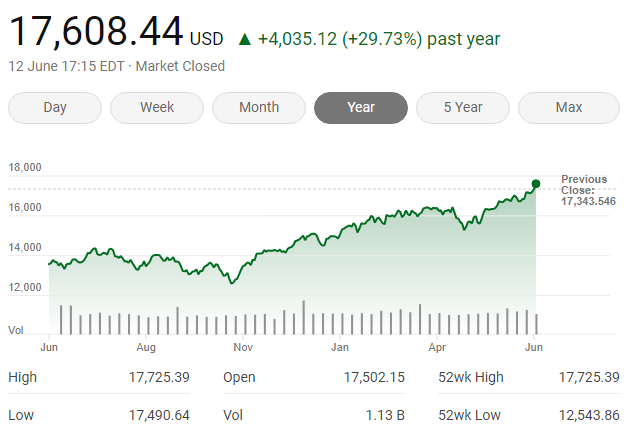
The S&P 500 index rose by 0.85%, closing at around 5421 while the Nasdaq Composite advanced 1.53%, finishing at 17608.

Both the S&P 500 and Nasdaq reached unprecedented levels and set closing records on Wednesday 12th June 2024. Conversely, the Dow Jones Industrial Average marginally declined by 0.09%, or around 35 points, to settle at 38712.

S&P 500 at new all-time high 12th June 2024

S&P 500 at new all-time high 12th June 2024

Nasdaq Composite at new all-time high 12th June 2024

Nasdaq Composite at new all-time high 12th June 2024

The Federal Reserve maintained the interest rates, aligning with widespread expectations. The Fed also acknowledged some progress on inflation. Modest further progress has been made toward the Committee’s 2% inflation goal and this was more than enough coupled with the recent jobs report to push U.S. markets even higher.

A tiny glimpse of the ‘2% inflation future’ was all it took to send markets on an AI led feeding frenzy to push the S&P 500 and Nasdaq to new all-time highs.

One caveat though, the Fed’s recent forecasts predict only one rate reduction this year, a decrease from the three rate cuts anticipated earlier in 2024.

It was enough to propel markets to fresh all-time highs!

U.S. job gains reached 272,000 in May 2024 – exceeding expectations of 190,000

U.S. jobs

The U.S. economy exceeded job growth expectations in May 2024, alleviating concerns of a labour market downturn but potentially diminishing the Federal Reserve’s motivation to cut interest rates.

Non-farm payrolls surged by 272,000 for the month – a significant increase from April’s 165,000 and surpassing the consensus forecast of 190,000.

Concurrently, the unemployment rate increased to 4%, marking the first instance it has reached this level since January 2022.

Bad economic news can be good for stocks

Bad news and good news

Bad economic news appears to have had an interesting impact on the stock market recently.

Traditionally, negative economic data might be anticipated to result in falling stock prices; however, recent trends have diverged from this norm.

News trend

In the past two months, negative economic news has had a paradoxically positive effect on equities. Investors have responded well to poor economic indicators, partly due to the belief that these could lead the Federal Reserve to begin reducing interest rates.

Dollar and the stock market

In recent times, the S&P 500, a large-cap equity index, and the U.S. dollar have exhibited a nearly perfect correlation. As the dollar has seen a gradual decline, the stock market has conversely experienced a rise. Typically, investors flock to the security of cash, and consequently the dollar, in times of uncertainty, yet they also channel investments into stocks upon the arrival of favourable news.

Economic data

Despite the upbeat trend in the stock market, real economic data has frequently fallen short of Wall Street’s predictions. The Citi Economic Surprise Index, a gauge that compares data to expectations, has been on a downward trajectory. This suggests that expectations have been surpassing the actual economic conditions, signalling that the economic situation may not be as favorable as previously thought.

Dilemma for the Fed

The Federal Reserve methodically reviews economic indicators to influence their interest rate decisions. Typically, unfavorable economic reports might prompt the Fed to reduce rates, unless there’s an uptick in inflation. Escalating inflation generally nudges the Fed towards a tighter monetary policy.

Monthly data roll-out

Data concerning the U.S. labour market presented to the Fed and markets may create that ‘pivotal’ moment – it often does – markets move of Fed comments and ‘awaited’ news. Reports detailing job openings, private sector job creation, and the Bureau of Labour Statistics’ nonfarm payrolls will shed light on the economy’s condition.

If job growth remains within the ‘Goldilocks range’ (neither too strong nor too weak), it may preserve the fragile equilibrium where unfavourable economic news has paradoxically favoured stock prices, while preventing excessive gloom.

Conclusion

To summarize, although adverse economic news has lately been advantageous for stock markets, monitoring this precarious balance is crucial. Excessive pessimism could be a harbinger of impending difficulties, despite its current benefits.

Note about Citigroup Economic Surprise Index

The Citigroup Economic Surprise Index is the sum of the difference between the actual value of various economic data and their consensus forecast. If the index is greater than zero, it means that the overall economic performance is generally better than expected, and the S&P 500 has a high probability of strengthening, and vice versa.

U.S. debt and deficits are generating concerns about potential threats to the economy and financial markets

Debt burden

The federal debt reportedly reached $34.5 trillion, marking an increase of approximately $11 trillion since March 2020.

This surge has sparked discussions among government and financial leaders, with a notable Wall Street firm questioning whether the associated costs could threaten the stock market’s upward trend. The Congressional Budget Office projects that the public debt will soon surpass any previously recorded levels relative to GDP.

Federal Reserve Chair Jerome Powell has emphasized the urgency for elected officials to address this issue promptly.

Dow, S&P 500 and Nasdaq Composite all hit new highs as favourable data allows potential rate cuts to get ever closer – September 2024 looks likely

All three major indices closed at records on 15th May 2024

The Dow climbed 0.88%, while the S&P 500 gained 1.17%, ending the session above 5,300 for the first time. The tech-related Nasdaq Composite closed higher by 1.40%.

Dow closed at a new high of: 39908

S&P 500 closed at a new high of: 5308

Nasdaq Composite closed at a new high of: 39908

UK interest rate held at a 16-year high as Bank of England holds rates at 5.25%

On hold

The decision comes as inflation, which measures price rises over a period of time, remains above the Bank’s 2% target at 3.2%. But bank says cuts are coming.

Is the 2% target still a sensible benchmark?

The 2% inflation target set by central banks has been a widely adopted benchmark for monetary policy.

History

The 2% inflation target became prominent in the 1990s and early 2000s. Central banks, such as the Federal Reserve and the Bank of England, have aimed to maintain inflation at this level.

The Federal Reserve has typically pursued an inflation rate of about 2% since 1996.

In January 2012, then-Fed Chairman Ben Bernanke formally established the 2% target, and subsequent Fed chairs have continued to endorse this rate as the preferred level of inflation.

Why the 2% target?

Price stability

The 2% inflation target was selected as it provides a balance between preventing problematic inflation and avoiding damaging deflation. Does it work?

Avoiding deflation

Deflation, characterized by falling prices, can hinder economic growth. Central banks target a 2% inflation rate to avert deflation and ensure stability.

Creditor-Debtor compromise

The 2% inflation target represents a balance between creditors’ preference for lower inflation and debtors’ inclination towards higher inflation.

Challenges

Changing economic environment

In recent years, the global economy has encountered distinct challenges, including sluggish growth, technological upheavals, and demographic changes. Consequently, there is a debate on whether the 2% inflation target requires reassessment.

Persistently low inflation

Despite the efforts of central banks, inflation has persisted below the 2% mark in numerous advanced economies, sparking debates over the potential need to modify the target.

Trade-offs

Aiming for a 2% inflation rate can occasionally clash with other policy objectives, like employment or financial stability. It’s crucial for central banks to judiciously manage these competing priorities.

Revision

Several central banks are revising their strategies. For example, the European Central Bank (ECB) has adopted a more adaptable inflation target, permitting temporary exceedances to balance out extended periods of below-target inflation.

The Bank of England also considers broader economic factors when setting policy, rather than rigidly adhering to the 2% target.

IIn summary, although the 2% inflation target has been a helpful benchmark, central banks are progressively willing to adjust their strategies in response to evolving economic conditions. The current debate focuses on striking an optimal balance between stability, growth, and adaptability.

Central banks saw this period of inflation as ‘transitory’ – it wasn’t. It could be argued that their lack of action led to a bigger inflation problem overall.

Fed foe inflation forces U.S. to hold rates and they will likely remain high for some time yet!

U.S. economic health

The Fed have deliberated over ‘transitory’ inflation – (they got that wrong). They have teased us about when rates will be cut (still waiting). And now we are told no rate cut but: ‘the next rate move is unlikely to be up!’

Probably better to say and do nothing at all? Are you a bit confused? I am.

The U.S. central bank has decided to maintain interest rates, reasoning a ‘lack of further progress’ in reducing inflation. This leaves the Federal Reserve’s key rate at its highest in over two decades, between 5.25% and 5.5%.

Sticky problem

By maintaining high borrowing costs, the Federal Reserve seeks to decelerate the economy and reduce inflationary pressures. However, this also increases the financial burden on businesses due to elevated borrowing expenses and on consumers through higher mortgage and loan payments.

However, as U.S. inflation remains more stubborn than anticipated (and that is being generous), the Fed is now being closely scrutinized over its forthcoming actions.

Analysts, who had predicted rate reductions early this year, have had to delay their projections, with some even suggesting a potential rate hike.

No rate cuts but ‘hike’ unlikely – that’s helpful then

Following the declaration, the Fed Chair reportedly expressed his belief that a rate hike is ‘unlikely,’ reiterating the need for more assurance of subsiding inflation before considering a reduction.

‘The decision will truly be data-dependent; it’s going to take longer to reach that point of comfort. I don’t know how long it will take’, he reportedly stated.