The federal debt reportedly reached $34.5 trillion, marking an increase of approximately $11 trillion since March 2020.
This surge has sparked discussions among government and financial leaders, with a notable Wall Street firm questioning whether the associated costs could threaten the stock market’s upward trend. The Congressional Budget Office projects that the public debt will soon surpass any previously recorded levels relative to GDP.
Federal Reserve Chair Jerome Powell has emphasized the urgency for elected officials to address this issue promptly.
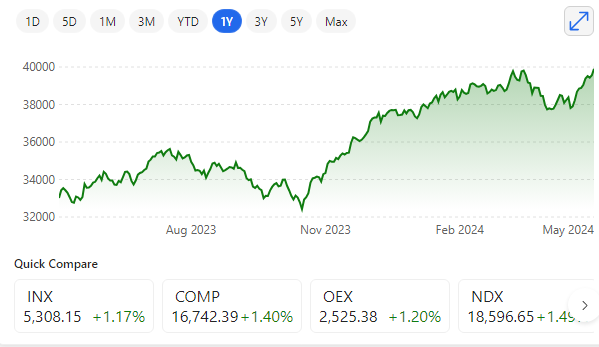
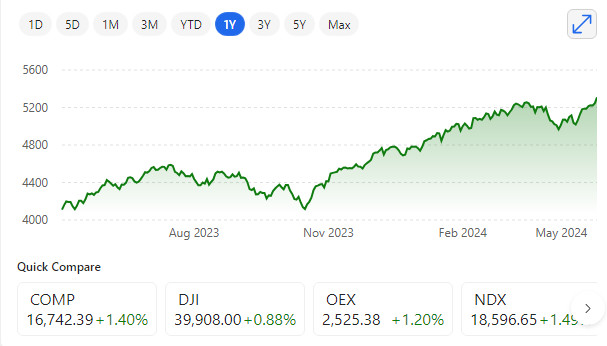
All three major indices closed at records on 15th May 2024
The Dow climbed 0.88%, while the S&P 500 gained 1.17%, ending the session above 5,300 for the first time. The tech-related Nasdaq Composite closed higher by 1.40%.
The decision comes as inflation, which measures price rises over a period of time, remains above the Bank’s 2% target at 3.2%. But bank says cuts are coming.
Is the 2% target still a sensible benchmark?
The 2% inflation target set by central banks has been a widely adopted benchmark for monetary policy.
History
The 2% inflation target became prominent in the 1990s and early 2000s. Central banks, such as the Federal Reserve and the Bank of England, have aimed to maintain inflation at this level.
The Federal Reserve has typically pursued an inflation rate of about 2% since 1996.
In January 2012, then-Fed Chairman Ben Bernanke formally established the 2% target, and subsequent Fed chairs have continued to endorse this rate as the preferred level of inflation.
Why the 2% target?
Price stability
The 2% inflation target was selected as it provides a balance between preventing problematic inflation and avoiding damaging deflation. Does it work?
Avoiding deflation
Deflation, characterized by falling prices, can hinder economic growth. Central banks target a 2% inflation rate to avert deflation and ensure stability.
Creditor-Debtor compromise
The 2% inflation target represents a balance between creditors’ preference for lower inflation and debtors’ inclination towards higher inflation.
Challenges
Changing economic environment
In recent years, the global economy has encountered distinct challenges, including sluggish growth, technological upheavals, and demographic changes. Consequently, there is a debate on whether the 2% inflation target requires reassessment.
Persistently low inflation
Despite the efforts of central banks, inflation has persisted below the 2% mark in numerous advanced economies, sparking debates over the potential need to modify the target.
Trade-offs
Aiming for a 2% inflation rate can occasionally clash with other policy objectives, like employment or financial stability. It’s crucial for central banks to judiciously manage these competing priorities.
Revision
Several central banks are revising their strategies. For example, the European Central Bank (ECB) has adopted a more adaptable inflation target, permitting temporary exceedances to balance out extended periods of below-target inflation.
The Bank of England also considers broader economic factors when setting policy, rather than rigidly adhering to the 2% target.
IIn summary, although the 2% inflation target has been a helpful benchmark, central banks are progressively willing to adjust their strategies in response to evolving economic conditions. The current debate focuses on striking an optimal balance between stability, growth, and adaptability.
Central banks saw this period of inflation as ‘transitory’ – it wasn’t. It could be argued that their lack of action led to a bigger inflation problem overall.
The Fed have deliberated over ‘transitory’ inflation – (they got that wrong). They have teased us about when rates will be cut (still waiting). And now we are told no rate cut but: ‘the next rate move is unlikely to be up!’
Probably better to say and do nothing at all? Are you a bit confused? I am.
The U.S. central bank has decided to maintain interest rates, reasoning a ‘lack of further progress’ in reducing inflation. This leaves the Federal Reserve’s key rate at its highest in over two decades, between 5.25% and 5.5%.
Sticky problem
By maintaining high borrowing costs, the Federal Reserve seeks to decelerate the economy and reduce inflationary pressures. However, this also increases the financial burden on businesses due to elevated borrowing expenses and on consumers through higher mortgage and loan payments.
However, as U.S. inflation remains more stubborn than anticipated (and that is being generous), the Fed is now being closely scrutinized over its forthcoming actions.
Analysts, who had predicted rate reductions early this year, have had to delay their projections, with some even suggesting a potential rate hike.
No rate cuts but ‘hike’ unlikely – that’s helpful then
Following the declaration, the Fed Chair reportedly expressed his belief that a rate hike is ‘unlikely,’ reiterating the need for more assurance of subsiding inflation before considering a reduction.
‘The decision will truly be data-dependent; it’s going to take longer to reach that point of comfort. I don’t know how long it will take’, he reportedly stated.
Inflation has become a persistent challenge for the Fed
The battle against inflation persists, gradually impacting the U.S. economy and presenting substantial challenges for the Federal Reserve.
Despite concerted efforts to control it, inflation remains stubbornly remains, leaving policymakers in a dilemma – to stimulate economic growth or to curb spiraling prices.
Let the data speak
Recent data presents a concerning scenario. Indexes from the Commerce Department, used by the Federal Reserve as indicators of inflation, reveal that prices are rising at a rate significantly exceeding the central bank’s annual target of 2%. Consumer spending persists, encouraged by the excessive amount of money circulating in the financial system.
However, this spending spree isn’t sustainable, and consumers are dipping into their savings to fund purchases. The personal savings rate has plummeted to its lowest level since October 2022. Borrowing is up and debt is far too high!
The Federal Reserve’s primary inflation gauge, the personal consumption expenditures price index, rose to 2.7% in March, encompassing all items. The crucial core index, excluding the more volatile food and energy prices, remained constant at 2.8%. These figures highlight the ongoing inflationary pressures.
Fed’s dilemma
The Federal Reserve is navigating a precarious inflation situation. Should it shift towards rate reductions prematurely, there’s a risk that inflation might surge back in 2024. Conversely, persistent inflation could compel central bankers to not only sustain the present rates but also ponder additional increases. The aspiration for a gentle economic descent is at stake.
Outlook
Forecasters anticipate inflation to dip below 2.5% in 2024, yet challenges persist. The Federal Reserve faces the difficult task of steering the economy towards stability and controlling inflation expectations. With the central bank’s policy meeting on the horizon, speculation abounds regarding their forthcoming strategy.
Will they maintain the current interest rates or implement more assertive measures? Their decision is set to influence the economic outlook for the foreseeable future.
Conclusion
U.S. inflation continues to be a persistent challenge, and the Federal Reserve’s efforts are ongoing. The path forward demands cautious steering, as policymakers must achieve a fine equilibrium to sustain economic stability while simultaneously curbing inflation.
And remember, the Fed said inflation was ‘transitory’.
Nvidia, manufacturer of one of the most advanced graphics processing units (GPUs), has significantly benefited from the artificial intelligence (AI) surge due to the high demand for its microchips.
The company’s shares have fallen 10% from their recent all-time high, which was over $950. On Tuesday, 9th April 2024, the stock closed at $853.54, but it saw a slight recovery on Wednesday 10th April 2024, to $870.39.
Nvidia Corporation share price off recent all time high
Nvidia Corporation share price off recent all time high
On Tuesday, 9th April 2024, Intel, a competitor in the chipmaking industry, introduced a new AI chip named Gaudi 3. This chip is designed to drive large language models and stands as a contender against Nvidia’s most sophisticated chips.
U.S. inflation data coming in higher than expected along with a climb in treasuries has led to doubts of a Fed rate cut anytime soon.
These concerns combined together, pushed Nvidia and some other tech stocks lower.
The U.S. economy is on a rip, with employers adding around 303,000 jobs in March 2024 – the largest increase in almost a year.
As the world’s largest economy continues to surge, questions arise about the Federal Reserve’s next move regarding interest rates.
Stronger-than-expected Job Growth
The unemployment rate fell to 3.8%, indicating strong job growth in several sectors such as health care, construction, and government. While economists had predicted job gains of approximately 200,000, the actual numbers have easily exceeded those expectations.
The labour market’s surprising resilience has caught analysts off guard, leading to speculation about the timing of interest rate cuts.
Fed’s Dilemma
The Federal Reserve has held interest rates in a range of 5.25%-5.5%, the highest level in over two decades. Initially, the Fed raised rates sharply in 2022 to curb inflationary pressures. However, the subsequent cooling of price inflation (down to 3.2% in February) without a significant spike in unemployment has complicated matters. The central bank now faces a delicate balancing act.
Delayed Rate Cuts?
The significant increase of 303,000 in non-farm payrolls for March 2024 reinforces the Federal Reserve’s stance that the robustness of the economy permits a gradual approach to interest rate reductions.
The Fed had been expected to initiate rate cuts this year to mitigate the impact of high borrowing costs. However, the stronger-than-anticipated economic performance suggests that rate cuts may not occur until the second half of this year.
Labour Market Dynamics
U.S. government spending in areas like high-tech manufacturing and infrastructure has bolstered the labor market. Additionally, an influx of more than three million immigrants last year has expanded the workforce, potentially keeping wage pressures in check. In March, average hourly pay rose by 4.1% year-on-year, consistent with expectations and near a three-year low.
America’s Comeback
President Joe Biden hailed the latest job figures as a “milestone in America’s comeback.” However, some market analysts argue that the strong jobs growth could complicate efforts to return inflation to the Fed’s 2% target. Some analysts even speculate that rate cuts may not materialize until 2025.
Global Implications
Higher U.S. interest rates have ripple effects worldwide, enticing investors to shift capital toward America. While the Fed’s in-tray still has some warnings, the delay in rate cuts reflects the economy’s underlying strength.
The U.S. jobs boom presents a conundrum for policymakers. Balancing economic vitality with inflation control remains a delicate task, and the Fed’s decisions will reverberate far beyond its borders.
Federal Reserve Chairman Jerome Powell stated on Wednesday 3rd April 2024 that policymakers will need time to assess the current inflation situation, leaving the schedule for potential interest rate reductions unclear.
Referring to the stronger-than-anticipated price pressures at the year’s onset, Powell reportedly stated that he and his colleagues are not in a hurry to relax monetary policy.
Market expectations are leaning towards the FOMC initiating policy easing this year, although adjustments to the anticipated timing and scale of reductions have been necessary due to persistently high inflation.
Meanwhile, other economic indicators, especially in the U.S. labour market and consumer spending sectors, remain robust, affording the Fed the opportunity to evaluate the prevailing situation prior to taking action.
The Fed in March 2024, indicated for the markets to expect three interest rate cuts by the end of 2024 – but what if this didn’t happen?
The Federal Reserve’s decision to maintain interest rates in 2024 could have significant implications for the U.S. economy.
Fed cred –credibility would be the first to go!
The cost of borrowing would remain unchanged. This could discourage businesses from taking out loans for expansion or investment, potentially slowing economic growth. Consumers may also be less inclined to take on debt for major purchases, such as homes or cars, which could impact sectors reliant on consumer spending.
Value of the U.S. dollar could strengthen relative to other currencies. A higher interest rate typically attracts foreign investors seeking better returns, increasing demand for the dollar. While a strong dollar can benefit consumers by making imports cheaper, it can hurt exporters whose goods become more expensive for foreign buyers.
The decision could signal the Fed’s confidence in the economy’s health. By not lowering rates, the Fed may be indicating that it believes the economy can withstand higher borrowing costs without slipping into recession. This could boost investor confidence and potentially lead to increased market activity.
However, the decision could also exacerbate wealth inequality. Those with investments tend to benefit from higher interest rates, as they can earn more from savings and bonds. Conversely, those living paycheck to paycheck may not see any immediate benefit and could face higher costs if they need to borrow.
In conclusion, should the Federal Reserve decide to maintain interest rates in 2024 this could have a mixed impact on the U.S. economy.
The effects would likely be felt across various sectors, influencing everything from business investment and consumer spending, credit to the strength of the dollar and wealth inequality. As always, the actual outcome would depend on a multitude of factors, including the overall health of the global economy and domestic fiscal policy decisions.
Federal Reserve Chair Jerome Powell said in a U.S. TV interview on Sunday 4th January 2024 that the central bank will proceed carefully with interest rate cuts this year and likely will move at a considerably slower pace than the market expects.
Election year rate cuts?
In the interview and after last week’s Federal Open Market Committee meeting (FOMC), Powell expressed confidence in the economy. However, he promised he wouldn’t be swayed by this year’s presidential election and said the pain he feared from rate hikes never really materialised.
“With the economy strong like that, we feel like we can approach the question of when to begin to reduce interest rates carefully,” he reportedly said.
“We want to see more evidence that inflation is moving sustainably down to 2%,” Powell added. “Our confidence is rising. We just want some more confidence before we take that very important step of beginning to cut interest rates.”
Powell indicated that it was unlikely the FOMC will make that first move in March 2024, which markets have been anticipating.
The Federal Open Market Committee (FOMC) held interest rates steady and indicated a willingness stop raising interest rates.
But a cut anytime soon is unlikely until inflation is brought fully under control and nearer to the Fed’s 2% inflation target.
The Federal Reserve sent a signal that it is finished with raising interest rates but made it clear that it is not ready to start cutting, just yet. It also said there are no plans yet to cut rates with inflation still running above the central bank’s target.
Federal Reserve interest targets and increases since 2022 to January 2024
Federal Reserve officials in December concluded that interest rate cuts are likely in 2024, though they appeared to provide little in the way of when that might occur, according to minutes from the meeting released Wednesday 3rd January 2024.
FOMC meeting minutes
The rate-setting Federal Open Market Committee (FOMC) agreed to keep its rate steady in a range between 5.25% and 5.5%. Members indicated they expect 0.75% cut by the end of 2024.
Uncertainty
However, the meeting summary noted a high level of uncertainty over how, or even if, that will happen. Markets have reacted negatively to this news.
The minutes noted an unusually elevated degree of uncertainty about the policy path. Several members said it might be necessary to keep the funds rate at an elevated level if inflation doesn’t cooperate, and others noted the potential for additional increases.
But, despite this cautionary tone from Fed officials, markets expect the central bank to cut rates in 2024.
Dot plot
The dot plot of individual members’ indications released following the meeting showed that members expect cuts over the coming three years. This will bring borrow back to the 2% desired target.
The minutes indicated that clear progress had been made against inflation, with a six-month measure of personal consumption expenditures even indicating that the inflation rate has edged below the Fed’s 2% target.
FOMC Dot plot projections through 2026
However, the document also noted that progress has been uneven across sectors, with energy and core goods moving lower but core services still moving higher.
The Dot plot – what is it?
The dot plot, in relation to the FED or FOMC, is a chart that shows the projections of the Federal Reserve Board members and Federal Reserve Bank presidents for the federal funds rate, which is the interest rate that U.S. banks charge each other for overnight loans.
The dot plot is updated four times a year, after each FOMC meeting, and reflects the individual views of the policymakers on the appropriate level of the federal funds rate for the current year, the next few years, and the longer run.
The graph (dot plot) can help markets and the general public understand the Fed’s monetary policy stance and expectations for the future path of interest rates.
However, the dot plot is not a policy commitment or a forecast, but rather a snapshot of the opinions of the FOMC participants at a given point in time. The dot plot can change over time as new information and economic conditions develop.
The 10-year Treasury yield slipped further on Monday 18th December 2023, as the final full trading week of 2023 gets underway.
Traders are attempting to digest the ‘dovish’ tone of the U.S. Federal Reserve. The central bank held its key interest rate at 5.5% and revealed that policymakers were pencilling in at least three rate cuts in 2024 marking a more aggressive series of cuts than what was previously expected.
The yield on the 10-year Treasury was marginally lower at 3.913%. Last Thursday, the yield fell below the 4% level, hitting its lowest since July this year.
Bank strategists described the Fed’s move as a ‘big shift’
Guessing game starts
The question now is when will these rate cuts happen, and on Friday we had some mild pushback from Fed officials against the market excitement.
The Dow Jones Industrial Average (DJIA) hit a new all-time high, on 13th December 2023. It closed at 36799 surpassing its previous record of 36585points that it had set on 4th January 2022. This was the fourth consecutive record close for the index.
Record high
The Dow’s record high was driven primarily by the Fed holding the interest rate at 5.5% and signalling that it expects to cut interest rates three times in 2024 to stimulate growth and inflation.
Other factors such as strong corporate earnings, optimism about the economic recovery from the COVID-19 pandemic, the emergence of AI and its effect on the economy and for a U.S. ‘soft landing’ all played their part.
Dow a bellwether for the U.S. economy
The Dow is not only a measure of stock market performance, but also a reflection of the overall health and confidence of the U.S. economy. It is often used as a benchmark for investors and analysts to evaluate their portfolios and strategies. The Dow is also closely watched by policymakers and media outlets as a measure of public sentiment and expectations.
Dow hits new all-time high
Dow hits new all-time high
The Dow, in intraday trading, continued to climb to over 37200.
Fed holds U.S. rates at 5.5%, indicates three cuts coming in 2024
The Federal Reserve on Wednesday 13th December 2023 held its key interest rate steady for the third time in a row and set the scene for multiple rate cuts in 2024 and 2025.
With inflation easing and the economy holding up policymakers Federal Open Market Committee policymakers voted unanimously to keep the rate in a range between 5.25%-5.5%.
Possible three Fed rate cuts pencilled in for 2024
Along with the decision to stay on hold, the FOMC pencilled in at least three rate cuts in 2024, assuming quarter percentage point increments. That’s less than market pricing of four, but more aggressive than what officials had previously indicated.
Markets had widely anticipated the status quo decision which could end a cycle that has seen 11 hikes, pushing the interest rate to its highest level in more than 22 years. There was uncertainty, though, about how ambitious the FOMC might be regarding policy easing.
The FOMC’s so called ‘dot plot’ of individual members’ expectations indicate another four cuts in 2025, or a full 1%. Three more reductions in 2026 would take the Fed rate down to between 2%-2.25%, close to the longer-term outlook, though there were considerable difference in the estimates for the final two years.
Dow at new all-time high!
Following the Fed update the Dow Jones Industrial Average jumped more than 400 points, surpassing 37,000 for the first time creating a new Dow all-time high.
Prices across a wide spectrum of goods and services moved slightly higher in November 2023 but were mostly in line with expectations, thus further easing pressure on the Federal Reserve.
The consumer price index, a closely watched inflation gauge, increased 0.1% in November, and was up 3.1% from a year ago, the U.S. Bureau of Labor Statistics reported Tuesday 12th December 2023.
While the monthly rate indicated a pickup from the flat CPI reading in October 2023, the annual rate showed another decline after hitting 3.2% a month earlier.
Gold prices on Monday 27th November 2023 climbed to a more than six-month high as the U.S. dollar weakened.
Investors, it is reported, have placed their bets, suggesting the Federal Reserve is finished with interest rate hikes.
Gold was up around 0.52% at $2,012 per ounce in early afternoon trading (London time). It reached a high of $2,017.82 earlier in the day. Gold futures for December 2023 hit $2,018.90 according to analysts’ data.
The dollar index, a measure of the greenback against major currencies, was 0.13% lower as markets price in a more than 90% chance the Fed will hold rates at its next two meetings.
Analysts at Goldman Sachs reportedly said that the outlook for 2024 is that gold’s ‘shine is returning’.
The potential upside in gold prices will be closely tied to U.S. real rates and dollar moves.
Federal Reserve members, in their most recent meeting, gave little indication of cutting interest rates anytime soon, particularly as inflation remains well above their goal of 2%, according to minutes released Tuesday 21st November 2023.
The detail of the meeting held 31st October – 1st November 2023, showed that Federal Open Market Committee (FOMC) members are still concerned that inflation could be stubborn or move higher, and that more may need to be done.
They indicated that policy would need to stay ‘restrictive’ at the very least, inflation is on a convincing move back to the central bank’s 2% goal.
Observing the data available at CME FedWatch the stock market does not seem to expect the Fed to start cutting rates aggressively anytime soon, this opinion is based on the current pricing data of the fed-funds futures market.
According to the CME FedWatch Tool, the probability of a rate cut in the next FOMC meeting on 13th December 2023 is very low. It is likely interest rates will be left unchanged.
The market seems to expect the Fed will hold the current rate of 5.25% until at least March 2024, but will then gradually lower it to 4.75% by December 2024.
The market seems to be more optimistic about the U.S. economic outlook and the Fed’s ability to control inflation. The mood on rates has been buoyed recently with inflation data coming in better than expected.
It is highly likely that the Fed will have to cut rates more aggressively in 2024 and 2025 to stimulate the economy and avoid a potential prolonged recession.
Fed Chair Jerome Powell reportedly said he and his colleagues remain steadfast in getting policy in line with their 2% inflation target, but ‘we are not confident that we have achieved such a stance’.
He stressed the Fed nevertheless can be cautious as the risks between doing too much and too little have come into closer balance.
Federal Reserve Chairman Jerome Powell reportedly said Thursday 9th November 2023 that he and his fellow policymakers are encouraged by the slowing pace of inflation but are unsure whether they’ve done enough to keep the momentum going.
Inflation battle
Speaking a little more than a week after the central bank voted to hold rates steady, Powell said in remarks aimed at the International Monetary Fund (IMF) gathering in Washington, D.C., that more work could be ahead in the battle against high prices.
The statement comes with inflation still well above the Fed’s long-standing goal but also considerably below its peak levels in the first half of 2022. After 11 U.S. rate hikes, we have witnessed the most aggressive policy tightening since the early 1980s, the FOMC have increased rates from pretty much zero to a range of 5.25%-5.5%.
Those increases have coincided with the Fed’s preferred inflation gauge, the core personal consumption expenditures price index, to fall to an annual rate of 3.7%, from 5.3% in February 2022. The more widely followed consumer price index peaked above 9% in June of last year.
Progress
Powell referenced the progress the economy has made. Gross domestic product (GDP) accelerated at a ‘quite strong’ 4.9% annualised pace Q3 2023, though Powell also said the expectation is for growth to ‘moderate in coming quarters’. He described the economy as ‘just remarkable’ in 2023 in the face of a broad expectation that a recession was inevitable.
Nothing like a massive ‘self-pat’ on the back for a job well-done? Remember the Fed’s initial analysis? IT was for inflation to be ‘transitory’. They didn’t get that right either.
Futures pricing, according to the CME Group, suggested there’s less than a 10% chance that the FOMC will approve a final rate hike at its Dec. 12-13, 2023, meeting, even though committee members in September pencilled in an additional 0.25% rise before the end of 2023.
Impression drawing of Fed Chair. The Fed is ‘not confident’ according to Jerome Powell.
Traders anticipate the Fed will start cutting rates next year, probably around June 2024.
Central banks, 18 months ago got it fundamentally wrong and they got it wrong on many other occasions too.
So why take any notice?
The Fed and other central banks insisted that inflation would be ‘transitory’ – it wasn’t. It reached 7%. That’s 5% above the target of 2%.
Along with the misdiagnosis on prices, Fed officials, according to projections released in March 2022, collectively saw the key interest rate rising to just 2.8% by the end of 2023. It is now 5.25%.
The Great Depression (1929–1939) was an economic bomb that affected countries across the world. It was a period of severe economic depression after a major fall in stock prices in the United States. It began around September 1929 and led to the Wall Street stock market crash on 24th October 1929 (Black Thursday). See Wikipedia article here.
It was the longest, deepest, and most widespread depression of the 20th century.
The Great Depression of 1929
The Great Inflation
The Fed pursued an overly expansionary monetary policy in the 1960s and 1970s, which fueled high inflation and eroded the value of the dollar. The Fed also underestimated the impact of oil shocks and other supply shocks on inflation and was slow to tighten monetary policy to restore price stability. The Fed eventually raised interest rates sharply in the late 1970s and early 1980s, which triggered a severe recession. And in1991 inflation surged to 8.5%.
The Great Recession
The Fed likely contributed to the build-up of financial imbalances and excessive risk-taking in the 2000s, (Dotcom bubble) – by keeping interest rates too low for too long and by failing to adequately supervise and regulate the financial system.
The Fed likely contributed to the build-up of financial imbalances and excessive risk-taking in the 2000s
The Fed also reacted too slowly to the emerging signs of distress in the housing market and the financial sector and was unprepared for the global financial crisis that erupted in 2008. Remember, ‘sub-prime’ lending. We can see signs of similar stress in the U.S. car loan market now.
The Fed and other central banks including the Bank of England initially underestimated the severity and duration of the pandemic and its impact on the economy. The Fed also overestimated the transitory nature of inflation, which surged to a 30-year high in 2021 due to supply chain disruptions, pent-up demand, fiscal stimulus, and base effects. The Fed maintained an ultra-accommodative monetary policy stance for too long, despite mounting evidence of overheating and inflationary pressures.
The Fed finally raised interest rates by 0.75% in December 2022, but faced criticism for being behind the curve and for communicating poorly with the markets.
Transitory inflation
The Fed said inflation would be transitory in 2021 and 2022. The Fed used this term to describe the higher-than-normal prices that emerged during the Covid-19 economic crisis, which were expected to be temporary and not part of a long-term trend. The Fed attributed the inflation surge to factors such as supply chain bottlenecks, pent-up demand, fiscal stimulus, and base effects.
The Fed also said that it would let inflation run above its 2% target for some time, to achieve an average inflation rate of 2% over time. However, as inflation remained high and persistent in 2021 and 2022, the Fed faced criticism for being behind the curve and for communicating poorly with the markets. The Fed eventually raised interest rates.
And now, much of the same. The Fed is again ‘tinkering’ with policy to manage ‘transitory’ inflation and will most probably engineer a recession as a result.
The U.S. Treasury yields are the interest rates that the U.S. government pays to borrow money for different periods of time.
The 10-year Treasury yield is one of the most important indicators of the state of the economy and the expectations of inflation and growth. On 23rd October 2023, the 10-year Treasury yield rose above 5% for the first time since 2007, as investors increasingly accepted that interest rates will stay higher for longer and that the U.S. government will further increase its borrowing to cover its deficits.
Significant
This is a significant milestone, as it reflects the market’s view that the Federal Reserve will maintain elevated interest rates to control inflation and that the U.S. economy will remain resilient despite the challenges posed by the Covid-19 pandemic, geopolitical tensions and environmental issues.
The higher yield also means that the government will have to pay more to service its debt, which could affect its fiscal policy and spending priorities. The higher yield also affects other borrowing costs, such as mortgages, student loans, and corporate bonds, which could have implications for consumers and businesses.
10 Year Yield
The 10-year Treasury yield is influenced by many factors, such as supply and demand, inflation expectations, economic growth, monetary policy, and global events. The yield has been rising steadily since it hit a record low of 0.5% in March 2020, when the pandemic triggered a flight to safety and a massive stimulus from the Fed. Since then, the yield has been driven by the recovery of the economy, the surge in inflation, the reversal of the Fed’s bond-buying program, and the increase in the government’s borrowing needs.
Yield curve
The ten-year yield is closely watched by investors, analysts and policymakers as it provides a benchmark for valuing other assets and assessing the outlook for the economy. The yield is also used to calculate the yield curve, which is the difference between short-term and long-term Treasury yields.
The shape of the yield curve can indicate the market’s expectations of future interest rates and economic activity.
Artwork impression of computer screen: U.S. ten-year treasury yield breaches 5% for the first time since 2007
A steep yield curve means that long-term yields are much higher than short-term yields, which suggests that investors expect higher inflation and growth in the future. A flat or inverted yield curve means that long-term yields are lower than or equal to short-term yields, which implies that investors expect lower inflation and growth or even a recession.
The current yield curve is steepening, as long-term yields are rising faster than short-term yields. This indicates that investors are anticipating higher inflation and growth in the long run, but also that they are concerned about the sustainability of the government’s fiscal position and the impact of higher interest rates on the economy.
Indicators
The 10-year Treasury yield is an important indicator of the state of the economy and the expectations of inflation and growth. It has reached a level that has not been seen since before the global financial crisis of 2008-2009. This reflects the market’s view that interest rates will stay higher for longer and that the government will increase its borrowing to cover its deficits. The higher yield also affects other borrowing costs and asset prices, which could have implications for consumers and businesses.
The yield is influenced by many factors and is closely watched by investors, policymakers, and analysts. A 5% yield is a worry for the market, inflation, interest rates, geo-political risks and recession are the others, that’s enough!
The interest the government pays on national debt has reached a 20-year high as the rate on 30-year bonds touches 5.05%.
A rise in the cost of borrowing comes at a difficult time for the chancellor, Jeremy Hunt, as he prepares for the autumn statement on 22nd November 2023. The chancellor has already made clear that tax cuts will not be announced in the autumn statement.
National debt £2,590,000,000,000
The total amount the UK government owes is called the national debt and it is currently about £2.59 trillion – £2,590,000,000,000.
The government borrows money by selling financial products called bonds. A bond is a promise to pay money in the future. Most require the borrower to make regular interest payments over the bond’s lifetime.
UK government bonds – known as ‘gilts’ – are normally considered very safe, with little risk the money will not be repaid. Gilts are mainly bought by financial institutions in the UK and abroad, such as pension funds, investment funds, banks and insurance companies.
QE
The Bank of England (BoE) has also bought hundreds of billions of pounds’ worth of government bonds in the past to support the economy, through a process called quantitative easing or QE.
A higher rate of interest on government debt will mean the chancellor will have to set aside more cash, to the tune of £23 billion to meet interest payments to the owners of bonds. This in-turn means the UK government may choose to spend less money on public services like healthcare and schools at a time when workers in key industries are demanding pay rises to match the cost of living.
Double debt
The current level of debt is more than double what was seen from the 1980s through to the financial crisis of 2008. The combination of the financial crash in 2007/8 and the Covid pandemic pushed the UK’s debt up from those historic lows to where it stands now. However, in relation to the size of the economy, today’s debt is still low compared with much of the last century.
UK debt £2,590,000,000,000
The U.S, German and Italian borrowing costs also hit their highest levels for more than a decade as markets adjusted to the prospect of a long period of high interest rates and the need for governments around the world to borrow.
It follows an indication from global central banks, including the United States Federal Reserve and the Bank of England (BoE), that interest rates will stay ‘higher for longer’ to continue their jobs of bringing down inflation.
£111billion on debt interest in a year
During the last financial year, the government spent £111 billion on debt interest – more than it spent on education. Some economists fear the government is borrowing too much, at too great a cost. Others argue extra borrowing helps the economy grow faster – generating more tax revenue in the long run.
The Office for Budget Responsibility (OBR), has warned that public debt could soar as the population ages and tax income falls. In an ageing population, the proportion of people of working age drops, meaning the government takes less in tax while paying out more in pensions, welfare and healthcare services.
The latest U.S. jobs report for September 2023 was released on Friday, October 6, 2023.
The U.S. economy added 336,000 jobs last month, much more than expected, despite the Federal Reserve’s struggle to cool the world’s largest economy.
The unemployment rate was 3.8%, in line with August 2023. The data lifted hopes that the central bank will manage to guide the U.S. economy to a ‘soft landing’, where a recession is avoided. Bear in mind the Fed were late in dealing with the initial rise in inflation – so this battle has become harder and prolonged.
The job gains were the largest monthly rise since January 2023, and almost twice what economists had anticipated. Government and healthcare added the most jobs. The labour market still appears solid.
However, not all indicators were positive. The ADP’s national employment report showed that private-sector employers added only 89,000 jobs in September, far fewer than expected. Some factors outside the Fed’s control, such as the autoworker strike and the threat of a government shutdown, could yet damage the U.S. economy.
The labour force participation rate also remained low at 63.2%, indicating that many workers have yet to return to the labour market since the Covid19 pandemic of 2020.
The stock market has been experiencing some volatility and uncertainty in September and October 2023, as investors fret about inflation, interest rates, and the possibility of a U.S. recession.
Main facts affecting the current stock market
The month of October has produced some severe stock market crashes over the past century, such as the Bank Panic of 1907, the Wall Street Crash of 1929, and Black Monday 1987.
October has also marked the start of several major long-term stock market rallies, such as Black Monday itself and the 2002 nadir of the Nasdaq-100 after the bursting of the dot-com bubble.
The S&P 500 dropped 4.5% in September 2023 and finished the third quarter in the red.
The U.S. Treasury yield curve has been inverted for months – which is a historically strong recession indicator.
The Fed maintained interest rates at the current target range of between 5.25% and 5.5% in September 2023, but signalled that it may need to raise rates again to combat inflation.
The consumer price index gained 3.7% year-over-year in August 2023, down from peak inflation levels of 9.1% in June 2022 but still well above the Fed’s 2% long-term target.
The bond market is currently pricing in an 81.7% chance the Fed will choose not to raise rates again on 1st November 2023.
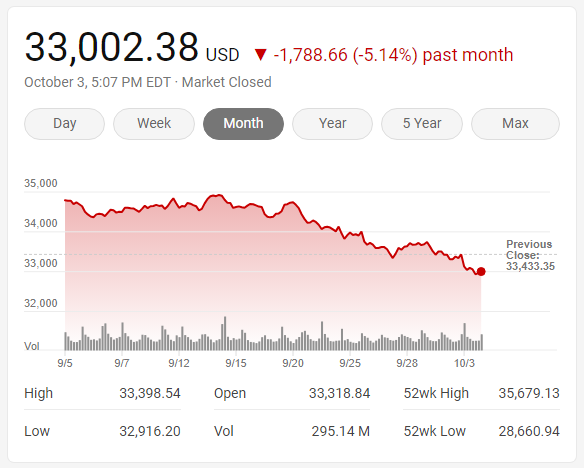
The Dow Jones Industrial Average was down at 33002, Tuesday 3rd October 2023.
Stocks fell as investors pulled money from equities and moved it to the hot bond market.
International markets also faced significant turmoil, sending mini shockwaves through global financial centres, which reverberated in equities.
The dollar rose to the highest since December and is heading towards the twelfth positive week in a row.
Uncertainty
Uncertainty in the U.S. political system is having a major affect too. Especially with the ousting of the speaker and the real fear of a government shutdown looming large.
The U.S. Treasury yields are the interest rates that the U.S. government pays to borrow money. The 10-year and 30-year Treasury yields are the most widely followed indicators of the long-term health of the U.S. economy and the expectations of inflation and growth.
10 year yield at 4.80%
According to the latest data, the 10-year Treasury yield surged to 4.80% on Tuesday, 3rd October 2023, which is the highest level since 12th October 2007.
30 year yield at 4.79
The 30-year Treasury yield rose to 4.79% on Monday, 2nd October 2023, which is the highest since 6th April 2010.
The main reasons for the rise in the Treasury yields
The strong U.S. economic data that showed that the labour market remains hot and the manufacturing sector rebounded in September 2023.
The Federal Reserve’s ‘higher for longer’ mantra signalled that the central bank would keep raising rates until inflation is under control.
The reduced demand for safe-haven assets as the U.S. government averted a shutdown over the weekend by passing a short-term stopgap funding measure.
Uncertainty at the heart of the U.S. political system.
The implications of higher Treasury yields
The higher borrowing costs could weigh on the economic growth and consumer spending in the future.
Higher inflation expectations could erode the purchasing power of the fixed-income investors and increase the risk of a bond market sell-off.
The higher interest rate differential could attract more foreign capital inflows into the U.S. dollar and strengthen its value against other currencies.