Apple delivered a stronger‑than‑expected set of Q2 2026 results, easing market concerns ahead of Tim Cook’s departure later this year.
Revenue
Revenue rose 17% to $111.18 billion, beating forecasts, while earnings per share reached $2.01. Services once again proved Apple’s most reliable growth engine, climbing to nearly $31 billion and helping push gross margin to 49.3%.
Apple’s China revenue for Q2 2026 was reported as $20.5 billion, up from $16 billion a year earlier — a 28 % increase.
Hardware
Hardware performance was mixed: iPhone sales narrowly missed expectations, though Mac, iPad and wearables all came in ahead of consensus. Apple also reportedly authorised a further $100 billion in share buybacks and raised its dividend by 4%.
Constraints
Cook acknowledged ongoing supply constraints driven by the global memory shortage, warning that higher component costs will increasingly shape the company’s outlook.
Investors also heard from incoming CEO John Ternus, who promised an “incredible roadmap” as Apple deepens its investment in AI and prepares for its next phase of product development.
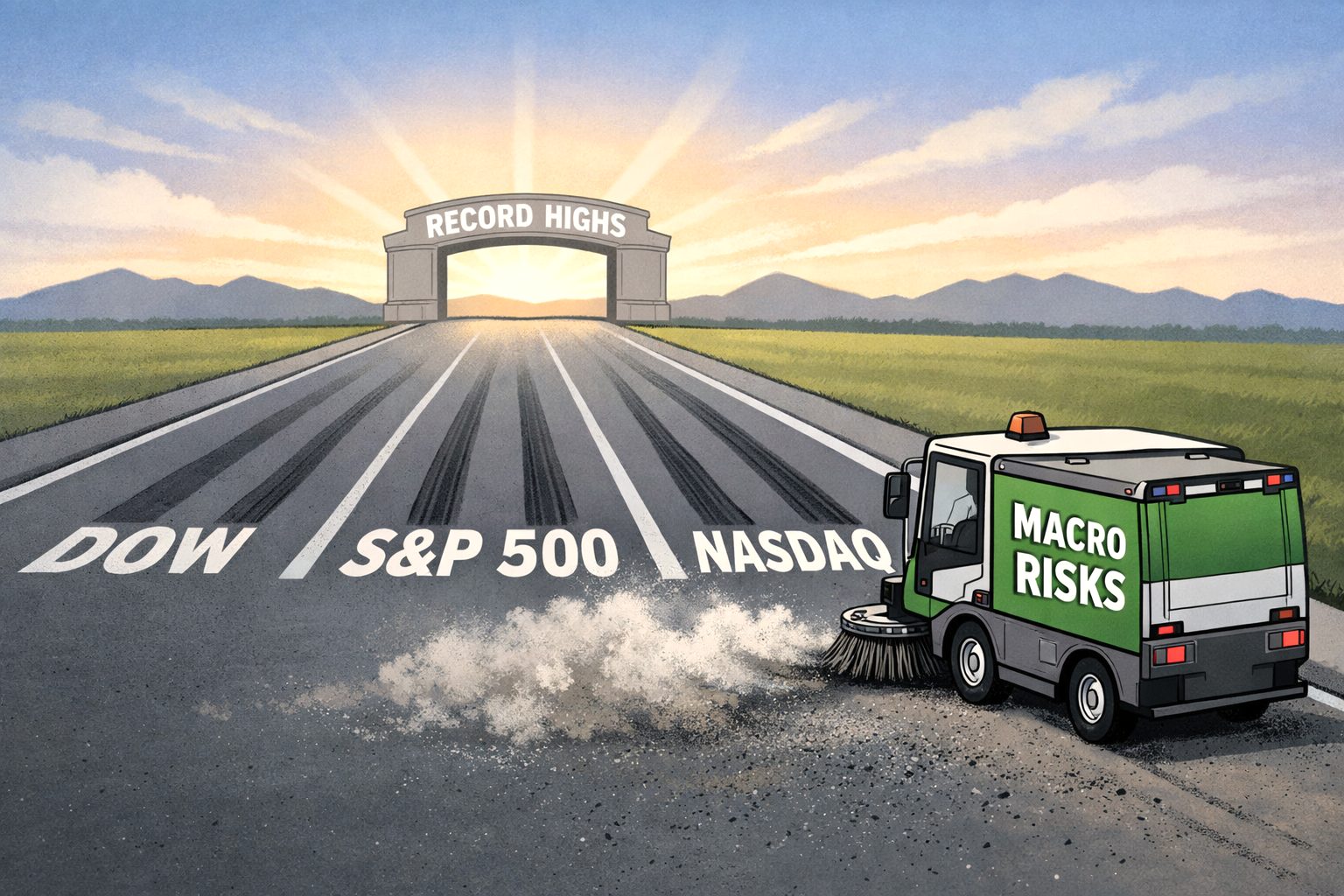
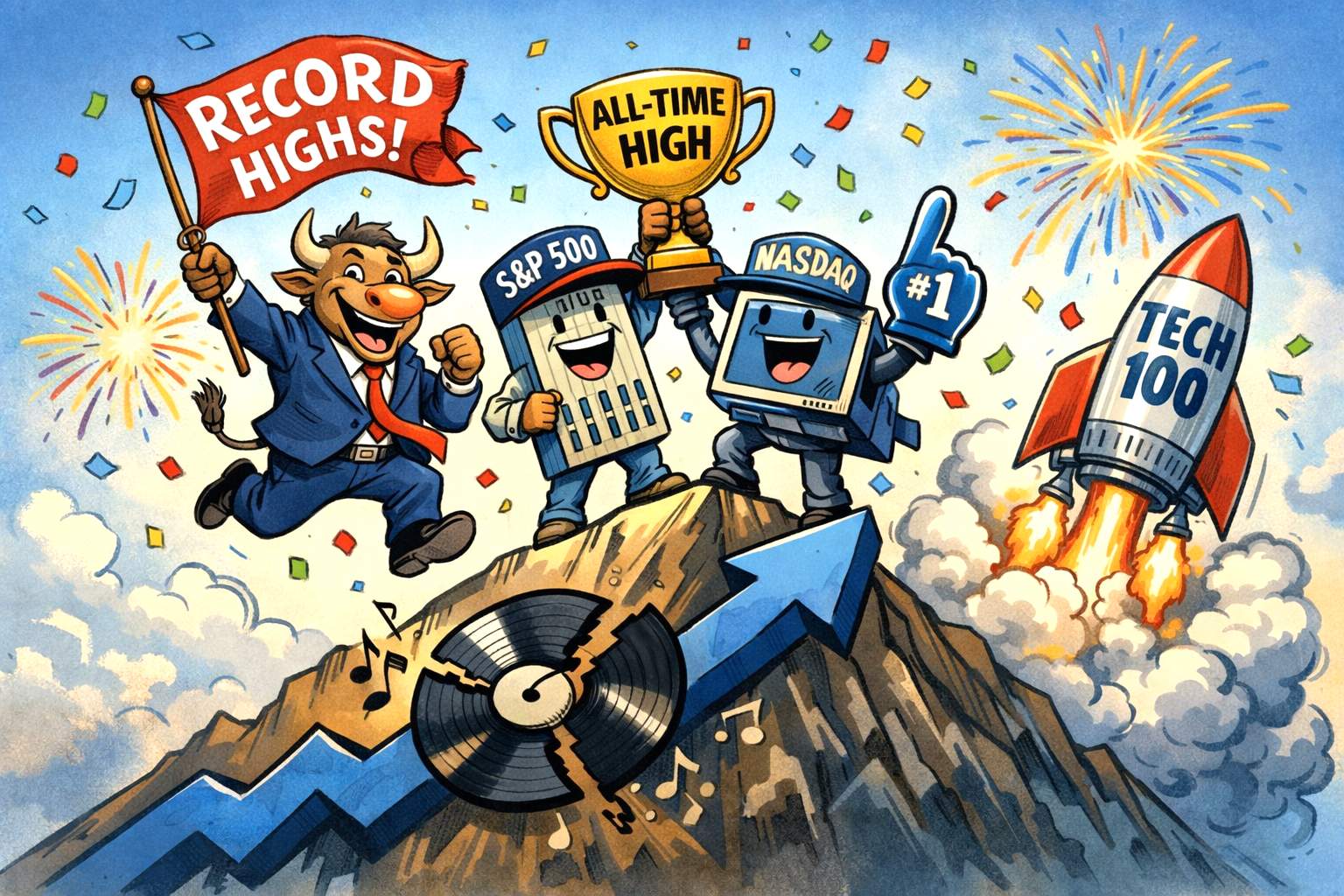
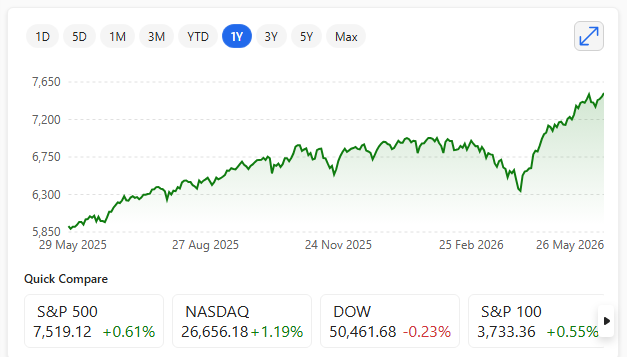
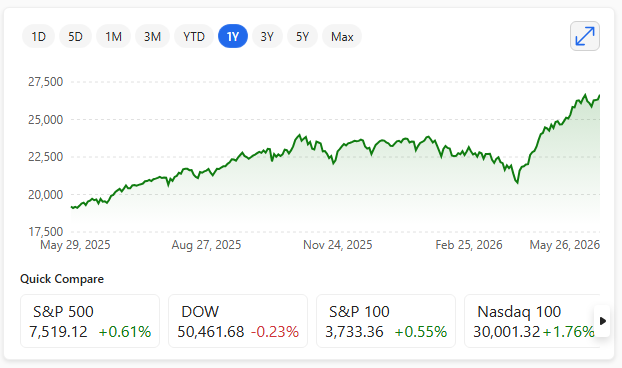
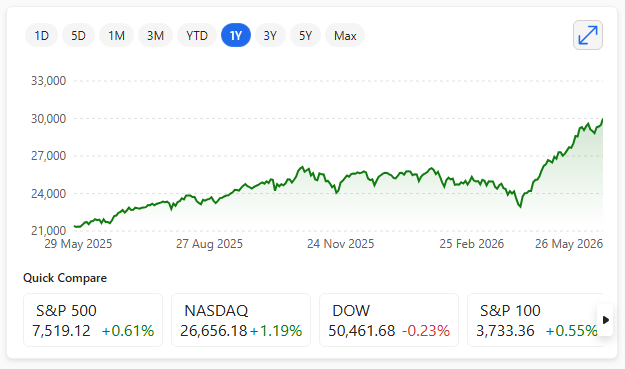
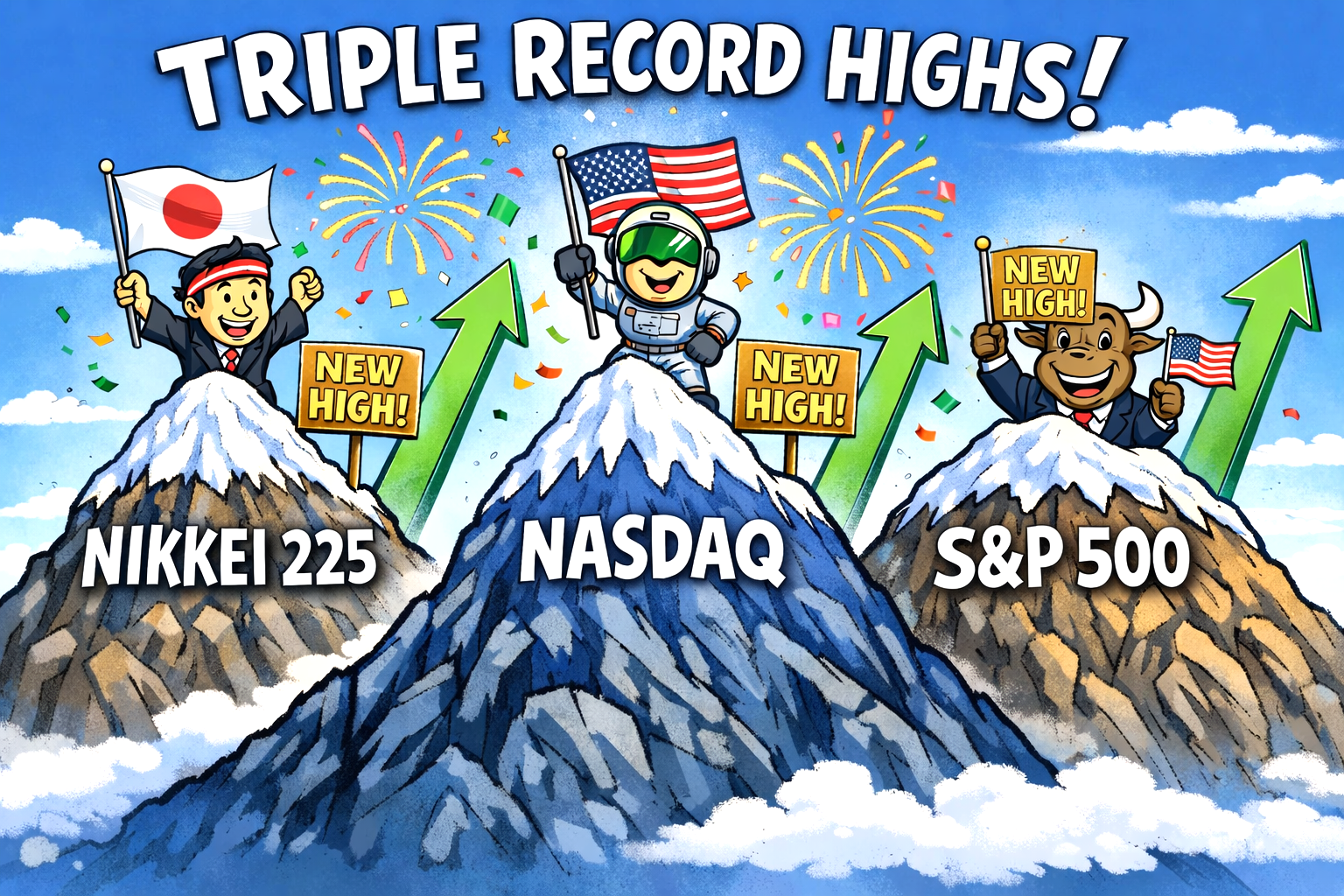
Wall Street ended April on a strong note as both the S&P 500 and the Nasdaq Composite closed at new record highs on 30th April 2026.
Investors pushed major indices higher for a second consecutive session, encouraged by resilient corporate earnings and renewed confidence in the technology sector.
The S&P 500 finished at 7,209, surpassing its previous peak set only days earlier. The Nasdaq Composite also broke new ground, closing at 24,892 after strong gains in semiconductor and cloud‑computing stocks.
Index
Close (30 Apr 2026)
Previous Record Close
New Record?
S&P 500
7,209.01
7,173.91
Yes
Nasdaq Composite
24,892.31
24,887.10
Yes
Market sentiment was buoyed by expectations that the Federal Reserve will maintain its current policy stance, with inflation data showing signs of stabilising.
April’s performance caps a remarkable start to the year for U.S. equities, driven largely by robust demand for AI‑related technologies.
While analysts warn that valuations are becoming stretched, investors appear comfortable extending the rally as earnings continue to justify optimism.
The latest earnings from the U.S. tech hyperscalers underline how aggressively AI investment is reshaping their financial profiles.
Amazon delivered a strong first quarter, with revenue up 17% to $181.5bn, driven by a sharp 28% surge in AWS sales and continued momentum in advertising. Net income jumped to $30.3bn, boosted by gains from its Anthropic investment, though free cash flow tightened as Amazon accelerated AI‑related capital expenditure.
Alphabet reported a robust start to 2026, with first‑quarter revenue rising 15% to over $113bn and operating income up 16%, supported by broad‑based strength across Search, YouTube and Google Cloud. AI infrastructure demand remains a major driver, with Google Cloud revenue climbing 48% in the latest comparable quarter.
Meta posted one of the strongest sets of results, with revenue up 33% to $56.3bn and net income soaring 61% to $26.8bn, helped by a significant tax benefit. Ad impressions and pricing both increased, while capital expenditure remained heavy as Meta scales its Superintelligence Labs.
Microsoft continued its consistent outperformance, with quarterly revenue up 18% to $82.9bn and net income rising 23%. Its AI business surpassed a $37bn annual run rate, and Intelligent Cloud revenue grew 30%, underscoring Microsoft’s leadership in enterprise AI adoption.
Alphabet and Amazon lifted markets sharply, while Meta fell and Microsoft dipped.
Alphabet’s strong cloud‑driven beat triggered a 7% after‑hours jump. Amazon also rose, gaining around 1–3% as investors welcomed AWS acceleration despite heavy AI spending.
Meta slumped 7% after hours on surging capex concerns.
Microsoft slipped about 1%, reflecting cautious sentiment despite solid cloud growth.
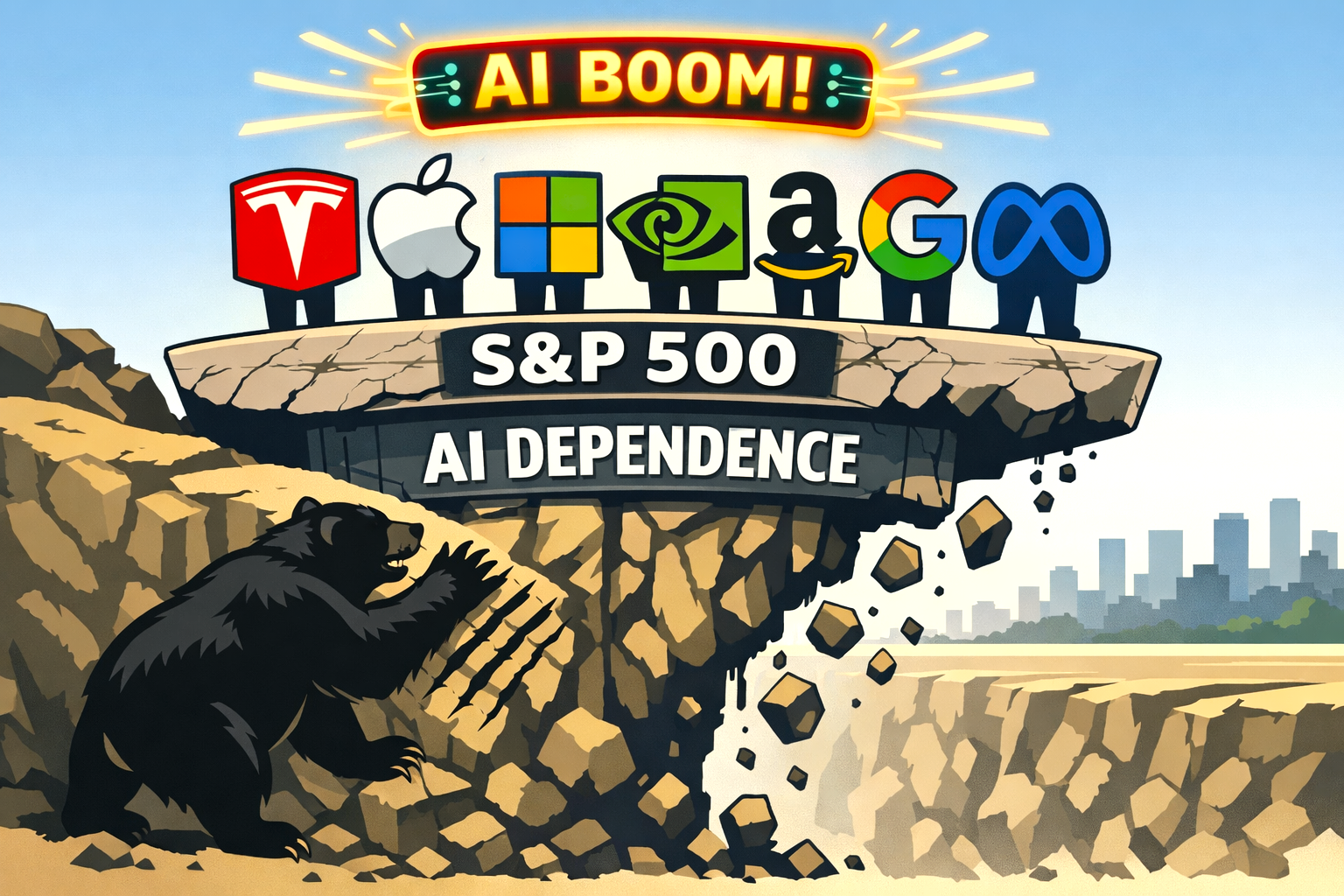
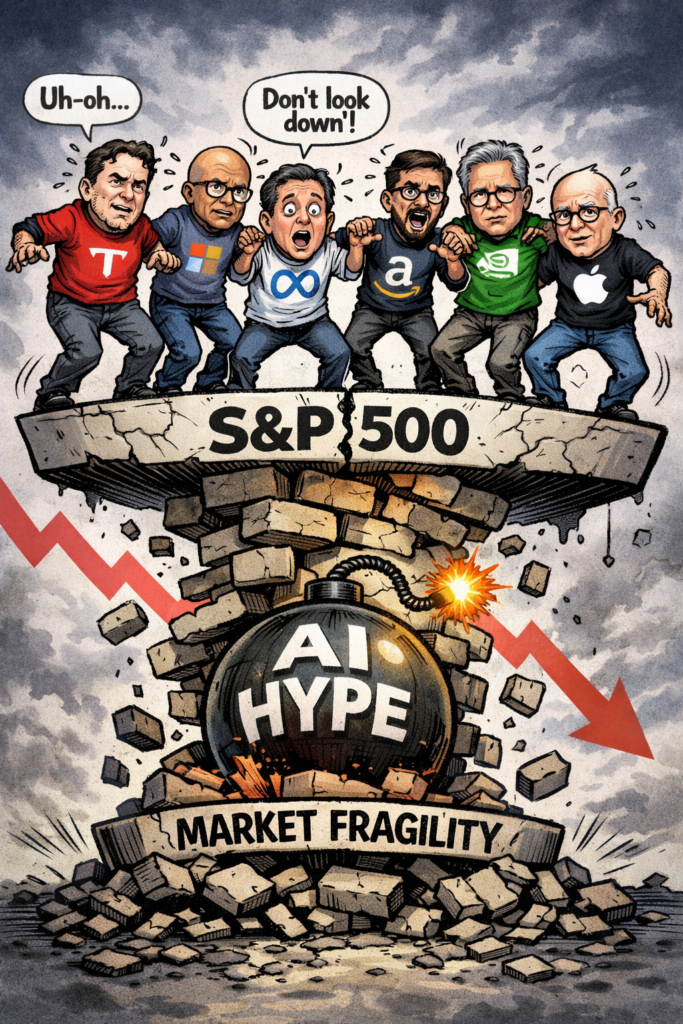
The S&P 500 has never been so dependent on so few companies. The Magnificent Seven — Microsoft, Apple, Nvidia, Alphabet, Amazon, Meta and Tesla — now account for roughly one‑third of the entire index’s value – that’s 33% of the whole S&P 500 vlauation.
Their dominance is not simply a reflection of current earnings power; it is a collective bet on an AI‑centred future that investors assume will transform productivity, reshape industries and justify valuations that stretch far beyond historical norms.
If one, several, or all of these companies fail to deliver the AI revolution that markets have priced in, the consequences for the S&P 500 would be immediate, structural and potentially severe.
Mild
The mildest scenario is a stumble by one or two members. If Apple’s device strategy falters, or Tesla’s autonomy narrative weakens further for instance, the index absorbs the shock.
A 3–5% pullback is plausible, driven by mechanical index weighting rather than systemic fear. Investors already expect uneven performance within the group, and the remaining leaders could offset the disappointment.
Major
The more destabilising scenario is a collective slowdown among the AI infrastructure leaders – Microsoft, Nvidia and Alphabet. These firms sit at the centre of the global capex cycle.
If cloud AI demand proves slower, less profitable or more niche than expected, the market would be forced to reassess the entire economic promise of generative AI.
In this case, the S&P 500 could see a 10–15% correction as valuations compress, volatility spikes and passive flows unwind years of momentum.
Dramatic
The most dramatic outcome is a broad failure of the AI ‘sector’ itself. If the promised productivity gains do not materialise, if enterprise adoption stalls, or if regulatory and cost pressures erode margins, the S&P 500 would face a structural reset.
With a third of the index priced for exponential growth, a collective disappointment could trigger a decline of 20% or more.
This would not resemble a cyclical recession; it would be a leadership collapse similar to the dot‑com unwind, but with far greater concentration and far more passive capital tied to the winners.
The uncomfortable truth is that the S&P 500’s trajectory is now inseparable from the Magnificent Seven. If they deliver, the index continues to defy gravity. If they falter, the market must rebuild a new narrative — and a new set of leaders — from the ground up.
If the Magnificent Seven Lose Their Grip, Who Rises Next?
For years, the S&P 500 has been defined by the gravitational pull of the Magnificent Seven. Their dominance has shaped index performance, investor psychology and the entire narrative arc of global markets.
If these companies lose momentum — whether through slower AI adoption, regulatory pressure, margin compression or simple over‑expectation — leadership will not disappear.
It will rotate. And the beneficiaries are already hiding in plain sight.
Alternative investment to AI
The first and most obvious winners would be Energy and Utilities. As AI enthusiasm cools, investors tend to rediscover the appeal of tangible cash flow. Energy companies, with their dividends and pricing power, become natural refuges.
Utilities, often dismissed as dull, regain relevance as defensive anchors in a more volatile market. If AI‑driven data‑centre demand slows, the sector’s cost pressures ease, improving margins.
Next in line are Industrials and Infrastructure. A retreat from speculative tech would likely redirect capital towards physical productivity — logistics, construction, defence, electrification and manufacturing modernisation.
These sectors have been quietly compounding earnings while Silicon Valley has monopolised attention. If the market shifts from promise to proof, industrials become the new growth story.
Healthcare and Pharmaceuticals would also rise. Their earnings cycles are largely independent of AI hype, driven instead by demographics, innovation and regulatory frameworks. When tech stumbles, healthcare’s stability becomes a premium rather than an afterthought.
Biotech, in particular, benefits from capital rotation when investors seek uncorrelated growth.
Financials stand to gain as well. A correction in mega‑cap tech would rebalance passive flows, giving banks and insurers a larger share of index‑tracking capital. Higher rates and wider spreads already support the sector; a shift away from tech simply amplifies the effect.
Finally, Consumer Staples would reassert themselves. In a market recalibrating after an AI disappointment, investors gravitate towards predictable earnings. Food, beverages and household goods regain their defensive premium as volatility rises.
The broader truth is simple: if the Magnificent Seven falter, the S&P 500 does not collapse — it redistributes. Leadership moves from code to concrete, from speculative multiples to operational reality. The market has always found new champions. It will again.
OpenAI’s reported failure to meet internal revenue and user‑growth targets has sent a sharp tremor through global tech markets, exposing just how dependent the wider AI sector has become on a single company’s momentum.
The Wall Street Journal report — which OpenAI has reportedly dismissed as “ridiculous” — suggested the firm is expanding more slowly than its own projections, raising questions about whether its vast compute‑spend commitments can be sustained. That alone was enough to trigger a sell‑off.
Slide
The steepest declines were concentrated among companies most financially tethered to OpenAI’s infrastructure demands. Oracle, which has a colossal $300 billion, five‑year cloud capacity agreement with the firm, fell more than 4%.
After the news story was released chipmakers followed OpenAI: Broadcom dropped over 4%, AMD slid more than 3%, Nvidia dipped around 1.5%, and CoreWeave — the highly leveraged neocloud provider — sank nearly 6%.
Even Qualcomm, which had recently enjoyed a lift from reports of collaboration with OpenAI on smartphone chips, slipped before recovering.
This is the first moment in the current AI cycle where a wobble at OpenAI has produced a synchronised pullback across the entire supply chain.
Investors are now confronting a question they have largely ignored: what if the sector’s flagship growth curve is not perfectly exponential? But my guess is, like all events at the moment, the market will likely overlook it.
Fragile
The reaction also exposes the fragility of AI‑linked valuations. Markets have priced the boom as if demand is both infinite and linear.
Any hint of deceleration — even one disputed by the company — forces a reassessment of the capital intensity underpinning the industry.
With Anthropic and Google’s Gemini gaining enterprise traction, OpenAI’s dominance is no longer assumed.
Still, several fund managers argue the broader AI investment cycle remains intact. The sell‑off looks less like a turning point and more like a reminder: when one company becomes the gravitational centre of an entire narrative, even a rumour can bend the orbit.
Nvidia has become the first company in history to reach a $5 trillion market capitalisation, driven by an extraordinary surge in global AI demand.
Nvidia’s stock jumped nearly 5% in a single session, lifting its valuation above the $5 trillion threshold and cementing its position as the world’s most valuable company by a wide margin.
Shares traded around $208–$209, briefly touching valuations as high as $5.12 trillion.
Nvidia One-year chart (24th April 2026) – New All-Time High
Game cards to major AI player
The milestone reflects Nvidia’s transformation from a gaming‑focused chipmaker into the backbone of the modern AI economy.
Demand for its advanced GPUs—particularly the Blackwell and B300 series—continues to outpace supply as data‑centre operators, cloud giants, and governments race to expand AI infrastructure.
This surge has pushed Nvidia’s revenue to more than $215.9 billion, with profits exceeding $120 billion, among the highest in the semiconductor industry.
Rally
The broader semiconductor sector has rallied alongside Nvidia, with Intel and AMD both posting double‑digit gains on strong earnings and renewed investor confidence.
Yet Nvidia remains the clear leader, commanding the majority of the data‑centre GPU market and benefiting from long‑term visibility as hyperscalers commit to multi‑year AI spending.
While the achievement underscores Nvidia’s dominance, analysts note that expectations are now exceptionally high.
Sustaining this momentum will depend on continued AI investment, stable macroeconomic conditions, and the company’s ability to stay ahead of rising competition and geopolitical constraints.
The Bank of England has warned that today’s exceptionally high equity valuations leave global markets vulnerable to a sharp correction, with risks building across geopolitics, private credit, and the AI‑driven tech sector.
The Bank of England has become increasingly vocal about the dangers posed by super‑high stock valuations, arguing that markets are no longer pricing risk realistically.
Combined economic threats
Deputy Governor Sarah Breeden has stressed that asset prices are sitting at all‑time highs despite a growing list of global threats, including geopolitical instability, volatile energy markets, and rising borrowing costs.
She reportedly noted that investors appear to be underestimating the likelihood of multiple shocks occurring simultaneously, a scenario that could trigger a rapid and disorderly repricing of risk.
Breeden reportedly remarked that the BoE expects a market adjustment at some stage, even if the precise timing is impossible to predict.
Wide disconnect
Her concern centres on the widening disconnect between stretched valuations and the underlying economic environment.
The Bank has highlighted that equity markets—particularly those driven by AI‑related optimism—are trading at levels reminiscent of the dot‑com bubble, with concentrated gains in a handful of large technology firms amplifying systemic vulnerability.
The Bank also warns that the rapid expansion of the private credit sector, now worth trillions globally, has never been tested under severe stress.
Fragile
A correction in equity markets could interact with this fragile segment, tightening financial conditions and spilling over into the wider economy.
In short, the Bank of England’s message is clear: valuations are too high, risks are too many, and a correction is increasingly likely.
Allegations have been reported of suspiciously timed trades that appear to have intensified in recent weeks as analysts, journalists, and regulators examine a series of market moves that coincided—sometimes to the minute—with major announcements about the U.S.–Iran conflict.
While no wrongdoing has been proven, the pattern has become difficult for commentators to ignore and calls for formal investigation are growing louder. Can these trades and market movement be explained as coincidence?
Potential ‘speculative’ trading?
Many media outlets are also highlighting anomalies. For instance, it has been reported that Wealth manager Rachel Winter indicated traders appeared to take out contracts positioned to profit from falling oil prices just minutes before a presidential post claiming “productive” talks with Iran—timing she described as “speculation about insider trading” and worthy of investigation.
This episode was not isolated. Multiple outlets have documented at least two major bursts of unusually large oil futures trades placed shortly before conflict‑related announcements.
On 17th April 2026, it was reported that roughly $760 million in Brent crude short positions were executed around 20 minutes before Iran’s foreign minister declared the Strait of Hormuz “completely open” following a ceasefire—an announcement that sent oil prices sharply lower.
Analysts at the London Stock Exchange Group reportedly described the volume as “completely atypical,” nearly nine times normal levels.
Earlier in March 2026, it has been reported that traders placed around $500 million in positions shortly before the White House delayed planned strikes on Iran’s energy sector.
A similar pattern emerged on 7th April 2026, when roughly $950 million was positioned for falling oil prices hours before another ceasefire announcement.
These repeated bursts—each ahead of market‑moving news—have fuelled concerns that some traders ‘may’ have had access to information not yet public. Or was it a good guess – a coincidence even?
Reports of ‘unusual’ trading patterns
These reports align with broader commentary. The Independent reportedly noted that at least 6 million barrels’ worth of Brent and WTI contracts were suddenly sold in the two minutes before a presidential post about “productive” talks—again raising questions about advance knowledge.
Meanwhile, The London Economic reported that around $580 million in oil bets were placed 15 minutes before the same announcement, with market strategists calling the timing “really abnormal” for a day with no scheduled events.
Even outside traditional markets, anomalies have surfaced. Blockchain analysts identified six newly funded crypto wallets that made nearly £780,000 by betting—hours before explosions were reported—that the U.S. would strike Iran on 28th February 2026.
Across all these cases, commentators stop short of asserting intent. But the clustering of high‑stakes trades immediately before geopolitical announcements has created a clear narrative: the market signals are too sharp, too well‑timed, and too frequent to dismiss without scrutiny.
No intent is suggested – it could just be coincidence?
Global equities have staged a striking recovery, erasing the losses triggered by the U.S.–Israel–Iran conflict and pushing into fresh record territory.
On the surface, this looks counter‑intuitive: the ceasefire remains fragile, diplomatic progress is uneven, and the threat of renewed escalation still hangs over the Strait of Hormuz. Yet markets have not only stabilised — they have surged.
It’s the AI boom stupid
The explanation lies less in geopolitics and more in positioning, psychology, and the gravitational pull of the AI boom.
The first phase of the conflict saw investors pile into defensive trades: higher oil, a stronger dollar, and a broad de‑risking across equities.
That created a sizeable war‑risk premium. Once even the possibility of a ceasefire emerged, that premium unwound at speed.
Analysts note that the rebound has been driven primarily by the rapid reversal of hedges rather than any fundamental improvement in the geopolitical outlook.
In other words, markets had priced in a worst‑case scenario — and when that scenario didn’t immediately materialise, the snap‑back was violent.
Short covering
This shift in sentiment was amplified by short‑covering, particularly among hedge funds that had positioned for prolonged disruption to energy flows.
As soon as investors judged the conflict likely to remain contained, the earlier sell‑off looked excessive. That alone was enough to propel global indices back above pre‑war levels. But it wasn’t the only force at work.
The macro backdrop has also proved more resilient than feared. U.S. labour market data has held up, and expectations for Federal Reserve rate cuts later in the year remain intact.
AI investment
Crucially, the AI‑driven investment cycle continues to dominate equity performance. Surging demand for compute, improving funding conditions, and strong earnings momentum in technology have provided a powerful counterweight to geopolitical anxiety.
For many investors, the structural growth story in AI simply outweighs the cyclical risks emanating from the Middle East.
Some caution
Still, the rally is not unqualified. Bond markets remain more cautious, with real yields and inflation expectations signalling that the risk of an energy‑driven slowdown has not disappeared.
And as peace talks wobble, equities have already begun to give back some gains — a reminder that this is a conditional rally, not a complacent one.
Markets may be hitting records, but they are doing so with one eye firmly on the horizon. The shadow of the conflict hasn’t lifted; investors have simply decided, for now, that it is not the dominant story.
U.S. equity markets surged to fresh record highs on Friday 17th April 2026, propelled less by economic fundamentals and more by a swirl of contradictory geopolitical signals and a single, highly visible social media post from the President of the United States.
The result was a rally that looked exuberant on the surface yet rested on information that remained unverified, disputed, or only partially understood.
Market makers, investors and traders can’t possibly verify that this information is safe to trade – it’s a bet – and this isn’t good for the stock market.
The world deserves better – this is not investing!
Catalyst
The catalyst was a presidential declaration that the Strait of Hormuz — a critical artery for global oil shipments — was “open”. The statement landed with the force of breaking news, despite the absence of confirmation from defence officials, maritime authorities, or international partners.
It was also reported that the U.S. would maintain its blockade of the Strait of Hormuz?
Reports circulating throughout the day suggested a more complicated reality: some sources described partial reopening, others spoke of restricted passage, and several indicated that conditions remained unstable.
In short, the facts were not settled.
Markets, however, behaved as though they were.
Melt-up driven by social media posts
Within minutes of the President’s post, U.S. index futures spiked sharply. By the closing bell, the S&P 500, Nasdaq, and Dow had all notched new highs.
S&P 500 closes a record high 17th April 2026
Traders reportedly described the move as a “headline‑driven melt‑up”, a familiar pattern in recent months/years in which presidential commentary — rather than institutional communication — becomes the primary driver of intraday sentiment.
The sensitivity is not new. Analysts have repeatedly noted that markets respond quickly to presidential statements on energy, security, and trade, even when the underlying information remains contested.
What made Friday’s rally notable was the scale of the reaction relative to the uncertainty surrounding the Strait itself. Oil prices fell, risk appetite surged, and equity markets behaved as though a major geopolitical bottleneck had been definitively resolved.
Structural vulnerability
Critics argued that this dynamic reflects a structural vulnerability: when markets move first and verify later, volatility becomes a feature rather than a flaw. Supporters countered that traders simply price information as it arrives, regardless of its source.
What is clear is that the rally was driven not by data releases, earnings results, or policy announcements, through the ‘accepted and usual channels’ but by social media messages amplified across global financial systems.
Whether the Strait of Hormuz is fully open, partially open, or operating under constraints remains to be clarified.
The markets, however, have already made up their mind — at least for now.
The ‘news’ is good or ‘bad’ enough to make money!
U.S. stock market credibility is being eroded daily – bit by bit.
This has to stop!
No intent is suggested
Update
Iran fired shots at vessels trying to exit the Strait of Hormuz over the weekend. And now the U.S. has attacked a vessel under the Iranian flag casting doubt on renewed talks. The fragile ceasefire expires Wednesday 22nd April 2026 – unless Trump extends this and does a TACO!
There has also reportedly been talk of a 60-day extension – but that was before these latest problems.
U.S. equity benchmarks surged to fresh record highs on Friday, 17th April 2026, as geopolitical tensions eased and investors responded to confirmation that the Strait of Hormuz had been declared “completely open” during the ongoing ceasefire period.
Record high for S&P 500 above 7100 for the first time
The S&P 500 closed at 7,126.06, up 1.2% and above the 7,100 mark for the first time. The Nasdaq Composite extended its remarkable winning streak to 13 consecutive sessions, finishing at 24,468.48, a 1.52% gain and its longest run since 1992.
The Dow Jones Industrial Average also rallied sharply, jumping 868.71 points (1.79%) to end at 49,447.43. The Russell 2000 hit new highs too.
The rally followed Iran’s announcement that commercial passage through the Strait of Hormuz was fully open under ‘coordinated’ routes, easing fears of supply disruption.
Oil prices tumbled in response: WTI crude oil fell nearly 12% to $83.85, while Brent dropped 9% to $90.38.
Sector‑level moves reflected a broad risk‑on shift. Travel‑exposed stocks such as airlines and cruise operators rebounded, while major technology names also advanced.
Market strategists suggested investors were “moving beyond this conflict” as worst‑case scenarios were reassessed.
Assuming the ‘news’ is to be believed. No intent is suggested.
With all major indices setting new highs, Friday’s session underscored how quickly sentiment can pivot when geopolitical uncertainty recedes — even temporarily.
TSMC’s 58% surge in first‑quarter profit is the clearest sign yet that the AI boom is no longer a cyclical uplift but a structural shift reshaping the entire semiconductor industry.
The Taiwanese chipmaker delivered record earnings, comfortably beating analyst expectations, as demand for advanced processors continued to outstrip supply.
Net income reportedly reached NT$572.48 billion, marking a fourth consecutive quarter of record profits, while revenue climbed to NT$1.134 trillion, driven overwhelmingly by high‑performance computing and AI‑related orders.
What stands out is the composition of that growth. Roughly three‑quarters of TSMC’s wafer revenue reportedly came from advanced nodes, with 3‑nanometre chips alone accounting for a quarter of shipments.
Nvidia
Nvidia has now overtaken Apple as TSMC’s largest customer, underscoring how AI accelerators have become the industry’s most valuable real estate.
TSMC’s executives described AI demand as “extremely robust”, with customers signalling multi‑year achievements rather than the usual stop‑start ordering cycle.
The company also moved to reassure investors over supply‑chain risks linked to the Middle East conflict, saying it has diversified sources for critical gases such as helium and hydrogen.
With capacity running hot and capital spending set to hit the top end of guidance, TSMC is positioning itself as the indispensable chipmaker in the AI era.
ASML’s decision to raise its 2026 guidance underlines a simple reality: demand for advanced AI chips is not easing, and the world’s most important semiconductor equipment maker remains at the centre of that surge.
The company signalled stronger-than-expected orders for its extreme ultraviolet (EUV) and next‑generation high‑NA systems, driven by chipmakers racing to expand capacity for AI accelerators, data‑centre processors and cutting‑edge logic nodes.
Bottleneck
The upgrade matters because ASML sits at the bottleneck of global chip production. Only a handful of firms can even buy its most advanced machines, and those firms – chiefly TSMC, Intel and Samsung – are all scaling up AI‑focused manufacturing.
Their capital expenditure plans have held firm despite broader economic uncertainty, suggesting that AI infrastructure is becoming a non‑discretionary investment rather than a cyclical one.
Two forces are driving the momentum. First, hyperscalers continue to pour billions into AI clusters, creating sustained demand for the most advanced lithography tools.
Long-term lock in
Second, geopolitical pressure to secure domestic chip capacity is pushing governments and manufacturers to lock in long‑term equipment orders.
ASML’s raised outlook reinforces the sense that the semiconductor cycle is diverging: consumer electronics remain patchy, but AI‑related manufacturing is entering a multi‑year expansion.
The key question now is whether supply can keep pace with the ambition of its customers.
There’s a growing sense that financial markets have drifted into a parallel reality. Not the usual detachment that comes with speculation, but something deeper — a structural break between what is happening in the world and what markets choose to see.
This is how the stock market feels at the moment. I might be wrong, but the overwhelming sense of despair feels so real. I believe the markets are broken at their core, and nobody seems to care. Markets make money and remain devoid of morality.
The system is morally bankrupt.
You can watch a crisis unfold in real time, with footage, statements, explosions and diplomatic failures, and yet the markets behave as though they’re responding to a completely different script.
A ceasefire that barely exists is treated as a turning point. A strategic waterway that is “open” only in the loosest, most cosmetic sense is priced as fully restored. The disconnect isn’t subtle. It’s brazen.
And yes — it feels deceptive
Not because traders are conspiring to mislead anyone, but because the modern market has evolved into something that no longer requires truth to function.
It only needs a narrative.
A headline. A phrase that can be interpreted as “less bad than yesterday”. That’s enough to ignite a rally, even if the underlying situation is deteriorating by the hour.
This wasn’t always the case. There was a time when markets, for all their volatility and irrationality, still behaved like instruments tethered to reality.
When a major shipping lane was threatened, prices moved accordingly. When a ceasefire collapsed, markets reflected the renewed danger. There was at least a rough correlation between events and valuations — imperfect, but recognisable.
Today, that correlation has snapped. The market trades on sentiment, not substance. On the idea of stability, not the presence of it.
Appearance
On the appearance of progress, even when the facts on the ground contradict every optimistic headline. A ceasefire announcement is enough to send equities higher, even if the ceasefire is violated before the ink dries.
A promise to reopen a strait is enough to calm oil prices, even if only a handful of ships actually move.
The deception is structural. It’s the product of algorithmic trading that reacts to keywords rather than conditions.
It’s the result of a decade of central bank intervention that has taught investors to treat every crisis as temporary and every dip as a buying opportunity. It’s reinforced by political communication that prioritises market stability over factual clarity.
The system rewards optimism, even when it’s unjustified. It punishes realism when it’s inconvenient.
Surreal
This is why the current moment feels so surreal. You can see the footage of strikes in Lebanon while reading headlines about “regional de‑escalation”. You can watch tankers stalled while analysts talk about “normalising flows”.
The market shrugs, because the narrative — however flimsy — is enough to sustain the illusion.
If markets don’t need truth, then they are, in effect, trading a deception. Not a deliberate deception, but a functional one.
Economic Truth
A deception that keeps prices elevated, volatility suppressed, and investors soothed.
A deception that allows the charts to climb even as the world beneath them fractures.
A deception that has become the operating principle of a system that no longer reflects reality, only the stories it finds convenient to believe.
This isn’t investing – this is pure manipulative gameplay and benefits only those who know how to play the game.
And ‘they’ set the rules.
Markets make the money but remain devoid of morality.
I feel like I am playing a video game without the controller or at least with a rule book.
Update:
U.S. announces it will blockade of the Strait of Hormuz, or rather Iranian ‘linked’ ships. And not in the Strait but further out in international waters. This is designed to reduce the risk of conflict.
Taiwan Semiconductor Manufacturing Company (TSMC) has delivered a striking 35% year‑on‑year jump in first‑quarter revenue, reaching a record NT$1.13 trillion.
The result underscores just how dramatically the centre of gravity in global technology has shifted towards advanced semiconductor manufacturing, with artificial intelligence now the defining force behind industry growth.
Relentless AI demand
TSMC’s performance is being powered by relentless demand for cutting‑edge chips from major clients such as Apple and Nvidia.
As AI infrastructure spending accelerates worldwide, the company has become one of the few manufacturers capable of producing the most sophisticated processors required for training and running large‑scale models.
March alone saw revenue climb more than 45%, highlighting the strength and urgency of this demand.
Ambition
Analysts suggest TSMC is on track to exceed its already ambitious 30% annual growth target, helped not only by volume but also by reported price increases for its most advanced nodes.
Even as smartphone and PC markets remain uneven, AI‑related orders are more than compensating.
With more companies—from hyperscalers to AI start‑ups—designing their own chips, TSMC’s strategic position looks increasingly unassailable.
Upcoming earnings and ASML’s results next week will offer further clues about the momentum behind the semiconductor sector’s AI‑driven boom.
Meta has unveiled Muse Spark, its first major artificial intelligence model since the company overhauled its AI strategy in response to the underwhelming reception of its previous Llama 4 models.
Developed by the newly formed Meta Superintelligence Labs under the leadership of Alexandr Wang, Muse Spark represents a deliberate shift towards smaller, faster, and more capable systems designed to compete directly with Google, OpenAI, and Anthropic.
Foundation
Muse Spark is positioned as the foundation of a new family of models internally known as Avocado. Meta reportedly describes it as “small and fast by design”, yet able to reason through complex questions in science, maths, and health — a notable claim given the company’s recent struggles to keep pace with rivals.
Early evaluations suggest the model performs competitively in language and visual understanding, though it still trails in coding and abstract reasoning.
Crucially, Muse Spark is deeply integrated into Meta’s ecosystem. It already powers the Meta AI app and website and will soon replace Llama across WhatsApp, Instagram, Facebook, Messenger, and Meta’s smart glasses.
Integrated
This rollout signals Meta’s intention to embed AI more tightly into everyday user interactions, from search and recommendations to multimodal tasks such as analysing photos or comparing products.
The company is also experimenting with new revenue streams by offering a private API preview to select partners — a departure from its previous open‑source approach.
Whether this shift will alienate developers who embraced the openness of Llama remains to be seen.
Meta frames Muse Spark as an early step toward “personal superintelligence”, an assistant that can understand the world alongside the user rather than waiting for typed instructions.
It’s an ambitious vision — and one that will be tested as the model expands globally and faces scrutiny over privacy, safety, and real‑world performance.
Oracle is swinging hard at its own workforce as the company races to reposition itself as an AI‑infrastructure contender.
Thousands of roles are being eliminated, a drastic move that reflects the sheer financial pressure of trying to keep up with hyperscale rivals in the most capital‑intensive tech shift in decades.
The company’s share price has slumped 25% this year, with investors increasingly uneasy about soaring data‑centre spending and the heavy debt required to fund it.
Oracle has already raised $50 billion to bankroll new GPU‑ready facilities, but unlike Amazon or Microsoft, it lacks the cushion of vast cloud scale.
The result: a balance sheet under strain and a leadership team forced into tough decisions.
Future
Oracle’s remaining performance obligations have ballooned to more than half a trillion dollars, fuelled by major AI partnerships including a huge deal with OpenAI.
But those future revenues don’t solve today’s cash‑flow squeeze. Analysts estimate that cutting 20,000 to 30,000 jobs could free up as much as $10 billion — enough to keep the AI build‑out moving without further rattling the markets.
Oracle is betting that a leaner organisation now will buy it the runway to compete later. The question is whether the cuts arrive in time to match the speed of the AI race.
Financial markets are no strangers to volatility, but even seasoned traders were taken aback by the extraordinary price action that unfolded recently.
Just a minute
In the space of minutes, global indices lurched upwards, oil prices collapsed, and billions of dollars shifted across the financial system — all triggered by a single, unexpected announcement from President Trump claiming “productive talks” with Iran.
What followed was a whiplash-inducing reversal, a diplomatic denial from Tehran, and a growing chorus of questions about whether the market’s initial leap was quite as spontaneous as it appeared.
Spike
The sequence of events is now well documented. In the quiet pre‑market hours, trading volumes in S&P 500 futures and crude oil contracts suddenly spiked.
These were not the tentative probes of retail traders or the routine adjustments of algorithmic systems. They were large, directional, and unusually well‑timed.
Snapshot of Wall Street DFT (Dow Jones Industrial Average) demonstrating the spike in question
Minutes later, Trump posted his statement about progress with Iran — a geopolitical development with obvious implications for equities and energy markets.
Instant
Prices reacted instantly. Equities surged. Oil tumbled. Within the hour, Iran publicly denied that any such talks had taken place, prompting a partial reversal of the earlier moves. Maybe we should draw a distinction between ‘talks’ and ‘messages’.
It is the precision of the trades placed before the announcement that has raised eyebrows. Markets do not move in anticipation of news that does not exist in the public domain.
Yet someone, somewhere, positioned themselves perfectly for the impact of Trump’s message posted on social media.
Fortuitous coincidence or deliberate manipulation?
Scale
The scale of the trades suggests institutional capability; the timing suggests foreknowledge. Whether that foreknowledge was legitimate, accidental, or illicit is now the central question.
Speculation about insider trading is inevitable in such circumstances, but it is important to distinguish between suspicion and proof. Political announcements are not governed by the same disclosure rules that apply to corporate earnings or mergers.
Presidents are not bound by quiet periods. Their advisers, however, are. So are the staff, intermediaries, and diplomatic channels through which sensitive information flows.
Obligation to investigate
If anyone in that chain traded — or tipped off someone who did — regulators will be obliged to investigate.
There is also a broader concern about the integrity of market‑moving communication. If Iran’s denial is accurate, and no talks occurred, then the market reacted to a statement that may not have reflected reality.
Even without malicious intent, such episodes undermine confidence in the informational foundations on which markets depend. When a single message can add or erase trillions in value, the accuracy and reliability of that message become matters of systemic importance.
Suspicion
For now, the episode sits in an ambiguous space: suspicious, but unproven; dramatic, but not unprecedented. Markets will move on, as they always do.
Yet the questions raised yesterday will linger — about transparency, about the porous boundaries between politics and finance, and about the unseen hands that sometimes seem to move just a little too quickly.
Does the idea that Trump ‘massages’ the market carry any weight?
It’s a fair question, and one that keeps resurfacing because the pattern is hard to ignore.
The idea that Trump “massages” the markets isn’t a conspiracy theory in itself — it’s an observation that his public statements often have immediate, dramatic financial consequences.
The real issue is whether those consequences are accidental, strategic, or exploited by people with advance knowledge.
The VIX index currently (18th March 2026 – 8:30GMT) at 21.62, down around 8% from its previous close of 23.51. This drop suggests a modest easing in market fear, despite looming catalysts like the Fed decision and geopolitical tension.
VIX Snapshot – 18th March 2026
Metric
Value
Current Price
21.62 USD
Previous Close
23.51 USD
Day Change
−1.89 Down 8%
Intraday High/Low
21.72 / 21.47
52-Week High/Low
60.13 / 13.38
One-year market volatility index snapshot image 18th March 2026 at approx: 08:30 GMT
Implications
Still Elevated: A VIX above 20 suggests lingering unease, even if not full-blown panic.
Compression Context: This aligns with your “coiled spring” thesis — volatility is contained but not absent.
Directional Bias: If VIX continues to fall post-Fed, it supports a bullish breakout. A spike, however, would signal risk-off sentiment and potential sell-off.
Markets rarely sit still without reason. When they do — as they have in recent sessions, grinding sideways in an ultra‑tight range — it signals not calm but compression.
Price action becomes like a coiled spring: energy building, tension rising, and traders waiting for the moment when restraint snaps into motion.
This week’s narrow trading bands reflect a market holding its breath. Geopolitical tension in the Middle East, oil volatility, and a Federal Reserve decision all loom over investors, yet equities have refused to break down.
Futures are edging higher, European indices are opening firmer, and even the tech wobble — with Nvidia’s muted reaction to its latest showcase — hasn’t derailed broader sentiment
Tight range – a waiting game.
Historically, such tight ranges rarely resolve with a whimper. When volatility is suppressed for too long, the eventual breakout tends to be sharp and directional. The question, of course, is which way.
Right now, the evidence suggests upward. Markets have absorbed war‑driven oil swings, shrugged off hedge‑fund losses, and continued to find buyers on dips.
Breadth is stabilising, and risk appetite — surprisingly resilient given the backdrop — is creeping back into European and Asian sessions.
That doesn’t guarantee a bullish surge, but it does suggest the path of least resistance is higher.
Fed tone
If the Fed avoids surprising investors and signals comfort with the current trajectory, the spring is more likely to uncoil to the upside.
A dovish‑leaning tone could ignite a breakout as sidelined capital rushes back into equities. Conversely, a hawkish shock would release the same stored energy — but violently downward.
The market is coiled. The catalyst is imminent. And when the range finally breaks, it won’t be subtle.
You know, it almost doesn’t matter what disasters are ongoing in the world – the stock market just wants to win and go up!
Just how bad does it have to be before the stock market corrects? And what will be the catalyst to make that happen?
Debt, credit concerns, geopolitical tension, political scandal, Epstein, a rogue nuclear attack, AI failure, war or just another Trump tariff scenario?
Who knows? And does anybody really care as long as ‘making money’ isn’t interrupted.
For years we’ve clung to the comforting fiction that financial markets are rational machines. Prices rise and fall based on fundamentals, investors weigh risks carefully, and governments act as steady hands guiding the system through uncertainty.
It’s a pleasant story — and almost entirely untrue. Modern markets no longer behave sensibly because the people and structures shaping them no longer behave sensibly either.
Instead, we’ve built a hyper‑reactive ecosystem that rewards drama, amplifies noise, and punishes patience. The 24-hour mind numbing rolling news media frenzy helps feed the ‘stupid’ stock market indifference.
The result is a marketplace that convulses on command. A single line in a political speech can send oil and equities plunging, equities soaring, and futures whipsawing before most people have even digested the words.
This isn’t forward‑looking behaviour. It’s a system addicted to the ‘dollar’ adrenaline.
A Market Built on Complexity, Not Clarity
The first step in understanding today’s dysfunction is recognising just how complicated markets have become. The old world of human traders weighing company quality and long‑term prospects has been replaced by a tangled web of:
algorithmic trading systems scanning headlines for emotional triggers
derivatives hedging flows that move the underlying market
passive investment vehicles pushing money in and out mechanically
central bank signalling that distorts risk pricing
geopolitical noise that algorithms treat as gospel
Each layer adds speed, leverage, and opacity. None of it adds stability.
When markets were simpler, they could afford to be sensible. Today, they are too complex to behave rationally even if they wanted to.
The Incentives Are All Wrong
If you want to understand why markets behave badly, follow the incentives.
Traders are rewarded for short‑term performance, not long‑term judgement. Fund managers fear underperforming their peers more than they fear being wrong.
Algorithms are rewarded for speed, not context. Politicians are rewarded for drama, not restraint. News outlets are rewarded for shock and sensation, not nuance.
A comment or speech fed through central banker infiltrates opinion and moves the markets. It’s irrational behaviour – because it is now ingrained and expected!
In such an environment, knee‑jerk reactions aren’t a flaw — they’re the logical outcome of the system’s design.
A calm, measured response to geopolitical tension doesn’t generate clicks, flows, or political capital. A dramatic statement, however, can move billions in minutes. And some actors know this.
And we have blindly accepted this. One of the most uncomfortable truths about modern markets is that drama is profitable for certain players.
Volatility traders thrive on big swings. High‑frequency firms thrive on rapid order flow. Media outlets thrive on sensational headlines. Political figures thrive on attention. Algorithms thrive on sharp, binary signals. Not a constructive mix.
A calm market is good for society. A dramatic market is good for business.
So we’ve normalised the abnormal. Markets now move on:
rumours
tone
misinterpreted headlines
algorithmic overreactions
political theatre
hedging flows
central bank adjectives
This isn’t price discovery. It’s noise discovery.
We Could Have Chosen a Different Path
Here’s the part that stings: none of this was inevitable.
If governments communicated with clarity and restraint, markets would be calmer. If market makers prioritised liquidity and stability over speed, volatility would fall.
If traders were rewarded for long‑term thinking, the system would breathe more slowly. If algorithms were designed to interpret context rather than react to keywords, markets would behave more like markets and less like mindless sheep following a lost leader.
But we didn’t choose that path. We chose complexity, speed, and drama — and now we live with the consequences.
A System Too Complicated to Behave Sensibly
The modern market is not a rational judge of value. It is a behavioural ecosystem shaped by incentives, emotion, and structural institutional distortions.
It reacts to tone. It can price uncertainty, not fundamentals. It amplifies drama, not discipline.
When a single political sentence can move global markets, the problem isn’t the sentence. It’s the system that reacts to it.
Markets haven’t lost their minds. We’ve simply built a marketplace too complicated — and too dramatic — to act as if it still has one.
Fortunately, at least a good quality business can still provide a good quality return – but we all have to ride the stupid stock market roller-coaster to get there!
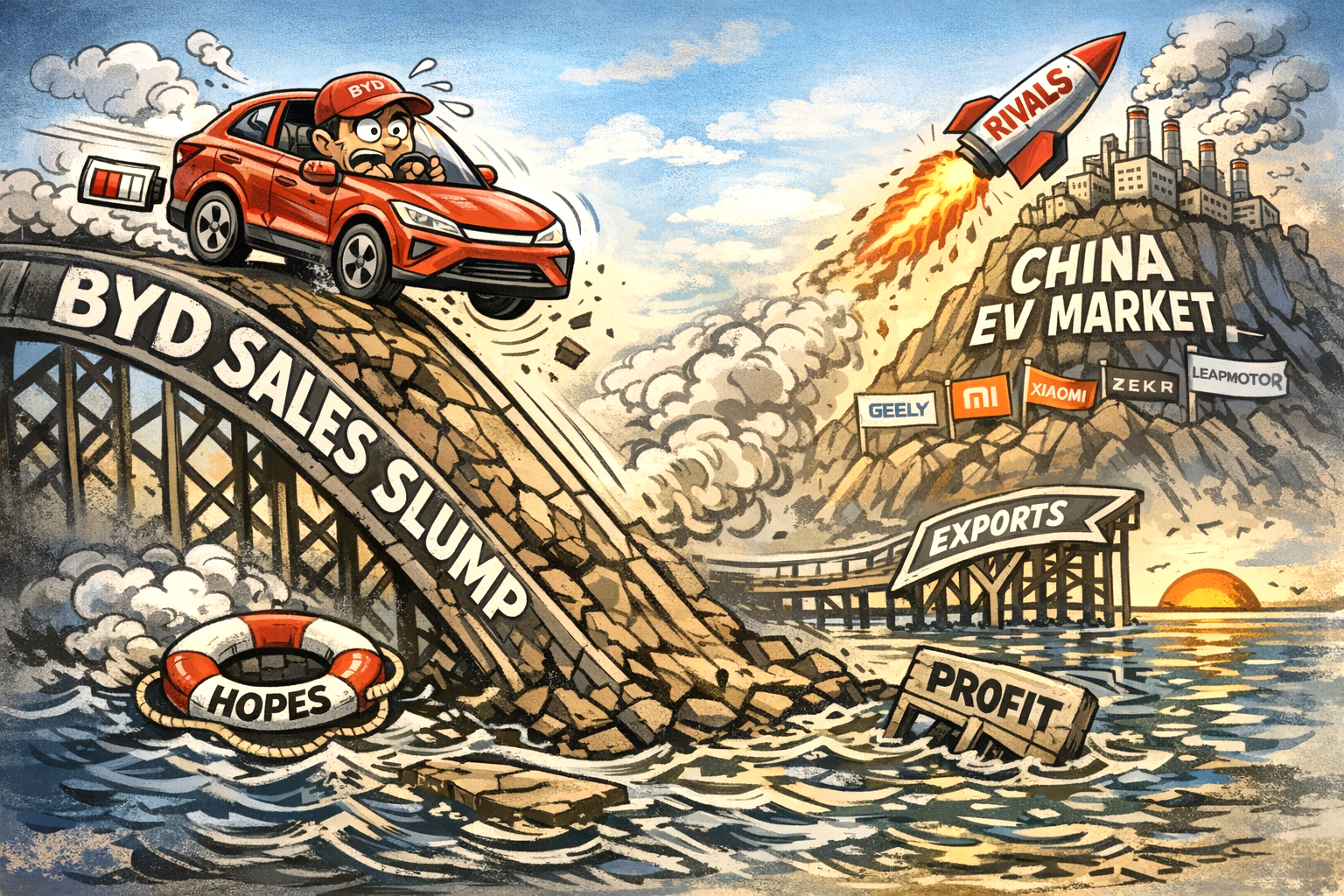
BYD’s sharp fall in electric‑vehicle sales across January and February 2026 marks a significant moment for the world’s largest EV maker, signalling both cyclical pressures and a deeper shift in China’s hyper‑competitive market.
Adjusted for the disruption caused by the mid‑February Lunar New Year holiday, BYD’s combined sales for the first two months of the year were down roughly 36% year on year, a rare contraction for a company that has spent the past three years dominating China’s new‑energy vehicle segment.
Slump
Several forces converged to produce the slump. The reinstatement of a 5% purchase tax on new‑energy vehicles at the end of 2025 pulled demand forward, leaving a vacuum in early 2026 as buyers rushed to complete purchases before the levy returned.
At the same time, China’s EV market is maturing, with consumers becoming more discerning and competitors far more aggressive.
Xiaomi, Leapmotor, Nio and Geely’s Zeekr all posted strong double‑digit growth over the same period, with Xiaomi’s YU7 SUV even becoming China’s best‑selling passenger vehicle in January.
This intensifying competition reflects a broader levelling of the playing field. Rivals are increasingly attacking BYD’s core mid‑market territory by packing more features into vehicles while keeping prices tight — a trend known locally as involution.
Leading still
Analysts note that while BYD’s lead remains substantial, it is narrowing as alternatives become more compelling.
Yet the picture is not uniformly negative. BYD’s strategic pivot towards overseas markets is beginning to pay off: in February 2026, its exports surpassed domestic sales for the first time, underscoring the company’s growing global footprint and providing a buffer against domestic volatility.
Later in 2026, BYD is expected to launch new models featuring its next‑generation Blade Battery 2.0 and faster flash‑charging technology — innovations that could help reignite domestic demand without resorting to a price war.
MiniMax’s M2.5 model has emerged as the unexpected frontrunner in China’s latest wave of artificial intelligence releases, earning a clear endorsement from analysts.
While much of the recent global conversation has fixated on DeepSeek’s rapid evolution, China has quietly produced five new frontier‑level models in recent weeks.
Widening choice
Among them—Alibaba’s Qwen 3.5, ByteDance’s Seedance 2.0, Zhipu’s latest offerings, DeepSeek’s V3.2, and MiniMax’s M2.5—it is MiniMax that reportedly has captured institutional attention.
Some analysts reportedly cite its performance, pricing, and commercial readiness as the reasons it stands apart.
MiniMax, which listed publicly in Hong Kong in January, released M2.5 in mid‑February 2026. The model rivals Anthropic’s Claude Opus 4.6 in capability while costing a fraction of the price—an advantage that has driven a surge of developer adoption.
Data from OpenRouter reportedly shows developers increasingly choosing M2.5 over DeepSeek’s V3.2 and even several U.S. based models.
Analysts argue that this combination of competitive performance and aggressive pricing positions MiniMax as the Chinese model with the strongest global commercial potential.
Productive and less expensive
The model’s technical profile reinforces that view. M2.5 is designed for real‑world productivity, with strengths in coding, agentic tool use, search, and office workflows.
It reportedly scores around 80.2% on SWE‑Bench Verified and outperforms leading Western models—including Claude Opus 4.6, GPT‑5.2, and Gemini 3 Pro—on tasks involving web search and office automation, all while operating at ten to twenty times lower cost.
MiniMax describes the model as delivering “intelligence too cheap to meter,” a claim supported by its lightweight Lightning variant, which generates 100 tokens per second and can run continuously for an hour at roughly one dollar.
This shift signals a broader trend: China’s AI race is no longer defined by a single breakout model. Instead, a competitive ecosystem is emerging, with MiniMax demonstrating that cost‑efficient frontier performance can reshape developer behaviour and enterprise planning.
For global markets, UBS’s preference suggests that investors are beginning to look beyond headline‑grabbing releases and toward models with sustainable commercial trajectories.
Comparison of China’s Five New AI Models
Model
Developer
Key Strengths
Performance Notes
Pricing Position
MiniMax M2.5
MiniMax
Coding, agentic tasks, office automation
Rivals Claude Opus 4.6; 80.2% SWE‑Bench Verified; outperforms GPT‑5.2 and Gemini 3 Pro on search/office tasks
Extremely low cost; “too cheap to meter”
DeepSeek V3.2
DeepSeek
Reasoning, general chat
Strong but losing developer share to M2.5
Low‑cost but not as aggressive as MiniMax
Alibaba Qwen 3.5
Alibaba
Enterprise integration, multilingual capability
Part of Alibaba’s expanding Qwen family
Competitive mid‑range
ByteDance Seedance 2.0
ByteDance
Video generation
Focused on multimodal creativity
Premium creative‑tool pricing
Zhipu (latest models)
Zhipu AI
Knowledge tasks, enterprise AI
Continues Zhipu’s push into LLM infrastructure
Mid‑range enterprise
MiniMax M2.5 leads China’s AI surge with performance rivalling Claude Opus and Gemini 1.5 Pro, yet at a fraction of the cost.
It excels in coding, search, and office automation, scoring 80.2% on SWE‑Bench Verified. DeepSeek V3.2 offers strong reasoning but lags in developer adoption.
Compared to ChatGPT-4, Claude 2.1, and Gemini 1.5, China’s models are closing the gap in capability, with MiniMax M2.5 now outperforming Western leaders on several benchmarks—especially in speed and cost efficiency.
Comparison of leading Chinese and Western AI models
(SWE‑Bench Verified — latest public leaderboard, early 2026) guide data
Model
Developer
Primary Strengths
SWE‑Bench Verified
Notes
Claude 4.6 Opus
Anthropic
High‑end reasoning, long‑context reliability
76–77%
Current top performer on independent coding benchmarks.
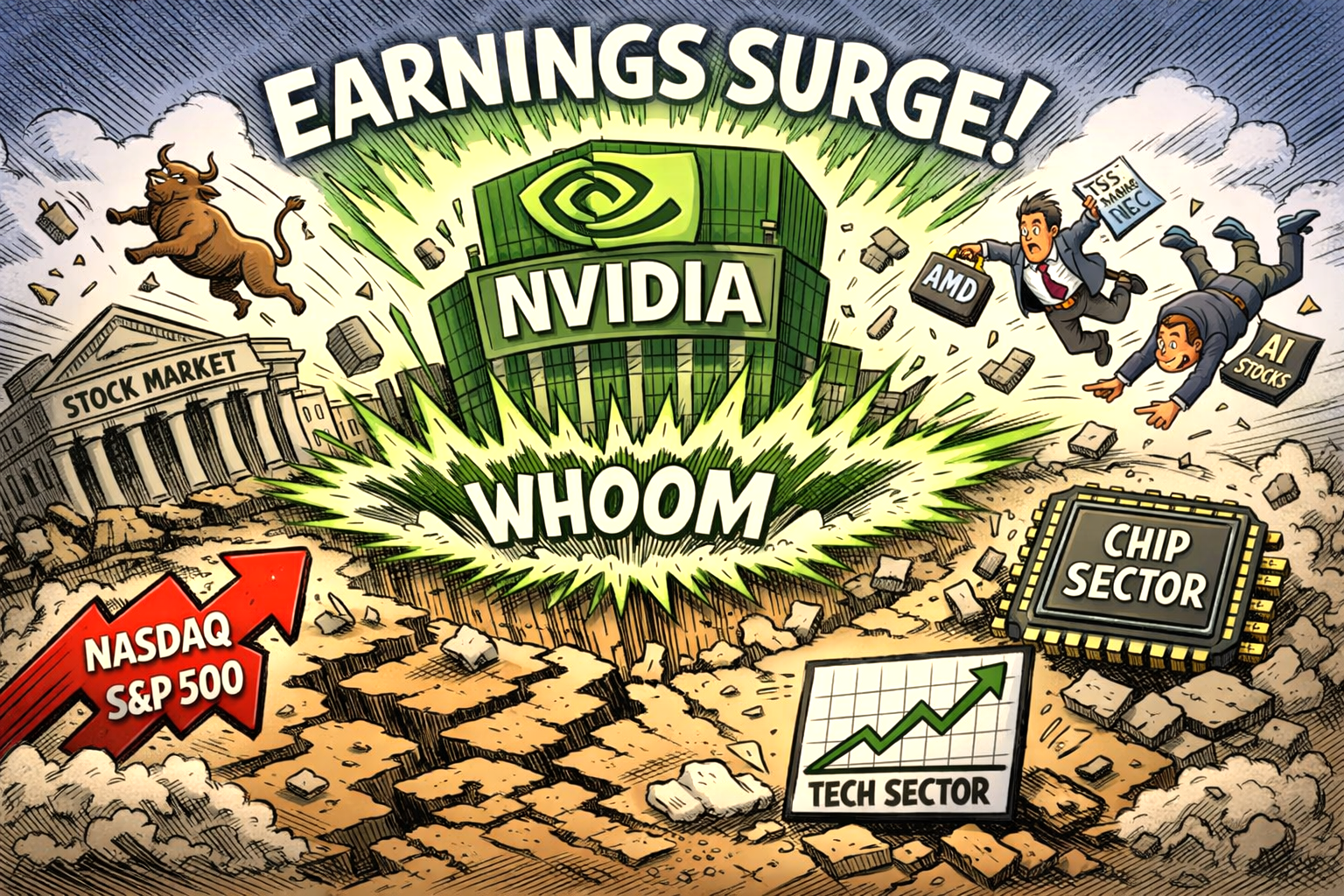
Nvidia’s earnings didn’t disappoint on the numbers — they were spectacular — but Wall Street was disappointed by the guidance, the pricing signals, and the shift in the AI‑chip cycle, which is why the stock fell despite a blowout quarter.
Nvidia’s latest quarterly results were, on the surface, extraordinary. Revenue surged, margins remained enviably high and demand for its AI chips continued to reshape the global technology landscape.
Yet the company’s shares fell sharply, dragging broader markets with them. The reaction reflects a deeper unease on Wall Street: not about what Nvidia has achieved, but about what comes next.
The company delivered a blowout quarter, but investors were looking for something even more explosive.
Cooling expectations after a year of euphoria
Nvidia has become the defining stock of the AI boom, and with that status comes a valuation that assumes relentless acceleration.
This quarter’s guidance, while strong, suggested growth is beginning to normalise. Investors who had priced in another step-change in demand instead saw signs of a company settling into a more sustainable—though still impressive—trajectory.
In a market conditioned to expect perpetual hyper‑growth, “very strong” can feel like a disappointment.
Fears of peak pricing power
A second concern is whether Nvidia’s extraordinary pricing power is nearing its peak. The company’s flagship AI chips have commanded eye‑watering prices, but cloud providers and enterprise customers are now signalling resistance.
Competitors are improving, and hyperscalers are accelerating development of their own silicon.
Some analysts are asking – whether the industry has already seen the high‑water mark for Nvidia’s margins, a question that goes straight to the heart of the stock’s valuation.
China remains a structural drag
Regulatory constraints continue to weigh on Nvidia’s China business. The company has not yet been able to meaningfully sell its U.S. approved AI chips into the market, and executives have warned that local rivals could fill the gap.
China was once a major contributor to Nvidia’s data‑centre revenue; now it is a source of uncertainty. Investors are increasingly factoring in the possibility that this revenue may not return in its previous form.
A crowded trade unwinds
Finally, Nvidia’s sell‑off reflects positioning as much as fundamentals. The stock has been one of the most crowded trades in global markets.
When expectations are stretched, even exceptional results can trigger profit‑taking. The pullback spilled into broader indices, with Asia‑Pacific markets trading mixed as investors digested the slump.
Nvidia remains the central force in the AI hardware boom, but Wall Street is beginning to ask harder questions about sustainability, competition and the next phase of growth.
When artificial intelligence first ignited investor enthusiasm, it lifted almost every major technology stock.
The narrative was simple: AI would transform industries, boost productivity and unlock vast new revenue streams.
Yet as the cycle matures, markets are becoming more selective. In recent weeks, shares of IBM have drifted lower, illustrating how the ‘AI effect’ can cut both ways.
At first glance, IBM should be a prime beneficiary. The company has spent years repositioning itself around hybrid cloud infrastructure, data analytics and enterprise AI solutions.
Its Watson platform has been refreshed with generative AI tools designed to automate customer service, streamline software development and enhance business decision-making. Management has repeatedly emphasised AI as a core growth engine.
Market Expectations
However, the market’s expectations have shifted. Investors are increasingly rewarding companies that sit at the very heart of AI infrastructure — those supplying advanced semiconductors, high-performance computing capacity and hyperscale cloud services.
These businesses are reporting visible surges in AI-related demand, often accompanied by sharp revenue acceleration and expanding margins.
By contrast, IBM’s AI exposure is embedded within broader consulting and software operations, making its growth trajectory appear steadier rather than explosive.
This distinction matters in a momentum-driven environment. When earnings updates fail to deliver dramatic upside surprises, shares can quickly lose favour.
Less AI Effect
IBM’s results have shown progress in software and recurring revenue, but they have not reflected the kind of dramatic AI-driven uplift seen elsewhere in the sector. For some investors, that raises questions about competitive positioning and pricing power.
There is also a perception issue. Despite its reinvention efforts, IBM still carries the legacy image of a mature technology conglomerate rather than a cutting-edge AI disruptor.
In a market captivated by bold innovation stories, narrative can influence valuation just as much as fundamentals.
If capital flows concentrate in a handful of high-growth AI names, diversified players may struggle to keep pace in share price performance.
AI Tension
Yet the sell-off may also highlight a deeper tension within the AI theme. Enterprise adoption of AI tools tends to be gradual, cautious and closely tied to measurable productivity gains.
IBM’s strategy is built around long-term integration rather than short-term hype. While that approach may lack immediate fireworks, it could prove more durable as corporate clients prioritise reliability, governance and cost control.
For now, though, the AI effect is amplifying investor discrimination. In a market eager for rapid transformation, IBM’s more measured path has translated into weaker share performance — a reminder that not all AI exposure is valued equally.
Further discussion
IBM has found itself on the wrong side of the artificial intelligence boom, with its shares tumbling more than 13% after Anthropic unveiled a new capability that directly targets one of the company’s most enduring revenue pillars: COBOL modernisation.
The sell‑off reflects a broader market anxiety that AI is beginning to erode long‑protected niches in enterprise technology, and IBM has become the latest high‑profile casualty.
For decades, IBM has been synonymous with mainframe computing and the maintenance of vast COBOL‑based systems that underpin global finance, government services, airlines, and retail transactions.
These systems are notoriously complex, expensive to update, and dependent on a shrinking pool of specialist developers.
Premium Brand
That scarcity has long worked in IBM’s favour, allowing it to charge a premium for modernisation and support.
Anthropic’s announcement threatens to upend that equation. Its Claude Code tool, the company claims, can automate the most time‑consuming and costly parts of understanding and restructuring legacy COBOL environments.
Tasks that once required teams of analysts months to complete—mapping dependencies, documenting workflows, identifying risks—can now be accelerated dramatically through AI‑driven analysis.
The implication is clear: modernising legacy systems may no longer require the same level of human expertise, nor the same level of spending.
Investors reacted swiftly. IBM’s share price fell to $223.35, extending a year‑to‑date decline of more than 24% – recovering later to $229.39
IBM one-year chart as of 24th February 2026
The drop reflects not only concerns about lost revenue, but also the fear that IBM’s competitive moat—built on decades of institutional reliance on COBOL—may be eroding faster than expected.
The timing has amplified market jitters. Only days earlier, cybersecurity stocks were hit by another Anthropic announcement: Claude Code Security, a feature designed to scan codebases for vulnerabilities.
AI Mood Logic
The rapid expansion of AI into specialised technical domains has created a ‘sell first, ask questions later’ mood across the market, with investors increasingly wary of companies whose business models depend on labour‑intensive or legacy‑bound processes.
For IBM, the challenge now is to demonstrate that it can harness AI rather than be displaced by it.
The company has invested heavily in its own AI initiatives, but the latest market reaction suggests investors are unconvinced that these efforts will offset the threat to its traditional strongholds.
The AI revolution is reshaping the technology landscape at speed. IBM’s sharp decline is a reminder that even the industry’s oldest giants are not insulated from disruption—and that the next wave of AI competition may hit the most established players hardest.
But remember, this is IBM we are talking about.
Explainer
What is COBOL?
COBOL is an old but remarkably durable programming language created in the late 1950s to run business, finance, and government systems, and it’s still powering much of the world’s banking and administrative infrastructure today.
It was designed to read almost like plain English, making it easier for non‑technical managers to understand, and its stability means many core systems have never been replaced.
For much of the past three years, the so‑called Magnificent Seven – Apple, Microsoft, Alphabet, Amazon, Meta, Tesla and Nvidia – have powered US equities to repeated record highs.
Their sheer scale, earnings strength and centrality to the AI boom turned them into a market narrative as much as an investment theme.
But as 2026 unfolds, the question is no longer whether they can keep leading the market higher, but whether the idea of treating them as a single trade still makes sense.
The short answer is closer to: the trade isn’t dead, but the era of effortless, broad‑based mega‑cap dominance is fading.
Mag 7 fatigue
The first sign of fatigue is the breakdown in cohesion. Last year, only a minority of the seven outperformed the wider S&P 500, a sharp contrast to the near‑uniform surges of 2023 and early 2024.
Nvidia and Alphabet continue to benefit from the structural demand for AI infrastructure and cloud‑driven productivity gains. Others, however, appear to be wrestling with slower growth, regulatory pressure or strategic resets.
Apple faces a maturing hardware cycle, Tesla is contending with intensifying global competition, and Meta’s spending plans continue to divide investors.
Mag 7 trade – which company is missing?
Divergence
This divergence matters. For years, investors could simply buy the group and let the rising tide of AI enthusiasm and index concentration do the work.
That simplicity has evaporated. Stock‑picking is back, and the market is finally distinguishing between companies with accelerating earnings power and those relying on past momentum.
At the same time, market breadth is improving. Capital is rotating into industrials and defensive sectors as investors seek exposure to areas that have lagged the mega‑cap rally. However, AI is affecting software stocks, law and financial sectors.
Healthy future
This broadening is healthy: it reduces concentration risk and signals that the U.S. economy is no longer dependent on a handful of tech giants to sustain equity performance.
Yet it would be premature to declare the Magnificent Seven irrelevant. Their combined earnings growth is still expected to outpace the rest of the index, and their role in AI, cloud computing and digital infrastructure remains foundational.
Change
What has changed is the nature of the trade. These are no longer seven interchangeable vehicles for tech exposure; they are seven distinct stories with diverging trajectories.
The Magnificent Seven haven’t left the stage. They have likely stopped performing in unison – and for investors, that marks the beginning of a more nuanced, more selective chapter.