


Sovereign wealth fund warns U.S. stocks may be due a pullback

Wealth Funds suggests possible pullback

The chief executive of New Zealand’s sovereign wealth fund has reportedly warned that the exceptional gains enjoyed by U.S. equities in recent years may not be sustainable, raising the prospect of a period of weaker returns or a market correction.

Jo Townsend, chief executive of the Guardians of New Zealand Superannuation, reportedly made the comments as the NZ Super Fund reported a 14.2% return for the year to the end of June 2026.

Top performance

The fund was valued at NZ$94.4 billion (£44.7bn/$54.4bn) at the end of the financial year and has been ranked the world’s best-performing sovereign wealth fund by Global SWF.

Townsend reportedly said returns from U.S. equities over the past two years had been close to double their annualised 20-year average, suggesting that some “reversion to the mean” should be expected at some point.

Warning!

The warning does not amount to a prediction that Wall Street is about to collapse. Rather, it reflects the fund’s longer-term assessment that investors should not assume the unusually strong returns of recent years will continue indefinitely.

The NZ Super Fund has consequently maintained a diversified investment strategy, rather than chasing the strongest-performing areas of the U.S. market.

Its long-term expected annual return has also been reduced from 7.8% to 7.2%, reflecting lower expectations for future investment returns.

Caution

The comments come as other major institutional investors have also expressed caution. The chief executive of Norway’s enormous sovereign wealth fund has reportedly said investors should not expect the same returns from equities as those seen over the previous six months.

For U.S. investors, the message is therefore less about abandoning equities and more about expectations. After a prolonged period of exceptional gains, even a return to more normal performance could represent a significant change in the market environment.

The key question now is whether U.S. corporate earnings and economic growth can continue to justify elevated valuations — or whether returns eventually move back towards historical norms.
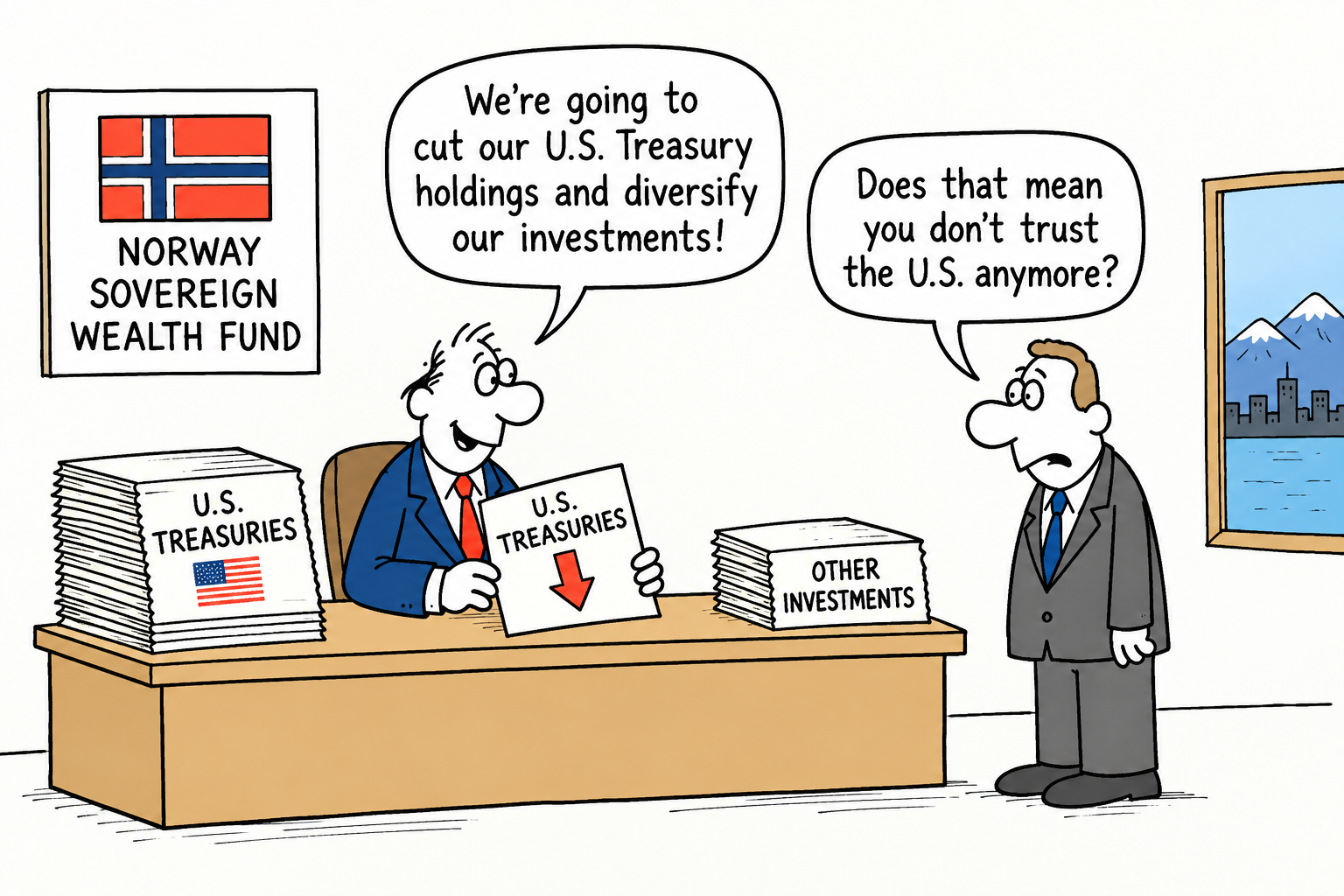
Norway’s Wealth Fund Signals a Shift Away From U.S. Treasuries

Norway’s enormous sovereign wealth fund is considering a significant reduction in its holdings of U.S. government debt, in a move that could add to concerns surrounding the future of the Treasury market.

Norges Bank Investment Management, which oversees Norway’s roughly $2.3 trillion Government Pension Fund Global, has proposed reducing the proportion of government bonds in its benchmark portfolio from 70% to 50%.

U.S. Treasuries

U.S. Treasuries supposedly would take the largest share of the reduction, potentially cutting the fund’s holdings by almost $80 billion from around $215 billion.

The proposal reflects a desire to diversify the fund and improve returns rather than abandon U.S. assets altogether.

Non-Government U.S. Debt

The fund intends to increase its exposure to non-government U.S. debt, including mortgage-backed securities and other government-related bonds. Its overall exposure to the U.S. dollar would remain broadly unchanged.

The timing is nevertheless significant. Government bond markets have faced renewed pressure as investors worry about high inflation, mounting government debt and rising long-term borrowing costs.

Warning?

Norway’s decision could therefore be interpreted as another warning that some major institutional investors are becoming less comfortable holding large quantities of traditional government debt.

Japanese Government Bonds

The fund also plans to increase its allocation to Japanese government bonds, while reducing exposure to euro-area government debt.

Importantly, this is reportedly a proposal rather than an immediate sell-off. Any changes would likely be introduced gradually, with Norway’s Finance Ministry and parliament involved in the approval process. The earliest significant changes are not expected before 2027.

Nevertheless, when one of the world’s largest investors starts questioning the traditional role of government bonds, markets are likely to take notice.

World’s largest sovereign wealth fund reports $40 billion loss

Wealth

Norway’s sovereign wealth fund, the largest in the world, has reported a first-quarter loss of $40 billion, largely due to a downturn in the technology sector.

The fund, managed by Norges Bank Investment Management (NBIM), saw its value drop to 18.53 trillion kroner by the end of March 2025, with 70% of its investments in equities, which recorded a 1.6% loss.

CEO Nicolai Tangen attributed the decline to significant market fluctuations, particularly in tech stocks, which have faced recent sell-offs. The fund holds major stakes in Meta, Alphabet, Amazon, Nvidia, Tesla, and Microsoft, all of which have experienced volatility.

Additionally, currency movements played a role, with the Norwegian krone strengthening against key currencies, contributing to an 879 billion kroner (around $84.5 billion) decrease in the fund’s value.

Despite the losses, NBIM maintains a diversified portfolio, with fixed-income investments returning 1.6% and unlisted real estate yielding 2.4% gains.

This downturn follows a record $222 billion profit in 2024, driven by the AI boom, highlighting the fund’s exposure to tech sector fluctuations.

As global markets remain uncertain, NBIM continues to navigate economic shifts while managing Norway’s oil and gas revenues.

Surging tech stocks allow world’s largest sovereign wealth fund to post $110 billion profit in Q1

Wealth fund

Norway’s massive sovereign wealth fund reported a first-quarter profit of 1.21 trillion kroner ($109.9 billion) – bolstered by strong returns from its technology stock investments it was announced on Thursday 18th April 2024.

Established in the 1990s, Norway’s sovereign wealth fund, the largest in the world, invests the surplus revenue from the nation’s oil and gas sector. The fund has invested in over 8,800 companies across more than 70 countries to date.