More than 20% of UK adults not seeking work

Not working

More than a fifth of working-age adults in the UK are currently not actively seeking employment, according to recent figures.

The economic inactivity rate during the period from November 2023 to January 2024 stood at 21.8%, a slight increase compared to the previous year. This means that approximately 9.2 million people aged between 16 and 64 are neither employed nor actively searching for jobs. The total figure has risen by over 700,000 since before the onset of the coronavirus pandemic.

Several factors contribute to this problem

Long-Term Illness: Approximately one-third of the working-age population not participating in the labour force cite long-term illness as the primary reason for their inactivity. Health-related issues have kept a significant portion of the population away from work.

The pandemic: of 2020 caused work flight. 700,000 extra out of the workplace since the coronavirus pandemic Covid 19 hit the UK in 2020.

Students and Education: Students pursuing education are often classified as economically inactive. Their focus on studies and lack of job-seeking activity contribute to this category.

Care Responsibilities: Individuals who care for family members or manage household responsibilities fall into this bracket. Caring duties can be time-consuming and prevent active job hunting.

People with Disabilities: Those with disabilities may face barriers in accessing employment opportunities. Accommodations and inclusive policies are essential to address this issue.

Early Retirement: Some adults choose early retirement, and once retired, they rarely express a desire to return to work. This group contributes significantly to the inactive population.

Discouraged Workers: Individuals who have given up on job searches due to discouragement or lack of suitable opportunities are also part of this category.

Gender Gap: Historically, more women have been classified as economically inactive compared to men. However, this gap has narrowed over the years as more women have entered the workforce.

Age Trends: Recent data indicates that while the number of economically inactive individuals due to illness has decreased, there has been an increase among those aged 16 to 34. Mental health issues are believed to be a contributing factor in this age group.

Persistently high level

The persistently high level of economic inactivity poses challenges for the UK economy. As the country emerges from the pandemic, addressing workforce shortages becomes crucial. Measures such as reducing National Insurance Contributions and extending free childcare services aim to encourage people to seek employment or increase their working hours. 

More effort is needed to further incentivise workforce participation, if not, the UK economy will suffer for many more years than would otherwise be necessary.

Office for national statistics

UK swings to economic growth in January 2024

UK economy

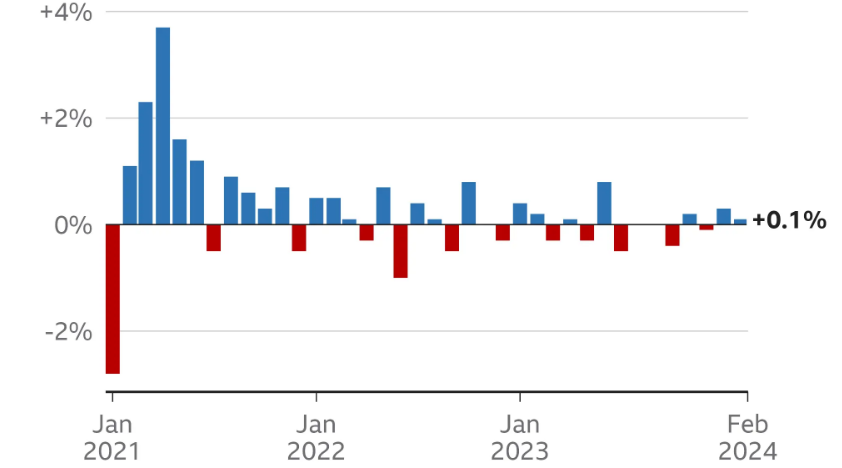
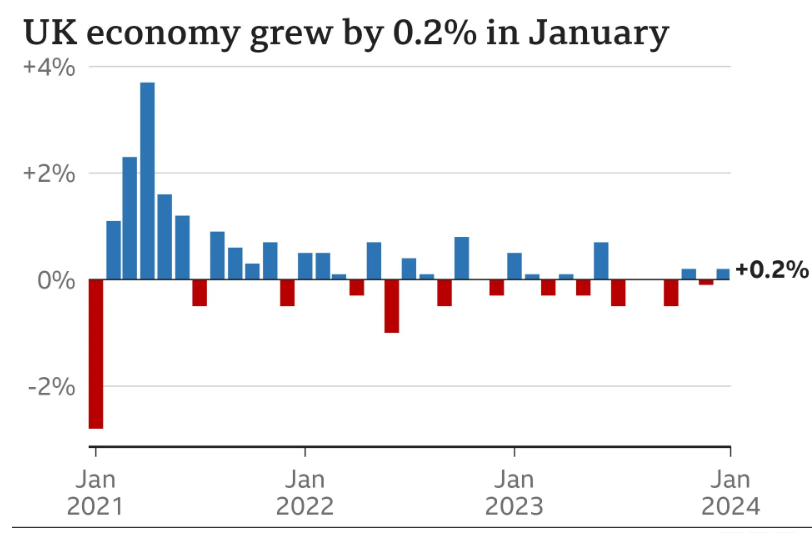
The economy grew by 0.2%, ONS figures show, boosted by sales in shops and online and from more construction activity.

Hopefully this means the UK is on its way out of recession.

The Office for National Statistics (ONS) said the services sector led the bounce back.

This is an early dataset, but demonstrates how the UK, which entered recession at the end of 2023, is faring.

ONS data suggests UK could be exiting a short-lived ‘technical’ recession

UK swings to economic growth in January 2024

Japan avoids technical recession

Japan GDP

According to the revised official data, the Japan’s gross domestic product (GDP) grew by 0.4% in the fourth quarter of 2023 compared to the same period in the previous year.

According to this revision, the economy avoided a technical recession, which is usually defined as two successive quarters of negative growth.

On Monday 11th March 2024, Japan’s Cabinet Office released figures that indicated a 0.3% decline in private consumption for the quarter. Private consumption accounts for about 60% of the economy.

Nevertheless, the updated figures fell short of expectations, as some economists had predicted a higher revision in Q4.

Nikkei 225 pulls back from recent highs

Nikkei 225 pulls back from recent highs

Powell says the Fed is not ready to start cutting interest rates yet

U.S. interest rates

In his Capitol Hill testimony on 6th March 2024, Federal Reserve Chairman Jerome Powell reiterated that was not yet time to begin cutting interest rates.

To fight inflation, which reached a rate of 9% in the summer of 2022, the central bank has significantly increased interest rates in recent times. However, prices are still stubborn, especially for things like housing and groceries.

Due to the robust economic performance in early 2024, the expected reduction in interest rates has been postponed. Instead of taking place this month, the rate cuts are now more probable in May or June 2024.

Powell reportedly said: ‘The Committee does not expect that it will be appropriate to reduce the target range until it has gained greater confidence that inflation is moving sustainably toward 2 percent.’

He reiterated the pledge to lower inflation to the 2% target and keep long-term inflation expectations stable.

UPDATE

On Thursday 7th March 2024 Powell also said: the Fed is ‘not far’ from the point of cutting interest rates

U.S. national debt is piling up

U.S. debt pile

The U.S. national debt has been growing more quickly in recent months, increasing about $1 trillion nearly every 100 days.

U.S. debt permanently crossed over $34 trillion on 4th January 2024 according to data from the U.S. Department of the Treasury.

It reached $33 trillion on 15th September 2023, and $32 trillion on 15th June 2023. Before that, the $1 trillion move higher from $31 trillion took about eight months.

The U.S. national debt is the total amount of money that the federal government owes to its creditors. That can include, individuals, other countries and corporation. It is composed of two main components: federal debt held by the public and federal governmental debt.

The national debt has grown over time due to various factors, such as recessions, defense spending, and tax cuts. The debt-to-GDP ratio gives insight into whether the US has the ability to cover all of its debt. It also shows how it affects economic growth. 

U.S. national debt pile is growing

U.S. Debt
U.S. national debt is piling up

The national debt increased by 13.3% under President Biden. Up from $27.77 trillion as of 1st March 2020 to $31.46 trillion as of 1st March 2023. The debt also grew by $1.5 trillion, or 5.6%, between the end of 2020 and the end of 2021.

The gross domestic product (GDP) measures the annual economic output of the entire country. The national debt exceeds this amount, which is very high.

As of the end of February 2024, the U.S. debt is almost $34.4 billion. This is the money that the federal government has to borrow to pay for its operating expenses.

The World Bank found that if the debt-to-GDP ratio exceeded 77% for an extended period, it slowed economic growth.

U.S. national debt

Inflation in the euro-zone eased to 2.6% in February 2024

Euro zone inflation

Euro zone inflation eased to 2.6% in February figures showed on Friday 1st March 2024, but both the headline and core figures were higher than expected.

Core inflation

Core inflation, removing the volatile elements of energy, food, alcohol and tobacco was 3.1% above the 2.9% rate expected.

The February figures will be a headache for EU policymakers, as core inflation is still holding above 3% even as the headline rate moves toward the ECB’s 2% target.

India’s economy smashes expectations with 8.4% growth

India GDP smashes expectations

India is ‘easily’ the fastest growing economy in the world according to the IMF, as the country’s Q3 GDP growth soared past analysts’ estimates.

The world’s fastest growing major economy expanded 8.4% in the last three months of 2023.

8.4% GDP growth in Q3

At 8.4%, India’s economy expanded at its fastest pace in six quarters, data showed late Thursday, on strong private consumption and upbeat manufacturing and construction activity. Reuters estimates had pegged growth in the October to December period at 6.6%.

Prime Minister Narendra Modi posted on the social media platform X, that it shows ‘the strength of Indian economy and its potential.’

India economy due to jump ahead of Japan and Germany

India is forecast to leap ahead of Japan and Germany as the world’s third biggest economy in the next few years.

The better-than-expected growth was led by a strong performance by the country’s manufacturers, with the sector expanding by 11.6% in the period.

Private consumption, which makes up almost two-thirds of the country’s gross domestic product (GDP), also rose by 3.5%.

India is on a tear.

Is the fight against inflation failing – or does it get much harder towards the end?

Stubborn inflation

Is progress on U.S. inflation stalling?

That’s the fear spreading through Wall Street as another inflation reading on Friday 16th February 2024 came in hotter-than-expected.  

The producer price index rose 0.3% in January 2024. The largest increase since August 2024 and higher than the 0.1% forecast. Excluding food and energy, core PPI jumped 0.5%, again well above consensus.

Stubborn

It is yet another sign of stubborn price pressures across the broader U.S. economy. And it came just days after an unexpectedly hot CPI reading, which gave markets a nasty jolt.  

Both data have stoked investor worries on whether inflation is firmly under control. The latest developments also reinforce the Fed’s caution that it will need to see more evidence of disinflation before committing to lower rates.

Mohamed El-Erian, Allianz chief economic advisor, posted on X that like the CPI data, the PPI report was a further indication that the last mile of the inflation battle is more complex than many had assumed (and still assume).

Some economists even argue the jump in Friday’s data will likely push January’s personal consumption expenditures price index, the Fed’s preferred inflation gauge.

The PPI data means we can finalise our core PCE forecast for January, at 0.32%. That would be the biggest increase since September. But the three months since then all saw much smaller gains.

But investors will have to wait until later this month for PCE data when it’s released on 29th February 2024.

UK inflation holds steady at 4%, lower than expected

UK inflation statistics

The UK’s inflation rate remained at 4% in January 2024, despite the first monthly fall in food prices in two years, ONS figures show.

January U.K. inflation held steady at 4% year-on-year benefitting from easing prices for furniture and household goods, food and non-alcoholic beverages.

According to the latest figures from the Office for National Statistics (ONS), prices for food and non-alcoholic beverages fell on a monthly basis by 0.4%, marking the first decrease since September 2021.

The core CPI figure excluding volatile food, energy, alcohol and tobacco prices annual reading was 5.1%, below the 5.2% estimate – but only a micro 0.1% difference.

The latest inflation data is a reflection of what is happening in the labour market: a tight labour supply is sustaining high wage growth and thus underlying inflationary pressure.

Inflation still sits double the BoE target of 2%.

Japan’s stock markets are on a tear but are the Zombies coming?

Nikkei 225 index

After a decade-long bull run throughout the 1980’s, the Nikkei 225 index reached an all-time high of 38,915 on December 29, 1989, the last trading day of the year.

Few could have imagined, on New Year’s Eve of 1989, that the index would be lower 34 years later. As the New Year arrived, the bubble burst.

And now, Japan’s stock markets are on a tear and closing in on that elusive 38195 high of 1989 – but there’s a catch – the Zombies are coming.

Zombie companies

Zombie firms are businesses that are unprofitable and struggling to keep afloat. They don’t have excess capital to invest and grow the business, or to pay down the loan capital.

Concerns about zombie firms are coming into focus as the Bank of Japan is tipped to raise interest rates in 2024 for the first time since 2007.

It comes as the Nikkei 225 rises to its highest point in almost 34 years

Japan’s stock markets have been on a meteoric run since the start of 2023, repeatedly breaching 33-year highs and outperforming the rest of Asia.

However, there are rising concerns that so called ‘zombie’ firms, which are unprofitable and struggling to keep afloat, could cut short that rally. The Bank of Japan is widely expected to raise interest rates this year, and that could easily tip many of these firms into bankruptcy, which could have a broader impact on the economy and stock market,

Nikkei 225 1-year chart 9th February 2024

Nikkei 225 1-year chart 9th February 2024

Bankrupt businesses

Zombie firms are nothing new in Japan. They first emerged after the stock ‘bubble’ and subsequent crash of the 1990s, when banks continued to support companies that would have otherwise gone bankrupt. 

The pandemic of 2020 accelerated the problem of zombie businesses, with the number of zombie firms in Japan reportedly jumping by around 33% between 2021 and 2022. 

At the end of 2023, Japan reportedly had around 250,000 companies that are technically zombie businesses

Some experts argue that zombie firms are a drag on Japan’s productivity, innovation, and growth, as they occupy resources and crowd out more efficient firms. The debate on how to deal with zombie firms is ongoing and may have implications for Japan’s economic recovery and future prospects.

Others suggest that zombie firms may have a positive effect, such as preserving employment, social stability, and industrial diversity.

Surely, there is no room for inefficiently run businesses making little or no profit in any economy.

Watch out for the Zombies!

Big surprise U.S. jobs rise in January 2024

U.S. workers

Job creation in the U.S. surged in January 2024, as the economy continued to defy predictions of a slowdown

The U.S. economy added 353,000 jobs and average hourly pay jumped, while the unemployment rate held steady at 3.7%, the Labour Department said.

The report extended more job gains that has surprised economists, who have expected a jump in interest rates since 2022 to slow the economy. It hasn’t. No recession or slowdown in the economy so far.

Early rate cut less likely according to these figures

  • Average hourly earnings increased 0.6%. Year-on-year basis, wages jumped 4.5%, above the 4.1% forecast.
  • Non-farm payrolls expanded by 353,000 for the month, well above the 185,000 estimate. The unemployment rate held at 3.7%.
  • Job growth was widespread in January 2024. Professional and business services 74,000. Other sectors included health care 70,000 and retail trade 45,000.

Analysts now say the job market gain and strength make an early interest rate cut less likely.

The U.S. employment data delivered quite a shock, easily beating expectations, with earnings much higher than expected. Stock markets gained and are at elevated levels for the Dow, Nasdaq and the S&P 500. Record highs have been set – are the highs?

Market analysts said these numbers show the U.S. economy is strong and will change the mindsets of those expecting an early interest rate cut.

Expectations of a recession are off the table too, for now.

The U.S. GDP up in Q4 as economy grew at a 3.3%

U.S. GDP

The U.S. economy grew at a much faster pace than expected in the final three months of 2023.

The U.S. easily avoided a recession that many had forecast as inevitable, the U.S. Commerce Department reported Thursday 25th January 2024.

Gross domestic product (GDP), a measure of all the goods and services produced, increased at a 3.3% annualised rate in the final quarter of 2023, according to data from the Commerce Department.

Wall Street consensus was for a figure of 2%.

U.S. BEA Bureau of Economic Analysis

Bureau of Economic Analysis

Dow Jones Industrial Average sets new all-time high

Dow Jones Index

The Dow Jones Industrial Average (DJIA) hit a new all-time high, on 13th December 2023. It closed at 36799 surpassing its previous record of 36585points that it had set on 4th January 2022. This was the fourth consecutive record close for the index.

Record high

The Dow’s record high was driven primarily by the Fed holding the interest rate at 5.5% and signalling that it expects to cut interest rates three times in 2024 to stimulate growth and inflation.

Other factors such as strong corporate earnings, optimism about the economic recovery from the COVID-19 pandemic, the emergence of AI and its effect on the economy and for a U.S. ‘soft landing’ all played their part.

Dow a bellwether for the U.S. economy

The Dow is not only a measure of stock market performance, but also a reflection of the overall health and confidence of the U.S. economy. It is often used as a benchmark for investors and analysts to evaluate their portfolios and strategies. The Dow is also closely watched by policymakers and media outlets as a measure of public sentiment and expectations.

Dow hits new all-time high

Dow hits new all-time high

The Dow, in intraday trading, continued to climb to over 37200.

More to come?

China’s debt outlook downgraded by Moody’s as economy slows

Debt

A Downgrade Amidst Economic Slowdown

In a significant development that has raised concerns among investors and policymakers worldwide, China’s debt outlook has been downgraded as the country grapples with a slowing economy. This move reflects growing apprehensions about the sustainability of China’s economic growth and its ability to manage its burgeoning debt.

Moody’s issued the warning as it cut its outlook on the government’s debt to negative, from stable. China said it was disappointed by the move, calling the economy resilient. China also reported to have said it is unnecessary for Moody’s to worry about China’s economic growth prospects and fiscal sustainability.

Rapid Expansion

For years, China’s rapid economic expansion has been the engine of global growth, but recent trends indicate a deceleration. The once double-digit growth rates have now tapered, with projections suggesting a further slowdown in the coming years.

China exports

This deceleration is attributed to various factors, including trade tensions, demographic shifts, and a maturing economy.

Downgrade

The downgrade, announced by a prominent credit rating agency recently, underscores the risks associated with China’s increasing debt levels. The country’s total debt, which includes government, household, and corporate debt, has climbed to around 85%* of its GDP. This debt accumulation is partly due to the government’s efforts to stimulate the economy through infrastructure spending and lending to state-owned enterprises.

Property Sector

The property sector, a significant pillar of China’s economy, has also shown signs of strain. High-profile defaults and a cooling housing market have added to the concerns, prompting fears of a ripple effect across the economy. The government’s crackdown on excessive borrowing and speculative investments has further tightened liquidity, impacting developers and homeowners alike.

Debt
The burden of debt sits heavy in China’s property sector.

Response

In response to the downgrade, China’s finance ministry has expressed confidence in the country’s economic resilience. Officials argue that the fundamentals of the Chinese economy remain strong, with continued efforts towards high-quality development and structural reforms. They assert that the concerns raised by the credit agencies are overstated and that China’s fiscal position remains robust.

Warning signal

Nevertheless, the downgrade should serve as a warning signal. It highlights the need for careful fiscal management and policy adjustments to navigate the challenges ahead. As the global economy faces uncertainty, the world will be closely watching how China addresses its debt dilemma and maintains its trajectory of growth.

This situation presents a complex puzzle for China’s leadership, balancing the goals of economic stability and sustainable development. The outcome will have far-reaching implications, not just for China but for the entire global economy.

The world awaits to see how China will write the next chapter in its remarkable economic story. If this goes wrong – it will go wrong in a big way.

Update Friday 8th December 2023

China’s top decision-making body of the ruling Communist Party on Friday said that the country’s fiscal policy ‘must be moderately strengthened’ to stimulate economic recovery, according to state-run news outlet. 

85%* debt to GDP ratio

China’s debt-to-GDP ratio was recorded at around 77% of the country’s Gross Domestic Product in 2022. This ratio is an important indicator of a country’s economic health, reflecting its ability to pay back its debts. This ratio has been on the rise in recent years, indicating an increase in national debt relative to the GDP. For instance, the ratio was around 23% in 2000 and grew to 34% in 2012, with a significant jump to the current level. 

China’s projected debt to GDP ration

Forecasts suggest that China’s debt-to-GDP ratio could reach 104% by 2028

It’s important to note that such figures can vary and should be interpreted within the context of each country’s economic structure and policies.

UK economy declines more than expected in October 2023

UK growth

The economy fell by 0.3% October, after growth of 0.2% in September 2023.

UK GDP is 0.0%

The UK economy shrank more than expected in October 2023, as higher interest rates hit consumers. The bad weather didn’t help either.

Household spending has been dented by rate rises as the Bank of England tries to tackle inflation. It is due to make its next rate decision on Thursday 14th December 2023. Retail and tourism were hit by severe weather hit the UK in October 2023.

Analysts had predicted that the economy would fall by just 0.1% but services, manufacturing and construction sectors all contracted more than expected.

The UK economy has been stagnating and the Prime Minister has promised to speed up economic growth. But no significant recovery is expected until January 2025.

Chancellor’s spin

Commenting on the latest figures, Chancellor Jeremy Hunt said it was ‘inevitable economic growth would be subdued, whilst interest rates are doing their job to bring down inflation.’

The figures underline the ongoing impact of the cost-of-living crisis and the tools employed by our ‘decision’ makers on our behalf.

Information from ONS

UK economy growth forecasts cut for next two years

UK economy growth

The UK economy will grow much more slowly than expected in the next two years as inflation takes longer to fall, the Office for Budget Responsibility (OBR) says.

Are we locked in a never-ending austerity cycle?

Living standards are also not expected to return to pre-pandemic levels until 2027-28, the Office for Budget Responsibility (OBR) said. It comes as the chancellor announced tax cuts and a rise in benefits in his 2023 Autumn Statement.

The OBR publishes two sets of economic forecasts a year, which are used to independently predict or guess what may happen to government finances. These are based on its best guess calculations about and are subject to ‘change’.

It’s just a forecast – so should we take any notice?

According to the OBR, the UK will grow by 0.6% in 2023 – much better than previous predications last autumn, when it calculated the economy would fall into recession and shrink.

However, it slashed its growth outlook to 0.7% in 2024 and 1.4% in 2025 – down from a previous forecast of 1.8% and 2.5%.

The OBR warned that inflation – currently 4.6% – will only fall to 2.8% by the end of 2024, before reaching the Bank of England’s 2% target in 2025. Previously it forecast inflation would easily beat the target next year.

OBR & ONS data set

These gloomy predictions put the Government on a collision course with the Bank of England and Britain’s budget watchdog as they clash over whether or not the UK economy is on the up.

The Governor of the Bank warned the UK was facing years of low growth, while the Office for Budget Responsibility (OBR) said the Chancellor’s ‘vague’ plans to cut spending put the public finances at risk.

Let’s re-visit these predictions this time next year and see how close or how far off the mark they were.

China factory activity shrinks

China factory output

China’s factory activity contracted for a second month in a row in November 2023.

Non-manufacturing activity hit yet another new low this year, signalling that the world’s second-largest economy was still not out of the woods and may require more policy support.

The official manufacturing purchasing managers’ index unexpectedly dropped slightly lower to 49.4 in November 2023 from 49.5 in October 2023, according to data from the National Bureau of Statistics released Thursday 30th November 2023.

U.S. GDP grew at a 5.2% in Q3, stronger than expected

U.S. GDP revision

U.S. GDP figure better that forecast

The U.S. economy grew even stronger than previously calculated in the third quarter, the result of better than expected business investment and stronger government spending, the Bureau of Economic Analysis reported  Wednesday 29th November 2023.

Gross domestic product (GDP), a measure of all goods and services produced during the three-month period, climbed to 5.2% annualised pace, the department’s second estimate showed. The increase superseded the initial 4.9% figure and was better than the 5% forecast from economists.

Upward revision

Primarily, the upward revision came from increases in non-residential fixed investment, which includes structures equipment and intellectual property. The category showed an increase of 1.3%, which still presented a sharp downward shift from previous quarters. Government spending also helped boost the Q3 estimate, rising 5.5% for the July-through-September 2023 period.

However, consumer spending registered a downward revision, now rising just 3.6%, compared to 4% in the initial estimate.

Inflation

There was some mixed news on the inflation front. The personal consumption expenditures price index, a gauge the Federal Reserve follows closely, increased 2.8% for the period, a 0.1% downward revision.

Corporate profits increased 4.3% during the period, up sharply from the 0.8% gain in the second quarter.

Bank of England governor worried over UK growth outlook

Central Banks are struggling to catch-up with inflation

The governor of the Bank of England, Andrew Bailey has raised concerns over economic growth as he warned again that interest rates will not be cut in the ‘foreseeable future’.

The bank boss said he was concerned over the UK economy’s potential to grow. It comes after the government’s forecaster cut its growth outlook for the UK, due to high inflation, interest rates, energy and food price increases which were exacerbated by the Covid pandemic and Russia’s invasion of Ukraine.

Inflation, which is the rate consumer prices rise at, has dropped sharply in recent months, falling to 4.6% in the year to October largely as a result of lower energy prices.

However, it is still more than double the Bank of England’s 2% target and Mr Bailey warned lowering inflation further would be ‘hard work’.

Interest rates are currently at 5.25%, a 15-year high, which has pushed up borrowing and mortgage costs.

The Bank of England (BoE) failed abysmally to maintain inflation at 2%.

European Central Bank says: Signs that the global economy is fragmenting into competing blocs

European Central Bank

Fear or Fact?

European Central Bank President Christine Lagarde on Friday 17th November 2023 reportedly said that Europe is now at a critical juncture, with deglobalization, demographics and decarbonization looming on the horizon.

Fragmentation

‘There are increasing signs that the global economy is fragmenting into competing blocs’, she said at the European Banking Congress, according to a transcript.

Focusing on Europe, she said that a continuous decline in the population of working age looks set to start as early as 2025, alongside climate disasters that are increasing every year.

Her answer to these shocks was that massive investment would be needed in a short space of time, requiring what she called a ‘generational effort‘.

Barriers

‘As new trade barriers appear, we will need to reassess supply chains and invest in new ones that are safer, more efficient and closer to home‘, Lagarde reportedly said.

‘As our societies age, we will need to deploy new technologies so that we can produce greater output with fewer workers. Digitalization will help. And as our climate warms, we will need to advance the green transition without any further delays‘.

Paving the way for AI?

UK economy flatlines

UK flatlined

The U.K. economy flatlined in the third quarter, initial figures showed Friday 10th November 2023.

Gross domestic product (GDP) showed zero quarterly growth in the three months to the end of September 2023, following an increase of 0.2% in the previous quarter. In annual terms, the UK’s Q3 GDP was 0.6% higher than in the same period in 2022.

Services sector output dropped 0.1% on the quarter, but the decline was offset by a 0.1% increase in construction performance, while the production sector flatlined.

U.K. Chancellor of the Exchequer Jeremy Hunt said high inflation remains the ‘single greatest barrier to economic growth’ in the country, with the consumer price index remaining at 6.7% year-on-year in September 2023.

UK economy flatlines as inflation sticks at 6.7% year-on-year as at September 2023.

‘The best way to sustainably grow our economy right now is to stick to our plan and knock inflation on its head’, Hunt reportedly said.

It’s useful to know the government have a plan, even though they were very late to the inflation party! Guess they were sidetracked with all the other parties at No.10!

‘The Autumn Statement will focus on how we get the economy growing healthily again by unlocking investment, getting people back into work and reforming our public services so we can deliver the growth our country needs’.

Up until September 2023, the Bank of England (BoE) raised interest rates 14 consecutive times to try to influence the UK ‘product and service’ price climb.

Red flags

Interest rates are now at a 15-year high of 5.25%, and are expected to remain high for some time to come. Bank Governor Andrew Bailey reportedly said last week it was ‘much too early’ to be considering rate cuts.

Thank you Governor Baily – it so comforting and reassuring to know that the very people who missed the red inflation flags are still in charge of policy.

Transitory?

Remember, the BoE and others originally suggested inflation would be transitory – I suppose it is, if given years to move back down. What did you think was going to happen after all that borrowing and the country crawling back to work after the pandemic.

Nice job guys! Don’t forget to collect your paycheque on the way out!

Moody’s cuts U.S. outlook to negative

U.S. credit rating stable to negative

Moody’s, a credit rating agency, lowered its ratings outlook on the United States to negative from stable.

This means that Moody’s sees a higher risk of a downgrade in the future, which could affect the borrowing costs and confidence of the U.S. government.

Moody’s actions

The main reasons for Moody’s action are the rising deficits and debt levels of the U.S., as well as the continued political polarization that hampers effective policymaking. Moody’s also cited the impact of the Covid-19 pandemic and the recent failures of some U.S. banks as factors that have worsened the environment for the U.S. government and the banking system in general.

Warning!

Moody’s warned that the U.S.’s deficits are likely to remain ‘very large’. It also warned that ‘continued political turmoil or polarization’ in Congress further increases the risk the U.S. will not be able to reach consensus on a fiscal plan to slow the decline in debt affordability‘.

Moody’s still maintains a triple ‘A’ (AAA) credit rating on the U.S. government debt, which is the highest possible rating, but warns of the challenges and uncertainties that the U.S. faces in restoring its fiscal strength and stability.

The ‘AAA‘ rating is at risk.

U.S. government on brink of shutdown, again

The federal government is on the brink of another shutdown, with just a week left for the Republican-led House, Democratic-led Senate and Biden White House to reach a breakthrough on funding.

U.S. debt is at an all-time high!

Economist says escalating Israel-Hamas conflict increases risk of global contagion

Stocks drop

If the Israel-Hamas conflict further intensifies, the risks to the global economy are growing, economist Mohamed el-Erian reportedly said Monday 30th October 2023.

The impact on global markets was initially limited, as investors viewed the conflict as contained. However, the prospect of a regional spillover has added to a sense of unease.

‘The longer this conflict goes on, the more likely it will escalate. The higher the risk of escalation, the higher the risk of contagion to the rest of the world in terms of economics and finance’, el-Erian said.

UK GDP grew in August 2023

GDP

U.K. Gross Domestic Product (GDP) grew by 0.2% in August, the Office for National Statistics (ONS) reported Thursday 12th October 2023, slightly recovering from a downwardly revised 0.6% contraction in July 2023.

Services output was the main contributor to growth in August 2023, adding 0.4% on the month to offset a fall in production output of 0.7% and a decline in construction output by 0.5%.

This data shows early signs of a cooldown in the labour market and thus, lower inflation further down the economic road.

Bank outlook

The data and outlook for the Bank of England (BoE) suggests that Bank rate increases do not have much upside from here and will most likely remain at current levels, but for a longer period.

The UK economy returning to growth in August 2023 has re-kindled expectations that interest rates will be left unchanged again in Novemeber 2023.

The economy grew marginally by 0.2% in August following a sharp fall in July 2023.

India’s ‘massive expansion’ could play key role in global economic growth

India expands

Many economists stronly believe that India’s stellar economic trajectory alongside strong forecasts for some Southeast Asian countries will be important drivers for future global growth.

The next decade, could see Asia Pacific become the fastest growing region of the world economy. India, Indonesia, the Philippines and Vietnam will most likely be among the world’s fastest growing emerging markets over the next 10 years.

India’s economy grew 7.8% in the June quarter, marking the fastest pace of growth in a year.

The momentum in the Indian economy looks really strong at the moment, economists suggest. Some forecasts expect that India will surpass Japan to become the third largest economy by 2030, with the country’s GDP projected to rise from $3.5 trillion in 2022 to $7.3 trillion by 2030.

As a region, Asia-Pacific’s growth is expected to strengthen from 3.3% last year to 4.2% this year, according to economic projections.

Over the next decade, we expect that about 55% of the total increase in the world’s GDP will come from the Asia-Pacific region.

Where does this leave the U.S. and China?

Still, the U.S. will remain an important driver of the global economy, accounting for some 15% of the world’s growth over the next decade.

China will also still be pivotal in this growth story, contributing to about one-third of the total increase over the same period, analysts suggest. China’s recovery has been weaker than expected and the expected ‘growth momentum’ has wained.

China has been affected by a slew of economic data broadly missing expectations.

As a whole, analysts expect global growth to come in at 2.5% this year and next. But please bear in mind these are forecast and move regularly.

Ashoka Chakra – the Flag of India

The flag of India is a horizontal tricolour of saffron, white and green, with a navy blue wheel called the Ashoka Chakra in the centre. The flag was adopted on 22nd July 1947, after India gained independence from British rule.

It is based on the Swaraj flag, which was designed by Pingali Venkayya and modified by Mahatma Gandhi. The colours and symbols of the flag have different meanings and interpretations.

Saffron represents courage, sacrifice, Hinduism and Buddhism. White represents peace, truth, purity and other religions in India. Green represents faith, fertility, Islam and Sikhism.

The Ashoka Chakra represents the law of dharma, the cycle of life and death, and the ancient Indian emperor Ashoka who spread Buddhism across Asia.

India’s flag is also known as the Tiranga, which means ‘the tricolour’ in Hindi. The flag has a ratio of 2:3 and can only be made of khadi, a hand-spun cloth.

The flag code of India regulates the usage and display of the flag by the government and the public.