Arm results exceeded expectations, but earnings guidance disappointed.
The chip-design company has ceased disclosing the quarterly shipment numbers of its chips.
Arm’s shares dropped over 13% in after-hours trading on Wednesday following the chip-architecture firm’s announcement of modest earnings projections for the current quarter and the entire fiscal year.
Total revenue was a record $939 million, up 39% year-on-year
Royalty revenues were up and amounted to $467 million, this represents a 17% increase.
Licence and other revenue was $472 million, up 72% year-on-year.
Arm’s revenue increased by 39% year-on-year for the quarter ending 30th June 2024, as reported in a shareholder update. The net income reached $223 million, a significant rise from the previous year’s $105 million.
Arm has kept its full year forecast unchanged, projecting revenues between $3.8 billion and $4.1 billion.
For the upcoming fiscal Q2, Arm anticipates revenues ranging from $780 million to $830 million. This projection suggests no mid-range growth, contrasting with some analysts’ expectations of $804.1 million in revenue.
Arm Holdings one day share price mid-day 1st August 2024
Arm Holdings one day share price mid-day 1st August 2024
While Nvidia continues to dominate the AI chip market headlines, Infineon, a German semiconductor company, is also making waves.
Infineon is capitalizing on the AI surge, aiming to generate billions in revenue through the sale of premium chips.
As AI applications proliferate, encompassing data centre servers and integrated chipsets for PCs and mobile devices, the demand for AI chips is skyrocketing. This trend has only one direction, and that is up.
Infineon is certainly one to watch – it may just become the next major player in the industry.
Microsoft is promoting new computers equipped with advanced chips, engineered to operate the new artificial intelligence (AI) capabilities embedded in the Windows operating system.
On Monday 20th May 2024, Microsoft unveiled a Surface Laptop and a Surface Pro tablet, both featuring a Qualcomm chip capable of executing AI tasks both online and offline.
The new Microsoft Copilot+ PCs feature chips designed by ARM and are powered by Qualcomm’s Snapdragon X Elite and X Plus chips, which are also based on ARM architecture. These Snapdragon-powered PCs represent the initial series of devices under the Copilot+ PC brand, introducing over 20 models from various manufacturers, such as Acer.
The partnership between Microsoft, Qualcomm, and PC manufacturers is focused on providing superior processing and quick response times, with these ARM-based chips being integral to the new AI designs.
In addition, manufacturers like Lenovo, Dell, HP, Asus, Acer, and Samsung are launching AI-ready PCs featuring Qualcomm’s Snapdragon X Elite and X Plus processors. These processors offer extended battery life and compatibility with Microsoft’s Copilot AI chatbot.
Microsoft’s powerful AI vision – some tech information
Windows PCs designed for AI, known as Copilot+ PCs, are fitted with new, powerful chips capable of an astounding 40+ TOPS, ensuring all-day battery life and access to cutting-edge AI models.
Promoted as the fastest and most intelligent Windows PCs ever created, they boast features like Recall, Cocreator, and Live Captions, which can translate audio from over 40 languages into English.
These devices include sleek, lightweight, and elegantly designed models from Microsoft Surface and OEM partners such as Acer, ASUS, Dell, HP, Lenovo, and Samsung. Pre-orders are now open, with availability starting on June 18 and prices reportedly beginning at $999. This represents a major shift in the Windows platform, placing AI at the forefront of PC architecture.
This progress is a big part of Microsoft’s wider initiative to drive AI innovation onto devices, enhancing the AI capabilities that are already present in the cloud through Copilot.
This is a massive development in the deployment of AI to the masses.
NVIDIA Corporation (NVDA) has experienced remarkable growth over the past decade.
Historical stock price trends
As of 10th May 2024, NVIDIA’s closing stock price stood at: $898.78
As of 10th May 2024, NVIDIA’s closing stock price stood at: $898.78
NVIDIA’s stock reached an all-time high of $950.02 on 25th March 2024. The 52-week high stands at $974.00, which is 9.7% higher than the current share price. Conversely, the 52-week low was $280.46, which is considerably below the current price.
Annual percentage changes
In 2024, the average stock price reached $763.29, marking a year-to-date rise of 79.30%.
In 2023, NVIDIA’s stock price experienced a remarkable surge of 239.02%.
Conversely, in 2022, the stock price witnessed a decline of 50.27%.
Throughout the past decade, the stock has undergone considerable volatility, exhibiting both notable gains and significant losses.
Focus
NVIDIA began as a pioneer in PC graphics and has since expanded its focus to artificial intelligence (AI) solutions. Its GPUs (graphics processing units) are pivotal in AI, high-performance computing (HPC), gaming, and virtual reality (VR) platforms.
The company’s parallel processing capabilities, powered by thousands of computing cores, are vital for executing deep learning algorithms. Additionally, NVIDIA is active in emerging markets such as robotics and autonomous vehicles.
Market position
NVIDIA holds a dominant position in the Data Centre, professional visualization, and gaming markets. Its success is bolstered by strategic partnerships with leading cloud service providers and server vendors.
Financial performance
NVIDIA’s revenue and profit have seen substantial growth over time. Its emphasis on AI and new technologies suggests a strong potential for further expansion. In summary, despite NVIDIA’s stock achieving impressive gains, it is still influenced by market trends and technological changes.
Its peak status hinges on multiple elements such as industry movements, competitive landscape, and upcoming innovations. Investors are advised to meticulously assess these factors when determining the stock’s future prospects.
Considering a long-term investment yet expecting a downturn, it might be prudent to realise some profits now, given the enormous 20,000% surge in stock value.
Arm, with a 90% holding by SoftBank, is reportedly set to establish an AI chip unit with the goal of developing a prototype by spring 2025.
This initiative is aimed at catching up with the booming AI market, currently dominated by Nvidia.
Arm, alongside competitors such as AMD, Intel, and Qualcomm, is accelerating efforts to gain position in the AI sector.
SoftBank is negotiating with contract manufacturers, including Taiwan’s TSMC, to produce the AI chips. Mass production is expected to commence in autumn 2025.
Arm’s shares have surged by nearly 45% this year, bringing its market capitalization to over $113 billion.
The chip designer based in the U.K., plans to create an AI chip unit to develop a prototype by spring 2025.
Discussions are reportedly ongoing with contract manufacturers like Taiwan’s TSMC for the production of the AI chips. It was reported that production is anticipated to start in fall 2025.
Arm is responsible for designing the core architecture for these chips. The company licences its designs to companies including Qualcomm and Nvidia and earning royalty fees from each sale. The company asserts that 99% of high-end smartphones utilize Arm technology.
Ambition
Established by Japanese billionaire Masayoshi Son, SoftBank is heavily investing in AI. The company has new plans to allocate $960 million by the following year to enhance its generative AI computing capabilities. In June 2023, Son expressed SoftBank’s ambition to occupy a leading role in the AI revolution.
Reportedly, SoftBank aims to establish AI data centres equipped with proprietary chips throughout the U.S., Europe, Asia, and the Middle East by 2026.
For the fiscal year concluding in March 2024, SoftBank recorded a 7.24 billion Japanese Yen ($4.6 billion) profit in its Vision Fund.
This was the first profitable year for the principal tech investment division since 2021.
UK chip designer Arm’s shares fell on Thursday 9th May 2024, subdued by revenue forecasts despite a strong sales quarter fueled by demand for AI applications.
Arm announced a 47% increase in fiscal Q4 revenue to $928 million on Wednesday.
This surge was propelled by its licensing business, which saw a 60% increase to $414 million for the quarter, attributed to several high-value licencing deals for AI chips.
Additionally, Arm’s royalty revenues rose 37% to $514 million year-over-year, thanks to the growing adoption of its new Armv9-based chips, which offer higher margins.
However, Arm’s revenue projection for 2025, estimated between $3.8 billion and $4.1 billion, did not meet investor expectations, with analysts anticipating $3.99 billion for the year.
What is Arm?
Contrary to chipmakers like Nvidia, which manufacture and market their own products, Arm creates the ‘architectures’ that form the foundation of chips.
These designs are then licenced to various chip manufacturers, including Qualcomm and Nvidia, with Arm earning royalties on each unit sold.
Originally founded in Cambridge, England, in 1990, Arm was an independent company listed in London until 2016, when it was acquired by Japanese tech investor SoftBank for $32 billion.
In September 2023, SoftBank listed Arm on the Nasdaq. Since its initial public offering, Arm’s share value has more than doubled, driven by the explosive demand for chips that power advanced generative AI applications, such as ChatGPT.
But this recent revenue forecast had a negative effect on its share price
Arm Holdings one year chart to 9th May 2024
The recent revenue forecast had a negative effect on its share price
Intel’s stock dropped by 4% during extended trading on Tuesday 2nd April 2024, following the disclosure of long-anticipated financial details for its semiconductor manufacturing division, often referred to as the foundry business, in a filing with the SEC.
The company reportedly disclosed that its foundry business incurred an operating loss of $7 billion in 2023, against sales of $18.9 billion. This represents a greater loss compared to the $5.2 billion operating loss reported by Intel for its foundry business in 2022, which had sales of $27.5 billion.
This is the first time that Intel has disclosed revenue totals for its foundry business separately. Historically, Intel has both designed its own chips as well as its own manufacturing and reported microchip sales to investors.
Other American semiconductor companies such as Nvidia and AMD design their microchips but send them off to Asian factories such as Taiwan’s TSMC for manufacturing.
Arm’s strong growth forecast has led investors to declare it an AI darling
Arm shares soared 29% on Monday, extending last week’s rally as investors continue to applaud the chipmaker’s better-than-expected third-quarter earnings and its position in the artificial intelligence boom.
Up 93% since 8th February 2024
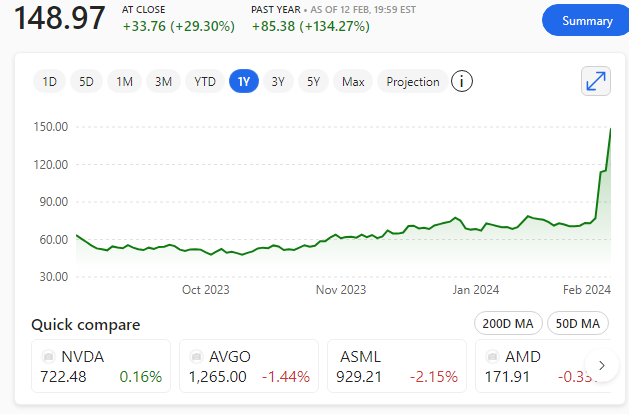
Arm is now up 93% since it reported quarterly figures on 8th February 2024. There is no obvious reason for the 29% climb on Monday. The fear of missing out (FOMO) could be playing a part in the meteoric share price move.
The stock has almost tripled since Arm’s initial public offering in September 2023, closing at $148.97 and is now worth almost $153 billion, that’s a little more than $30 billion below Intel’s market cap.
Arm 1 year chart showing huge gain in February 2024
Arm 1 year chart showing huge gain in February 2024
AI demand fuels Arm’s success
Last week, Arm said it could double the price for its latest instruction set, which accounts for 15% of the company’s royalties, suggesting it can expand its margin and make more money off new chips. It also said it was breaking into new markets, such as cloud servers and automotive, due to AI demand.
Its royalty strength combined with Arm’s optimistic growth forecast has made the company the latest AI darling among investors, despite a higher earnings multiple than Nvidia or AMD.
U.S. microchip giant Advanced Micro Devices (AMD) is investing in AI PCs to take on the likes of Nvidia and Intel and Arm as the AI race gains momentum.
As the AI market expands so too will AI powered personal computer (PC). These are personal computers embedded with processors specifically designed to perform AI functions such as real-time language translation. Intel has already announced its AI powered chip for the PC.
Tech research firm Canalys in a December report said the boom in generative AI is expected to boost PC sales as consumers are seeking devices with AI features, predicting that 60% of the PCs shipped in 2027 will be AI-capable.
AI tech interest explodes
An explosion of interest in AI was sparked by the launch of ChatGPT in November 2022 as the chatbot went viral for its ability to generate human-like responses to users’ prompts.
Microsoft was quick to adopt the Technolgy and incorporate AI into its Bing search engine. Other companies such as Amazon, Alphabet (Google), Arm, Meta, Tesla and Apple are all heavily involved in AI development too.
Intel’s new chip will go head-to-head with Nvidia and AMD
Intel unveiled new computer microchips on Thursday 14th December 2023, including Gaudi3, a chip for generative AI software.
Intel also announced Core Ultra chips, designed for Windows laptops and PCs, and new fifth-generation Xeon server chips. Intel’s server and PC processors include specialized AI parts called NPUs that can be used to run AI programs faster.
AI race
AI models, like OpenAI’s ChatGPT, run on Nvidia GPUs in the cloud. It’s one reason Nvidia stock has been up nearly 230% year to date while Intel shares have risen 68%. And it’s why companies like AMD and, now Intel, have announced chips that they hope will attract AI companies away from Nvidia’s dominant position in the market.
Gaudi3 will compete with Nvidia’s H100, the main choice among companies that build huge factories of the chips to power AI applications, and AMD’s forthcoming MI300X, when it starts shipping to customers in 2024.
CEO Gelsinger
‘We’ve been seeing the excitement with generative AI, the star of the show for 2023,’ Intel CEO Pat Gelsinger reportedly said at a launch event in New York where he announced Gaudi3 along other chips focused on AI applications.
Intel upping the anti with its Gaudi AI chip. The AI PC to become the new AI start of 2024 and beyond!
‘We think the AI PC will be the star of the show for the upcoming year,’ Gelsinger added. And that’s where Intel’s new Core Ultra processors, also announced on Thursday, will come into play.
Reports suggest as much as $3 trillion is waiting on the sidelines to be invested in tech’.
AI FOMO
The reasoning is that AI is driving a fear of missing out (FOMO). We could very well be experiencing the fourth industrial revolution right now, and it is AI-driven. Strategically, companies can’t just sit around and wait. There’s a window where if they don’t join in or realise the potential and grab the opportunity, they’ll miss out.
IPO’s
Three of the biggest initial public offerings (IPO) in the tech’ sector in nearly two years raised some $6 billion collectively in less than a week. Nvidia has attracted much attention with the AI driven interest it has created recently.
While a handful of tech IPOs and one big acquisition wouldn’t have been much cause for celebration in previous years, they are a welcome return after the drought of pandemic-era hit investment.
The IPO market for tech was effectively shut down until Arm Holdings, Instacart and Klaviyo opened the investors door again. Merger activity such as that driven by Microsoft Corp., OpenAI ChatGPT and Activision Blizzard Inc. is helping to lift up the appetitie for investment again. And it’s pretty much AI induced.
Money ready to go
Some analysts suggest there is $3 trillion sitting on the sidelines ready to invest, mostly held by Big Tech and private equity companies. The fascination with artificial intelligence (AI) and fear of missing out (FOMO) will create massive AI led tech investing opportunities. Everyone will want a slice of this cake.
This could very well be the biggest transformational spending wave that we’ve seen in years and certainly since the internet arrived in 1995.
Just look out for that ‘bubble’ again – it will pop! But much money will be made before that happens and then again after.
Masayoshi Son says AI to surpass human intelligence and that SoftBank will ‘rule the world’. Oh dear…!
Main points in brief
Masayoshi Son reportedly said AI is capable of helping solve the world’s biggest problems and could potentially surpass the intelligence of humans.
He said he was a ‘big believer’ in AI and that Arm, a chip design company owned by Softbank, was a ‘core’ beneficiary of the AI revolution.
He said AI would supercharge human ability and that Softbank would ‘rule the world’ and win the latest generative-AI race thanks to its heavy investment in startups and its majority stake in Arm.
He also acknowledged that AI posed some threats to humanity if mishandled and that society should regulate it to protect humankind.
Masayoshi Son and SoftBank
The 66-year-old founded SoftBank, which still controls about 90% of Arm Holdings after the IPO, back in 1981 after graduating from the University of California, Berkeley. Forbes estimates his net worth at more than $24 billion, making him the world’s 69th richest person.
Son made his early reputation as an investor in Japan’s mobile phone industry, and went on to become one of the first backers of Yahoo as well as Alibaba. Son continues to serve as the chairman of Arm’s board of directors.
AI does pose some threats to humanity if mishandled, Son said, likening its potential misuse to the dangers of speeding, or drinking alcohol while driving a car. But, more positively, AI can also help solve key world problems like diseases or help mitigate or recover from natural disasters, he reportedly said.
‘AI, society should regulate to protect humankind’, Son said. ‘However, it has more merit than the demerits. So, I think I’m a believer. I’m optimistic that AI is going to solve the issues that mankind couldn’t solve in the past‘.
Investors gobbled up UK microchip designer Arm Holdings at its U.S. debut on the Nasdaq on 14th September 2023, sending its market value soaring to $60 billion (£48.3 billion).
The shares ended the day worth more than $63 each, after climbing by almost 25% from the high end start of $51 per share set by Arm.
The sale was the biggest initial public offering of the year, raising $4.87 billion for owner Softbank Group.
Despite some concerns surrounding the company’s exposure to risks in China and a potential AI slowdown – the shares soared.
British tech
A star of the British technology industry, Arm designs microchips for devices including smartphones and game consoles. It estimates that some 70% of the world’s population uses products that rely on its chips, including nearly all of the world’s smartphones. And with AI nestling in on the horizon, the future potential for Arm is massive.
Arm stock chart 14th September 2023
Arm said it expects the total market for its chip designs to be worth about $250 billion by 2025, including new growth areas such as data centres and cars.
Legacy
Many of Arm’s royalties come from products released decades ago. About half of the company’s royalty revenue of $1.68 billion in 2022, came from products released between 1990 and 2012.
Bright Future
The future looks bright for Arm but the company is trading at more than 25 times its most recent full year of revenue, and at more than 100 times profit.
And that could be where things get tricky for Arm in the not too distant future. Projections for future profits will be interesting, esecially if it’s to keep up with Nvidia for instance.
Chip design firm Arm on 5th September 2023 submitted an updated filing for its upcoming initial public offering on the New York Stock Exchange, setting a price range between $47 and $51. Only 9.4% of Arm’s shares will be freely traded on the NYSE.
Arm was previously listed in London and New York, before SoftBank acquired it for $32 billion in 2016.
Chip design firm Arm on Tuesday is looking to acquire as much as $4.87 billion in its upcoming initial public offering on the New York Stock Exchange, according to the new filing.
The deal could value the company at as much as $52 billion
As a British company, Arm qualifies as a foreign private issuer in the U.S. and its shares will count as American depositary shares, or ADS’s. It is reported that the company will list some 95.5 million ADS’s at a price range of between $47 and $51. At the upper end of that range it is estimated that Arm will likely raise up to $4.87 billion. At the lower end, the IPO would fetch $4.49 billion of fresh capital for Arm. It could do even better.
Institutional funds
When the company floats in New York, it will look to enjoy a very deep pool of professional institutional funds. Arm seeks to ramp up its investments in research and development, particularly as it pursues growth in the artificial intelligence (AI) space with some of its newer chips. The company recently released new chips specifically targeted at AI and machine learning use cases.
Arm seeks up to $52 billion valuation in U.S. IPO
Upper end
At the upper end of the pricing range, Arm would also touch a total valuation of $52 billion or more. Only 9.4% of Arm’s shares will be freely traded on the New York Stock Exchange, with SoftBank expected to own roughly 90.6% of the company’s outstanding shares after the completion of the IPO.
Arm’s listing is set to be the biggest technology IPO of the year. Investors are hoping that the listing could breathe new life into an IPO market that has been ‘slack’ since 2022.
250 billion chips globally
Arm says its energy-efficient processor designs and software platforms are integrated into more than 250 billion chips globally, into products ranging from sensors and smartphones to supercomputers.
The company estimates it enjoys approximately 48.9% share of the market for semiconductor design. Other players, such as Intel and AMD, have raced to catch up on designing their own chip architectures, but have struggled so far.
U.K. misses out… again
The U.K. government had originally hoped Arm would list on the London Stock Exchange, but the company instead dealt a major blow to Britain’s ambitions to become the leading global tech hub by opting for New York. The U.S. financial center has a deep institutional investor base and analysts who have a close understanding of the technology sector.
BIG interest
Chip design firm Arm said in a Tuesday filing that Apple, Google parent Alphabet, Nvidia and other technology companies are interested in buying up to $735 million in its shares as it seeks to go public on Nasdaq.
The investments might not happen, but the fact that these companies are considering them underlines the importance of Arm, whose designs are used for processors in data center servers, consumer devices and industrial products.
Arm chip – some 250 billion chips globally
Chip makers Intel, Samsung and TSMC are interested in investing alongside the three trillion-dollar technology companies, along with AMD and MediaTek, which make chip designs based on Arm architectures. Cadence Design Systems and Synopsys, which make electronic design automation software for processor development, have also expressed interest, according to a revised prospectus for Arm’s shares sale. This IPO could easily be the biggest of the 2023!
As part of the deal, Arm could wind up with a $52 billion market capitalization and almost $5 billion in new cash.
This is likely to be the biggest IPO of 2023
It is estimated that there will be about 19 billion devices using the Arm processor in the world by the end of 2023.
Arm target
The market share of Arm across different technology markets worldwide, which was 90% for mobile application processors, 34% for embedded computing, and 5% for data center and cloud in 2019.
Arm has a target of increasing its market share to more than 90%, 50%, and 25% respectively by 2028.
Arm is a British semiconductor and software design company that is known for its Arm processors, which are widely used in smartphones, tablets, laptops, and other devices. Arm was founded in 1990 as a joint venture between Acorn Computers, Apple Computer, and VLSI Technology. The company was originally called Advanced RISC Machines, but later changed its name to Arm Ltd in 1998.
In 1985, the first Arm silicon chip was created by Acorn engineers Sophie Wilson and Steve Furber, who designed a 32-bit processor with a simple and elegant instruction set.
In 1990, Arm was spun off from Acorn as a separate company, with Apple as a major investor. Arm’s first product was the ARM6 processor, which was used in Apple’s Newton personal digital assistant.
Impression of the Apple Newton PDA device
In 1993, Arm introduced the ARM7 processor, which became one of the most successful embedded processors in history. It was used in devices such as the Nokia 6110 mobile phone, the Nintendo Game Boy Advance, and the Lego Mindstorms robotics kit.
In 1994, Arm launched the ARM9 processor family, which offered higher performance and lower power consumption than previous generations. The ARM9 was used in devices such as the Sony PlayStation Portable, the Palm Treo smartphone, and the Amazon Kindle e-reader.
In 1997, Arm introduced the ARM10 processor family, which featured a superscalar architecture and a floating-point unit. The ARM10 was used in devices such as the Apple iPod, the Samsung Galaxy S smartphone, and the Raspberry Pi computer.
In 1998, Arm changed its name from Advanced RISC Machines to Arm Ltd, reflecting its global expansion and recognition.
In 1999, Arm launched the ARM11 processor family, which featured a vector floating-point unit and a TrustZone security extension. The ARM11 was used in devices such as the iPhone 3G, the Nintendo DS, and the Raspberry Pi Zero.
In 2000, Arm became a public company, listing on the London Stock Exchange and the Nasdaq. The company raised £213 million in its initial public offering.
In 2001, Arm introduced the Cortex processor family, which offered a range of performance, power, and cost options for different applications. The Cortex processors are used in devices such as the Samsung Galaxy S10, the Apple Watch, and the Tesla Model 3.
In 2005, Arm acquired Artisan Components, a provider of physical intellectual property (IP) for chip design. This enabled Arm to offer a complete solution for system-on-chip (SoC) development.
In 2006, Arm announced the Mali graphics processing unit (GPU) family, which complemented its CPU offerings with high-performance graphics capabilities. The Mali GPUs are used in devices such as the Huawei Mate 20 Pro, the Oculus Quest, and the Samsung Smart TV.
Artistic image of ARM chip
In 2009, Arm partnered with IBM, Samsung, Texas Instruments, and others to form the Linaro consortium, which aimed to improve the Linux software ecosystem for Arm-based devices.
In 2010, Arm unveiled the Cortex-A15 processor, which was the first Arm processor to support virtualization and big.LITTLE technology. The Cortex-A15 was used in devices such as the Google Nexus 10, the LG G3, and the Nintendo Switch.
In 2011, Arm announced the Cortex-M0+ processor, which was the world’s most energy-efficient microcontroller. The Cortex-M0+ was used in devices such as the Arduino Nano 33 IoT, the Fitbit Flex 2, and the Nest Thermostat.
In 2012, Arm launched the Cortex-A53 and Cortex-A57 processors, which were the first Arm processors to support the 64-bit ARMv8 architecture. The Cortex-A53 and Cortex-A57 were used in devices such as the iPhone 6s, the Samsung Galaxy S6 Edge+, and the Microsoft Surface Pro X.
In 2013, Arm acquired Geomerics, a developer of real-time lighting technology for video games. This enhanced Arm’s graphics portfolio with dynamic illumination and global illumination effects.
In 2014, Arm introduced the Cortex-A72 processor, which delivered a 50% performance improvement over the previous generation. The Cortex-A72 was used in devices such as the Huawei P9, the Xiaomi Mi 5s Plus, and the Amazon Fire HD 10.
In 2015, Arm announced the Cortex-A35 processor, which was the most efficient Arm processor for smartphones and tablets. The Cortex-A35 was used in devices such as the Nokia 2.1, the Samsung Galaxy J2 Core, and the Lenovo Tab M7.
In 2016, Arm was acquired by SoftBank Group for £24.3 billion, becoming a subsidiary of the Japanese conglomerate. The deal was motivated by SoftBank’s vision of investing in technologies that would drive the future of artificial intelligence (AI), internet of things (IoT), and smart cities.
In 2017, Arm launched Project Trillium, a suite of machine learning (ML) solutions that included an ML processor , an object detection processor , and an open-source software framework. The Project Trillium products aimed to enable low-power and high-performance ML applications on edge devices.
In 2018, Arm unveiled the Cortex-A76 processor , which offered a 35% performance boost over its predecessor. The Cortex-A76 was used in devices such as the OnePlus 7T, the Huawei MateBook D14, and the Acer Chromebook Spin 13.
In 2019, Arm announced the Cortex-A77 processor , which improved on its predecessor with a higher clock speed, a larger cache, and better branch prediction . The Cortex-A77 was used in devices such as the Samsung Galaxy S20, the Asus ROG Phone II, and the Lenovo Yoga C940.
In 2020, Arm introduced the Cortex-X1 processor , which was its most powerful CPU design to date. The Cortex-X1 was designed to deliver peak performance for premium device , such as flagship smartphones, laptops and gaming consoles. The Cortex-X1 was used in devices such as the Samsung Galaxy S21 Ultra, the Xiaomi Mi 11, and the Google Pixel 6.
In 2021, Arm launched the Cortex-A78C processor , which was optimized for high-performance computing (HPC) applications. The Cortex-A78C featured up to eight CPU cores , a larger L3 cache, and support for ECC memory. The Cortex-A78C was used in devices such as the Samsung Galaxy Book Pro, the HP Elite Folio , and the Acer Chromebook Spin 513.
Microchip
In 2022, Arm unveiled the Cortex-A710 processor, which was its first big core to support the Armv9 architecture. The Cortex-A710 offered a 30% energy efficiency improvement over its predecessor, as well as enhanced security and ML features. The Cortex-A710 was used in devices such as the OnePlus 10 Pro, the Huawei MatePad Pro 2, and the Microsoft Surface Laptop Studio.
In 2023, Arm announced the Immortalis GPU family , which was its next-generation graphics solution that included hardware-based ray-tracing and variable rate shading capabilities . The Immortalis GPUs aimed to deliver realistic and immersive graphics for gaming, VR and AR applications on mobile devices . The Immortalis GPUs were used in devices such as the Samsung Galaxy S22 Ultra , the Sony Xperia 1 IV, and the Oculus Quest 3.
Powerful world presence
Arm is a leading semiconductor and software design company that has revolutionized the computing industry with its innovative and efficient processor architectures. Arm’s processors power billions of devices across various domains, such as mobile, IoT, AI, HPC, and gaming. Arm has been at the forefront of technological advancements for over three decades, delivering performance, energy efficiency, and security to its customers and partners.
Arm is a subsidiary of SoftBank Group and has a massive global presence.
British microchip designing giant Arm has announced that it has filed paperwork to sell its shares in the U.S.
The Cambridge-based company, which designs chips for devices from smartphones to game consoles, plans to list on New York’s Nasdaq in September. The highly anticipated IPO in the U.S. comes after UK Prime Minister, failed to convince Arm to float in London or pursue a dual UK-U.S. listing.
Arm’s decision to list in New York rather than London has fuelled fears that the City is losing its competitiveness to Wall Street, where valuations are typically higher. SoftBank-owned chip designer Arm on 21st August 2023 disclosed a modest 1% fall in annual revenue as it made public the paperwork for a U.S. listing that is expected to be the year’s biggest initial public offering. The company is reportedly looking for a valuation of between $60bn (£47bn) to $70bn.
Arm was bought in 2016 by Japanese conglomerate Softbank in a deal worth £23.4bn. Prior to the takeover, it was listed in both London and New York for 18 years.
Companies that use ARM processors in their products
Some of the companies that use ARM processors include Apple, Qualcomm, Samsung, Broadcom, and Fujitsu. ARM technology is used in a wide range of devices, from smartphones to game consoles to supercomputers.
ARM
Arm is a British semiconductor and software design company that is known for its Arm processors, which are widely used in smartphones, tablets, laptops, and other devices. Arm was founded in 1990 as a joint venture between Acorn Computers, Apple Computer, and VLSI Technology. The company was originally called Advanced RISC Machines, but later changed its name to Arm Ltd in 1998.