On 5th July 2024, Japan’s benchmark Nikkei 225 index climbed above 41,000 before retreating from its record close of 40,913.65.
The Nikkei 225 serves as a crucial barometer for the Japanese stock market, representing the performance of prominent companies on the Tokyo Stock Exchange. It continues to stand at historically elevated levels.
Nikkei one year chart closes at 40912 after passing 41000 for the first time
Nikkei one year chart closes at 40912 after passing 41000 for the first time
The S&P 500 reached new heights in a shortened trading session on Wednesday 3rd July 2024, with investors seemingly dismissing lacklustre economic data.
The S&P 500 closed at a new high of 5537, while the Nasdaq Composite finished the session at 18188, buoyed by rallies in technology and AI stocks like Tesla and Nvidia. Both indices reached new all-time highs during the session and closed at record levels.
The Dow Jones Industrial Average lost just closed down at 39308.
Trading volume was subdued as the New York Stock Exchange closed early at 1 p.m. ET. The exchange will remain closed on Thursday 4th July 2024 for Independence Day celebrations.
S&P 500: One-year chart – index closed at a new record high
S&P 500 One-year chart closed at new record high
Nasdaq Composite: One-year chart closed at new record high
Nasdaq Composite: One-year chart closed at new record high
On 2nd July 2024, the S&P 500 reached a significant milestone, closing above 5500 for the first time in its history.
This impressive achievement has prolonged the blistering rally of 2024, during which the index has reached 32 record highs. Since July 2023, the S&P 500 index has surged by more than 1000 points.
The rise in U.S. equities has been propelled by robust corporate earnings, the artificial intelligence (AI) boom, and the anticipation of interest rate reductions. Although some analysts warn that the market might be stretched too far, others are forecasting additional increases.
Many analysts have now raised their target for the S&P 500 to end the year at around 5700.
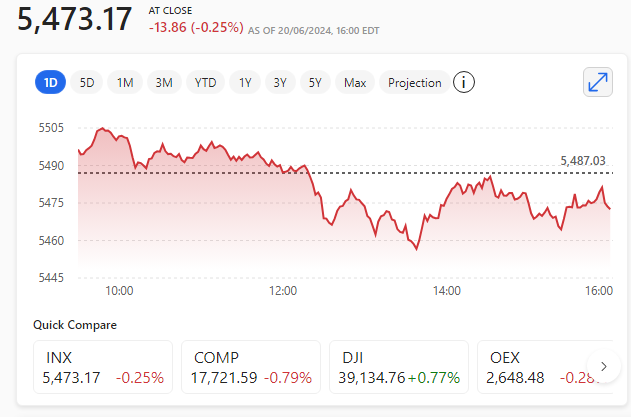
The S&P 500 retreated on Thursday 20th June 2024, having momentarily surpassed the 5500 for the first time ever, as Nvidia, a favourite stock with Wall Street investors, relinquished its earlier gains.
The S&P 500 index fell 0.25% to end at 5473. Earlier in the session, the S&P 500 gained around 0.34% to hit a new all-time high.
S&P 500 one day chart 20th June 2024
S&P 500 one day chart 20th June 2024
The Nasdaq Composite dropped 0.79% to finish at 17721. The Dow Jones Industrial Average (Dow) jumped around 299 points, to close at 39134.
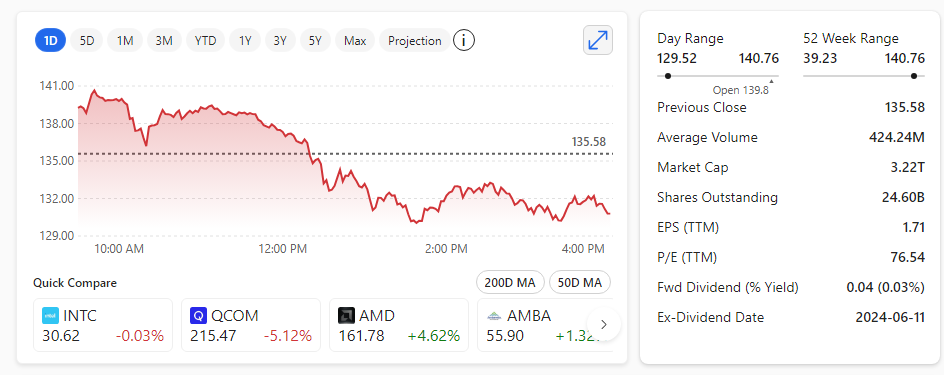
Nvidia lost ground and handed the Market Cap crown back to Microsoft after briefly enjoying the accolade for just 2 days. At one point, Nvidia trimmed around $240 billion off its Market Cap as investors took profits.
Will Nvidia regain the crown in the coming weeks? Probably.
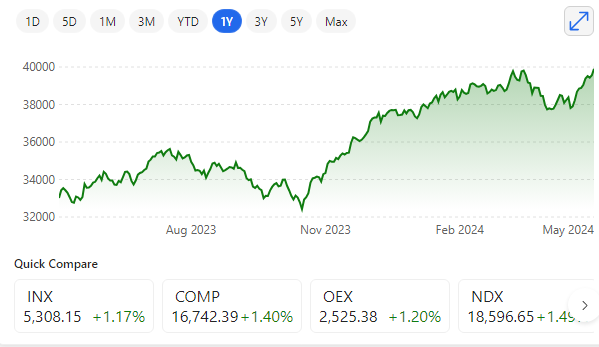
The Dow Jones Industrial Average marked a historic achievement by closing above 40,000 points for the first time. On Friday 17th May 2024, the index increased by 134.21 points to settle at 40,003.59.
Concurrently, the S&P 500 saw a modest rise, while the Nasdaq Composite closed lower. The rise this week has shifted the three major stock indexes into the green for the second quarter, following a challenging start.
Despite some investors’ concerns about the sustainability of the rally, the mix of economic expansion and slowing inflation continues to act as a positive driver.
It’s an optimistic setup for the near future in 2024
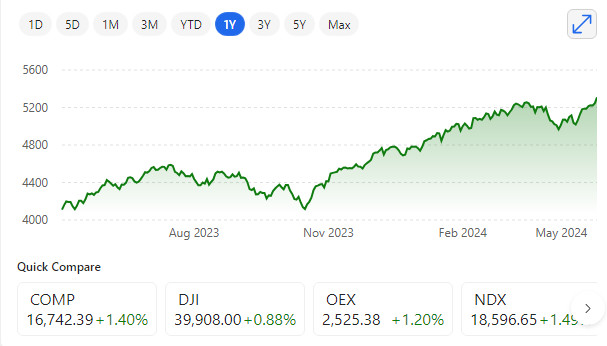
All three major indices closed at records on 15th May 2024
The Dow climbed 0.88%, while the S&P 500 gained 1.17%, ending the session above 5,300 for the first time. The tech-related Nasdaq Composite closed higher by 1.40%.
The index continues its march breaking all-time records on its way
The index continues on its march breaking all-time records on its journey
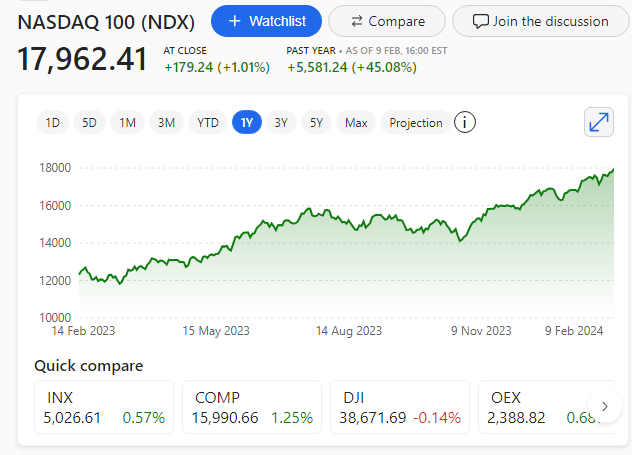
Nasdaq 100 climbs to new record 9th February 2024
A solid earnings season, easing inflation data and a resilient economy have charged 2024′s market rally. It has helped propel the Nasdaq 100 to close at these new highs!
We are enjoying good news at an economic and earnings level, and the market is reacting positively. The longer the good news story plays out, the more likely it will be that the market will hold from here.
FOMO or the fear of missing out is likely playing its part here too.
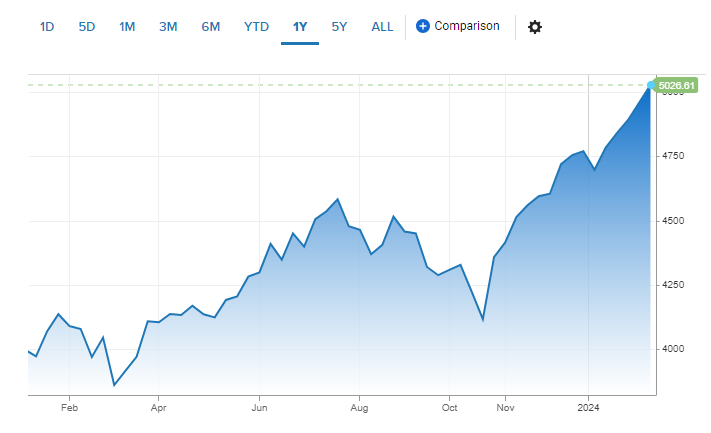
The S&P 500 climbed to a new all-time high of 5026 on 9th February 2024
Stocks rose on Friday 9th February 2024 after December’s revised inflation reading came in lower than first reported, and the S&P 500 closed above the key 5,000 level as strong earnings and economic news came in.
A solid earnings season, easing inflation data and a resilient economy have charged 2024′s market rally. It propelled the S&P 500 to close above the 5,000 level after first touching the milestone during the trading week. The index first crossed 4,000 in April 2021.
We are enjoying good news at an economic and earnings level, and the market is reacting positively. The longer the good news story plays out, the more likely it will be that the market will hold from here.
But it won’t take much to spoil the party, right now I don’t know what that might be…?
S&P 500 1-year chart 9th February 2024 – new all-time high of 5026
S&P 500 1 year chart 9th February 2024 – new all-time high of 5026
FOMO or the fear of missing out is likely playing its part here too.
The S&P 500 climbed again Wednesday 7th February 2024 and edged ever closer to the 5,000 level.
S&P 500 hit a new high of 4995
S&P 500 hit a new high of 4995 on 7th February 2024
The index, which first breached the 4,000 level in April 2021, added around 0.82% to close at 4,995.06. During session highs, the S&P hit 4,999.89. Quarterly results signalled a thriving U.S. economy.
The Nasdaq 100 jumped to a new high of 15,755
The Nasdaq 100 jumped to a new high of 15,755 on 7th February 2024
The Dow Jones Industrial Average rallied 156 points to close at 38,677 and an all-time high
DJIA closes at new high of 38677on 7th February 2024
Euphoric
Are investors getting swept away with the latest wave of AI related tech results? Quite possibly, as some of what we’re seeing could be based on FOMO (fear of missing out) as traders/investors don’t want to be left behind like they were last year.
However, one undeniable fact is that the U.S. economy isn’t facing as recession any time soon as predicted by many.