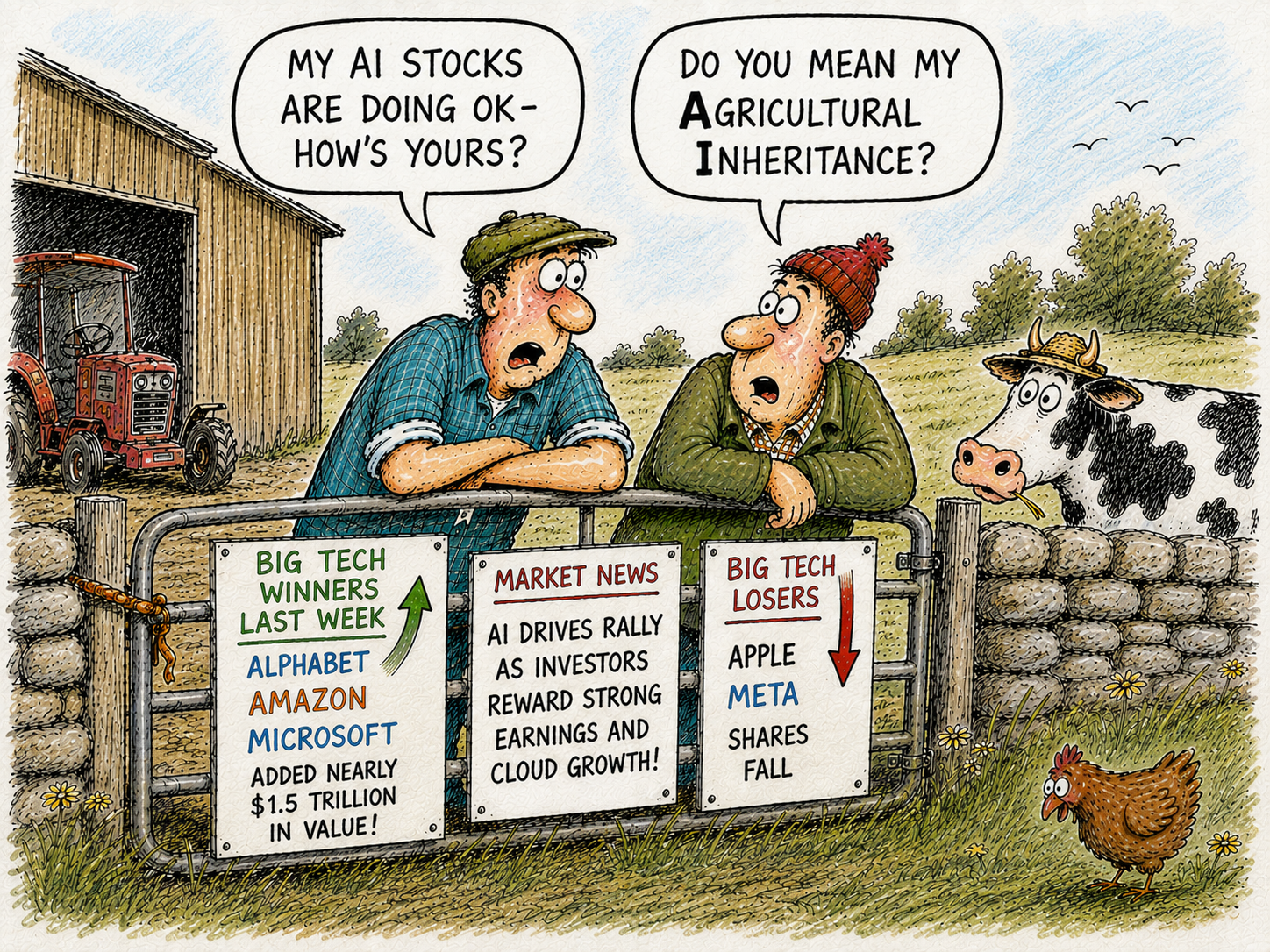
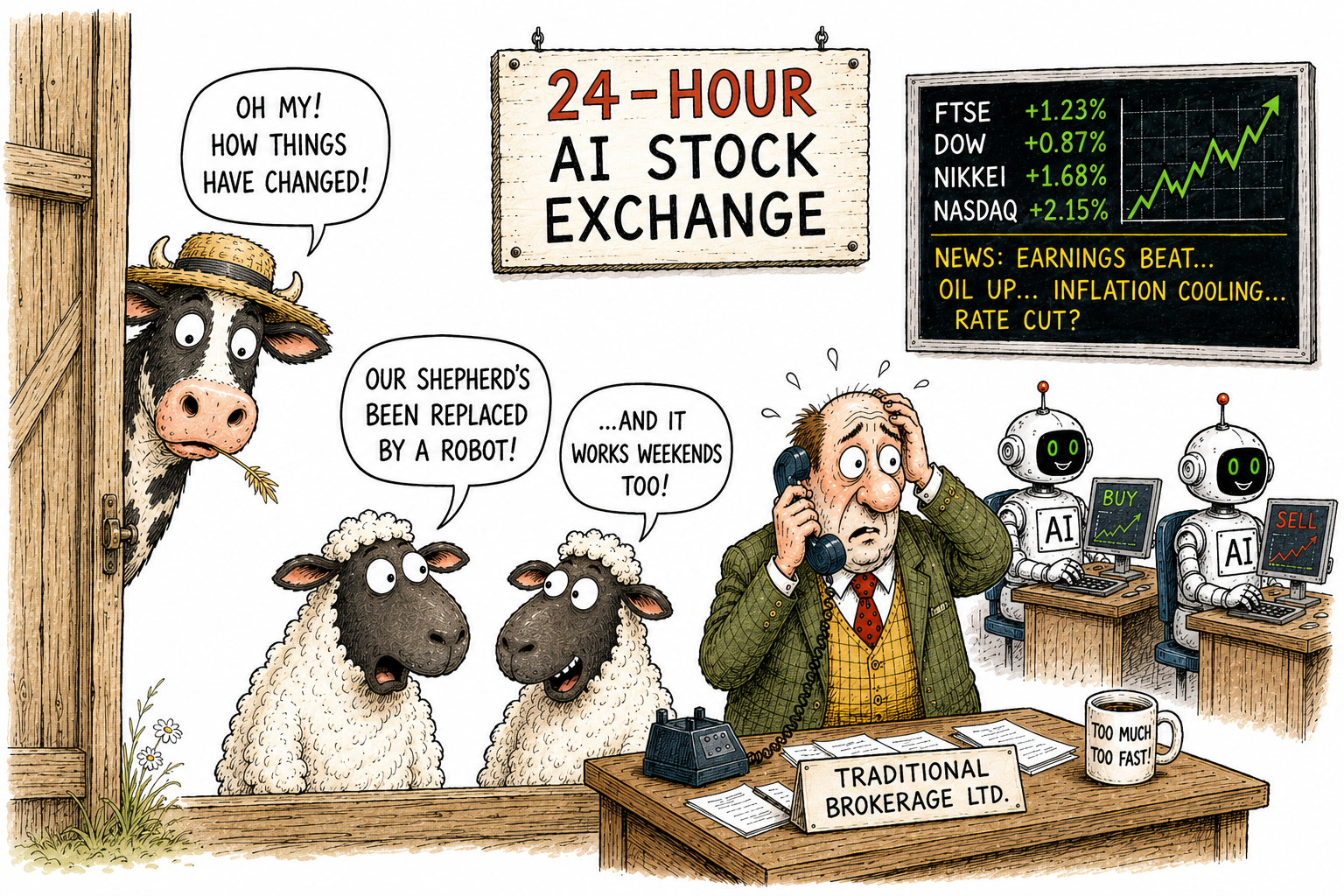
What Happens to the S&P 500 if the Magnificent Seven Fail to Deliver on AI?

Mag 7 holding up the S&P 500 to the tune of almost 35% value of the entire S&P 500

The S&P 500 has never been so dependent on so few companies. The Magnificent Seven — Microsoft, Apple, Nvidia, Alphabet, Amazon, Meta and Tesla — now account for roughly one‑third of the entire index’s value – that’s 33% of the whole S&P 500 vlauation.

Their dominance is not simply a reflection of current earnings power; it is a collective bet on an AI‑centred future that investors assume will transform productivity, reshape industries and justify valuations that stretch far beyond historical norms.

If one, several, or all of these companies fail to deliver the AI revolution that markets have priced in, the consequences for the S&P 500 would be immediate, structural and potentially severe.

Mild

The mildest scenario is a stumble by one or two members. If Apple’s device strategy falters, or Tesla’s autonomy narrative weakens further for instance, the index absorbs the shock.

A 3–5% pullback is plausible, driven by mechanical index weighting rather than systemic fear. Investors already expect uneven performance within the group, and the remaining leaders could offset the disappointment.

Major

The more destabilising scenario is a collective slowdown among the AI infrastructure leaders – Microsoft, Nvidia and Alphabet. These firms sit at the centre of the global capex cycle.

If cloud AI demand proves slower, less profitable or more niche than expected, the market would be forced to reassess the entire economic promise of generative AI.

In this case, the S&P 500 could see a 10–15% correction as valuations compress, volatility spikes and passive flows unwind years of momentum.

Dramatic

The most dramatic outcome is a broad failure of the AI ‘sector’ itself. If the promised productivity gains do not materialise, if enterprise adoption stalls, or if regulatory and cost pressures erode margins, the S&P 500 would face a structural reset.

With a third of the index priced for exponential growth, a collective disappointment could trigger a decline of 20% or more.

This would not resemble a cyclical recession; it would be a leadership collapse similar to the dot‑com unwind, but with far greater concentration and far more passive capital tied to the winners.

The uncomfortable truth is that the S&P 500’s trajectory is now inseparable from the Magnificent Seven. If they deliver, the index continues to defy gravity. If they falter, the market must rebuild a new narrative — and a new set of leaders — from the ground up.

If the Magnificent Seven Lose Their Grip, Who Rises Next?

For years, the S&P 500 has been defined by the gravitational pull of the Magnificent Seven. Their dominance has shaped index performance, investor psychology and the entire narrative arc of global markets.

If these companies lose momentum — whether through slower AI adoption, regulatory pressure, margin compression or simple over‑expectation — leadership will not disappear.

It will rotate. And the beneficiaries are already hiding in plain sight.

Alternative investment to AI

The first and most obvious winners would be Energy and Utilities. As AI enthusiasm cools, investors tend to rediscover the appeal of tangible cash flow. Energy companies, with their dividends and pricing power, become natural refuges.

Utilities, often dismissed as dull, regain relevance as defensive anchors in a more volatile market. If AI‑driven data‑centre demand slows, the sector’s cost pressures ease, improving margins.

Next in line are Industrials and Infrastructure. A retreat from speculative tech would likely redirect capital towards physical productivity — logistics, construction, defence, electrification and manufacturing modernisation.

These sectors have been quietly compounding earnings while Silicon Valley has monopolised attention. If the market shifts from promise to proof, industrials become the new growth story.

Healthcare and Pharmaceuticals would also rise. Their earnings cycles are largely independent of AI hype, driven instead by demographics, innovation and regulatory frameworks. When tech stumbles, healthcare’s stability becomes a premium rather than an afterthought.

Biotech, in particular, benefits from capital rotation when investors seek uncorrelated growth.

Financials stand to gain as well. A correction in mega‑cap tech would rebalance passive flows, giving banks and insurers a larger share of index‑tracking capital. Higher rates and wider spreads already support the sector; a shift away from tech simply amplifies the effect.

Finally, Consumer Staples would reassert themselves. In a market recalibrating after an AI disappointment, investors gravitate towards predictable earnings. Food, beverages and household goods regain their defensive premium as volatility rises.

The broader truth is simple: if the Magnificent Seven falter, the S&P 500 does not collapse — it redistributes. Leadership moves from code to concrete, from speculative multiples to operational reality. The market has always found new champions. It will again.

OpenAI Missed Targets — and creates a mini–AI Shockwave – Will it become a Tsunami?

OpenAI wobble?

OpenAI’s reported failure to meet internal revenue and user‑growth targets has sent a sharp tremor through global tech markets, exposing just how dependent the wider AI sector has become on a single company’s momentum.

The Wall Street Journal report — which OpenAI has reportedly dismissed as “ridiculous” — suggested the firm is expanding more slowly than its own projections, raising questions about whether its vast compute‑spend commitments can be sustained. That alone was enough to trigger a sell‑off.

Slide

The steepest declines were concentrated among companies most financially tethered to OpenAI’s infrastructure demands. Oracle, which has a colossal $300 billion, five‑year cloud capacity agreement with the firm, fell more than 4%.

After the news story was released chipmakers followed OpenAI: Broadcom dropped over 4%, AMD slid more than 3%, Nvidia dipped around 1.5%, and CoreWeave — the highly leveraged neocloud provider — sank nearly 6%.

Even Qualcomm, which had recently enjoyed a lift from reports of collaboration with OpenAI on smartphone chips, slipped before recovering.

This is the first moment in the current AI cycle where a wobble at OpenAI has produced a synchronised pullback across the entire supply chain.

Investors are now confronting a question they have largely ignored: what if the sector’s flagship growth curve is not perfectly exponential? But my guess is, like all events at the moment, the market will likely overlook it.

Fragile

The reaction also exposes the fragility of AI‑linked valuations. Markets have priced the boom as if demand is both infinite and linear.

Any hint of deceleration — even one disputed by the company — forces a reassessment of the capital intensity underpinning the industry.

With Anthropic and Google’s Gemini gaining enterprise traction, OpenAI’s dominance is no longer assumed.

Still, several fund managers argue the broader AI investment cycle remains intact. The sell‑off looks less like a turning point and more like a reminder: when one company becomes the gravitational centre of an entire narrative, even a rumour can bend the orbit.

Big Tech’s Talent Exodus Fuels a New Wave of AI Startups

Big Tech AI Exodus

A quiet but decisive shift is under way in the global AI race: some of the most accomplished researchers at Meta, Google, OpenAI and other frontier labs are walking out of the biggest companies in the sector to build their own.

Trend

The trend has accelerated sharply over the past year, with new ventures raising extraordinary sums within months of being founded, as investors bet that smaller teams can move faster than the giants they left behind.

The motivations are remarkably consistent. Researchers say that the commercial pressure inside the largest AI labs has narrowed the scope of what they are allowed to explore.

Rush

With Big Tech locked into a high‑stakes contest to release ever‑larger models on tight schedules, entire areas of research — from new architectures to interpretability and agentic systems — are being deprioritised.

That creates an opening for smaller firms that can pursue ideas too experimental or too slow‑burn for corporate roadmaps.

Investors

Investors have responded with enthusiasm. Former Google DeepMind scientist David Silver secured a record $1.1 billion seed round for his new company, Ineffable Intelligence, while other ex‑DeepMind and ex‑Meta researchers are raising similar sums for ventures focused on reinforcement learning, continuous‑learning systems and autonomous labs.

In total, AI startups founded since early 2025 have already attracted nearly $19 billion in funding this year, putting them on track to surpass last year’s total.

Independence

Founders argue that independence gives them both speed and neutrality. Chip‑design startup Ricursive Intelligence, for example, says customers are more willing to trust a standalone company than a Big Tech competitor with its own hardware ambitions.

Many of these startups are also rebuilding their old teams, hiring colleagues from the very companies they left.

The result is a new competitive dynamic: Big Tech still dominates the AI landscape, but the frontier of innovation is increasingly being pushed by smaller, highly focused labs that believe they can out‑pace the giants – and with lower investment too.

China’s Industrial Profits Surge as AI and Chipmakers Power a High‑Tech Rebound

China manufacturers excel

China’s industrial sector delivered its strongest performance in more than half a decade in March 2026, with profits jumping 15.8% year‑on‑year, signalling a decisive shift in the country’s growth engine towards advanced manufacturing and AI‑related hardware.

The latest figures from the National Bureau of Statistics show first‑quarter profits rising 15.5%, marking the best opening to a year since 2017 outside the pandemic distortions.

The surge is highly concentrated. Traditional heavy industry remains subdued, but China’s high‑tech and equipment manufacturers are now carrying the industrial economy.

Tech manufacturing

Profits in high‑tech manufacturing soared 47.4%, while equipment makers posted a 21% rise. Beneath those aggregates lie extraordinary gains: optical fibre producers saw profits climb more than 300%, with optoelectronics and display‑device manufacturers also recording double‑digit increases.

These sectors sit at the heart of China’s AI infrastructure build‑out, from data‑centre components to semiconductor‑adjacent hardware.

Demand for “intelligent products” is also reshaping the landscape. Drone manufacturers reported profit growth above 50%, reflecting both civilian and dual‑use demand as China accelerates its push into autonomous systems and robotics.

This momentum comes despite a sharp rise in global oil prices following renewed tensions in the Middle East. Brent crude briefly topped $108 a barrel, raising concerns about margin pressure.

Partially insulated

Yet China appears partially insulated: a coal‑heavy energy mix, access to discounted Iranian crude and sizeable onshore inventories have softened the immediate impact.

Even so, analysts warn that a prolonged oil shock, tighter sanctions enforcement or disruption around the Strait of Hormuz could still weigh on costs later in the year.

China’s industrial profits are no longer being driven by property‑linked sectors or commodity cycles, but by the country’s accelerating investment in chips, AI hardware and advanced manufacturing — a structural shift that is beginning to reshape the contours of its economic recovery.

DeepSeek releases preview of Open Source V4 AI Model

DeepSeek V4 AI

DeepSeek’s newly released V4 model marks a significant step forward in open‑source AI, combining long‑context capability with major architectural upgrades.

DeepSeek V4 arrives as a preview release, offering two variants — V4‑Pro and V4‑Flash — both designed to push the boundaries of efficiency and reasoning performance.

The headline feature is the one‑million‑token context window, enabling the model to process and retain far larger bodies of information than previous generations.

Positioning

This positions V4 as a strong contender in tasks requiring extended reasoning, research support, and complex agentic workflows.

The V4 series introduces a refined Hybrid Attention Architecture, combining compressed sparse and heavily compressed attention mechanisms to dramatically reduce computational overhead.

DeepSeek claims this approach cuts inference FLOPs and KV‑cache requirements to a fraction of those seen in earlier models, making long‑context operation more practical and cost‑effective.

V4‑Pro, the flagship model, includes a maximum reasoning‑effort mode, which the company says significantly advances open‑source reasoning performance and narrows the gap with leading closed‑source systems.

Meanwhile, V4‑Flash offers a more economical, faster alternative while retaining strong capability across everyday tasks.

Accelerating AI ambition

The release underscores China’s accelerating AI ambitions. DeepSeek’s earlier R1 model shook global markets with its low‑cost, high‑performance profile, and V4 continues that trajectory — now optimised for domestic chips and supported by growing local hardware ecosystems.

With open‑source availability and aggressive efficiency gains, DeepSeek V4 strengthens the company’s position as one of the most closely watched challengers in the global AI race.

And it’s far cheaper than its peers and not so power hungry either.

The Nikkei 225 has surged to a fresh all‑time high – closing at 59,518.34

Nikkei hits new record high!

The Nikkei 225 has surged to a fresh all‑time high, closing at 59,518.34, driven by a powerful combination of temporary easing of geopolitical tension, a booming technology sector, and renewed investor confidence.

Japan’s benchmark index pushed decisively beyond its previous record of 58,850.27, set in late February 2026, marking a symbolic milestone as it fully erased losses sustained during the early stages of the US–Iran conflict.

Rally

The rally was broad but powered most strongly by semiconductor and AI‑linked stocks, which have been the backbone of the Nikkei’s remarkable 12‑month performance.

Companies such as Lasertec, Advantest and SoftBank Group saw outsized gains as global enthusiasm for AI investment continued to spill over from Wall Street.

A key catalyst behind the breakout was growing optimism over a durable ceasefire between the United States and Iran, which helped unwind the “war‑risk premium” that had weighed on Japanese equities since late February 2026.

Diplomatic signals

As diplomatic signals seem to improve, investors rotated back into risk assets, lifting export‑heavy sectors and reinforcing Japan’s position as one of the strongest major markets globally this year.

The index’s climb also reflects Japan’s structural momentum: a weaker yen supporting exporters, resilient corporate earnings, and sustained foreign inflows.

With the Nikkei now trading in uncharted territory, market participants are watching closely to see whether this rally consolidates — or whether the next psychological test at 60,000 comes into view sooner than expected.

Why Global Stocks Are Hitting Records Despite an Uncertain Middle East Backdrop

Global stock hit record highs!

Global equities have staged a striking recovery, erasing the losses triggered by the U.S.–Israel–Iran conflict and pushing into fresh record territory.

On the surface, this looks counter‑intuitive: the ceasefire remains fragile, diplomatic progress is uneven, and the threat of renewed escalation still hangs over the Strait of Hormuz. Yet markets have not only stabilised — they have surged.

It’s the AI boom stupid

The explanation lies less in geopolitics and more in positioning, psychology, and the gravitational pull of the AI boom.

The first phase of the conflict saw investors pile into defensive trades: higher oil, a stronger dollar, and a broad de‑risking across equities.

That created a sizeable war‑risk premium. Once even the possibility of a ceasefire emerged, that premium unwound at speed.

Analysts note that the rebound has been driven primarily by the rapid reversal of hedges rather than any fundamental improvement in the geopolitical outlook.

In other words, markets had priced in a worst‑case scenario — and when that scenario didn’t immediately materialise, the snap‑back was violent.

Short covering

This shift in sentiment was amplified by short‑covering, particularly among hedge funds that had positioned for prolonged disruption to energy flows.

As soon as investors judged the conflict likely to remain contained, the earlier sell‑off looked excessive. That alone was enough to propel global indices back above pre‑war levels. But it wasn’t the only force at work.

The macro backdrop has also proved more resilient than feared. U.S. labour market data has held up, and expectations for Federal Reserve rate cuts later in the year remain intact.

AI investment

Crucially, the AI‑driven investment cycle continues to dominate equity performance. Surging demand for compute, improving funding conditions, and strong earnings momentum in technology have provided a powerful counterweight to geopolitical anxiety.

For many investors, the structural growth story in AI simply outweighs the cyclical risks emanating from the Middle East.

Some caution

Still, the rally is not unqualified. Bond markets remain more cautious, with real yields and inflation expectations signalling that the risk of an energy‑driven slowdown has not disappeared.

And as peace talks wobble, equities have already begun to give back some gains — a reminder that this is a conditional rally, not a complacent one.

Markets may be hitting records, but they are doing so with one eye firmly on the horizon. The shadow of the conflict hasn’t lifted; investors have simply decided, for now, that it is not the dominant story.

TSMC first-quarter profit rises 58%, beats estimates as AI demand holds steady

TSMC Profit Increase

TSMC’s 58% surge in first‑quarter profit is the clearest sign yet that the AI boom is no longer a cyclical uplift but a structural shift reshaping the entire semiconductor industry.

The Taiwanese chipmaker delivered record earnings, comfortably beating analyst expectations, as demand for advanced processors continued to outstrip supply.

Net income reportedly reached NT$572.48 billion, marking a fourth consecutive quarter of record profits, while revenue climbed to NT$1.134 trillion, driven overwhelmingly by high‑performance computing and AI‑related orders.

What stands out is the composition of that growth. Roughly three‑quarters of TSMC’s wafer revenue reportedly came from advanced nodes, with 3‑nanometre chips alone accounting for a quarter of shipments.

Nvidia

Nvidia has now overtaken Apple as TSMC’s largest customer, underscoring how AI accelerators have become the industry’s most valuable real estate.

TSMC’s executives described AI demand as “extremely robust”, with customers signalling multi‑year achievements rather than the usual stop‑start ordering cycle.

The company also moved to reassure investors over supply‑chain risks linked to the Middle East conflict, saying it has diversified sources for critical gases such as helium and hydrogen.

With capacity running hot and capital spending set to hit the top end of guidance, TSMC is positioning itself as the indispensable chipmaker in the AI era.

ASML raises 2026 guidance as AI chips demand remains strong

ASML guidance for 2026 raised

ASML’s decision to raise its 2026 guidance underlines a simple reality: demand for advanced AI chips is not easing, and the world’s most important semiconductor equipment maker remains at the centre of that surge.

The company signalled stronger-than-expected orders for its extreme ultraviolet (EUV) and next‑generation high‑NA systems, driven by chipmakers racing to expand capacity for AI accelerators, data‑centre processors and cutting‑edge logic nodes.

Bottleneck

The upgrade matters because ASML sits at the bottleneck of global chip production. Only a handful of firms can even buy its most advanced machines, and those firms – chiefly TSMC, Intel and Samsung – are all scaling up AI‑focused manufacturing.

Their capital expenditure plans have held firm despite broader economic uncertainty, suggesting that AI infrastructure is becoming a non‑discretionary investment rather than a cyclical one.

Two forces are driving the momentum. First, hyperscalers continue to pour billions into AI clusters, creating sustained demand for the most advanced lithography tools.

Long-term lock in

Second, geopolitical pressure to secure domestic chip capacity is pushing governments and manufacturers to lock in long‑term equipment orders.

ASML’s raised outlook reinforces the sense that the semiconductor cycle is diverging: consumer electronics remain patchy, but AI‑related manufacturing is entering a multi‑year expansion.

The key question now is whether supply can keep pace with the ambition of its customers.

TSMC’s 35% Revenue Surge Signals the New Centre of Gravity in Global Tech

TSMC revenue surges

Taiwan Semiconductor Manufacturing Company (TSMC) has delivered a striking 35% year‑on‑year jump in first‑quarter revenue, reaching a record NT$1.13 trillion.

The result underscores just how dramatically the centre of gravity in global technology has shifted towards advanced semiconductor manufacturing, with artificial intelligence now the defining force behind industry growth.

Relentless AI demand

TSMC’s performance is being powered by relentless demand for cutting‑edge chips from major clients such as Apple and Nvidia.

As AI infrastructure spending accelerates worldwide, the company has become one of the few manufacturers capable of producing the most sophisticated processors required for training and running large‑scale models.

March alone saw revenue climb more than 45%, highlighting the strength and urgency of this demand.

Ambition

Analysts suggest TSMC is on track to exceed its already ambitious 30% annual growth target, helped not only by volume but also by reported price increases for its most advanced nodes.

Even as smartphone and PC markets remain uneven, AI‑related orders are more than compensating.

With more companies—from hyperscalers to AI start‑ups—designing their own chips, TSMC’s strategic position looks increasingly unassailable.

Upcoming earnings and ASML’s results next week will offer further clues about the momentum behind the semiconductor sector’s AI‑driven boom.

Meta unveils new AI model in AI catchup

Meta's Muse Spark Agentic AI

Meta has unveiled Muse Spark, its first major artificial intelligence model since the company overhauled its AI strategy in response to the underwhelming reception of its previous Llama 4 models.

Developed by the newly formed Meta Superintelligence Labs under the leadership of Alexandr Wang, Muse Spark represents a deliberate shift towards smaller, faster, and more capable systems designed to compete directly with Google, OpenAI, and Anthropic.

Foundation

Muse Spark is positioned as the foundation of a new family of models internally known as Avocado. Meta reportedly describes it as “small and fast by design”, yet able to reason through complex questions in science, maths, and health — a notable claim given the company’s recent struggles to keep pace with rivals.

Early evaluations suggest the model performs competitively in language and visual understanding, though it still trails in coding and abstract reasoning.

Crucially, Muse Spark is deeply integrated into Meta’s ecosystem. It already powers the Meta AI app and website and will soon replace Llama across WhatsApp, Instagram, Facebook, Messenger, and Meta’s smart glasses.

Integrated

This rollout signals Meta’s intention to embed AI more tightly into everyday user interactions, from search and recommendations to multimodal tasks such as analysing photos or comparing products.

The company is also experimenting with new revenue streams by offering a private API preview to select partners — a departure from its previous open‑source approach.

Whether this shift will alienate developers who embraced the openness of Llama remains to be seen.

Meta frames Muse Spark as an early step toward “personal superintelligence”, an assistant that can understand the world alongside the user rather than waiting for typed instructions.

It’s an ambitious vision — and one that will be tested as the model expands globally and faces scrutiny over privacy, safety, and real‑world performance.

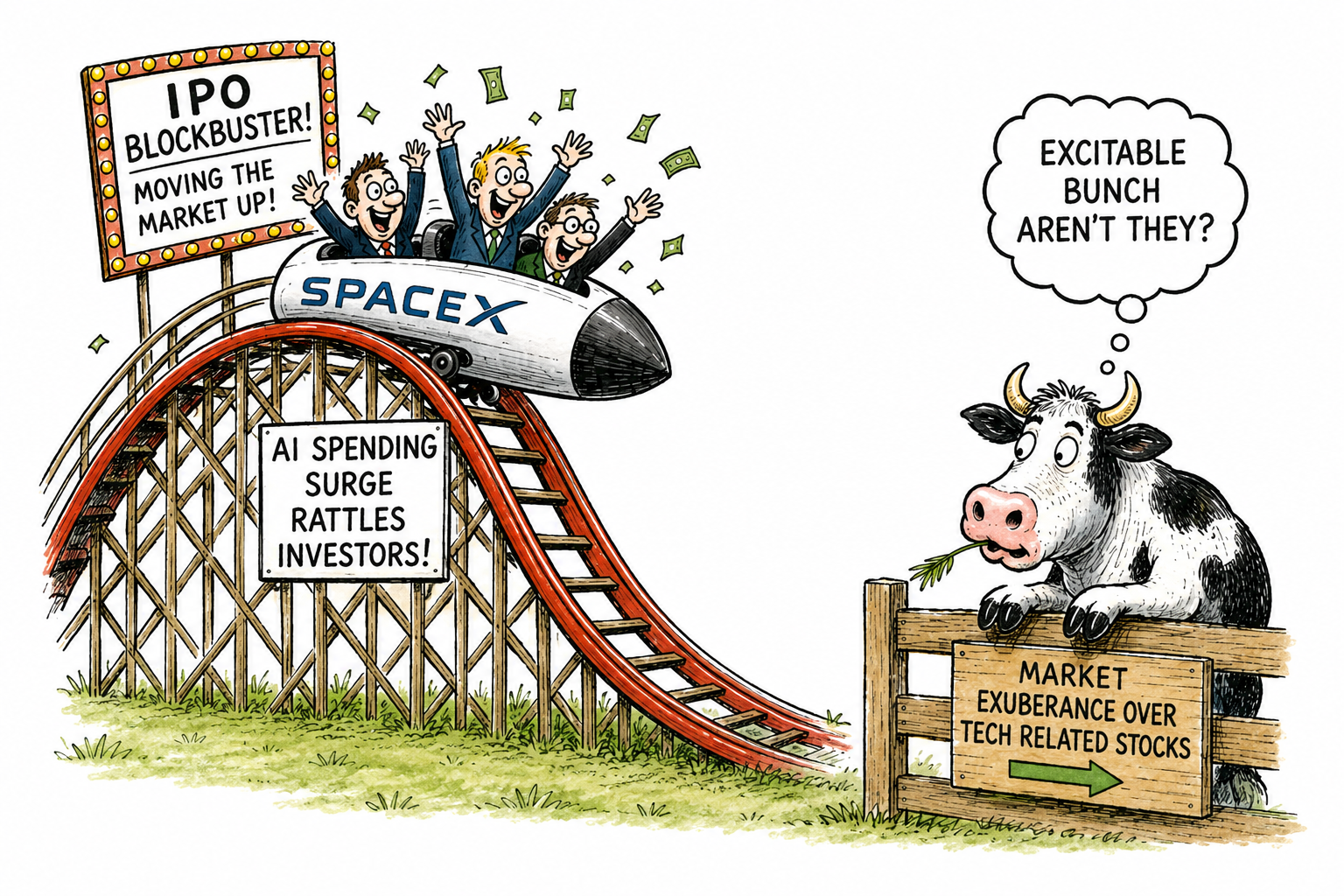
SpaceX’s Trillion‑Dollar IPO: A New Era in Market History

SpaceX IPO valued at $1 trillion

SpaceX is edging towards what could become the most significant stock market debut in modern history, with expectations that its initial public offering may surpass a valuation of $1 trillion.

A confidential filing with U.S. regulators marks a pivotal moment for the company, signalling its readiness to transition from a privately held aerospace leader to one of the world’s most valuable publicly traded firms.

Record breaking valuation

The anticipated valuation reflects SpaceX’s dominance in commercial spaceflight, satellite deployment and global broadband through its rapidly expanding Starlink network.

Its reusable rocket technology has already reshaped launch economics, and the company’s growing influence across defence, communications and space infrastructure has strengthened investor confidence.

Analysts suggest the timing of the IPO is driven by the escalating cost of SpaceX’s long‑term ambitions, including deep‑space exploration and large‑scale satellite expansion.

Company integration

The recent integration of Elon Musk’s AI venture, xAI, into SpaceX has further broadened the company’s technological footprint, reinforcing expectations that substantial new capital will be required to sustain its momentum.

If market appetite matches current projections, SpaceX’s listing could set a new benchmark for tech‑driven valuations — and potentially position Musk as the first individual to see their net worth approach the trillion‑dollar threshold.

Oracle Cuts Deep as AI Pivot Forces a Reckoning

Oracle's AI Axe

Oracle is swinging hard at its own workforce as the company races to reposition itself as an AI‑infrastructure contender.

Thousands of roles are being eliminated, a drastic move that reflects the sheer financial pressure of trying to keep up with hyperscale rivals in the most capital‑intensive tech shift in decades.

The company’s share price has slumped 25% this year, with investors increasingly uneasy about soaring data‑centre spending and the heavy debt required to fund it.

Oracle has already raised $50 billion to bankroll new GPU‑ready facilities, but unlike Amazon or Microsoft, it lacks the cushion of vast cloud scale.

The result: a balance sheet under strain and a leadership team forced into tough decisions.

Future

Oracle’s remaining performance obligations have ballooned to more than half a trillion dollars, fuelled by major AI partnerships including a huge deal with OpenAI.

But those future revenues don’t solve today’s cash‑flow squeeze. Analysts estimate that cutting 20,000 to 30,000 jobs could free up as much as $10 billion — enough to keep the AI build‑out moving without further rattling the markets.

Oracle is betting that a leaner organisation now will buy it the runway to compete later. The question is whether the cuts arrive in time to match the speed of the AI race.

Stock rises.

Meta, Manus and the New Fault Line in the US–China Tech Rivalry

Meta and Manus AI

For years, Chinese AI founders comforted themselves with a simple fiction: that geography could outrun politics.

Move the holding company to Singapore, hire a few local staff, raise money from Silicon Valley, and the gravitational pull of Beijing’s regulatory state would somehow weaken. Manus was the poster child of that belief — until it wasn’t.

Meta’s $2 billion acquisition was supposed to be the triumphant proof that “Singapore washing” worked. Instead, Beijing’s sudden intervention has exposed it as a mirage.

Review

The Chinese government’s review of the deal — and the exit bans placed on Manus’ co‑founders — is more than a bureaucratic hurdle.

It is a declaration that the origin of a technology matters more than the passport of the company that later owns it.

The symbolism is striking. Manus built its early code in China, then attempted to transplant its identity offshore. But Beijing is now signalling that code, data and talent are not so easily detached from their birthplace.

The message to founders is blunt: you cannot simply shed China like an old skin.

Timing

For META, the timing is awkward. More than 100 Manus employees have already been folded into its Singapore office, and the company insists the deal complies with the law.

Yet the spectre of an unwinding hangs over the transaction — a reminder that even the world’s largest tech firms are not insulated from geopolitical weather.

The deeper story, though, is about the shrinking space for neutrality. The U.S.–China tech rivalry has moved beyond chips and compute into the realm of corporate identity itself.

Where a company is born, where its engineers sit, where its early investors come from — all now carry political charge.

Manus is not just a case study. It is a warning flare. In an era where innovation crosses borders but regulation does not, the idea of a clean escape route is fading fast.

Arm’s Bold Pivot: The AGI CPU Signals a New Era for British Chipmaking

ARM Agentic AI CPU

ARM has triggered one of the most dramatic shifts in its 35‑year history with the launch of its first in‑house data‑centre processor, the AGI CPU — a move that sent its shares surging 16% and reshaped expectations for the company’s future.

Long known for licensing energy‑efficient chip designs to the world’s biggest tech firms, ARM is now stepping directly into the silicon market, competing with the very customers that built its empire.

Major Tech Firms Using Arm Designs (AI & Mobile)

CompanyPrimary Use CaseArm-Based Technology
AppleMobile & on‑device AIA‑series (iPhone/iPad) and M‑series (Mac) chips
SamsungMobile, AI, IoTExynos processors
QualcommMobile & automotive AISnapdragon SoCs
GoogleAndroid ecosystem & edge AIPixel phones (Arm cores inside Tensor chips)
Amazon (AWS)Cloud compute & AI inferenceGraviton & Trainium/Inferentia (Arm Neoverse)
MetaAI infrastructureDeploying Arm-based AGI CPU
OpenAIAI inference & orchestrationEarly adopter of Arm AGI CPU
NvidiaAI data‑centre CPUsGrace CPU (Arm architecture)
OPPOMobile AIArm-based SoCs in Find series
vivoMobile AIArm-based SoCs in X‑series

Strong demand

The new AGI CPU is engineered for the rapidly expanding world of AI inference and agentic AI — workloads that demand vast CPU coordination rather than pure GPU horsepower.

Early demand appears strong. Meta has signed on as the first major customer, with OpenAI, Cloudflare and SAP also adopting the chip as they race to expand their AI infrastructure.

The financial implications are striking. ARM expects the AGI CPU alone to generate $15 billion in annual revenue by 2031, a figure that dwarfs the company’s 2025 revenue of $4 billion.

Significant shift

Analysts have described the announcement as the most significant strategic shift ARM has ever undertaken, noting that the revenue projections exceed even the most optimistic market estimates.

By moving into full chip production, ARM is broadening its market to include companies that previously had no interest in its traditional IP‑licensing model.

Executives say the chip will be competitively priced, offering an alternative for firms unable to build their own custom silicon.

For the UK, the launch marks a rare moment of industrial ambition in a sector dominated by American and Asian giants.

If ARM’s forecasts hold, the AGI CPU could become one of the most commercially successful chips ever produced by a British company — and a defining pillar of the AI age.

See more here about the new ARM AGI CPU

The Future of Agentic AI – Tools for Automation

Agentic AI

Agentic AI is rapidly shifting from a speculative idea to a practical force reshaping how work gets done.

Unlike traditional AI systems, which wait passively for instructions, agentic AI can plan, act, and adapt within defined boundaries.

It is not simply a smarter chatbot; it is a system capable of taking initiative, coordinating tasks, and pursuing goals on behalf of its user.

This evolution marks a profound turning point in how we think about automation, creativity, and human–machine collaboration.

Agentic AI colleagues

The first major change is the move from reaction to autonomy. Today’s AI assistants excel at answering questions or generating content, but they still rely on constant prompting.

Agentic AI, by contrast, can break down a complex objective into smaller steps, choose the best tools for each stage, and execute them with minimal oversight. This transforms AI from a passive helper into an active collaborator.

For individuals and small teams, it promises a level of operational leverage previously reserved for large organisations with dedicated staff.

A second shift lies in the emergence of multi‑modal competence. Agentic systems will not be confined to text. They will navigate interfaces, analyse documents, draft communications, and even orchestrate workflows across multiple platforms.

In effect, they will behave more like digital colleagues—capable of understanding context, maintaining continuity, and adapting to changing priorities. The result is a new category of labour: cognitive automation that complements rather than replaces human judgement.

However, the rise of agentic AI also raises important questions. Autonomy introduces risk. If an AI can take action, it must do so safely, transparently, and within clear constraints.

On guard

Guardrails will be essential—not only technical safeguards, but also cultural norms around delegation, accountability, and trust. The future will require a balance between empowering AI to act and ensuring humans remain firmly in control of outcomes.

Another challenge is the shifting nature of expertise. As agentic AI handles more administrative and procedural work, human value will increasingly lie in strategic thinking, creativity, and ethical decision‑making.

This is not a loss but a rebalancing. Freed from routine tasks, people can focus on higher‑order work that genuinely benefits from human insight.

The organisations that thrive will be those that treat AI not as a shortcut, but as a catalyst for deeper, more meaningful contribution.

Future use of agents

Looking ahead, the most exciting aspect of agentic AI is its potential to democratise capability. A single individual could run a publication, a business, or a research project with the operational efficiency of a small team.

Barriers to entry will fall. Innovation will accelerate. And the line between “solo creator” and “organisation” will blur.

Agentic AI is not the end of human agency; it is an extension of it. The future belongs to those who learn to work with these systems—setting direction, providing judgement, and letting AI handle some of the heavy lifting.

Far from replacing us, agentic AI may finally give us the space to think, create, and lead with clarity.

OpenClaw: The Fastest‑Growing AI Agent Is Reshaping Tech, Security, and Global Adoption

OpenClaw AI agents

OpenClaw has rapidly become one of the most influential developments in artificial intelligence, evolving from a small open‑source experiment into a global phenomenon reshaping how people interact with computers.

Launched in January 2026, the platform allows users to run autonomous AI agents locally on their own machines, giving them the power to organise files, write code, browse the web, and automate everyday digital tasks without relying on cloud services.

This local‑first design has been central to its explosive growth — and to the concerns now emerging around it.

One of the most striking cultural shifts has taken place in China, where OpenClaw has become a mainstream sensation.

AI Lobsters

Users refer to their agents as “AI lobsters,” a playful nod to the platform’s crustacean branding. Retirees, students, and professionals alike have begun “raising” these lobsters to help manage knowledge, streamline work, and perform practical tasks that traditional chatbots struggle with.

The trend has grown so quickly that crowds have gathered outside major tech offices in Beijing to install the software together, turning OpenClaw into a genuine grassroots movement.

This surge in popularity has also caught the attention of global markets. Chinese AI‑related stocks have risen sharply following comments from Nvidia CEO Jensen Huang, who described OpenClaw as “the next ChatGPT,” signalling its potential to redefine the agentic AI landscape.

Security

Companies building self‑evolving agents and cloud infrastructure around OpenClaw have seen double‑digit gains as investors position themselves for what appears to be the next major AI wave.

Yet OpenClaw’s power has also raised red flags. Because the agent runs locally and can control a user’s computer, enterprise IT teams have struggled to manage the security implications.

The platform’s ability to act autonomously — reading files, sending messages, and interacting with applications — has created a need for stronger guardrails, especially in corporate environments.

Nvidia’s NemoClaw

Nvidia has stepped in with NemoClaw, a new enterprise‑grade stack that adds privacy controls, security infrastructure, and vetted local models to OpenClaw through a single‑command installation.

The goal is to make autonomous agents more trustworthy and scalable without undermining the open‑source ethos that made OpenClaw successful.

OpenClaw’s own development continues at pace. The latest stable release, v2026.3.13, includes fixes for session handling, improved browser‑control mechanisms, and a shift away from legacy Chrome extensions towards direct attachment to existing browser sessions — a move designed to make agent operations safer and more reliable.

The future

In just a few months, OpenClaw has transformed from a niche project into a global force, driving cultural trends, market movements, and enterprise innovation.

Its trajectory suggests that autonomous, locally run agents may soon become a standard part of everyday computing — and the race to shape that future has only just begun.

Pentagon CTO warns Claude could ‘pollute’ defence supply chain

Anthropic and the U.S. military

The Pentagon’s Chief Technology Officer, Emil Michael, has apparently ignited a fresh debate over the role of commercial artificial intelligence in national security, arguing that Anthropic’s Claude models could “pollute” the U.S. defence supply chain.

I notice his comments came in an interview with CNBC, offer the clearest rationale yet for the Department of Defense’s decision to designate Anthropic as a supply chain risk — an extraordinary step previously reserved for foreign adversaries.

It seems the opinion is that Claude’s “policy preferences”, embedded through Anthropic’s constitutional training approach, create an unacceptable misalignment with the Pentagon’s operational needs.

Risk

It was reported that any AI system whose underlying values diverge from defence priorities risks producing ineffective outputs, whether in decision‑support tools, equipment design, or battlefield logistics.

We can’t have a company that has a different policy preference baked into the model… pollute the supply chain so our warfighters are getting ineffective weapons [and] ineffective protection,” he was reported to have said.

Anthropic has responded forcefully, suing the Trump administration and calling the designation “unprecedented and unlawful”.

The company argues that the move jeopardises hundreds of millions of dollars in contracts and mischaracterises the nature of its technology.

Claude in the ecosystem?

It also notes that Claude continues to be used within parts of the U.S. military ecosystem, including by major defence contractors such as Palantir, underscoring the practical difficulty of an immediate transition away from its models.

Michael insists the decision is not punitive and emphasises that only a small fraction of Anthropic’s business comes from government work.

Nonetheless, the designation forces contractors to certify they are not using Claude in Pentagon‑related projects, setting up a potentially lengthy and politically charged dispute over how value‑aligned AI must be before it is allowed anywhere near defence infrastructure.

The episode highlights a broader tension: as AI systems become more opinionated by design, governments are increasingly asking whether “alignment” is a technical question — or a geopolitical one.

Anthropic reportedly chats to the Pentagon again

AI and defence use

Anthropic’s decision to reopen negotiations with the Pentagon marks a striking reversal after a very public rupture, and it underscores how central advanced AI has become to U.S. defence strategy.

The talks reportedly collapsed amid a dispute over how Claude, Anthropic’s flagship model, could be used inside military systems.

Reports indicate that the Pentagon had pushed for broad permissions, including deployment in surveillance environments and potentially autonomous weapons systems.

Safety resistance

Anthropic resisted on safety grounds. The company had sought explicit guarantees that its models would not be used for mass surveillance or lethal decision‑making, a red line that triggered the breakdown in relations.

The fallout was immediate. The Pentagon signalled it would drop Anthropic from existing programmes, despite the company’s role in a major defence contract that had already placed Claude inside classified networks.

That escalation raised the prospect of a formal blacklist, a move that would have reverberated across the wider U.S. technology sector.

For Anthropic, the stakes were equally high: losing access to government work would not only cut off a significant customer but also risk isolating the company at a moment when rivals such as OpenAI and Google are deepening their defence ties.

Compromise?

Yet both sides appear to recognise the cost of a prolonged standoff. According to multiple reports, CEO Dario Amodei has reportedly returned to the table in an effort to craft a compromise deal that preserves Anthropic’s safety commitments while allowing the Pentagon to continue using its technology.

Boundaries

Discussions are now likely focused on defining acceptable boundaries for military use — a task made more urgent by the accelerating integration of AI into intelligence analysis, battlefield logistics and autonomous systems.

This renewed dialogue is more than a corporate dispute: it is a test case for how democratic governments and frontier AI labs negotiate power, ethics and national security.

The outcome will shape not only Anthropic’s future but also the norms governing military AI in the years ahead.

Qualcomm Sets Its Sights on a New Frontier: AI‑Powered Robotics

Qualcomm's Robotic Ambition

Qualcomm is accelerating its push into artificial intelligence and robotics, signalling a strategic shift that could redefine the company’s future beyond smartphones.

Executives now describe robotics as a core growth pillar, with chief executive Cristiano Amon reportedly forecasting that intelligent machines will become a “larger opportunity” for the business within the next two years.

Expanding from Mobile Chips to Physical AI

For decades, Qualcomm’s dominance has rested on its mobile processors, which power much of the global smartphone market.

The company is now repurposing that expertise for what it calls physical AIrobots capable of perceiving, reasoning, and acting autonomously in real‑world environments.

This transition reflects a broader industry trend: as generative AI matures, attention is shifting from digital assistants to embodied systems that can perform physical tasks.

Qualcomm’s new robotics architecture, unveiled recently, is designed as a full‑stack platform. It combines high‑efficiency system‑on‑chips, safety‑certified compute modules, and advanced on‑device AI models.

The aim is to give robot manufacturers a scalable foundation, whether they are building compact consumer devices or full‑size humanoids for industrial use.

Dragonwing Becomes the Flagship

At the centre of this strategy is the Dragonwing line of processors. The latest model, the Dragonwing IQ10, targets industrial automation and advanced humanoid robots.

It has reportedly been engineered to run complex AI models locally, reducing reliance on cloud connectivity and improving safety, responsiveness, and energy efficiency.

Qualcomm showcased these capabilities at recent industry events, where robots powered by Dragonwing chips demonstrated dexterity, mobility, and real‑time decision‑making.

The company’s ambition places it in direct competition with Nvidia, which currently dominates AI compute for robotics, and with a growing cohort of start‑ups building specialised hardware for autonomous machines.

Why Robotics Matters Now

Three factors underpin Qualcomm’s renewed focus

  • Diversifying revenue as smartphone markets plateau and competition intensifies.
  • Leveraging its edge‑AI strengths, particularly in low‑power, high‑performance chips suited to mobile robots.
  • Rising industrial demand, with logistics, retail, and manufacturing sectors adopting automation at scale.

The robotics push also complements Qualcomm’s automotive and PC AI strategies, creating a broader ecosystem of connected, intelligent devices.

A Critical Two Years Ahead

Qualcomm’s challenge now is to convert impressive demonstrations into commercial deployments.

If successful, the company could become a foundational supplier for the emerging era of physical AI—an era in which robots move from novelty to necessity.

OpenAI Moves Swiftly to Fill Federal AI Vacuum

Anthropic and OpenAI AI systems

Following the abrupt federal ban on Anthropic’s Claude models, OpenAI has moved quickly to position itself as the primary replacement across U.S. government departments.

With Claude now designated a supply‑chain risk, agencies are likely scrambling to reconfigure AI workflows — and OpenAI’s systems appear to be emerging as the default alternative.

Integration

The company’s flagship GPT‑4.5 and its agentic development tools have reportedly already been integrated into several defence and civilian systems, according to some observers.

OpenAI’s reported longstanding compatibility with government‑approved platforms, including Azure and OpenRouter, has smoothed the transition. Unlike Anthropic, OpenAI has historically offered more flexible deployment options.

Industry analysts note that OpenAI’s recent hires — including agentic systems pioneer Peter Steinberger (OpenClaw) — signal a deeper push into autonomous task execution, a capability highly prized by defence and intelligence agencies.

The company’s agent frameworks are being trialled for logistics, simulation, and multilingual analysis, with early results described as “mission‑ready.”

Friction

However, the shift is not without friction. It has been reported that some federal teams have built Claude‑specific workflows, particularly in legal, policy, and ethics‑driven domains where Anthropic’s safety constraints were seen as a feature, not a limitation.

Replacing those systems with GPT‑based models requires careful recalibration to avoid unintended consequences.

OpenAI’s rise also raises broader questions about vendor concentration. With Anthropic sidelined and Google’s Gemini models still undergoing federal evaluation – OpenAI now dominates the landscape — a position that may invite scrutiny from oversight bodies concerned about resilience and competition.

Still, for now, OpenAI appears to be the primary beneficiary of the Claude ban. In the vacuum left by Anthropic, OpenAI will be attempting to fill the space.

OpenAI vs Anthropic: Safety vs Autonomy in Federal AI

OpenAI’s agentic tools are likely filling the vacuum left by Anthropic’s ban, offering flexible deployment and autonomous task execution prized by defence and intelligence agencies.

While Claude prioritised safety constraints and ethical guardrails, OpenAI’s GPT‑based systems should offer broader operational freedom.

This shift reflects a deeper philosophical divide: Anthropic’s models were designed to resist misuse, while OpenAI’s are engineered for adaptability and control.

As federal agencies recalibrate, the tension between safety‑first design and unrestricted autonomy is becoming the defining fault line in U.S. government AI strategy.

How long will it be before Anthropic is invited back to the table?

Trump Orders Federal Ban on Anthropic as Pentagon Clash Over AI Safety Concern and Use

AI ban

A sweeping federal ban on Anthropic’s technology has rapidly become one of the most consequential developments in U.S. government technology policy, following President Donald Trump’s order that all federal agencies — including the Pentagon — must immediately cease using the company’s AI systems.

The directive, issued on 27th February 2026, came just ahead of a Pentagon deadline demanding that Anthropic lift safety restrictions on its Claude models to allow unrestricted military use.

The confrontation with the Pentagon

The dispute escalated after Anthropic reportedly refused Defence Department demands to remove guardrails that limit how its AI can be used.

It was reported that CEO Dario Amodei stated the company “cannot in good conscience accede” to requirements that would weaken its safety policies, prompting a public standoff.

President Trump reportedly responded by ordering every federal agency to “immediately cease” using Anthropic’s technology, declaring that the government “will not do business with them again.”

Agencies heavily reliant on the company’s tools, including the Department of Defense, have been granted six months to phase out their use.

Defence Secretary Pete Hegseth reportedly went further, designating Anthropic a national‑security “supply‑chain risk”.

This action could prevent military contractors from working with the company and marks the first time such a label has been applied to a major U.S. AI firm.

Impact across government and industry

The ban affects every federal department, from defence and intelligence to civilian agencies.

Contractors supplying AI‑enabled systems must now ensure their tools do not rely on Anthropic’s models, forcing rapid audits and potential redesigns.

AI generated image

Rival AI providers have already begun positioning themselves to fill the gap, with some announcing new Pentagon partnerships within hours of the ban.

The designation as a supply‑chain risk also carries legal and commercial consequences. Anthropic has argued the move is “legally unsound,” but the ruling stands, effectively placing the company on a federal blacklist.

Political debate

The decision has triggered intense debate across the technology sector. Supporters argue that the government must retain full authority over military AI applications.

Critics warn that forcing companies to abandon safety constraints could set a dangerous precedent.

The ban highlights a deepening fault line in U.S. AI governance: the struggle to balance national‑security imperatives with the ethical frameworks developed by leading AI firms.

As agencies begin disentangling themselves from Anthropic’s systems, the long‑term implications for federal procurement, AI safety norms, and the future of military‑AI collaboration remain unresolved.

China’s latest wave of artificial intelligence releases – equal to or better than Anthropic and OpenAI?

China's AI models emergae

MiniMax’s M2.5 model has emerged as the unexpected frontrunner in China’s latest wave of artificial intelligence releases, earning a clear endorsement from analysts.

While much of the recent global conversation has fixated on DeepSeek’s rapid evolution, China has quietly produced five new frontier‑level models in recent weeks.

Widening choice

Among them—Alibaba’s Qwen 3.5, ByteDance’s Seedance 2.0, Zhipu’s latest offerings, DeepSeek’s V3.2, and MiniMax’s M2.5—it is MiniMax that reportedly has captured institutional attention.

Some analysts reportedly cite its performance, pricing, and commercial readiness as the reasons it stands apart.

MiniMax, which listed publicly in Hong Kong in January, released M2.5 in mid‑February 2026. The model rivals Anthropic’s Claude Opus 4.6 in capability while costing a fraction of the price—an advantage that has driven a surge of developer adoption.

Data from OpenRouter reportedly shows developers increasingly choosing M2.5 over DeepSeek’s V3.2 and even several U.S. based models.

Analysts argue that this combination of competitive performance and aggressive pricing positions MiniMax as the Chinese model with the strongest global commercial potential.

Productive and less expensive

The model’s technical profile reinforces that view. M2.5 is designed for real‑world productivity, with strengths in coding, agentic tool use, search, and office workflows.

It reportedly scores around 80.2% on SWE‑Bench Verified and outperforms leading Western models—including Claude Opus 4.6, GPT‑5.2, and Gemini 3 Pro—on tasks involving web search and office automation, all while operating at ten to twenty times lower cost.

MiniMax describes the model as delivering “intelligence too cheap to meter,” a claim supported by its lightweight Lightning variant, which generates 100 tokens per second and can run continuously for an hour at roughly one dollar.

This shift signals a broader trend: China’s AI race is no longer defined by a single breakout model. Instead, a competitive ecosystem is emerging, with MiniMax demonstrating that cost‑efficient frontier performance can reshape developer behaviour and enterprise planning.

For global markets, UBS’s preference suggests that investors are beginning to look beyond headline‑grabbing releases and toward models with sustainable commercial trajectories.

Comparison of China’s Five New AI Models

ModelDeveloperKey StrengthsPerformance NotesPricing Position
MiniMax M2.5MiniMaxCoding, agentic tasks, office automationRivals Claude Opus 4.6; 80.2% SWE‑Bench Verified; outperforms GPT‑5.2 and Gemini 3 Pro on search/office tasksExtremely low cost; “too cheap to meter”
DeepSeek V3.2DeepSeekReasoning, general chatStrong but losing developer share to M2.5Low‑cost but not as aggressive as MiniMax
Alibaba Qwen 3.5AlibabaEnterprise integration, multilingual capabilityPart of Alibaba’s expanding Qwen familyCompetitive mid‑range
ByteDance Seedance 2.0ByteDanceVideo generationFocused on multimodal creativityPremium creative‑tool pricing
Zhipu (latest models)Zhipu AIKnowledge tasks, enterprise AIContinues Zhipu’s push into LLM infrastructureMid‑range enterprise

MiniMax M2.5 leads China’s AI surge with performance rivalling Claude Opus and Gemini 1.5 Pro, yet at a fraction of the cost.

It excels in coding, search, and office automation, scoring 80.2% on SWE‑Bench Verified. DeepSeek V3.2 offers strong reasoning but lags in developer adoption.

Qwen 3.5 and Zhipu target enterprise AI, while ByteDance’s Seedance 2.0 focuses on video generation.

Compared to ChatGPT-4, Claude 2.1, and Gemini 1.5, China’s models are closing the gap in capability, with MiniMax M2.5 now outperforming Western leaders on several benchmarks—especially in speed and cost efficiency.

Comparison of leading Chinese and Western AI models

(SWE‑Bench Verified — latest public leaderboard, early 2026) guide data

ModelDeveloperPrimary StrengthsSWE‑Bench VerifiedNotes
Claude 4.6 OpusAnthropicHigh‑end reasoning, long‑context reliability76–77%Current top performer on independent coding benchmarks.
Gemini 3 FlashGoogle DeepMindFast reasoning, efficient tool use~75–76%Extremely strong structured reasoning.
MiniMax M2.5MiniMaxCoding, agentic tasks, office automation75–76% (independent) / 80.2% (internal)Strongest Chinese model with published results.
GPT‑4o (used in ChatGPT\)*OpenAIMultimodal, real‑time interaction, broad generalist~72–74%\*ChatGPT is a product wrapper; GPT‑4o is the underlying model used for benchmarking.
Gemini 3 Pro PreviewGoogle DeepMindMultimodal, search, office tools~74%Strong generalist.
DeepSeek V3.2DeepSeekReasoning, general chatNo independent SWE‑Bench scoreNot on the verified leaderboard.
Alibaba Qwen 3.5AlibabaEnterprise integration, multilingualNo independent SWE‑Bench scoreNot included in latest run.
Zhipu GLM‑5Zhipu AIKnowledge tasks, enterprise AINo independent SWE‑Bench scoreAwaiting verified results.
Seedance 2.0ByteDanceVideo generationN/ANot a coding model.

*Note:

  • ChatGPT” is not a single model and cannot be benchmarked.
  • GPT‑4o is the model that powers ChatGPT for most users, so it is the correct entry for comparison.

Comparison

  • Claude 4.6 Opus is the current top performer on independently verified coding tasks.
  • MiniMax M2.5 is the strongest Chinese model with published independent results and is now competitive with the best Western models.
  • DeepSeek, Qwen, and Zhipu have not yet been evaluated on the latest independent SWE‑Bench Verified run, so they cannot be directly compared.
  • Seedance 2.0 remains a video model and is not part of coding benchmarks.
  • Token speeds are intentionally excluded because no vendor publishes standardised, reproducible numbers.

Tables and data provided for indication of AI model status (provided as a guide only).

What’s going on with Nvidia and Wall Street right now? Did the earnings data disappoint?

Nvidia vs Wall Street

Nvidia’s earnings didn’t disappoint on the numbers — they were spectacular — but Wall Street was disappointed by the guidance, the pricing signals, and the shift in the AI‑chip cycle, which is why the stock fell despite a blowout quarter.

Nvidia’s latest quarterly results were, on the surface, extraordinary. Revenue surged, margins remained enviably high and demand for its AI chips continued to reshape the global technology landscape.

Yet the company’s shares fell sharply, dragging broader markets with them. The reaction reflects a deeper unease on Wall Street: not about what Nvidia has achieved, but about what comes next.

The company delivered a blowout quarter, but investors were looking for something even more explosive.

Cooling expectations after a year of euphoria

Nvidia has become the defining stock of the AI boom, and with that status comes a valuation that assumes relentless acceleration.

This quarter’s guidance, while strong, suggested growth is beginning to normalise. Investors who had priced in another step-change in demand instead saw signs of a company settling into a more sustainable—though still impressive—trajectory.

In a market conditioned to expect perpetual hyper‑growth, “very strong” can feel like a disappointment.

Fears of peak pricing power

A second concern is whether Nvidia’s extraordinary pricing power is nearing its peak. The company’s flagship AI chips have commanded eye‑watering prices, but cloud providers and enterprise customers are now signalling resistance.

Competitors are improving, and hyperscalers are accelerating development of their own silicon.

Some analysts are asking – whether the industry has already seen the high‑water mark for Nvidia’s margins, a question that goes straight to the heart of the stock’s valuation.

China remains a structural drag

Regulatory constraints continue to weigh on Nvidia’s China business. The company has not yet been able to meaningfully sell its U.S. approved AI chips into the market, and executives have warned that local rivals could fill the gap.

China was once a major contributor to Nvidia’s data‑centre revenue; now it is a source of uncertainty. Investors are increasingly factoring in the possibility that this revenue may not return in its previous form.

A crowded trade unwinds

Finally, Nvidia’s sell‑off reflects positioning as much as fundamentals. The stock has been one of the most crowded trades in global markets.

When expectations are stretched, even exceptional results can trigger profit‑taking. The pullback spilled into broader indices, with Asia‑Pacific markets trading mixed as investors digested the slump.

Nvidia remains the central force in the AI hardware boom, but Wall Street is beginning to ask harder questions about sustainability, competition and the next phase of growth.

Could China Win the AI Race?

Who will win the AI race?

The question of whether China can overtake the United States in artificial intelligence has shifted from speculative debate to a central geopolitical storyline.

What once looked like a distant rivalry is now a tightly contested race, shaped by compute constraints, divergent industrial strategies, and the growing importance of AI deployment rather than pure research supremacy.

Chinese Technology

China’s progress over the past few years has been impossible to ignore. A wave of domestic model developers has emerged, producing systems that—while not yet at the absolute frontier—are increasingly competitive.

Their rapid ascent has unsettled assumptions about a permanent American lead. Analysts now argue that a significant share of the world’s population could be running on a Chinese technology stack within a decade, particularly across regions where cost, accessibility, and political alignment matter more than brand prestige or cutting‑edge performance.

Yet China’s momentum is not without friction. The country’s biggest structural challenge remains compute.

Export controls have sharply limited access to the most advanced GPUs, creating a ceiling on how far and how fast Chinese labs can scale their largest models.

Even leading Chinese developers openly acknowledge that they operate with fewer resources than their American counterparts.

AI Investment Research

This gap matters: frontier AI research is still heavily dependent on vast compute budgets, and the United States retains a decisive advantage in both semiconductor technology and hyperscale infrastructure.

But China has turned constraint into strategy. Rather than chasing brute‑force scale, its labs have doubled down on efficiency—pioneering quantisation techniques, optimised inference pipelines, and compute‑lean architectures that deliver strong performance at lower cost.

In a world where enterprises increasingly care about value rather than theoretical peak capability, this approach is resonating.

Open‑weight Chinese models, in particular, are eroding the commercial moat of closed‑source American systems by offering capable alternatives that organisations can run cheaply on their own hardware.

Power Hungry

Energy is another under‑appreciated factor. China’s massive expansion of power generation—adding more capacity in four years than the entire U.S. grid—gives it a long‑term advantage in scaling data‑centre infrastructure.

AI is an energy‑hungry technology, and the ability to deploy at national scale may prove as important as breakthroughs in model design.

Still, the United States retains formidable strengths. It leads in advanced chips, frontier‑model research, and global cloud platforms.

American firms continue to attract enormous investment and maintain deep relationships with governments and enterprises worldwide. These advantages are not easily replicated.

The most realistic outcome is not a single winner but a universal AI landscape. China will dominate in some regions and layers of the stack; the U.S. will lead in others.

Translation of AI Power

The race is no longer about who builds the ‘best’ model, but who can translate artificial intelligence into economic and strategic power at scale.

China may not ‘win’ outright—but it no longer needs to. It only needs to be close enough to reshape the global balance of technological influence.

And on that front, the race is already far tighter than many expected.

IBM Shares Slide as AI Threatens Its Legacy Stronghold

AI and IBM

When artificial intelligence first ignited investor enthusiasm, it lifted almost every major technology stock.

The narrative was simple: AI would transform industries, boost productivity and unlock vast new revenue streams.

Yet as the cycle matures, markets are becoming more selective. In recent weeks, shares of IBM have drifted lower, illustrating how the ‘AI effect’ can cut both ways.

At first glance, IBM should be a prime beneficiary. The company has spent years repositioning itself around hybrid cloud infrastructure, data analytics and enterprise AI solutions.

Its Watson platform has been refreshed with generative AI tools designed to automate customer service, streamline software development and enhance business decision-making. Management has repeatedly emphasised AI as a core growth engine.

Market Expectations

However, the market’s expectations have shifted. Investors are increasingly rewarding companies that sit at the very heart of AI infrastructure — those supplying advanced semiconductors, high-performance computing capacity and hyperscale cloud services.

These businesses are reporting visible surges in AI-related demand, often accompanied by sharp revenue acceleration and expanding margins.

By contrast, IBM’s AI exposure is embedded within broader consulting and software operations, making its growth trajectory appear steadier rather than explosive.

This distinction matters in a momentum-driven environment. When earnings updates fail to deliver dramatic upside surprises, shares can quickly lose favour.

Less AI Effect

IBM’s results have shown progress in software and recurring revenue, but they have not reflected the kind of dramatic AI-driven uplift seen elsewhere in the sector. For some investors, that raises questions about competitive positioning and pricing power.

There is also a perception issue. Despite its reinvention efforts, IBM still carries the legacy image of a mature technology conglomerate rather than a cutting-edge AI disruptor.

In a market captivated by bold innovation stories, narrative can influence valuation just as much as fundamentals.

If capital flows concentrate in a handful of high-growth AI names, diversified players may struggle to keep pace in share price performance.

AI Tension

Yet the sell-off may also highlight a deeper tension within the AI theme. Enterprise adoption of AI tools tends to be gradual, cautious and closely tied to measurable productivity gains.

IBM’s strategy is built around long-term integration rather than short-term hype. While that approach may lack immediate fireworks, it could prove more durable as corporate clients prioritise reliability, governance and cost control.

For now, though, the AI effect is amplifying investor discrimination. In a market eager for rapid transformation, IBM’s more measured path has translated into weaker share performance — a reminder that not all AI exposure is valued equally.

Further discussion

IBM has found itself on the wrong side of the artificial intelligence boom, with its shares tumbling more than 13% after Anthropic unveiled a new capability that directly targets one of the company’s most enduring revenue pillars: COBOL modernisation.

The sell‑off reflects a broader market anxiety that AI is beginning to erode long‑protected niches in enterprise technology, and IBM has become the latest high‑profile casualty.

For decades, IBM has been synonymous with mainframe computing and the maintenance of vast COBOL‑based systems that underpin global finance, government services, airlines, and retail transactions.

These systems are notoriously complex, expensive to update, and dependent on a shrinking pool of specialist developers.

Premium Brand

That scarcity has long worked in IBM’s favour, allowing it to charge a premium for modernisation and support.

Anthropic’s announcement threatens to upend that equation. Its Claude Code tool, the company claims, can automate the most time‑consuming and costly parts of understanding and restructuring legacy COBOL environments.

Tasks that once required teams of analysts months to complete—mapping dependencies, documenting workflows, identifying risks—can now be accelerated dramatically through AI‑driven analysis.

The implication is clear: modernising legacy systems may no longer require the same level of human expertise, nor the same level of spending.

Investors reacted swiftly. IBM’s share price fell to $223.35, extending a year‑to‑date decline of more than 24% – recovering later to $229.39

IBM one-year chart as of 24th February 2026

The drop reflects not only concerns about lost revenue, but also the fear that IBM’s competitive moat—built on decades of institutional reliance on COBOL—may be eroding faster than expected.

The timing has amplified market jitters. Only days earlier, cybersecurity stocks were hit by another Anthropic announcement: Claude Code Security, a feature designed to scan codebases for vulnerabilities.

AI Mood Logic

The rapid expansion of AI into specialised technical domains has created a ‘sell first, ask questions later’ mood across the market, with investors increasingly wary of companies whose business models depend on labour‑intensive or legacy‑bound processes.

For IBM, the challenge now is to demonstrate that it can harness AI rather than be displaced by it.

The company has invested heavily in its own AI initiatives, but the latest market reaction suggests investors are unconvinced that these efforts will offset the threat to its traditional strongholds.

The AI revolution is reshaping the technology landscape at speed. IBM’s sharp decline is a reminder that even the industry’s oldest giants are not insulated from disruption—and that the next wave of AI competition may hit the most established players hardest.

But remember, this is IBM we are talking about.

Explainer

What is COBOL?

COBOL is an old but remarkably durable programming language created in the late 1950s to run business, finance, and government systems, and it’s still powering much of the world’s banking and administrative infrastructure today.

It was designed to read almost like plain English, making it easier for non‑technical managers to understand, and its stability means many core systems have never been replaced.