

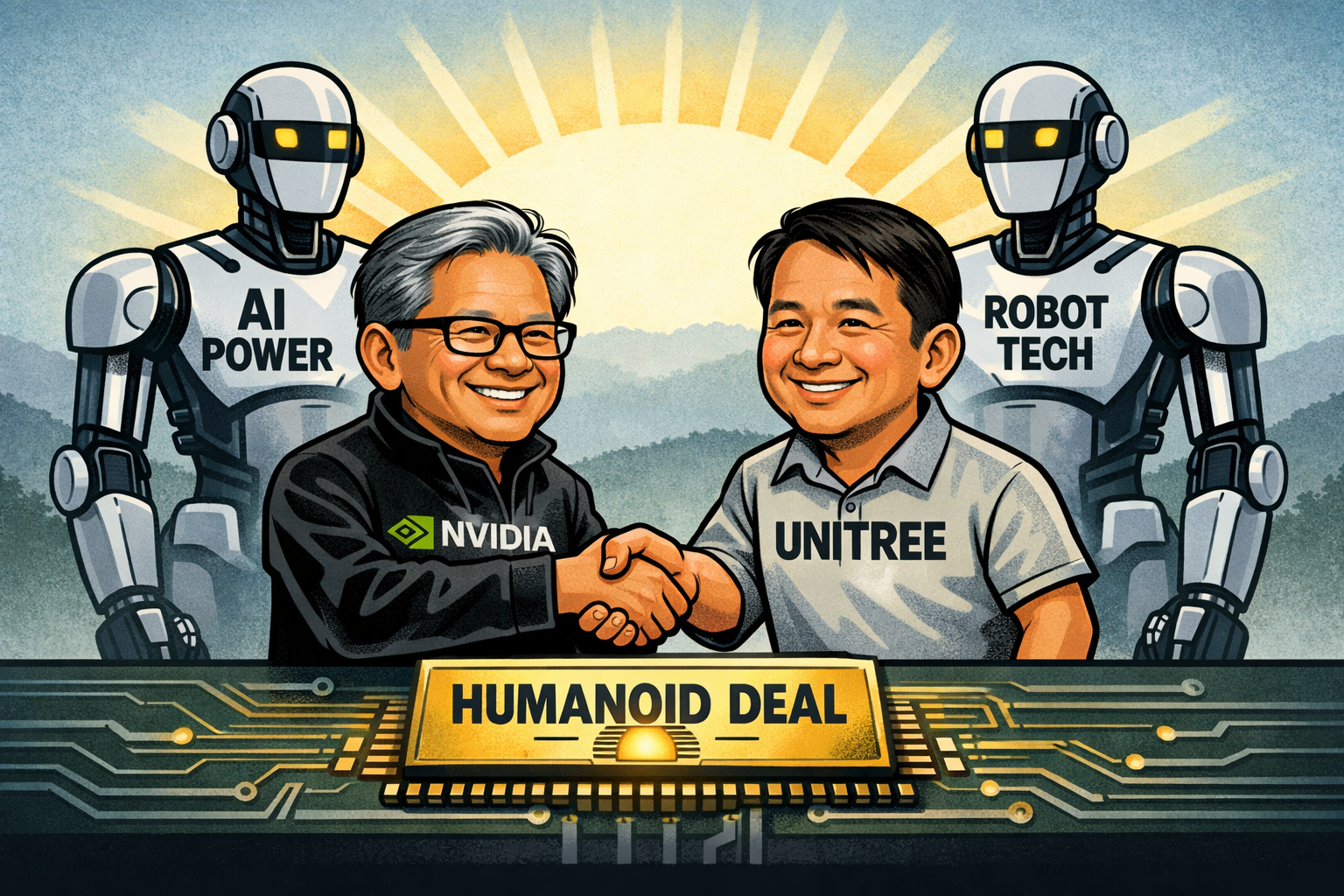
Nvidia has taken another decisive step into the world of “physical AI” by selecting China’s Unitree as its partner for a new humanoid robotics platform aimed squarely at global research institutions.
The collaboration pairs Nvidia’s Jetson Thor hardware — built around the company’s advanced Blackwell GPU — with Unitree’s nearly six‑foot H2 humanoid frame, creating a turnkey system designed to accelerate robotics development in universities and specialist labs.
Isaac Groot
The package integrates Nvidia’s Isaac GR00T humanoid‑focused AI models, simulation tools, and data‑generation stack, effectively offering researchers a complete environment for training, testing, and deploying humanoid behaviours.
Nvidia argues that building such a system independently is “insanely hard”, and that lowering the barrier to entry will broaden the field beyond the world’s largest tech companies.
Unitree timing
For Unitree, the timing is significant. The Hangzhou‑based robotics firm is preparing for a 4.2 billion yuan IPO on Shanghai’s STAR Market, with more than 40% of its revenue already coming from outside China.
The Nvidia partnership gives Unitree a high‑profile global showcase just as it seeks to convince investors of its international potential.
The upgraded H2 Plus model — available later this year — will be open for purchase by any lab, not just elite institutions. Early adopters include Stanford, ETH Zurich, UC San Diego and Seattle’s AI2, underlining Nvidia’s ambition to make humanoid research mainstream.
Multi-trillion-dollar industry in the making
Nvidia reportedly argues that building such a system independently is “insanely hard”, and that lowering the barrier to entry will broaden the field beyond the world’s largest tech companies.
Humanoid robots remain a nascent market, with deployments still limited and safety concerns unresolved. But Nvidia’s move signals a belief that physical AI will become a multi‑trillion‑dollar industry.
By fusing its AI stack with Unitree’s maturing hardware, Nvidia is positioning itself not just as the supplier of chips for the robotics boom, but as the architect of the ecosystem that powers it.