
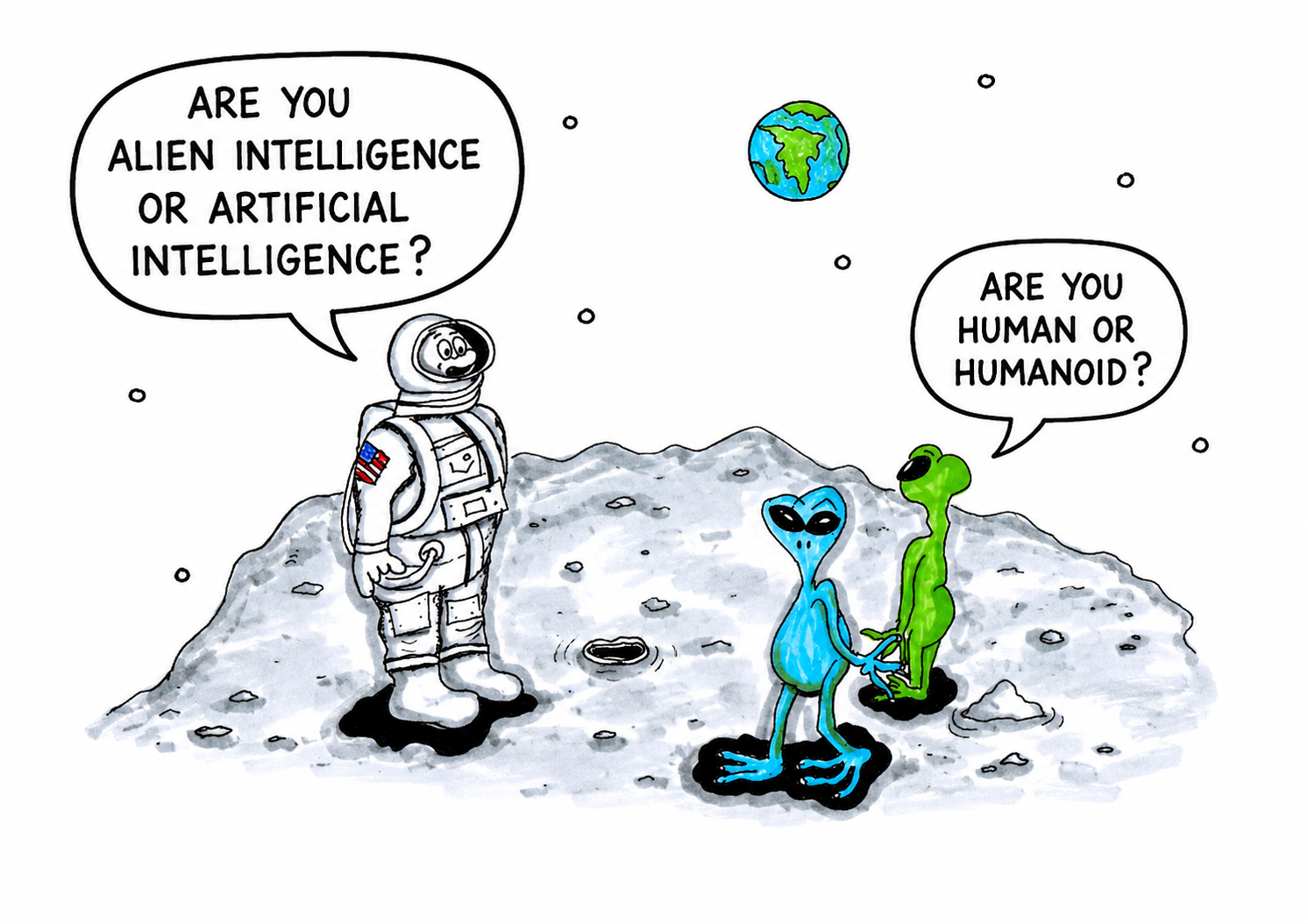
China’s Dancing Robots – Clever – But Can They Actually do Anything Useful – Can they Make Money?

China’s humanoid robots have become remarkably good at grabbing attention. They can dance, perform kung-fu, box, run, jump and even execute backflips that would leave most humans reaching for an ice pack.

But there is a rather important question behind all the impressive videos: what can they actually do that somebody is prepared to pay for?

The answer is increasingly encouraging — although it is considerably less glamorous than kung-fu.

The robots are coming

Chinese humanoid robots are already beginning to move into factories, warehouses and other controlled environments. Some are being used for repetitive tasks such as moving components, loading machines, inspecting products and sorting goods.

One Chinese electronics production trial reported a humanoid robot completing 2,283 operations during an eight-hour shift without errors.

Cup of tea anyone?

That is where the real commercial opportunity lies. A robot does not need to be ‘clever’ to make dinner, walk the dog and discuss the economy.

If it can reliably perform one repetitive task for hours without getting tired, injured or demanding a tea break, it can potentially save a company money.

China is particularly well placed to exploit this. It has enormous manufacturing capacity, established electronics and battery supply chains and a huge domestic industrial market.

The objective is increasingly to make humanoid robots cheaper and produce them in large numbers.

Unitree

There are signs that money is already being made. Unitree, one of China’s best-known robot manufacturers, reported 1.7 billion yuan in revenue in 2025 and was profitable. Its forthcoming Shanghai listing has attracted extraordinary investor enthusiasm.

But this does not mean the robot revolution has arrived in your kitchen.

The biggest problem is versatility. A robot can be extraordinarily impressive at one carefully prepared task while struggling with the chaos of an ordinary home.

Picking up identical components on a production line is one thing; finding a dropped sock under the sofa, loading a dishwasher and working out which cupboard contains the washing-up liquid is another.

That is why the immediate future is likely to involve robots as workers rather than robots as servants.

Work ethic

Factories, warehouses, logistics centres, hotels, shops and perhaps hospitals offer predictable environments where a machine can be trained to perform specific jobs.

Home robots will probably take longer because homes are messy, unpredictable and full of objects designed for humans rather than machines.

So, can China’s robots make money? Absolutely — but probably not because they can do backflips.

The backflips sell the dream. The boring eight-hour shift is where the business case is being tested.

And if Chinese manufacturers can make these machines cheap enough, reliable enough and useful enough, the robots really could become everywhere — not dancing on stage, but quietly doing the jobs nobody wants to do.

And the U.S.?

The U.S. is very much in the robot race, and in some respects it may be ahead of China — particularly in combining humanoid robots with advanced AI.

The interesting question is whether America can turn that technological lead into mass production and profitable businesses.

The leading U.S. names include Tesla and Optimus, Figure AI, Agility Robotics and Digit, and Apptronik with Apollo.

Apptronik, for example, raised more than $935 million in its latest funding round to scale Apollo, with investors including Google, Mercedes-Benz, John Deere and AT&T Ventures.

Agility’s Digit is probably one of the clearest examples of an American humanoid moving beyond the demonstration stage.

Digit has been used commercially in logistics, including work for GXO, where robots have been handling totes. Agility is now expanding its manufacturing and AI development capacity in the U.S.

Then there is Figure AI, which has attracted enormous investment and is concentrating on robots capable of learning a range of tasks rather than simply performing one pre-programmed movement.

Figure has demonstrated robots working in industrial environments, including BMW’s manufacturing operations.

Tesla

And, of course, there is Tesla’s Optimus. Tesla has something its rivals desperately want: enormous manufacturing experience, a huge AI operation and the potential ability to produce robots at scale.

Elon Musk’s ambition is considerably bigger than building a warehouse worker — he ultimately envisages a general-purpose robot that can work in factories and homes.

The fascinating difference is that China appears to have an advantage in manufacturing scale and cost, while the U.S. has extraordinary strengths in AI, software, robotics research and access to investment capital.

That makes this less like a traditional technology race and more like a three-way contest:

China: Can we manufacture millions cheaply?

America: Can we make them intelligent?

Everyone else: Can we work out how use and pay for them?

And there is an important reality check. The global humanoid industry is still tiny. Only around 13,000 humanoid robots were shipped worldwide in 2025, although forecasts suggest shipments could rise dramatically over the next decade.

So the U.S. is not losing the robot race. If anything, it is running a different race.

China may be trying to make humanoid robots into mass-produced industrial products.

America is trying to make them into AI-powered workers.

Whichever approach produces a robot that can reliably work an eight-hour shift — and costs less than employing a human to do the same job — could ultimately win.

The dancing and backflips are impressive.

But the real championship event is the payslip.
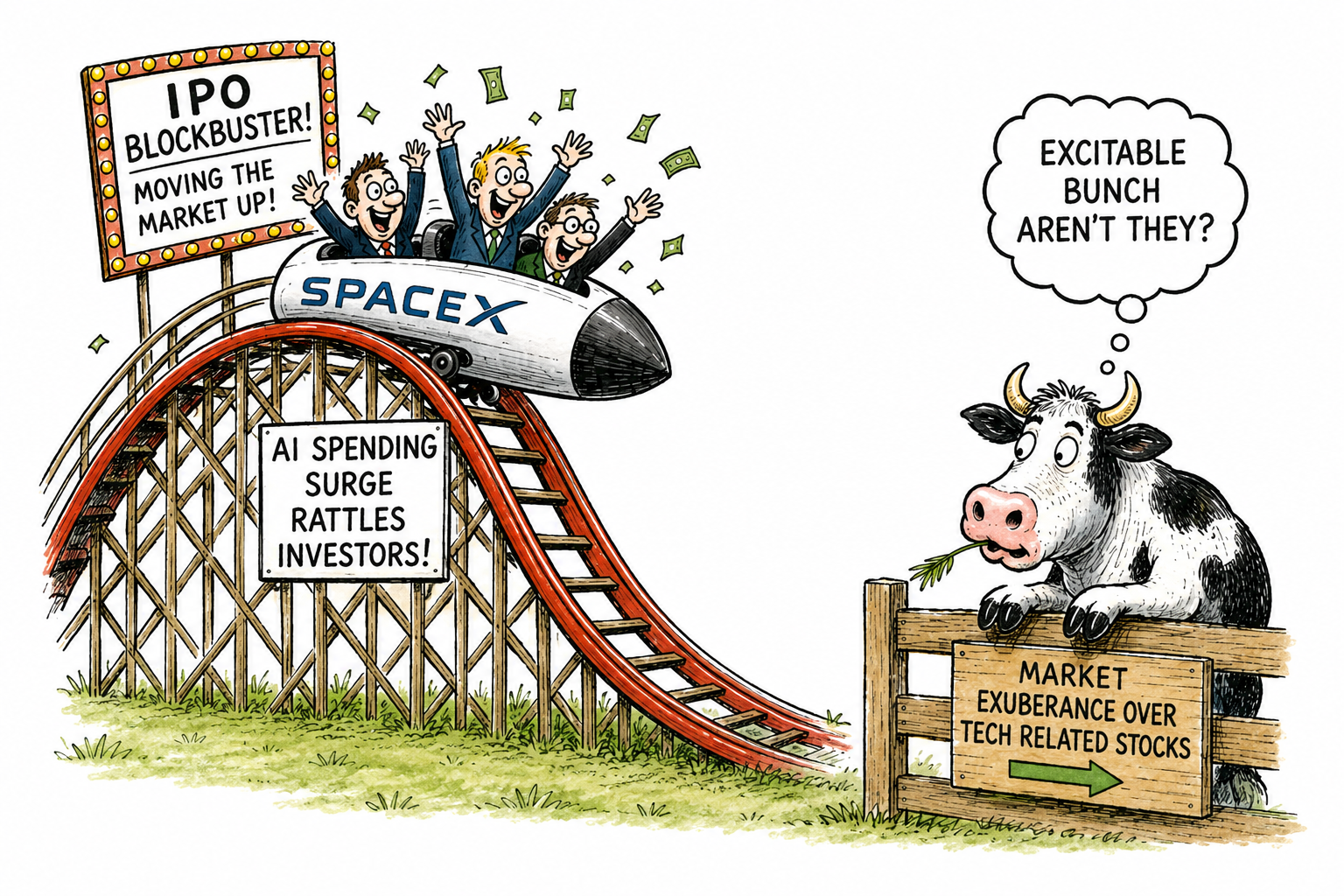
SpaceX Stumbles as AI Spending Clouds the IPO Glow

SpaceX Shares Drop from IPO Value

In June 2026 – SpaceX seemed unstoppable. Its long-awaited stock market debut was hailed as one of the biggest public offerings in years, helping lift investor confidence and fuelling another wave of enthusiasm for technology shares.

The company’s arrival on public markets was viewed as confirmation that the AI revolution, combined with space technology, would continue to power the next leg of the bull market.

That optimism has now been tempered.

Sharp fall

SpaceX shares fell sharply after investors reacted to the company’s latest results, with soaring artificial intelligence spending becoming the chief concern.

While management argued that massive investment in AI infrastructure and advanced computing would strengthen the company’s long-term competitive position, many shareholders focused instead on the near-term impact on profits and cash flow.

The sell-off highlights an increasingly familiar dilemma across the technology sector. Investors remain excited by the promise of artificial intelligence, but they are becoming more selective about how much they are willing to finance before seeing meaningful returns.

Massive Investment

Building cutting-edge AI systems requires enormous investment in data centres, specialised chips and energy-hungry computing infrastructure, all of which place pressure on corporate earnings.

Yet despite the decline in SpaceX shares, broader market sentiment has remained remarkably resilient.

Investors have largely shrugged off the weakness, instead turning their attention to fresh AI announcements, semiconductor developments and upbeat economic data.

Focus

The enthusiasm that once surrounded the SpaceX IPO has not disappeared; it has simply migrated elsewhere.

This shifting focus demonstrates just how rapidly today’s markets move. Yesterday’s headline can quickly become today’s footnote as investors chase the next technological breakthrough or market narrative.

From vision to achievement

For SpaceX, the challenge now is clear. Investors have already bought into the vision. The next step is proving that billions spent on artificial intelligence can eventually translate into stronger revenues, higher margins and sustainable shareholder returns.

In today’s market, bold ambition alone is no longer enough. Investors increasingly want evidence that the AI race will deliver profits as well as promises.

Nvidia–Unitree: A BIG Strategic Investment on Physical AI

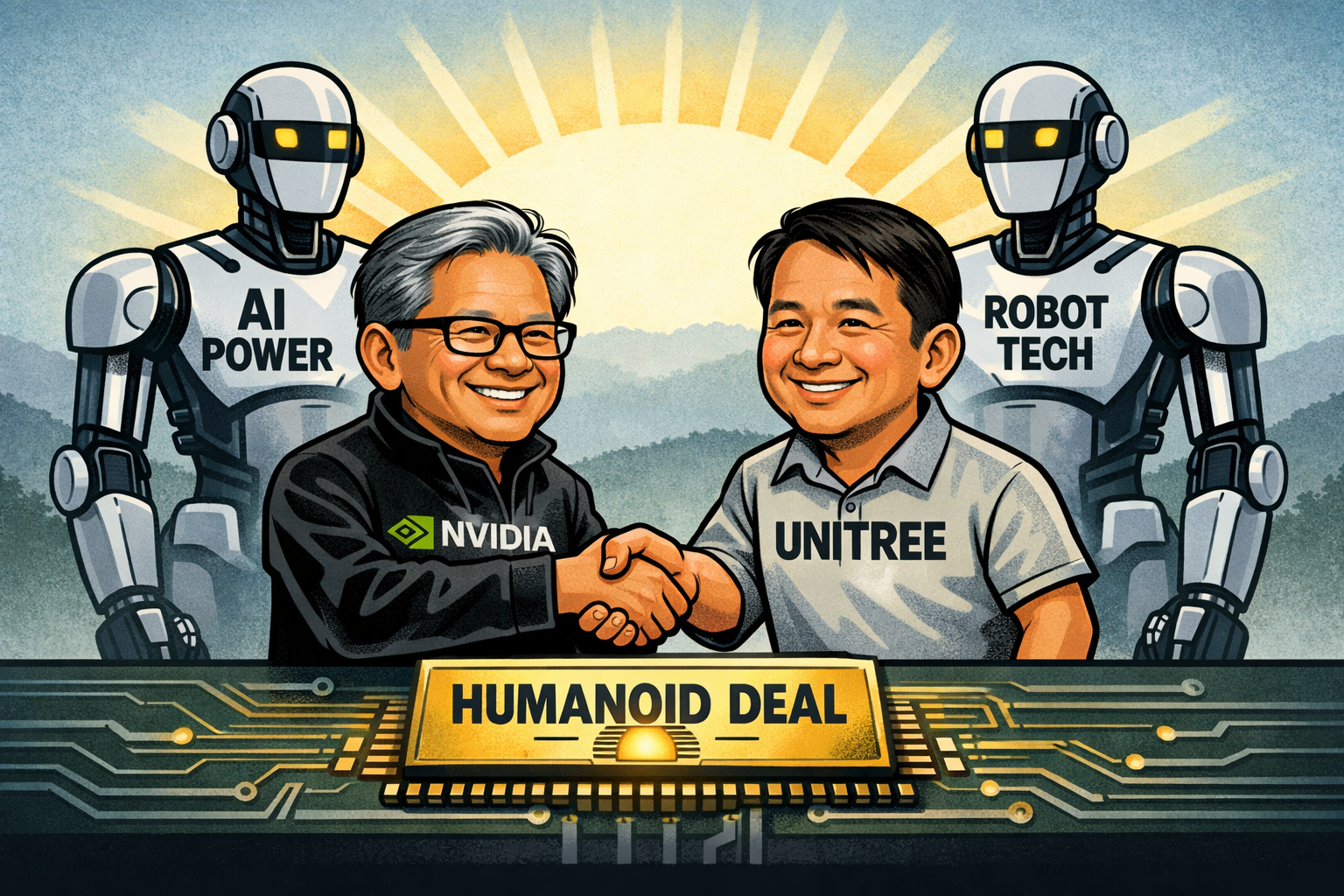
Nvidia has taken another decisive step into the world of “physical AI” by selecting China’s Unitree as its partner for a new humanoid robotics platform aimed squarely at global research institutions.

The collaboration pairs Nvidia’s Jetson Thor hardware — built around the company’s advanced Blackwell GPU — with Unitree’s nearly six‑foot H2 humanoid frame, creating a turnkey system designed to accelerate robotics development in universities and specialist labs.

Isaac Groot

The package integrates Nvidia’s Isaac GR00T humanoid‑focused AI models, simulation tools, and data‑generation stack, effectively offering researchers a complete environment for training, testing, and deploying humanoid behaviours.

Nvidia argues that building such a system independently is “insanely hard”, and that lowering the barrier to entry will broaden the field beyond the world’s largest tech companies.

Unitree timing

For Unitree, the timing is significant. The Hangzhou‑based robotics firm is preparing for a 4.2 billion yuan IPO on Shanghai’s STAR Market, with more than 40% of its revenue already coming from outside China.

The Nvidia partnership gives Unitree a high‑profile global showcase just as it seeks to convince investors of its international potential.

The upgraded H2 Plus model — available later this year — will be open for purchase by any lab, not just elite institutions. Early adopters include Stanford, ETH Zurich, UC San Diego and Seattle’s AI2, underlining Nvidia’s ambition to make humanoid research mainstream.

Multi-trillion-dollar industry in the making

Nvidia reportedly argues that building such a system independently is “insanely hard”, and that lowering the barrier to entry will broaden the field beyond the world’s largest tech companies.

Humanoid robots remain a nascent market, with deployments still limited and safety concerns unresolved. But Nvidia’s move signals a belief that physical AI will become a multi‑trillion‑dollar industry.

By fusing its AI stack with Unitree’s maturing hardware, Nvidia is positioning itself not just as the supplier of chips for the robotics boom, but as the architect of the ecosystem that powers it.

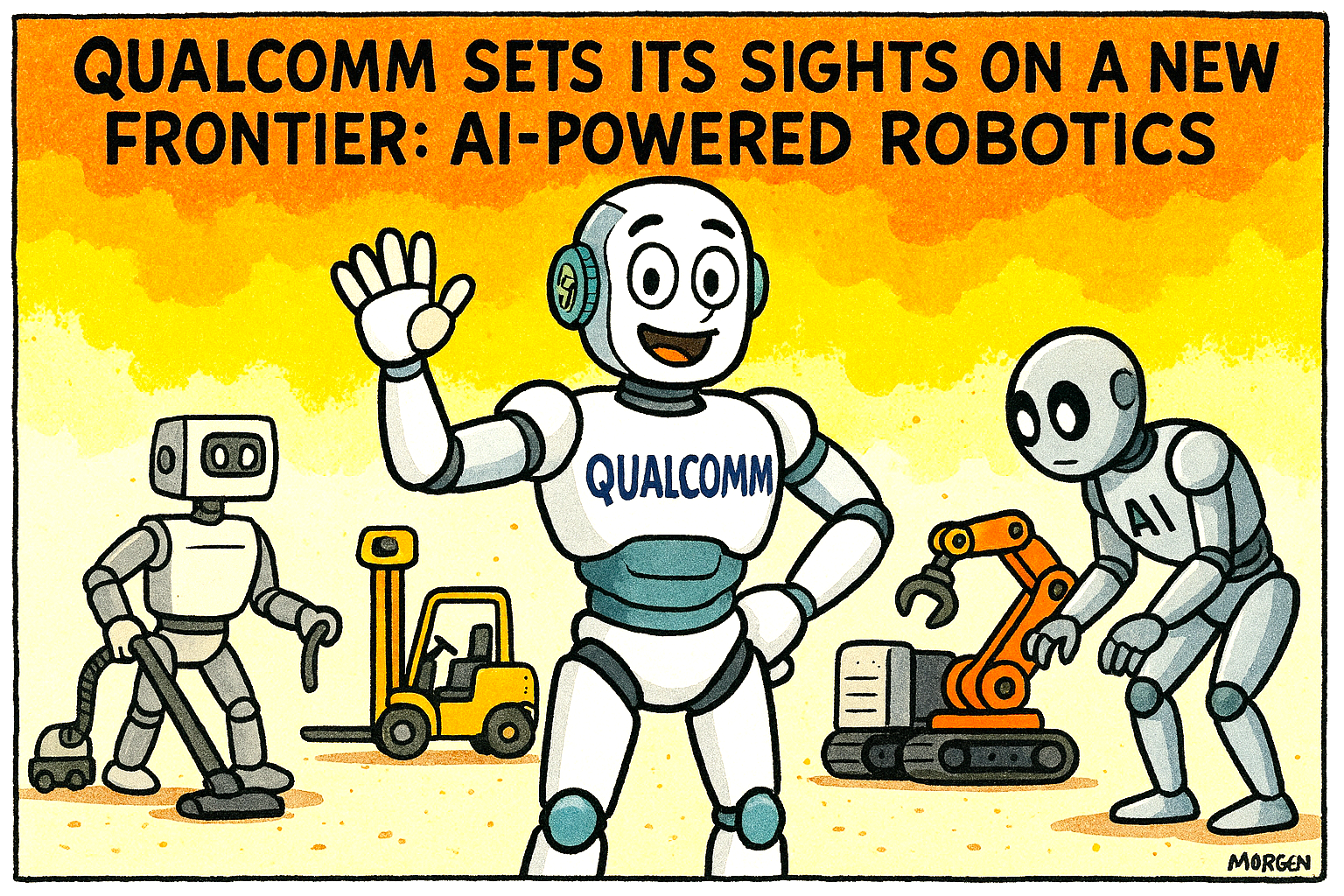
Qualcomm Sets Its Sights on a New Frontier: AI‑Powered Robotics

Qualcomm's Robotic Ambition

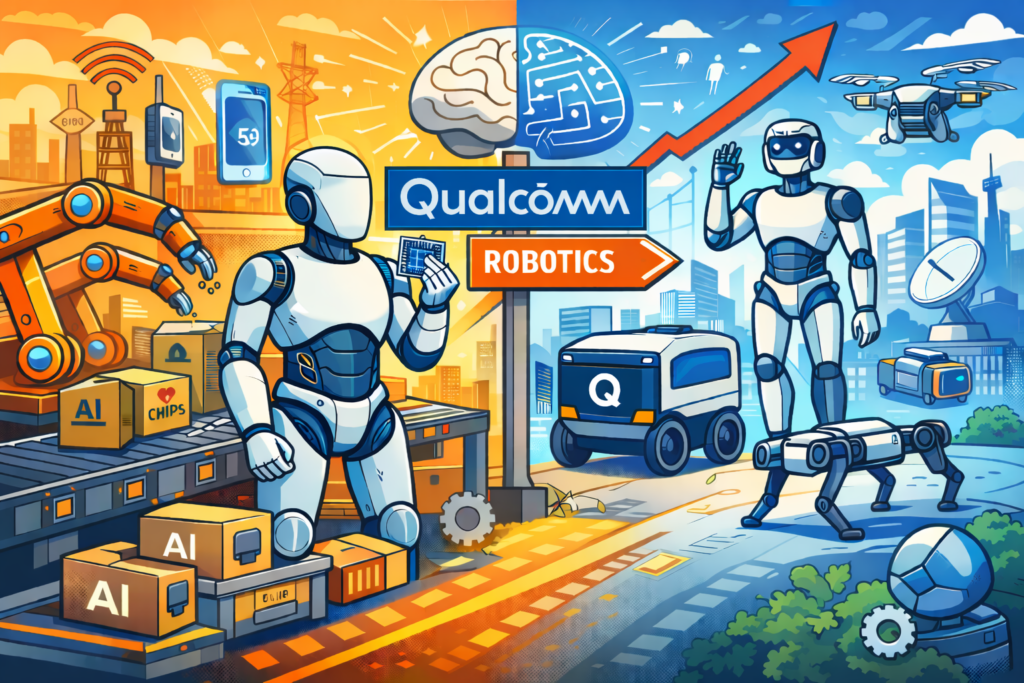
Qualcomm is accelerating its push into artificial intelligence and robotics, signalling a strategic shift that could redefine the company’s future beyond smartphones.

Executives now describe robotics as a core growth pillar, with chief executive Cristiano Amon reportedly forecasting that intelligent machines will become a “larger opportunity” for the business within the next two years.

Expanding from Mobile Chips to Physical AI

For decades, Qualcomm’s dominance has rested on its mobile processors, which power much of the global smartphone market.

The company is now repurposing that expertise for what it calls physical AIrobots capable of perceiving, reasoning, and acting autonomously in real‑world environments.

This transition reflects a broader industry trend: as generative AI matures, attention is shifting from digital assistants to embodied systems that can perform physical tasks.

Qualcomm’s new robotics architecture, unveiled recently, is designed as a full‑stack platform. It combines high‑efficiency system‑on‑chips, safety‑certified compute modules, and advanced on‑device AI models.

The aim is to give robot manufacturers a scalable foundation, whether they are building compact consumer devices or full‑size humanoids for industrial use.

Dragonwing Becomes the Flagship

At the centre of this strategy is the Dragonwing line of processors. The latest model, the Dragonwing IQ10, targets industrial automation and advanced humanoid robots.

It has reportedly been engineered to run complex AI models locally, reducing reliance on cloud connectivity and improving safety, responsiveness, and energy efficiency.

Qualcomm showcased these capabilities at recent industry events, where robots powered by Dragonwing chips demonstrated dexterity, mobility, and real‑time decision‑making.

The company’s ambition places it in direct competition with Nvidia, which currently dominates AI compute for robotics, and with a growing cohort of start‑ups building specialised hardware for autonomous machines.

Why Robotics Matters Now

Three factors underpin Qualcomm’s renewed focus

  • Diversifying revenue as smartphone markets plateau and competition intensifies.
  • Leveraging its edge‑AI strengths, particularly in low‑power, high‑performance chips suited to mobile robots.
  • Rising industrial demand, with logistics, retail, and manufacturing sectors adopting automation at scale.

The robotics push also complements Qualcomm’s automotive and PC AI strategies, creating a broader ecosystem of connected, intelligent devices.

A Critical Two Years Ahead

Qualcomm’s challenge now is to convert impressive demonstrations into commercial deployments.

If successful, the company could become a foundational supplier for the emerging era of physical AI—an era in which robots move from novelty to necessity.

Tesla’s $1 Trillion Bet on Elon Musk

$1 trillion Elon pay deal

In a move that has stunned financial analysts, corporate governance experts, and the broader public alike, Tesla Inc. has approved a record-breaking $1 trillion (£761 billion) compensation package for its CEO, Elon Musk.

In a landmark decision, Tesla shareholders have approved a staggering $1 trillion (£761 billion) compensation package for CEO Elon Musk, marking the largest executive pay deal in corporate history.

The vote, held at Tesla’s annual meeting in Austin, Texas, reportedly saw over 75% of investors back the plan, reaffirming their confidence in Musk’s leadership and long-term vision.

Share deal

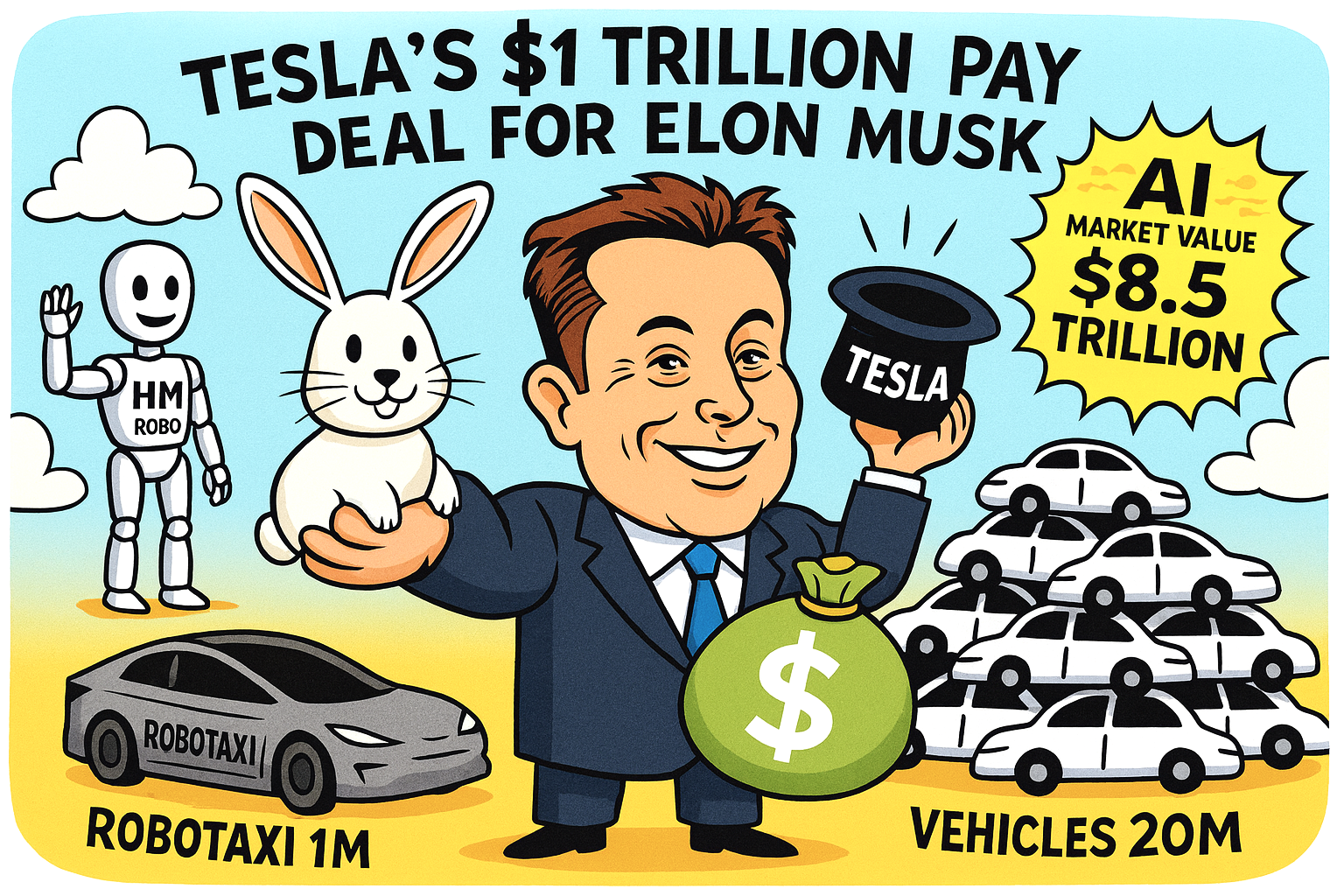
The deal is entirely performance-based, with Musk eligible to receive up to 423 million Tesla shares if the company meets a series of ambitious milestones.

These include producing 20 million vehicles annually, deploying one million robotaxis and humanoid robots, and reaching a market valuation of $8.5 trillion.

Reportedly there is no salary or cash bonus—Musk’s payout depends solely on Tesla’s success.

Supporters argue the package aligns Musk’s incentives with shareholder interests, encouraging innovation and growth.

Critics, however, warn of governance risks and the unprecedented concentration of wealth and power.

Musk, already the world’s richest person, could become the first trillionaire if Tesla achieves its targets.

The vote signals Tesla’s intent to evolve beyond electric vehicles into a broader tech powerhouse, betting on AI, robotics, and autonomy—with Musk at the helm.

AI creates paradigm shift in computing – programming AI is like training a person

Teaching or programing?

At London Tech Week, Nvidia CEO Jensen Huang made a striking statement: “The way you program an AI is like the way you program a person.” (Do we really program people or do we teach)?

This marks a fundamental shift in how we interact with artificial intelligence, moving away from traditional coding languages and towards natural human communication.

Historically, programming required specialised knowledge of languages like C++ or Python. Developers had to meticulously craft instructions for computers to follow.

Huang argues that AI has now evolved to understand and respond to human language, making programming more intuitive and accessible.

This transformation is largely driven by advancements in conversational AI models, such as ChatGPT, Gemini, and Copilot.

These systems allow users to issue commands in plain English – whether asking an AI to generate images, write a poem, or even create software code. Instead of writing complex algorithms, users can simply ask nicely, much like instructing a colleague or student.

Huang’s analogy extends beyond convenience. Just as people learn through feedback and iteration, AI models refine their responses based on user input.

If an AI-generated poem isn’t quite right, users can prompt it to improve, and it will think and adjust accordingly.

This iterative process mirrors human learning, where guidance and refinement lead to better outcomes.

The implications of this shift are profound. AI is no longer just a tool for experts – it is a great equalizer, enabling anyone to harness computing power without technical expertise.

As businesses integrate AI into their workflows, employees will need to adapt, treating AI as a collaborative partner rather than a mere machine.

This evolution in AI programming is not just about efficiency; it represents a new era where technology aligns more closely with human thought and interaction.

Robots are coming to a home near you..?

Robot AI

Think of the biggest market for a physical product you can possibly imagine – are you thinking mobile phones, cars or game devices even? Think again…?

They are all big commercial markets but in the coming decades a new product is coming and it will be so desirable that it will dwarf these giants – it will be… the ‘robot’.

Robots will be able to understand what we want, comprehend the way the world works and looks and have the skills to execute our commands in a safe and controlled manner – at home and in the workplace.

Biggest market

The labour market is the biggest market that has ever existed in the history of business – it’s the market where we want things ‘done’ – where we do things – and it’s forever evolving. It carries massive stock market and investing potential right now and for the future.

Robot AI tech
Robot AI tech – a market place to explore

Take Nvidia, Microsoft, Google, Meta, Apple and Tesla as prime examples of companies pioneering technological advancements for instance – we can already enjoy and invest in these – and there’s much more to come.

Dozens of firms around the world are working on the technology

In the UK, Dyson is investing in AI and robotics aimed at household chores.

One of the highest profile companies in the market is Tesla, Elon Musk’s electric car company. It is working on the Optimus humanoid robot, which Mr Musk intimates could be on sale to the public in a few years’ time.

Massive tecnological advancement in artificial intelligence (AI) and robotics suggest the development of humanoid robots is accelerating… and fast. It’s a race to the become the first to succeed in the biggest practical labour market ever… and it carries huge potential for everyone, including you and me.

20 years from now…? Where were Tesla and Apple 20 years ago?

Twenty years at the pace the technology is developing now is is an eternity – every week, month and year there are new developments in the AI world that have introduced fundamental changes and enhancements to our world.

Mainstream interest in AI exploded late 2022 when a powerful version of ChatGPT was made public. Its ability to generate almost unlimited useful text and images has spawned rivals and a wave of investment in AI technology.

But developing the AI that would allow a robot to complete useful tasks is a different and much more difficult task. Tesla could be the company best placed to be one of the first to achieve this goal – given its advancements in ‘self driving’ technology. But, unlike ChatGPT and its rivals, humanoid robots have to navigate the physical world and need to understand how objects in that world relate to each other.

Tasks that seem easy to humans are major feats for humanoid robots. This is a problem that engages a lot of different complex issues in an AI driven robotics system. Picking up a cup and having a drink is a major undergoing for a robot.

The market place potential is unlimited

The potential market for robots in the future depends on various factors, such as the level of technological innovation, the demand from different industries and sectors, the regulatory and ethical frameworks, and the social and economic impacts of robot adoption. But if recent developments are anything to go by – it promises to be big!

Robot
Robot AI – a massive potential future market place

Based on the some indicative web search results, the current market size for robots is estimated to be around $55 billion to $114 billion in 2023, depending on the type and scope of robots included. The projected market size for robots in 2028 or 2029 ranges from $165 billion to $260 billion, with a compound annual growth rate (CAGR) of 11.4% to 17.6%.

The professional services robots, which include medical, agricultural, and personal assistance robots, are expected to dominate the market and account for more than half of the total sales by 2030. The industrial and logistics robots, which include conventional, collaborative, and mobile robots, are also expected to grow steadily and increase their productivity and efficiency in various manufacturing and transportation applications.

However, these projections are based on assumptions – but one thing is for sure the robots are coming and the market will be massive!

I for one will be keeping a watchful eye on where to invest my hard earned cash to take advantage of this potentially high growth market in the coming years (and now).

Nvidia stock anyone?