
China’s Dancing Robots – Clever – But Can They Actually do Anything Useful – Can they Make Money?

China’s humanoid robots have become remarkably good at grabbing attention. They can dance, perform kung-fu, box, run, jump and even execute backflips that would leave most humans reaching for an ice pack.

But there is a rather important question behind all the impressive videos: what can they actually do that somebody is prepared to pay for?

The answer is increasingly encouraging — although it is considerably less glamorous than kung-fu.

The robots are coming

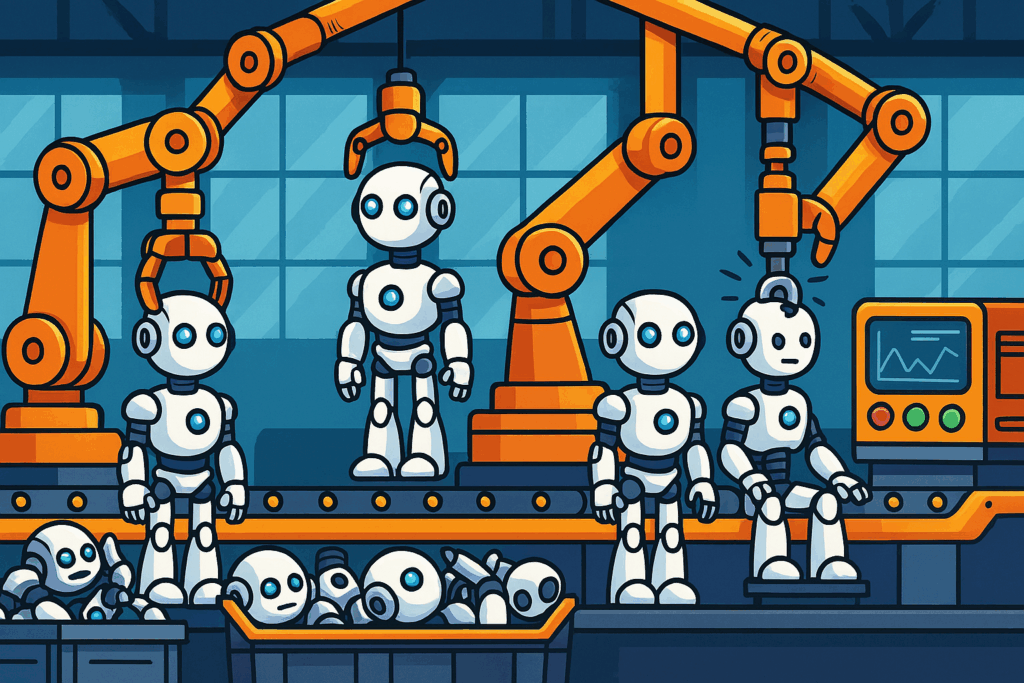
Chinese humanoid robots are already beginning to move into factories, warehouses and other controlled environments. Some are being used for repetitive tasks such as moving components, loading machines, inspecting products and sorting goods.

One Chinese electronics production trial reported a humanoid robot completing 2,283 operations during an eight-hour shift without errors.

Cup of tea anyone?

That is where the real commercial opportunity lies. A robot does not need to be ‘clever’ to make dinner, walk the dog and discuss the economy.

If it can reliably perform one repetitive task for hours without getting tired, injured or demanding a tea break, it can potentially save a company money.

China is particularly well placed to exploit this. It has enormous manufacturing capacity, established electronics and battery supply chains and a huge domestic industrial market.

The objective is increasingly to make humanoid robots cheaper and produce them in large numbers.

Unitree

There are signs that money is already being made. Unitree, one of China’s best-known robot manufacturers, reported 1.7 billion yuan in revenue in 2025 and was profitable. Its forthcoming Shanghai listing has attracted extraordinary investor enthusiasm.

But this does not mean the robot revolution has arrived in your kitchen.

The biggest problem is versatility. A robot can be extraordinarily impressive at one carefully prepared task while struggling with the chaos of an ordinary home.

Picking up identical components on a production line is one thing; finding a dropped sock under the sofa, loading a dishwasher and working out which cupboard contains the washing-up liquid is another.

That is why the immediate future is likely to involve robots as workers rather than robots as servants.

Work ethic

Factories, warehouses, logistics centres, hotels, shops and perhaps hospitals offer predictable environments where a machine can be trained to perform specific jobs.

Home robots will probably take longer because homes are messy, unpredictable and full of objects designed for humans rather than machines.

So, can China’s robots make money? Absolutely — but probably not because they can do backflips.

The backflips sell the dream. The boring eight-hour shift is where the business case is being tested.

And if Chinese manufacturers can make these machines cheap enough, reliable enough and useful enough, the robots really could become everywhere — not dancing on stage, but quietly doing the jobs nobody wants to do.

And the U.S.?

The U.S. is very much in the robot race, and in some respects it may be ahead of China — particularly in combining humanoid robots with advanced AI.

The interesting question is whether America can turn that technological lead into mass production and profitable businesses.

The leading U.S. names include Tesla and Optimus, Figure AI, Agility Robotics and Digit, and Apptronik with Apollo.

Apptronik, for example, raised more than $935 million in its latest funding round to scale Apollo, with investors including Google, Mercedes-Benz, John Deere and AT&T Ventures.

Agility’s Digit is probably one of the clearest examples of an American humanoid moving beyond the demonstration stage.

Digit has been used commercially in logistics, including work for GXO, where robots have been handling totes. Agility is now expanding its manufacturing and AI development capacity in the U.S.

Then there is Figure AI, which has attracted enormous investment and is concentrating on robots capable of learning a range of tasks rather than simply performing one pre-programmed movement.

Figure has demonstrated robots working in industrial environments, including BMW’s manufacturing operations.

Tesla

And, of course, there is Tesla’s Optimus. Tesla has something its rivals desperately want: enormous manufacturing experience, a huge AI operation and the potential ability to produce robots at scale.

Elon Musk’s ambition is considerably bigger than building a warehouse worker — he ultimately envisages a general-purpose robot that can work in factories and homes.

The fascinating difference is that China appears to have an advantage in manufacturing scale and cost, while the U.S. has extraordinary strengths in AI, software, robotics research and access to investment capital.

That makes this less like a traditional technology race and more like a three-way contest:

China: Can we manufacture millions cheaply?

America: Can we make them intelligent?

Everyone else: Can we work out how use and pay for them?

And there is an important reality check. The global humanoid industry is still tiny. Only around 13,000 humanoid robots were shipped worldwide in 2025, although forecasts suggest shipments could rise dramatically over the next decade.

So the U.S. is not losing the robot race. If anything, it is running a different race.

China may be trying to make humanoid robots into mass-produced industrial products.

America is trying to make them into AI-powered workers.

Whichever approach produces a robot that can reliably work an eight-hour shift — and costs less than employing a human to do the same job — could ultimately win.

The dancing and backflips are impressive.

But the real championship event is the payslip.
Nvidia–Unitree: A BIG Strategic Investment on Physical AI

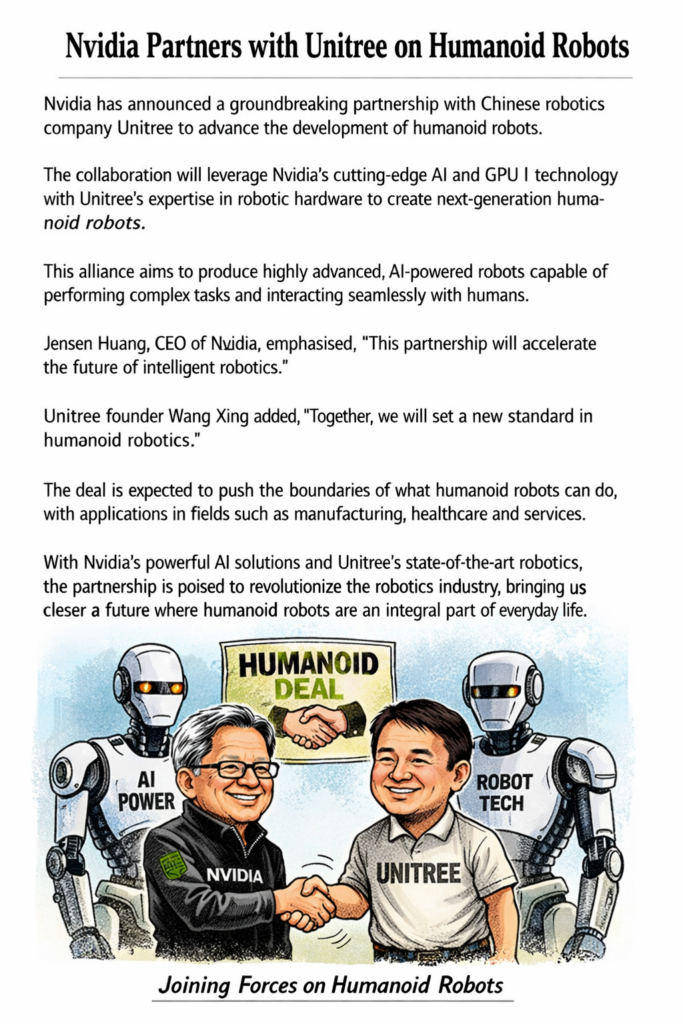
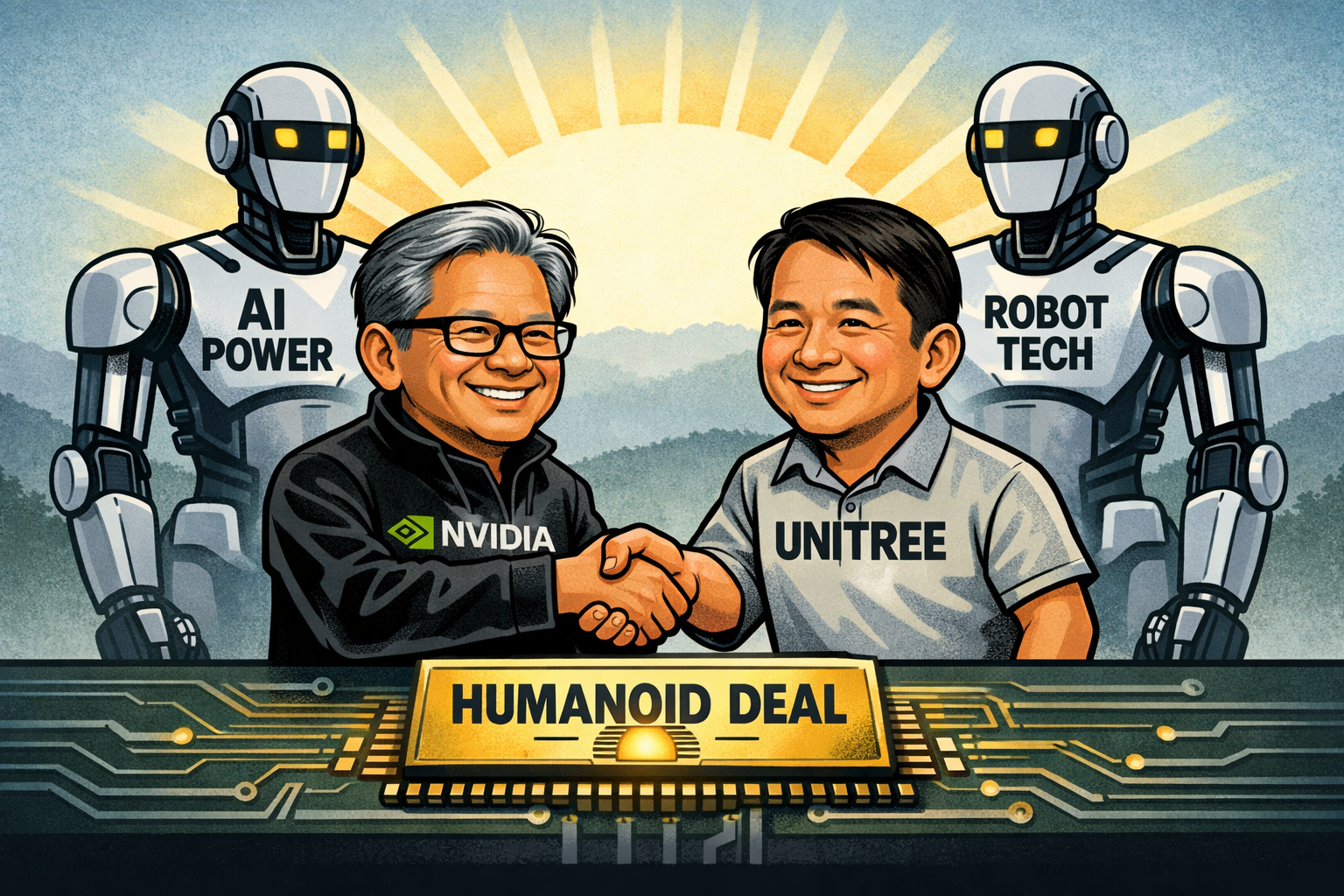
Nvidia has taken another decisive step into the world of “physical AI” by selecting China’s Unitree as its partner for a new humanoid robotics platform aimed squarely at global research institutions.

The collaboration pairs Nvidia’s Jetson Thor hardware — built around the company’s advanced Blackwell GPU — with Unitree’s nearly six‑foot H2 humanoid frame, creating a turnkey system designed to accelerate robotics development in universities and specialist labs.

Isaac Groot

The package integrates Nvidia’s Isaac GR00T humanoid‑focused AI models, simulation tools, and data‑generation stack, effectively offering researchers a complete environment for training, testing, and deploying humanoid behaviours.

Nvidia argues that building such a system independently is “insanely hard”, and that lowering the barrier to entry will broaden the field beyond the world’s largest tech companies.

Unitree timing

For Unitree, the timing is significant. The Hangzhou‑based robotics firm is preparing for a 4.2 billion yuan IPO on Shanghai’s STAR Market, with more than 40% of its revenue already coming from outside China.

The Nvidia partnership gives Unitree a high‑profile global showcase just as it seeks to convince investors of its international potential.

The upgraded H2 Plus model — available later this year — will be open for purchase by any lab, not just elite institutions. Early adopters include Stanford, ETH Zurich, UC San Diego and Seattle’s AI2, underlining Nvidia’s ambition to make humanoid research mainstream.

Multi-trillion-dollar industry in the making

Nvidia reportedly argues that building such a system independently is “insanely hard”, and that lowering the barrier to entry will broaden the field beyond the world’s largest tech companies.

Humanoid robots remain a nascent market, with deployments still limited and safety concerns unresolved. But Nvidia’s move signals a belief that physical AI will become a multi‑trillion‑dollar industry.

By fusing its AI stack with Unitree’s maturing hardware, Nvidia is positioning itself not just as the supplier of chips for the robotics boom, but as the architect of the ecosystem that powers it.

U.S. AI vs China AI – the difference

China and U.S. AI

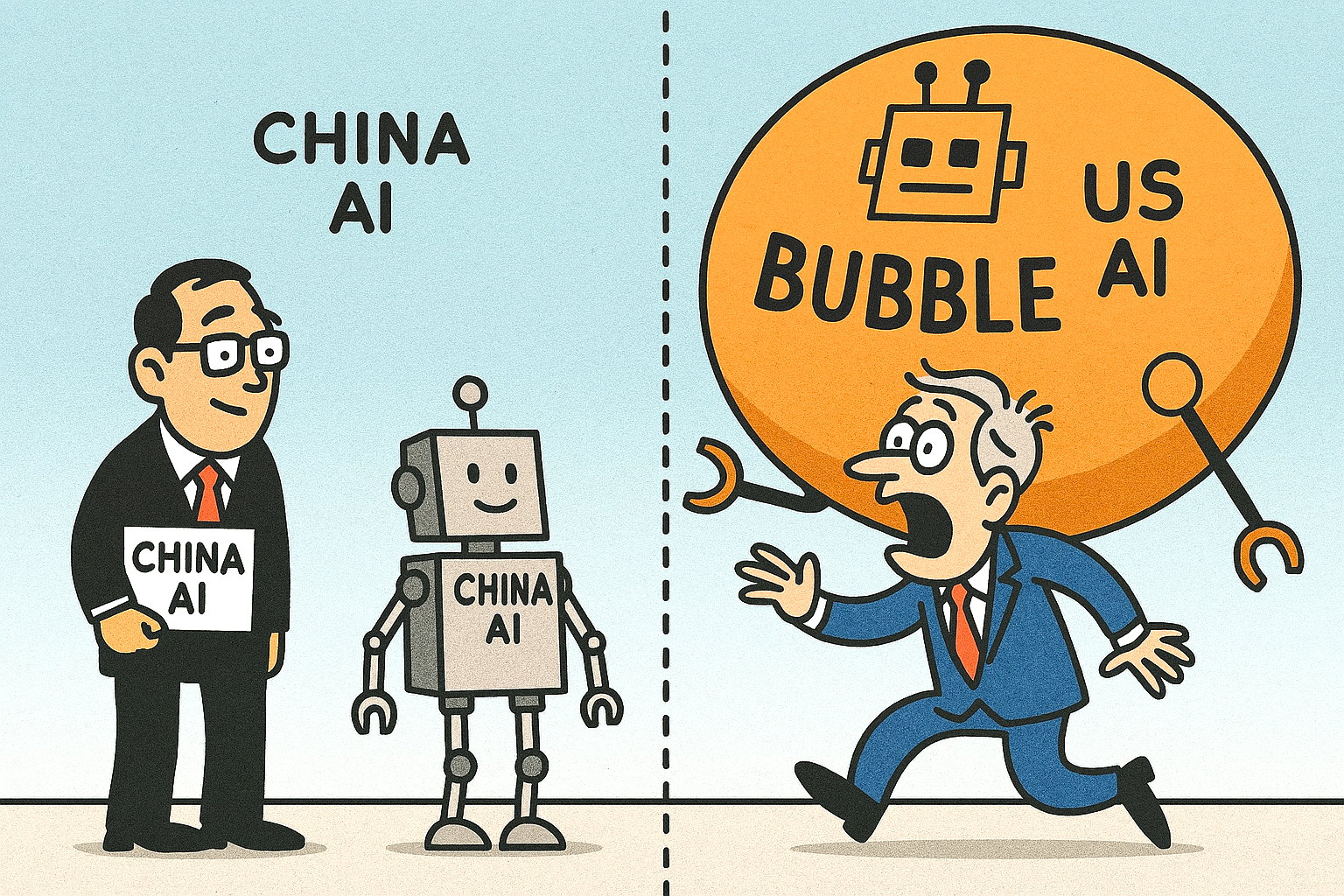
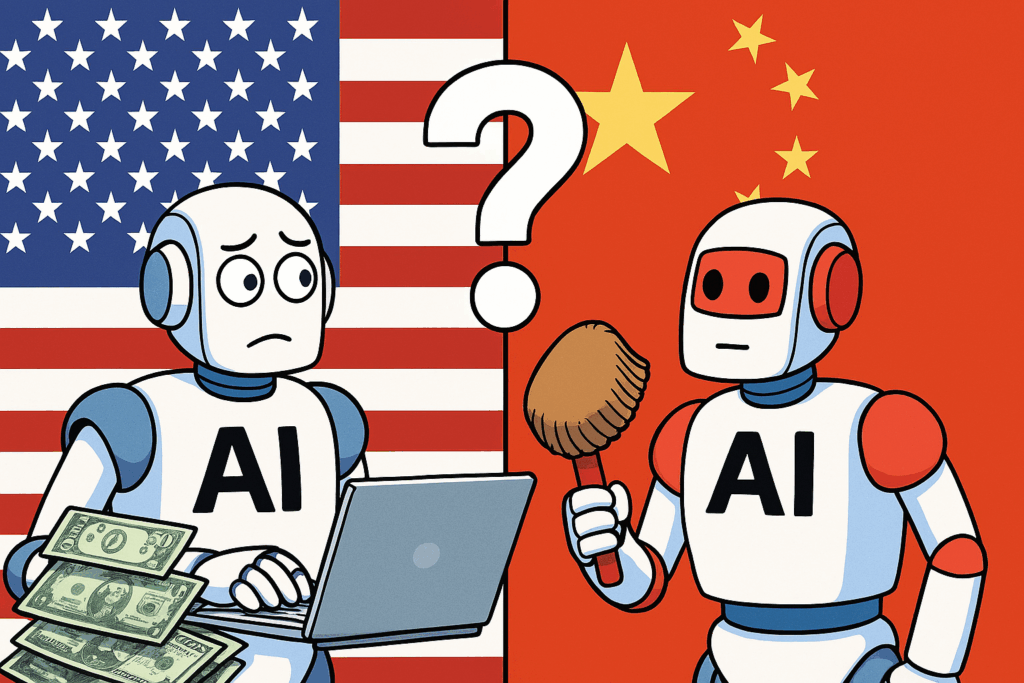
China’s AI industry has indeed cultivated a reputation for ‘doing more with less’, while the U.S. has poured vast sums into AI development, raising concerns about overinvestment and inflated valuations.

The contrast lies not only in the scale of funding but also in the efficiency and strategic focus of each country’s approach.

The U.S. Approach: Scale and Spending

The United States remains the global leader in AI infrastructure, driven by massive private investment and access to advanced computing resources.

Venture capital deals in U.S. AI and robotics startups have more than quadrupled since 2023, surpassing $160 billion in 2025.

This surge has produced headline-grabbing valuations, such as humanoid robotics firms raising billions in single rounds. Yet analysts warn of bubble risks, with valuations often detached from sustainable revenue models.

The U.S. strategy prioritises scale: building the largest models, securing the most powerful GPUs, and attracting top-tier talent.

This has led to breakthroughs in generative AI and large language models, but at extraordinary cost.

Estimates suggest that OpenAI alone has spent over $100 billion on development. Critics argue this reflects a ‘more is better’ philosophy, where innovation is equated with sheer financial muscle.

China’s Approach: Efficiency and Restraint

China, by contrast, has invested heavily but with a different emphasis. In 2025, Chinese AI investment is reportedly projected at $98 billion, far below U.S. levels.

Yet Chinese firms have achieved notable progress by focusing on cost-efficient innovation. For example, AI2 Robotics developed a model requiring less than 10% of the parameters used by Alphabet’s RT-2, demonstrating a commitment to leaner, more resource-conscious design.

Foreign investors are increasingly drawn to China’s cheaper valuations, which are roughly one-quarter of U.S. equivalents.

This efficiency stems from lower research costs, government-led initiatives, and a culture of frugality shaped by regulatory pressures and limited access to advanced hardware.

Rather than chasing scale, Chinese firms often prioritise practical applications and affordability, enabling broader adoption across industries.

Doing More with Less?

The evidence suggests that China has achieved competitive outcomes with far fewer resources, while the U.S. has arguably overpaid in pursuit of dominance.

However, the U.S. still leads in infrastructure, talent, and global influence. China’s strength lies in its ability to innovate under constraints, turning scarcity into efficiency.

Ultimately, the question is not whether one side has ‘overinvested’ or ‘underinvested’, but whether their strategies align with long-term sustainability.

The U.S. risks a bubble fuelled by excess capital, while China’s leaner approach may prove more resilient. In this sense, China is indeed ‘doing more with less’—but whether that will be enough to surpass U.S. dominance remains uncertain.

Bubble vulnerability

The sheer scale of U.S. AI investment has left the industry vulnerable to bubble shock, as valuations and spending appear increasingly detached from sustainable returns.

Analysts warn that the U.S. equity market is showing signs of an AI-driven bubble, with trillions poured into data centres, chips, and generative models at unprecedented speed.

While this has fuelled rapid innovation, it has also created irrational exuberance reminiscent of the dot-com era, where hype outpaces monetisation.

If growth expectations falter or capital tightens, the U.S. could face sharp corrections across tech stocks, credit markets, and employment, exposing the fragility of an industry built on extraordinary but potentially unsustainable levels of investment.

China’s humanoid robots are coming for Elon Musk’s Tesla $1 trillion dollar payday

China humanoid robot challenge

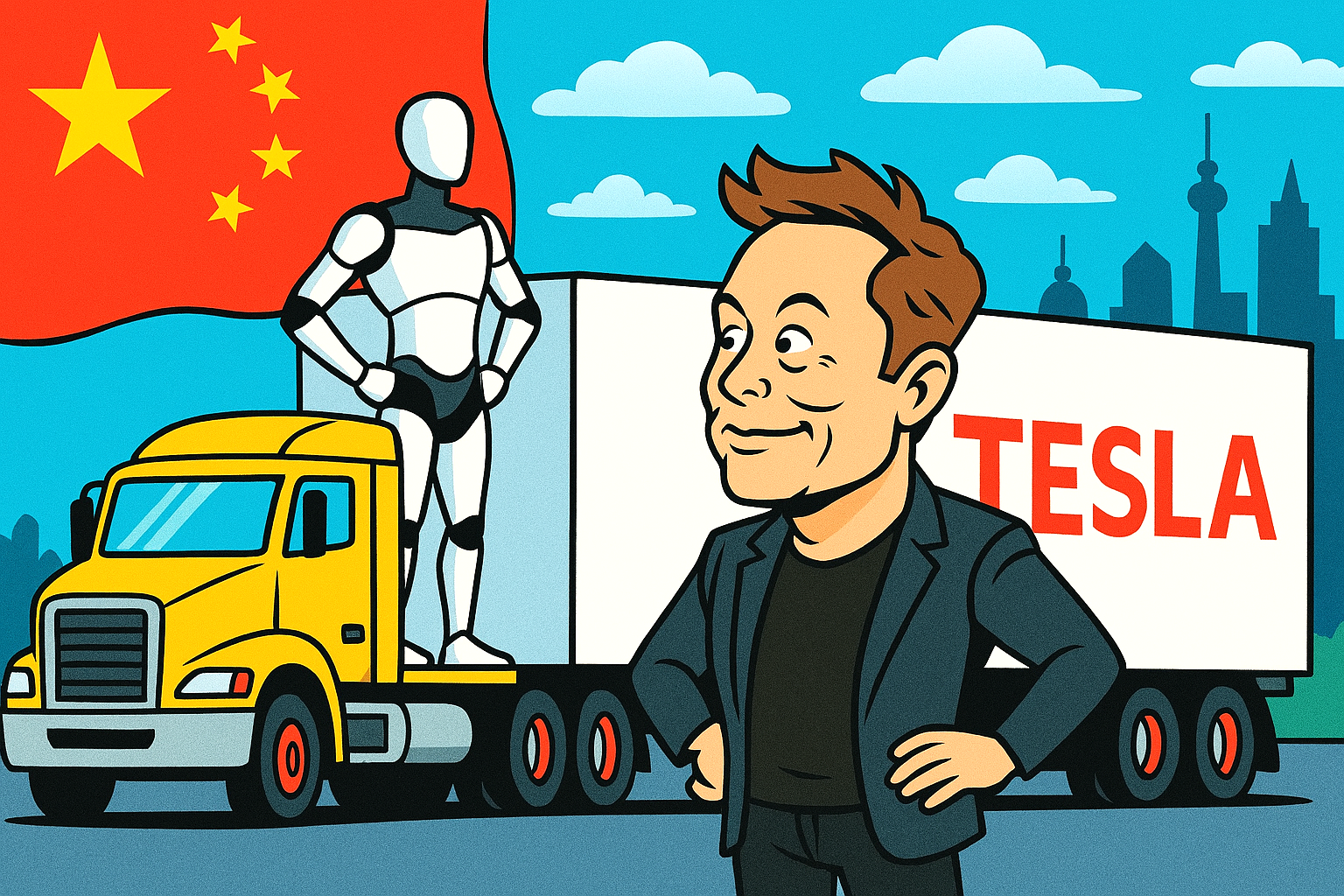
Elon Musk’s $1 trillion Tesla payday is tightly bound to the rise of humanoid robots—and China’s role in their production may determine whether his vision succeeds.

Elon Musk’s record-breaking compensation package, worth up to $1 trillion, hinges on Tesla’s transformation from an electric vehicle pioneer into a robotics powerhouse.

At the centre of this ambition is Optimus, Tesla’s humanoid robot, designed to walk, learn, and mimic human actions. Musk envisions deploying one million robots within the next decade, a scale that would redefine both Tesla’s business model and the global labour market.

Yet the road to mass production likely runs directly through China. While Tesla engineers designed prototype Optimus in the United States, China dominates the industrial infrastructure and critical components needed for large-scale deployment.

Robot installations in China

In 2023 alone, China reportedly installed over 290,000 industrial robots, more than the rest of the world combined, and reached a robot density of 470 per 10,000 workers, surpassing Japan and Germany.

This aggressive expansion is reportedly backed by state subsidies, low-cost financing, and mandates requiring provincial governments to integrate automation into their restructuring plans.

For Musk, this creates both opportunity and risk. On one hand, China’s manufacturing ecosystem offers the scale and efficiency necessary to bring Optimus to market at competitive costs.

On the other, Beijing’s strict regulations on humanoid robots introduce uncertainty, with geopolitical permission becoming the most unpredictable factor in Tesla’s robot revolution.

If Musk can navigate these challenges, Optimus could anchor Tesla’s evolution into a robotics giant, securing the milestones required for his trillion-dollar payday, and beyond.

But if Chinese competitors or regulatory hurdles slow progress, Tesla risks losing ground in the very sector Musk believes will make work ‘optional’ and money ‘irrelevant’.

In short, the robots coming from China are not just machines—they are very much the ‘key code’ to Musk’s trillion-dollar future.

Never underestimate Elon Musk.

The ‘cold’ race heats up!

The cold rush!

The Arctic is rapidly becoming the new frontier in the global scramble for critical minerals, with nations vying for influence and resources that could shape the future of energy and technology.

The Arctic, long viewed as a remote and inhospitable region, is now at the centre of a geopolitical and economic contest.

Beneath its icy landscapes lie vast reserves of rare earths, base metals, uranium, and precious minerals, all essential for renewable energy technologies, electric vehicles, and advanced defence systems.

As the world accelerates its transition away from fossil fuels, these resources are increasingly seen as strategic assets.

Countries including the United States, Canada, Russia, and Greenland are intensifying exploration and investment. Greenland, in particular, has emerged as a focal point, with experts noting its abundance of rare earths and uranium.

Canada’s northern territories are also being positioned as key suppliers, with government-backed initiatives to strengthen supply chains and reduce reliance on Chinese dominance in the sector.

Control

The race is not solely about economics. Control of Arctic resources carries profound geopolitical weight. As melting ice opens new shipping routes and makes extraction more feasible, competition is sharpening.

Russia has already expanded its Arctic infrastructure, while Western nations are seeking partnerships and technological innovations to ensure sustainable development.

The Oxford Institute for Energy Studies has highlighted that the Arctic could become a significant contributor to the global energy transition, though environmental risks remain a pressing concern.

Fragile

Critics warn that the pursuit of minerals in such fragile ecosystems could have devastating consequences. Mining operations threaten biodiversity, indigenous communities, and the delicate balance of Arctic environments.

Balancing economic opportunity with ecological responsibility will be one of the defining challenges of this new ‘cold gold rush’.

Ultimately, the Arctic’s mineral wealth represents both promise and peril. If managed responsibly, it could underpin the technologies needed to combat climate change and secure energy independence.

If exploited recklessly, it risks becoming another chapter in humanity’s history of resource-driven conflict and environmental degradation.

The ‘cold race’ is heating up!

Tesla and Musk struggle against Trump’s Tariff Tidalwave

Tesla

Tesla has been making headlines with a series of major developments, from financial setbacks to strategic shifts by CEO Elon Musk.

The electric vehicle giant recently reported a 20% drop in automotive revenue, a significant decline that has raised concerns among investors.

Meanwhile, Musk has announced that he will be spending much less time on the Department of Government Efficiency (DOGE), a move that could signal a renewed focus on Tesla.

Additionally, Tesla’s ambitious Optimus humanoid robot project has hit a roadblock due to China’s restrictions on rare earth materials, further complicating the company’s future plans.

Tesla’s Revenue Decline

Tesla’s first-quarter earnings report revealed a 20% drop in automotive revenue, with total revenue sliding 9% year-on-year.

The company attributed the decline to factory retooling for a refreshed Model Y, lower average selling prices, and increased sales incentives.

Net income plummeted 71%, reflecting the broader challenges Tesla faces in a competitive EV market.

Tesla 3 month share price chart 2025

The company has refrained from promising growth this year, stating that it will revisit its 2025 guidance in its Q2 update.

Musk’s Shift Away from DOGE

Elon Musk’s involvement in the Department of Government Efficiency (DOGE) has been a controversial topic, with critics arguing that his political commitments have distracted him from Tesla’s operations.

However, Musk has now confirmed that his time allocation to DOGE will drop significantly, allowing him to focus more on Tesla.

He stated that he will likely spend only one or two days per week on government matters, a shift that could reassure investors concerned about his divided attention.

Reports of his popularity in recent U.S. polls suggest he is out of favour with the American people and is now low in people’s opinion around the world because of his contentious DOGE role.

Optimus Robots and China’s Rare Earth Restrictions

Tesla’s Optimus humanoid robots, which Musk has touted as a revolutionary step toward automation, have encountered a major obstacle due to China’s export restrictions on rare earth materials.

The restrictions, imposed as part of an escalating trade war, have disrupted Tesla’s supply chain, particularly affecting the rare earth magnets used in Optimus actuators.

Musk has expressed hope that Tesla will secure an export licence, but the uncertainty surrounding the restrictions could delay production.

Looking Ahead

Tesla is navigating a challenging landscape, balancing financial setbacks, Musk’s shifting priorities, and geopolitical hurdles.

While the company remains a leader in EV innovation, its ability to adapt to market pressures and geopolitical challenges will be crucial in determining its future success.

Investors and industry watchers will be closely monitoring Tesla’s next moves as it works to regain momentum.

U.S. tech giants are betting big on humanoid robots

Humanoid robots

U.S. tech giants are making bold strides in the development of humanoid robots, signalling a transformative shift in the robotics industry

Companies like Tesla, Google, Microsoft, and Nvidia are investing heavily in this cutting-edge technology, aiming to create machines that mimic human movement and behaviour.

These humanoid robots are envisioned to revolutionise industries ranging from manufacturing to healthcare, offering solutions to labor shortages and enhancing productivity.

Tesla’s Optimus project is a prime example of this ambition. CEO Elon Musk has announced plans to produce thousands of these robots, designed to perform repetitive and physically demanding tasks.

Optimus robots are expected to integrate seamlessly into factory settings, reducing the need for human intervention in hazardous environments.

Similarly, Boston Dynamics, known for its agile robots, continues to push the boundaries of what humanoid machines can achieve, focusing on tasks that require precision and adaptability.

The integration of artificial intelligence (AI) is a driving force behind these advancements. AI enables robots to learn from their environments, adapt to new tasks, and interact with humans in more intuitive ways.

Companies like Nvidia are leveraging their expertise in AI and machine learning are helping to develop robots capable of complex decision-making and problem-solving.

However, challenges remain. High production costs, limited battery life, and safety concerns are significant hurdles that need to be addressed before humanoid robots can achieve widespread adoption.

Despite these obstacles, the potential benefits are immense. From assisting the elderly to performing intricate surgeries, humanoid robots could redefine the boundaries of human capability.

As U.S. tech giants continue to innovate, the race to dominate the humanoid robotics market intensifies.

Tesla Optimus Gen 2

With China and other nations also making significant investments, the competition is fierce. Analysts warn that U.S. firms could lose out to China, which aims to replicate its success with electric vehicles in the robotics space race.

The future of humanoid robots promises to be a fascinating blend of technology, creativity, and global collaboration

U.S. companies that may benefit from this AI humanoid tech advancement

Tesla: Known for its Optimus humanoid robot project, Tesla is pushing boundaries in robotics and AI.

Google (Alphabet): A leader in AI and robotics research, with projects aimed at enhancing humanoid capabilities.

Microsoft: Investing in AI technologies that support robotics and automation.

Nvidia: Provides advanced AI chips and systems crucial for humanoid robot development.

Boston Dynamics: Famous for its agile robots like Atlas, focusing on precision and adaptability.

Agility Robotics: Creator of Digit, a humanoid robot designed for logistics and manufacturing.

Meta (Facebook): Exploring humanoid robots for social and interactive applications.

Apple: Investing in robotics and AI for potential humanoid advancements.

Amazon: Developing robots like Astro for home monitoring and other tasks.

Figure AI: Innovating humanoid robots like Figure 02 for various industries.

Bill Gates on AI

Bill Gates has shared some fascinating insights about AI recently. He reportedly believes that within the next decade, AI will transform many industries, making specialised knowledge widely accessible.

For example, he predicts that AI could provide high-quality medical advice and tutoring, addressing global shortages of doctors and educators.

Gates has also described this shift as the ‘age of free intelligence,’ where AI becomes a commonplace tool integrated into everyday life. While he acknowledges the immense potential of AI to solve global challenges – like developing breakthrough treatments for diseases and innovative solutions for climate change – he also recognises the disruptive impact it could have on jobs and the workforce.

Despite these concerns, Gates remains optimistic about AI’s ability to drive innovation and improve lives.

He has emphasised that certain human activities, like playing sports or hosting talk shows, will likely remain uniquely human.

However, despite all these predictions from powerful tech leaders – it does beg the question, do these ultra rich CEOs predict the future, or simply make it?

What if Quantum Physics coincides and collides with the ‘full’ arrival of AI and humanoid robots

Quantum computing could enhance the capabilities of AI-powered robots by solving complex optimisation problems, improving machine learning algorithms, and enabling real-time decision-making.

For instance, robots equipped with quantum sensors could navigate intricate environments, detect subtle changes in their surroundings, and interact with humans in more intuitive ways.

This fusion could revolutionise industries such as healthcare, manufacturing, and space exploration. Imagine humanoid robots performing intricate surgeries with precision, managing large-scale logistics, or exploring distant planets with advanced problem-solving abilities.

However, this convergence also raises ethical and societal questions. The potential for such powerful technologies to disrupt industries, impact employment, and challenge privacy norms must be carefully managed.

Collaboration between scientists, policymakers, and ethicists will be crucial to ensure these advancements benefit humanity as a whole.

The intersection of quantum physics, AI, and humanoid robotics is not just a technological milestone – it’s a glimpse into a future where the boundaries of human capability and machine intelligence blur.

It’s an exciting, albeit complex future humans are creating.

But will AI surpass human intelligence – and if it does what then for the human civilisation?

Access videos of Tesla robots here

Tesla shares dropped 9% on Friday 11th October 2024 after Cybercab Robotaxi event disappointed investors

Elon Musk's Sci-Fi vision

Tesla’s stock declined on Friday 11th October 2024 following the electric vehicle maker’s highly anticipated robotaxi event, which left investors unimpressed

£60 billion was wiped off Tesla market cap

CEO Elon Musk showcased the Cybercab concept vehicle, announcing that it would be available for purchase at a price below $30,000.

Analysts reportedly commented that the event did not emphasise any immediate opportunities for Tesla, focusing instead on Musk’s long-term vision for fully autonomous driving.

At the ‘We, Robot’ event on Thursday 10th October 2024, CEO Elon Musk presented the Cybercab, a sleek, silver two-seater without steering wheels or pedals, underscoring his company’s goal to develop a fleet of self-driving vehicles and robots.

Musk expressed his hope for Tesla to start producing the Cybercab by 2027, though he did not specify the manufacturing locations. He reiterated that the Tesla Cybercab would be sold for less than $30,000.

Furthermore, he anticipated that Tesla’s Model 3 and Model Y electric vehicles would feature ‘unsupervised FSD’ operational in Texas and California by next year. FSD, standing for Full Self-Driving, is Tesla’s advanced driver assistance system, currently available in a supervised format.

Investors and analysts were underwhelmed by the event. Tesla shares fell.

Tesla one year chart as of 11th October 2024

Tesla one year chart as of 11th October 2024

Elon Musk’s wealth

Elon Musk is projected to become the world’s first trillionaire by 2027, as per a recent report by Informa Connect Academy. Among global billionaires, Musk is nearest to reaching the 13-figure threshold, with his wealth continuing to increase.

Bloomberg Billionaire Index