
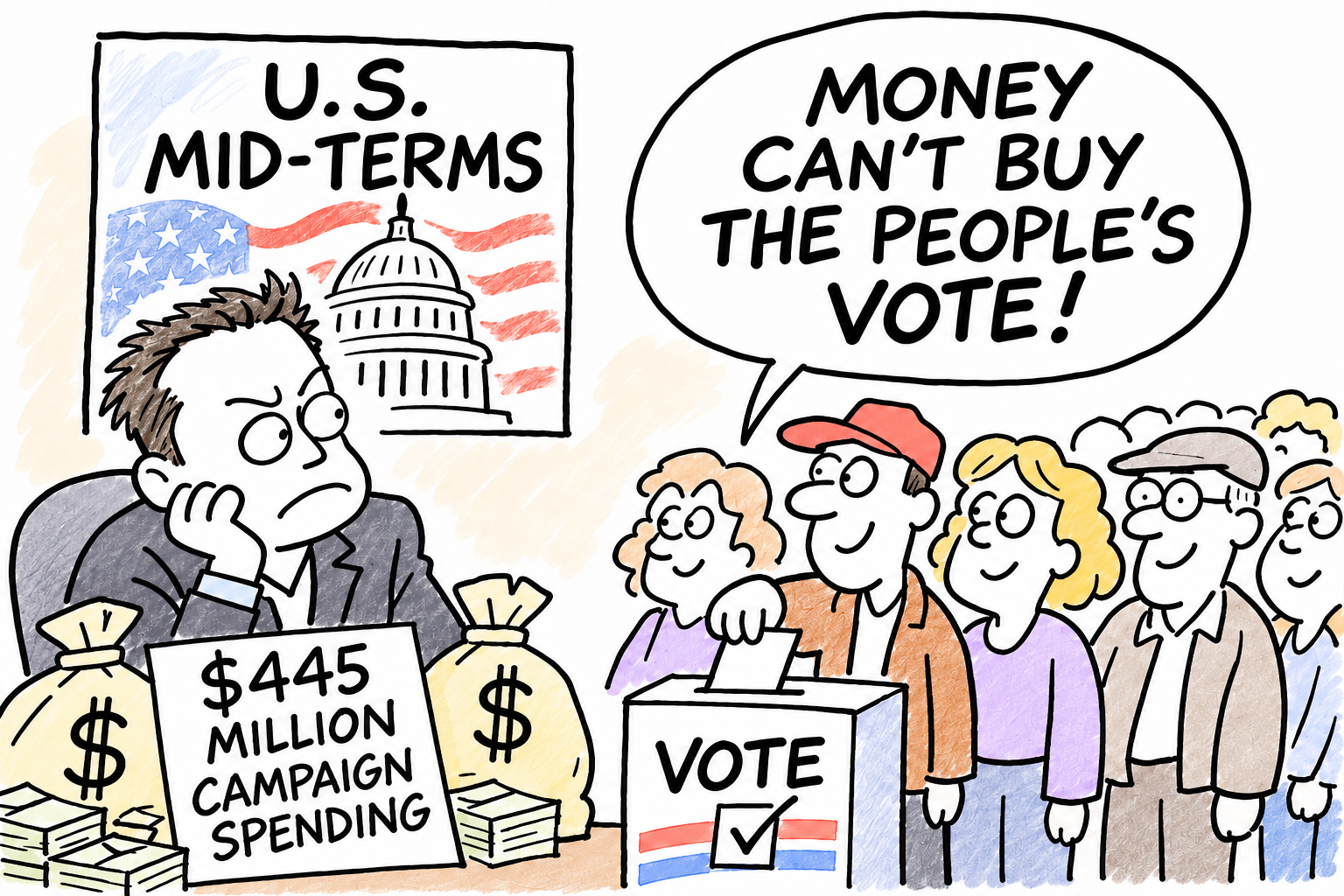
The 2026 US midterm elections have delivered a powerful reminder to America’s wealthiest political donors: money can buy advertising, influence and political access, but it cannot guarantee the one thing that matters most – the support of the electorate.
Musk’s Money
Few individuals demonstrated this more dramatically than billionaire Elon Musk, who reportedly poured at least $445 million (£334 million) into Republican-aligned political campaigns in an extraordinary attempt to help the party retain control of Congress.
Despite the unprecedented financial backing, the results proved disastrous for many of the candidates he supported.
Musk’s spending was channelled through political action committees and other organisations, funding advertising campaigns, voter outreach and attacks on Democratic opponents.
His involvement was particularly significant in several closely contested Senate races, including Texas, where Republican candidate Ken Paxton ultimately lost to Democrat James Talarico.
Setback
For Musk, the outcome represented an extraordinary political setback. Despite spending tens of millions supporting Republican candidates, many failed to secure election victories.
Across the country, Democratic candidates made substantial gains, with Republicans losing control of both chambers of Congress.
The results raise important questions about the growing influence of billionaire donors in American politics.
When individuals can contribute hundreds of millions of dollars to influence election campaigns, concerns inevitably arise about whether political power is becoming increasingly concentrated in the hands of the extremely wealthy.
However, the American electorate has delivered its own response. Voters are not simply advertising targets, nor can their political opinions necessarily be changed by an endless stream of campaign funding.
Economic pressures, living costs, employment, healthcare, immigration and dissatisfaction with government policies all influence voting decisions.
A candidate may have enormous financial backing, but if voters believe their priorities and concerns are being ignored, no advertising budget can easily overcome that dissatisfaction.
Political Disadvantage
There is also a danger that excessive spending and the involvement of high-profile billionaires can become a political liability.
Rather than attracting support, wealthy outsiders can become symbols of the very political influence that voters are rejecting.
Musk‘s experience is a particularly expensive lesson. His fortune may be enormous, but his electoral influence has proved far less predictable.
Ultimately, democracy rests on the principle that every voter has a choice. Campaigns can spend billions trying to shape that choice, but when people enter the polling booth, the final decision belongs to them.
Money can buy a louder political voice. It cannot buy the people’s trust – or their vote.