

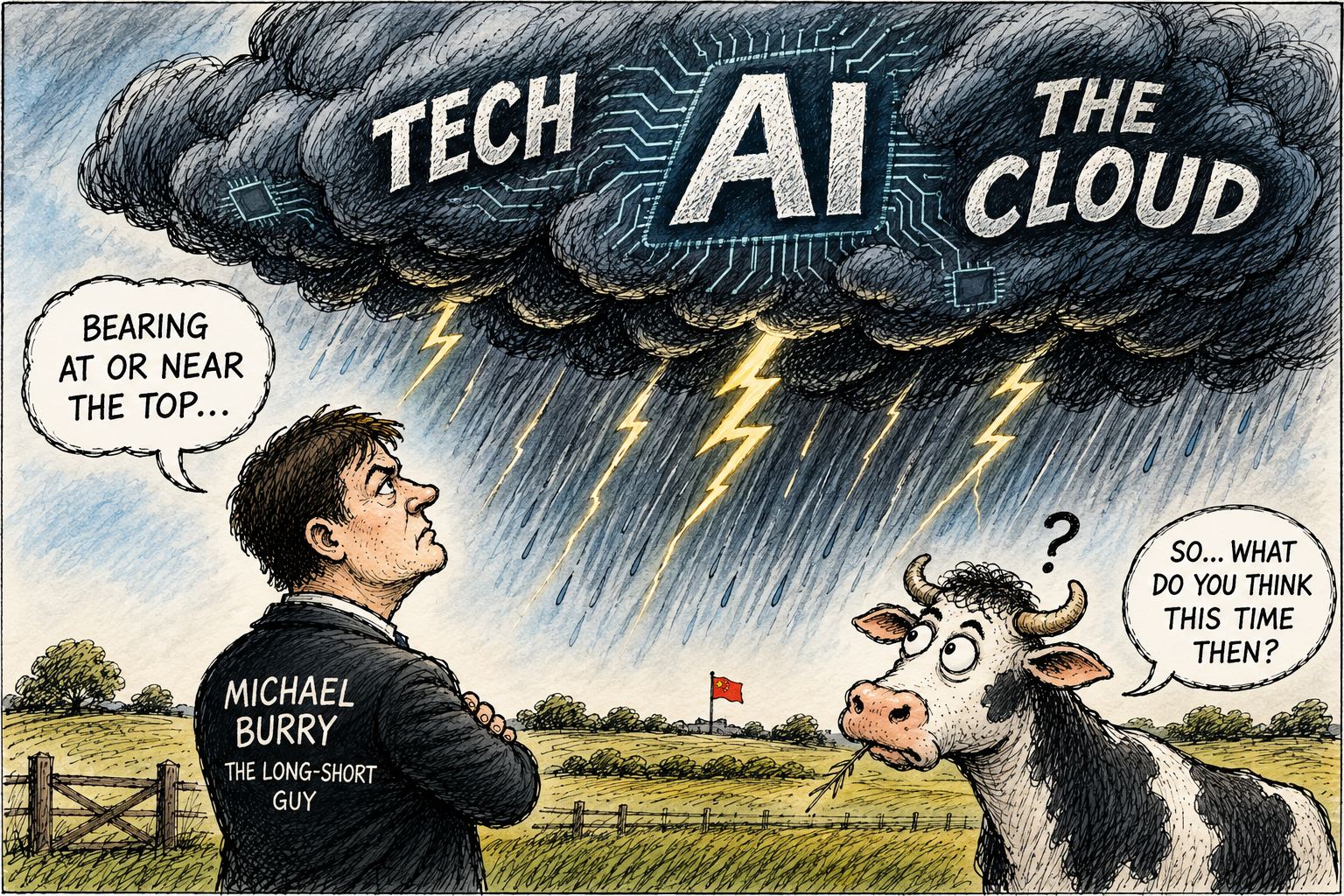
What Michael Burry Has to Say about the AI Fueled Stock Frenzy

Michael Burry Says

Michael Burry, the investor made famous by The Big Short, is once again swimming against the tide.

While Wall Street has embraced the latest AI-driven surge, Burry believes investors should be asking whether enthusiasm has once again raced too far ahead of reality.

Concern

His concern is not that artificial intelligence lacks transformative potential. Rather, he argues that today’s market is showing many of the hallmarks of previous speculative booms.

According to Burry, soaring semiconductor shares, record valuations and relentless optimism are beginning to resemble the final stages of the dot-com bubble in 1999 and 2000.

More recently, he has warned that markets could even be approaching the type of sharp reversal witnessed during the 1987 stock market crash.

Bearish against AI

Burry has taken a series of bearish positions against AI-related stocks and semiconductor investments, arguing that demand for cutting-edge chips may have been pulled forward by hyperscale technology companies racing to build AI infrastructure.

If that spending eventually slows, suppliers could face a painful adjustment as excess capacity meets softer demand.

His stance stands in stark contrast to today’s market mood. Investors continue to reward companies linked to AI, encouraged by strong earnings, heavy capital investment and expectations that artificial intelligence will reshape industries for years to come.

Bulls argue this is a genuine technological revolution rather than another speculative bubble.

High profile

Whether Burry proves right remains uncertain. He has made several high-profile bearish calls over the years that arrived far too early, yet his successful prediction of the 2008 financial crisis ensures markets continue to listen whenever he speaks.

For investors, his latest warning serves as a reminder that even the most exciting technological revolutions can produce excessive optimism.

As history has repeatedly shown, the higher valuations climb, the greater the importance of separating genuine long-term opportunity from speculative excess.

October – a notorious month for volatility and for stock market crashes

Stock crash and depression 1929

October has historically been a month of significant stock market volatility, with notable crashes occurring in 1929 and 1987

Now we are already part way through October 2024, investors are understandably cautious, wondering if history might repeat itself.

1929

The Wall Street Crash of 1929, also known as the Great Crash, began on 24th October 1929, with Black Thursday, followed by Black Tuesday on 29th October 1929. The Dow Jones Industrial Average (DJIA) plummeted nearly 13% on Black Monday and an additional 12% on Black Tuesday.

This crash marked the beginning of the Great Depression, a period of severe economic downturn that lasted for over a decade. The 1929 crash was precipitated by a combination of speculative investments, excessive leverage, and a lack of regulatory oversight, leading to a massive sell-off as panic spread among investors.

The 1929 crash marked the beginning of the Great Depression, a period of severe economic downturn that lasted for over a decade

1987

In contrast, the stock market crash of 1987, known as Black Monday, occurred on 19th October 1987, when the DJIA dropped by 22.6% in a single day. Unlike the 1929 crash, the 1987 crash did not lead to a prolonged economic depression. Instead, it was a sharp correction in an otherwise strong bull market. The causes of the 1987 crash included program trading, overvaluation, and market psychology.

The rapid recovery following the crash was aided by swift intervention from the Federal Reserve, which provided liquidity to stabilize the markets.

Comparing these historical crashes to today’s stock market, several differences and similarities emerge. The current market environment is characterized by high valuations, geopolitical tensions, and concerns about inflation and interest rates.

However, today’s markets are also more resilient due to advanced technology, better regulatory frameworks, and more sophisticated risk management practices.

The likelihood of a significant stock market crash in October 2024 is difficult to predict. While some analysts argue that the market is due for a correction, others believe that the underlying economic fundamentals remain strong.

The lessons from 1929 and 1987 highlight the importance of investor psychology and the impact of external shocks on market stability.

Conclusion

In conclusion, while October has a notorious reputation for stock market crashes, the probability of a crash in October 2024 is uncertain. Investors should remain vigilant, diversify their portfolios, and avoid speculative investments to mitigate potential risks.

By learning from past crashes, we can better navigate the uncertainties of the current market environment and prepare for any potential downturns.