

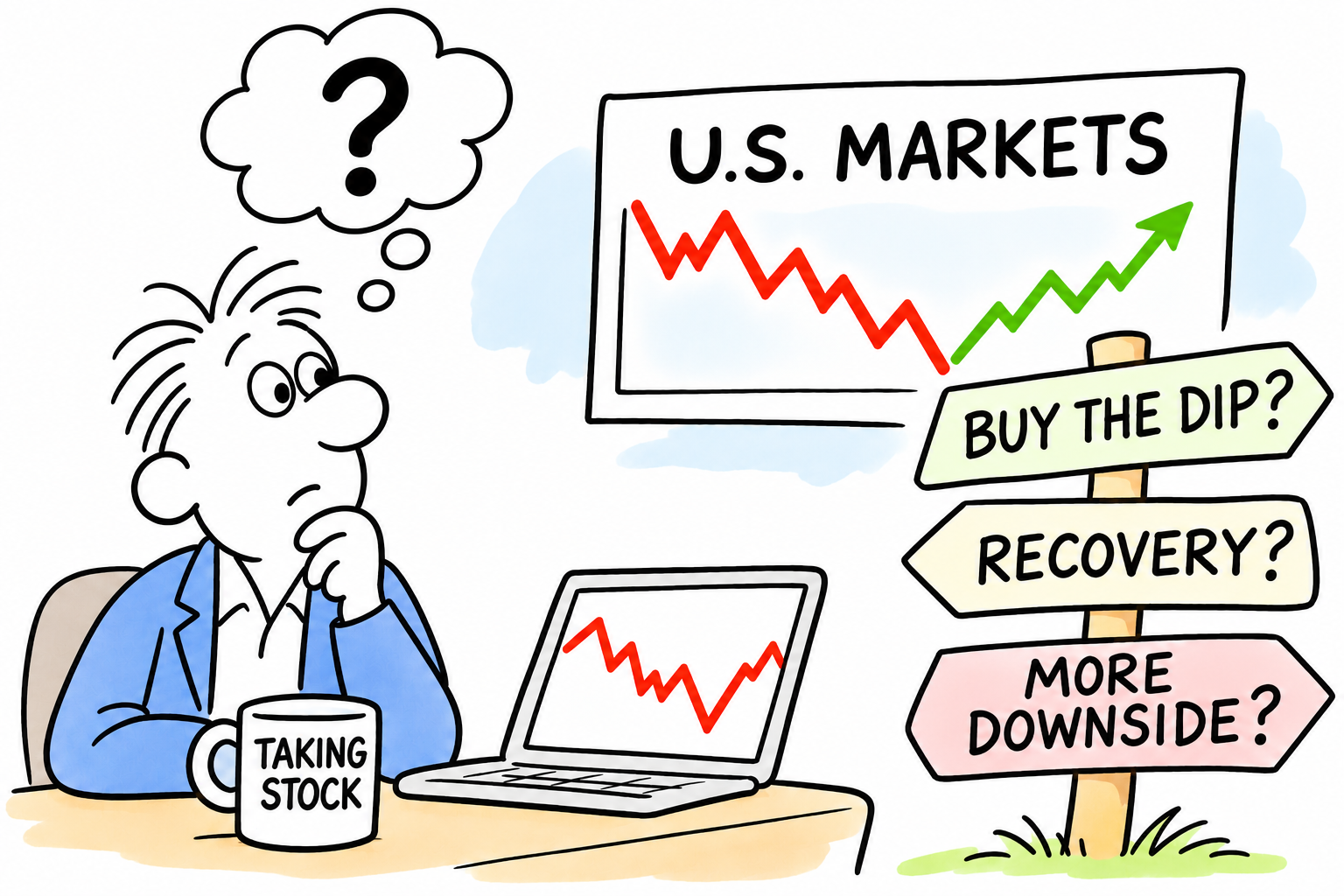
Wall Street has staged another impressive recovery, but beneath the optimism there are some uncomfortable questions.
Are investors genuinely confident that the worst is over, or are they buying into a recovery that could prove short-lived?
The U.S. stock market has experienced considerable turbulence, particularly across technology, artificial intelligence and semiconductor shares.
Dipping in
Yet every significant fall appears to attract buyers hoping to take advantage of lower prices. The question is whether they are buying genuine value or simply delaying the inevitable.
Monday and Tuesday’s (9th and 10th November 2026) trading offered plenty of encouragement. The S&P 500 rose 1.9%, the Dow Jones gained 1.6% and the Nasdaq climbed 2.5%.
More than three-quarters of S&P 500 companies advanced, suggesting the recovery was broader than a handful of heavyweight technology stocks.
Who is buying the dip?
Retail investors have been an important source of demand. Citadel Securities reported that individual investors bought nearly $33 billion of U.S. equities over 22 consecutive trading sessions between 5th October and 3rd November 2026.
Their purchases continued even as the S&P 500 declined. Is this good at this stage?
Corporate share buybacks have also provided potential support. Companies have announced substantial repurchase programmes, with many now returning to the market following earnings-related restrictions.
Systemic buying
Meanwhile, systematic investment funds, which follow market trends, have reduced their exposure considerably.
A sustained recovery could encourage these funds to rebuild positions, creating further demand.
But there is a complication. On Thursday, 5th November 2026, retail investors sold approximately $338 million of individual U.S. shares, their biggest single-day net selling since March 2020, according to Vanda Research.
This suggests that confidence is not unlimited and that some investors may already be losing their appetite for buying weakness.
Could dip buyers become trapped?
Absolutely. Buying shares simply because they have fallen is not necessarily a sound investment strategy.
If earnings expectations deteriorate, borrowing costs remain elevated or confidence in the enormous spending on artificial intelligence weakens, today’s apparent bargains could become tomorrow’s expensive mistakes.
Technology companies face particularly difficult questions. Investors want evidence that the billions being invested in data centres, chips and AI infrastructure will eventually translate into sustainable profits.
Strong earnings are no longer enough on their own. Markets increasingly want to see convincing returns on investment.
There is also the danger of concentrated buying. The largest ten companies account for approximately 37% of the S&P 500.
Weakness among these heavyweight stocks can therefore undermine the entire index, even when many smaller companies are performing reasonably well.
Is there more downside to come?
The warning signs have not disappeared. U.S. Treasury yields remain elevated, economic uncertainty persists and investors are still questioning whether technology valuations adequately reflect the risks.
The next inflation figures and Federal Reserve decisions will be important tests of market confidence.
There are two possible outcomes. The recent weakness may prove to have been a healthy correction, allowing valuations to settle before another sustained advance.
Alternatively, the latest recovery could be a temporary rally within a broader downward trend.
Investors should also remember that falling share prices do not automatically mean institutional investors are preparing to buy.
Sometimes the absence of sellers creates a recovery that looks stronger than the underlying demand really is.
Caution rather than celebration
Wall Street may yet recover its momentum, and there are genuine reasons for optimism. But declaring the bottom too early could prove costly.
The important question is not whether investors are buying the dip, but whether the buying is strong enough to withstand another wave of selling.
For now, the recovery remains unconfirmed. Investors chasing the latest rally should remember that catching a falling market can be just as dangerous as missing the beginning of a recovery.
A rising market is encouraging. A sustainable recovery is something altogether different.
Note: Figures are indicative only and unverified